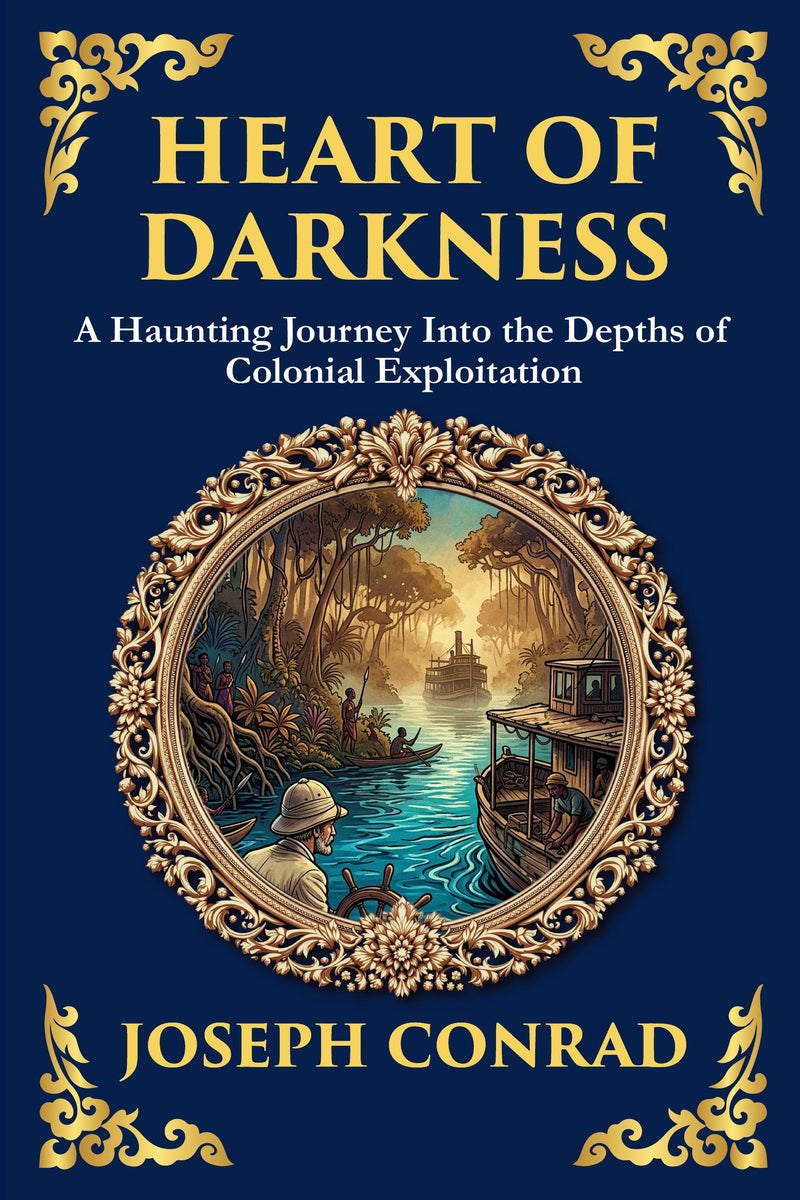
Heart of Darkness
A journey into the mysterious heart of the African Congo becomes a chilling exploration of the darkest parts of the human soul.
or free app
10,000+ hrs library
30-day guarantee
The complete Heart of Darkness appears in modern English through Library of Alexandria Press, available online with audiobook narration included for members.
Have you ever wondered why the most dangerous darkness is not found in the jungle, but in the human heart? Joseph Conrad’s Heart of Darkness is one of the most powerful and haunting works of modern literature, a journey that takes readers into the very soul of colonial exploitation and moral corruption. When Marlow sets out as the captain of a steamboat navigating the Congo River, he expects a thrilling adventure.
Instead, he encounters the stark reality of European imperialism and the cruelty inflicted on native populations by those who claim to bring "civilization." His obsession grows as he hears stories of Kurtz, an ambitious ivory trader revered like a god by the local people, yet feared for his descent into madness and tyranny. This gripping novella is both a vivid travel narrative and a profound allegory of humanity’s capacity for evil. Conrad’s evocative prose forces readers to confront uncomfortable questions about greed, power, and the fragile boundaries between savagery and civilization.
What you’ll discover in this modern edition
- A Journey into the Unknown – Experience Marlow’s harrowing voyage along the Congo River into the very heart of imperial exploitation.
- The Mystery of Kurtz – Unravel the enigmatic character whose ambitions and ideals are destroyed by absolute power.
- Themes of Civilization vs. Savagery – Explore how Conrad challenges the notion of who is truly "civilized."
- A Masterpiece of Symbolism and Allegory – Delve into layers of meaning about colonialism, morality, and the darkness within every human soul.
- A Timeless Literary Classic – Discover why this novella continues to influence literature, psychology, and political thought today.
| Formats | eBook (EPUB + PDF) · Audiobook · Paperback · Hardcover · Large Print |
| Language | English |
| Trim size (print) | 6 × 9 in |
| Binding | Paperback — perfect-bound · Hardcover — casewrap |
| Large Print edition | Same text in a larger, easy-read type — a larger font, not a larger trim |
| Print pricing | Every physical book at our true cost — at-cost, no profit (members) |
| Library | 873 restored titles, always growing |
| Length | 41,089 words · ~2 hr 44 min reading |
| Reading level | Grade 3 · an easy, flowing read (this modern-English edition) |
| Edition | Modern English translation · 2026 |
Member reviews for this edition are collected as readers finish it — be the first. Across the library: 12,000+ books shipped, every plan covered by a 365-day print guarantee.
About this edition
A faithful, unabridged modern-English edition by The Library of Alexandria — carefully rendered for today's reader and verified paragraph-by-paragraph against the public-domain source. Available as eBook, audiobook, paperback, hardcover, and large print.
- Complete & unabridgedVerified paragraph by paragraph against the source — never a scan, never abridged.
- Modern English, faithfulReadable today, with the author’s meaning kept intact. Readable — not simplified.
- Every format, one membershipRead in your browser or the free app, or listen to the full audiobook.
Included free with your membership
Cancel anytime, one click · 30-day money-back guarantee
Edition last updated July 2026
What’s inside
Heart of Darkness — complete and unabridged: all 4 sections included with membership, plus the full audiobook.
Begin reading Heart of Darkness
In clear modern English — the complete text is included with membership.
Introduction
There are certain books that do not so much tell a story as cast a spell. They draw you down a current you cannot quite see, into waters that grow darker and stranger with every page, until you find yourself somewhere you never expected to be — confronting truths about human nature that you may have spent your whole life trying not to see. Joseph Conrad’s masterwork is one of these books. Slim enough to be read in a single long evening, yet vast enough to have haunted the imagination of the world for more than a century, it remains one of the most discussed, debated, adapted, and quietly disturbing works of fiction ever committed to paper.
This edition presents the text in a modern translation, carefully adapted for the contemporary reader. That phrase deserves a moment of explanation, because it speaks directly to the experience you are about to have. Conrad wrote in dense, coiling, hypnotic prose — sentences that loop back on themselves, that pile clause upon clause, that were considered challenging even by the standards of his own era. He was, remarkably, not a native English speaker. Born in what is now Ukraine to Polish parents, he spoke Polish and French long before he learned English, which he absorbed largely through years at sea in the British merchant marine. The result is a style that is gorgeous and strange, almost foreign in its rhythms, like a man performing extraordinary feats in a language he was determined to master rather than simply inherit. That style is part of what makes the original so powerful — and also part of what makes it, for many modern readers, genuinely difficult to penetrate. This adaptation aims to preserve the atmosphere, the moral weight, and the unmistakable voice of the work while smoothing the path so that nothing stands between you and the heart of the matter. You will still descend into the same shadows. You will simply not have to fight the prose to get there.
A Man Who Lived the Story Before He Wrote It
To understand why this short book strikes with such force, it helps to know something of the man who wrote it — because, unusually for a work of fiction, much of what you are about to read was lived rather than imagined.
Joseph Conrad was born Józef Teodor Konrad Korzeniowski in 1857, into a family of Polish patriots living under the heavy hand of the Russian Empire. His father was a writer, translator, and political activist whose involvement in the Polish independence movement led to the family’s exile to a remote and bitterly cold province of Russia. Both of Conrad’s parents died during these years of hardship — his mother when he was seven, his father when he was eleven — leaving the boy an orphan whose early life had already been shaped by oppression, displacement, and loss. He was raised thereafter by an uncle, a sober and devoted guardian, but the wound of those early years never fully closed. The themes that run through his fiction — isolation, the fragility of moral certainty, the loneliness of the individual confronting forces far larger than himself — were not abstractions to him. They were the texture of his childhood.
At sixteen, Conrad did something that would define the rest of his life: he went to sea. He joined the French merchant marine, and later the British, spending nearly twenty years sailing the world’s oceans. He saw the Caribbean, the Far East, Australia, South America, and the coasts of Africa. He rose from common sailor to master mariner, qualified to command British ships, and along the way he absorbed a body of experience that few writers have ever possessed. He knew the sea not as a romantic backdrop but as a working reality — its tedium, its terror, its capacity to strip men down to their essential selves. He knew ports and trading posts, the strange intimacy and brutality of life aboard ship, and the way that distance from home could loosen the bonds of ordinary morality.
The single most important voyage of his life, for the purposes of this book, came in 1890, when Conrad traveled into the Congo region of central Africa. At the time, this vast territory was the personal possession — not of a nation, but of a single man, King Leopold II of Belgium, who administered it as a private enterprise under the cynically named “Congo Free State.” Behind a public rhetoric of philanthropy and civilization lay one of the most savage systems of exploitation in modern history: forced labor, mutilation, hostage-taking, and the wholesale plunder of ivory and, later, rubber, carried out with a violence so extreme that estimates of the death toll run into the millions. Conrad went there to command a riverboat, and what he witnessed during his months in the region marked him permanently. He returned to Europe broken in health, suffering from illness and a profound disillusionment that would never quite leave him. He had set out, like many young men of his time, half-believing in the noble adventure of empire. He came back having seen its true face.
Nearly a decade later, Conrad transformed that experience into the work you now hold. He had by then abandoned the sea for the writing desk, producing a series of novels and stories that established him as one of the most original voices in English literature. But this particular book stands apart. It is the most concentrated, the most unflinching, and in many ways the most personal of all his writings — a fictionalized distillation of what he had seen and what it had done to his understanding of the world. He was not inventing horror for effect. He was reporting, through the veil of fiction, on something real that he could not forget.
This biography matters because it shapes how you should read what follows. This is not the work of an armchair moralist condemning evils he had only read about. It is the testimony of a witness — a man who had stood in those places, breathed that air, and looked into the eyes of both the exploited and the exploiters. The authority of the book comes from that lived knowledge. When the narrative grows oppressive, when the atmosphere thickens with dread, when you feel that something deeply wrong is being described, you are experiencing, at one remove, what Conrad himself experienced. He is not asking you to imagine a nightmare. He is showing you one he survived.
On its surface, the story is simple enough to summarize in a sentence — though out of respect for your experience, I will keep that summary deliberately vague. A man undertakes a journey by water into a remote and dangerous interior, in search of another man whose reputation precedes him and whose fate has become a kind of obsession. That is the frame. But to describe the book as a story of travel and search would be like describing a cathedral as a building with a roof. What makes this work endure is not its plot, which is spare almost to the point of austerity, but the layers of meaning that gather around it like fog around a river at dawn.
At one level, it is a searing indictment of colonialism. Written at the very height of European imperial confidence — when maps were being colored in to mark the possessions of the great powers, and when schoolchildren across the continent were taught that empire was a noble civilizing mission — the book pulls back the curtain on what that mission actually involved. It exposes the gap between the lofty rhetoric of progress and the squalid reality of greed, the way that high-minded language about bringing light to dark places served to disguise the most ruthless extraction of wealth and the most casual destruction of human life. Conrad does this not through speeches or arguments but through accumulated detail: a string of images, encounters, and moments that build into an unanswerable case. Long before the historical record fully exposed the atrocities of the Congo, this book had already captured their moral essence. In this sense it was prophetic, and it remains one of the earliest and most influential works of literature to question the entire imperial project from within the culture that produced it.
But Conrad’s ambitions ran deeper than political critique. The journey at the center of the book is, unmistakably, a journey inward as well as outward — a descent not only into a geographical interior but into the interior of the human soul. The further the narrator travels from the comforting structures of civilization, the more the familiar markers of right and wrong, of order and meaning, begin to dissolve. The book asks, with a directness that can be genuinely frightening, what human beings are capable of when the external restraints of society are removed. What lies beneath the polished surface of the civilized man? Is morality something solid and innate, or merely a thin crust that can crack under the right — or wrong — conditions? These are not comfortable questions, and the book offers no comfortable answers. It is one of the reasons the work has been read and reread for generations: it refuses to let the reader off the hook.
There is also, woven throughout, a profound meditation on the nature of truth itself, and on the difficulty — perhaps the impossibility — of ever truly knowing another person, or even ourselves. The story is told at a remove, narrated by a man recalling events he experienced, and this layering of perspective is no accident. Conrad wants you to feel how partial, how uncertain, how filtered all human understanding really is. The famous figure at the heart of the search becomes a kind of mirror, reflecting back whatever the seeker brings to him, remaining finally elusive and unknowable. The book is full of fog, both literal and figurative — moments where vision fails, where sound is distorted, where the characters grope toward a clarity that never quite arrives. This is part of its deliberate design. Conrad is not interested in tidy revelations. He is interested in the murky, shifting, half-glimpsed quality of real experience and real moral life.
It would be a mistake, then, to read this book expecting the satisfactions of conventional adventure fiction. There are dangers and exotic settings and an undercurrent of suspense, yes — but the true drama is psychological and philosophical. The tension comes not from wondering what will happen next so much as from the slowly mounting pressure of dread, the sense that the narrator is moving toward some revelation that will be terrible precisely because it is true. By the time the book reaches its climax, you may find that what disturbs you most is not any single event but the cumulative weight of what has been suggested about the world and about ourselves.
A word should be said here about the controversy that has surrounded the book in recent decades, because a thoughtful reader deserves to approach it with open eyes. Some critics have argued, powerfully, that for all its critique of imperialism, the book itself reflects the prejudices of its time — that it treats the African continent and its people primarily as a backdrop for a European drama of the soul, and that its portrayals can dehumanize the very people whose oppression it depicts. This is a serious argument, advanced by serious readers, and it should not be brushed aside. At the same time, many others — including writers and scholars from the formerly colonized world — have continued to find in the book a uniquely honest reckoning with the violence at the heart of empire. The truth is that the book can be both things at once: a courageous and prophetic condemnation of colonial brutality, and a product of the limited perspective of its author and his era. Part of the richness of reading it today is precisely this tension. You are invited not simply to accept the book or to reject it, but to engage with it critically, to hold its insights and its blind spots in the same hand. A great book does not demand your agreement. It demands your attention and your thought, and this one rewards both.
How to Read This Book — and Why It Still Matters
If you are coming to this work for the first time, let me offer a few thoughts on how to read it so that you get the most from the experience.
Cancel anytime, one click · 30-day money-back guarantee
Founding annual rate available now — your price locks for life when you join.
Not ready? Get this free chapter by email — read it anytime.
✓ Sent — check your inbox for Heart of Darkness.
Questions about Heart of Darkness
What is Heart of Darkness about?
A journey into the mysterious heart of the African Congo becomes a chilling exploration of the darkest parts of the human soul. When Marlow, a seaman seeking adventure, accepts a commission to captain a river steamboat for a powerful trading company, he ventures deep into the Congo River Basin. There, he encounters the enigmatic and feared figure of Kurtz—a man who has succumbed to the savagery of absolute power and greed.
Who wrote Heart of Darkness?
Heart of Darkness was written by Joseph Conrad. This edition presents the complete work in clear modern English, faithfully rendered from the public-domain original by Library of Alexandria Press.
Is Heart of Darkness free to read?
The opening chapter is free to read on this page. Members read and listen to the complete work — and the entire library — free, and can order any physical book at our true print cost.
How long is Heart of Darkness?
4 chapters (~41,089 words) — about 2 hr 44 min of reading in this modern-English edition.
Is this an abridged version of Heart of Darkness?
No. This is the complete, unabridged Heart of Darkness, carefully rendered into clear modern English and verified paragraph-by-paragraph against the public-domain source — nothing is cut or summarised.
What formats does Heart of Darkness come in?
Heart of Darkness is available as eBook, paperback, hardcover and large print. eBook and audiobook are included with membership; printed editions ship at our true print cost.
Shipping & returns
Billing & membership
More from the library


Explore Classic & Literary
- Dream Psychology: Psychoanalysis for Beginners · Sigmund Freud
- Great Expectations · Charles Dickens
- The Brothers Karamazov · Fyodor Dostoyevsky
- The Great Gatsby · F. Scott Fitzgerald
- Wild Flowers Worth Knowing · Neltje Blanchan
- Italian Hours · Henry James
- A Popular History of France from the Earliest Times, Volume 5 · François Guizot
- A history of English literature: A practical text-book · Edward Albert
- Italian Highways and Byways from a Motor Car · M. F. Mansfield
- The Heart-Cry of Jesus · Byron J. Rees
- Castes and Tribes of Southern India. Vol. 6 of 7 · Edgar Thurston
- Against the Grain · J.-K. Huysmans
- Dombey and Son · Charles Dickens
- How to Invest Money · George Garr Henry
- The Great Controversy Between Christ and Satan · Ellen Gould Harmon White
- One Hundred Proofs That the Earth Is Not a Globe · William Carpenter
- Southern Literature From 1579–1895 · Louise Manly
- The Renaissance: Studies in Art and Poetry · Walter Pater
- Mark Twain’s Speeches · Mark Twain
- Tacitus on Germany · Cornelius Tacitus
- The Rosary · Florence L. Barclay
- Peculiarities of American Cities · Willard W. Glazier
- Tennis for Girls · Florence A. Ballin
- The World’s Greatest Books — Volume 02 — Fiction
- Shirley · Charlotte Brontë
- Daisy Miller: A Study · Henry James
- Louis Lambert · Honoré de Balzac
- Historic Jamaica · Frank Cundall
- The Gambler · Fyodor Dostoyevsky
- The Mayor of Casterbridge · Thomas Hardy
Heart of Darkness
Heart of Darkness
A Haunting Journey Into the Depths of Colonial Exploitation
Joseph Conrad
Contents
- Introduction
- Chapter 1
- Chapter 2
- Chapter 3
Introduction
There are certain books that do not so much tell a story as cast a spell. They draw you down a current you cannot quite see, into waters that grow darker and stranger with every page, until you find yourself somewhere you never expected to be — confronting truths about human nature that you may have spent your whole life trying not to see. Joseph Conrad’s masterwork is one of these books. Slim enough to be read in a single long evening, yet vast enough to have haunted the imagination of the world for more than a century, it remains one of the most discussed, debated, adapted, and quietly disturbing works of fiction ever committed to paper.
This edition presents the text in a modern translation, carefully adapted for the contemporary reader. That phrase deserves a moment of explanation, because it speaks directly to the experience you are about to have. Conrad wrote in dense, coiling, hypnotic prose — sentences that loop back on themselves, that pile clause upon clause, that were considered challenging even by the standards of his own era. He was, remarkably, not a native English speaker. Born in what is now Ukraine to Polish parents, he spoke Polish and French long before he learned English, which he absorbed largely through years at sea in the British merchant marine. The result is a style that is gorgeous and strange, almost foreign in its rhythms, like a man performing extraordinary feats in a language he was determined to master rather than simply inherit. That style is part of what makes the original so powerful — and also part of what makes it, for many modern readers, genuinely difficult to penetrate. This adaptation aims to preserve the atmosphere, the moral weight, and the unmistakable voice of the work while smoothing the path so that nothing stands between you and the heart of the matter. You will still descend into the same shadows. You will simply not have to fight the prose to get there.
A Man Who Lived the Story Before He Wrote It
To understand why this short book strikes with such force, it helps to know something of the man who wrote it — because, unusually for a work of fiction, much of what you are about to read was lived rather than imagined.
Joseph Conrad was born Józef Teodor Konrad Korzeniowski in 1857, into a family of Polish patriots living under the heavy hand of the Russian Empire. His father was a writer, translator, and political activist whose involvement in the Polish independence movement led to the family’s exile to a remote and bitterly cold province of Russia. Both of Conrad’s parents died during these years of hardship — his mother when he was seven, his father when he was eleven — leaving the boy an orphan whose early life had already been shaped by oppression, displacement, and loss. He was raised thereafter by an uncle, a sober and devoted guardian, but the wound of those early years never fully closed. The themes that run through his fiction — isolation, the fragility of moral certainty, the loneliness of the individual confronting forces far larger than himself — were not abstractions to him. They were the texture of his childhood.
At sixteen, Conrad did something that would define the rest of his life: he went to sea. He joined the French merchant marine, and later the British, spending nearly twenty years sailing the world’s oceans. He saw the Caribbean, the Far East, Australia, South America, and the coasts of Africa. He rose from common sailor to master mariner, qualified to command British ships, and along the way he absorbed a body of experience that few writers have ever possessed. He knew the sea not as a romantic backdrop but as a working reality — its tedium, its terror, its capacity to strip men down to their essential selves. He knew ports and trading posts, the strange intimacy and brutality of life aboard ship, and the way that distance from home could loosen the bonds of ordinary morality.
The single most important voyage of his life, for the purposes of this book, came in 1890, when Conrad traveled into the Congo region of central Africa. At the time, this vast territory was the personal possession — not of a nation, but of a single man, King Leopold II of Belgium, who administered it as a private enterprise under the cynically named “Congo Free State.” Behind a public rhetoric of philanthropy and civilization lay one of the most savage systems of exploitation in modern history: forced labor, mutilation, hostage-taking, and the wholesale plunder of ivory and, later, rubber, carried out with a violence so extreme that estimates of the death toll run into the millions. Conrad went there to command a riverboat, and what he witnessed during his months in the region marked him permanently. He returned to Europe broken in health, suffering from illness and a profound disillusionment that would never quite leave him. He had set out, like many young men of his time, half-believing in the noble adventure of empire. He came back having seen its true face.
Nearly a decade later, Conrad transformed that experience into the work you now hold. He had by then abandoned the sea for the writing desk, producing a series of novels and stories that established him as one of the most original voices in English literature. But this particular book stands apart. It is the most concentrated, the most unflinching, and in many ways the most personal of all his writings — a fictionalized distillation of what he had seen and what it had done to his understanding of the world. He was not inventing horror for effect. He was reporting, through the veil of fiction, on something real that he could not forget.
This biography matters because it shapes how you should read what follows. This is not the work of an armchair moralist condemning evils he had only read about. It is the testimony of a witness — a man who had stood in those places, breathed that air, and looked into the eyes of both the exploited and the exploiters. The authority of the book comes from that lived knowledge. When the narrative grows oppressive, when the atmosphere thickens with dread, when you feel that something deeply wrong is being described, you are experiencing, at one remove, what Conrad himself experienced. He is not asking you to imagine a nightmare. He is showing you one he survived.
On its surface, the story is simple enough to summarize in a sentence — though out of respect for your experience, I will keep that summary deliberately vague. A man undertakes a journey by water into a remote and dangerous interior, in search of another man whose reputation precedes him and whose fate has become a kind of obsession. That is the frame. But to describe the book as a story of travel and search would be like describing a cathedral as a building with a roof. What makes this work endure is not its plot, which is spare almost to the point of austerity, but the layers of meaning that gather around it like fog around a river at dawn.
At one level, it is a searing indictment of colonialism. Written at the very height of European imperial confidence — when maps were being colored in to mark the possessions of the great powers, and when schoolchildren across the continent were taught that empire was a noble civilizing mission — the book pulls back the curtain on what that mission actually involved. It exposes the gap between the lofty rhetoric of progress and the squalid reality of greed, the way that high-minded language about bringing light to dark places served to disguise the most ruthless extraction of wealth and the most casual destruction of human life. Conrad does this not through speeches or arguments but through accumulated detail: a string of images, encounters, and moments that build into an unanswerable case. Long before the historical record fully exposed the atrocities of the Congo, this book had already captured their moral essence. In this sense it was prophetic, and it remains one of the earliest and most influential works of literature to question the entire imperial project from within the culture that produced it.
But Conrad’s ambitions ran deeper than political critique. The journey at the center of the book is, unmistakably, a journey inward as well as outward — a descent not only into a geographical interior but into the interior of the human soul. The further the narrator travels from the comforting structures of civilization, the more the familiar markers of right and wrong, of order and meaning, begin to dissolve. The book asks, with a directness that can be genuinely frightening, what human beings are capable of when the external restraints of society are removed. What lies beneath the polished surface of the civilized man? Is morality something solid and innate, or merely a thin crust that can crack under the right — or wrong — conditions? These are not comfortable questions, and the book offers no comfortable answers. It is one of the reasons the work has been read and reread for generations: it refuses to let the reader off the hook.
There is also, woven throughout, a profound meditation on the nature of truth itself, and on the difficulty — perhaps the impossibility — of ever truly knowing another person, or even ourselves. The story is told at a remove, narrated by a man recalling events he experienced, and this layering of perspective is no accident. Conrad wants you to feel how partial, how uncertain, how filtered all human understanding really is. The famous figure at the heart of the search becomes a kind of mirror, reflecting back whatever the seeker brings to him, remaining finally elusive and unknowable. The book is full of fog, both literal and figurative — moments where vision fails, where sound is distorted, where the characters grope toward a clarity that never quite arrives. This is part of its deliberate design. Conrad is not interested in tidy revelations. He is interested in the murky, shifting, half-glimpsed quality of real experience and real moral life.
It would be a mistake, then, to read this book expecting the satisfactions of conventional adventure fiction. There are dangers and exotic settings and an undercurrent of suspense, yes — but the true drama is psychological and philosophical. The tension comes not from wondering what will happen next so much as from the slowly mounting pressure of dread, the sense that the narrator is moving toward some revelation that will be terrible precisely because it is true. By the time the book reaches its climax, you may find that what disturbs you most is not any single event but the cumulative weight of what has been suggested about the world and about ourselves.
A word should be said here about the controversy that has surrounded the book in recent decades, because a thoughtful reader deserves to approach it with open eyes. Some critics have argued, powerfully, that for all its critique of imperialism, the book itself reflects the prejudices of its time — that it treats the African continent and its people primarily as a backdrop for a European drama of the soul, and that its portrayals can dehumanize the very people whose oppression it depicts. This is a serious argument, advanced by serious readers, and it should not be brushed aside. At the same time, many others — including writers and scholars from the formerly colonized world — have continued to find in the book a uniquely honest reckoning with the violence at the heart of empire. The truth is that the book can be both things at once: a courageous and prophetic condemnation of colonial brutality, and a product of the limited perspective of its author and his era. Part of the richness of reading it today is precisely this tension. You are invited not simply to accept the book or to reject it, but to engage with it critically, to hold its insights and its blind spots in the same hand. A great book does not demand your agreement. It demands your attention and your thought, and this one rewards both.
How to Read This Book — and Why It Still Matters
If you are coming to this work for the first time, let me offer a few thoughts on how to read it so that you get the most from the experience.
The Nellie, a small cruising yacht, swung on her anchor with her sails still, coming to a complete stop. The tide had risen and the wind had died down. Since we were heading downriver, our only option was to stop and wait for the tide to turn.
The stretch of the Thames leading to the sea looked like the start of an endless waterway. On the horizon, the sea and sky blended together seamlessly. In that bright space, the tanned sails of barges drifting up with the tide seemed to stand still in sharp, red clusters of canvas, their varnished poles gleaming. A haze hung over the low shores that flattened out as they reached the sea. Above Gravesend, the air grew dark, and further inland it seemed to thicken into a mournful gloom, hanging motionless over the largest and greatest city on earth.
The Company Director served as our captain and host. The four of us watched him fondly as he stood at the bow, looking out toward the sea. Out of everyone on the river, he looked the most like a real sailor. He resembled a pilot, which to any seaman is the definition of reliability. It was hard to believe that his actual work wasn’t out there in the bright estuary, but was instead behind him, hidden within that brooding gloom.
As I’ve mentioned before, we were all bonded by our connection to the sea. This bond not only kept us close during long periods apart, but also made us patient with each other’s stories—and even our opinions. The Lawyer—a wonderful old man—had the only cushion and rug on deck, thanks to his age and his many virtues. The Accountant had already brought out a box of dominoes and was absentmindedly arranging the tiles into patterns. Marlow sat cross-legged at the back of the boat, leaning against the mizzen-mast. With his sunken cheeks, yellowish skin, straight back, and austere look, he looked like a statue with his arms hanging down and palms facing outward. Once the director was sure the anchor was secure, he walked aft and sat down with us. We chatted lazily for a bit, and then the yacht fell silent. For some reason, we never started that game of dominoes. We felt thoughtful, in the mood for nothing but quiet staring. The day was ending with a still and beautiful brilliance. The water shone peacefully; the cloudless sky was a vast, pure expanse of light; even the mist over the Essex marsh looked like a glowing, sheer fabric draped from the inland hills over the low shores. Only the gloom to the west, hanging over the upper river, grew darker by the minute, as if the approaching sun had angered it.
End of the free sample
Keep reading, free
Members read and listen to the complete book — and the entire library. Cancel anytime, one click · 30-day money-back guarantee.