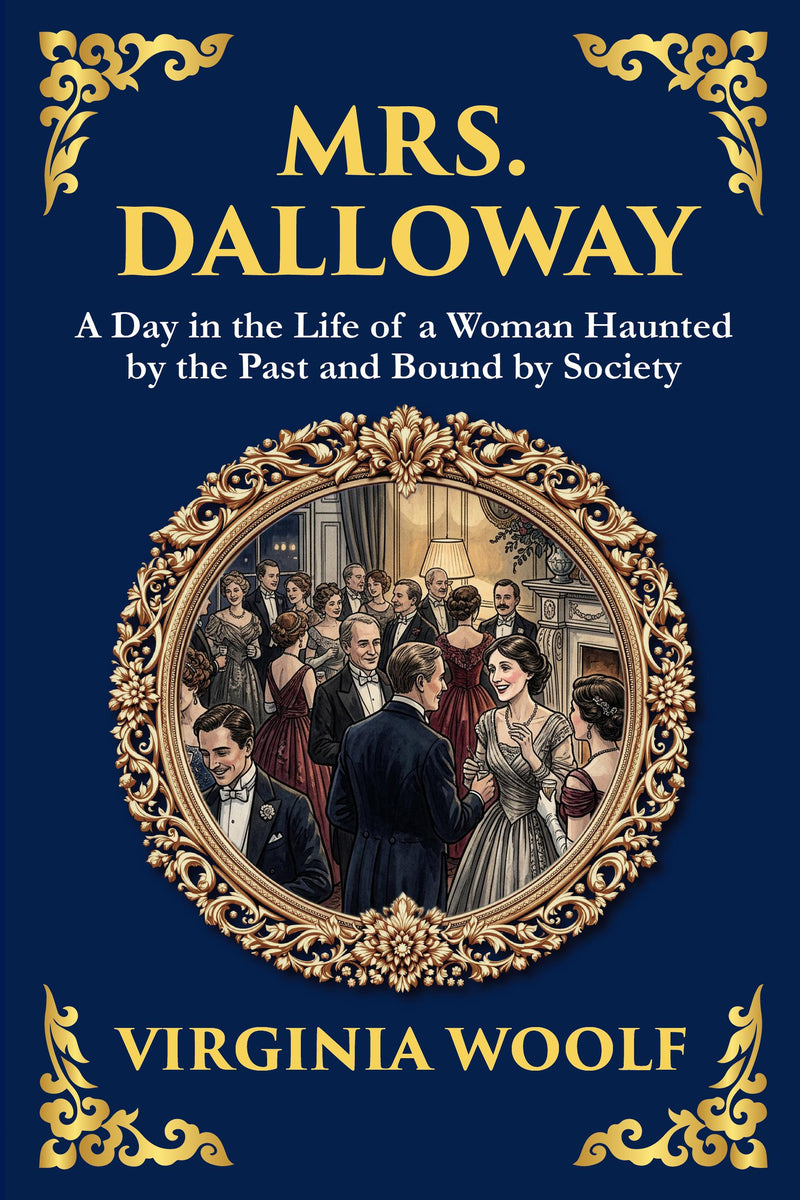
Mrs. Dalloway
In a single June day in London, Clarissa Dalloway prepares for a grand evening party. Yet beneath the surface of her refined world lies a storm of memory, regret, and questions about the choices that have defined her life.
or free app
10,000+ hrs library
30-day guarantee
The complete Mrs. Dalloway appears in modern English through Library of Alexandria Press, available online with audiobook narration included for members.
Have you ever wondered why the smallest moments reveal the deepest truths? Virginia Woolf’s Mrs. Dalloway is one of the defining works of modernist literature, a masterful exploration of one day in the life of a woman and the shadows that linger from the past.
With lyrical prose and stream-of-consciousness narration, Woolf captures the fleeting impressions, emotions, and memories that shape our lives. Clarissa Dalloway, a polished London hostess, spends her day preparing for a party. Yet as she shops for flowers, greets acquaintances, and reflects on her past, she is haunted by choices left behind—loves not pursued, paths not taken, and the constant pressure of societal expectations.
Parallel to her story runs that of Septimus Warren Smith, a traumatized veteran unable to escape the horrors of war. Through their intertwined narratives, Woolf paints a portrait of the fragility of the human spirit and the search for meaning in a fleeting world.
What you’ll discover in this modern edition
- A Day in the Life of Clarissa Dalloway – Witness the subtle interplay of memory, choice, and identity as she reflects on her past while navigating her present.
- The Tragic Story of Septimus Warren Smith – A war veteran’s haunting perspective that contrasts and deepens Clarissa’s world.
- Themes of Time, Memory, and Identity – A poetic meditation on how life is both fleeting and eternal.
- A Modernist Masterpiece – Experience Virginia Woolf’s pioneering style of stream-of- consciousness narrative, capturing the intimate rhythms of thought.
- A Timeless Reflection on Society and the Self – Explore how love, regret, trauma, and social convention shape who we become. More than a novel, Mrs.
| Formats | eBook (EPUB + PDF) · Audiobook · Paperback · Hardcover · Large Print |
| Language | English |
| Trim size (print) | 6 × 9 in |
| Binding | Paperback — perfect-bound · Hardcover — casewrap |
| Large Print edition | Same text in a larger, easy-read type — a larger font, not a larger trim |
| Print pricing | Every physical book at our true cost — at-cost, no profit (members) |
| Library | 873 restored titles, always growing |
| Length | 67,435 words · ~4 hr 30 min reading |
| Reading level | Grade 3 · an easy, flowing read (this modern-English edition) |
| Edition | Modern English translation · 2026 |
Member reviews for this edition are collected as readers finish it — be the first. Across the library: 12,000+ books shipped, every plan covered by a 365-day print guarantee.
About this edition
A faithful, unabridged modern-English edition by The Library of Alexandria — carefully rendered for today's reader and verified paragraph-by-paragraph against the public-domain source. Available as eBook, audiobook, paperback, hardcover, and large print.
- Complete & unabridgedVerified paragraph by paragraph against the source — never a scan, never abridged.
- Modern English, faithfulReadable today, with the author’s meaning kept intact. Readable — not simplified.
- Every format, one membershipRead in your browser or the free app, or listen to the full audiobook.
Included free with your membership
Cancel anytime, one click · 30-day money-back guarantee
Edition last updated July 2026
What’s inside
Mrs. Dalloway — complete and unabridged, included in full with membership, plus the full audiobook.
Begin reading Mrs. Dalloway
In clear modern English — the complete text is included with membership.
Introduction
There are novels that tell you a story, and there are novels that hand you a way of seeing. Mrs. Dalloway belongs unmistakably to the second kind. When Virginia Woolf published it in 1925, she was not simply adding another title to the shelf of English fiction; she was quietly dismantling the assumptions about what a novel could be and rebuilding them from the inside out. The result is a book that seems, on its surface, almost impossibly simple. A woman in London decides to give a party. She walks through the city to buy flowers. She returns home, prepares, receives her guests, and the evening unfolds. That is, in the most literal sense, the entire plot. And yet within that single June day, Woolf manages to compress an entire universe of human experience—memory, regret, love, time, mortality, longing, and the strange, luminous ordinariness of being alive.
This edition, adapted as a modern translation for the contemporary reader, exists to make that universe more accessible without diminishing its power. Woolf’s prose, for all its beauty, can feel daunting to readers encountering it for the first time. Her sentences spill and loop; her thoughts dissolve into one another; her narrative slips from one mind to the next without warning or announcement. These are not flaws but deliberate innovations—and the purpose of this version is to preserve the spirit and the music of that innovation while smoothing the path for readers who might otherwise turn away too soon. The goal is not to replace Woolf but to invite you closer to her, so that the genius of what she accomplished becomes something you can feel rather than something you must labor to decode.
Before you begin, it helps to understand a little of what makes this book so unusual, so cherished, and so quietly revolutionary. What follows is meant to prepare you—not to tell you what happens, for very little “happens” in the conventional sense, but to attune your ear and your imagination to the rhythms you are about to enter. Think of this introduction as a window opening onto a particular morning in London, nearly a century ago, where the bells of Big Ben are about to strike and a woman is about to step out into the streets to buy flowers for a party she will give that night.
The most immediate thing to understand about Mrs. Dalloway is its astonishing compression of time. The events of the novel occupy a single ordinary day in mid-June in London, sometime in the years after the First World War. There are no chapter breaks of the traditional kind, no neat divisions into beginnings, middles, and ends. Instead, the book moves like the day itself—continuously, fluidly, marked only by the periodic chiming of clocks across the city. Woolf was deeply interested in time, and in Mrs. Dalloway she draws a crucial distinction between two kinds of it. There is clock time, the relentless, public, measured time of Big Ben striking the hours, dividing the day into orderly portions that the whole city obeys together. And then there is inner time, the private time of the mind, which obeys no clock at all. In the space of a single tolling bell, a character can travel thirty years into the past, relive a kiss, feel again the sting of a long-ago refusal, and return to the present street corner without having moved an inch.
This is the secret engine of the novel. While the body walks through London buying flowers, mending dresses, attending appointments, the mind ranges freely across decades. A familiar face glimpsed in a shop window, the smell of summer air, the sound of someone’s voice—any of these can crack open a door into the past. Woolf understood that this is how memory actually works in us. We do not remember in tidy chronological order; we remember in flashes, associations, sudden floods of feeling triggered by the smallest sensory cue. By building her novel around this truth, she created something that feels far more lifelike than the carefully plotted stories that came before it, even though, paradoxically, almost nothing dramatic occurs on the surface.
What this means for you as a reader is that the richness of Mrs. Dalloway lies not in suspense about events but in the gradual accumulation of meaning. As the day progresses, you will come to know its central characters not through what they do but through what they remember, fear, desire, and conceal. You will learn the contours of a marriage, the shape of a friendship that once teetered on the edge of becoming something more, the weight of choices made long ago that can never be unmade. The party at the end of the day, which gives the whole book its forward momentum, is not the point in itself. It is the vessel into which the entire day’s stream of consciousness finally pours—the social surface beneath which an ocean of private feeling has been moving all along.
The phrase “stream of consciousness” is one you may have encountered, and it is worth pausing on, because Mrs. Dalloway is one of the supreme examples of the technique in all of literature. Rather than describing a character’s thoughts from the outside, Woolf places us directly inside the flow of the mind itself—the half-formed impressions, the leaps of association, the way one idea slides into another without logical connection. Reading her is sometimes less like watching a film and more like overhearing the inside of someone’s head. This can feel disorienting at first, especially if you are accustomed to more straightforward storytelling. But once you surrender to the rhythm of it—once you stop trying to hold everything in tidy categories and simply let the prose carry you—a remarkable thing happens. You begin to inhabit these characters with an intimacy that conventional narration could never achieve. You are not told that someone feels lonely; you feel the loneliness rise up in them, mid-sentence, in the middle of an ordinary thought about the weather.
This modern adaptation has been prepared with the understanding that such intimacy is precisely what makes the book worth reading—and that the obstacles to reaching it should be lowered, not removed entirely. The aim throughout has been to keep the doors of perception open: to let Woolf’s distinctive flow remain a flow, while ensuring that you never lose your footing so completely that you give up. Some sentences that might have run on for half a page in the original have been gently clarified. Some references that would have been instantly recognizable to a London reader of 1925, but might baffle a reader today, have been made more transparent. Yet the essential experience—the dizzying, beautiful immersion in human consciousness—remains fully intact. You will still feel the way the mind leaps and circles. You will still be carried from one head to another. You will still emerge from the book feeling that you have lived an entire interior lifetime in the span of a single day.
It is also worth noting how daringly Woolf moves between different minds. The narrative does not stay locked inside one character. Instead, it glides from person to person, often within the same scene, the same paragraph, even the same sentence. Two characters might pass each other on the street, and we slip seamlessly from the thoughts of one into the thoughts of the other, then perhaps into the thoughts of a stranger watching them both. This technique creates an extraordinary sense of a shared world, a single living organism made up of countless separate consciousnesses, all moving through the same city on the same morning, all connected by invisible threads they themselves can barely perceive. London itself becomes almost a character—its parks and shops, its motorcars and aeroplanes, its bells and bustle—the common stage on which all these private dramas silently unfold. Part of the deep pleasure of the book is this sense of a great web of human life, in which even those who never meet are bound together by the simple fact of being alive at the same moment, under the same sky.
The Woman, the World, and the Wounds of an Age
At the center of this web stands Clarissa Dalloway herself, and to read this novel well you must understand something about who she is and the world she moves through. She is a woman of a certain class and a certain age—middle-aged, married to a member of Parliament, comfortable, respectable, the kind of woman whose chief social occupation is the giving of parties. To a careless reader she might appear shallow, a mere society hostess fussing over flowers and guest lists. This is exactly the impression Woolf invites us to form at first, and exactly the impression she then dismantles, layer by layer, as the day goes on. For beneath the polished surface of the perfect hostess lies a woman of profound depth, haunted by roads not taken, troubled by the passage of time, alive to the beauty of existence and terrified by its fragility. One of the great achievements of the book is the way it teaches us to take seriously the inner life of a woman whom her own society—and much of literature before Woolf—would have dismissed as trivial.
This brings us to one of the novel’s most important and lasting concerns: the constraints that society places upon the individual, and especially upon women. The world of Mrs. Dalloway is one rigidly bound by class, by convention, by expectations of how a person—particularly a woman of a particular station—ought to behave, feel, and live. Clarissa has fashioned a self that fits these expectations, and there is real fulfillment for her in the role she plays. But there is also a cost, a sense of something surrendered, of passions tamed and possibilities foreclosed. The novel is acutely conscious of how social roles can both shelter and imprison us, how the performance of a self can crowd out the experience of being one. Without ever lecturing, Woolf invites us to ask what it means to live a conventional life, whether such a life is a betrayal of one’s deeper nature or simply the form that life inevitably takes, and whether the small private rebellions of the heart—a memory cherished in secret, a feeling never spoken aloud—are enough to redeem the compromises we all make.
The subtitle of this edition speaks of a woman “haunted by the past and bound by society,” and both of those phrases point to something essential. The haunting is everywhere in the book. Clarissa’s mind returns again and again to her youth, to a summer long ago when she stood at a threshold between two possible lives and chose one over the other. The people who shaped that distant summer reappear, some in memory and some in the flesh, and their reappearance forces her—and us—to weigh the life she chose against the lives she might have had. There is no melodrama in this, no grand confrontation. There is only the quiet, persistent ache of the road not taken, the question that everyone past a certain age must eventually face: was it the right choice, and what does it even mean to ask such a thing now, when the choice is decades old and cannot be undone?
There is another presence in the novel that must be addressed, though carefully, so as not to diminish the experience of discovering it for yourself. Woolf does not confine herself to Clarissa’s world of parties and drawing rooms. Running alongside that bright, social surface is a darker current, embodied in another character whose story unfolds in parallel and who never directly enters Clarissa’s circle, yet whose fate is bound up with hers in ways that become, by the novel’s end, devastatingly clear. Through this parallel story, Woolf brings into her sunlit June day the long shadow of the First World War, which had ended only a few years before she wrote the book. The war haunts Mrs. Dalloway the way it haunted the entire generation that survived it. The novel is unflinching in its portrayal of trauma—of the psychological wounds that war inflicts and that polite society, with its determined cheerfulness and its faith in appearances, was so eager to ignore or misunderstand. In this thread of the book, Woolf delivers some of her sharpest social criticism, taking aim at the medical authorities and the social pressures that failed those who returned from the trenches damaged in ways no one could see.
Cancel anytime, one click · 30-day money-back guarantee
Founding annual rate available now — your price locks for life when you join.
Not ready? Get this free chapter by email — read it anytime.
✓ Sent — check your inbox for Mrs. Dalloway.
Questions about Mrs. Dalloway
What is Mrs. Dalloway about?
In a single June day in London, Clarissa Dalloway prepares for a grand evening party. Yet beneath the surface of her refined world lies a storm of memory, regret, and questions about the choices that have defined her life. As she moves through her day, her story interweaves with that of Septimus Warren Smith, a shell-shocked war veteran wrestling with despair.
Who wrote Mrs. Dalloway?
Mrs. Dalloway was written by Virginia Woolf. This edition presents the complete work in clear modern English, faithfully rendered from the public-domain original by Library of Alexandria Press.
Is Mrs. Dalloway free to read?
The opening chapter is free to read on this page. Members read and listen to the complete work — and the entire library — free, and can order any physical book at our true print cost.
How long is Mrs. Dalloway?
2 chapters (~67,435 words) — about 4 hr 30 min of reading in this modern-English edition.
Is this an abridged version of Mrs. Dalloway?
No. This is the complete, unabridged Mrs. Dalloway, carefully rendered into clear modern English and verified paragraph-by-paragraph against the public-domain source — nothing is cut or summarised.
What formats does Mrs. Dalloway come in?
Mrs. Dalloway is available as eBook, paperback, hardcover and large print. eBook and audiobook are included with membership; printed editions ship at our true print cost.
Shipping & returns
Billing & membership
More from the library


Explore Classic & Literary
- Dream Psychology: Psychoanalysis for Beginners · Sigmund Freud
- Great Expectations · Charles Dickens
- The Brothers Karamazov · Fyodor Dostoyevsky
- The Great Gatsby · F. Scott Fitzgerald
- Wild Flowers Worth Knowing · Neltje Blanchan
- Italian Hours · Henry James
- A Popular History of France from the Earliest Times, Volume 5 · François Guizot
- A history of English literature: A practical text-book · Edward Albert
- Italian Highways and Byways from a Motor Car · M. F. Mansfield
- The Heart-Cry of Jesus · Byron J. Rees
- Castes and Tribes of Southern India. Vol. 6 of 7 · Edgar Thurston
- Against the Grain · J.-K. Huysmans
- Dombey and Son · Charles Dickens
- How to Invest Money · George Garr Henry
- The Great Controversy Between Christ and Satan · Ellen Gould Harmon White
- One Hundred Proofs That the Earth Is Not a Globe · William Carpenter
- Southern Literature From 1579–1895 · Louise Manly
- The Renaissance: Studies in Art and Poetry · Walter Pater
- Mark Twain’s Speeches · Mark Twain
- Tacitus on Germany · Cornelius Tacitus
- The Rosary · Florence L. Barclay
- Peculiarities of American Cities · Willard W. Glazier
- Tennis for Girls · Florence A. Ballin
- The World’s Greatest Books — Volume 02 — Fiction
- Shirley · Charlotte Brontë
- Daisy Miller: A Study · Henry James
- Louis Lambert · Honoré de Balzac
- Historic Jamaica · Frank Cundall
- The Gambler · Fyodor Dostoyevsky
- The Mayor of Casterbridge · Thomas Hardy
Mrs. Dalloway
Mrs. Dalloway
A Day in the Life of a Woman Haunted by the Past and Bound by Society
Virginia Woolf
Contents
- Introduction
- Mrs. Dalloway
Introduction
There are novels that tell you a story, and there are novels that hand you a way of seeing. Mrs. Dalloway belongs unmistakably to the second kind. When Virginia Woolf published it in 1925, she was not simply adding another title to the shelf of English fiction; she was quietly dismantling the assumptions about what a novel could be and rebuilding them from the inside out. The result is a book that seems, on its surface, almost impossibly simple. A woman in London decides to give a party. She walks through the city to buy flowers. She returns home, prepares, receives her guests, and the evening unfolds. That is, in the most literal sense, the entire plot. And yet within that single June day, Woolf manages to compress an entire universe of human experience—memory, regret, love, time, mortality, longing, and the strange, luminous ordinariness of being alive.
This edition, adapted as a modern translation for the contemporary reader, exists to make that universe more accessible without diminishing its power. Woolf’s prose, for all its beauty, can feel daunting to readers encountering it for the first time. Her sentences spill and loop; her thoughts dissolve into one another; her narrative slips from one mind to the next without warning or announcement. These are not flaws but deliberate innovations—and the purpose of this version is to preserve the spirit and the music of that innovation while smoothing the path for readers who might otherwise turn away too soon. The goal is not to replace Woolf but to invite you closer to her, so that the genius of what she accomplished becomes something you can feel rather than something you must labor to decode.
Before you begin, it helps to understand a little of what makes this book so unusual, so cherished, and so quietly revolutionary. What follows is meant to prepare you—not to tell you what happens, for very little “happens” in the conventional sense, but to attune your ear and your imagination to the rhythms you are about to enter. Think of this introduction as a window opening onto a particular morning in London, nearly a century ago, where the bells of Big Ben are about to strike and a woman is about to step out into the streets to buy flowers for a party she will give that night.
The most immediate thing to understand about Mrs. Dalloway is its astonishing compression of time. The events of the novel occupy a single ordinary day in mid-June in London, sometime in the years after the First World War. There are no chapter breaks of the traditional kind, no neat divisions into beginnings, middles, and ends. Instead, the book moves like the day itself—continuously, fluidly, marked only by the periodic chiming of clocks across the city. Woolf was deeply interested in time, and in Mrs. Dalloway she draws a crucial distinction between two kinds of it. There is clock time, the relentless, public, measured time of Big Ben striking the hours, dividing the day into orderly portions that the whole city obeys together. And then there is inner time, the private time of the mind, which obeys no clock at all. In the space of a single tolling bell, a character can travel thirty years into the past, relive a kiss, feel again the sting of a long-ago refusal, and return to the present street corner without having moved an inch.
This is the secret engine of the novel. While the body walks through London buying flowers, mending dresses, attending appointments, the mind ranges freely across decades. A familiar face glimpsed in a shop window, the smell of summer air, the sound of someone’s voice—any of these can crack open a door into the past. Woolf understood that this is how memory actually works in us. We do not remember in tidy chronological order; we remember in flashes, associations, sudden floods of feeling triggered by the smallest sensory cue. By building her novel around this truth, she created something that feels far more lifelike than the carefully plotted stories that came before it, even though, paradoxically, almost nothing dramatic occurs on the surface.
What this means for you as a reader is that the richness of Mrs. Dalloway lies not in suspense about events but in the gradual accumulation of meaning. As the day progresses, you will come to know its central characters not through what they do but through what they remember, fear, desire, and conceal. You will learn the contours of a marriage, the shape of a friendship that once teetered on the edge of becoming something more, the weight of choices made long ago that can never be unmade. The party at the end of the day, which gives the whole book its forward momentum, is not the point in itself. It is the vessel into which the entire day’s stream of consciousness finally pours—the social surface beneath which an ocean of private feeling has been moving all along.
The phrase “stream of consciousness” is one you may have encountered, and it is worth pausing on, because Mrs. Dalloway is one of the supreme examples of the technique in all of literature. Rather than describing a character’s thoughts from the outside, Woolf places us directly inside the flow of the mind itself—the half-formed impressions, the leaps of association, the way one idea slides into another without logical connection. Reading her is sometimes less like watching a film and more like overhearing the inside of someone’s head. This can feel disorienting at first, especially if you are accustomed to more straightforward storytelling. But once you surrender to the rhythm of it—once you stop trying to hold everything in tidy categories and simply let the prose carry you—a remarkable thing happens. You begin to inhabit these characters with an intimacy that conventional narration could never achieve. You are not told that someone feels lonely; you feel the loneliness rise up in them, mid-sentence, in the middle of an ordinary thought about the weather.
This modern adaptation has been prepared with the understanding that such intimacy is precisely what makes the book worth reading—and that the obstacles to reaching it should be lowered, not removed entirely. The aim throughout has been to keep the doors of perception open: to let Woolf’s distinctive flow remain a flow, while ensuring that you never lose your footing so completely that you give up. Some sentences that might have run on for half a page in the original have been gently clarified. Some references that would have been instantly recognizable to a London reader of 1925, but might baffle a reader today, have been made more transparent. Yet the essential experience—the dizzying, beautiful immersion in human consciousness—remains fully intact. You will still feel the way the mind leaps and circles. You will still be carried from one head to another. You will still emerge from the book feeling that you have lived an entire interior lifetime in the span of a single day.
It is also worth noting how daringly Woolf moves between different minds. The narrative does not stay locked inside one character. Instead, it glides from person to person, often within the same scene, the same paragraph, even the same sentence. Two characters might pass each other on the street, and we slip seamlessly from the thoughts of one into the thoughts of the other, then perhaps into the thoughts of a stranger watching them both. This technique creates an extraordinary sense of a shared world, a single living organism made up of countless separate consciousnesses, all moving through the same city on the same morning, all connected by invisible threads they themselves can barely perceive. London itself becomes almost a character—its parks and shops, its motorcars and aeroplanes, its bells and bustle—the common stage on which all these private dramas silently unfold. Part of the deep pleasure of the book is this sense of a great web of human life, in which even those who never meet are bound together by the simple fact of being alive at the same moment, under the same sky.
The Woman, the World, and the Wounds of an Age
At the center of this web stands Clarissa Dalloway herself, and to read this novel well you must understand something about who she is and the world she moves through. She is a woman of a certain class and a certain age—middle-aged, married to a member of Parliament, comfortable, respectable, the kind of woman whose chief social occupation is the giving of parties. To a careless reader she might appear shallow, a mere society hostess fussing over flowers and guest lists. This is exactly the impression Woolf invites us to form at first, and exactly the impression she then dismantles, layer by layer, as the day goes on. For beneath the polished surface of the perfect hostess lies a woman of profound depth, haunted by roads not taken, troubled by the passage of time, alive to the beauty of existence and terrified by its fragility. One of the great achievements of the book is the way it teaches us to take seriously the inner life of a woman whom her own society—and much of literature before Woolf—would have dismissed as trivial.
This brings us to one of the novel’s most important and lasting concerns: the constraints that society places upon the individual, and especially upon women. The world of Mrs. Dalloway is one rigidly bound by class, by convention, by expectations of how a person—particularly a woman of a particular station—ought to behave, feel, and live. Clarissa has fashioned a self that fits these expectations, and there is real fulfillment for her in the role she plays. But there is also a cost, a sense of something surrendered, of passions tamed and possibilities foreclosed. The novel is acutely conscious of how social roles can both shelter and imprison us, how the performance of a self can crowd out the experience of being one. Without ever lecturing, Woolf invites us to ask what it means to live a conventional life, whether such a life is a betrayal of one’s deeper nature or simply the form that life inevitably takes, and whether the small private rebellions of the heart—a memory cherished in secret, a feeling never spoken aloud—are enough to redeem the compromises we all make.
The subtitle of this edition speaks of a woman “haunted by the past and bound by society,” and both of those phrases point to something essential. The haunting is everywhere in the book. Clarissa’s mind returns again and again to her youth, to a summer long ago when she stood at a threshold between two possible lives and chose one over the other. The people who shaped that distant summer reappear, some in memory and some in the flesh, and their reappearance forces her—and us—to weigh the life she chose against the lives she might have had. There is no melodrama in this, no grand confrontation. There is only the quiet, persistent ache of the road not taken, the question that everyone past a certain age must eventually face: was it the right choice, and what does it even mean to ask such a thing now, when the choice is decades old and cannot be undone?
There is another presence in the novel that must be addressed, though carefully, so as not to diminish the experience of discovering it for yourself. Woolf does not confine herself to Clarissa’s world of parties and drawing rooms. Running alongside that bright, social surface is a darker current, embodied in another character whose story unfolds in parallel and who never directly enters Clarissa’s circle, yet whose fate is bound up with hers in ways that become, by the novel’s end, devastatingly clear. Through this parallel story, Woolf brings into her sunlit June day the long shadow of the First World War, which had ended only a few years before she wrote the book. The war haunts Mrs. Dalloway the way it haunted the entire generation that survived it. The novel is unflinching in its portrayal of trauma—of the psychological wounds that war inflicts and that polite society, with its determined cheerfulness and its faith in appearances, was so eager to ignore or misunderstand. In this thread of the book, Woolf delivers some of her sharpest social criticism, taking aim at the medical authorities and the social pressures that failed those who returned from the trenches damaged in ways no one could see.
Mrs. Dalloway said she would buy the flowers herself.
Lucy already had plenty to do. The doors were being taken off their hinges; Rumpelmayer’s crew was on their way. Clarissa Dalloway thought about what a beautiful morning it was—as fresh as a day at the beach for children.
What a thrill! What a leap! That was how it had always felt to her. She could almost hear the hinges squeak now, just as she had once burst through the French windows at Bourton into the open air. The early morning air had been so fresh and calm—stiller than this, of course. It felt like the brush of a wave, a cold and sharp kiss. Yet, as an eighteen-year-old girl standing at that open window, she had felt a sense of solemnity, as if something terrible was about to happen. She had stood there watching the flowers, the smoke curling off the trees, and the rooks rising and falling. She stayed there until Peter Walsh asked, “Daydreaming among the vegetables?”—or was that how he said it?—“I prefer people to cauliflowers”—was that it? He must have said it one morning at breakfast when she stepped out onto the terrace. Peter Walsh. He would be returning from India soon, in June or July—she couldn’t remember which, because his letters were incredibly boring. It was his way of speaking that stayed with her; his eyes, his pocketknife, his smile, and his moodiness. It was strange how, after millions of other memories had vanished, a few remarks about cabbages remained.
She stood stiffly on the curb, waiting for Durtnall’s van to pass. Scrope Purvis thought she was a charming woman—the kind of familiarity one has with a neighbor in Westminster. Even though she was over fifty and had grown very pale since her illness, she had a bird-like quality about her—like a blue-green jay, light and lively. There she perched, perfectly upright, waiting to cross the street, never noticing him.
End of the free sample
Keep reading, free
Members read and listen to the complete book — and the entire library. Cancel anytime, one click · 30-day money-back guarantee.