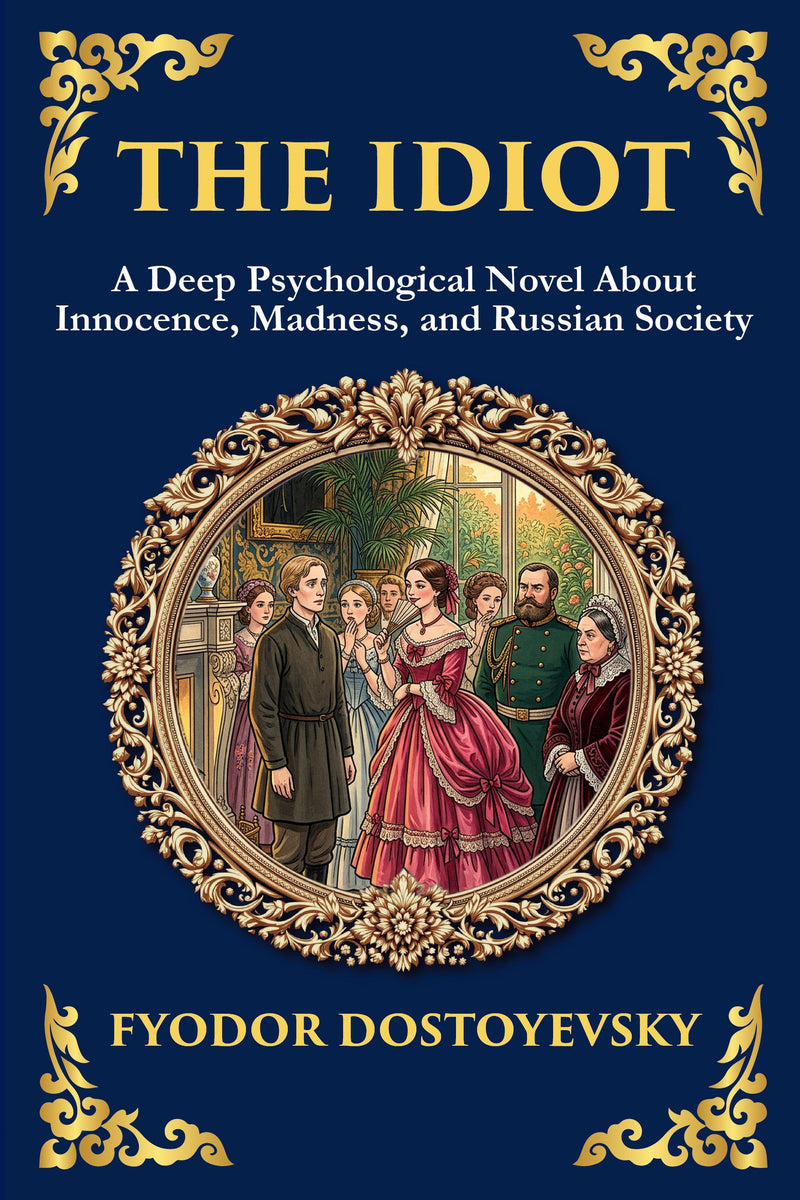
The Idiot
Prince Myshkin returns to Russia after years in a Swiss sanatorium. Kind, sincere, and almost childlike in his honesty, he steps into a world that thrives on power, manipulation, and social ambition.
or free app
10,000+ hrs library
30-day guarantee
The complete The Idiot appears in modern English through Library of Alexandria Press, available online with audiobook narration included for members.
Have you ever wondered why true innocence seems dangerous in a corrupted world? In The Idiot, Fyodor Dostoyevsky presents one of his most emotionally complex and spiritually intense novels—a powerful exploration of what happens when pure goodness enters a society sick with vanity, greed, and selfishness. Prince Lev Nikolayevich Myshkin, returning from years of treatment for epilepsy and presumed madness in Switzerland, enters St.
Petersburg’s upper society with only kindness, honesty, and compassion to offer. But these very virtues are interpreted as weakness. Caught between two women—Nastasya Filippovna, the seductive and self-destructive beauty, and Aglaya Epanchin, the idealistic young aristocrat—Myshkin finds himself spiraling into a tragic conflict between love, sacrifice, and the brutal reality of a morally crumbling world.
Dostoyevsky’s masterwork is more than a novel. It is a psychological and philosophical investigation into the clash between spiritual purity and worldly corruption.
What you’ll discover in this modern edition
- The Tragic Story of Prince Myshkin – A man whose purity both uplifts and destroys in equal measure.
- A Riveting Exploration of Russian Society – Social classes, power dynamics, and the illusions of civility are laid bare.
- A Study in Human Psychology and Moral Dilemma – Dive into the minds of characters torn between selfishness, guilt, passion, and conscience.
- Timeless Questions of Goodness and Suffering – Can true innocence survive in a world ruled by egos and lies?
- One of Dostoyevsky’s Greatest Achievements – A modern translation of his deeply personal vision of Christ-like suffering and misunderstood purity.
| Formats | eBook (EPUB + PDF) · Audiobook · Paperback · Hardcover · Large Print |
| Language | English |
| Trim size (print) | 6 × 9 in |
| Binding | Paperback — perfect-bound · Hardcover — casewrap |
| Large Print edition | Same text in a larger, easy-read type — a larger font, not a larger trim |
| Print pricing | Every physical book at our true cost — at-cost, no profit (members) |
| Library | 873 restored titles, always growing |
| Length | 222,809 words · ~14 hr 51 min reading |
| Reading level | Grade 5 · an easy, flowing read (this modern-English edition) |
| Edition | Modern English translation · 2026 |
Member reviews for this edition are collected as readers finish it — be the first. Across the library: 12,000+ books shipped, every plan covered by a 365-day print guarantee.
About this edition
A faithful, unabridged modern-English edition by The Library of Alexandria — carefully rendered for today's reader and verified paragraph-by-paragraph against the public-domain source. Available as eBook, audiobook, paperback, hardcover, and large print.
- Complete & unabridgedVerified paragraph by paragraph against the source — never a scan, never abridged.
- Modern English, faithfulReadable today, with the author’s meaning kept intact. Readable — not simplified.
- Every format, one membershipRead in your browser or the free app, or listen to the full audiobook.
Included free with your membership
Cancel anytime, one click · 30-day money-back guarantee
Edition last updated July 2026
What’s inside
The Idiot — complete and unabridged: all 21 sections included with membership, plus the full audiobook.
Begin reading The Idiot
In clear modern English — the complete text is included with membership.
Introduction
When Fyodor Dostoyevsky set out to write this novel, he gave himself one of the most audacious tasks a writer has ever undertaken. In letters to his niece and his closest correspondents, he confessed his ambition: he wanted to portray “a perfectly beautiful human being.” Not beautiful in face or fortune, but beautiful in soul — a person of such genuine goodness, transparency, and compassion that he would seem almost otherworldly. Dostoyevsky knew the danger immediately. He understood that nothing is harder to render convincingly in fiction than pure virtue, because goodness, when handled clumsily, becomes dull, sanctimonious, or unbelievable. The world’s literature is crowded with memorable villains and tormented antiheroes, but truly good characters tend to fade into the background, too saintly to feel real. Dostoyevsky wanted to do the impossible. He wanted to take such a man and drop him into the corrupt, glittering, money-hungry world of nineteenth-century Russian high society and watch what happened.
What happened, in the pages that follow, is one of the strangest and most haunting experiments in all of literature. The “idiot” of the title is not stupid — far from it. The word, as it was used in the Russia of the period, carried connotations of someone naive, simple-hearted, mentally fragile, and socially helpless. He is a man who has spent years abroad in a sanatorium being treated for epilepsy and nervous illness, and who returns to Russia with almost no understanding of how the social game is played. He says exactly what he thinks. He trusts everyone. He forgives instantly. He feels other people’s suffering as though it were his own. And precisely because of these qualities — the very qualities we are taught to admire in saints and children — he becomes a kind of mirror held up to everyone around him, revealing their vanity, their greed, their desperation, and their secret longing to be better than they are.
This modern translation has been prepared with the contemporary reader firmly in mind. Dostoyevsky wrote at breakneck speed, often under crushing financial pressure and against punishing deadlines, and his original prose can be dense, digressive, and tangled with the conventions of nineteenth-century Russian society. The aim here has been to preserve the fire, the psychological intensity, and the moral seriousness of the original while smoothing the path for readers encountering this world for the first time. The names, the social rituals, the labyrinthine conversations — all of these have been rendered in language that flows naturally for a modern audience without sacrificing the depth that makes the book a masterpiece. You will not need a degree in Russian history to follow what is happening. What you will need is patience, curiosity, and a willingness to be moved.
To understand why this novel pulses with such raw emotional electricity, it helps to know something of the extraordinary circumstances of its author’s life. Dostoyevsky was no comfortable man of letters composing from a quiet study. He had lived through experiences that few writers in history could match, and every one of them found its way into his fiction.
In 1849, as a young man, he was arrested for his involvement with a group of intellectuals who met to discuss banned political and social ideas. The punishment was severe beyond all proportion to the offense. He and his fellow prisoners were sentenced to death and led out to a public square in front of a firing squad. They were made to stand in the freezing cold, their burial clothes prepared, listening to a priest, certain that they had only minutes left to live. At the last possible moment — quite literally as the soldiers raised their rifles — a messenger arrived with the news that the Tsar had commuted their sentences. The entire execution had been a deliberate piece of psychological theater, a calculated act of cruelty designed to terrorize the condemned before sending them to prison instead.
Dostoyevsky never forgot those moments. The experience of believing, with absolute certainty, that he had only seconds left to live, and then suddenly being given his life back, branded itself into his consciousness forever. In this novel, the protagonist describes precisely this scenario in some of the most powerful passages ever written about the human mind in the face of death — what a man thinks, what he notices, how time itself seems to stretch and shatter when every second becomes infinitely precious. These are not the imaginings of an author. They are the lived memories of a man who stood at the very threshold.
His four years of hard labor in a Siberian prison camp that followed gave him an unflinching education in human nature at its rawest. He lived among murderers, thieves, and the most desperate of men, and he discovered there both the depths of human cruelty and the unexpected flashes of goodness that could appear in the most degraded souls. He returned from Siberia transformed, having shed his youthful political idealism in favor of a profound, almost mystical Christianity and an obsessive interest in the deepest questions of guilt, suffering, redemption, and faith.
There was also the matter of his health. Dostoyevsky suffered from epilepsy throughout his adult life, and his seizures were both a curse and, strangely, a source of revelation. He described how, in the moments immediately before a seizure, he sometimes experienced a feeling of overwhelming joy and harmony, a sense that everything in the universe was reconciled and beautiful — a flash of ecstasy so intense that he said he would gladly give years of his life to experience it again. This too is woven directly into the novel. The protagonist shares the author’s condition, and Dostoyevsky uses it to explore one of his deepest questions: what is the relationship between illness and insight, between the broken body and the illuminated soul? Is the man who sees the world differently because of his disease mad, or is he seeing something the rest of us are too healthy and too comfortable to perceive?
The novel itself was written during a period of intense personal turmoil. Dostoyevsky had fled abroad to escape his creditors and the debts that had crushed him after the death of his first wife and his brother. He was struggling with a gambling addiction that would repeatedly bring him to financial ruin. He composed much of the book in Switzerland and Italy, far from his homeland, homesick and broke, dictating portions to the young stenographer who would become his second wife and his salvation. The result is a book that feels written with the author’s nerves exposed — urgent, uneven, sometimes chaotic, but always burning with a sincerity that polished, comfortable literature can never achieve.
When you read this novel, then, you are not simply reading a story. You are encountering the distilled experience of a man who knew what it was to face execution, to live among the damned, to be visited by visions, and to gamble away everything he owned. Every page carries the weight of a life lived at the extremes of human possibility. This is why the book continues to grip readers more than a century and a half after it was written. It is not an exercise in craft. It is a confession, a prophecy, and a desperate question hurled at the heart of existence.
If you come to this book expecting a conventional narrative — a neat plot that builds steadily toward a tidy resolution — you may at first feel disoriented. Dostoyevsky does not write the way most novelists write. His genius lies elsewhere, and understanding what he is doing will transform your reading experience from puzzled to enthralled.
The first thing to understand is that Dostoyevsky is, above all else, a psychologist of extraordinary depth. He is less interested in what people do than in why they do it, and especially in the contradictions that live inside every human heart. His characters are not consistent in the way that characters in lesser fiction are consistent. They love and hate the same person in the same moment. They humiliate themselves and then take a perverse pride in their own humiliation. They commit acts of stunning generosity and acts of petty cruelty within the space of a single conversation. They lie to themselves constantly, and Dostoyevsky lets us see both the lie and the truth it conceals. This is what makes his people feel so devastatingly real. We recognize in them the chaos of our own inner lives, the parts of ourselves we usually keep hidden even from our own awareness.
Pay attention, as you read, to the conversations. Dostoyevsky’s scenes often unfold as long, charged dialogues in crowded rooms, where a dozen characters circle one another, probing, accusing, confessing, performing. These scenes can run for many pages and may feel, at first, almost overwhelming in their intensity. But this is not idle chatter. This is where the real drama happens. In Dostoyevsky, the battlefield is the human soul, and the weapons are words. A single conversation can contain a murder, a resurrection, a betrayal, and a redemption — all of them spiritual rather than physical. Slow down for these scenes. Let the tension build. Notice how the social masks slip, how people reveal far more than they intend, how the truth keeps breaking through the polite surface like water through cracked ice.
The second thing to understand is that this is a novel of ideas wrestling with one another in human form. Dostoyevsky was deeply troubled by the direction his country and the wider world were taking. He saw a society increasingly obsessed with money, status, and material success, in which the old religious and moral certainties were dissolving. He worried about the rise of a cold, calculating rationalism that reduced human beings to economic units, and about a younger generation that, in his view, was abandoning faith and tradition for fashionable theories that justified anything in the name of progress. These anxieties run all through the book, but Dostoyevsky never lectures. Instead, he embodies his ideas in characters and lets them collide. Each major figure represents not just an individual but a way of living, a philosophy, an answer to the question of how one ought to be in the world. The protagonist, with his radical kindness and his refusal to judge, is set loose among people who embody pride, ambition, sensuality, despair, and calculating self-interest, and the friction between them produces the novel’s tremendous heat.
The third thing to understand — and perhaps the most important — is that beauty is the great hidden subject of this book. There is a famous line that recurs in Dostoyevsky’s work, a question that obsessed him: can beauty save the world? It is a strange, almost naive-sounding idea, and yet the more you sit with it, the more profound it becomes. What does it mean for beauty to save us? Beauty of what kind? The novel is full of beautiful things and beautiful people, but Dostoyevsky is intensely interested in the way that beauty can be both a force of redemption and a source of destruction. A beautiful face can inspire love and self-sacrifice, but it can also drive men to obsession, jealousy, and ruin. A beautiful soul can heal, but it can also be crushed by a world that has no place for it. As you read, watch how the theme of beauty threads through everything — how it is praised, pursued, corrupted, and ultimately tested against the brutal realities of greed and violence. This is one of the deepest currents in the book, and following it will reward you richly.
A word about the women in this novel, who are among the most unforgettable Dostoyevsky ever created. Without revealing anything of the story, it is worth saying that the central female figures here are not passive objects of desire but volcanic forces of will, pride, and wounded dignity. One in particular ranks among the most psychologically complex women in all of literature — a woman so scarred by what life has done to her that she destroys her own happiness almost as an act of defiance, punishing herself and others for a corruption that was forced upon her against her will. The way Dostoyevsky understands her — her contradictions, her self-loathing, her terrible pride, her genuine nobility buried under layers of rage and shame — is a masterclass in human insight. She and the other women in the book refuse every easy category. They are alternately cruel and tender, regal and broken, calculating and helplessly impulsive. They drive the action as powerfully as any character, and they linger in the memory long after the book is closed.
Cancel anytime, one click · 30-day money-back guarantee
Founding annual rate available now — your price locks for life when you join.
Not ready? Get this free chapter by email — read it anytime.
✓ Sent — check your inbox for The Idiot.
Questions about The Idiot
What is The Idiot about?
Prince Myshkin returns to Russia after years in a Swiss sanatorium. Kind, sincere, and almost childlike in his honesty, he steps into a world that thrives on power, manipulation, and social ambition. Branded “an idiot” for his goodness, he becomes entangled in a tragic web of love, greed, and moral decay.
Who wrote The Idiot?
The Idiot was written by Fyodor Dostoyevsky. This edition presents the complete work in clear modern English, faithfully rendered from the public-domain original by Library of Alexandria Press.
Is The Idiot free to read?
The opening chapter is free to read on this page. Members read and listen to the complete work — and the entire library — free, and can order any physical book at our true print cost.
How long is The Idiot?
21 chapters (~222,809 words) — about 14 hr 51 min of reading in this modern-English edition.
Is this an abridged version of The Idiot?
No. This is the complete, unabridged The Idiot, carefully rendered into clear modern English and verified paragraph-by-paragraph against the public-domain source — nothing is cut or summarised.
What formats does The Idiot come in?
The Idiot is available as eBook, paperback and hardcover. eBook and audiobook are included with membership; printed editions ship at our true print cost.
Shipping & returns
Billing & membership
More from the library


Explore Classic & Literary
- Dream Psychology: Psychoanalysis for Beginners · Sigmund Freud
- Great Expectations · Charles Dickens
- The Brothers Karamazov · Fyodor Dostoyevsky
- The Great Gatsby · F. Scott Fitzgerald
- Wild Flowers Worth Knowing · Neltje Blanchan
- Italian Hours · Henry James
- A Popular History of France from the Earliest Times, Volume 5 · François Guizot
- A history of English literature: A practical text-book · Edward Albert
- Italian Highways and Byways from a Motor Car · M. F. Mansfield
- The Heart-Cry of Jesus · Byron J. Rees
- Castes and Tribes of Southern India. Vol. 6 of 7 · Edgar Thurston
- Against the Grain · J.-K. Huysmans
- Dombey and Son · Charles Dickens
- How to Invest Money · George Garr Henry
- The Great Controversy Between Christ and Satan · Ellen Gould Harmon White
- One Hundred Proofs That the Earth Is Not a Globe · William Carpenter
- Southern Literature From 1579–1895 · Louise Manly
- The Renaissance: Studies in Art and Poetry · Walter Pater
- Mark Twain’s Speeches · Mark Twain
- Tacitus on Germany · Cornelius Tacitus
- The Rosary · Florence L. Barclay
- Peculiarities of American Cities · Willard W. Glazier
- Tennis for Girls · Florence A. Ballin
- The World’s Greatest Books — Volume 02 — Fiction
- Shirley · Charlotte Brontë
- Daisy Miller: A Study · Henry James
- Louis Lambert · Honoré de Balzac
- Historic Jamaica · Frank Cundall
- The Gambler · Fyodor Dostoyevsky
- The Mayor of Casterbridge · Thomas Hardy
The Idiot
The Idiot
A Deep Psychological Novel About Innocence, Madness, and Russian Society
Fyodor Dostoyevsky
Contents
- Introduction
- Part 1
- Chapter 1
- Chapter 2
- Chapter 3
- Chapter 4
- Chapter 5
- Chapter 6
- Chapter 7
- Chapter 8
- Chapter 9
- Chapter 10
- Chapter 11
- Chapter 12
- Chapter 13
- Chapter 14
- Chapter 15
- Chapter 16
- Part 2
- Part 3
- Part 4
Introduction
When Fyodor Dostoyevsky set out to write this novel, he gave himself one of the most audacious tasks a writer has ever undertaken. In letters to his niece and his closest correspondents, he confessed his ambition: he wanted to portray “a perfectly beautiful human being.” Not beautiful in face or fortune, but beautiful in soul — a person of such genuine goodness, transparency, and compassion that he would seem almost otherworldly. Dostoyevsky knew the danger immediately. He understood that nothing is harder to render convincingly in fiction than pure virtue, because goodness, when handled clumsily, becomes dull, sanctimonious, or unbelievable. The world’s literature is crowded with memorable villains and tormented antiheroes, but truly good characters tend to fade into the background, too saintly to feel real. Dostoyevsky wanted to do the impossible. He wanted to take such a man and drop him into the corrupt, glittering, money-hungry world of nineteenth-century Russian high society and watch what happened.
What happened, in the pages that follow, is one of the strangest and most haunting experiments in all of literature. The “idiot” of the title is not stupid — far from it. The word, as it was used in the Russia of the period, carried connotations of someone naive, simple-hearted, mentally fragile, and socially helpless. He is a man who has spent years abroad in a sanatorium being treated for epilepsy and nervous illness, and who returns to Russia with almost no understanding of how the social game is played. He says exactly what he thinks. He trusts everyone. He forgives instantly. He feels other people’s suffering as though it were his own. And precisely because of these qualities — the very qualities we are taught to admire in saints and children — he becomes a kind of mirror held up to everyone around him, revealing their vanity, their greed, their desperation, and their secret longing to be better than they are.
This modern translation has been prepared with the contemporary reader firmly in mind. Dostoyevsky wrote at breakneck speed, often under crushing financial pressure and against punishing deadlines, and his original prose can be dense, digressive, and tangled with the conventions of nineteenth-century Russian society. The aim here has been to preserve the fire, the psychological intensity, and the moral seriousness of the original while smoothing the path for readers encountering this world for the first time. The names, the social rituals, the labyrinthine conversations — all of these have been rendered in language that flows naturally for a modern audience without sacrificing the depth that makes the book a masterpiece. You will not need a degree in Russian history to follow what is happening. What you will need is patience, curiosity, and a willingness to be moved.
To understand why this novel pulses with such raw emotional electricity, it helps to know something of the extraordinary circumstances of its author’s life. Dostoyevsky was no comfortable man of letters composing from a quiet study. He had lived through experiences that few writers in history could match, and every one of them found its way into his fiction.
In 1849, as a young man, he was arrested for his involvement with a group of intellectuals who met to discuss banned political and social ideas. The punishment was severe beyond all proportion to the offense. He and his fellow prisoners were sentenced to death and led out to a public square in front of a firing squad. They were made to stand in the freezing cold, their burial clothes prepared, listening to a priest, certain that they had only minutes left to live. At the last possible moment — quite literally as the soldiers raised their rifles — a messenger arrived with the news that the Tsar had commuted their sentences. The entire execution had been a deliberate piece of psychological theater, a calculated act of cruelty designed to terrorize the condemned before sending them to prison instead.
Dostoyevsky never forgot those moments. The experience of believing, with absolute certainty, that he had only seconds left to live, and then suddenly being given his life back, branded itself into his consciousness forever. In this novel, the protagonist describes precisely this scenario in some of the most powerful passages ever written about the human mind in the face of death — what a man thinks, what he notices, how time itself seems to stretch and shatter when every second becomes infinitely precious. These are not the imaginings of an author. They are the lived memories of a man who stood at the very threshold.
His four years of hard labor in a Siberian prison camp that followed gave him an unflinching education in human nature at its rawest. He lived among murderers, thieves, and the most desperate of men, and he discovered there both the depths of human cruelty and the unexpected flashes of goodness that could appear in the most degraded souls. He returned from Siberia transformed, having shed his youthful political idealism in favor of a profound, almost mystical Christianity and an obsessive interest in the deepest questions of guilt, suffering, redemption, and faith.
There was also the matter of his health. Dostoyevsky suffered from epilepsy throughout his adult life, and his seizures were both a curse and, strangely, a source of revelation. He described how, in the moments immediately before a seizure, he sometimes experienced a feeling of overwhelming joy and harmony, a sense that everything in the universe was reconciled and beautiful — a flash of ecstasy so intense that he said he would gladly give years of his life to experience it again. This too is woven directly into the novel. The protagonist shares the author’s condition, and Dostoyevsky uses it to explore one of his deepest questions: what is the relationship between illness and insight, between the broken body and the illuminated soul? Is the man who sees the world differently because of his disease mad, or is he seeing something the rest of us are too healthy and too comfortable to perceive?
The novel itself was written during a period of intense personal turmoil. Dostoyevsky had fled abroad to escape his creditors and the debts that had crushed him after the death of his first wife and his brother. He was struggling with a gambling addiction that would repeatedly bring him to financial ruin. He composed much of the book in Switzerland and Italy, far from his homeland, homesick and broke, dictating portions to the young stenographer who would become his second wife and his salvation. The result is a book that feels written with the author’s nerves exposed — urgent, uneven, sometimes chaotic, but always burning with a sincerity that polished, comfortable literature can never achieve.
When you read this novel, then, you are not simply reading a story. You are encountering the distilled experience of a man who knew what it was to face execution, to live among the damned, to be visited by visions, and to gamble away everything he owned. Every page carries the weight of a life lived at the extremes of human possibility. This is why the book continues to grip readers more than a century and a half after it was written. It is not an exercise in craft. It is a confession, a prophecy, and a desperate question hurled at the heart of existence.
If you come to this book expecting a conventional narrative — a neat plot that builds steadily toward a tidy resolution — you may at first feel disoriented. Dostoyevsky does not write the way most novelists write. His genius lies elsewhere, and understanding what he is doing will transform your reading experience from puzzled to enthralled.
The first thing to understand is that Dostoyevsky is, above all else, a psychologist of extraordinary depth. He is less interested in what people do than in why they do it, and especially in the contradictions that live inside every human heart. His characters are not consistent in the way that characters in lesser fiction are consistent. They love and hate the same person in the same moment. They humiliate themselves and then take a perverse pride in their own humiliation. They commit acts of stunning generosity and acts of petty cruelty within the space of a single conversation. They lie to themselves constantly, and Dostoyevsky lets us see both the lie and the truth it conceals. This is what makes his people feel so devastatingly real. We recognize in them the chaos of our own inner lives, the parts of ourselves we usually keep hidden even from our own awareness.
Pay attention, as you read, to the conversations. Dostoyevsky’s scenes often unfold as long, charged dialogues in crowded rooms, where a dozen characters circle one another, probing, accusing, confessing, performing. These scenes can run for many pages and may feel, at first, almost overwhelming in their intensity. But this is not idle chatter. This is where the real drama happens. In Dostoyevsky, the battlefield is the human soul, and the weapons are words. A single conversation can contain a murder, a resurrection, a betrayal, and a redemption — all of them spiritual rather than physical. Slow down for these scenes. Let the tension build. Notice how the social masks slip, how people reveal far more than they intend, how the truth keeps breaking through the polite surface like water through cracked ice.
The second thing to understand is that this is a novel of ideas wrestling with one another in human form. Dostoyevsky was deeply troubled by the direction his country and the wider world were taking. He saw a society increasingly obsessed with money, status, and material success, in which the old religious and moral certainties were dissolving. He worried about the rise of a cold, calculating rationalism that reduced human beings to economic units, and about a younger generation that, in his view, was abandoning faith and tradition for fashionable theories that justified anything in the name of progress. These anxieties run all through the book, but Dostoyevsky never lectures. Instead, he embodies his ideas in characters and lets them collide. Each major figure represents not just an individual but a way of living, a philosophy, an answer to the question of how one ought to be in the world. The protagonist, with his radical kindness and his refusal to judge, is set loose among people who embody pride, ambition, sensuality, despair, and calculating self-interest, and the friction between them produces the novel’s tremendous heat.
The third thing to understand — and perhaps the most important — is that beauty is the great hidden subject of this book. There is a famous line that recurs in Dostoyevsky’s work, a question that obsessed him: can beauty save the world? It is a strange, almost naive-sounding idea, and yet the more you sit with it, the more profound it becomes. What does it mean for beauty to save us? Beauty of what kind? The novel is full of beautiful things and beautiful people, but Dostoyevsky is intensely interested in the way that beauty can be both a force of redemption and a source of destruction. A beautiful face can inspire love and self-sacrifice, but it can also drive men to obsession, jealousy, and ruin. A beautiful soul can heal, but it can also be crushed by a world that has no place for it. As you read, watch how the theme of beauty threads through everything — how it is praised, pursued, corrupted, and ultimately tested against the brutal realities of greed and violence. This is one of the deepest currents in the book, and following it will reward you richly.
A word about the women in this novel, who are among the most unforgettable Dostoyevsky ever created. Without revealing anything of the story, it is worth saying that the central female figures here are not passive objects of desire but volcanic forces of will, pride, and wounded dignity. One in particular ranks among the most psychologically complex women in all of literature — a woman so scarred by what life has done to her that she destroys her own happiness almost as an act of defiance, punishing herself and others for a corruption that was forced upon her against her will. The way Dostoyevsky understands her — her contradictions, her self-loathing, her terrible pride, her genuine nobility buried under layers of rage and shame — is a masterclass in human insight. She and the other women in the book refuse every easy category. They are alternately cruel and tender, regal and broken, calculating and helplessly impulsive. They drive the action as powerfully as any character, and they linger in the memory long after the book is closed.
Around the end of November, during a thaw, a train on the Warsaw-Petersburg railway was speeding toward the city at nine o’clock one morning. The morning was so damp and foggy that the sun barely managed to break through, and it was impossible to see more than a few yards past the carriage windows.
Some of the passengers were returning from abroad, but the third-class carriages were the most crowded. They were mostly filled with ordinary people of various jobs and social standings who had been picked up at stations closer to the city. Everyone looked exhausted; most had sleepy eyes and were shivering, their skin appearing as gray as the fog outside.
As day broke, two passengers in one of the third-class carriages found themselves sitting opposite each other. Both were young men, both were poorly dressed, both had striking faces, and both were clearly eager to start a conversation. If they had known why they were both such remarkable individuals at that moment, they would have been amazed at the strange coincidence that placed them across from one another in a third-class carriage of the Warsaw Railway Company.
One was a man of about twenty-seven, not very tall, with curly black hair and small, intense gray eyes. He had a broad, flat nose and high cheekbones. His thin lips were curled into a permanent, arrogant, and almost malicious smile. However, his high, well-shaped forehead balanced out the ugliness of the lower half of his face. He was strikingly pale, which made him look incredibly gaunt despite his tough demeanor. At the same time, he had a passionate, suffering look that clashed with his sarcastic smile and smug attitude. He wore a heavy astrachan fur coat that had kept him warm all night, while his neighbor had been forced to endure the full brutality of a Russian November night completely unprepared. The other man wore a wide, sleeveless cloak with a large cape—the kind of garment travelers wear in winter in Switzerland or Northern Italy—which was not at all suitable for a long, freezing journey through Russia from Eydkuhnen to St. Petersburg.
End of the free sample
Keep reading, free
Members read and listen to the complete book — and the entire library. Cancel anytime, one click · 30-day money-back guarantee.