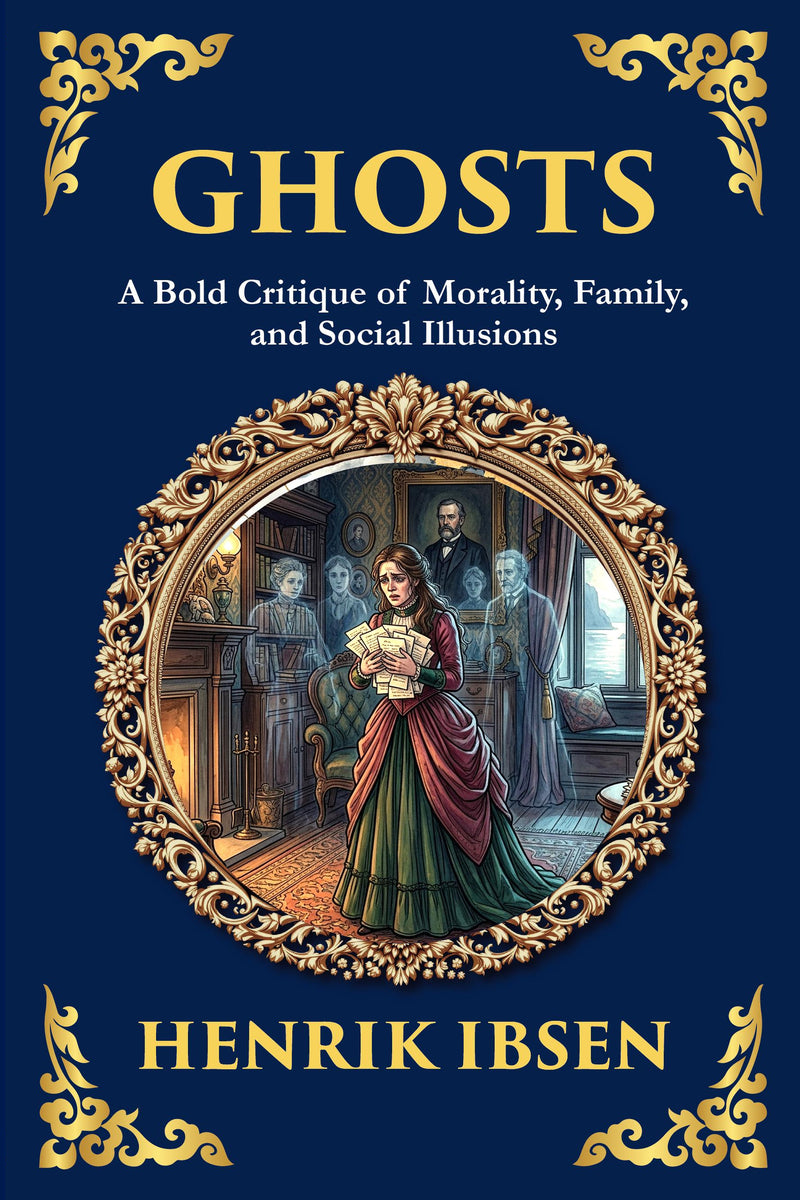
Ghosts — Large Print
Ghosts In a world where silence is virtue and truth is taboo, what happens when the past refuses to stay buried? In Ghosts, Ibsen tears through the fabric of polite society to reveal the hypocrisy, repression, and inherited shame festering beneath its surface.
or free app
10,000+ hrs library
30-day guarantee
The complete Ghosts appears in modern English through Library of Alexandria Press, available online with audiobook narration included for members.
Have you ever wondered why some truths are too dangerous to speak—especially within your own family? Henrik Ibsen’s Ghosts is a landmark of modern drama: a fearless confrontation with the illusions that hold families—and entire societies—together. Set in a seemingly serene Norwegian household, the story centers around Mrs.
Helen Alving, a widow who has spent her life preserving her late husband’s public reputation while concealing his private moral failures. As she prepares to open an orphanage in his name, her son Oswald returns home—bringing with him both hope and a shadow that will shake her carefully maintained illusions to the core. What follows is a relentless unraveling.
Old secrets emerge. Hypocrisy crumbles. And the “ghosts” of the past—unspoken truths, cultural norms, and inherited shame—come roaring into the present.
A masterwork of psychological insight and social criticism, Ghosts is as shocking and relevant today as it was at its scandalous 1881 debut. This modern edition offers clear, accessible language that retains Ibsen’s original emotional intensity and biting commentary.
What you’ll discover in this modern edition
- A Groundbreaking Social Drama – Challenge outdated values surrounding family, morality, religion, and public image.
- A Haunting Exploration of Guilt and Inheritance – Witness how silence and repression poison generations.
- A Strong Female Protagonist Facing Impossible Choices – Follow Mrs. Alving as she confronts the consequences of protecting the truth too long.
- Themes That Still Resonate – From public scandal to private despair, the play confronts timeless dilemmas of freedom, duty, and identity.
- A Work That Sparked a Revolution in Theater – Understand how Ghosts helped birth modern psychological and realist drama. Few works peel back the mask of society with such bravery.
| Formats | eBook (EPUB + PDF) · Audiobook · Paperback · Hardcover · Large Print |
| Language | English |
| Trim size (print) | 6 × 9 in |
| Binding | Paperback — perfect-bound · Hardcover — casewrap |
| Large Print edition | Same text in a larger, easy-read type — a larger font, not a larger trim |
| Print pricing | Every physical book at our true cost — at-cost, no profit (members) |
| Library | 873 restored titles, always growing |
| Length | 23,741 words · ~1 hr 35 min reading |
| Reading level | Grade 3 · an easy, flowing read (this modern-English edition) |
| Edition | Modern English translation · 2026 |
Member reviews for this edition are collected as readers finish it — be the first. Across the library: 12,000+ books shipped, every plan covered by a 365-day print guarantee.
About this edition
A faithful, unabridged modern-English edition by The Library of Alexandria — carefully rendered for today's reader and verified paragraph-by-paragraph against the public-domain source. Available as eBook, audiobook, paperback, hardcover, and large print.
- Complete & unabridgedVerified paragraph by paragraph against the source — never a scan, never abridged.
- Modern English, faithfulReadable today, with the author’s meaning kept intact. Readable — not simplified.
- Every format, one membershipRead in your browser or the free app, or listen to the full audiobook.
Included free with your membership
Cancel anytime, one click · 30-day money-back guarantee
Edition last updated July 2026
What’s inside
Ghosts — Large Print — complete and unabridged: all 4 sections included with membership, plus the full audiobook.
Begin reading Ghosts — Large Print
In clear modern English — the complete text is included with membership.
Introduction
When Ghosts first appeared in print in December of 1881, it landed in the cultural landscape of Europe not as a book but as a detonation. Theaters refused to stage it. Critics competed to find adjectives violent enough to express their disgust. One London reviewer famously described it as “an open drain; a loathsome sore unbandaged; a dirty act done publicly.” The play was denounced from pulpits, banned by censors, and treated by respectable society as something closer to a contagion than a work of art. And yet, within a few short years, it had become impossible to discuss the modern theater—or modern thought itself—without reckoning with it. The very people who had recoiled from its supposed indecency found themselves quoting it, arguing with it, and ultimately bowing to its power. Henrik Ibsen had written something that the nineteenth century was not prepared to hear, and precisely for that reason, something the twentieth century could not do without.
To approach this play today is to approach a work that has shed none of its essential heat. Time has dulled the shock of its specific scandals, but it has only clarified the deeper provocation at its core. What scandalized Ibsen’s contemporaries was the surface; what unsettles us now is the structure underneath. The play asks questions that remain genuinely difficult, questions about inheritance and freedom, about duty and self-deception, about the lies we tell to keep our homes intact and the price those lies extract from us. It is a work about the past refusing to stay buried, about the way the dead continue to govern the living, and about a woman who, late in her life, decides she would rather face an unbearable truth than continue to serve a comfortable falsehood. The title itself names the central preoccupation: not literal apparitions, but the spectral persistence of old beliefs, old obligations, old sins, and old institutions that have lost their meaning yet retain their grip.
This edition presents Ghosts in a modern translation, adapted for the contemporary reader, and it is worth pausing over what that means and why it matters. Ibsen wrote in Dano-Norwegian, in a register that was, for its own time, deliberately stripped of theatrical ornament. He was reacting against the florid, verse-driven, melodramatic conventions that dominated the stage of his youth. He wanted characters who spoke the way people actually spoke in drawing rooms and parlors, who interrupted each other, evaded each other, said one thing while meaning another. That conversational realism was itself part of his revolution. But the gulf between his Norwegian and our English—and between his century and ours—has often been bridged by translations that, however faithful in vocabulary, reintroduce a stiffness and formality the original was designed to avoid. The aim of this version is to restore the immediacy Ibsen intended: to let the reader feel the pressure of these conversations as living speech, charged with everything that is being withheld. The goal is fidelity to the experience of the play, not merely to its dictionary equivalents.
To understand why Ghosts provoked such fury, it helps to understand the man who wrote it and the world he was writing against. Henrik Ibsen was born in 1828 in the small Norwegian coastal town of Skien, into a family whose comfortable prosperity collapsed when he was a boy. His father’s bankruptcy and the resulting social humiliation marked him deeply, and the experience of watching a respectable household fall under the weight of shame and reduced circumstances would echo throughout his work. He left home young, worked as a pharmacist’s apprentice, and fathered an illegitimate child in his late teens—an episode that taught him early about the chasm between public morality and private fact, between what a society professed and what it practiced. These were not abstract themes for Ibsen. They were the texture of his own experience.
By the time he wrote Ghosts, Ibsen had spent years in self-imposed exile, living in Italy and Germany, viewing his native Norway from a critical distance. He had already produced A Doll’s House in 1879, a play that ended with a sound that, according to legend, was heard across Europe: the slam of a door as a wife walked out on her husband and children to seek a self of her own. That ending was itself a scandal, so much so that Ibsen was pressured into writing an alternative, softened conclusion for certain German productions, a concession he later described with bitter regret as a “barbaric outrage” against his own work. The controversy taught him something crucial. The audiences and critics who attacked A Doll’s House had, in their objections, revealed exactly the assumptions he meant to expose. They were outraged not by the play’s flaws but by its truth.
Ghosts can be read, in part, as Ibsen’s answer to those critics. They had asked, in effect: what right does a woman have to abandon her sacred duties as wife and mother? What would happen to society if women simply walked out when they were unhappy? Ghosts offers a devastating reply by presenting a woman who did the opposite—who stayed, who endured, who did everything that duty and respectability demanded—and by tracing, with relentless logic, what that obedience cost. If A Doll’s House dramatized the act of leaving, Ghosts dramatizes the consequences of staying. It is the darker, more uncompromising sibling of the earlier play, and it pursues its premises to conclusions that left even sympathetic readers shaken.
What made Ibsen so threatening was not that he held radical opinions—plenty of writers held those—but that he constructed his plays with the precision of a watchmaker and the inevitability of a mathematical proof. He had absorbed the technical lessons of the well-made play, the tightly constructed dramatic form perfected by French playwrights, and he turned its machinery against the very values such plays usually upheld. In a conventional well-made play, secrets are revealed, complications arise, and order is restored in a reassuring resolution. Ibsen kept the structure but inverted its purpose. In his hands, the revelation of secrets does not restore order; it exposes that there was never any real order to begin with, only a fragile crust of appearances over a chaos of evasion and consequence. He used the audience’s expectation of resolution to make the absence of resolution all the more unbearable.
This is why his contemporaries reached so quickly for the language of disease and contamination. They sensed, correctly, that Ibsen was not merely depicting a corrupt household but indicting an entire social order. The respectable Norwegian community of the play—its institutions, its religion, its notions of family honor, its policing of reputation—is not the backdrop against which a private tragedy unfolds. It is itself the engine of the tragedy. The characters suffer not because they are wicked but because they have internalized a system of values that makes their suffering inevitable. To attack the play was, in a sense, to defend that system; and the violence of the attacks measured precisely how much was at stake.
It is worth remembering, too, that Ibsen wrote during the great age of intellectual upheaval in the West. Charles Darwin had published On the Origin of Species in 1859, and ideas about heredity, inheritance, and the biological transmission of traits were percolating through European thought, often in crude and distorted forms. The new sciences seemed to suggest that human beings were shaped by forces beyond their control—by blood, by environment, by the accumulated past. At the same time, the old religious certainties were under pressure, and thinkers across the continent were beginning to ask whether the inherited moral framework of Christianity could survive the loss of its foundations. Ghosts lives at the precise intersection of these anxieties. It is a play about inheritance in every sense: biological, moral, financial, spiritual. It asks whether we are doomed to repeat the sins and patterns of those who came before us, whether freedom is even possible for creatures so thoroughly shaped by what they have inherited. These were the urgent questions of the era, and Ibsen refused to offer the comforting answers his audience craved.
One of the most extraordinary features of Ghosts is its construction, and a reader new to Ibsen will benefit from understanding what he is doing before the door of the play opens. The action observes a near-classical unity. It takes place in a single setting over the course of roughly a single day, with a small cast of characters whose lives are bound together in ways that gradually become clear. There is an almost suffocating compression to it. Nothing in the play happens by accident; every line of dialogue, every casual reference, every apparently incidental detail is load-bearing. Ibsen builds the play the way an architect builds a structure designed to collapse at a single, precisely calculated point.
The technique he employs is sometimes called retrospective or analytic dramaturgy, and it is one of his signature achievements. Rather than presenting events as they happen, the play continually excavates events that have already happened. The present moment is thin; what matters has mostly occurred long before the curtain rises. The drama lies not in what the characters do but in what they discover—about their past, about each other, about themselves. The whole play is, in a sense, an act of uncovering, layer by layer, until something is revealed that can never again be concealed. This is why the imagery of ghosts is so apt. The past is not gone. It is present in every room, in every relationship, in the very air the characters breathe. They imagine themselves to be living in the present, making free choices, but they are in fact moving through a landscape entirely shaped by decisions made before they were born or before they understood what they were doing.
This structure makes Ghosts a profoundly modern work, and its influence on the drama that followed is incalculable. When you watch a contemporary play or film in which the slow revelation of a buried secret transforms our understanding of everything we have seen, you are watching Ibsen’s invention at work. He demonstrated that the most powerful drama could arise not from external action—battles, murders, grand confrontations—but from the gradual exposure of an interior reality, the dawning recognition of a truth that has been present all along, hiding in plain sight. The terror of Ghosts is the terror of recognition, of understanding too late, of seeing clearly only when nothing can be done.
For the contemporary reader, this structure rewards careful attention. The play moves quickly once it begins, but it operates by accumulation. Early conversations that seem to concern practical matters—the management of a household, the building of an institution, the supervision of servants, questions of money and propriety—turn out to carry an enormous freight of meaning. A reference dropped in the opening pages may not detonate until much later. Ibsen trusts his reader to listen, to remember, to connect. Part of the pleasure—and it is a grim, demanding pleasure—lies in watching the pieces assemble themselves into a pattern that the characters cannot see even as we begin to. There is a dramatic irony at work throughout, but it is not the comfortable irony of a comedy where we laugh at characters who do not know what we know. It is a tragic irony, in which our superior knowledge only deepens our dread.
The play also rewards attention to its central images and motifs. Light and darkness recur with almost obsessive insistence. The Norwegian setting itself, with its perpetual rain and its rare, longed-for sunshine, becomes a kind of psychological landscape. Characters speak repeatedly of the sun, of seeing the sun, of the joy of life and light, and these references gather a terrible weight as the play proceeds. The contrast between the gray, enclosed world of duty and the imagined warmth of freedom and pleasure is one of the play’s deepest structural tensions. Ibsen was a poet before he was a prose dramatist, and even in his most austere realist works, the symbolic dimension never disappears. The reader who notices these patterns will find the play resonating on levels far beyond its surface plot.
Cancel anytime, one click · 30-day money-back guarantee
Founding annual rate available now — your price locks for life when you join.
Not ready? Get this free chapter by email — read it anytime.
✓ Sent — check your inbox for Ghosts — Large Print.
Questions about Ghosts — Large Print
What is Ghosts about?
Ghosts In a world where silence is virtue and truth is taboo, what happens when the past refuses to stay buried? In Ghosts, Ibsen tears through the fabric of polite society to reveal the hypocrisy, repression, and inherited shame festering beneath its surface. When Mrs.
Who wrote Ghosts?
Ghosts was written by Henrik Ibsen. This edition presents the complete work in clear modern English, faithfully rendered from the public-domain original by Library of Alexandria Press.
Is Ghosts free to read?
The opening chapter is free to read on this page. Members read and listen to the complete work — and the entire library — free, and can order any physical book at our true print cost.
How long is Ghosts?
4 chapters (~23,741 words) — about 1 hr 35 min of reading in this modern-English edition.
Is this an abridged version of Ghosts?
No. This is the complete, unabridged Ghosts, carefully rendered into clear modern English and verified paragraph-by-paragraph against the public-domain source — nothing is cut or summarised.
What formats does Ghosts come in?
Ghosts is available as eBook, paperback, hardcover and large print. eBook and audiobook are included with membership; printed editions ship at our true print cost.
Shipping & returns
Billing & membership
More from the library


Explore Poetry & Drama
- As You Like It · William Shakespeare
- The Raven · Edgar Allan Poe
- The Merchant of Venice · William Shakespeare
- A Midsummer Night’s Dream · William Shakespeare
- Romeo and Juliet · William Shakespeare
- The Imaginary Invalid · Molière
- A Woman of No Importance · Oscar Wilde
- Gitanjali · Rabindranath Tagore
- Sonnets from the Portuguese · Elizabeth Barrett Browning
- The New Life (La Vita Nuova) · Dante Alighieri
- The Rime of the Ancient Mariner · Samuel Taylor Coleridge
- Lady Windermere’s Fan · Oscar Wilde
- The Home Book of Verse — Volume 4 · Burton Egbert Stevenson
- Ghosts · Henrik Ibsen
- Mrs. Warren’s Profession · Bernard Shaw
- An Enemy of the People · Henrik Ibsen
- Gawayne and the Green Knight: A Fairy Tale · Charlton M. Lewis
- The Nibelungenlied · G. H. Needler
- Julius Caesar · William Shakespeare
- The Aeneid of Virgil · Virgil
- Troilus and Criseyde · Geoffrey Chaucer
- The Post Office · Rabindranath Tagore
- Lamia · John Keats
- The Ballad of the White Horse · G. K. Chesterton
- A Shropshire Lad · A. E. Housman
- The Birth of the War-God: A Poem by Kalidasa · Kálidása
- Riders to the Sea · J. M. Synge
- The Prophet · Kahlil Gibran
- Twelfth Night; Or, What You Will · William Shakespeare
- Othello, the Moor of Venice · William Shakespeare
Ghosts — Large Print
Ghosts — Large Print
A Fearless Critique of Morality, Family, and Social Delusions
Henrik Ibsen
Contents
- Introduction
- Act 1, Scene 1
- Act 2, Scene 1
- Act 3, Scene 1
Introduction
When Ghosts first appeared in print in December of 1881, it landed in the cultural landscape of Europe not as a book but as a detonation. Theaters refused to stage it. Critics competed to find adjectives violent enough to express their disgust. One London reviewer famously described it as “an open drain; a loathsome sore unbandaged; a dirty act done publicly.” The play was denounced from pulpits, banned by censors, and treated by respectable society as something closer to a contagion than a work of art. And yet, within a few short years, it had become impossible to discuss the modern theater—or modern thought itself—without reckoning with it. The very people who had recoiled from its supposed indecency found themselves quoting it, arguing with it, and ultimately bowing to its power. Henrik Ibsen had written something that the nineteenth century was not prepared to hear, and precisely for that reason, something the twentieth century could not do without.
To approach this play today is to approach a work that has shed none of its essential heat. Time has dulled the shock of its specific scandals, but it has only clarified the deeper provocation at its core. What scandalized Ibsen’s contemporaries was the surface; what unsettles us now is the structure underneath. The play asks questions that remain genuinely difficult, questions about inheritance and freedom, about duty and self-deception, about the lies we tell to keep our homes intact and the price those lies extract from us. It is a work about the past refusing to stay buried, about the way the dead continue to govern the living, and about a woman who, late in her life, decides she would rather face an unbearable truth than continue to serve a comfortable falsehood. The title itself names the central preoccupation: not literal apparitions, but the spectral persistence of old beliefs, old obligations, old sins, and old institutions that have lost their meaning yet retain their grip.
This edition presents Ghosts in a modern translation, adapted for the contemporary reader, and it is worth pausing over what that means and why it matters. Ibsen wrote in Dano-Norwegian, in a register that was, for its own time, deliberately stripped of theatrical ornament. He was reacting against the florid, verse-driven, melodramatic conventions that dominated the stage of his youth. He wanted characters who spoke the way people actually spoke in drawing rooms and parlors, who interrupted each other, evaded each other, said one thing while meaning another. That conversational realism was itself part of his revolution. But the gulf between his Norwegian and our English—and between his century and ours—has often been bridged by translations that, however faithful in vocabulary, reintroduce a stiffness and formality the original was designed to avoid. The aim of this version is to restore the immediacy Ibsen intended: to let the reader feel the pressure of these conversations as living speech, charged with everything that is being withheld. The goal is fidelity to the experience of the play, not merely to its dictionary equivalents.
To understand why Ghosts provoked such fury, it helps to understand the man who wrote it and the world he was writing against. Henrik Ibsen was born in 1828 in the small Norwegian coastal town of Skien, into a family whose comfortable prosperity collapsed when he was a boy. His father’s bankruptcy and the resulting social humiliation marked him deeply, and the experience of watching a respectable household fall under the weight of shame and reduced circumstances would echo throughout his work. He left home young, worked as a pharmacist’s apprentice, and fathered an illegitimate child in his late teens—an episode that taught him early about the chasm between public morality and private fact, between what a society professed and what it practiced. These were not abstract themes for Ibsen. They were the texture of his own experience.
By the time he wrote Ghosts, Ibsen had spent years in self-imposed exile, living in Italy and Germany, viewing his native Norway from a critical distance. He had already produced A Doll’s House in 1879, a play that ended with a sound that, according to legend, was heard across Europe: the slam of a door as a wife walked out on her husband and children to seek a self of her own. That ending was itself a scandal, so much so that Ibsen was pressured into writing an alternative, softened conclusion for certain German productions, a concession he later described with bitter regret as a “barbaric outrage” against his own work. The controversy taught him something crucial. The audiences and critics who attacked A Doll’s House had, in their objections, revealed exactly the assumptions he meant to expose. They were outraged not by the play’s flaws but by its truth.
Ghosts can be read, in part, as Ibsen’s answer to those critics. They had asked, in effect: what right does a woman have to abandon her sacred duties as wife and mother? What would happen to society if women simply walked out when they were unhappy? Ghosts offers a devastating reply by presenting a woman who did the opposite—who stayed, who endured, who did everything that duty and respectability demanded—and by tracing, with relentless logic, what that obedience cost. If A Doll’s House dramatized the act of leaving, Ghosts dramatizes the consequences of staying. It is the darker, more uncompromising sibling of the earlier play, and it pursues its premises to conclusions that left even sympathetic readers shaken.
What made Ibsen so threatening was not that he held radical opinions—plenty of writers held those—but that he constructed his plays with the precision of a watchmaker and the inevitability of a mathematical proof. He had absorbed the technical lessons of the well-made play, the tightly constructed dramatic form perfected by French playwrights, and he turned its machinery against the very values such plays usually upheld. In a conventional well-made play, secrets are revealed, complications arise, and order is restored in a reassuring resolution. Ibsen kept the structure but inverted its purpose. In his hands, the revelation of secrets does not restore order; it exposes that there was never any real order to begin with, only a fragile crust of appearances over a chaos of evasion and consequence. He used the audience’s expectation of resolution to make the absence of resolution all the more unbearable.
This is why his contemporaries reached so quickly for the language of disease and contamination. They sensed, correctly, that Ibsen was not merely depicting a corrupt household but indicting an entire social order. The respectable Norwegian community of the play—its institutions, its religion, its notions of family honor, its policing of reputation—is not the backdrop against which a private tragedy unfolds. It is itself the engine of the tragedy. The characters suffer not because they are wicked but because they have internalized a system of values that makes their suffering inevitable. To attack the play was, in a sense, to defend that system; and the violence of the attacks measured precisely how much was at stake.
It is worth remembering, too, that Ibsen wrote during the great age of intellectual upheaval in the West. Charles Darwin had published On the Origin of Species in 1859, and ideas about heredity, inheritance, and the biological transmission of traits were percolating through European thought, often in crude and distorted forms. The new sciences seemed to suggest that human beings were shaped by forces beyond their control—by blood, by environment, by the accumulated past. At the same time, the old religious certainties were under pressure, and thinkers across the continent were beginning to ask whether the inherited moral framework of Christianity could survive the loss of its foundations. Ghosts lives at the precise intersection of these anxieties. It is a play about inheritance in every sense: biological, moral, financial, spiritual. It asks whether we are doomed to repeat the sins and patterns of those who came before us, whether freedom is even possible for creatures so thoroughly shaped by what they have inherited. These were the urgent questions of the era, and Ibsen refused to offer the comforting answers his audience craved.
One of the most extraordinary features of Ghosts is its construction, and a reader new to Ibsen will benefit from understanding what he is doing before the door of the play opens. The action observes a near-classical unity. It takes place in a single setting over the course of roughly a single day, with a small cast of characters whose lives are bound together in ways that gradually become clear. There is an almost suffocating compression to it. Nothing in the play happens by accident; every line of dialogue, every casual reference, every apparently incidental detail is load-bearing. Ibsen builds the play the way an architect builds a structure designed to collapse at a single, precisely calculated point.
The technique he employs is sometimes called retrospective or analytic dramaturgy, and it is one of his signature achievements. Rather than presenting events as they happen, the play continually excavates events that have already happened. The present moment is thin; what matters has mostly occurred long before the curtain rises. The drama lies not in what the characters do but in what they discover—about their past, about each other, about themselves. The whole play is, in a sense, an act of uncovering, layer by layer, until something is revealed that can never again be concealed. This is why the imagery of ghosts is so apt. The past is not gone. It is present in every room, in every relationship, in the very air the characters breathe. They imagine themselves to be living in the present, making free choices, but they are in fact moving through a landscape entirely shaped by decisions made before they were born or before they understood what they were doing.
This structure makes Ghosts a profoundly modern work, and its influence on the drama that followed is incalculable. When you watch a contemporary play or film in which the slow revelation of a buried secret transforms our understanding of everything we have seen, you are watching Ibsen’s invention at work. He demonstrated that the most powerful drama could arise not from external action—battles, murders, grand confrontations—but from the gradual exposure of an interior reality, the dawning recognition of a truth that has been present all along, hiding in plain sight. The terror of Ghosts is the terror of recognition, of understanding too late, of seeing clearly only when nothing can be done.
For the contemporary reader, this structure rewards careful attention. The play moves quickly once it begins, but it operates by accumulation. Early conversations that seem to concern practical matters—the management of a household, the building of an institution, the supervision of servants, questions of money and propriety—turn out to carry an enormous freight of meaning. A reference dropped in the opening pages may not detonate until much later. Ibsen trusts his reader to listen, to remember, to connect. Part of the pleasure—and it is a grim, demanding pleasure—lies in watching the pieces assemble themselves into a pattern that the characters cannot see even as we begin to. There is a dramatic irony at work throughout, but it is not the comfortable irony of a comedy where we laugh at characters who do not know what we know. It is a tragic irony, in which our superior knowledge only deepens our dread.
The play also rewards attention to its central images and motifs. Light and darkness recur with almost obsessive insistence. The Norwegian setting itself, with its perpetual rain and its rare, longed-for sunshine, becomes a kind of psychological landscape. Characters speak repeatedly of the sun, of seeing the sun, of the joy of life and light, and these references gather a terrible weight as the play proceeds. The contrast between the gray, enclosed world of duty and the imagined warmth of freedom and pleasure is one of the play’s deepest structural tensions. Ibsen was a poet before he was a prose dramatist, and even in his most austere realist works, the symbolic dimension never disappears. The reader who notices these patterns will find the play resonating on levels far beyond its surface plot.
MRS. HELEN ALVING, widow of Captain Alving, who was the King’s Chamberlain. OSWALD ALVING, her son, an artist. PASTOR MANDERS. JACOB ENGSTRAND, a carpenter. REGINA ENGSTRAND, Mrs. Alving’s maid.
The story takes place at Mrs. Alving’s country home, located next to one of the large fjords in Western Norway.
[A large garden room with one door on the left and two doors on the right. A round table with chairs around it sits in the center of the room. Books, magazines, and newspapers are scattered on the table. To the left in the foreground is a window with a small sofa beside it and a worktable in front. In the back, the room opens into a slightly narrower conservatory with walls made of large glass panes. A door in the right wall of the conservatory leads down to the garden. Through the glass, a bleak fjord landscape is dimly visible through a steady rain.]
[ENGSTRAND, a carpenter, is standing by the garden door. His left leg is slightly bent, and there is a piece of wood stuck to the bottom of his boot. REGINA, holding an empty watering can, blocks him from coming closer.]
REGINA. [Whispering.] What do you want? Stay right there. You’re absolutely soaking wet.
ENGSTRAND. It’s just the Lord’s rain, my dear.
ENGSTRAND. Goodness, Regina, the way you talk. [Limps a few steps into the room.] All I wanted to say was—
REGINA. Stop making so much noise with that foot of yours! The young master is sleeping upstairs.
ENGSTRAND. Sleeping? In the middle of the day?
ENGSTRAND. I was out on the town last night—
ENGSTRAND. Yes, we are fragile creatures, we poor humans, my dear—
ENGSTRAND.—And there are so many temptations in this world, you know. But even so, God knows I was working hard at five-thirty this morning.
End of the free sample
Keep reading, free
Members read and listen to the complete book — and the entire library. Cancel anytime, one click · 30-day money-back guarantee.