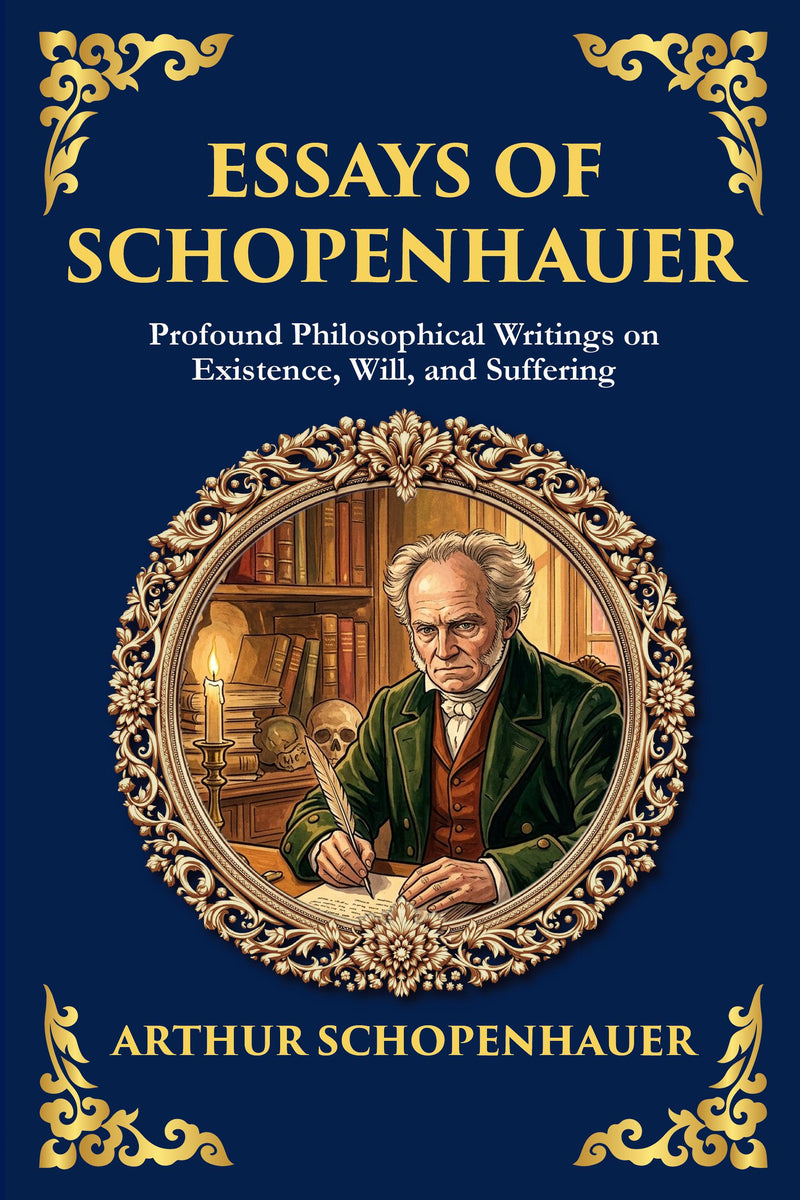
Essays of Schopenhauer — Large Print
Why do we suffer? What drives human behavior? In these brilliant and biting essays, Arthur Schopenhauer probes the nature of existence with unmatched clarity and depth.
or free app
10,000+ hrs library
30-day guarantee
The complete Essays of Schopenhauer appears in modern English through Library of Alexandria Press, available online with audiobook narration included for members.
Have you ever wondered why human life is filled with struggle—and what truly lies behind our desires, frustrations, and illusions? Arthur Schopenhauer’s Essays offer a penetrating analysis of the forces that shape our inner and outer worlds. Drawing from metaphysics, ethics, and psychology, Schopenhauer lays bare the grim truths of existence: that suffering is universal, that desire is endless, and that only detachment and aesthetic contemplation offer fleeting relief.
In these carefully selected essays, readers will encounter Schopenhauer at his most provocative and profound. Whether reflecting on genius and madness, analyzing the deceptive pursuit of happiness, or dissecting the operations of the human will, Schopenhauer writes with a clarity and boldness that remains fresh, fierce, and intellectually exhilarating. This modern translation presents his key essays in language that retains the weight and precision of the original while making them accessible to today’s reader.
It is the perfect entry point into one of philosophy’s most compelling—and unsettling—voices.
What you’ll discover in this modern edition
- A Bold Theory of the Will Understand Schopenhauer’s view of the will as the fundamental force behind all human action and suffering.
| Formats | eBook (EPUB + PDF) · Audiobook · Paperback · Hardcover · Large Print |
| Language | English |
| Trim size (print) | 6 × 9 in |
| Binding | Paperback — perfect-bound · Hardcover — casewrap |
| Large Print edition | Same text in a larger, easy-read type — a larger font, not a larger trim |
| Print pricing | Every physical book at our true cost — at-cost, no profit (members) |
| Library | 873 restored titles, always growing |
| Length | 60,172 words · ~4 hr 1 min reading |
| Reading level | Grade 6 · an easy, flowing read (this modern-English edition) |
| Edition | Modern English translation · 2026 |
Member reviews for this edition are collected as readers finish it — be the first. Across the library: 12,000+ books shipped, every plan covered by a 365-day print guarantee.
About this edition
A faithful, unabridged modern-English edition by The Library of Alexandria — carefully rendered for today's reader and verified paragraph-by-paragraph against the public-domain source. Available as eBook, audiobook, paperback, hardcover, and large print.
- Complete & unabridgedVerified paragraph by paragraph against the source — never a scan, never abridged.
- Modern English, faithfulReadable today, with the author’s meaning kept intact. Readable — not simplified.
- Every format, one membershipRead in your browser or the free app, or listen to the full audiobook.
Included free with your membership
Cancel anytime, one click · 30-day money-back guarantee
Edition last updated July 2026
What’s inside
Essays of Schopenhauer — Large Print — complete and unabridged: all 14 sections included with membership, plus the full audiobook.
Begin reading Essays of Schopenhauer — Large Print
In clear modern English — the complete text is included with membership.
Introduction
There are philosophers we read to feel reassured, and there are philosophers we read to feel awakened. Arthur Schopenhauer belongs decisively to the second kind. To open his essays is to encounter a mind that refuses every comfortable illusion, that pulls back the curtain on the half-truths we tell ourselves, and that insists—with a clarity that can be almost unsettling—on looking directly at the things most people spend their lives avoiding. He writes about desire and disappointment, about the strange machinery of the human will, about death, boredom, love, suffering, genius, and the curious question of why we are here at all. And he does so not in the dry, technical idiom one might expect from a German metaphysician, but in prose that crackles with wit, irony, and an almost conversational intimacy.
This collection brings together the shorter, more accessible writings of a thinker who has often been caricatured as the great pessimist of Western thought. That label, while not entirely false, badly underestimates him. Schopenhauer is not a man wallowing in gloom for its own sake. He is, rather, a profoundly honest observer who believes that the first step toward any kind of wisdom—or even any kind of peace—is to see existence as it actually is, stripped of the consoling fictions we drape over it. What emerges from his pages is not despair but something stranger and more valuable: a bracing, liberating candor. Once you stop expecting life to be something it is not, he suggests, you can begin to live it with far greater equanimity. This is philosophy that aims not merely to be understood but to be used.
The present edition has been prepared with the contemporary reader firmly in mind. Schopenhauer wrote in the early and middle decades of the nineteenth century, and the original translations of his work—many of them produced in the Victorian era—can feel stilted, overgrown with subordinate clauses, and weighed down by archaic vocabulary. The aim here has been to preserve every ounce of his argument, his sharpness, and his characteristic voice while rendering the language fluid and immediate for a modern audience. Nothing essential has been simplified away. The thoughts remain as demanding and as rewarding as they ever were. But the path to them has been cleared of unnecessary obstacles, so that what reaches you is the philosopher himself, speaking almost as if across a table, rather than a faded echo muffled by the conventions of another century.
To read Schopenhauer well, it helps to understand a little about who he was, because few philosophers have been so thoroughly shaped by the texture of their own lives. He was born in 1788 in the city of Danzig, into a prosperous merchant family. His father, a successful businessman, hoped his son would follow him into commerce, and the young Arthur was for a time groomed for that career. But the boy’s temperament leaned irresistibly toward books, ideas, and a brooding intensity of observation. When his father died—possibly by suicide—Schopenhauer was freed, both financially and psychologically, to pursue the life of the mind. The inheritance he received gave him a rare independence; he never had to teach for a living in any sustained way, never had to flatter patrons or trim his views to suit an institution. This independence is everywhere in his writing. He says exactly what he thinks, with a frankness that can be exhilarating, because he answers to no one.
His relationship with his mother, the novelist Johanna Schopenhauer, was famously strained, and one cannot help but notice the shadow it casts over some of his more acerbic remarks on women, family, and human attachment. He traveled widely as a young man, absorbing the cultures and landscapes of Europe, and these early journeys gave him an unusually cosmopolitan perspective for a German philosopher of his time. He was, crucially, among the first major Western thinkers to engage seriously with Eastern philosophy—with the Upanishads, with Buddhism, with the great currents of Indian thought that were only just beginning to reach European readers through new translations. This encounter left a permanent mark on him. The resonances between his ideas and certain insights of Buddhism are not coincidental; he recognized in those traditions a kindred understanding of desire as the root of suffering, and of liberation as a kind of release from the relentless grasping of the will.
Schopenhauer produced his great systematic work, The World as Will and Representation, while still a young man, convinced he had unlocked something fundamental about the nature of reality. The book was almost completely ignored. For decades he labored in obscurity, embittered by the fame that flowed instead to rivals he considered intellectual frauds—above all Hegel, whom he despised with a venom that occasionally erupts into his prose. He once scheduled his university lectures at the same hour as Hegel’s, an act of breathtaking confidence that ended, predictably, with Schopenhauer lecturing to nearly empty rooms while crowds flocked to his rival. It was a humiliation he never forgot.
And yet the final chapter of his story is one of vindication. In his later years he assembled a collection of shorter writings—essays, observations, aphorisms—under a Greek title meaning, roughly, “incidental thoughts” or “supplementary remarks.” These pieces, more accessible and more immediately engaging than his dense early masterwork, brought him sudden and unexpected fame in the last decade of his life. Readers who had never been able to penetrate his systematic philosophy found in these essays a wise, witty, sometimes savage commentator on the human condition. By the time of his death in 1860, he had become one of the most talked-about thinkers in Europe. The essays gathered in this volume are drawn from that rich late harvest, the writings of a man who had spent a lifetime thinking, who had been ignored and then celebrated, and who had distilled his decades of reflection into prose of remarkable force and economy.
Understanding this trajectory matters because it explains the peculiar tone of these essays—the blend of melancholy and mischief, of cosmic pessimism and earthy practical advice. This is not the voice of a young firebrand or a comfortable academic. It is the voice of a man who has lived, suffered, observed, and arrived at hard-won conclusions, and who now offers them to you with a kind of unsentimental generosity. He is not trying to recruit you to a school or a movement. He is trying, in his own prickly way, to help you see clearly.
His influence, it should be said, extends far beyond philosophy departments. Nietzsche described his first encounter with Schopenhauer as a kind of conversion experience, even as he later rebelled against him. Wagner set out to compose music under his spell. Tolstoy, Thomas Mann, Proust, Borges, and countless others found in him a vital source. The young Freud absorbed his ideas about the unconscious dominance of irrational drives; the entire edifice of depth psychology owes him an unacknowledged debt. Einstein kept a portrait of him on his study wall. To read Schopenhauer, then, is not merely to read an interesting figure from the past—it is to encounter one of the hidden architects of the modern mind, the man who first articulated so much of what we now take for granted about the irrational forces that govern human behavior.
What is it, exactly, that Schopenhauer wants us to understand? At the center of his thought lies a single, startling idea, and it is worth approaching it slowly, because it transforms everything else he says.
Most of us assume that we are, fundamentally, rational creatures who occasionally feel things. We believe that our intellect is in charge, that we deliberate, decide, and then act, and that our desires and impulses are subordinate to this governing reason. Schopenhauer reverses this picture entirely. For him, the intellect is not the master but the servant. What truly drives us—what drives all of existence, in fact—is something deeper, blinder, and more relentless than reason. He calls it the will. It is the striving, craving, grasping force that pulses through every living thing: the hunger of the animal, the growth of the plant toward light, the desperate self-preservation of every organism, and, in us, the ceaseless wanting that no satisfaction ever permanently quiets. The intellect, in this view, exists largely to serve the will—to find food, secure mates, avoid danger, rationalize our impulses after the fact. We think we are reasoning our way through life, but more often we are simply finding clever justifications for what the will has already decided.
From this single insight, an entire understanding of life unfolds. If we are fundamentally creatures of endless wanting, then satisfaction can only ever be temporary. We desire something, we suffer in the wanting, we obtain it, and almost immediately the satisfaction fades and a new desire takes its place. Schopenhauer observes, with merciless precision, that this is the basic rhythm of human life: a pendulum swinging between the pain of unfulfilled desire and the emptiness—what he calls boredom—that descends once a desire is satisfied. We are rarely content for long. Get what you want, and you soon want something else. The hamster wheel of craving never stops turning. This is why he is called a pessimist: he denies that lasting happiness, understood as a permanent state of fulfilled satisfaction, is even structurally possible for beings constituted as we are.
But—and this is the crucial point that the pessimist label obscures—Schopenhauer does not leave us stranded in this bleak diagnosis. He spends a great deal of his energy exploring how human beings can find moments of release from the tyranny of the will, brief reprieves in which the endless wanting falls silent and we glimpse something like peace. One of these is aesthetic experience. When we lose ourselves in a piece of music, a painting, a poem, or the contemplation of natural beauty, we momentarily stop wanting. We cease to relate to the object as something to use or consume; we simply behold it. In that state of pure contemplation, the restless will quiets, and we experience a kind of liberation. Music held a special place in his thought—he regarded it as the highest of the arts, the one that speaks most directly to the inner nature of reality, bypassing concepts altogether. Anyone who has been transported by a piece of music, who has felt their everyday anxieties dissolve into something larger, will recognize what he is describing.
Another path away from the dominion of the will is compassion. Here Schopenhauer’s pessimism reveals its ethical heart. If we are all expressions of the same blind, striving force, then the boundaries between us are, at the deepest level, a kind of illusion. When we feel genuine compassion for another’s suffering—when we recognize that their pain is, in some profound sense, our own—we momentarily break through the illusion of separateness that the will imposes. For Schopenhauer, all genuine morality is rooted in this experience of compassion, this dissolving of the barrier between self and other. It is a remarkably tender idea from a thinker so often portrayed as cold and misanthropic, and it reveals the moral seriousness beneath his apparent gloom.
He also has a great deal to say, in these essays, about the practical art of living—what we might today call life advice, though of a far more profound order than the self-help that crowds our shelves. He writes with unusual wisdom about happiness and its limits, about the cultivation of an inner life that does not depend on external circumstances, about the immense value of solitude for those of intellectual temperament, about how to bear the inevitable disappointments of existence with dignity. There is something almost Stoic in his counsel here, a hard-edged practicality. He understood that since we cannot rearrange the fundamental structure of existence, we can at least arrange our relationship to it more wisely. Lower your expectations, he suggests, not out of defeat but out of realism, and you will find that life treats you better than you feared. Value your own company and the riches of your own mind, because these are the only possessions that cannot be taken from you. Recognize the foolishness of pursuing wealth, fame, and the good opinion of others as ends in themselves, since these deliver far less than they promise.
Cancel anytime, one click · 30-day money-back guarantee
Founding annual rate available now — your price locks for life when you join.
Not ready? Get this free chapter by email — read it anytime.
✓ Sent — check your inbox for Essays of Schopenhauer — Large Print.
Questions about Essays of Schopenhauer — Large Print
What is Essays of Schopenhauer about?
Why do we suffer? What drives human behavior? In these brilliant and biting essays, Arthur Schopenhauer probes the nature of existence with unmatched clarity and depth.
Who wrote Essays of Schopenhauer?
Essays of Schopenhauer was written by Arthur Schopenhauer. This edition presents the complete work in clear modern English, faithfully rendered from the public-domain original by Library of Alexandria Press.
Is Essays of Schopenhauer free to read?
The opening chapter is free to read on this page. Members read and listen to the complete work — and the entire library — free, and can order any physical book at our true print cost.
How long is Essays of Schopenhauer?
14 chapters (~60,172 words) — about 4 hr 1 min of reading in this modern-English edition.
Is this an abridged version of Essays of Schopenhauer?
No. This is the complete, unabridged Essays of Schopenhauer, carefully rendered into clear modern English and verified paragraph-by-paragraph against the public-domain source — nothing is cut or summarised.
What formats does Essays of Schopenhauer come in?
Essays of Schopenhauer is available as eBook, paperback, hardcover and large print. eBook and audiobook are included with membership; printed editions ship at our true print cost.
Shipping & returns
Billing & membership
More from the library


Explore Philosophy & Ideas
- Kant's Prolegomena to Any Future Metaphysics · Immanuel Kant
- The Advancement of Learning · Francis Bacon
- The Dawn of Day · Friedrich Wilhelm Nietzsche
- Meditations · Marcus Aurelius
- The Confessions of St. Augustine · Saint Augustine
- Dialogues Concerning Natural Religion · David Hume
- Considerations on Representative Government · John Stuart Mill
- The Will to Power: An Attempted Transvaluation of All Values. Book III and IV · Friedrich Nietzsche
- Groundwork of the Metaphysics of Morals · Immanuel Kant
- The Confessions of Jean-Jacques Rousseau — Complete · Jean-Jacques Rousseau
- Democracy in America — Volume 2 · Alexis de Tocqueville
- Ecce Homo · Friedrich Wilhelm Nietzsche
- Second Treatise of Government · John Locke
- The Prince · Niccolò Machiavelli
- Thus Spake Zarathustra: A Book for All and None · Friedrich Wilhelm Nietzsche
- The Island of Doctor Moreau · H. G. Wells
- Sophist · Plato
- The Seven Lamps of Architecture · John Ruskin
- Essays — First Series · Ralph Waldo Emerson
- The Book of the Damned · Charles Fort
- The Everlasting Man · G. K. Chesterton
- The Initiates of the Flame · Manly P. Hall
- The Book of Tea · Kakuzo Okakura
- The Japanese Spirit · Yoshisaburo Okakura
- The Analysis of Mind · Bertrand Russell
- Orthodoxy · G. K. Chesterton
- Apology, Crito, and Phaedo of Socrates · Plato
- Euthyphro · Plato
- Timaeus · Plato
- Ion · Plato
Essays of Schopenhauer — Large Print
Essays of Schopenhauer — Large Print
Deep Philosophical Writings on Existence, Will, and Suffering
Arthur Schopenhauer
Contents
- Introduction
- Chapter 1
- Chapter 2
- Chapter 3
- Chapter 4
- Chapter 5
- Chapter 6
- Chapter 7
- Chapter 8
- Chapter 9
- Chapter 10
- Chapter 11
- Chapter 12
- Chapter 13
Introduction
There are philosophers we read to feel reassured, and there are philosophers we read to feel awakened. Arthur Schopenhauer belongs decisively to the second kind. To open his essays is to encounter a mind that refuses every comfortable illusion, that pulls back the curtain on the half-truths we tell ourselves, and that insists—with a clarity that can be almost unsettling—on looking directly at the things most people spend their lives avoiding. He writes about desire and disappointment, about the strange machinery of the human will, about death, boredom, love, suffering, genius, and the curious question of why we are here at all. And he does so not in the dry, technical idiom one might expect from a German metaphysician, but in prose that crackles with wit, irony, and an almost conversational intimacy.
This collection brings together the shorter, more accessible writings of a thinker who has often been caricatured as the great pessimist of Western thought. That label, while not entirely false, badly underestimates him. Schopenhauer is not a man wallowing in gloom for its own sake. He is, rather, a profoundly honest observer who believes that the first step toward any kind of wisdom—or even any kind of peace—is to see existence as it actually is, stripped of the consoling fictions we drape over it. What emerges from his pages is not despair but something stranger and more valuable: a bracing, liberating candor. Once you stop expecting life to be something it is not, he suggests, you can begin to live it with far greater equanimity. This is philosophy that aims not merely to be understood but to be used.
The present edition has been prepared with the contemporary reader firmly in mind. Schopenhauer wrote in the early and middle decades of the nineteenth century, and the original translations of his work—many of them produced in the Victorian era—can feel stilted, overgrown with subordinate clauses, and weighed down by archaic vocabulary. The aim here has been to preserve every ounce of his argument, his sharpness, and his characteristic voice while rendering the language fluid and immediate for a modern audience. Nothing essential has been simplified away. The thoughts remain as demanding and as rewarding as they ever were. But the path to them has been cleared of unnecessary obstacles, so that what reaches you is the philosopher himself, speaking almost as if across a table, rather than a faded echo muffled by the conventions of another century.
To read Schopenhauer well, it helps to understand a little about who he was, because few philosophers have been so thoroughly shaped by the texture of their own lives. He was born in 1788 in the city of Danzig, into a prosperous merchant family. His father, a successful businessman, hoped his son would follow him into commerce, and the young Arthur was for a time groomed for that career. But the boy’s temperament leaned irresistibly toward books, ideas, and a brooding intensity of observation. When his father died—possibly by suicide—Schopenhauer was freed, both financially and psychologically, to pursue the life of the mind. The inheritance he received gave him a rare independence; he never had to teach for a living in any sustained way, never had to flatter patrons or trim his views to suit an institution. This independence is everywhere in his writing. He says exactly what he thinks, with a frankness that can be exhilarating, because he answers to no one.
His relationship with his mother, the novelist Johanna Schopenhauer, was famously strained, and one cannot help but notice the shadow it casts over some of his more acerbic remarks on women, family, and human attachment. He traveled widely as a young man, absorbing the cultures and landscapes of Europe, and these early journeys gave him an unusually cosmopolitan perspective for a German philosopher of his time. He was, crucially, among the first major Western thinkers to engage seriously with Eastern philosophy—with the Upanishads, with Buddhism, with the great currents of Indian thought that were only just beginning to reach European readers through new translations. This encounter left a permanent mark on him. The resonances between his ideas and certain insights of Buddhism are not coincidental; he recognized in those traditions a kindred understanding of desire as the root of suffering, and of liberation as a kind of release from the relentless grasping of the will.
Schopenhauer produced his great systematic work, The World as Will and Representation, while still a young man, convinced he had unlocked something fundamental about the nature of reality. The book was almost completely ignored. For decades he labored in obscurity, embittered by the fame that flowed instead to rivals he considered intellectual frauds—above all Hegel, whom he despised with a venom that occasionally erupts into his prose. He once scheduled his university lectures at the same hour as Hegel’s, an act of breathtaking confidence that ended, predictably, with Schopenhauer lecturing to nearly empty rooms while crowds flocked to his rival. It was a humiliation he never forgot.
And yet the final chapter of his story is one of vindication. In his later years he assembled a collection of shorter writings—essays, observations, aphorisms—under a Greek title meaning, roughly, “incidental thoughts” or “supplementary remarks.” These pieces, more accessible and more immediately engaging than his dense early masterwork, brought him sudden and unexpected fame in the last decade of his life. Readers who had never been able to penetrate his systematic philosophy found in these essays a wise, witty, sometimes savage commentator on the human condition. By the time of his death in 1860, he had become one of the most talked-about thinkers in Europe. The essays gathered in this volume are drawn from that rich late harvest, the writings of a man who had spent a lifetime thinking, who had been ignored and then celebrated, and who had distilled his decades of reflection into prose of remarkable force and economy.
Understanding this trajectory matters because it explains the peculiar tone of these essays—the blend of melancholy and mischief, of cosmic pessimism and earthy practical advice. This is not the voice of a young firebrand or a comfortable academic. It is the voice of a man who has lived, suffered, observed, and arrived at hard-won conclusions, and who now offers them to you with a kind of unsentimental generosity. He is not trying to recruit you to a school or a movement. He is trying, in his own prickly way, to help you see clearly.
His influence, it should be said, extends far beyond philosophy departments. Nietzsche described his first encounter with Schopenhauer as a kind of conversion experience, even as he later rebelled against him. Wagner set out to compose music under his spell. Tolstoy, Thomas Mann, Proust, Borges, and countless others found in him a vital source. The young Freud absorbed his ideas about the unconscious dominance of irrational drives; the entire edifice of depth psychology owes him an unacknowledged debt. Einstein kept a portrait of him on his study wall. To read Schopenhauer, then, is not merely to read an interesting figure from the past—it is to encounter one of the hidden architects of the modern mind, the man who first articulated so much of what we now take for granted about the irrational forces that govern human behavior.
What is it, exactly, that Schopenhauer wants us to understand? At the center of his thought lies a single, startling idea, and it is worth approaching it slowly, because it transforms everything else he says.
Most of us assume that we are, fundamentally, rational creatures who occasionally feel things. We believe that our intellect is in charge, that we deliberate, decide, and then act, and that our desires and impulses are subordinate to this governing reason. Schopenhauer reverses this picture entirely. For him, the intellect is not the master but the servant. What truly drives us—what drives all of existence, in fact—is something deeper, blinder, and more relentless than reason. He calls it the will. It is the striving, craving, grasping force that pulses through every living thing: the hunger of the animal, the growth of the plant toward light, the desperate self-preservation of every organism, and, in us, the ceaseless wanting that no satisfaction ever permanently quiets. The intellect, in this view, exists largely to serve the will—to find food, secure mates, avoid danger, rationalize our impulses after the fact. We think we are reasoning our way through life, but more often we are simply finding clever justifications for what the will has already decided.
From this single insight, an entire understanding of life unfolds. If we are fundamentally creatures of endless wanting, then satisfaction can only ever be temporary. We desire something, we suffer in the wanting, we obtain it, and almost immediately the satisfaction fades and a new desire takes its place. Schopenhauer observes, with merciless precision, that this is the basic rhythm of human life: a pendulum swinging between the pain of unfulfilled desire and the emptiness—what he calls boredom—that descends once a desire is satisfied. We are rarely content for long. Get what you want, and you soon want something else. The hamster wheel of craving never stops turning. This is why he is called a pessimist: he denies that lasting happiness, understood as a permanent state of fulfilled satisfaction, is even structurally possible for beings constituted as we are.
But—and this is the crucial point that the pessimist label obscures—Schopenhauer does not leave us stranded in this bleak diagnosis. He spends a great deal of his energy exploring how human beings can find moments of release from the tyranny of the will, brief reprieves in which the endless wanting falls silent and we glimpse something like peace. One of these is aesthetic experience. When we lose ourselves in a piece of music, a painting, a poem, or the contemplation of natural beauty, we momentarily stop wanting. We cease to relate to the object as something to use or consume; we simply behold it. In that state of pure contemplation, the restless will quiets, and we experience a kind of liberation. Music held a special place in his thought—he regarded it as the highest of the arts, the one that speaks most directly to the inner nature of reality, bypassing concepts altogether. Anyone who has been transported by a piece of music, who has felt their everyday anxieties dissolve into something larger, will recognize what he is describing.
Another path away from the dominion of the will is compassion. Here Schopenhauer’s pessimism reveals its ethical heart. If we are all expressions of the same blind, striving force, then the boundaries between us are, at the deepest level, a kind of illusion. When we feel genuine compassion for another’s suffering—when we recognize that their pain is, in some profound sense, our own—we momentarily break through the illusion of separateness that the will imposes. For Schopenhauer, all genuine morality is rooted in this experience of compassion, this dissolving of the barrier between self and other. It is a remarkably tender idea from a thinker so often portrayed as cold and misanthropic, and it reveals the moral seriousness beneath his apparent gloom.
He also has a great deal to say, in these essays, about the practical art of living—what we might today call life advice, though of a far more profound order than the self-help that crowds our shelves. He writes with unusual wisdom about happiness and its limits, about the cultivation of an inner life that does not depend on external circumstances, about the immense value of solitude for those of intellectual temperament, about how to bear the inevitable disappointments of existence with dignity. There is something almost Stoic in his counsel here, a hard-edged practicality. He understood that since we cannot rearrange the fundamental structure of existence, we can at least arrange our relationship to it more wisely. Lower your expectations, he suggests, not out of defeat but out of realism, and you will find that life treats you better than you feared. Value your own company and the riches of your own mind, because these are the only possessions that cannot be taken from you. Recognize the foolishness of pursuing wealth, fame, and the good opinion of others as ends in themselves, since these deliver far less than they promise.
First of all, there are two types of authors: those who write because they have something to say, and those who write for the sake of writing. The first group has thoughts or experiences they feel are worth sharing, while the second group needs money and therefore writes for profit. They think only so they have something to write. You can recognize them by the way they stretch their thoughts out as long as possible, and by the way they develop ideas that are half-true, twisted, forced, or inconsistent. They also love to be vague so they seem like something they are not, which is why their writing lacks precision and clarity.
As a result, it quickly becomes obvious that they are writing just to fill pages. This sometimes happens even with the best authors; for instance, in parts of Lessing’s Dramaturgie and many of Jean Paul’s novels. As soon as you notice this, the book should be tossed aside, because time is too valuable. In reality, an author is cheating the reader the moment he writes just to fill space, because he pretends he has something meaningful to share. Writing for money and the desire to protect copyrights are, at their core, the destruction of literature. Only the person who writes purely for the sake of the subject produces anything worth reading. Imagine what an incredible advantage it would be if every field of literature contained only a few, but excellent, books! This will never happen as long as writing is used to make money. It is as if money carries a curse, because any author begins to decline the moment they write for profit. The greatest works of great men were all produced when they wrote for nothing or for very little pay. This is backed up by the Spanish proverb: honra y provecho no caben en un saco (Honor and money do not fit in the same bag). The terrible state of today’s literature, both in Germany and elsewhere, is because books are written to earn money. Anyone who needs cash simply sits down and writes a book, and the public is foolish enough to buy it. A side effect of this is the decay of language.
End of the free sample
Keep reading, free
Members read and listen to the complete book — and the entire library. Cancel anytime, one click · 30-day money-back guarantee.