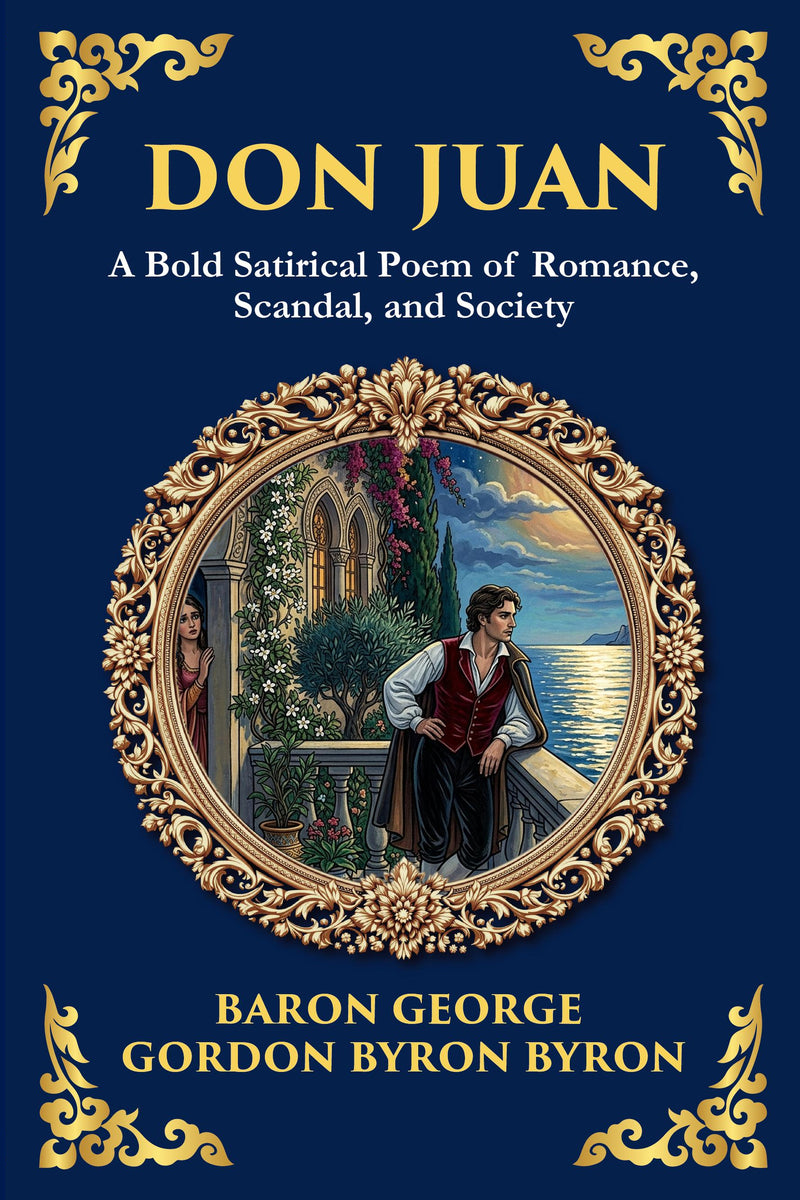
Don Juan
Lord Byron Witty. Scandalous. Brilliantly subversive. In Don Juan, Lord Byron reimagines the legendary lover not as the seducer—but as the seduced.
or free app
10,000+ hrs library
30-day guarantee
The complete Don Juan appears in modern English through Library of Alexandria Press, available online with audiobook narration included for members.
Have you ever wondered why scandal tells us more truth than silence ever could? Don Juan by Lord Byron is a literary tour de force: a sprawling, brilliant poem that challenges, mocks, and redefines the moral codes of its age—and ours. Byron flips the script on one of literature’s most infamous figures, portraying Don Juan not as a heartless seducer, but as a wide-eyed, unlucky-in-love romantic—pulled by fate into situations that seduce him more than he seduces.
Spanning shipwrecks, duels, harems, revolutions, and romantic misadventures, Byron uses his verse to satirize everything from war and politics to love and literature itself. Beneath the razor- sharp wit lies a deeper exploration of identity, masculinity, and the absurdities of social expectation. This edition features a refined layout and careful lineation to make Byron’s rhymed couplets flow effortlessly for modern readers while preserving the melodic energy and rhythmic mastery of the original.
What you’ll discover in this modern edition
- A Satirical Masterpiece Across Seventeen Cantos – Follow Juan’s journey from Spain to Russia to England, through scandal, heartbreak, and hilarity.
- Byron’s Genius in Full Force – Experience the unmatched wit, irony, and poetic fire of one of history’s most fascinating literary rebels.
- A Revolutionary Portrayal of Masculinity and Morality – Uncover how the world shapes the man—and how Byron challenges every rule in the process.
- Layered Social Commentary Still Relevant Today – War, class, gender, celebrity—it’s all here, sharper than ever.
- Perfect for Lovers of Poetry, History, and Rebellion – An essential volume for readers who appreciate literary mischief and the thrill of breaking rules.
| Formats | eBook (EPUB + PDF) · Audiobook · Paperback · Hardcover · Large Print |
| Language | English |
| Trim size (print) | 6 × 9 in |
| Binding | Paperback — perfect-bound · Hardcover — casewrap |
| Large Print edition | Same text in a larger, easy-read type — a larger font, not a larger trim |
| Print pricing | Every physical book at our true cost — at-cost, no profit (members) |
| Library | 873 restored titles, always growing |
| Length | 90,519 words · ~6 hr 2 min reading |
| Reading level | Grade 11 · a confident, adult read (this modern-English edition) |
| Edition | Modern English translation · 2026 |
Member reviews for this edition are collected as readers finish it — be the first. Across the library: 12,000+ books shipped, every plan covered by a 365-day print guarantee.
About this edition
A faithful, unabridged modern-English edition by The Library of Alexandria — carefully rendered for today's reader and verified paragraph-by-paragraph against the public-domain source. Available as eBook, audiobook, paperback, hardcover, and large print.
- Complete & unabridgedVerified paragraph by paragraph against the source — never a scan, never abridged.
- Modern English, faithfulReadable today, with the author’s meaning kept intact. Readable — not simplified.
- Every format, one membershipRead in your browser or the free app, or listen to the full audiobook.
Included free with your membership
Cancel anytime, one click · 30-day money-back guarantee
Edition last updated July 2026
What’s inside
Don Juan — complete and unabridged: all 18 sections included with membership, plus the full audiobook.
Begin reading Don Juan
In clear modern English — the complete text is included with membership.
Introduction
There are poems that belong to their age, and there are poems that belong to every age. George Gordon Byron’s Don Juan — left unfinished at his death in 1824, comprising sixteen completed cantos and the opening stanzas of a seventeenth — is emphatically the second kind, even though it could not have been written in any century but the nineteenth, and by no one but Byron. It is the longest, strangest, funniest, most digressive, most politically ferocious, and most emotionally honest long poem in the English language, and the fact that it remains less widely read than it deserves is one of the quiet scandals of literary culture. This edition exists to do something about that.
Byron began Don Juan in 1818, publishing the first two cantos anonymously in 1819 amid considerable controversy, and continued adding to it — in bursts of extraordinary productivity — until the final months of his life. The poem takes its name from the legendary Spanish libertine, a figure already well established in European drama and opera, but Byron’s Juan is almost a deliberate inversion of the type. Where the traditional Don Juan pursues women with predatory calculation, Byron’s hero is perpetually pursued, seduced, swept along, and acted upon by circumstance and by the desires of others. He is young, handsome, good-natured, and almost entirely without guile — which makes him, in Byron’s ironic scheme, the perfect instrument for exposing the guile of everyone around him.
The poem opens in Seville, where Juan is born to a noble but feckless father and a formidably learned, morally impeccable mother, Donna Inez, whose portrait is one of the great comic achievements in English verse. From this domestic beginning, Juan’s adventures carry him across an astonishing range of geography and society: shipwreck and survival, slavery and harem, the court of Catherine the Great, the battlefields of the Russo-Turkish War, and eventually the drawing rooms and country houses of England. Each new setting gives Byron fresh material for satire, and the satire is never merely decorative. It cuts at war, at political hypocrisy, at the cant of literary respectability, at the cruelties of empire, and at the comfortable self-deceptions by which societies justify their worst behavior to themselves.
Yet to call Don Juan a satire is to undersell it considerably. The poem is also, in its way, a love poem — or rather a series of love poems, each one different in tone and temperature, each one aware of the others. Byron can move within a single stanza from genuine tenderness to devastating mockery, and the reader is never quite sure which register to trust, which is precisely the point. The emotional intelligence at work here is considerable, and it is not always hidden behind the wit. Some of the most affecting passages in the poem arrive without warning, in the middle of apparent comedy, and they land with a force that more conventionally earnest writing rarely achieves.
The verse form Byron chose for all of this is ottava rima, an eight-line stanza rhyming ABABABCC that Italian poets had used for epic and mock-epic purposes for centuries. In Byron’s hands it becomes something entirely his own. The first six lines build momentum, argument, or narrative; the final couplet snaps shut like a trap, delivering the punchline, the reversal, or the sudden shaft of melancholy that reframes everything that came before. The effect, sustained across thousands of stanzas, is of a mind thinking aloud at tremendous speed — associative, self-interrupting, capable of genuine surprise even to itself. Reading Don Juan is less like reading a conventional narrative poem and more like spending time in the company of an exceptionally brilliant, restless, and candid intelligence.
That intelligence is, of course, Byron’s own, and the poem makes no great effort to pretend otherwise. The narrator of Don Juan is not a fictional persona kept at arm’s length from the author; he is Byron, or something very close to Byron — opinionated, self-aware, prone to sudden seriousness, and constitutionally unable to resist a good digression. The famous dedication, addressed with magnificent contempt to the Poet Laureate Robert Southey and taking in Wordsworth and Coleridge along the way, announces from the outset that this will be a poem with enemies and that its author relishes the fact. The political commitments are real: Byron’s hostility to tyranny, his sympathy with subject peoples, his contempt for those who had exchanged radical principles for establishment comfort, are not rhetorical postures but convictions he held and acted upon throughout his life.
For readers coming to Don Juan for the first time, the best advice is simply to surrender to its pace and trust its tonal shifts. The poem rewards patience with digressions, because the digressions are often where the most interesting thinking happens. It rewards attention to the couplets, because they are where Byron’s craft is most concentrated. And it rewards a willingness to be moved as well as amused, because the poem is, beneath all its armor of irony, genuinely and sometimes painfully alive to the costs of the world it describes.
This Library of Alexandria Press edition presents the complete text in contemporary English, with spelling and punctuation modernized for clarity while preserving the integrity of Byron’s meter, rhyme, and meaning. Our aim throughout has been to remove unnecessary barriers between the poem and the reader without softening any of the edges that make it worth reading. Don Juan is a masterpiece that has been waiting, with characteristic impatience, for a wider audience. We are glad to make the introduction.
Byron drew on a figure already ancient when he touched him. The Don Juan of Spanish legend and of Molière, of Mozart’s Don Giovanni, was a seducer, a libertine, a man who dragged the statue of a murdered father down to hell. Byron kept the name and discarded almost everything else. His Juan — pronounced, he insists, in the English fashion, to rhyme with “new one” and “true one” — is not a predator but something closer to a beautiful, good-natured young man upon whom the world acts. Women pursue him more often than he pursues them. He is swept along by shipwreck, by slave markets, by war, by the drawing rooms of English aristocracy, by forces larger than himself. He is, in this sense, the opposite of the legend’s original, and that reversal is entirely the point. Byron wanted a hero who was not a hero in the conventional sense — not a conqueror, not a moralist, not a man of destiny — but simply a person alive in the world, responsive to it, occasionally brave, frequently bewildered, and always, underneath the comedy, capable of genuine feeling.
To read this poem expecting a conventional narrative is to misread it from the first stanza. Byron announces his intentions with cheerful aggression: he wants a hero, he says, and finds the age has none worth celebrating. The great military figures of recent memory are catalogued and dismissed. The epic tradition is acknowledged and immediately subverted. He will begin, he tells us, at the beginning — and then spends the next several cantos doing something far stranger and richer than any straightforward beginning could provide.
The poem operates on at least three registers simultaneously, and learning to hold all three in mind at once is the key to its pleasures. There is the story itself, which is genuinely absorbing: a young Spaniard’s education in love and danger, carried across seas and continents and social worlds. There is the narrator’s voice, which is Byron’s own — or rather, a heightened, theatrical, brilliantly unreliable version of it — constantly interrupting, digressing, contradicting itself, making jokes at the expense of the very emotions it has just stirred up. And there is the poem’s sustained engagement with the political and literary world of the early nineteenth century, an engagement so specific and so fierce that it sometimes reads like a newspaper column written in ottava rima.
That verse form — eight lines of iambic pentameter, rhyming ABABABCC — is the engine that makes everything possible. Byron inherited it from the Italian comic epic tradition, from Ariosto and Pulci, and he understood immediately that its final couplet, arriving after six lines of narrative or argument, was a perfect mechanism for deflation, for wit, for the sudden puncturing of whatever solemnity had been building. He uses it with a virtuosity that has never quite been matched in English. The rhymes themselves become part of the comedy: he will rhyme “intellectual” with “hen-pecked you all,” or find three rhymes for “Castlereagh” that manage to be simultaneously absurd and devastating. The form is not decoration. It is the poem’s moral instrument, the means by which Byron insists that nothing — not love, not war, not death, not his own considerable feelings — is exempt from irony.
This does not mean the poem is cold. One of the persistent misreadings of Byron is to mistake his irony for detachment. The passages about shipwreck, about the realities of siege warfare, about the particular cruelties that power inflicts on ordinary people — these are written with a controlled anger that the comedy around them only intensifies. The jokes do not cancel the grief. They coexist with it, which is a far more honest account of how human beings actually experience catastrophe than any purely solemn treatment could provide.
A few practical suggestions will make the journey considerably more enjoyable. First, read aloud when you can, or at least hear the lines in your head as you go. Byron’s rhythms are conversational in the best sense — they have the cadence of a very intelligent person talking to you directly — and the poem loses something essential when it is processed purely as text on a page. The rhymes, in particular, need to be heard to be fully appreciated. When a couplet lands perfectly, it produces a small physical sensation of pleasure that silent reading can muffle.
Second, do not worry about the digressions. Byron digresses constantly and magnificently. He will be in the middle of a scene of genuine dramatic tension and suddenly spend a stanza on the state of English poetry, or the hypocrisy of politicians, or the nature of fame, or what he had for dinner. These digressions are not interruptions to the poem; they are the poem. The narrator’s restless, associative, self-interrupting intelligence is the central character of the work in a way that Juan himself never quite is. Trust the digressions. Follow them. They will bring you back.
Third, the Dedication — which was suppressed during Byron’s lifetime and appears here in its proper place — is essential reading and not merely a historical curiosity. It is a sustained, brilliantly vicious attack on Robert Southey, the Poet Laureate, and through him on William Wordsworth, Samuel Taylor Coleridge, and the entire conservative literary establishment that Byron despised. It also contains one of the most remarkable political passages Byron ever wrote, a denunciation of Viscount Castlereagh, the Foreign Secretary, that is so extreme in its language that it was considered unpublishable. Reading it first will calibrate your ear for the poem’s political register and help you understand that the comedy is never merely comic — it is always in the service of a serious, sometimes furious argument about power, freedom, and the corruption of talent by ambition.
Fourth, a word about the contemporary English of this edition. Byron’s original language is not, for the most part, difficult. He wrote to be read, and he wrote for a broad audience, and his syntax is generally clear even across two centuries. What this edition has addressed are the specific points of friction: archaic constructions that genuinely impede comprehension, references that require footnotes to decode, and occasional passages where the demands of rhyme pushed Byron into inversions that modern readers find more confusing than charming. The aim throughout has been to preserve the voice — that unmistakable combination of elegance and irreverence, of high seriousness and low comedy — while removing the obstacles that might cause a reader to stumble out of the poem’s considerable momentum. Where Byron’s original phrasing is perfectly clear, it has been left entirely alone. This is his poem, and the best service an editor can render is to stay out of its way.
Cancel anytime, one click · 30-day money-back guarantee
Founding annual rate available now — your price locks for life when you join.
Not ready? Get this free chapter by email — read it anytime.
✓ Sent — check your inbox for Don Juan.
Questions about Don Juan
What is Don Juan about?
Lord Byron Witty. Scandalous. Brilliantly subversive.
Who wrote Don Juan?
Don Juan was written by Baron George Gordon Byron Byron. This edition presents the complete work in clear modern English, faithfully rendered from the public-domain original by Library of Alexandria Press.
Is Don Juan free to read?
The opening chapter is free to read on this page. Members read and listen to the complete work — and the entire library — free, and can order any physical book at our true print cost.
How long is Don Juan?
18 chapters (~90,519 words) — about 6 hr 2 min of reading in this modern-English edition.
Is this an abridged version of Don Juan?
No. This is the complete, unabridged Don Juan, carefully rendered into clear modern English and verified paragraph-by-paragraph against the public-domain source — nothing is cut or summarised.
What formats does Don Juan come in?
Don Juan is available as eBook, paperback and hardcover. eBook and audiobook are included with membership; printed editions ship at our true print cost.
Shipping & returns
Billing & membership
More from the library


Explore Poetry & Drama
- As You Like It · William Shakespeare
- The Raven · Edgar Allan Poe
- The Merchant of Venice · William Shakespeare
- A Midsummer Night’s Dream · William Shakespeare
- Romeo and Juliet · William Shakespeare
- The Imaginary Invalid · Molière
- A Woman of No Importance · Oscar Wilde
- Gitanjali · Rabindranath Tagore
- Sonnets from the Portuguese · Elizabeth Barrett Browning
- The New Life (La Vita Nuova) · Dante Alighieri
- The Rime of the Ancient Mariner · Samuel Taylor Coleridge
- Lady Windermere’s Fan · Oscar Wilde
- The Home Book of Verse — Volume 4 · Burton Egbert Stevenson
- Ghosts · Henrik Ibsen
- Mrs. Warren’s Profession · Bernard Shaw
- An Enemy of the People · Henrik Ibsen
- Gawayne and the Green Knight: A Fairy Tale · Charlton M. Lewis
- The Nibelungenlied · G. H. Needler
- Julius Caesar · William Shakespeare
- The Aeneid of Virgil · Virgil
- Troilus and Criseyde · Geoffrey Chaucer
- The Post Office · Rabindranath Tagore
- Lamia · John Keats
- The Ballad of the White Horse · G. K. Chesterton
- A Shropshire Lad · A. E. Housman
- The Birth of the War-God: A Poem by Kalidasa · Kálidása
- Riders to the Sea · J. M. Synge
- The Prophet · Kahlil Gibran
- Twelfth Night; Or, What You Will · William Shakespeare
- Othello, the Moor of Venice · William Shakespeare
Don Juan
Don Juan
A Modern Translation
Baron George Gordon Byron Byron
Contents
- Introduction
- Canto 1
- Canto 2
- Canto 3
- Canto 4
- Canto 5
- Canto 6
- Canto 7
- Canto 8
- Canto 9
- Canto 10
- Canto 11
- Canto 12
- Canto 13
- Canto 14
- Canto 15
- Canto 16
- Canto 17
Introduction
There are poems that belong to their age, and there are poems that belong to every age. George Gordon Byron’s Don Juan — left unfinished at his death in 1824, comprising sixteen completed cantos and the opening stanzas of a seventeenth — is emphatically the second kind, even though it could not have been written in any century but the nineteenth, and by no one but Byron. It is the longest, strangest, funniest, most digressive, most politically ferocious, and most emotionally honest long poem in the English language, and the fact that it remains less widely read than it deserves is one of the quiet scandals of literary culture. This edition exists to do something about that.
Byron began Don Juan in 1818, publishing the first two cantos anonymously in 1819 amid considerable controversy, and continued adding to it — in bursts of extraordinary productivity — until the final months of his life. The poem takes its name from the legendary Spanish libertine, a figure already well established in European drama and opera, but Byron’s Juan is almost a deliberate inversion of the type. Where the traditional Don Juan pursues women with predatory calculation, Byron’s hero is perpetually pursued, seduced, swept along, and acted upon by circumstance and by the desires of others. He is young, handsome, good-natured, and almost entirely without guile — which makes him, in Byron’s ironic scheme, the perfect instrument for exposing the guile of everyone around him.
The poem opens in Seville, where Juan is born to a noble but feckless father and a formidably learned, morally impeccable mother, Donna Inez, whose portrait is one of the great comic achievements in English verse. From this domestic beginning, Juan’s adventures carry him across an astonishing range of geography and society: shipwreck and survival, slavery and harem, the court of Catherine the Great, the battlefields of the Russo-Turkish War, and eventually the drawing rooms and country houses of England. Each new setting gives Byron fresh material for satire, and the satire is never merely decorative. It cuts at war, at political hypocrisy, at the cant of literary respectability, at the cruelties of empire, and at the comfortable self-deceptions by which societies justify their worst behavior to themselves.
Yet to call Don Juan a satire is to undersell it considerably. The poem is also, in its way, a love poem — or rather a series of love poems, each one different in tone and temperature, each one aware of the others. Byron can move within a single stanza from genuine tenderness to devastating mockery, and the reader is never quite sure which register to trust, which is precisely the point. The emotional intelligence at work here is considerable, and it is not always hidden behind the wit. Some of the most affecting passages in the poem arrive without warning, in the middle of apparent comedy, and they land with a force that more conventionally earnest writing rarely achieves.
The verse form Byron chose for all of this is ottava rima, an eight-line stanza rhyming ABABABCC that Italian poets had used for epic and mock-epic purposes for centuries. In Byron’s hands it becomes something entirely his own. The first six lines build momentum, argument, or narrative; the final couplet snaps shut like a trap, delivering the punchline, the reversal, or the sudden shaft of melancholy that reframes everything that came before. The effect, sustained across thousands of stanzas, is of a mind thinking aloud at tremendous speed — associative, self-interrupting, capable of genuine surprise even to itself. Reading Don Juan is less like reading a conventional narrative poem and more like spending time in the company of an exceptionally brilliant, restless, and candid intelligence.
That intelligence is, of course, Byron’s own, and the poem makes no great effort to pretend otherwise. The narrator of Don Juan is not a fictional persona kept at arm’s length from the author; he is Byron, or something very close to Byron — opinionated, self-aware, prone to sudden seriousness, and constitutionally unable to resist a good digression. The famous dedication, addressed with magnificent contempt to the Poet Laureate Robert Southey and taking in Wordsworth and Coleridge along the way, announces from the outset that this will be a poem with enemies and that its author relishes the fact. The political commitments are real: Byron’s hostility to tyranny, his sympathy with subject peoples, his contempt for those who had exchanged radical principles for establishment comfort, are not rhetorical postures but convictions he held and acted upon throughout his life.
For readers coming to Don Juan for the first time, the best advice is simply to surrender to its pace and trust its tonal shifts. The poem rewards patience with digressions, because the digressions are often where the most interesting thinking happens. It rewards attention to the couplets, because they are where Byron’s craft is most concentrated. And it rewards a willingness to be moved as well as amused, because the poem is, beneath all its armor of irony, genuinely and sometimes painfully alive to the costs of the world it describes.
This Library of Alexandria Press edition presents the complete text in contemporary English, with spelling and punctuation modernized for clarity while preserving the integrity of Byron’s meter, rhyme, and meaning. Our aim throughout has been to remove unnecessary barriers between the poem and the reader without softening any of the edges that make it worth reading. Don Juan is a masterpiece that has been waiting, with characteristic impatience, for a wider audience. We are glad to make the introduction.
Byron drew on a figure already ancient when he touched him. The Don Juan of Spanish legend and of Molière, of Mozart’s Don Giovanni, was a seducer, a libertine, a man who dragged the statue of a murdered father down to hell. Byron kept the name and discarded almost everything else. His Juan — pronounced, he insists, in the English fashion, to rhyme with “new one” and “true one” — is not a predator but something closer to a beautiful, good-natured young man upon whom the world acts. Women pursue him more often than he pursues them. He is swept along by shipwreck, by slave markets, by war, by the drawing rooms of English aristocracy, by forces larger than himself. He is, in this sense, the opposite of the legend’s original, and that reversal is entirely the point. Byron wanted a hero who was not a hero in the conventional sense — not a conqueror, not a moralist, not a man of destiny — but simply a person alive in the world, responsive to it, occasionally brave, frequently bewildered, and always, underneath the comedy, capable of genuine feeling.
To read this poem expecting a conventional narrative is to misread it from the first stanza. Byron announces his intentions with cheerful aggression: he wants a hero, he says, and finds the age has none worth celebrating. The great military figures of recent memory are catalogued and dismissed. The epic tradition is acknowledged and immediately subverted. He will begin, he tells us, at the beginning — and then spends the next several cantos doing something far stranger and richer than any straightforward beginning could provide.
The poem operates on at least three registers simultaneously, and learning to hold all three in mind at once is the key to its pleasures. There is the story itself, which is genuinely absorbing: a young Spaniard’s education in love and danger, carried across seas and continents and social worlds. There is the narrator’s voice, which is Byron’s own — or rather, a heightened, theatrical, brilliantly unreliable version of it — constantly interrupting, digressing, contradicting itself, making jokes at the expense of the very emotions it has just stirred up. And there is the poem’s sustained engagement with the political and literary world of the early nineteenth century, an engagement so specific and so fierce that it sometimes reads like a newspaper column written in ottava rima.
That verse form — eight lines of iambic pentameter, rhyming ABABABCC — is the engine that makes everything possible. Byron inherited it from the Italian comic epic tradition, from Ariosto and Pulci, and he understood immediately that its final couplet, arriving after six lines of narrative or argument, was a perfect mechanism for deflation, for wit, for the sudden puncturing of whatever solemnity had been building. He uses it with a virtuosity that has never quite been matched in English. The rhymes themselves become part of the comedy: he will rhyme “intellectual” with “hen-pecked you all,” or find three rhymes for “Castlereagh” that manage to be simultaneously absurd and devastating. The form is not decoration. It is the poem’s moral instrument, the means by which Byron insists that nothing — not love, not war, not death, not his own considerable feelings — is exempt from irony.
This does not mean the poem is cold. One of the persistent misreadings of Byron is to mistake his irony for detachment. The passages about shipwreck, about the realities of siege warfare, about the particular cruelties that power inflicts on ordinary people — these are written with a controlled anger that the comedy around them only intensifies. The jokes do not cancel the grief. They coexist with it, which is a far more honest account of how human beings actually experience catastrophe than any purely solemn treatment could provide.
A few practical suggestions will make the journey considerably more enjoyable. First, read aloud when you can, or at least hear the lines in your head as you go. Byron’s rhythms are conversational in the best sense — they have the cadence of a very intelligent person talking to you directly — and the poem loses something essential when it is processed purely as text on a page. The rhymes, in particular, need to be heard to be fully appreciated. When a couplet lands perfectly, it produces a small physical sensation of pleasure that silent reading can muffle.
Second, do not worry about the digressions. Byron digresses constantly and magnificently. He will be in the middle of a scene of genuine dramatic tension and suddenly spend a stanza on the state of English poetry, or the hypocrisy of politicians, or the nature of fame, or what he had for dinner. These digressions are not interruptions to the poem; they are the poem. The narrator’s restless, associative, self-interrupting intelligence is the central character of the work in a way that Juan himself never quite is. Trust the digressions. Follow them. They will bring you back.
Third, the Dedication — which was suppressed during Byron’s lifetime and appears here in its proper place — is essential reading and not merely a historical curiosity. It is a sustained, brilliantly vicious attack on Robert Southey, the Poet Laureate, and through him on William Wordsworth, Samuel Taylor Coleridge, and the entire conservative literary establishment that Byron despised. It also contains one of the most remarkable political passages Byron ever wrote, a denunciation of Viscount Castlereagh, the Foreign Secretary, that is so extreme in its language that it was considered unpublishable. Reading it first will calibrate your ear for the poem’s political register and help you understand that the comedy is never merely comic — it is always in the service of a serious, sometimes furious argument about power, freedom, and the corruption of talent by ambition.
Fourth, a word about the contemporary English of this edition. Byron’s original language is not, for the most part, difficult. He wrote to be read, and he wrote for a broad audience, and his syntax is generally clear even across two centuries. What this edition has addressed are the specific points of friction: archaic constructions that genuinely impede comprehension, references that require footnotes to decode, and occasional passages where the demands of rhyme pushed Byron into inversions that modern readers find more confusing than charming. The aim throughout has been to preserve the voice — that unmistakable combination of elegance and irreverence, of high seriousness and low comedy — while removing the obstacles that might cause a reader to stumble out of the poem’s considerable momentum. Where Byron’s original phrasing is perfectly clear, it has been left entirely alone. This is his poem, and the best service an editor can render is to stay out of its way.
When every year and month sends forth a new one,
Till, after cloying the gazettes with cant,
The age discovers he is not the true one;
Of such as these I should not care to vaunt,
I’ll therefore take our ancient friend Don Juan—
Vernon, the butcher Cumberland, Wolfe, Hawke,
Prince Ferdinand, Granby, Burgoyne, Keppel, Howe,
Evil and good, have had their tithe of talk,
And filled their sign posts then, like Wellesley now;
Each in their turn like Banquo’s monarchs stalk,
Followers of fame, ‘nine farrow’ of that sow:
France, too, had Buonaparte and Dumourier
Petion, Clootz, Danton, Marat, La Fayette,
Were French, and famous people, as we know:
And there were others, scarce forgotten yet,
Joubert, Hoche, Marceau, Lannes, Desaix, Moreau,
And still should be so, but the tide is turned;
Besides, the prince is all for the land-service,
Forgetting Duncan, Nelson, Howe, and Jervis.
A good deal like him too, though quite the same none;
But then they shone not on the poet’s page,
And so have been forgotten:—I condemn none,
Fit for my poem (that is, for my new one);
So, as I said, I’ll take my friend Don Juan.
(Horace makes this the heroic turnpike road),
And then your hero tells, whenever you please,
Which serves the happy couple for a tavern.
Forbids all wandering as the worst of sinning,
(Although it cost me half an hour in spinning)
Who has not seen it will be much to pity,
Of all the Spanish towns is none more pretty,
Don Juan’s parents lived beside the river,
A noble stream, and called the Guadalquivir.
His father’s name was Jose—Don, of course,—
Of Moor or Hebrew blood, he traced his source
Through the most Gothic gentlemen of Spain;
End of the free sample
Keep reading, free
Members read and listen to the complete book — and the entire library. Cancel anytime, one click · 30-day money-back guarantee.