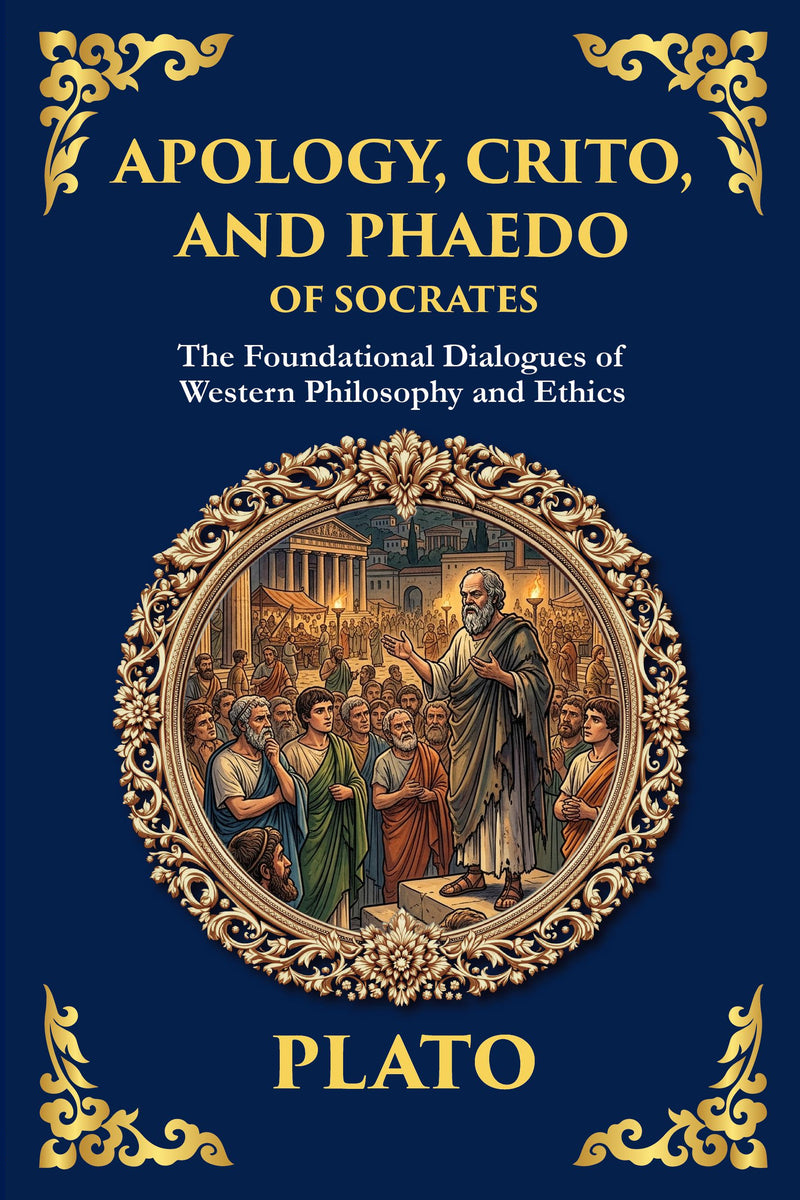
Apology, Crito, and Phaedo of Socrates — Large Print
Socrates Apology, Crito, and Phaedo represent three of the most powerful and enduring philosophical texts ever written. In these dialogues, Plato captures the voice and legacy of his teacher Socrates as he defends his life, accepts his sentence, and calmly awaits his death.
or free app
10,000+ hrs library
30-day guarantee
The complete Apology, Crito, and Phaedo of Socrates appears in modern English through Library of Alexandria Press, available online with audiobook narration included for members.
Have you ever wondered why Socrates chose to die rather than betray his beliefs? Plato’s Apology, Crito, and Phaedo of Socrates form the cornerstone of Western philosophy. These dialogues chronicle the final days of Socrates, offering profound insight into ethics, truth, mortality, and the examined life.
In Apology, we hear Socrates’ stirring defense before the Athenian court, where he refuses to renounce his philosophical mission. In Crito, Socrates discusses justice and the social contract with a close friend who urges him to escape prison. In Phaedo, we witness his final hours and hear his meditations on the soul’s immortality and the philosopher’s duty to truth.
This edition provides a faithful modern rendering of Plato’s original Greek texts, retaining their philosophical power while making them engaging and approachable for today’s readers.
What you’ll discover in this modern edition
- The Philosophical Trial of Socrates (Apology) – A fearless defense of reason, conscience, and the pursuit of wisdom over comfort
- A Dialogue on Duty and Integrity (Crito) – Explore the ethical dilemmas of civil disobedience, justice, and social responsibility
- A Vision of the Afterlife and the Soul (Phaedo) – Delve into Socratic arguments for the soul’s immortality and the philosopher’s acceptance of death
- The Birth of Western Ethical Thought – These texts shaped centuries of discourse on morality, knowledge, and personal virtue
| Formats | eBook (EPUB + PDF) · Audiobook · Paperback · Hardcover · Large Print |
| Language | English |
| Trim size (print) | 6 × 9 in |
| Binding | Paperback — perfect-bound · Hardcover — casewrap |
| Large Print edition | Same text in a larger, easy-read type — a larger font, not a larger trim |
| Print pricing | Every physical book at our true cost — at-cost, no profit (members) |
| Library | 873 restored titles, always growing |
| Length | 46,997 words · ~3 hr 8 min reading |
| Reading level | Grade 3 · an easy, flowing read (this modern-English edition) |
| Edition | Modern English translation · 2026 |
Member reviews for this edition are collected as readers finish it — be the first. Across the library: 12,000+ books shipped, every plan covered by a 365-day print guarantee.
About this edition
A faithful, unabridged modern-English edition by The Library of Alexandria — carefully rendered for today's reader and verified paragraph-by-paragraph against the public-domain source. Available as eBook, audiobook, paperback, hardcover, and large print.
- Complete & unabridgedVerified paragraph by paragraph against the source — never a scan, never abridged.
- Modern English, faithfulReadable today, with the author’s meaning kept intact. Readable — not simplified.
- Every format, one membershipRead in your browser or the free app, or listen to the full audiobook.
Included free with your membership
Cancel anytime, one click · 30-day money-back guarantee
Edition last updated July 2026
What’s inside
Apology, Crito, and Phaedo of Socrates — Large Print — complete and unabridged: all 6 sections included with membership, plus the full audiobook.
Begin reading Apology, Crito, and Phaedo of Socrates — Large Print
In clear modern English — the complete text is included with membership.
Introduction
There are moments in human history when a single life, lived to its uttermost conclusion, comes to define what it means to be human at all. The death of Socrates in 399 BCE was such a moment. An old man, seventy years of age, stood before a jury of his fellow citizens in Athens and was condemned to die for the crimes of impiety and corrupting the youth. He had the opportunity to flee. He had the means to bargain, to weep, to grovel, to escape into exile. He chose none of these. Instead, he drank the cup of poison hemlock with the calm of a man rising from an ordinary meal, and in doing so he gave the Western world its most enduring image of philosophical courage. The three works gathered in this volume — the Apology, the Crito, and the Phaedo — are the literary monuments built around that final act. They are, taken together, perhaps the most important dramatic record of a single human death ever committed to writing, and they have shaped the moral imagination of more than two thousand years.
What you hold in your hands is not a dusty relic to be admired from a respectful distance. These dialogues are alive. They throb with argument, defiance, tenderness, fear, and exaltation. They were written by Plato, the most gifted prose stylist of the ancient world, who had been Socrates’ devoted student and who never fully recovered from the loss of his teacher. In these pages, Plato set out to do something extraordinary: to preserve not merely the words of Socrates but the very texture of his being — the maddening questions, the disarming humility, the unshakeable serenity in the face of annihilation. To read them is to sit in the courtroom, to crouch by the prison cot in the gray hours before dawn, and finally to stand among grieving friends as the sun sets on the life of the most famous philosopher who ever lived.
This modern translation has been prepared with a single, urgent purpose: to make these ancient conversations feel as immediate and gripping to you as they were to the Athenians who first encountered them. The aim has been to strip away the layers of stiff, archaic English that have, for too long, made Plato seem forbidding. Socrates was a man of the marketplace, who buttonholed shoemakers and generals alike, who spoke plainly even when his thoughts soared to dizzying heights. The language here seeks to honor that plainness — to let his voice ring out clearly across the centuries — while losing none of the philosophical depth that makes these works inexhaustible. You do not need a degree in classics to follow what is happening on these pages. You need only the willingness to think, and the courage to let your own assumptions be questioned.
The Man on Trial and the World That Tried Him
To understand the drama that unfolds in these dialogues, it helps to know something of the man and the city that produced this collision. Socrates was born around 470 BCE, the son of a stonemason and a midwife. He fought bravely as a soldier in the long and ruinous Peloponnesian War between Athens and Sparta, distinguishing himself for his physical endurance and his cool nerve under fire. He was famously unattractive — snub-nosed, pot-bellied, with bulging eyes — and famously poor, wandering the city barefoot, indifferent to wealth and comfort. Yet around this odd figure gathered some of the brightest young men of Athens, drawn by the strange power of his conversation.
For Socrates did not teach in the ordinary sense. He claimed to know nothing, and he meant it. He did not lecture or deliver wisdom from on high. Instead, he asked questions — relentless, probing, deceptively simple questions. What is justice? What is courage? What is piety? When his interlocutors offered confident definitions, he gently dismantled them, exposing the contradictions hidden in their certainty. This was the famous “Socratic method,” and it had a peculiar effect: it left people feeling that they knew far less than they had imagined. Some found this liberating. Others found it humiliating and infuriating. The young men who followed Socrates began to imitate him, turning his questions upon their elders, and the result was a generation of Athenians who felt their authority, their reputations, and their comfortable assumptions being undermined.
This was no small matter in the Athens of Socrates’ later years. The city had been the most brilliant in the Greek world — the birthplace of democracy, of tragedy and comedy, of architecture and sculpture that still take the breath away. But by the time Socrates came to trial, Athens was a wounded and frightened place. It had lost the long war with Sparta. It had endured a brutal oligarchic coup, the rule of the so-called Thirty Tyrants, who had executed and exiled their enemies before democracy was restored. The city was suspicious, exhausted, eager to root out anyone who might be blamed for its misfortunes. Several of Socrates’ former associates had been connected with the tyranny and with treason, and though Socrates himself had defied the Thirty at personal risk, the taint of association clung to him.
So when three citizens — Meletus, Anytus, and Lycon — brought charges against him, the accusations had a long history behind them. Officially, he was charged with refusing to recognize the gods of the state, with introducing new divinities, and with corrupting the youth of Athens. Beneath these formal charges lay decades of resentment, the accumulated irritation of a city that had been questioned one time too many. Socrates was, in a sense, on trial for being himself.
The first work in this volume, the Apology, is the speech he gave in his own defense. The title is a translation of the Greek apologia, which does not mean an expression of regret — Socrates apologizes for nothing — but rather a defense, a justification, a reasoned account of one’s actions. And what a defense it is. Rather than flattering the jury or pleading for mercy, Socrates uses the occasion to put Athens itself on trial. He explains how his whole peculiar mission began: how the oracle at Delphi declared that no one was wiser than Socrates, and how he, certain that he was not wise at all, set out to disprove the god by finding someone wiser. In the process, he discovered that the people who claimed to know things — politicians, poets, craftsmen — actually knew far less than they pretended. His only wisdom, he concluded, was that he alone was aware of his own ignorance.
This is a speech of breathtaking nerve. Socrates compares himself to a gadfly sent by the gods to sting a sluggish, noble horse — the city of Athens — into wakefulness. He tells the jurors that he will never stop philosophizing, even if they release him, because to abandon his questioning would be to disobey the divine command that governs his life. He refuses to weep or to parade his children before the court. He treats the threat of death with a calm that some found majestic and others found insufferable. As you read, watch how the very qualities that make Socrates magnificent are the same qualities that doomed him. His refusal to compromise, his insistence on speaking the truth as he saw it, his open contempt for the theatrics of the courtroom — these were not the behaviors of a man trying to save his life. They were the behaviors of a man trying to save his soul. The verdict, when it comes, and the chilling moment when Socrates is asked to propose his own penalty, will linger in your mind long after you have closed the book.
The second dialogue, the Crito, takes place after the trial, in the quiet of Socrates’ prison cell. By a curious accident of religious observance — the city was sending its sacred ship on an annual voyage, and no executions could take place until it returned — there was a delay of some weeks between the sentence and its execution. During this interval, Socrates’ friends had ample time to arrange his escape. Bribes could be paid, guards could be bought, a comfortable exile could be secured in a friendly city. Everything was ready.
The Crito opens in the darkness before dawn, with Socrates’ old and wealthy friend Crito arriving at the cell with a desperate plan. He has come to persuade Socrates to flee. His arguments are passionate and entirely human. He pleads that Socrates owes it to his friends not to abandon them; that his death would be a stain on their honor, since people will say they were too cheap or too cowardly to save him; that Socrates has a duty to his young sons, who will be left fatherless; and that to stay and die would be to collaborate in an unjust verdict, to do the work of his enemies for them. These are not foolish arguments. They are the arguments any of us might make to a friend we loved and were about to lose. They appeal to loyalty, to family, to the simple, overpowering human desire to live.
And here the dialogue becomes one of the most profound meditations on civic duty ever written. Socrates, instead of seizing the chance to live, turns the conversation into a careful examination of a single question: is it ever right to do wrong, even in response to a wrong done to you? He argues that one must never repay injustice with injustice, and never harm another even when harmed oneself — a principle that would have seemed strange and even shocking to many of his contemporaries, who lived by a code of helping friends and hurting enemies. Then comes the dialogue’s most famous passage, in which Socrates imagines the Laws of Athens themselves coming to life and speaking to him. The Laws ask him: if you escape, do you not destroy us? Have you not lived your whole life under our protection, accepting our benefits — your education, your marriage, the very order that made your philosophy possible? Did you not have the freedom to leave Athens at any time, and by staying, did you not agree to abide by our judgments, even when they go against you?
The question at the heart of the Crito is one that has never lost its urgency. What do we owe to the society that raised us? When the law treats us unjustly, are we entitled to break it? Is there a difference between protesting an unjust verdict and simply evading its consequences for our own benefit? These are questions that echo down to our own day, in every debate about civil disobedience, conscience, and the rule of law. Socrates’ answer — and the reasoning by which he reaches it — has been admired, challenged, and argued over for centuries. As you read, you may find yourself siding with Crito, urging the old man to take the chance and live. Or you may come to feel, as Socrates does, that there are things worse than death, and that a life purchased by the betrayal of one’s own deepest principles would not be worth living. The dialogue does not let you off easily. It demands that you decide what kind of person you would be.
The Last Day and the Question of the Soul
The third and longest work, the Phaedo, brings us to the final day of Socrates’ life. It is narrated by Phaedo, one of the disciples who was present in the prison cell, recounting the scene some time later to a friend who had not been there. This framing gives the dialogue a particular emotional power: we are hearing the memories of a man who watched his teacher die, and who has not stopped thinking about it since. The atmosphere is heavy with grief, yet shot through with an almost unbearable serenity, for Socrates is the calmest person in the room.
The friends gather early, and they find Socrates in good spirits, his chains just removed. He spends his last hours not in lamentation but in conversation — the activity he loved above all others. And the subject he chooses is the most fitting one imaginable for a man about to die: the immortality of the soul. Why, his friends ask, is he not afraid? Why does he seem to welcome death? Socrates replies that the true philosopher has spent his whole life preparing for this very moment. To philosophize, he suggests, is to practice dying — to free the soul, as much as possible, from the distractions and appetites of the body, so that it may pursue truth in its purest form. If the soul is immortal, then death is not the extinction of the self but its liberation.
Cancel anytime, one click · 30-day money-back guarantee
Founding annual rate available now — your price locks for life when you join.
Not ready? Get this free chapter by email — read it anytime.
✓ Sent — check your inbox for Apology, Crito, and Phaedo of Socrates — Large Print.
Questions about Apology, Crito, and Phaedo of Socrates — Large Print
What is Apology, Crito, and Phaedo of Socrates about?
Socrates Apology, Crito, and Phaedo represent three of the most powerful and enduring philosophical texts ever written. In these dialogues, Plato captures the voice and legacy of his teacher Socrates as he defends his life, accepts his sentence, and calmly awaits his death. With reasoned clarity, unwavering principle, and a soul unshaken by fear, Socrates inspires us to confront truth, justice, and the meaning of existence.
Who wrote Apology, Crito, and Phaedo of Socrates?
Apology, Crito, and Phaedo of Socrates was written by Plato. This edition presents the complete work in clear modern English, faithfully rendered from the public-domain original by Library of Alexandria Press.
Is Apology, Crito, and Phaedo of Socrates free to read?
The opening chapter is free to read on this page. Members read and listen to the complete work — and the entire library — free, and can order any physical book at our true print cost.
How long is Apology, Crito, and Phaedo of Socrates?
6 chapters (~46,997 words) — about 3 hr 8 min of reading in this modern-English edition.
Is this an abridged version of Apology, Crito, and Phaedo of Socrates?
No. This is the complete, unabridged Apology, Crito, and Phaedo of Socrates, carefully rendered into clear modern English and verified paragraph-by-paragraph against the public-domain source — nothing is cut or summarised.
What formats does Apology, Crito, and Phaedo of Socrates come in?
Apology, Crito, and Phaedo of Socrates is available as eBook, paperback, hardcover and large print. eBook and audiobook are included with membership; printed editions ship at our true print cost.
Shipping & returns
Billing & membership
More from the library


Explore Philosophy & Ideas
- Kant's Prolegomena to Any Future Metaphysics · Immanuel Kant
- The Advancement of Learning · Francis Bacon
- The Dawn of Day · Friedrich Wilhelm Nietzsche
- Meditations · Marcus Aurelius
- The Confessions of St. Augustine · Saint Augustine
- Dialogues Concerning Natural Religion · David Hume
- Considerations on Representative Government · John Stuart Mill
- The Will to Power: An Attempted Transvaluation of All Values. Book III and IV · Friedrich Nietzsche
- Groundwork of the Metaphysics of Morals · Immanuel Kant
- The Confessions of Jean-Jacques Rousseau — Complete · Jean-Jacques Rousseau
- Democracy in America — Volume 2 · Alexis de Tocqueville
- Ecce Homo · Friedrich Wilhelm Nietzsche
- Second Treatise of Government · John Locke
- The Prince · Niccolò Machiavelli
- Thus Spake Zarathustra: A Book for All and None · Friedrich Wilhelm Nietzsche
- The Island of Doctor Moreau · H. G. Wells
- Sophist · Plato
- The Seven Lamps of Architecture · John Ruskin
- Essays — First Series · Ralph Waldo Emerson
- The Book of the Damned · Charles Fort
- The Everlasting Man · G. K. Chesterton
- The Initiates of the Flame · Manly P. Hall
- The Book of Tea · Kakuzo Okakura
- The Japanese Spirit · Yoshisaburo Okakura
- The Analysis of Mind · Bertrand Russell
- Orthodoxy · G. K. Chesterton
- Apology, Crito, and Phaedo of Socrates · Plato
- Euthyphro · Plato
- Timaeus · Plato
- Ion · Plato
Apology, Crito, and Phaedo of Socrates — Large Print
Apology, Crito, and Phaedo of Socrates — Large Print
The Essential Dialogues of Western Philosophy and Ethics
Plato
Contents
- Introduction
- Chapter 1
- Chapter 2
- Chapter 3
- Chapter 4
- Chapter 5
Introduction
There are moments in human history when a single life, lived to its uttermost conclusion, comes to define what it means to be human at all. The death of Socrates in 399 BCE was such a moment. An old man, seventy years of age, stood before a jury of his fellow citizens in Athens and was condemned to die for the crimes of impiety and corrupting the youth. He had the opportunity to flee. He had the means to bargain, to weep, to grovel, to escape into exile. He chose none of these. Instead, he drank the cup of poison hemlock with the calm of a man rising from an ordinary meal, and in doing so he gave the Western world its most enduring image of philosophical courage. The three works gathered in this volume — the Apology, the Crito, and the Phaedo — are the literary monuments built around that final act. They are, taken together, perhaps the most important dramatic record of a single human death ever committed to writing, and they have shaped the moral imagination of more than two thousand years.
What you hold in your hands is not a dusty relic to be admired from a respectful distance. These dialogues are alive. They throb with argument, defiance, tenderness, fear, and exaltation. They were written by Plato, the most gifted prose stylist of the ancient world, who had been Socrates’ devoted student and who never fully recovered from the loss of his teacher. In these pages, Plato set out to do something extraordinary: to preserve not merely the words of Socrates but the very texture of his being — the maddening questions, the disarming humility, the unshakeable serenity in the face of annihilation. To read them is to sit in the courtroom, to crouch by the prison cot in the gray hours before dawn, and finally to stand among grieving friends as the sun sets on the life of the most famous philosopher who ever lived.
This modern translation has been prepared with a single, urgent purpose: to make these ancient conversations feel as immediate and gripping to you as they were to the Athenians who first encountered them. The aim has been to strip away the layers of stiff, archaic English that have, for too long, made Plato seem forbidding. Socrates was a man of the marketplace, who buttonholed shoemakers and generals alike, who spoke plainly even when his thoughts soared to dizzying heights. The language here seeks to honor that plainness — to let his voice ring out clearly across the centuries — while losing none of the philosophical depth that makes these works inexhaustible. You do not need a degree in classics to follow what is happening on these pages. You need only the willingness to think, and the courage to let your own assumptions be questioned.
The Man on Trial and the World That Tried Him
To understand the drama that unfolds in these dialogues, it helps to know something of the man and the city that produced this collision. Socrates was born around 470 BCE, the son of a stonemason and a midwife. He fought bravely as a soldier in the long and ruinous Peloponnesian War between Athens and Sparta, distinguishing himself for his physical endurance and his cool nerve under fire. He was famously unattractive — snub-nosed, pot-bellied, with bulging eyes — and famously poor, wandering the city barefoot, indifferent to wealth and comfort. Yet around this odd figure gathered some of the brightest young men of Athens, drawn by the strange power of his conversation.
For Socrates did not teach in the ordinary sense. He claimed to know nothing, and he meant it. He did not lecture or deliver wisdom from on high. Instead, he asked questions — relentless, probing, deceptively simple questions. What is justice? What is courage? What is piety? When his interlocutors offered confident definitions, he gently dismantled them, exposing the contradictions hidden in their certainty. This was the famous “Socratic method,” and it had a peculiar effect: it left people feeling that they knew far less than they had imagined. Some found this liberating. Others found it humiliating and infuriating. The young men who followed Socrates began to imitate him, turning his questions upon their elders, and the result was a generation of Athenians who felt their authority, their reputations, and their comfortable assumptions being undermined.
This was no small matter in the Athens of Socrates’ later years. The city had been the most brilliant in the Greek world — the birthplace of democracy, of tragedy and comedy, of architecture and sculpture that still take the breath away. But by the time Socrates came to trial, Athens was a wounded and frightened place. It had lost the long war with Sparta. It had endured a brutal oligarchic coup, the rule of the so-called Thirty Tyrants, who had executed and exiled their enemies before democracy was restored. The city was suspicious, exhausted, eager to root out anyone who might be blamed for its misfortunes. Several of Socrates’ former associates had been connected with the tyranny and with treason, and though Socrates himself had defied the Thirty at personal risk, the taint of association clung to him.
So when three citizens — Meletus, Anytus, and Lycon — brought charges against him, the accusations had a long history behind them. Officially, he was charged with refusing to recognize the gods of the state, with introducing new divinities, and with corrupting the youth of Athens. Beneath these formal charges lay decades of resentment, the accumulated irritation of a city that had been questioned one time too many. Socrates was, in a sense, on trial for being himself.
The first work in this volume, the Apology, is the speech he gave in his own defense. The title is a translation of the Greek apologia, which does not mean an expression of regret — Socrates apologizes for nothing — but rather a defense, a justification, a reasoned account of one’s actions. And what a defense it is. Rather than flattering the jury or pleading for mercy, Socrates uses the occasion to put Athens itself on trial. He explains how his whole peculiar mission began: how the oracle at Delphi declared that no one was wiser than Socrates, and how he, certain that he was not wise at all, set out to disprove the god by finding someone wiser. In the process, he discovered that the people who claimed to know things — politicians, poets, craftsmen — actually knew far less than they pretended. His only wisdom, he concluded, was that he alone was aware of his own ignorance.
This is a speech of breathtaking nerve. Socrates compares himself to a gadfly sent by the gods to sting a sluggish, noble horse — the city of Athens — into wakefulness. He tells the jurors that he will never stop philosophizing, even if they release him, because to abandon his questioning would be to disobey the divine command that governs his life. He refuses to weep or to parade his children before the court. He treats the threat of death with a calm that some found majestic and others found insufferable. As you read, watch how the very qualities that make Socrates magnificent are the same qualities that doomed him. His refusal to compromise, his insistence on speaking the truth as he saw it, his open contempt for the theatrics of the courtroom — these were not the behaviors of a man trying to save his life. They were the behaviors of a man trying to save his soul. The verdict, when it comes, and the chilling moment when Socrates is asked to propose his own penalty, will linger in your mind long after you have closed the book.
The second dialogue, the Crito, takes place after the trial, in the quiet of Socrates’ prison cell. By a curious accident of religious observance — the city was sending its sacred ship on an annual voyage, and no executions could take place until it returned — there was a delay of some weeks between the sentence and its execution. During this interval, Socrates’ friends had ample time to arrange his escape. Bribes could be paid, guards could be bought, a comfortable exile could be secured in a friendly city. Everything was ready.
The Crito opens in the darkness before dawn, with Socrates’ old and wealthy friend Crito arriving at the cell with a desperate plan. He has come to persuade Socrates to flee. His arguments are passionate and entirely human. He pleads that Socrates owes it to his friends not to abandon them; that his death would be a stain on their honor, since people will say they were too cheap or too cowardly to save him; that Socrates has a duty to his young sons, who will be left fatherless; and that to stay and die would be to collaborate in an unjust verdict, to do the work of his enemies for them. These are not foolish arguments. They are the arguments any of us might make to a friend we loved and were about to lose. They appeal to loyalty, to family, to the simple, overpowering human desire to live.
And here the dialogue becomes one of the most profound meditations on civic duty ever written. Socrates, instead of seizing the chance to live, turns the conversation into a careful examination of a single question: is it ever right to do wrong, even in response to a wrong done to you? He argues that one must never repay injustice with injustice, and never harm another even when harmed oneself — a principle that would have seemed strange and even shocking to many of his contemporaries, who lived by a code of helping friends and hurting enemies. Then comes the dialogue’s most famous passage, in which Socrates imagines the Laws of Athens themselves coming to life and speaking to him. The Laws ask him: if you escape, do you not destroy us? Have you not lived your whole life under our protection, accepting our benefits — your education, your marriage, the very order that made your philosophy possible? Did you not have the freedom to leave Athens at any time, and by staying, did you not agree to abide by our judgments, even when they go against you?
The question at the heart of the Crito is one that has never lost its urgency. What do we owe to the society that raised us? When the law treats us unjustly, are we entitled to break it? Is there a difference between protesting an unjust verdict and simply evading its consequences for our own benefit? These are questions that echo down to our own day, in every debate about civil disobedience, conscience, and the rule of law. Socrates’ answer — and the reasoning by which he reaches it — has been admired, challenged, and argued over for centuries. As you read, you may find yourself siding with Crito, urging the old man to take the chance and live. Or you may come to feel, as Socrates does, that there are things worse than death, and that a life purchased by the betrayal of one’s own deepest principles would not be worth living. The dialogue does not let you off easily. It demands that you decide what kind of person you would be.
The Last Day and the Question of the Soul
The third and longest work, the Phaedo, brings us to the final day of Socrates’ life. It is narrated by Phaedo, one of the disciples who was present in the prison cell, recounting the scene some time later to a friend who had not been there. This framing gives the dialogue a particular emotional power: we are hearing the memories of a man who watched his teacher die, and who has not stopped thinking about it since. The atmosphere is heavy with grief, yet shot through with an almost unbearable serenity, for Socrates is the calmest person in the room.
The friends gather early, and they find Socrates in good spirits, his chains just removed. He spends his last hours not in lamentation but in conversation — the activity he loved above all others. And the subject he chooses is the most fitting one imaginable for a man about to die: the immortality of the soul. Why, his friends ask, is he not afraid? Why does he seem to welcome death? Socrates replies that the true philosopher has spent his whole life preparing for this very moment. To philosophize, he suggests, is to practice dying — to free the soul, as much as possible, from the distractions and appetites of the body, so that it may pursue truth in its purest form. If the soul is immortal, then death is not the extinction of the self but its liberation.
People of Athens, I don’t know how much my accusers have influenced you. As for me, listening to them almost made me forget who I was because their arguments sounded so convincing. However, they haven’t told the truth about anything. Out of all the lies they told, one particularly surprised me: the claim that you should be careful not to let me trick you with my clever speaking. It seems incredibly bold of them to risk being proven wrong immediately, because I will show you that I am not a polished speaker at all—unless, of course, they consider someone who tells the truth to be “eloquent.” If that is what they mean, then I admit I am a public speaker, but not in the way they are. As I said, they told no truths, but from me, you will hear the whole truth. Now, Athenians, you won’t hear a highly crafted speech filled with fancy words and polished phrases like theirs. Instead, you will hear me speak spontaneously, using whatever words come to mind. I am confident that what I have to say is fair, and I ask you to expect nothing else; after all, at my age, it would be inappropriate for me to stand before you like a young man with a rehearsed speech. Therefore, I beg you, Athenians, if you hear me defending myself using the same language I use in the marketplace—where many of you have heard me—or anywhere else, please do not be surprised or bothered by it. The fact is, even though I am over seventy years old, this is my first time appearing in a court of law, so I am completely unfamiliar with the legal language used here. Just as you would forgive a real foreigner for speaking in the style and language they were taught, I ask you now, as a matter of fairness, to ignore the way I speak. It might be slightly worse or perhaps better than the norm, but I ask you to focus only on one thing: whether what I am saying is true. For that is the true quality of a judge, and the only goal of a speaker should be to tell the truth.
End of the free sample
Keep reading, free
Members read and listen to the complete book — and the entire library. Cancel anytime, one click · 30-day money-back guarantee.