
 10 h 42 minAudiobook13 minSummaryRead it, hear it, the 15-minute summary, and print and large print at cost
 Audiobook edition · 10 h 42 minPaperback · 6 × 9 in · printing soonHardcover · 6 × 9 in · printing soon
About this book
What if anarchism is not one doctrine, but a question that leads seven thinkers in different directions?
In Anarchism, Paul Eltzbacher looks past the bombs and chaos associated with the word to ask what anarchist writers actually say. A German jurist rather than a partisan, he examines their views on the state, law and property. His aim is clear: to discover whether these ideas belong to one shared doctrine.
William Godwin, Pierre-Joseph Proudhon, Max Stirner, Mikhail Bakunin, Peter Kropotkin, Benjamin Tucker and Leo Tolstoy come under the same careful lens. Reason, justice, the individual, community and religious conviction enter the comparison. As their differences emerge, you can weigh each position without being asked to defend a single school.
What you’ll discover
- Texts before myths Follow a careful inquiry that starts with what thinkers write, rather than what their label suggests.
- Reason and justice Explore Godwin and Proudhon through the ideas that ground their approaches to anarchy.
- The individual comes first Meet Stirner and Tucker as Eltzbacher examines the place of the individual in their thought.
- Revolution and community Consider Bakunin and Kropotkin through their approaches to collective life, freedom and radical change.
- Tolstoy's religious path See how Tolstoy's reading of the Sermon on the Mount shapes his rejection of the state.
Who will love it
This book suits readers who like to see an argument built step by step, anyone curious about the thinkers behind anarchism, and those who enjoy clear definitions and comparisons.
What’s inside
The key ideas, in the 15-minute summary
- Compare thinkers instead of chasing slogans
- Clear definitions make comparison possible
- Godwin puts reason before fixed law
- Proudhon builds order through voluntary agreements
- Stirner makes personal welfare the measure
- Bakunin sees freedom advancing through history
- Kropotkin finds cooperation already taking shape
- Different beliefs lead toward shared refusal
- Shared questions reveal differences and agreement
Formats and delivery
- eBook
- On your phone, tablet or computer, once the book texts are online.
- Large-print eBook
- The same book in bigger, clearer type, once the book texts are online.
- Audiobook
- Read by Lucas Linden, complete. It opens once the recording is online.
- 15-minute summary
- The key ideas in about 13 minutes, to read today.
- Paperback
- 6 × 9 in. Printing soon: leave your email under Paperback or Hardcover above.
- Hardcover
- 6 × 9 in. Printing soon: leave your email under Paperback or Hardcover above.
- Large print paperback
- 8.5 × 11 in. Printing soon: leave your email under Paperback or Hardcover above.
- Large print hardcover
- 8.5 × 11 in. Printing soon: leave your email under Paperback or Hardcover above.
Every printed copy is made when you order it and shipped worldwide; shipping is shown at checkout. The eBook and the audiobook open when the book texts go online.
How it works
- Start free. Nothing to pay today; the eBook of this book is yours to keep.
- Read, listen and print. 200,000+ classics as eBook, large-print eBook, audiobook and 15-minute summary, and any book printed at cost as a paperback, hardcover or large print, 5 accounts for the price of one.
- We remind you first. Free for 3 months, and we email you 7 days before your first payment. Then USD 0.14 a day in your first year on the yearly plan and USD 0.27 a day after, or USD 0.66 a day on the monthly plan. Cancel online in two clicks.
Bought on its own? Every eBook, audiobook and printed book you buy without the plan carries our 30-day money-back guarantee.
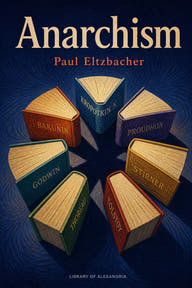
Anarchism
 by Paul Eltzbacher · 1900
Seven thinkers, one word: a German lawyer sorts Godwin, Proudhon, Stirner, Bakunin, Kropotkin, Tucker and Tolstoi.
Medium level5–10 hours to readEnglish
Learn a language with medium classicsSpanishFrenchGermanItalianJapanesePortugueseEnglishHow we measure levels
Excellent
Free for 3 months · starts right away, on any device
Read free3 months free · cancel anytimeFree for 3 months, then USD 0.14 a dayCancel anytimeHow it works


- Read or listen
- Print and large print at cost
- 5 accounts for the price of one
In short
Everyone has an opinion about anarchism, and almost no two people mean the same thing by it. Some think it means chaos.
Anarchism at a glance
- Reading time
- About 5 h 50 min4 h 35 min fast, 6 h 55 min slow
- Length
- 83,100 words
- Library level
- Medium longer sentences, everyday words
- First published
- 1900by Paul Eltzbacher
Reading time at 238 words a minute (fast 300, slow 200). How long the classics take to read · Updated
From the 15-minute summary · Key idea 1
Define your terms and choose your witnesses
Eltzbacher opens with a problem. Ask ten people what anarchism teaches and you get ten answers. Some say it rejects law, others say society, others only the State.
To study anarchist teachings, you must first know which teachings count. That seems to need the very definition you are looking for. He solves it by asking whom the study is for: readers whose loose notions must be replaced with exact concepts. Then he takes the group of teachings that the greatest number of scholars recognize. When a scholar names a teaching as anarchist, that counts for more than any general definition. The result is seven names that nearly every account offers.
Free for 3 months · Cancel anytime
You looked at
Which edition is right for me
- 15-minute summary
- The key ideas of the whole book in about 13 minutes. A good first look, or a refresher.
Details
- First published
- 1900
- Language
- English
- Level
- Medium level
Cite this edition
Eltzbacher, Paul. Anarchism. Library of Alexandria, 2026, libraryofalexandria.com/products/anarchism.
Eltzbacher, P. (2026). Anarchism. Library of Alexandria. https://libraryofalexandria.com/products/anarchism (Original work published 1900)
Eltzbacher, Paul. Anarchism. Library of Alexandria, 2026. https://libraryofalexandria.com/products/anarchism.
@book{eltzbacher2026anarchism,
  author = {Eltzbacher, Paul},
  title = {Anarchism},
  publisher = {Library of Alexandria},
  year = {2026},
  url = {https://libraryofalexandria.com/products/anarchism},
  note = {First published 1900}
}
Free gifts
USD 580 in free gifts when you start
Every book in every format and in 25 languages, 5 accounts for the price of one. Nothing to pay today.
- 200,000+ classic eBooksIn 25 languages, side by side
USD 170FREE - Every audiobookIn 25 languages, any device
USD 120FREE - 15-minute summariesRead or listen, in 25 languages
USD 60FREE - Print at cost, no markupPaperback, hardcover, large print
USD 60FREE - 5 accounts for the price of oneA shelf for everyone at home
USD 170FREE - A part in rebuilding the libraryNew languages and books for all
FREE
Questions about Anarchism
Can I read it free?
Yes. The first key idea of the 15-minute summary is free with no sign-up. Start free and the whole book is yours for 3 months, with the eBook to keep, plus 200,000+ more classics and any book printed at cost as a paperback, hardcover or large print. Nothing to pay today: we email you 7 days before your first payment, and you can cancel online in two clicks.
Can I buy the printed book?
Soon. The paperback, hardcover and large print editions are being prepared. Choose Paperback or Hardcover above, leave your email, and we tell you the day you can order it, printed at cost.
How many accounts do I get?
Five, for the price of one: you and 4 more people, each with their own login, shelf and their own place in every book.
Can I cancel anytime?
Yes. Cancel online in two clicks at any time and nothing more is charged. Nothing is charged in your first 3 months, and we email you 7 days before your first payment.
What is Anarchism by Paul Eltzbacher about?
It is a comparative study of seven thinkers, Godwin, Proudhon, Stirner, Bakunin, Kropotkin, Tucker and Tolstoy. Eltzbacher asks each the same questions about law, the State and property, then defines anarchism from what they share.
Who are the seven thinkers in Eltzbacher's Anarchism?
They are William Godwin, Pierre-Joseph Proudhon, Max Stirner, Mikhail Bakunin, Peter Kropotkin, Benjamin Tucker and Leo Tolstoy. Eltzbacher chose them because most scholars of his day counted their teachings as anarchist.
How does Eltzbacher define anarchism?
Within legal philosophy, he defines anarchism as a rejection of the State. That is the one thing all seven teachings share, though they differ on law, property, basis and the means of change.

The author
Paul Eltzbacher
1868–1928 · German jurist
Paul Eltzbacher (1868–1928) was a German lawyer and legal scholar. He was born in Cologne and died in Berlin. He wrote Anarchism, first published in German in 1900 under the title Der Anarchismus. An English translation appeared in 1908. He also wrote about law.
More like this
Our mission
The library burned once. We are building it back.
Every great book, in every language and every format, for every family. Every plan helps pay for new languages, new audiobooks and books for readers who have never had them. Join the movement.
Read our story- Every language25 languages today, side by side, and more every year
- No wastePrinted on demand: no warehouses, no unsold stock, no pulped copies
- For everyonePaperback, hardcover and large print at the cost of printing





