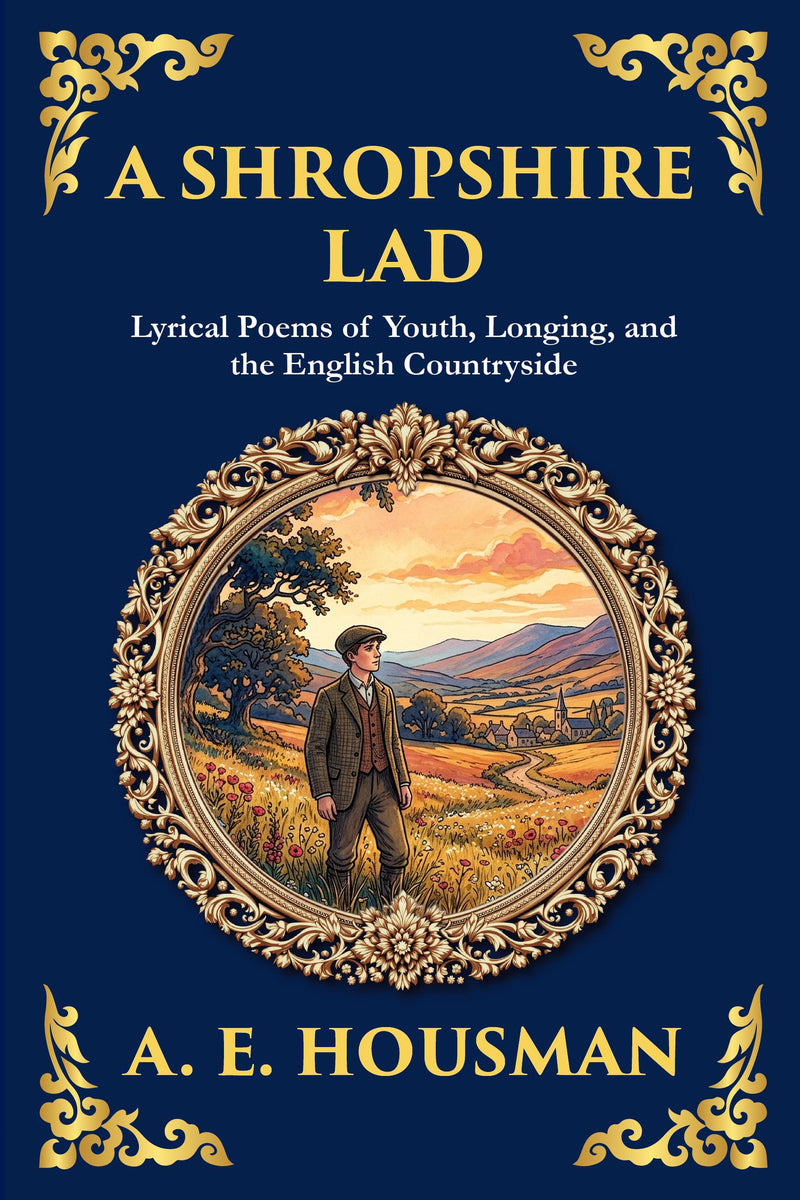
A Shropshire Lad — Large Print
First published in 1896, A Shropshire Lad is a timeless collection of poems that captures the fragile beauty of youth, the ache of unfulfilled longing, and the quiet melancholy of the English countryside.
or free app
10,000+ hrs library
30-day guarantee
The complete A Shropshire Lad appears in modern English through Library of Alexandria Press, available online with audiobook narration included for members.
Have you ever wondered why the simplest poems can leave the deepest mark on the soul? In A Shropshire Lad, A. E. Housman invites readers into a world where beauty is tinged with sorrow, and the quiet rhythms of rural life conceal profound emotional depths. These poems, written in the late 19th century, speak of love and loss, fleeting youth, patriotic sacrifice, and the enduring ache of remembrance.
Despite—or perhaps because of—their gentle simplicity, these verses have moved generations of readers with their sincerity and grace. Housman’s themes of heartbreak, mortality, and the inevitability of change are universal, yet rendered with such musical elegance that they linger long after the last stanza. This modern edition preserves the integrity of the original text while offering a renewed appreciation for its delicate emotional cadence.
What you’ll discover in this modern edition
- Timeless Reflections on Youth and Loss – Poems that capture the joy and heartbreak of adolescence and young manhood
| Formats | eBook (EPUB + PDF) · Audiobook · Paperback · Hardcover · Large Print |
| Language | English |
| Trim size (print) | 6 × 9 in |
| Binding | Paperback — perfect-bound · Hardcover — casewrap |
| Large Print edition | Same text in a larger, easy-read type — a larger font, not a larger trim |
| Print pricing | Every physical book at our true cost — at-cost, no profit (members) |
| Library | 873 restored titles, always growing |
| Length | 13,009 words · ~52 min reading |
| Reading level | Grade 3 · an easy, flowing read (this modern-English edition) |
| Edition | Modern English translation · 2026 |
Member reviews for this edition are collected as readers finish it — be the first. Across the library: 12,000+ books shipped, every plan covered by a 365-day print guarantee.
About this edition
A faithful, unabridged modern-English edition by The Library of Alexandria — carefully rendered for today's reader and verified paragraph-by-paragraph against the public-domain source. Available as eBook, audiobook, paperback, hardcover, and large print.
- Complete & unabridgedVerified paragraph by paragraph against the source — never a scan, never abridged.
- Modern English, faithfulReadable today, with the author’s meaning kept intact. Readable — not simplified.
- Every format, one membershipRead in your browser or the free app, or listen to the full audiobook.
Included free with your membership
Cancel anytime, one click · 30-day money-back guarantee
Edition last updated July 2026
What’s inside
A Shropshire Lad — Large Print — complete and unabridged, included in full with membership, plus the full audiobook.
Begin reading A Shropshire Lad — Large Print
In clear modern English — the complete text is included with membership.
Introduction
There are certain books that arrive quietly into the world and then refuse to leave it. They do not announce themselves with fanfare or controversy; they slip into the consciousness of a culture and take up residence there, returning at unexpected moments — in songs, in soldiers’ letters, in the memories of those who read them once and never quite forgot. The slim collection of poems you are about to read is one of these rare works. First published in 1896 at the author’s own expense, after being turned away by at least one publisher, it has gone on to become one of the most beloved and most quoted books of verse in the English language. Generations of readers have carried it in their pockets, memorized its stanzas, set its lines to music, and turned to it in moments of joy, grief, longing, and farewell.
This edition presents these poems in a form adapted for the contemporary reader — a modern rendering designed to ease the path for those encountering this remarkable body of work for the first time, while preserving the spirit, the music, and the emotional truth that have made it endure. Before you begin, it is worth pausing to understand a little about the world from which these poems emerged, the singular man who wrote them, and the qualities that have allowed them to speak so powerfully across more than a century of readers.
To understand these poems, it helps first to understand something of the temperament behind them. Their author, Alfred Edward Housman, was by profession not a poet at all but a classical scholar — and one of the most formidable of his generation. He spent his working life poring over the manuscripts of ancient Latin authors, correcting the errors of centuries of copyists, and producing editions of such forbidding rigor that few specialists could follow him into the thickets of his learning. He was famously austere, exacting, and reserved, a man who guarded his privacy with an almost monastic discipline and who could wither careless scholarship with a single cutting sentence. He did not seem, on the surface, the sort of person who would pour his heart into lyric verse about doomed young men, country fairs, blossoming cherry trees, and the ache of love and loss.
And yet that is precisely what makes his poetry so extraordinary. Beneath the cold marble of the scholar lay a wellspring of feeling so deep and so carefully concealed that it could only find expression in art. The story of how these poems came to be written is itself revealing. Housman composed most of them in a remarkably short and intense period, during a time of personal turmoil and emotional strain. He later described the process in almost involuntary terms — lines and stanzas would come to him unbidden, often while he was out walking, sometimes welling up with a force that seemed to bypass his conscious will entirely. He spoke of poetry as something physical, almost like a secretion or a fever, a phenomenon of the body as much as the mind. For a man so committed to precision and control, this surrender to feeling was a kind of confession in itself.
The result is a body of work shaped by a tension that runs through every line: the discipline of the classicist meeting the rawness of human longing. Housman knew the ancient poets intimately — the Greek and Latin masters who had written, two thousand years before, about youth and death and the brevity of beauty. From them he inherited a sense of form, of compression, of the way a single perfectly chosen word can carry the weight of an entire emotion. He learned from them the art of saying much by saying little. But the feelings he poured into these inherited forms were entirely his own, and entirely modern: a melancholy that feels closer to our own anxious age than to the confident certainties of the era in which it was written.
It is worth remembering when these poems appeared. The late nineteenth century in England was an age of empire, industry, and outward optimism — a society that prided itself on progress and certainty. But beneath that confident surface ran currents of doubt and unease. The old religious faith that had once given life its shape was being eroded by science and skepticism. The countryside, with its ancient rhythms, was emptying as young people streamed into the cities and the factories. And looming on the horizon, though no one yet knew it, were the catastrophes of the new century. These poems, with their preoccupation with mortality, their tender attention to vanishing rural life, and their unflinching gaze at the shortness of human happiness, caught something in the air that many felt but few could name. That is part of why they struck such a deep chord — and why they would only grow more beloved as the years went on.
There is a haunting irony in the book’s afterlife. Though it was written in the 1890s, its true moment came two decades later, during the First World War. The poems’ obsession with young men marching away, with soldiers and graves, with the doomed beauty of youth cut short, made them speak with almost unbearable directness to a generation being sent to die in the trenches of France and Belgium. Soldiers carried this small book into battle. Its lines were read aloud in hospitals and recited over graves. What had been written as a personal meditation on mortality became, almost by accident, the elegy for an entire generation. No poet could have foreseen such a thing, and Housman himself seems to have regarded the phenomenon with a mixture of bafflement and quiet sorrow. But it tells us something important about the work: these poems possess a strange prophetic quality, an ability to find the universal grief hidden inside the particular moment.
One of the first things a new reader notices is the setting. The poems return again and again to a particular landscape — a region of rolling hills, blossoming orchards, market towns, church bells, and the slow turning of the agricultural seasons. This is a countryside of fairs and football matches, of taverns and harvest, of young men working the land and dreaming of the wider world. It is rendered with such loving precision and such concrete detail that readers have often assumed the poet must have spent his whole life there, walking its lanes and knowing its people intimately.
The truth is more curious and more instructive. Housman was not, in fact, a native of the region these poems so lovingly evoke. He grew up nearby but at a remove, and he visited the area he made famous only rarely. The landscape of these poems is, in large part, a creation of the imagination — a kind of dreamed England, a country of the heart rather than a country of the map. He even admitted to small geographical errors, having drawn on memory and longing rather than direct survey. And this, far from being a flaw, is one of the great secrets of the book’s power.
For the place these poems describe is not really a place at all, or not only a place. It is the landscape of memory itself — the half-remembered, half-invented territory of youth that every reader carries inside them. The blue remembered hills of the distance, the fields one ran through as a child, the friends one has lost, the home one can never return to: these are not specific to any one county or country. They belong to all of us. By rooting his vision in a particular, vividly imagined landscape, Housman paradoxically made it universal. We do not need to have ever set foot in the English countryside to recognize the emotion these poems describe — the bittersweet pang of looking back at a place and a time that can never be reclaimed, of knowing that we cannot go again.
This is the great theme that binds the collection together: the irreversibility of time and the loss it brings. The young man at the center of these poems — and there is a kind of central figure, a youthful speaker whose voice we come to know — stands at the threshold between childhood and the adult world, between the country and the city, between innocence and experience. He watches the seasons turn and knows that each turning carries him further from the spring of his life. He sees the cherry trees bloom and counts how few springs he has left to see them. He thinks of friends who have died young, of love that has been lost or never found, of the soldier marching off and the lad who will not come home. Everywhere he looks, he sees the shadow of mortality falling across the brightness of youth.
It would be easy to mistake all this for mere gloom, but that would be a serious misreading. The remarkable achievement of these poems is the way they hold sorrow and beauty in perfect balance. Yes, they are preoccupied with death — but precisely because they value life so intensely. The awareness of how short our time is does not lead the poet to despair but to a heightened, almost unbearable appreciation of the world’s beauty. The cherry blossom is more precious because it will fall. The friendship is more dear because it cannot last. The morning is more golden because it will not come again. In one of the most famous poems in the collection, the speaker reflects on the death of an athlete who died young, and finds in that early death not only tragedy but a strange kind of mercy — a beauty preserved, a glory that will never have to fade and be forgotten. This is the characteristic Housman move: to look directly at the worst, and to find within it something luminous, something that makes life more rather than less worth living.
The poems achieve this effect partly through their extraordinary economy. Housman was a master of compression. His stanzas are short, his lines often simple and direct, his vocabulary drawn largely from the plain, ancient Anglo-Saxon roots of English rather than the elaborate Latinate diction his scholarship might have suggested. He admired the old ballads and folk songs of England, with their bare, haunting simplicity, and he learned from them how to suggest enormous feeling through the plainest means. A great deal of the emotional force of his poetry comes not from what is said but from what is left unsaid — the silence around the words, the implication beneath the surface. Reading him is sometimes like hearing a tune played on a single instrument in an empty room: the very sparseness amplifies the feeling.
This is why the music of these poems matters so much, and why so many composers have been drawn to set them to song. There is a singing quality to Housman’s verse, a lilting, ballad-like rhythm that lodges in the memory and refuses to leave. The lines have the cadence of folk song, of hymns, of the old tunes that people sang at fairs and firesides. Read them aloud, even quietly to yourself, and you will feel this immediately. The sound is part of the meaning. A reader who races through these poems silently, treating them as information to be absorbed, will miss half of what they offer. They are meant to be tasted, lingered over, spoken — savored the way one savors a piece of music or a glass of something rare. Take your time with them. Read them slowly. Read them more than once. Their depths reveal themselves gradually, and a poem that seems simple on first reading will often disclose new layers on the second or the tenth.
A word should be said about the deeper, more personal currents that run beneath the surface of this work. Housman was an intensely private man who carried within him a great unspoken grief — a profound and unfulfilled love that shaped his entire emotional life and that he concealed from the world with rigid discipline. He never wrote openly about it; the customs and laws of his time would have made such openness dangerous as well as foreign to his reserved nature. But the wound is everywhere in these poems, transmuted into art. The recurring themes of impossible love, of farewell, of the loneliness of the outsider, of the young man set apart from his fellows by some secret sorrow — all of these draw their extraordinary intensity from a private suffering that the poet could express only obliquely, through the mask of his country lads and soldiers. You do not need to know the biographical details to feel the power of the emotion; indeed, part of the genius of the work is the way it transforms a specific, private grief into something every human heart can recognize. But knowing that the feeling is real — that behind these polished lyrics stands a man who knew loss and longing in his own flesh — adds a further dimension of poignancy to the reading.
Cancel anytime, one click · 30-day money-back guarantee
Founding annual rate available now — your price locks for life when you join.
Not ready? Get this free chapter by email — read it anytime.
✓ Sent — check your inbox for A Shropshire Lad — Large Print.
Questions about A Shropshire Lad — Large Print
What is A Shropshire Lad about?
First published in 1896, A Shropshire Lad is a timeless collection of poems that captures the fragile beauty of youth, the ache of unfulfilled longing, and the quiet melancholy of the English countryside. A. E. Housman’s lyrical verses are steeped in nostalgia, mortality, and the passing of time—offering readers a poignant reflection on the joys and sorrows of life. This treasured edition brings Housman’s beloved work to a new generation, presenting a voice that is as tender as it is haunting.
Who wrote A Shropshire Lad?
A Shropshire Lad was written by A. E. Housman. This edition presents the complete work in clear modern English, faithfully rendered from the public-domain original by Library of Alexandria Press.
Is A Shropshire Lad free to read?
The opening chapter is free to read on this page. Members read and listen to the complete work — and the entire library — free, and can order any physical book at our true print cost.
How long is A Shropshire Lad?
2 chapters (~13,009 words) — about 52 min of reading in this modern-English edition.
Is this an abridged version of A Shropshire Lad?
No. This is the complete, unabridged A Shropshire Lad, carefully rendered into clear modern English and verified paragraph-by-paragraph against the public-domain source — nothing is cut or summarised.
What formats does A Shropshire Lad come in?
A Shropshire Lad is available as eBook, paperback, hardcover and large print. eBook and audiobook are included with membership; printed editions ship at our true print cost.
Shipping & returns
Billing & membership
More from the library


Explore Poetry & Drama
- As You Like It · William Shakespeare
- The Raven · Edgar Allan Poe
- The Merchant of Venice · William Shakespeare
- A Midsummer Night’s Dream · William Shakespeare
- Romeo and Juliet · William Shakespeare
- The Imaginary Invalid · Molière
- A Woman of No Importance · Oscar Wilde
- Gitanjali · Rabindranath Tagore
- Sonnets from the Portuguese · Elizabeth Barrett Browning
- The New Life (La Vita Nuova) · Dante Alighieri
- The Rime of the Ancient Mariner · Samuel Taylor Coleridge
- Lady Windermere’s Fan · Oscar Wilde
- The Home Book of Verse — Volume 4 · Burton Egbert Stevenson
- Ghosts · Henrik Ibsen
- Mrs. Warren’s Profession · Bernard Shaw
- An Enemy of the People · Henrik Ibsen
- Gawayne and the Green Knight: A Fairy Tale · Charlton M. Lewis
- The Nibelungenlied · G. H. Needler
- Julius Caesar · William Shakespeare
- The Aeneid of Virgil · Virgil
- Troilus and Criseyde · Geoffrey Chaucer
- The Post Office · Rabindranath Tagore
- Lamia · John Keats
- The Ballad of the White Horse · G. K. Chesterton
- A Shropshire Lad · A. E. Housman
- The Birth of the War-God: A Poem by Kalidasa · Kálidása
- Riders to the Sea · J. M. Synge
- The Prophet · Kahlil Gibran
- Twelfth Night; Or, What You Will · William Shakespeare
- Othello, the Moor of Venice · William Shakespeare
A Shropshire Lad — Large Print
A Shropshire Lad — Large Print
Lyrical Poems of Youth, Longing, and the English Countryside
A. E. Housman
Contents
- Introduction
- A Shropshire Lad
Introduction
There are certain books that arrive quietly into the world and then refuse to leave it. They do not announce themselves with fanfare or controversy; they slip into the consciousness of a culture and take up residence there, returning at unexpected moments — in songs, in soldiers’ letters, in the memories of those who read them once and never quite forgot. The slim collection of poems you are about to read is one of these rare works. First published in 1896 at the author’s own expense, after being turned away by at least one publisher, it has gone on to become one of the most beloved and most quoted books of verse in the English language. Generations of readers have carried it in their pockets, memorized its stanzas, set its lines to music, and turned to it in moments of joy, grief, longing, and farewell.
This edition presents these poems in a form adapted for the contemporary reader — a modern rendering designed to ease the path for those encountering this remarkable body of work for the first time, while preserving the spirit, the music, and the emotional truth that have made it endure. Before you begin, it is worth pausing to understand a little about the world from which these poems emerged, the singular man who wrote them, and the qualities that have allowed them to speak so powerfully across more than a century of readers.
To understand these poems, it helps first to understand something of the temperament behind them. Their author, Alfred Edward Housman, was by profession not a poet at all but a classical scholar — and one of the most formidable of his generation. He spent his working life poring over the manuscripts of ancient Latin authors, correcting the errors of centuries of copyists, and producing editions of such forbidding rigor that few specialists could follow him into the thickets of his learning. He was famously austere, exacting, and reserved, a man who guarded his privacy with an almost monastic discipline and who could wither careless scholarship with a single cutting sentence. He did not seem, on the surface, the sort of person who would pour his heart into lyric verse about doomed young men, country fairs, blossoming cherry trees, and the ache of love and loss.
And yet that is precisely what makes his poetry so extraordinary. Beneath the cold marble of the scholar lay a wellspring of feeling so deep and so carefully concealed that it could only find expression in art. The story of how these poems came to be written is itself revealing. Housman composed most of them in a remarkably short and intense period, during a time of personal turmoil and emotional strain. He later described the process in almost involuntary terms — lines and stanzas would come to him unbidden, often while he was out walking, sometimes welling up with a force that seemed to bypass his conscious will entirely. He spoke of poetry as something physical, almost like a secretion or a fever, a phenomenon of the body as much as the mind. For a man so committed to precision and control, this surrender to feeling was a kind of confession in itself.
The result is a body of work shaped by a tension that runs through every line: the discipline of the classicist meeting the rawness of human longing. Housman knew the ancient poets intimately — the Greek and Latin masters who had written, two thousand years before, about youth and death and the brevity of beauty. From them he inherited a sense of form, of compression, of the way a single perfectly chosen word can carry the weight of an entire emotion. He learned from them the art of saying much by saying little. But the feelings he poured into these inherited forms were entirely his own, and entirely modern: a melancholy that feels closer to our own anxious age than to the confident certainties of the era in which it was written.
It is worth remembering when these poems appeared. The late nineteenth century in England was an age of empire, industry, and outward optimism — a society that prided itself on progress and certainty. But beneath that confident surface ran currents of doubt and unease. The old religious faith that had once given life its shape was being eroded by science and skepticism. The countryside, with its ancient rhythms, was emptying as young people streamed into the cities and the factories. And looming on the horizon, though no one yet knew it, were the catastrophes of the new century. These poems, with their preoccupation with mortality, their tender attention to vanishing rural life, and their unflinching gaze at the shortness of human happiness, caught something in the air that many felt but few could name. That is part of why they struck such a deep chord — and why they would only grow more beloved as the years went on.
There is a haunting irony in the book’s afterlife. Though it was written in the 1890s, its true moment came two decades later, during the First World War. The poems’ obsession with young men marching away, with soldiers and graves, with the doomed beauty of youth cut short, made them speak with almost unbearable directness to a generation being sent to die in the trenches of France and Belgium. Soldiers carried this small book into battle. Its lines were read aloud in hospitals and recited over graves. What had been written as a personal meditation on mortality became, almost by accident, the elegy for an entire generation. No poet could have foreseen such a thing, and Housman himself seems to have regarded the phenomenon with a mixture of bafflement and quiet sorrow. But it tells us something important about the work: these poems possess a strange prophetic quality, an ability to find the universal grief hidden inside the particular moment.
One of the first things a new reader notices is the setting. The poems return again and again to a particular landscape — a region of rolling hills, blossoming orchards, market towns, church bells, and the slow turning of the agricultural seasons. This is a countryside of fairs and football matches, of taverns and harvest, of young men working the land and dreaming of the wider world. It is rendered with such loving precision and such concrete detail that readers have often assumed the poet must have spent his whole life there, walking its lanes and knowing its people intimately.
The truth is more curious and more instructive. Housman was not, in fact, a native of the region these poems so lovingly evoke. He grew up nearby but at a remove, and he visited the area he made famous only rarely. The landscape of these poems is, in large part, a creation of the imagination — a kind of dreamed England, a country of the heart rather than a country of the map. He even admitted to small geographical errors, having drawn on memory and longing rather than direct survey. And this, far from being a flaw, is one of the great secrets of the book’s power.
For the place these poems describe is not really a place at all, or not only a place. It is the landscape of memory itself — the half-remembered, half-invented territory of youth that every reader carries inside them. The blue remembered hills of the distance, the fields one ran through as a child, the friends one has lost, the home one can never return to: these are not specific to any one county or country. They belong to all of us. By rooting his vision in a particular, vividly imagined landscape, Housman paradoxically made it universal. We do not need to have ever set foot in the English countryside to recognize the emotion these poems describe — the bittersweet pang of looking back at a place and a time that can never be reclaimed, of knowing that we cannot go again.
This is the great theme that binds the collection together: the irreversibility of time and the loss it brings. The young man at the center of these poems — and there is a kind of central figure, a youthful speaker whose voice we come to know — stands at the threshold between childhood and the adult world, between the country and the city, between innocence and experience. He watches the seasons turn and knows that each turning carries him further from the spring of his life. He sees the cherry trees bloom and counts how few springs he has left to see them. He thinks of friends who have died young, of love that has been lost or never found, of the soldier marching off and the lad who will not come home. Everywhere he looks, he sees the shadow of mortality falling across the brightness of youth.
It would be easy to mistake all this for mere gloom, but that would be a serious misreading. The remarkable achievement of these poems is the way they hold sorrow and beauty in perfect balance. Yes, they are preoccupied with death — but precisely because they value life so intensely. The awareness of how short our time is does not lead the poet to despair but to a heightened, almost unbearable appreciation of the world’s beauty. The cherry blossom is more precious because it will fall. The friendship is more dear because it cannot last. The morning is more golden because it will not come again. In one of the most famous poems in the collection, the speaker reflects on the death of an athlete who died young, and finds in that early death not only tragedy but a strange kind of mercy — a beauty preserved, a glory that will never have to fade and be forgotten. This is the characteristic Housman move: to look directly at the worst, and to find within it something luminous, something that makes life more rather than less worth living.
The poems achieve this effect partly through their extraordinary economy. Housman was a master of compression. His stanzas are short, his lines often simple and direct, his vocabulary drawn largely from the plain, ancient Anglo-Saxon roots of English rather than the elaborate Latinate diction his scholarship might have suggested. He admired the old ballads and folk songs of England, with their bare, haunting simplicity, and he learned from them how to suggest enormous feeling through the plainest means. A great deal of the emotional force of his poetry comes not from what is said but from what is left unsaid — the silence around the words, the implication beneath the surface. Reading him is sometimes like hearing a tune played on a single instrument in an empty room: the very sparseness amplifies the feeling.
This is why the music of these poems matters so much, and why so many composers have been drawn to set them to song. There is a singing quality to Housman’s verse, a lilting, ballad-like rhythm that lodges in the memory and refuses to leave. The lines have the cadence of folk song, of hymns, of the old tunes that people sang at fairs and firesides. Read them aloud, even quietly to yourself, and you will feel this immediately. The sound is part of the meaning. A reader who races through these poems silently, treating them as information to be absorbed, will miss half of what they offer. They are meant to be tasted, lingered over, spoken — savored the way one savors a piece of music or a glass of something rare. Take your time with them. Read them slowly. Read them more than once. Their depths reveal themselves gradually, and a poem that seems simple on first reading will often disclose new layers on the second or the tenth.
A word should be said about the deeper, more personal currents that run beneath the surface of this work. Housman was an intensely private man who carried within him a great unspoken grief — a profound and unfulfilled love that shaped his entire emotional life and that he concealed from the world with rigid discipline. He never wrote openly about it; the customs and laws of his time would have made such openness dangerous as well as foreign to his reserved nature. But the wound is everywhere in these poems, transmuted into art. The recurring themes of impossible love, of farewell, of the loneliness of the outsider, of the young man set apart from his fellows by some secret sorrow — all of these draw their extraordinary intensity from a private suffering that the poet could express only obliquely, through the mask of his country lads and soldiers. You do not need to know the biographical details to feel the power of the emotion; indeed, part of the genius of the work is the way it transforms a specific, private grief into something every human heart can recognize. But knowing that the feeling is real — that behind these polished lyrics stands a man who knew loss and longing in his own flesh — adds a further dimension of poignancy to the reading.
I 1887 From Clee hill to heaven the beacon burns, The counties have seen it clearly, From north and south the signal returns And beacons burn again. Look left, look right, the hills are bright, The valleys are lit in between, Because tonight marks fifty years Since God saved the Queen. Now, while the flames they didn’t see tower Over the soil they walked on, Lads, we’ll remember our friends Who shared the work of God. To the skies that touched their hearts, To the fields that made them brave, The saviors do not come home tonight: They could not save themselves. It is dawn in Asia, where tombstones show Shropshire names; And the Nile floods its banks Beside the dead of the Severn. We pledge in peace, in farms and towns, To the Queen they served in war, And we light the beacons across The land they died for. “God Save the Queen” we living sing, It is heard from peak to peak; And your voices ring with the rest, Lads of the Fifty-third. Oh, God will save her, do not fear: Keep being the men you’ve been, Be the sons your fathers were, And God will Save the Queen.
II The loveliest of trees, the cherry now Is covered in blossoms along the branch, And it stands by the woodland path Wearing white for the Easter season. Now, of my seventy years, Twenty will not come again; If you take twenty from seventy springs, It only leaves me fifty more. And since fifty springs are not enough time to look at things in bloom, I will walk through the woodlands To see the cherry covered in white.
III THE RECRUIT Leave your home, young man, And say goodbye to your friends. Go now, and may luck follow you As long as the Ludlow tower stands.
End of the free sample
Keep reading, free
Members read and listen to the complete book — and the entire library. Cancel anytime, one click · 30-day money-back guarantee.