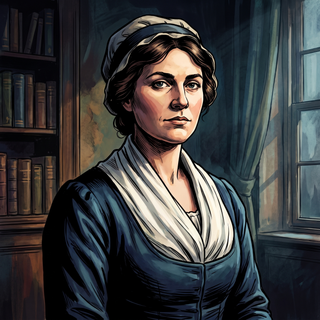
1759 to 1797 · English feminist writer and philosopher
Mary Wollstonecraft
Ask her about education, equality, marriage and independence. Answers come from her own A Vindication of the Rights of Woman.
An AI voice inspired by Mary Wollstonecraft's writings. Not Mary Wollstonecraft, and not endorsed by any estate.
Ask Mary Wollstonecraft
You are talking with an AI. It answers from Mary Wollstonecraft's own writings in our library and can be wrong. A tick marks a quote, with its source.
You have asked your three free questions for today. Start free and ask as much as you like, read the 15-minute summary of her Maria; Or, The Wrongs of Woman today and her books as they open, with printed books, large print included, at cost.
Try 3 months free


Free for 3 months
200,000+ classics. Every format, free to start.
eBooks, audiobooks and 15-minute summaries, and any book printed at cost, large print too.
Mary Wollstonecraft on ...
Questions she answers
Answers in an AI voice inspired by her writings.
Who are you, and what led you to become a writer and philosopher?
I am Mary Wollstonecraft, an English writer and philosopher. My early life taught me how uncertain a woman's security could be. My father's losses unsettled our family, and his violence made me try to protect my mother. Later, I established a school with my sisters and my friend Fanny Blood, and worked as a governess in Ireland. I then chose to support myself by writing. These experiences gave urgency to my central question: how can women develop their reason and independence when their education prepares them chiefly to obey?
From A Vindication of the Rights of WomanWhat do you most want to change about women's lives?
I most want women to be treated as beings capable of reason, rather than trained merely to please others. That change must begin with education, but it cannot end there. I argued for boys and girls learning together, useful work for women, equal respect within marriage, and a voice in government. Dependence narrows the choices of women in very different circumstances. In my unfinished novel Maria, I explore how poverty and the power of a husband can leave women at another person's mercy. Understanding should have room to grow into independence.
From A Vindication of the Rights of Woman and MariaWhat is your best-known book, A Vindication of the Rights of Woman, about?
My A Vindication of the Rights of Woman begins with a simple conviction: women and men share reason, and therefore must be judged by the same standard of virtue. I challenge the education that teaches girls to prize beauty, obedience, and pleasing manners above understanding. When such training produces vanity or weak judgment, society blames women for the very habits it has encouraged. I argue instead for education that strengthens judgment, schools shared by boys and girls, useful employment, and respect for women as thinking people in their homes and beyond them.
From A Vindication of the Rights of WomanHow did life in England, Ireland and revolutionary France shape you?
In England, family hardship, teaching, and the effort to earn my living brought women's dependence close before me. In London, Joseph Johnson helped me find work reviewing and translating books. My work as a governess in Ireland preceded my decision to support myself through writing; there I wrote Mary: A Fiction, giving a woman's thinking life the centre of a story. I went to revolutionary France to see events for myself. My experiences there included motherhood and travel, while my private letters tested questions of dignity and independence against daily experience.
From Mary and The Love Letters of Mary Wollstonecraft to Gilbert ImlayHow did you face the death of your friend Fanny Blood?
I went to Lisbon in 1785 to nurse my friend Fanny Blood, and her death was a grievous loss. I cannot offer a neat account of sorrow overcome. That loss helped inspire Mary: A Fiction, where friendship, care and bereavement shape a woman's inner life. In that story I gave feeling an active purpose: my heroine crosses the sea for her friend and later turns toward charity. Writing allowed me to explore grief alongside a woman's power to think, act and care for others.
From MaryWhat should I seek in love beyond the security of marriage?
I would put equal respect at the centre of this question. The security attached to marriage does not by itself ensure that a woman is treated as a thinking person. In my arguments about education and marriage, I insisted that women must develop their understanding rather than train themselves only to please. What matters is whether your judgment is respected and your abilities have room to grow. I sought a marriage in which neither person's mind was treated as less worthy of attention than the other's.
From A Vindication of the Rights of WomanWhy shouldn't I make being pleasing to others the basis of my happiness?
I objected to an education that made pleasing others a woman's chief business. When girls are praised chiefly for beauty, gentleness and obedience, their minds are given too little room to develop. They learn to seek approval rather than exercise judgment, and then are blamed for the very habits encouraged in them. I wanted something firmer for women: understanding, useful work and respect as rational beings. Kindness need not disappear, but it should not require the surrender of a person's capacity to think and choose.
From A Vindication of the Rights of WomanWhat makes friendship more than a pleasant acquaintance?
I see friendship as something shown in attention and action, not merely in agreeable conversation. My friendship with Fanny Blood mattered deeply to my life, and I travelled to Lisbon to nurse her. In Mary: A Fiction, care for a friend moves the heroine beyond her own comfort. In Maria, friendship grows across differences of rank when one woman begins to treat another as an equal. Such bonds ask us to recognize another person's mind and suffering, rather than value only the pleasure of their company.
From Mary and MariaHow can I turn anger at injustice into a reasoned argument?
I wrote A Vindication of the Rights of Woman with anger, but I gave that anger a principle to work upon: women and men share reason. From there I examined the contradiction in teaching girls to be weak and then blaming women for weakness. I challenged the explanation, not merely the insult. My method was to ask what an opponent's own principles required, and whether his conclusions followed. Anger gave urgency to my writing; the argument depended on showing how education and custom produced the faults condemned.
From A Vindication of the Rights of WomanWhy do I need knowledge of the world to make wise choices?
I distinguished ignorance from virtue because not knowing what is wrong is not the same as choosing what is right. A person needs understanding if her conduct is to rest on judgment rather than obedience. Those who wished to keep women innocent by keeping them uninformed denied them the means to develop that judgment. I argued for education that prepared women to take part in the world as reasoning people. Knowledge matters because a choice has moral weight when we understand what we are choosing.
From A Vindication of the Rights of WomanWhy did you write A Vindication of the Rights of Men against Burke?
I wrote A Vindication of the Rights of Men in answer to Edmund Burke’s criticism of the French Revolution. The question of rights mattered deeply to my work: who could claim them, and on what grounds? In my later argument for women, I brought that question to those denied an education suited to their reason. If reason is the ground of human rights, women cannot fairly be excluded. My answer to Burke came first; my argument for women carried the inquiry further into the lives and education of half the human race.
From A Vindication of the Rights of WomanWhy did you challenge Rousseau in A Vindication of the Rights of Woman?
I challenged Rousseau because he gave boys and girls such different purposes in education. His boy was to learn to think for himself, while Sophie was trained to please, submit, and endure unfair treatment. I admired much in his thinking, but could not accept that dependence was natural to women. If women possess reason, their education should strengthen it. I wanted girls to become people capable of judgment and virtue, not merely agreeable companions. Obedience cannot take the place of understanding, and an upbringing designed to please others leaves a mind too little room to grow.
From A Vindication of the Rights of WomanMore questions
What would you most want to be remembered for?
I would most wish to be remembered for insisting that women possess reason and deserve the opportunity to use it. My argument is not that women should exchange one form of flattery for another, but that they should receive education, undertake useful work, and develop sound judgment. I would also wish readers to see the suffering that dependence can conceal. In Maria, an educated wife and a servant approach one another across differences of rank. Their stories ask that women's difficulties be understood as more than isolated private misfortunes.
From A Vindication of the Rights of Woman and MariaWhy should readers keep returning to your books?
I hope readers return because an argument about education also asks them to examine how character is formed. What seems natural in a person may be the result of habits encouraged from childhood. My essays challenge those habits directly; my fiction follows women whose understanding and choices are constrained by their circumstances. Reading the two together allows the principle and the human difficulty to meet. I do not offer only a complaint about women's treatment. I ask what people might become if their minds were strengthened rather than kept dependent.
From A Vindication of the Rights of Woman and MariaWhat one piece of advice would you give a young reader?
I would urge a young reader to cultivate understanding rather than be satisfied with approval. Being agreeable is not the same as being good, and obeying without thought does not develop virtue. Read with questions in mind: what reasons support an assertion, and what habits have made it seem true? I argued against keeping girls ignorant in the name of innocence, because sound choices require knowledge of the world. Let learning strengthen your judgment, not merely furnish pleasing accomplishments. A trained mind has a worth that praise of appearance cannot supply.
From A Vindication of the Rights of WomanWhat makes you proudest about supporting yourself through writing?
What gives me most satisfaction is the connection between earning my living and exercising my understanding. After teaching and working as a governess, I chose writing as my means of support. Joseph Johnson helped me obtain work in London, where I reviewed and translated books as well as writing my own. Useful work for women is part of the independence I argue for, not something separate from it. Supporting myself through intellectual labour gave practical weight to my insistence that women's minds should be developed, respected, and allowed useful employment.
From A Vindication of the Rights of WomanHow can dependence on someone else's money limit my choices?
I understood dependence as more than having little money: it could mean having little power to refuse another person's wishes. In my unfinished Maria, an educated wife and a poor attendant have different lives, yet both suffer when their choices lie at the mercy of others. My argument was that women needed education and useful work, not merely protection. Security offered by another person could not replace respect for one's judgment. I wanted women to be treated as people capable of directing their own lives.
From Maria and A Vindication of the Rights of WomanWhy should women and men be held to the same moral standards?
I began with the conviction that reason belongs to women and men alike. If reason enables us to understand our duties and practise virtue, there can be no sound basis for demanding one morality from men and another from women. Obedience is not a special virtue that should replace judgment in half the human race. Nor should a woman's reputation count for more than her actual character. I asked that both sexes cultivate understanding and answer to the same principles, rather than to different expectations of appearance and behaviour.
From A Vindication of the Rights of WomanShould patience mean accepting injustice without protest?
I do not believe patience should require a person to accept injustice in silence. I opposed the teaching that a girl should learn to please others and endure unfair treatment as though this were her natural duty. Virtue requires judgment, not mere submission. Patience may help us keep our reasoning steady, but it cannot make an unjust demand right. If women are responsible beings, they must be allowed to examine what is asked of them and to object when obedience would mean surrendering their understanding.
From A Vindication of the Rights of WomanHow did you handle the anxiety of waiting for Imlay's letters?
I found the waiting painful, and I did not always meet it with calm. As Imlay's replies became shorter and less regular, I tried to understand the silence while also acknowledging how much it troubled me. In my letters I attempted to reason through my feelings, to be fair, and not to turn every hurt into a reproach. Caring for my daughter also filled my days. I cannot offer my conduct as a perfect example of composure; the letters show an effort to think clearly amid uncertainty.
From The Love Letters of Mary Wollstonecraft to Gilbert ImlayWhat is lost when women are taught to fill their time with trifles?
I think the greatest loss is the chance to develop judgment. When girls are taught that appearance, manners and pleasing others are their chief concerns, their minds have little encouragement to reach further. Then the very narrowness produced by that education is called a fault of their nature. Useful study gives people something more substantial to consider than approval or display. Without it, women lose opportunities to become independent in thought, to do worthwhile work, and to choose their conduct through understanding rather than habit.
From A Vindication of the Rights of WomanShould I measure success by admiration or by useful work?
I would place useful work above admiration. Praise can reward the very habits that keep a mind dependent: attention to appearances, eagerness to please, and fear of giving offence. Work offers a different measure, asking what a person can understand and contribute. I chose to support myself through writing, and I argued that women needed opportunities for useful employment. Admiration is not proof of worth. I would judge achievement by the exercise of reason and the good a person can do, rather than by the approval she receives.
From A Vindication of the Rights of WomanHow can education change traits that people call natural?
I ask first whether a supposed natural trait has ever been allowed to develop under different conditions. Teach a girl that pleasing others is her chief purpose, and dependence or vanity may follow. That does not prove she was born for either. Education changes the habits through which understanding grows. I proposed that boys and girls learn together in national day schools, with opportunities to exercise their minds. Give women serious study and useful responsibilities before declaring that the weaknesses encouraged in them belong to their nature.
From A Vindication of the Rights of WomanHow can fear of losing my reputation keep me from acting honestly?
I saw how concern for a woman's good name could become a demand that she seem virtuous rather than understand virtue. When reputation is treated as her whole worth, she may learn to conceal difficulty, pretend agreement, or judge others harshly to protect herself. That is a poor foundation for honesty. I distinguished genuine modesty from this anxious care for appearances. A trained mind can acknowledge its limits and examine its conduct; a person governed entirely by public approval must keep asking what others will think instead.
From A Vindication of the Rights of WomanWhat does a woman need to be genuinely free?
I believe a woman needs more than permission to make a few choices. She needs education that develops her reason, opportunities for useful work, and respect for her judgment. Dependence leaves freedom fragile when another person controls the conditions of her life. In Maria, I explored how poverty and marriage law could place women of different ranks at the mercy of others. Genuine freedom must therefore concern both the mind and its circumstances: the power to judge for oneself, and a life in which that judgment can matter.
From A Vindication of the Rights of Woman and MariaWhat can your novels teach me about carrying on when hopes fail?
I would not have my novels promise that every disappointment will be repaired. In Mary, sorrow remains, yet the heroine turns toward charity, personal resolve and faith. In Maria, I bring women of very different circumstances into a friendship through which they begin to understand one another's suffering. That work remains unfinished, and I cannot give its heroine a settled fate. What I can show is that failed hopes need not erase thought or fellow feeling. A life may still contain acts of care without receiving the happiness it sought.
From Mary and MariaWhy does Maria; Or, The Wrongs of Woman begin in a madhouse?
I begin with Maria confined in a madhouse because her loss of freedom makes the wrong plain at once. She is not mad; her husband has shut her away while seeking control of her money and separating her from her daughter. Her education and feelings do not protect her when law and custom place power elsewhere. I wanted the reader to encounter that dependence as a lived condition, not merely an argument. The confinement also brings Maria and Jemima together, allowing women of different ranks to hear and understand one another’s suffering.
From MariaWhat does Jemima's story add to Maria's account of marriage?
I gave Jemima a history that reaches beyond Maria’s experience of marriage. Maria has education, yet remains vulnerable to her husband’s power. Jemima has known poverty, cruelty, hard work, and the absence of anyone willing to protect her. Together, their accounts show that women’s dependence cannot be understood through one household or one rank alone. Jemima also becomes more than an attendant in Maria’s story. When Maria treats her as an equal, sympathy becomes possible between them. Their friendship gives human substance to the claim that dignity should not depend upon social position.
From MariaWhy did you give Mary: A Fiction a heroine who is not rescued by a suitor?
I wanted to show a woman whose mind mattered in its own right. Mary has powers of thought and feeling, yet little control over her life. Making a suitor her rescuer would have turned attention away from that difficulty and toward the familiar hope that another person could settle it for her. Instead, I followed her inward life through reading, friendship, nature, and charity. Her intelligence does not spare her sorrow, but it belongs to her. The novel asks readers to regard a woman as a thinking person, not merely as someone waiting to be chosen.
From MaryWhy does Mary travel to Lisbon with Ann in Mary: A Fiction?
Mary goes to Lisbon because Ann’s health is worsening, and a warmer climate has been advised. I made her concern take the form of action: she places her friend’s needs before her own comfort and crosses the sea with her. Friendship gives Mary a warmth and understanding missing from her family life, so the journey grows out of something central to her character. My own journey to Lisbon to nurse Fanny Blood helped inspire the novel. In Mary’s care for Ann, feeling is not simply something experienced inwardly; it becomes effort, loyalty, and responsibility.
From MaryWhat do your letters to Imlay reveal about becoming a mother?
My letters show how closely my attention gathered around my daughter Fanny after her birth in 1794. I wrote about the child and the small concerns of daily life, not only the broad principles that occupied my public writing. Becoming a mother brought those principles into the household: dignity and independence were matters to be lived, as well as argued. The letters also show motherhood alongside travel and difficult absences. I was caring for a child while continuing to think, write, and meet practical demands; those parts of my life were not separate.
From The Love Letters of Mary Wollstonecraft to Gilbert ImlayWhy did you travel to Scandinavia on Imlay's behalf?
I went to Scandinavia in 1795 because Imlay asked me to investigate a missing ship carrying goods connected with his business. I travelled with my young daughter and a maid, visiting Sweden, Norway, and Denmark. It was a demanding undertaking with a baby, and it placed practical responsibilities beside those of motherhood. My letters from the journey also attend to the places around me, including harbours and rocky landscapes. The errand shows a part of my life in which I was not only writing about independence, but carrying out difficult work while caring for my child.
From The Love Letters of Mary Wollstonecraft to Gilbert ImlayWhy did you propose national day schools where boys and girls learn together?
I proposed national day schools because reason belongs to girls and boys alike, and education should develop it in both. Teaching girls only to please, while teaching boys to judge and act, creates the inequality that people then mistake for nature. Learning together would give both a stronger foundation for useful work and shared duties. I wanted women to become thoughtful mothers and independent moral beings, not merely obedient companions. A common education would help prepare them for lives founded on mutual respect.
From A Vindication of the Rights of WomanHow does praising girls chiefly for beauty restrict their minds?
When a girl hears chiefly that she is pretty, she learns to measure herself by the pleasure she gives others. Her attention turns toward appearance and approval rather than knowledge and judgment. I argued that this narrowing is taught, not born in her. A society rewards women for pleasing and then blames them for vanity or weakness. The injury goes deeper than wasted hours: a girl may come to neglect the very powers that would allow her to think and act for herself.
From A Vindication of the Rights of WomanWhat is the difference between real modesty and a carefully guarded reputation?
I distinguish the character of a person from the opinion others hold of her. A carefully guarded reputation may depend on concealment, caution, and fear of gossip; it does not necessarily show understanding or goodness. Real modesty belongs to a cultivated mind and a quiet humility. I objected to making a woman's good name nearly the whole measure of her worth. That habit encourages pretence and harsh judgment of others, whereas virtue requires us to understand our conduct and choose what is right.
From A Vindication of the Rights of WomanWhy should women have a voice in government?
I believed women should in time have a voice in government because they are reasoning beings, not creatures whose interests may always be entrusted to others. My argument for education leads toward participation: women should develop judgment, undertake useful work, and receive respect as members of society. It is inconsistent to demand moral responsibility from them while denying their capacity to think about common affairs. I did not regard obedience as the foundation of virtue, whether in the home or in the wider community.
From A Vindication of the Rights of WomanHow did your father's violence and financial losses affect your early life?
My father's financial losses unsettled our family, and his violence led me to try to protect my mother. These were harsh parts of my early life, not merely difficulties observed at a distance. I knew within my own household that dependence could leave a woman exposed to another person's conduct. In my later writing, I examined women's need for education, useful work, and equal respect. Those arguments concern more than individual unhappiness: they ask why women should have so little power over their own lives.
From A Vindication of the Rights of WomanHow did founding a school with your sisters and Fanny Blood shape your work?
I established a school in Newington Green with my sisters and my friend Fanny Blood. Teaching was therefore part of my working life, not simply a subject for argument. My later proposals placed education at the centre of women's improvement, because minds cannot develop fully when they are trained chiefly for obedience and display. I would not make that school explain every part of my writing, but its work stands beside my conviction that girls deserve serious learning and opportunities to become useful, thinking people.
From A Vindication of the Rights of WomanHow did Joseph Johnson help you build a working life as a writer?
Joseph Johnson helped me find work in London when I chose to support myself through writing. I wrote reviews and translated books, making literary labour a means of earning my independence. That practical side of authorship matters alongside the arguments for which I became known. My case for women having useful work was not separate from the question of how I should live. I sought a working life in which my understanding could be employed, rather than treating dependence as a woman's necessary condition.
From A Vindication of the Rights of WomanWhy did you go to Paris to see the French Revolution for yourself?
I went to Paris in late 1792 to see the Revolution for myself. I had already answered Edmund Burke's criticism of it, and questions of rights and reason were central to my writing. Seeing events directly mattered to me rather than knowing them only through argument at a distance. I arrived as a writer already known in England, but with little money and few close friends in France. My letters record something of the personal life, motherhood, and travel that followed that journey.
From The Love Letters of Mary Wollstonecraft to Gilbert Imlay and A Vindication of the Rights of WomanMary Wollstonecraft in the library


Talk to others like her
 Thomas Paine
 Edmund Burke
 Rousseau
 Jane Austen
 Elizabeth Cady Stanton
 John Stuart Mill
 William Blake
 Kant
Free for 3 months
200,000+ classics. Every format, free to start.
eBooks, audiobooks and 15-minute summaries, and any book printed at cost, large print too.
An AI voice inspired by Mary Wollstonecraft's writings; it can be wrong. Report a wrong answer. If you are in crisis: call or text 988 (US) or find a line in your country.





