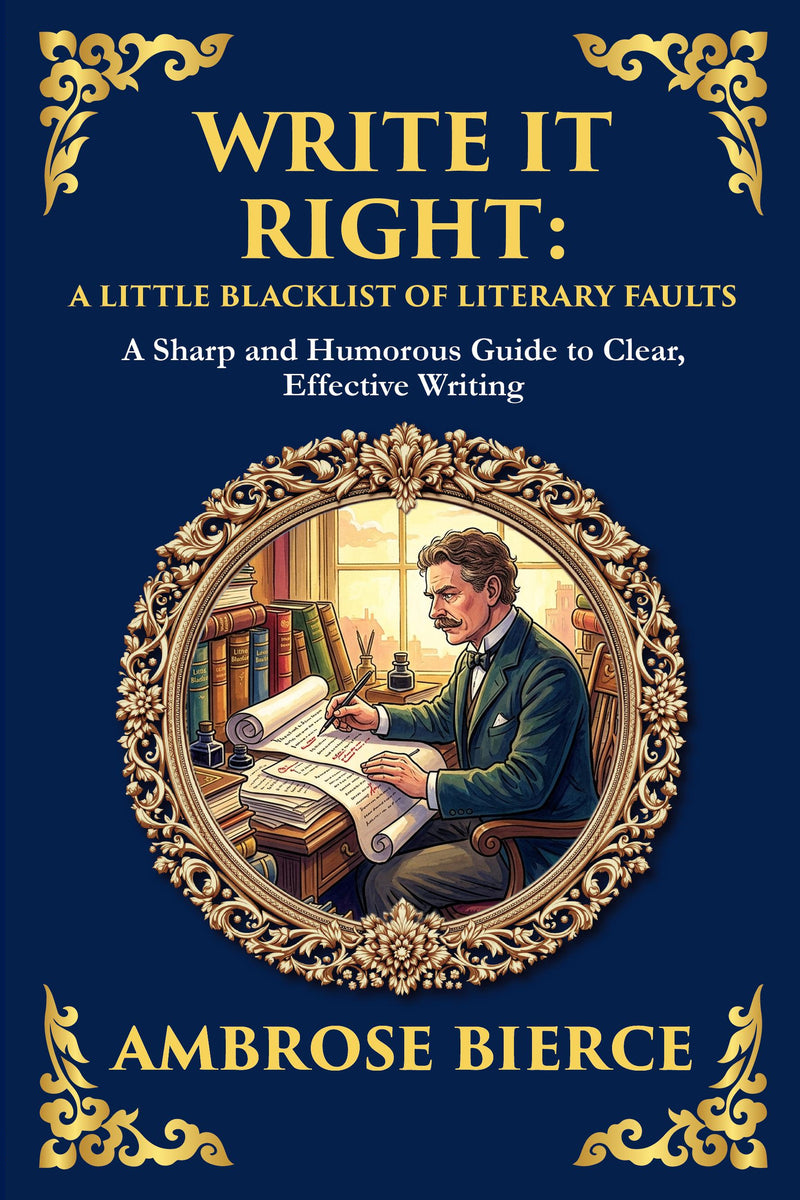
Write It Right: A Little Blacklist of Literary Faults
Wielding his signature wit like a scalpel, Ambrose Bierce takes no prisoners in this sharp, satirical guide to the misuse and abuse of the English language.
or free app
10,000+ hrs library
30-day guarantee
The complete Write It Right: A Little Blacklist of Literary Faults appears in modern English through Library of Alexandria Press, available online with audiobook narration included for members.
Have you ever wondered why your writing still feels wrong—even when it's grammatically correct? In Write It Right: A Little Blacklist of Literary Faults, Ambrose Bierce dismantles the self- important fluff, sloppy construction, and misused expressions that dilute the English language. Equal parts grammar guide, vocabulary manual, and sardonic manifesto, this book offers practical corrections delivered with merciless charm.
Bierce’s aim is simple: to promote clarity, conciseness, and stylistic integrity in writing. But he doesn’t teach with a ruler—he teaches with a rapier. From common redundancies to misused phrases and pompous jargon, Bierce calls out the offenders with elegant contempt and wicked wit.
What you’ll discover in this modern edition
- A Literary Hit List of Common Offenses – Say goodbye to overused buzzwords, bloated phrases, and confused constructions.
- Sharp, Witty Definitions and Corrections – Learn what to say, what not to say, and why it matters.
- A Masterclass in Brevity and Style – Channel Bierce’s precision into your own writing to become clearer, stronger, and more impactful.
- Enduring Relevance for Modern Writers – Despite being written over a century ago, Bierce’s commentary on language is hilariously—and shockingly—timeless.
- Perfect for Writers, Editors, and Word Nerds – A must-read for anyone serious (or seriously irritated) about effective communication.
| Formats | eBook (EPUB + PDF) · Audiobook · Paperback · Hardcover · Large Print |
| Language | English |
| Trim size (print) | 6 × 9 in |
| Binding | Paperback — perfect-bound · Hardcover — casewrap |
| Large Print edition | Same text in a larger, easy-read type — a larger font, not a larger trim |
| Print pricing | Every physical book at our true cost — at-cost, no profit (members) |
| Library | 873 restored titles, always growing |
| Length | 16,118 words · ~1 hr 4 min reading |
| Reading level | Grade 3 · an easy, flowing read (this modern-English edition) |
| Edition | Modern English translation · 2026 |
Member reviews for this edition are collected as readers finish it — be the first. Across the library: 12,000+ books shipped, every plan covered by a 365-day print guarantee.
About this edition
A faithful, unabridged modern-English edition by The Library of Alexandria — carefully rendered for today's reader and verified paragraph-by-paragraph against the public-domain source. Available as eBook, audiobook, paperback, hardcover, and large print.
- Complete & unabridgedVerified paragraph by paragraph against the source — never a scan, never abridged.
- Modern English, faithfulReadable today, with the author’s meaning kept intact. Readable — not simplified.
- Every format, one membershipRead in your browser or the free app, or listen to the full audiobook.
Included free with your membership
Cancel anytime, one click · 30-day money-back guarantee
Edition last updated July 2026
What’s inside
Write It Right: A Little Blacklist of Literary Faults — complete and unabridged, included in full with membership, plus the full audiobook.
Begin reading Write It Right: A Little Blacklist of Literary Faults
In clear modern English — the complete text is included with membership.
Introduction
There is a particular kind of pleasure in watching a master craftsman at work—the way a skilled carpenter runs a hand along a joint to feel for the slightest imperfection, or how a jeweler holds a stone to the light, turning it until the flaw reveals itself. Ambrose Bierce, in the slim and formidable volume you are about to read, performs exactly this kind of inspection. His subject is not wood or gemstone but the English language as it is spoken, written, and—in his exacting view—abused by nearly everyone who dares to put pen to paper. Write It Right is his workshop, and you, dear reader, are invited to watch him hold each word up to the light and pronounce his verdict.
First published in 1909, this book carries the wonderfully blunt subtitle A Little Blacklist of Literary Faults, and that single word—blacklist—tells you almost everything you need to know about the spirit in which Bierce wrote it. He was not interested in gentle encouragement. He was not in the business of coaxing timid writers toward confidence with soft words and reassuring nods. Bierce had a list, and on that list were the crimes against clarity, logic, and good taste that he had observed accumulating in the writing of his contemporaries like dust on an unloved shelf. His purpose was simple and severe: to identify these faults, name them, explain why they offended, and prescribe the correction. The result is a reference work that reads less like a textbook and more like the case notes of a brilliant, irritable physician diagnosing the chronic illnesses of the language.
To understand why this book deserves your attention more than a century after its first appearance, it helps to understand the man who wrote it. Ambrose Bierce was, by almost any measure, one of the most fearless and uncompromising figures in American letters. Born in 1842 in rural Ohio, the tenth of thirteen children in a poor and pious family, he rose through sheer force of intellect and an unflinching willingness to say what others would not. He fought in the American Civil War, where he saw combat at some of its bloodiest engagements, and the experience left him with both a permanent skepticism toward human pretension and a writer’s gift for unsentimental observation. After the war he turned to journalism, becoming one of the most influential and feared columnists on the West Coast of the United States. His pen could destroy reputations. His wit could reduce the pompous to ash. He earned the nickname “Bitter Bierce,” and he wore it not as an insult but as something close to a badge.
This is the same author who gave the world The Devil’s Dictionary, that masterpiece of cynical definition in which he redefined the entire vocabulary of polite society to expose the hypocrisy beneath it. He defined a “bore,” for instance, as “a person who talks when you wish him to listen,” and “patience” as “a minor form of despair, disguised as a virtue.” Once you have read Bierce in this satirical mode, you will recognize the same sharp intelligence at work throughout Write It Right. The difference is that here, his cynicism is harnessed to a constructive purpose. He is not merely mocking; he is teaching. And what he teaches, beneath the wit and the occasional cutting remark, is something genuinely valuable: how to think clearly enough to write clearly.
When you open this book, you will find that it is organized as an alphabetical list of words, phrases, and constructions that Bierce considered errors. Each entry is brief—often just a sentence or two. He presents the offending usage, frequently in italics, and then explains why it is wrong and what should be written instead. The format is deceptively simple, but within that simplicity lies the entire architecture of his thinking about language.
Consider how this approach differs from the way we usually encounter advice about writing. Most guides offer broad principles: be concise, avoid clichés, use the active voice. These are sensible enough, but they are abstract, and abstraction is easy to nod along with and impossible to apply in the moment of composition. Bierce, by contrast, gives you specifics. He does not tell you to “avoid imprecision”; he tells you exactly which words people use imprecisely and exactly what they actually mean. He shows you the difference between words that careless writers treat as interchangeable but which, to a careful reader, carry entirely distinct meanings. He is the kind of teacher who does not lecture you on the theory of accuracy but hands you a list of the precise places where you are likely to slip.
The philosophy underlying all of this is what makes the book endure. Bierce believed that words have meanings—real, specific, defensible meanings—and that to use a word in a way that contradicts its meaning is not a matter of personal style or harmless variation but a genuine error, a failure of thought made visible on the page. To him, the loose use of language was symptomatic of loose thinking, and loose thinking was a kind of moral failure. This may strike the modern reader as extreme, and in many cases Bierce was indeed extreme. But beneath the severity lies a profoundly serious conviction: that communication matters, that precision is a form of respect for both the subject and the reader, and that the writer who cannot be bothered to choose the right word has not earned the reader’s attention.
There is something bracing about this conviction in our own era, when language often seems to be in a state of perpetual erosion, when words are inflated until they mean nothing and phrases are repeated until they are emptied of all content. Bierce would have had a great deal to say about the verbal habits of the twenty-first century—about the words we use to avoid saying anything, the euphemisms that obscure rather than clarify, the fashionable phrases that spread like weeds through speech and writing alike. Reading him is a corrective experience. It makes you suddenly, almost uncomfortably, aware of the words coming out of your own mouth and flowing from your own pen.
This particular edition has been adapted for the contemporary reader, and a word about that adaptation is in order. Bierce wrote for an audience of his own time, and some of his examples and references would land oddly or obscurely on a modern ear. The aim of this modern translation is to preserve everything that makes Bierce valuable—his precision, his wit, his uncompromising standards—while ensuring that his lessons remain as clear and useful to you as they were to his original readers. The goal has never been to soften him. Bierce un-softened is Bierce at his best, and any edition that smoothed away his sharp edges would have betrayed the entire spirit of the enterprise. What you will encounter, then, is the genuine article: the same demanding, witty, occasionally infuriating teacher, made accessible across the distance of more than a century.
You may, as you read, find yourself disagreeing with him. This is not only permitted but encouraged. Bierce was a man of strong opinions, and not all of his rulings have stood the test of time. Some of the distinctions he insisted upon have collapsed entirely into common usage, and a few of his pronouncements reflect the particular prejudices of his moment rather than any timeless principle of good writing. Language is, after all, a living thing—it grows, shifts, and reinvents itself, and even the most authoritative pronouncements of one generation become the quaint curiosities of the next. Bierce knew this, even if he fought against it with every fiber of his being. To read Write It Right is to enter into an argument with a brilliant and stubborn man, and the argument itself is illuminating regardless of who, in any particular instance, turns out to be correct.
What you should not do is dismiss him simply because some of his rulings have aged. The vast majority of what Bierce identifies as a fault remains a fault today. The confusions he warns against are confusions we still commit. The imprecisions he flags are imprecisions that still litter our prose. And even where the specific rule has loosened, the habit of mind he is trying to instill—the habit of asking, before you write a word, whether it means what you intend it to mean—remains the single most valuable discipline any writer can acquire.
It would be easy to mistake Write It Right for a mere curiosity, a period piece of interest only to historians of the language or collectors of forgotten reference works. This would be a mistake. The book is, in its way, a small masterpiece of a very particular kind of writing—the kind that does an enormous amount in a very small space. There is not a wasted word in it, which is precisely what you would expect from a man who built his life around the conviction that wasted words are a kind of sin. Each entry is a model of compression. Bierce identifies the problem, explains it, and moves on, never lingering, never padding, never indulging in the very verbosity he condemns. The book practices what it preaches with a consistency that is almost startling.
There is also the matter of Bierce’s voice, which carries through even the driest grammatical entry. He cannot help himself; he is a wit, and the wit breaks through. A correction that another author might offer in a flat, instructional tone becomes, in Bierce’s hands, a small comedy of human folly. He has a gift for the devastating aside, the pointed observation that turns a simple matter of usage into a meditation on the absurdity of how people actually speak and write. You will find yourself laughing at certain entries—not at the language, but at the perfect economy with which Bierce skewers the people who misuse it. This humor is not incidental; it is one of the chief pleasures of the book and one of the reasons it has survived when so many drier manuals of usage have been forgotten.
But the deepest reason this book still matters has nothing to do with its wit or its compression or even its specific rules. It has to do with the attitude toward language that it embodies and asks you to adopt. We live in an age that is, in many ways, hostile to the kind of care Bierce demands. We write quickly, we write carelessly, we write in fragments and abbreviations and shorthand. We have at our disposal more words than any generation in human history, and we use a smaller fraction of them with less precision than perhaps any generation before us. The pressure is always toward speed, toward approximation, toward “good enough.” Bierce stands as a stubborn rebuke to all of this. He insists that good enough is not good enough, that the difference between the almost-right word and the right word is, as another great writer once observed, the difference between the lightning bug and the lightning.
To spend time with Bierce is to recalibrate your standards. After reading him, you will not be able to use certain words without a small voice in your head asking whether you really mean what you are saying. You will catch yourself reaching for a lazy phrase and stopping, suddenly aware of the laziness. You will read the writing of others—newspapers, advertisements, the endless flood of text that surrounds modern life—with a newly critical eye, noticing the imprecisions and confusions that you would once have passed over without a thought. This heightened awareness is, perhaps, the single greatest gift the book has to offer. It is not merely a list of rules to memorize; it is a training of the attention, a sharpening of the instrument with which you perceive and produce language.
There is a paradox worth noting here. Bierce was, in many respects, a deeply pessimistic man. He had seen the worst of human nature in war and in journalism, and his view of humanity was, to put it mildly, unsentimental. Yet Write It Right is, at its core, an optimistic book. It assumes that writing can be improved, that errors can be corrected, that the reader who pays attention can become better than they were. A truly cynical man would not have bothered to write a guide to good writing; he would have concluded that the cause was hopeless and the effort wasted. The very existence of this book is evidence that Bierce, beneath all his bitterness, believed in the possibility of getting it right. He cared—deeply, ferociously—about the language, and care of that intensity is always, in the end, a form of hope.
Cancel anytime, one click · 30-day money-back guarantee
Founding annual rate available now — your price locks for life when you join.
Not ready? Get this free chapter by email — read it anytime.
✓ Sent — check your inbox for Write It Right: A Little Blacklist of Literary Faults.
Questions about Write It Right: A Little Blacklist of Literary Faults
What is Write It Right: A Little Blacklist of Literary Faults about?
Wielding his signature wit like a scalpel, Ambrose Bierce takes no prisoners in this sharp, satirical guide to the misuse and abuse of the English language. Write It Right is more than just a style manual—it’s a literary blacklist. With brutal honesty and biting humor, Bierce exposes the clichés, redundancies, and pretensions that plague everyday writing.
Who wrote Write It Right: A Little Blacklist of Literary Faults?
Write It Right: A Little Blacklist of Literary Faults was written by Ambrose Bierce. This edition presents the complete work in clear modern English, faithfully rendered from the public-domain original by Library of Alexandria Press.
Is Write It Right: A Little Blacklist of Literary Faults free to read?
The opening chapter is free to read on this page. Members read and listen to the complete work — and the entire library — free, and can order any physical book at our true print cost.
How long is Write It Right: A Little Blacklist of Literary Faults?
2 chapters (~16,118 words) — about 1 hr 4 min of reading in this modern-English edition.
Is this an abridged version of Write It Right: A Little Blacklist of Literary Faults?
No. This is the complete, unabridged Write It Right: A Little Blacklist of Literary Faults, carefully rendered into clear modern English and verified paragraph-by-paragraph against the public-domain source — nothing is cut or summarised.
What formats does Write It Right: A Little Blacklist of Literary Faults come in?
Write It Right: A Little Blacklist of Literary Faults is available as eBook, paperback, hardcover and large print. eBook and audiobook are included with membership; printed editions ship at our true print cost.
Shipping & returns
Billing & membership
More from the library


Explore Classic & Literary
- Dream Psychology: Psychoanalysis for Beginners · Sigmund Freud
- Great Expectations · Charles Dickens
- The Brothers Karamazov · Fyodor Dostoyevsky
- The Great Gatsby · F. Scott Fitzgerald
- Wild Flowers Worth Knowing · Neltje Blanchan
- Italian Hours · Henry James
- A Popular History of France from the Earliest Times, Volume 5 · François Guizot
- A history of English literature: A practical text-book · Edward Albert
- Italian Highways and Byways from a Motor Car · M. F. Mansfield
- The Heart-Cry of Jesus · Byron J. Rees
- Castes and Tribes of Southern India. Vol. 6 of 7 · Edgar Thurston
- Against the Grain · J.-K. Huysmans
- Dombey and Son · Charles Dickens
- How to Invest Money · George Garr Henry
- The Great Controversy Between Christ and Satan · Ellen Gould Harmon White
- One Hundred Proofs That the Earth Is Not a Globe · William Carpenter
- Southern Literature From 1579–1895 · Louise Manly
- The Renaissance: Studies in Art and Poetry · Walter Pater
- Mark Twain’s Speeches · Mark Twain
- Tacitus on Germany · Cornelius Tacitus
- The Rosary · Florence L. Barclay
- Peculiarities of American Cities · Willard W. Glazier
- Tennis for Girls · Florence A. Ballin
- The World’s Greatest Books — Volume 02 — Fiction
- Shirley · Charlotte Brontë
- Daisy Miller: A Study · Henry James
- Louis Lambert · Honoré de Balzac
- Historic Jamaica · Frank Cundall
- The Gambler · Fyodor Dostoyevsky
- The Mayor of Casterbridge · Thomas Hardy
Write It Right: A Little Blacklist of Literary Faults
Write It Right: A Little Blacklist of Literary Faults
A Sharp and Humorous Guide to Clear, Effective Writing
Ambrose Bierce
Contents
- Introduction
- The Blacklist
Introduction
There is a particular kind of pleasure in watching a master craftsman at work—the way a skilled carpenter runs a hand along a joint to feel for the slightest imperfection, or how a jeweler holds a stone to the light, turning it until the flaw reveals itself. Ambrose Bierce, in the slim and formidable volume you are about to read, performs exactly this kind of inspection. His subject is not wood or gemstone but the English language as it is spoken, written, and—in his exacting view—abused by nearly everyone who dares to put pen to paper. Write It Right is his workshop, and you, dear reader, are invited to watch him hold each word up to the light and pronounce his verdict.
First published in 1909, this book carries the wonderfully blunt subtitle A Little Blacklist of Literary Faults, and that single word—blacklist—tells you almost everything you need to know about the spirit in which Bierce wrote it. He was not interested in gentle encouragement. He was not in the business of coaxing timid writers toward confidence with soft words and reassuring nods. Bierce had a list, and on that list were the crimes against clarity, logic, and good taste that he had observed accumulating in the writing of his contemporaries like dust on an unloved shelf. His purpose was simple and severe: to identify these faults, name them, explain why they offended, and prescribe the correction. The result is a reference work that reads less like a textbook and more like the case notes of a brilliant, irritable physician diagnosing the chronic illnesses of the language.
To understand why this book deserves your attention more than a century after its first appearance, it helps to understand the man who wrote it. Ambrose Bierce was, by almost any measure, one of the most fearless and uncompromising figures in American letters. Born in 1842 in rural Ohio, the tenth of thirteen children in a poor and pious family, he rose through sheer force of intellect and an unflinching willingness to say what others would not. He fought in the American Civil War, where he saw combat at some of its bloodiest engagements, and the experience left him with both a permanent skepticism toward human pretension and a writer’s gift for unsentimental observation. After the war he turned to journalism, becoming one of the most influential and feared columnists on the West Coast of the United States. His pen could destroy reputations. His wit could reduce the pompous to ash. He earned the nickname “Bitter Bierce,” and he wore it not as an insult but as something close to a badge.
This is the same author who gave the world The Devil’s Dictionary, that masterpiece of cynical definition in which he redefined the entire vocabulary of polite society to expose the hypocrisy beneath it. He defined a “bore,” for instance, as “a person who talks when you wish him to listen,” and “patience” as “a minor form of despair, disguised as a virtue.” Once you have read Bierce in this satirical mode, you will recognize the same sharp intelligence at work throughout Write It Right. The difference is that here, his cynicism is harnessed to a constructive purpose. He is not merely mocking; he is teaching. And what he teaches, beneath the wit and the occasional cutting remark, is something genuinely valuable: how to think clearly enough to write clearly.
When you open this book, you will find that it is organized as an alphabetical list of words, phrases, and constructions that Bierce considered errors. Each entry is brief—often just a sentence or two. He presents the offending usage, frequently in italics, and then explains why it is wrong and what should be written instead. The format is deceptively simple, but within that simplicity lies the entire architecture of his thinking about language.
Consider how this approach differs from the way we usually encounter advice about writing. Most guides offer broad principles: be concise, avoid clichés, use the active voice. These are sensible enough, but they are abstract, and abstraction is easy to nod along with and impossible to apply in the moment of composition. Bierce, by contrast, gives you specifics. He does not tell you to “avoid imprecision”; he tells you exactly which words people use imprecisely and exactly what they actually mean. He shows you the difference between words that careless writers treat as interchangeable but which, to a careful reader, carry entirely distinct meanings. He is the kind of teacher who does not lecture you on the theory of accuracy but hands you a list of the precise places where you are likely to slip.
The philosophy underlying all of this is what makes the book endure. Bierce believed that words have meanings—real, specific, defensible meanings—and that to use a word in a way that contradicts its meaning is not a matter of personal style or harmless variation but a genuine error, a failure of thought made visible on the page. To him, the loose use of language was symptomatic of loose thinking, and loose thinking was a kind of moral failure. This may strike the modern reader as extreme, and in many cases Bierce was indeed extreme. But beneath the severity lies a profoundly serious conviction: that communication matters, that precision is a form of respect for both the subject and the reader, and that the writer who cannot be bothered to choose the right word has not earned the reader’s attention.
There is something bracing about this conviction in our own era, when language often seems to be in a state of perpetual erosion, when words are inflated until they mean nothing and phrases are repeated until they are emptied of all content. Bierce would have had a great deal to say about the verbal habits of the twenty-first century—about the words we use to avoid saying anything, the euphemisms that obscure rather than clarify, the fashionable phrases that spread like weeds through speech and writing alike. Reading him is a corrective experience. It makes you suddenly, almost uncomfortably, aware of the words coming out of your own mouth and flowing from your own pen.
This particular edition has been adapted for the contemporary reader, and a word about that adaptation is in order. Bierce wrote for an audience of his own time, and some of his examples and references would land oddly or obscurely on a modern ear. The aim of this modern translation is to preserve everything that makes Bierce valuable—his precision, his wit, his uncompromising standards—while ensuring that his lessons remain as clear and useful to you as they were to his original readers. The goal has never been to soften him. Bierce un-softened is Bierce at his best, and any edition that smoothed away his sharp edges would have betrayed the entire spirit of the enterprise. What you will encounter, then, is the genuine article: the same demanding, witty, occasionally infuriating teacher, made accessible across the distance of more than a century.
You may, as you read, find yourself disagreeing with him. This is not only permitted but encouraged. Bierce was a man of strong opinions, and not all of his rulings have stood the test of time. Some of the distinctions he insisted upon have collapsed entirely into common usage, and a few of his pronouncements reflect the particular prejudices of his moment rather than any timeless principle of good writing. Language is, after all, a living thing—it grows, shifts, and reinvents itself, and even the most authoritative pronouncements of one generation become the quaint curiosities of the next. Bierce knew this, even if he fought against it with every fiber of his being. To read Write It Right is to enter into an argument with a brilliant and stubborn man, and the argument itself is illuminating regardless of who, in any particular instance, turns out to be correct.
What you should not do is dismiss him simply because some of his rulings have aged. The vast majority of what Bierce identifies as a fault remains a fault today. The confusions he warns against are confusions we still commit. The imprecisions he flags are imprecisions that still litter our prose. And even where the specific rule has loosened, the habit of mind he is trying to instill—the habit of asking, before you write a word, whether it means what you intend it to mean—remains the single most valuable discipline any writer can acquire.
It would be easy to mistake Write It Right for a mere curiosity, a period piece of interest only to historians of the language or collectors of forgotten reference works. This would be a mistake. The book is, in its way, a small masterpiece of a very particular kind of writing—the kind that does an enormous amount in a very small space. There is not a wasted word in it, which is precisely what you would expect from a man who built his life around the conviction that wasted words are a kind of sin. Each entry is a model of compression. Bierce identifies the problem, explains it, and moves on, never lingering, never padding, never indulging in the very verbosity he condemns. The book practices what it preaches with a consistency that is almost startling.
There is also the matter of Bierce’s voice, which carries through even the driest grammatical entry. He cannot help himself; he is a wit, and the wit breaks through. A correction that another author might offer in a flat, instructional tone becomes, in Bierce’s hands, a small comedy of human folly. He has a gift for the devastating aside, the pointed observation that turns a simple matter of usage into a meditation on the absurdity of how people actually speak and write. You will find yourself laughing at certain entries—not at the language, but at the perfect economy with which Bierce skewers the people who misuse it. This humor is not incidental; it is one of the chief pleasures of the book and one of the reasons it has survived when so many drier manuals of usage have been forgotten.
But the deepest reason this book still matters has nothing to do with its wit or its compression or even its specific rules. It has to do with the attitude toward language that it embodies and asks you to adopt. We live in an age that is, in many ways, hostile to the kind of care Bierce demands. We write quickly, we write carelessly, we write in fragments and abbreviations and shorthand. We have at our disposal more words than any generation in human history, and we use a smaller fraction of them with less precision than perhaps any generation before us. The pressure is always toward speed, toward approximation, toward “good enough.” Bierce stands as a stubborn rebuke to all of this. He insists that good enough is not good enough, that the difference between the almost-right word and the right word is, as another great writer once observed, the difference between the lightning bug and the lightning.
To spend time with Bierce is to recalibrate your standards. After reading him, you will not be able to use certain words without a small voice in your head asking whether you really mean what you are saying. You will catch yourself reaching for a lazy phrase and stopping, suddenly aware of the laziness. You will read the writing of others—newspapers, advertisements, the endless flood of text that surrounds modern life—with a newly critical eye, noticing the imprecisions and confusions that you would once have passed over without a thought. This heightened awareness is, perhaps, the single greatest gift the book has to offer. It is not merely a list of rules to memorize; it is a training of the attention, a sharpening of the instrument with which you perceive and produce language.
There is a paradox worth noting here. Bierce was, in many respects, a deeply pessimistic man. He had seen the worst of human nature in war and in journalism, and his view of humanity was, to put it mildly, unsentimental. Yet Write It Right is, at its core, an optimistic book. It assumes that writing can be improved, that errors can be corrected, that the reader who pays attention can become better than they were. A truly cynical man would not have bothered to write a guide to good writing; he would have concluded that the cause was hopeless and the effort wasted. The very existence of this book is evidence that Bierce, beneath all his bitterness, believed in the possibility of getting it right. He cared—deeply, ferociously—about the language, and care of that intensity is always, in the end, a form of hope.
A instead of An. “A hotel.” “A heroic man.” Use “an” before an unaccented “h.” The opposite habit in this country comes from over-emphasizing the “h” sound.
Action instead of Act. “In wrestling, a blow is a reprehensible action.” A blow is an act, not an action. An action may consist of many acts.
Admission instead of Admittance. “The price of admission is one dollar.”
Admit instead of Confess. To admit is to agree with an accusation. A person who hasn’t been accused cannot admit their guilt.
Adopt. “He adopted a disguise.” You can adopt a child or an opinion, but a disguise is assumed.
Advisedly instead of Advertently or Intentionally. “It was done advisedly” should mean it was done after receiving advice.
Afford. It is incorrect to say “the fact affords a reasonable presumption” or “the house afforded ample accommodation.” The fact supplies a reasonable presumption. The house offered, or provided, ample accommodation.
Afraid. Don’t say, “I am afraid it will rain.” Say, “I fear it will rain.”
Use Irritate instead of Aggravate. For example, “He irritated me with his insolence.” To aggravate means to make something already bad or unpleasant even worse. You cannot “aggravate” a person, even if that person is unpleasant. Women are especially prone to using this word incorrectly.
All of. “He gave all of his property.” These words contradict each other: a whole thing cannot be “of” itself. Just leave out the word “of.”
Alleged. “The alleged murderer.” You can allege a murder, but not a murderer; you can allege a crime, but not a criminal. Someone who is merely suspected of a crime is not an “alleged criminal,” because an allegation is a definite, positive statement. Newspapers use “alleged” constantly to avoid libel lawsuits. They might argue there is no other single word that fits perfectly, but just because a mud puddle is the shortest path doesn’t mean you have to walk through it. You can just go around.
End of the free sample
Keep reading, free
Members read and listen to the complete book — and the entire library. Cancel anytime, one click · 30-day money-back guarantee.