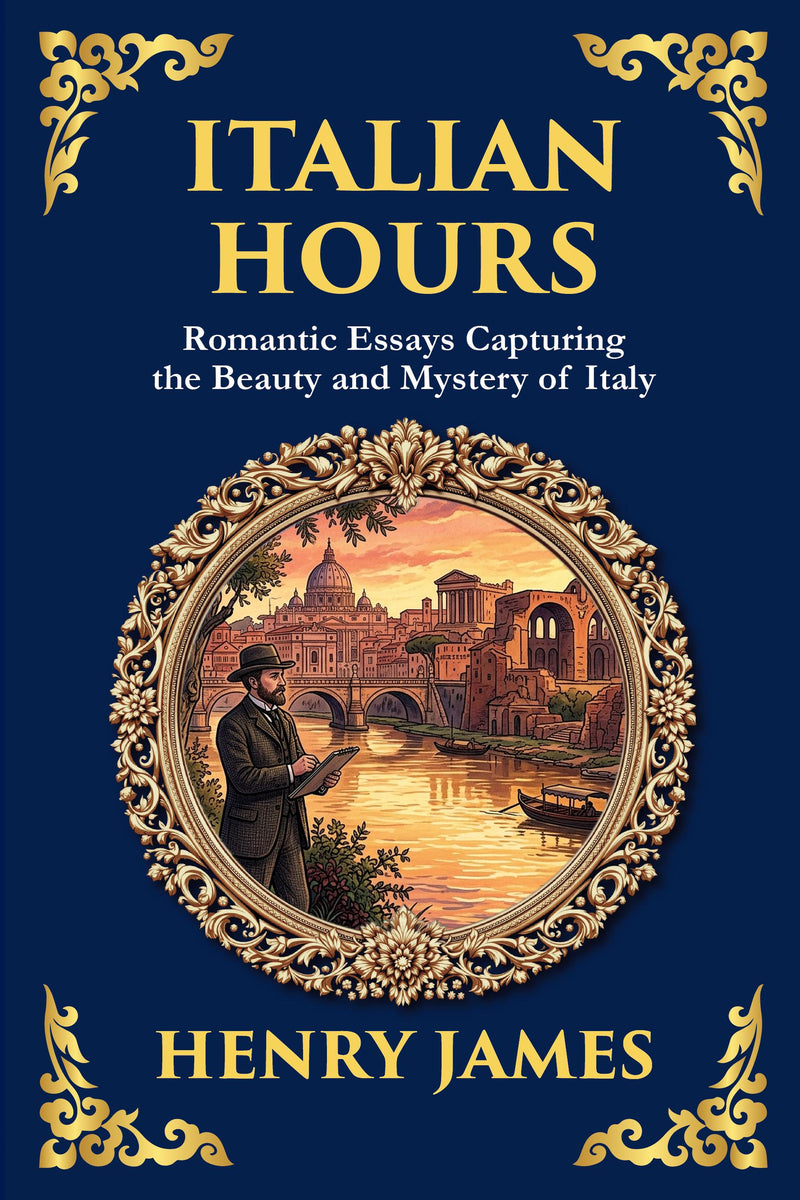
Italian Hours
Wander with Henry James through the sunlit piazzas, shadowed canals, and ancient ruins of Italy in Italian Hours—a lyrical collection of travel essays that evoke the timeless splendor, culture, and mystery of the Italian soul.
or free app
10,000+ hrs library
30-day guarantee
The complete Italian Hours appears in modern English through Library of Alexandria Press, available online with audiobook narration included for members.
Have you ever wondered why Italy continues to enchant the hearts of travelers, writers, and dreamers century after century? Italian Hours is Henry James’s love letter to Italy—a nation that stirred his imagination and soul like no other. Spanning more than two decades of visits, this rich collection of literary essays captures not only the physical beauty of Italy but the spiritual essence that radiates from its art, architecture, and people.
With the eye of a novelist and the heart of a romantic, James weaves intimate reflections and vivid portrayals of cities steeped in history. From the haunting allure of Venice’s fading grandeur to the eternal drama of Rome, each essay invites the reader to pause, observe, and fall under Italy’s spell. But Italian Hours is more than a travelogue—it’s a meditation on beauty, time, civilization, and the deep inner longing that such places inspire.
Whether he’s walking through the medieval alleyways of Perugia or contemplating the sculptures of Florence, James evokes a dreamlike reverence for a land where every stone tells a story.
What you’ll discover in this modern edition
- Venice, the City of Reflections – Explore James’s beloved lagoon city as a haunting blend of melancholy and splendor
- The Eternal Allure of Rome – Witness the sacred and the secular, the ruin and the resurrection, in every crumbling wall and soaring dome
- Florence, Siena, and the Soul of Tuscany – Delve into the artistic and architectural majesty of the Renaissance heartland
- The Hidden Charms of Lesser-Known Towns – Discover Perugia, Ravenna, and others as poetic symbols of permanence and memory
- A Deep Meditation on Culture and the Self – James reflects on how travel awakens the contemplative mind and transforms perception
| Formats | eBook (EPUB + PDF) · Audiobook · Paperback · Hardcover · Large Print |
| Language | English |
| Trim size (print) | 6 × 9 in |
| Binding | Paperback — perfect-bound · Hardcover — casewrap |
| Large Print edition | Same text in a larger, easy-read type — a larger font, not a larger trim |
| Print pricing | Every physical book at our true cost — at-cost, no profit (members) |
| Library | 873 restored titles, always growing |
| Length | 122,114 words · ~8 hr 8 min reading |
| Reading level | Grade 15 · a demanding, literary read (this modern-English edition) |
| Edition | Modern English translation · 2026 |
Member reviews for this edition are collected as readers finish it — be the first. Across the library: 12,000+ books shipped, every plan covered by a 365-day print guarantee.
About this edition
A faithful, unabridged modern-English edition by The Library of Alexandria — carefully rendered for today's reader and verified paragraph-by-paragraph against the public-domain source. Available as eBook, audiobook, paperback, hardcover, and large print.
- Complete & unabridgedVerified paragraph by paragraph against the source — never a scan, never abridged.
- Modern English, faithfulReadable today, with the author’s meaning kept intact. Readable — not simplified.
- Every format, one membershipRead in your browser or the free app, or listen to the full audiobook.
Included free with your membership
Cancel anytime, one click · 30-day money-back guarantee
Edition last updated July 2026
What’s inside
Italian Hours — complete and unabridged: all 60 sections included with membership, plus the full audiobook.
Begin reading Italian Hours
In clear modern English — the complete text is included with membership.
Introduction
There is a particular kind of book that does not announce itself as a masterpiece. It arrives without the fanfare of a novel, without the moral urgency of a manifesto, without the structural confidence of a history. It presents itself modestly — as notes, as impressions, as the casual record of a traveler who happened to be paying close attention — and then, somewhere between the first paragraph and the last, it quietly becomes one of the most beautiful things you have ever read. Henry James published this collection of Italian travel essays in November 1909, gathering pieces written across nearly four decades of visits, revisions, and returns. He called them light inquiries. He was being characteristically, almost mischievously, modest. What he had actually assembled was something closer to a sustained meditation on beauty, time, consciousness, and the strange labor of truly seeing a place — a book that rewards not just reading but rereading, not just attention but surrender.
To come to this book as a general reader in the twenty-first century is to arrive at a peculiar crossroads. On one side stands the Italy you already know, or think you know: the postcards, the films, the restaurant menus, the Instagram grids of golden light on ancient stone. On the other side stands Henry James, a writer whose reputation for difficulty has preceded him so thoroughly that many readers approach his work the way they might approach a very grand and slightly forbidding palazzo — admiring the facade from a respectful distance, uncertain whether they are actually invited inside. The purpose of this introduction is to throw open the doors. Because the Italy that James found, and the prose he used to describe it, constitute one of the great pleasures available to any reader willing to slow down and pay the kind of attention that the book itself models and rewards.
James made his first extended visit to Italy in 1869, when he was twenty-six years old and still in the early stages of becoming the writer he would eventually be. He returned repeatedly over the following decades — to Venice, to Rome, to Florence, to the smaller Tuscan cities, to Ravenna, to the hill towns of Umbria — and the essays collected here span that entire arc of engagement. The earliest pieces carry the breathless, slightly overwhelmed quality of a young American encountering the Old World for the first time, that particular mixture of reverence and intellectual excitement that James would later describe, in his fiction, as the characteristic condition of the American abroad. The later pieces are quieter, more elegiac, more willing to sit with ambiguity and loss. Together they form something that is more than a travel book and less than a memoir — a record of a relationship, really, between a writer and a country, conducted over a lifetime and never quite resolved.
This matters for the reader because it means the book has a hidden architecture that is not immediately visible from the table of contents. The chapters are organized geographically rather than chronologically — Venice comes first, then the journey south through Milan and the Alpine passes, then Rome, then Florence, then the smaller cities of Tuscany and Umbria, then Ravenna — but within that geographical frame, time moves in complicated ways. James affixed dates to his essays, and he was candid in his preface about having introduced later passages into earlier texts, layering a more experienced vision over a younger one without always marking the seam. The result is that you are sometimes reading two Jameses at once: the young man who arrived in Venice in a state of barely contained rapture, and the older man who returned to find the city changed, or himself changed, or both, and who had learned to hold beauty and loss in the same sentence without flinching.
This layering is not a flaw or an inconsistency. It is, in fact, one of the book’s deepest pleasures. James understood, as few travel writers have, that a place is never simply a place — it is always also a moment in your own life, a particular configuration of your own readiness to receive it. The Venice of a twenty-six-year-old and the Venice of a man in his sixties are not the same city, even if the stones are identical. By allowing both visions to coexist in the same text, James gives us something that pure reportage cannot: the experience of time itself, the way a beloved place accumulates meaning through repeated encounter, the way return is never quite repetition.
A word of practical guidance is in order here, because this is a book that can be read in several ways, and some of those ways are more rewarding than others.
The most obvious approach is to read it as a companion to travel — to carry it to Italy and read the Venice chapters in Venice, the Roman chapters in Rome, the Florentine chapters in Florence. This is entirely legitimate, and the book rewards it handsomely. James is extraordinarily specific about places: particular churches, particular paintings, particular views from particular bridges at particular times of day. Reading him on the spot, with the actual light falling on the actual stones, produces a kind of double vision that is one of the great pleasures of literary travel. You see what he saw, and you see what has changed, and the gap between those two perceptions becomes itself a form of historical understanding.
But the book also rewards — perhaps even more deeply rewards — being read at home, in an armchair, without any immediate prospect of travel. This is because what James is ultimately writing about is not Italy as a destination but Italy as an experience of consciousness: the way beauty makes demands on the observer, the way the past presses against the present in a place saturated with history, the way the act of looking carefully at something is itself a form of thought. These are not concerns that require a passport. They are concerns that any reader who has ever stood before something beautiful and felt simultaneously enlarged and inadequate will recognize immediately.
The third approach, and perhaps the most honest one, is to read it slowly and without a plan — to open it at random, to follow your interest, to let James lead you where he wants to go. The book is not a narrative with a destination; it is a series of encounters, each complete in itself, each opening onto the next through association and temperament rather than plot. It is, in this sense, closer to music than to fiction. You do not need to have read the Venice chapters to appreciate the Roman ones, and you do not need to finish the book to have gotten something essential from it. What you need, above all, is patience — not the patience of endurance, but the patience of attention, the willingness to stay with a sentence long enough to feel what it is doing.
And what James’s sentences are doing, in this book, is extraordinary. His prose here is not the late style of the great novels — not the elaborate, parenthetical, almost architectural syntax of The Wings of the Dove or The Golden Bowl, which can require a reader to hold an entire paragraph in suspension before the meaning resolves. The travel essays were written, for the most part, for magazine publication, and they retain a relative directness, a willingness to make a point and move on, that makes them far more accessible than James’s reputation might suggest. There are still long sentences, still subordinate clauses that open onto further subordinate clauses, still the characteristic Jamesian habit of qualifying a statement almost as soon as it is made — but the overall effect is of a mind thinking aloud in your company rather than performing for an audience. The difficulty, such as it is, is the difficulty of precision: James is trying to say exactly what he means, and exactly what he means is sometimes genuinely complex. The reward for following him is that you arrive, repeatedly, at formulations that feel not just accurate but inevitable, sentences that say something you have always half-known but never quite managed to articulate.
What makes this book endure, a century and more after its publication, is not the information it contains — much of that is dated, some of it superseded, and James himself disclaimed any intention of being informative — but the quality of attention it models and invites. James was, above all things, a great noticer. He noticed the way light fell on water at different hours of the day. He noticed the social dynamics of a piazza, the way different classes of people occupied different corners of the same public space. He noticed the relationship between a building’s exterior and its interior, between a painting’s subject and its technique, between a city’s history and its present atmosphere. He noticed, with particular acuity, the way his own responses changed from visit to visit, the way a place that had once seemed purely beautiful could reveal, on return, a melancholy that had always been there but that he had not been ready to receive.
This quality of attention is not merely aesthetic. It is, in James’s hands, a moral and philosophical practice. To look carefully at Venice — to resist the temptation of the postcard view, the received response, the comfortable cliché — is to insist on the reality of the place and of your own experience of it. It is to refuse the consolations of tourism in favor of the more demanding pleasures of genuine encounter. James is acutely aware of the ways in which Italy, and Venice in particular, had already become, even in his own time, a kind of cultural commodity — a place that people visited in order to confirm impressions they had already formed from paintings and guidebooks and the accounts of previous travelers. He is funny about this, and sharp, and occasionally a little impatient. But his response to the problem is not cynicism or ironic detachment. It is, rather, a redoubling of attention, a determination to see past the received image to whatever is actually there.
The Venice essays, which open the book, are the most famous and in some ways the most immediately seductive. James begins with a disarming admission: there is, he says, notoriously nothing more to be said about Venice. Every painter has painted it, every writer has described it, every tourist has photographed it. The city has been so thoroughly processed by culture that it has become, in a sense, more image than place. And then, having made this admission, he proceeds to say more about Venice than almost anyone else ever has — not by ignoring the problem but by making it part of the subject. The Venice he writes about is always partly the Venice of his own consciousness, the Venice that exists at the intersection of the actual city and the accumulated weight of everything that has been thought and felt and written about it. This is not a limitation. It is, James suggests, the only honest way to write about a place that has been so thoroughly loved.
The Roman essays have a different quality — more spacious, more historically minded, more willing to sit with the sheer weight of time that presses down on the city. James in Rome is a walker, a rider, a wanderer through neighborhoods that the standard tourist itinerary ignores. He is interested in the Campagna, the vast plain that surrounds the city, as much as in the monuments at its center. He is interested in the way Rome absorbs and outlasts everything that happens to it, the way its ruins are not simply evidence of destruction but of a kind of permanence that transcends any particular civilization. There is an essay here called A Roman Holiday that is among the finest things James ever wrote in any genre — a piece that begins as a description of a particular afternoon and expands, almost imperceptibly, into a meditation on history, beauty, and the strange privilege of being alive in a place where so many others have been alive before you.
The Florentine and Tuscan essays are perhaps the most intimate, the most personal in their engagement with specific works of art and specific experiences of place. James loved Florence with a particular intensity, and the essays on the city and its surroundings have a warmth and a specificity that reflect long familiarity. He writes about paintings not as a critic cataloguing qualities but as a person responding to presences — the Florentine masters are, for him, not historical figures but living interlocutors, artists whose choices and achievements continue to make demands on anyone who stands before their work. The essays on the smaller Tuscan cities — Siena, Lucca, Pistoia, San Gimignano, Cortona — are among the book’s hidden treasures, pieces in which James’s pleasure in the less-visited, the less-celebrated, the places that have not yet been entirely consumed by their own fame, produces some of his most relaxed and generous writing.
Cancel anytime, one click · 30-day money-back guarantee
Founding annual rate available now — your price locks for life when you join.
Not ready? Get this free chapter by email — read it anytime.
✓ Sent — check your inbox for Italian Hours.
Questions about Italian Hours
What is Italian Hours about?
Wander with Henry James through the sunlit piazzas, shadowed canals, and ancient ruins of Italy in Italian Hours—a lyrical collection of travel essays that evoke the timeless splendor, culture, and mystery of the Italian soul. Through James’ perceptive lens, cities like Venice, Rome, Florence, and Siena come alive with romance, decay, and reverence. A master of psychological depth, James captures not just the places, but the moods and meanings they evoke, painting Italy not as a destination but as a dreamscape of t
Who wrote Italian Hours?
Italian Hours was written by Henry James. This edition presents the complete work in clear modern English, faithfully rendered from the public-domain original by Library of Alexandria Press.
Is Italian Hours free to read?
The opening chapter is free to read on this page. Members read and listen to the complete work — and the entire library — free, and can order any physical book at our true print cost.
How long is Italian Hours?
60 chapters (~122,114 words) — about 8 hr 8 min of reading in this modern-English edition.
Is this an abridged version of Italian Hours?
No. This is the complete, unabridged Italian Hours, carefully rendered into clear modern English and verified paragraph-by-paragraph against the public-domain source — nothing is cut or summarised.
What formats does Italian Hours come in?
Italian Hours is available as eBook, paperback, hardcover and large print. eBook and audiobook are included with membership; printed editions ship at our true print cost.
Shipping & returns
Billing & membership
More from the library


Explore Classic & Literary
- Dream Psychology: Psychoanalysis for Beginners · Sigmund Freud
- Great Expectations · Charles Dickens
- The Brothers Karamazov · Fyodor Dostoyevsky
- The Great Gatsby · F. Scott Fitzgerald
- Wild Flowers Worth Knowing · Neltje Blanchan
- A Popular History of France from the Earliest Times, Volume 5 · François Guizot
- A history of English literature: A practical text-book · Edward Albert
- Italian Highways and Byways from a Motor Car · M. F. Mansfield
- The Heart-Cry of Jesus · Byron J. Rees
- Castes and Tribes of Southern India. Vol. 6 of 7 · Edgar Thurston
- Against the Grain · J.-K. Huysmans
- Dombey and Son · Charles Dickens
- How to Invest Money · George Garr Henry
- The Great Controversy Between Christ and Satan · Ellen Gould Harmon White
- One Hundred Proofs That the Earth Is Not a Globe · William Carpenter
- Southern Literature From 1579–1895 · Louise Manly
- The Renaissance: Studies in Art and Poetry · Walter Pater
- Mark Twain’s Speeches · Mark Twain
- Tacitus on Germany · Cornelius Tacitus
- The Rosary · Florence L. Barclay
- Peculiarities of American Cities · Willard W. Glazier
- Tennis for Girls · Florence A. Ballin
- The World’s Greatest Books — Volume 02 — Fiction
- Shirley · Charlotte Brontë
- Daisy Miller: A Study · Henry James
- Louis Lambert · Honoré de Balzac
- Historic Jamaica · Frank Cundall
- The Gambler · Fyodor Dostoyevsky
- The Mayor of Casterbridge · Thomas Hardy
- The International Jew: The World’s Foremost Problem
Italian Hours
Italian Hours
A Modern Translation
Henry James
Contents
- Introduction
- Chapter 1
- Chapter 2
- Chapter 3
- Chapter 4
- Chapter 5
- Chapter 6
- Chapter 7
- Chapter 8
- Chapter 9
- Chapter 10
- Chapter 11
- Chapter 12
- Chapter 13
- Chapter 14
- Chapter 15
- Chapter 16
- Chapter 17
- Chapter 18
- Chapter 19
- Chapter 20
- Chapter 21
- Chapter 22
- Chapter 23
- Chapter 24
- Chapter 25
- Chapter 26
- Chapter 27
- Chapter 28
- Chapter 29
- Chapter 30
- Chapter 31
- Chapter 32
- Chapter 33
- Chapter 34
- Chapter 35
- Chapter 36
- Chapter 37
- Chapter 38
- Chapter 39
- … and 20 more chapters
Introduction
There is a particular kind of book that does not announce itself as a masterpiece. It arrives without the fanfare of a novel, without the moral urgency of a manifesto, without the structural confidence of a history. It presents itself modestly — as notes, as impressions, as the casual record of a traveler who happened to be paying close attention — and then, somewhere between the first paragraph and the last, it quietly becomes one of the most beautiful things you have ever read. Henry James published this collection of Italian travel essays in November 1909, gathering pieces written across nearly four decades of visits, revisions, and returns. He called them light inquiries. He was being characteristically, almost mischievously, modest. What he had actually assembled was something closer to a sustained meditation on beauty, time, consciousness, and the strange labor of truly seeing a place — a book that rewards not just reading but rereading, not just attention but surrender.
To come to this book as a general reader in the twenty-first century is to arrive at a peculiar crossroads. On one side stands the Italy you already know, or think you know: the postcards, the films, the restaurant menus, the Instagram grids of golden light on ancient stone. On the other side stands Henry James, a writer whose reputation for difficulty has preceded him so thoroughly that many readers approach his work the way they might approach a very grand and slightly forbidding palazzo — admiring the facade from a respectful distance, uncertain whether they are actually invited inside. The purpose of this introduction is to throw open the doors. Because the Italy that James found, and the prose he used to describe it, constitute one of the great pleasures available to any reader willing to slow down and pay the kind of attention that the book itself models and rewards.
James made his first extended visit to Italy in 1869, when he was twenty-six years old and still in the early stages of becoming the writer he would eventually be. He returned repeatedly over the following decades — to Venice, to Rome, to Florence, to the smaller Tuscan cities, to Ravenna, to the hill towns of Umbria — and the essays collected here span that entire arc of engagement. The earliest pieces carry the breathless, slightly overwhelmed quality of a young American encountering the Old World for the first time, that particular mixture of reverence and intellectual excitement that James would later describe, in his fiction, as the characteristic condition of the American abroad. The later pieces are quieter, more elegiac, more willing to sit with ambiguity and loss. Together they form something that is more than a travel book and less than a memoir — a record of a relationship, really, between a writer and a country, conducted over a lifetime and never quite resolved.
This matters for the reader because it means the book has a hidden architecture that is not immediately visible from the table of contents. The chapters are organized geographically rather than chronologically — Venice comes first, then the journey south through Milan and the Alpine passes, then Rome, then Florence, then the smaller cities of Tuscany and Umbria, then Ravenna — but within that geographical frame, time moves in complicated ways. James affixed dates to his essays, and he was candid in his preface about having introduced later passages into earlier texts, layering a more experienced vision over a younger one without always marking the seam. The result is that you are sometimes reading two Jameses at once: the young man who arrived in Venice in a state of barely contained rapture, and the older man who returned to find the city changed, or himself changed, or both, and who had learned to hold beauty and loss in the same sentence without flinching.
This layering is not a flaw or an inconsistency. It is, in fact, one of the book’s deepest pleasures. James understood, as few travel writers have, that a place is never simply a place — it is always also a moment in your own life, a particular configuration of your own readiness to receive it. The Venice of a twenty-six-year-old and the Venice of a man in his sixties are not the same city, even if the stones are identical. By allowing both visions to coexist in the same text, James gives us something that pure reportage cannot: the experience of time itself, the way a beloved place accumulates meaning through repeated encounter, the way return is never quite repetition.
A word of practical guidance is in order here, because this is a book that can be read in several ways, and some of those ways are more rewarding than others.
The most obvious approach is to read it as a companion to travel — to carry it to Italy and read the Venice chapters in Venice, the Roman chapters in Rome, the Florentine chapters in Florence. This is entirely legitimate, and the book rewards it handsomely. James is extraordinarily specific about places: particular churches, particular paintings, particular views from particular bridges at particular times of day. Reading him on the spot, with the actual light falling on the actual stones, produces a kind of double vision that is one of the great pleasures of literary travel. You see what he saw, and you see what has changed, and the gap between those two perceptions becomes itself a form of historical understanding.
But the book also rewards — perhaps even more deeply rewards — being read at home, in an armchair, without any immediate prospect of travel. This is because what James is ultimately writing about is not Italy as a destination but Italy as an experience of consciousness: the way beauty makes demands on the observer, the way the past presses against the present in a place saturated with history, the way the act of looking carefully at something is itself a form of thought. These are not concerns that require a passport. They are concerns that any reader who has ever stood before something beautiful and felt simultaneously enlarged and inadequate will recognize immediately.
The third approach, and perhaps the most honest one, is to read it slowly and without a plan — to open it at random, to follow your interest, to let James lead you where he wants to go. The book is not a narrative with a destination; it is a series of encounters, each complete in itself, each opening onto the next through association and temperament rather than plot. It is, in this sense, closer to music than to fiction. You do not need to have read the Venice chapters to appreciate the Roman ones, and you do not need to finish the book to have gotten something essential from it. What you need, above all, is patience — not the patience of endurance, but the patience of attention, the willingness to stay with a sentence long enough to feel what it is doing.
And what James’s sentences are doing, in this book, is extraordinary. His prose here is not the late style of the great novels — not the elaborate, parenthetical, almost architectural syntax of The Wings of the Dove or The Golden Bowl, which can require a reader to hold an entire paragraph in suspension before the meaning resolves. The travel essays were written, for the most part, for magazine publication, and they retain a relative directness, a willingness to make a point and move on, that makes them far more accessible than James’s reputation might suggest. There are still long sentences, still subordinate clauses that open onto further subordinate clauses, still the characteristic Jamesian habit of qualifying a statement almost as soon as it is made — but the overall effect is of a mind thinking aloud in your company rather than performing for an audience. The difficulty, such as it is, is the difficulty of precision: James is trying to say exactly what he means, and exactly what he means is sometimes genuinely complex. The reward for following him is that you arrive, repeatedly, at formulations that feel not just accurate but inevitable, sentences that say something you have always half-known but never quite managed to articulate.
What makes this book endure, a century and more after its publication, is not the information it contains — much of that is dated, some of it superseded, and James himself disclaimed any intention of being informative — but the quality of attention it models and invites. James was, above all things, a great noticer. He noticed the way light fell on water at different hours of the day. He noticed the social dynamics of a piazza, the way different classes of people occupied different corners of the same public space. He noticed the relationship between a building’s exterior and its interior, between a painting’s subject and its technique, between a city’s history and its present atmosphere. He noticed, with particular acuity, the way his own responses changed from visit to visit, the way a place that had once seemed purely beautiful could reveal, on return, a melancholy that had always been there but that he had not been ready to receive.
This quality of attention is not merely aesthetic. It is, in James’s hands, a moral and philosophical practice. To look carefully at Venice — to resist the temptation of the postcard view, the received response, the comfortable cliché — is to insist on the reality of the place and of your own experience of it. It is to refuse the consolations of tourism in favor of the more demanding pleasures of genuine encounter. James is acutely aware of the ways in which Italy, and Venice in particular, had already become, even in his own time, a kind of cultural commodity — a place that people visited in order to confirm impressions they had already formed from paintings and guidebooks and the accounts of previous travelers. He is funny about this, and sharp, and occasionally a little impatient. But his response to the problem is not cynicism or ironic detachment. It is, rather, a redoubling of attention, a determination to see past the received image to whatever is actually there.
The Venice essays, which open the book, are the most famous and in some ways the most immediately seductive. James begins with a disarming admission: there is, he says, notoriously nothing more to be said about Venice. Every painter has painted it, every writer has described it, every tourist has photographed it. The city has been so thoroughly processed by culture that it has become, in a sense, more image than place. And then, having made this admission, he proceeds to say more about Venice than almost anyone else ever has — not by ignoring the problem but by making it part of the subject. The Venice he writes about is always partly the Venice of his own consciousness, the Venice that exists at the intersection of the actual city and the accumulated weight of everything that has been thought and felt and written about it. This is not a limitation. It is, James suggests, the only honest way to write about a place that has been so thoroughly loved.
The Roman essays have a different quality — more spacious, more historically minded, more willing to sit with the sheer weight of time that presses down on the city. James in Rome is a walker, a rider, a wanderer through neighborhoods that the standard tourist itinerary ignores. He is interested in the Campagna, the vast plain that surrounds the city, as much as in the monuments at its center. He is interested in the way Rome absorbs and outlasts everything that happens to it, the way its ruins are not simply evidence of destruction but of a kind of permanence that transcends any particular civilization. There is an essay here called A Roman Holiday that is among the finest things James ever wrote in any genre — a piece that begins as a description of a particular afternoon and expands, almost imperceptibly, into a meditation on history, beauty, and the strange privilege of being alive in a place where so many others have been alive before you.
The Florentine and Tuscan essays are perhaps the most intimate, the most personal in their engagement with specific works of art and specific experiences of place. James loved Florence with a particular intensity, and the essays on the city and its surroundings have a warmth and a specificity that reflect long familiarity. He writes about paintings not as a critic cataloguing qualities but as a person responding to presences — the Florentine masters are, for him, not historical figures but living interlocutors, artists whose choices and achievements continue to make demands on anyone who stands before their work. The essays on the smaller Tuscan cities — Siena, Lucca, Pistoia, San Gimignano, Cortona — are among the book’s hidden treasures, pieces in which James’s pleasure in the less-visited, the less-celebrated, the places that have not yet been entirely consumed by their own fame, produces some of his most relaxed and generous writing.
It is very true that Mr. Ruskin has given up on the city, but only after extracting half a lifetime of pleasure and an immeasurable amount of fame from it. We can all do the same after the city has served its purpose for us, which it likely will continue to do for many years to come. In the meantime, Mr. Ruskin is the person who, more than anyone else, helps us enjoy it. He has indeed recently produced several aids to depression in the form of certain small, humorous—or rather, ill-humored—pamphlets (the St. Mark’s Rest series) which embody his latest reflections on our city and describe the latest atrocities committed there. These atrocities are numerous and deeply regrettable; however, to admit that they have spoiled Venice would be to admit that Venice can be spoiled—an admission that seems to us to be a form of disloyalty. Fortunately, one reacts against this Ruskinian contagion, as one hour spent on the lagoon is worth a hundred pages of demoralized prose. This strange, late-career prose of Mr. Ruskin (including the revised and condensed edition of The Stones of Venice, of which only one small volume has been published, and perhaps ever will be) should all be read, even though much of it seems addressed to very young children. It is written in a nursery tone and could be mistaken for the words of an angry governess. It is, however, all suggestive, and much of it is delightfully accurate. There is an inconceivable lack of structure in it, despite the fact that the author spent his life establishing the principles of form and scolding people for ignoring them; yet it pulses and flashes with love for his subject—a love that has been disrupted and renounced, but which still possesses much of the power of inspiration. Among the many strange things that have happened to Venice, she has had the good fortune to become the object of passion for a man of splendid genius, who made her his own and, in doing so, made her the world’s. Therefore, as I say, there is no better reading in Venice than Ruskin, because every true lover of Venice can separate the wheat from the chaff. The narrow theological spirit, the constant moralizing, the odd provincialisms, and the pruderies are merely wild weeds in a mountain of flowers.
End of the free sample
Keep reading, free
Members read and listen to the complete book — and the entire library. Cancel anytime, one click · 30-day money-back guarantee.