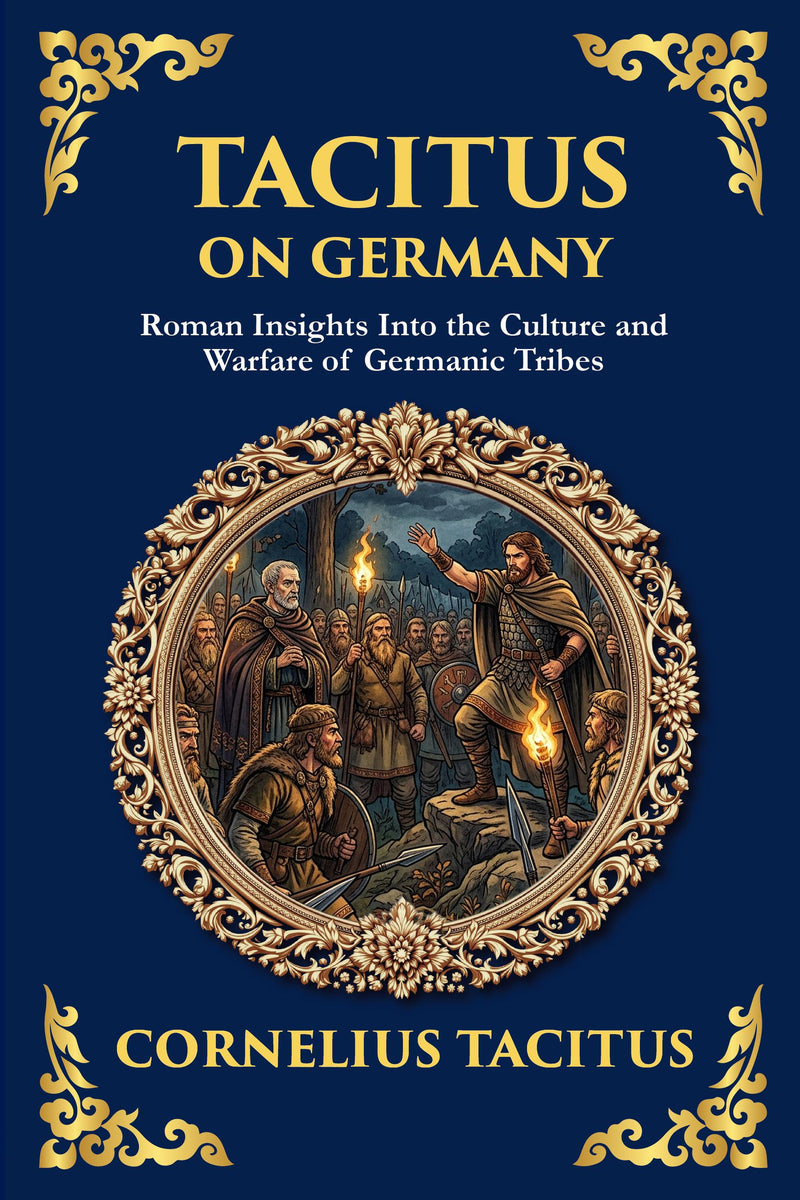
Tacitus on Germany
In a world where empires rose and fell, one Roman historian turned his gaze beyond the frontier —to the untamed tribes of Germania.
or free app
10,000+ hrs library
30-day guarantee
The complete Tacitus on Germany appears in modern English through Library of Alexandria Press, available online with audiobook narration included for members.
Have you ever wondered why ancient tribes could terrify even the mightiest empires? Tacitus on Germany: Roman Insights Into the Culture and Warfare of Germanic Tribes is a remarkable window into the world beyond the Roman Empire. Written by the eminent Roman historian Cornelius Tacitus around 98 AD, this work—commonly known as Germania— examines the customs, laws, rituals, and martial discipline of the various Germanic peoples living beyond the Rhine.
Far from a mere catalog of tribes, Tacitus’s Germania is a study in contrasts. He admires the tribes’ bravery, honor-based leadership, and communal values—while subtly condemning the corruption, luxury, and moral decay of imperial Rome. What emerges is not only an anthropological document, but also a mirror held up to Tacitus’s own civilization.
This modern edition brings clarity and context to Tacitus’s keen observations, offering both historical precision and accessibility for modern readers interested in the roots of European identity and the origins of tribal resistance.
What you’ll discover in this modern edition
- Cultural Profiles of Germanic Tribes Learn about the laws, leadership structures, family life, and warfare practices of ancient Germanic peoples
- A Roman Historian’s Perspective Understand how Tacitus both admired and idealized these tribes as a critique of his own society
- Early Ethnography and Political Philosophy Discover the foundational influence this work had on Western anthropology, nationalism, and historical theory
- Clear, Modern Translation Thoughtfully adapted to preserve Tacitus’s intent while ensuring readability for the 21st- century audience
- A Legacy That Shaped Europe’s Self-Understanding See how this short work influenced medieval chroniclers, Enlightenment philosophers, and even modern national movements
| Formats | eBook (EPUB + PDF) · Audiobook · Paperback · Hardcover · Large Print |
| Language | English |
| Trim size (print) | 6 × 9 in |
| Binding | Paperback — perfect-bound · Hardcover — casewrap |
| Large Print edition | Same text in a larger, easy-read type — a larger font, not a larger trim |
| Print pricing | Every physical book at our true cost — at-cost, no profit (members) |
| Library | 873 restored titles, always growing |
| Length | 14,316 words · ~57 min reading |
| Reading level | Grade 4 · an easy, flowing read (this modern-English edition) |
| Edition | Modern English translation · 2026 |
Member reviews for this edition are collected as readers finish it — be the first. Across the library: 12,000+ books shipped, every plan covered by a 365-day print guarantee.
About this edition
A faithful, unabridged modern-English edition by The Library of Alexandria — carefully rendered for today's reader and verified paragraph-by-paragraph against the public-domain source. Available as eBook, audiobook, paperback, hardcover, and large print.
- Complete & unabridgedVerified paragraph by paragraph against the source — never a scan, never abridged.
- Modern English, faithfulReadable today, with the author’s meaning kept intact. Readable — not simplified.
- Every format, one membershipRead in your browser or the free app, or listen to the full audiobook.
Included free with your membership
Cancel anytime, one click · 30-day money-back guarantee
Edition last updated July 2026
What’s inside
Tacitus on Germany — complete and unabridged, included in full with membership, plus the full audiobook.
Begin reading Tacitus on Germany
In clear modern English — the complete text is included with membership.
Introduction
When a Roman senator and historian set down his observations of the peoples living beyond the Rhine and the Danube near the close of the first century AD, he could scarcely have imagined that his slim treatise would survive nearly two millennia to become one of the most consulted, debated, admired, and misused texts in the entire Western tradition. Yet that is precisely what happened. The short work you are about to read—composed around the year 98 AD and known to history by its Latin title De origine et situ Germanorum, or simply the Germania—has cast a shadow and a light far longer than its modest length would suggest. It is at once an ethnographic survey, a moral commentary, a piece of political reflection, and, depending on how one chooses to read it, a warning addressed to the author’s own civilization.
This edition presents that ancient text in a modern translation, adapted with the contemporary reader in mind. The aim has been to preserve the bite and concentration of the original prose while clearing away the obstacles that often stand between a modern audience and a classical author: the unfamiliar names, the compressed allusions, the assumptions about a shared cultural world that no longer exist. What remains is the voice of an extraordinarily intelligent observer attempting to describe a world utterly foreign to his own, and in doing so revealing as much about himself and his readers as about the people he sought to portray. Before you begin, it is worth pausing to consider who this observer was, what he was trying to accomplish, and why his account has continued to provoke such intense responses across the centuries.
Cornelius Tacitus was born around 56 or 57 AD, into a Roman world that had recently emerged from civil war and was settling into the long, ambiguous reality of life under emperors. We know surprisingly little about his personal life—even his first name is uncertain, with some sources giving Publius and others Gaius—but we know a great deal about the kind of man he was, because his writings reveal a mind of rare penetration and a temperament shaped by both ambition and disillusionment. He rose through the standard sequence of public offices that defined a senatorial career, serving as praetor and eventually attaining the consulship, the highest regular magistracy in Rome, in the year 97. He was a celebrated orator in an age when oratory still carried weight, and he married into a distinguished family: his wife was the daughter of Gnaeus Julius Agricola, the general who completed the Roman conquest of much of Britain and whose biography Tacitus would later write.
Tacitus came of age and built his career during a particularly fraught period of imperial history. He lived through the reign of Domitian, the last of the Flavian emperors, whose increasingly suspicious and tyrannical rule cast a pall over the senatorial class to which Tacitus belonged. Senators learned to keep their heads down, to flatter when flattery was demanded, and to survive by silence. This experience marked Tacitus deeply. Much of his later writing is animated by a barely suppressed anger at the corruption of public life under autocracy, and by a corresponding nostalgia—perhaps idealized, perhaps genuine—for an older Rome of liberty, severity, and civic virtue. When Domitian was assassinated in 96 and the more moderate emperors Nerva and then Trajan came to power, the atmosphere relaxed, and it was in this period of cautious renewal that Tacitus produced his first works.
The Germania belongs to this early phase of his literary output, written at roughly the same time as his biography of Agricola and well before the great historical masterpieces of his maturity, the Histories and the Annals, on which his towering reputation as a historian principally rests. It is important to grasp this sequence, because it tells us something about the perspective from which the Germania was written. This is not the work of a young man dazzled by the exotic; it is the work of a mature politician and intellectual at the height of his powers, a man who had seen the inner workings of empire and had formed firm, even bitter, opinions about the trajectory of his own society. When he turned his gaze northward to the tribes beyond the imperial frontier, he did so as a Roman acutely aware of what Rome had become.
To understand why the Germanic peoples should have interested him at all, we must remember what they represented in the Roman imagination. For centuries the regions north of the great rivers had been a source of both fascination and dread. The Romans had not forgotten the catastrophe of the Teutoburg Forest in 9 AD, when three entire legions under the command of Publius Quinctilius Varus were annihilated by a coalition of Germanic tribes led by Arminius—a disaster so traumatic that the emperor Augustus was said to have wandered his palace striking his head against the doors and crying out for Varus to give him back his legions. The frontier along the Rhine and Danube remained one of the most heavily militarized zones of the entire empire, garrisoned by large concentrations of troops precisely because the danger from across the rivers was understood to be real and persistent. The Germanic peoples were not a distant abstraction to the Roman mind. They were the great unconquered neighbor, the population that Rome had failed to absorb, the living reminder that the empire had limits.
It was natural, then, that an educated Roman audience should want to know more about these people—their customs, their religion, their methods of war, their political organization, the lands they inhabited. Tacitus was not the first to write about them; he drew on earlier accounts, most notably the now-largely-lost writings of the elder Pliny, who had served on the German frontier and composed a multi-volume history of the German wars, as well as on the famous descriptions left by Julius Caesar in his account of the Gallic War. But Tacitus brought to the subject a literary artistry and a moral seriousness that set his treatment apart. The result is a work that functions on several levels at once, and appreciating those levels is the key to reading it well.
The first and most obvious level is the ethnographic. The treatise sets out to describe a people: where they live, what they look like, how they organize their families and communities, what gods they worship, how they fight, how they govern themselves, what they eat and drink, how they treat their guests, their slaves, their dead. It moves from general observations applicable to the Germanic peoples as a whole to a survey of individual tribes, ranging across a vast geography and cataloguing groups with names that would have meant little to the average Roman reader and mean even less to us today. This descriptive impulse connects the work to a long tradition of classical ethnography stretching back to the Greek historians, who had long been interested in the customs of foreign peoples as a way of understanding the variety of human existence.
But the second level is where the Germania becomes truly arresting, and it is the level on which most modern controversy turns. Tacitus does not describe the Germanic tribes neutrally. Again and again, he uses them as a foil, a mirror, a counterexample against which to measure—and to criticize—his own civilization. Where the Romans of his day had grown, in his view, soft, luxurious, greedy, and politically servile, the Germanic peoples are presented as hardy, austere, fiercely independent, sexually chaste, and contemptuous of the wealth and refinement that had corrupted the Mediterranean world. Their marriages are presented as models of fidelity. Their hospitality is presented as boundless. Their courage in battle is presented as ferocious and uncompromising. When Tacitus praises the chastity of Germanic women or the simplicity of Germanic life, he is implicitly rebuking the adulteries and excesses of Roman high society. When he describes the freedom-loving spirit of the tribes, he is mourning the loss of liberty under the emperors.
This brings us to one of the most important things a modern reader needs to understand before turning to the text itself: the Germania is not, and was never meant to be, a purely objective report. It is a literary and moral document shaped by its author’s purposes, prejudices, and limitations. Some of what Tacitus tells us is accurate, confirmed by archaeology and by other sources. Some of it is exaggerated for effect. Some of it is borrowed from earlier writers and may have been out of date even when he set it down. And some of it almost certainly reflects what Tacitus wished to be true—or what he wished his Roman readers to feel—rather than what he had verified.
It is, in fact, quite possible that Tacitus never set foot in the lands he describes. There is no firm evidence that he ever traveled to the German frontier, and much of his information was probably gathered second-hand: from the accounts of soldiers and merchants, from earlier books, from the reports of officials. This does not make his work worthless as evidence—far from it—but it means we must read it critically, alert to the difference between observation and reconstruction, between fact and idealization. The technique of holding up a foreign people as a moral mirror to one’s own society was an old one. The “noble savage” was not invented in the eighteenth century; the Greeks and Romans had long used distant or primitive peoples as vehicles for criticizing their own corruption. When you read Tacitus praising the simple virtues of the tribes, you are reading a Roman moralist as much as a Roman reporter, and the praise tells you about Roman anxieties as much as about Germanic realities.
This double character—part description, part reflection—is precisely what makes the Germania so endlessly fascinating, and it is also what has made it so dangerous. For the great and terrible irony of this little book is that its long afterlife has been bound up with one of the darkest chapters in human history. The text was rediscovered and circulated again in the Renaissance, and over the following centuries it became something of a foundational document for emerging ideas of national and ethnic identity in the German-speaking lands. The notion that the modern inhabitants of those regions were descended from a pure, vigorous, freedom-loving ancient stock—a people unlike the decadent Mediterranean civilizations—drew enormous nourishment from Tacitus’s pages. By the nineteenth and especially the twentieth century, these ideas had curdled into something poisonous. The racial ideologues of the Nazi era seized upon the Germania as supposed ancient testimony to the existence of a distinct and superior Germanic race, and certain passages—particularly those in which Tacitus speculates that the tribes were native to their land and unmixed with other peoples—were quoted and weaponized in the service of an ideology of racial purity that culminated in catastrophe.
It is worth being absolutely clear about this so that you can read with open eyes: the uses to which the Germania was later put bear no necessary relationship to what Tacitus actually wrote or intended. He was a Roman describing a foreign people for a Roman audience, not a prophet of nineteenth-century nationalism or twentieth-century racial theory. The passage about the tribes being “indigenous” and physically uniform reflects ancient ideas about the relationship between peoples and their environment, not a modern biological theory of race. To read these lines as if they were a charter for any later political movement is to commit a profound anachronism. Nevertheless, the history of how the book has been read is part of its story, and an honest introduction cannot pass over it in silence. One of the marks of reading a classic well is the ability to separate what an author wrote from what later generations did with it. The text is innocent of its own misuse; the responsibility for that misuse lies entirely with those who twisted it.
Cancel anytime, one click · 30-day money-back guarantee
Founding annual rate available now — your price locks for life when you join.
Not ready? Get this free chapter by email — read it anytime.
✓ Sent — check your inbox for Tacitus on Germany.
Questions about Tacitus on Germany
What is Tacitus on Germany about?
In a world where empires rose and fell, one Roman historian turned his gaze beyond the frontier —to the untamed tribes of Germania. Tacitus on Germany is a compelling ethnographic and political account of ancient Germanic peoples, their customs, values, and military might, seen through the sharp lens of a Roman senator. Written in the first century AD, Tacitus’s Germania is both an anthropological marvel and a political critique—drawing contrasts between Roman decadence and Germanic virtue.
Who wrote Tacitus on Germany?
Tacitus on Germany was written by Cornelius Tacitus. This edition presents the complete work in clear modern English, faithfully rendered from the public-domain original by Library of Alexandria Press.
Is Tacitus on Germany free to read?
The opening chapter is free to read on this page. Members read and listen to the complete work — and the entire library — free, and can order any physical book at our true print cost.
How long is Tacitus on Germany?
2 chapters (~14,316 words) — about 57 min of reading in this modern-English edition.
Is this an abridged version of Tacitus on Germany?
No. This is the complete, unabridged Tacitus on Germany, carefully rendered into clear modern English and verified paragraph-by-paragraph against the public-domain source — nothing is cut or summarised.
What formats does Tacitus on Germany come in?
Tacitus on Germany is available as eBook, paperback, hardcover and large print. eBook and audiobook are included with membership; printed editions ship at our true print cost.
Shipping & returns
Billing & membership
More from the library


Explore Classic & Literary
- Dream Psychology: Psychoanalysis for Beginners · Sigmund Freud
- Great Expectations · Charles Dickens
- The Brothers Karamazov · Fyodor Dostoyevsky
- The Great Gatsby · F. Scott Fitzgerald
- Wild Flowers Worth Knowing · Neltje Blanchan
- Italian Hours · Henry James
- A Popular History of France from the Earliest Times, Volume 5 · François Guizot
- A history of English literature: A practical text-book · Edward Albert
- Italian Highways and Byways from a Motor Car · M. F. Mansfield
- The Heart-Cry of Jesus · Byron J. Rees
- Castes and Tribes of Southern India. Vol. 6 of 7 · Edgar Thurston
- Against the Grain · J.-K. Huysmans
- Dombey and Son · Charles Dickens
- How to Invest Money · George Garr Henry
- The Great Controversy Between Christ and Satan · Ellen Gould Harmon White
- One Hundred Proofs That the Earth Is Not a Globe · William Carpenter
- Southern Literature From 1579–1895 · Louise Manly
- The Renaissance: Studies in Art and Poetry · Walter Pater
- Mark Twain’s Speeches · Mark Twain
- The Rosary · Florence L. Barclay
- Peculiarities of American Cities · Willard W. Glazier
- Tennis for Girls · Florence A. Ballin
- The World’s Greatest Books — Volume 02 — Fiction
- Shirley · Charlotte Brontë
- Daisy Miller: A Study · Henry James
- Louis Lambert · Honoré de Balzac
- Historic Jamaica · Frank Cundall
- The Gambler · Fyodor Dostoyevsky
- The Mayor of Casterbridge · Thomas Hardy
- The International Jew: The World’s Foremost Problem
Tacitus on Germany
Tacitus on Germany
Roman Perspectives on the Culture and Warfare of the Germanic Tribes
Cornelius Tacitus
Contents
- Introduction
- Tacitus on Germany
Introduction
When a Roman senator and historian set down his observations of the peoples living beyond the Rhine and the Danube near the close of the first century AD, he could scarcely have imagined that his slim treatise would survive nearly two millennia to become one of the most consulted, debated, admired, and misused texts in the entire Western tradition. Yet that is precisely what happened. The short work you are about to read—composed around the year 98 AD and known to history by its Latin title De origine et situ Germanorum, or simply the Germania—has cast a shadow and a light far longer than its modest length would suggest. It is at once an ethnographic survey, a moral commentary, a piece of political reflection, and, depending on how one chooses to read it, a warning addressed to the author’s own civilization.
This edition presents that ancient text in a modern translation, adapted with the contemporary reader in mind. The aim has been to preserve the bite and concentration of the original prose while clearing away the obstacles that often stand between a modern audience and a classical author: the unfamiliar names, the compressed allusions, the assumptions about a shared cultural world that no longer exist. What remains is the voice of an extraordinarily intelligent observer attempting to describe a world utterly foreign to his own, and in doing so revealing as much about himself and his readers as about the people he sought to portray. Before you begin, it is worth pausing to consider who this observer was, what he was trying to accomplish, and why his account has continued to provoke such intense responses across the centuries.
Cornelius Tacitus was born around 56 or 57 AD, into a Roman world that had recently emerged from civil war and was settling into the long, ambiguous reality of life under emperors. We know surprisingly little about his personal life—even his first name is uncertain, with some sources giving Publius and others Gaius—but we know a great deal about the kind of man he was, because his writings reveal a mind of rare penetration and a temperament shaped by both ambition and disillusionment. He rose through the standard sequence of public offices that defined a senatorial career, serving as praetor and eventually attaining the consulship, the highest regular magistracy in Rome, in the year 97. He was a celebrated orator in an age when oratory still carried weight, and he married into a distinguished family: his wife was the daughter of Gnaeus Julius Agricola, the general who completed the Roman conquest of much of Britain and whose biography Tacitus would later write.
Tacitus came of age and built his career during a particularly fraught period of imperial history. He lived through the reign of Domitian, the last of the Flavian emperors, whose increasingly suspicious and tyrannical rule cast a pall over the senatorial class to which Tacitus belonged. Senators learned to keep their heads down, to flatter when flattery was demanded, and to survive by silence. This experience marked Tacitus deeply. Much of his later writing is animated by a barely suppressed anger at the corruption of public life under autocracy, and by a corresponding nostalgia—perhaps idealized, perhaps genuine—for an older Rome of liberty, severity, and civic virtue. When Domitian was assassinated in 96 and the more moderate emperors Nerva and then Trajan came to power, the atmosphere relaxed, and it was in this period of cautious renewal that Tacitus produced his first works.
The Germania belongs to this early phase of his literary output, written at roughly the same time as his biography of Agricola and well before the great historical masterpieces of his maturity, the Histories and the Annals, on which his towering reputation as a historian principally rests. It is important to grasp this sequence, because it tells us something about the perspective from which the Germania was written. This is not the work of a young man dazzled by the exotic; it is the work of a mature politician and intellectual at the height of his powers, a man who had seen the inner workings of empire and had formed firm, even bitter, opinions about the trajectory of his own society. When he turned his gaze northward to the tribes beyond the imperial frontier, he did so as a Roman acutely aware of what Rome had become.
To understand why the Germanic peoples should have interested him at all, we must remember what they represented in the Roman imagination. For centuries the regions north of the great rivers had been a source of both fascination and dread. The Romans had not forgotten the catastrophe of the Teutoburg Forest in 9 AD, when three entire legions under the command of Publius Quinctilius Varus were annihilated by a coalition of Germanic tribes led by Arminius—a disaster so traumatic that the emperor Augustus was said to have wandered his palace striking his head against the doors and crying out for Varus to give him back his legions. The frontier along the Rhine and Danube remained one of the most heavily militarized zones of the entire empire, garrisoned by large concentrations of troops precisely because the danger from across the rivers was understood to be real and persistent. The Germanic peoples were not a distant abstraction to the Roman mind. They were the great unconquered neighbor, the population that Rome had failed to absorb, the living reminder that the empire had limits.
It was natural, then, that an educated Roman audience should want to know more about these people—their customs, their religion, their methods of war, their political organization, the lands they inhabited. Tacitus was not the first to write about them; he drew on earlier accounts, most notably the now-largely-lost writings of the elder Pliny, who had served on the German frontier and composed a multi-volume history of the German wars, as well as on the famous descriptions left by Julius Caesar in his account of the Gallic War. But Tacitus brought to the subject a literary artistry and a moral seriousness that set his treatment apart. The result is a work that functions on several levels at once, and appreciating those levels is the key to reading it well.
The first and most obvious level is the ethnographic. The treatise sets out to describe a people: where they live, what they look like, how they organize their families and communities, what gods they worship, how they fight, how they govern themselves, what they eat and drink, how they treat their guests, their slaves, their dead. It moves from general observations applicable to the Germanic peoples as a whole to a survey of individual tribes, ranging across a vast geography and cataloguing groups with names that would have meant little to the average Roman reader and mean even less to us today. This descriptive impulse connects the work to a long tradition of classical ethnography stretching back to the Greek historians, who had long been interested in the customs of foreign peoples as a way of understanding the variety of human existence.
But the second level is where the Germania becomes truly arresting, and it is the level on which most modern controversy turns. Tacitus does not describe the Germanic tribes neutrally. Again and again, he uses them as a foil, a mirror, a counterexample against which to measure—and to criticize—his own civilization. Where the Romans of his day had grown, in his view, soft, luxurious, greedy, and politically servile, the Germanic peoples are presented as hardy, austere, fiercely independent, sexually chaste, and contemptuous of the wealth and refinement that had corrupted the Mediterranean world. Their marriages are presented as models of fidelity. Their hospitality is presented as boundless. Their courage in battle is presented as ferocious and uncompromising. When Tacitus praises the chastity of Germanic women or the simplicity of Germanic life, he is implicitly rebuking the adulteries and excesses of Roman high society. When he describes the freedom-loving spirit of the tribes, he is mourning the loss of liberty under the emperors.
This brings us to one of the most important things a modern reader needs to understand before turning to the text itself: the Germania is not, and was never meant to be, a purely objective report. It is a literary and moral document shaped by its author’s purposes, prejudices, and limitations. Some of what Tacitus tells us is accurate, confirmed by archaeology and by other sources. Some of it is exaggerated for effect. Some of it is borrowed from earlier writers and may have been out of date even when he set it down. And some of it almost certainly reflects what Tacitus wished to be true—or what he wished his Roman readers to feel—rather than what he had verified.
It is, in fact, quite possible that Tacitus never set foot in the lands he describes. There is no firm evidence that he ever traveled to the German frontier, and much of his information was probably gathered second-hand: from the accounts of soldiers and merchants, from earlier books, from the reports of officials. This does not make his work worthless as evidence—far from it—but it means we must read it critically, alert to the difference between observation and reconstruction, between fact and idealization. The technique of holding up a foreign people as a moral mirror to one’s own society was an old one. The “noble savage” was not invented in the eighteenth century; the Greeks and Romans had long used distant or primitive peoples as vehicles for criticizing their own corruption. When you read Tacitus praising the simple virtues of the tribes, you are reading a Roman moralist as much as a Roman reporter, and the praise tells you about Roman anxieties as much as about Germanic realities.
This double character—part description, part reflection—is precisely what makes the Germania so endlessly fascinating, and it is also what has made it so dangerous. For the great and terrible irony of this little book is that its long afterlife has been bound up with one of the darkest chapters in human history. The text was rediscovered and circulated again in the Renaissance, and over the following centuries it became something of a foundational document for emerging ideas of national and ethnic identity in the German-speaking lands. The notion that the modern inhabitants of those regions were descended from a pure, vigorous, freedom-loving ancient stock—a people unlike the decadent Mediterranean civilizations—drew enormous nourishment from Tacitus’s pages. By the nineteenth and especially the twentieth century, these ideas had curdled into something poisonous. The racial ideologues of the Nazi era seized upon the Germania as supposed ancient testimony to the existence of a distinct and superior Germanic race, and certain passages—particularly those in which Tacitus speculates that the tribes were native to their land and unmixed with other peoples—were quoted and weaponized in the service of an ideology of racial purity that culminated in catastrophe.
It is worth being absolutely clear about this so that you can read with open eyes: the uses to which the Germania was later put bear no necessary relationship to what Tacitus actually wrote or intended. He was a Roman describing a foreign people for a Roman audience, not a prophet of nineteenth-century nationalism or twentieth-century racial theory. The passage about the tribes being “indigenous” and physically uniform reflects ancient ideas about the relationship between peoples and their environment, not a modern biological theory of race. To read these lines as if they were a charter for any later political movement is to commit a profound anachronism. Nevertheless, the history of how the book has been read is part of its story, and an honest introduction cannot pass over it in silence. One of the marks of reading a classic well is the ability to separate what an author wrote from what later generations did with it. The text is innocent of its own misuse; the responsibility for that misuse lies entirely with those who twisted it.
This is how the borders of Germany are defined. The Rhine and Danube rivers separate it from Gaul, Rhoetia, and Pannonia. It is divided from Sarmatia and Dacia by mutual fear or by towering mountains. The rest of the region is surrounded by the ocean, which creates massive bays and includes a vast stretch of islands; indeed, we have recently learned of certain nations and kingdoms there, revealed to us through war. The Rhine begins in the Rhoetian Alps, starting from a steep, rocky peak, and after curving slightly to the west, it flows into the Northern Ocean. The Danube originates from Mount Abnoba, which is very high but easy to climb. After passing through several territories, it empties into the Euxine Sea via six different streams, as its seventh channel is swallowed by the marshes.
I believe the Germans descended from a single people and have not mixed with other nations. In ancient times, people looking for new homes didn’t travel by land; they sailed in fleets. Very few ships from our world ever ventured into that vast, endless ocean, which I would describe as hostile and forbidding. Furthermore, given the dangers of a violent and mysterious sea, who would leave Asia, Africa, or Italy to move to Germany? It is a harsh, rugged land with a brutal climate, depressing to look at and difficult to farm, unless it was already one’s homeland. In their old songs—which serve as their only records and history—they honor Tuisto, a god born from the earth, and his son Mannus as the ancestors and founders of the nation. They say Mannus had three sons, from whom three groups of people take their names: the Ingaevones, who live by the ocean; the Herminones, who live in the central region; and the rest, the Instaevones. Some people, using the mystery of the distant past as a justification, claim the god had more sons. They argue that this led to more tribal names, such as the Marsians, Gambrians, Suevians, and Vandalians, and that these are the truly original names. Others claim that “Germany” is a new term. They say that the people who first crossed the Rhine and drove out the Gauls—now known as the Tungrians—were called Germans at the time. Gradually, the name of one specific tribe became the name for the whole population. Because they were first known by a name associated with terror and conquest, they later chose to be identified by that new title and became known universally as Germans.
End of the free sample
Keep reading, free
Members read and listen to the complete book — and the entire library. Cancel anytime, one click · 30-day money-back guarantee.