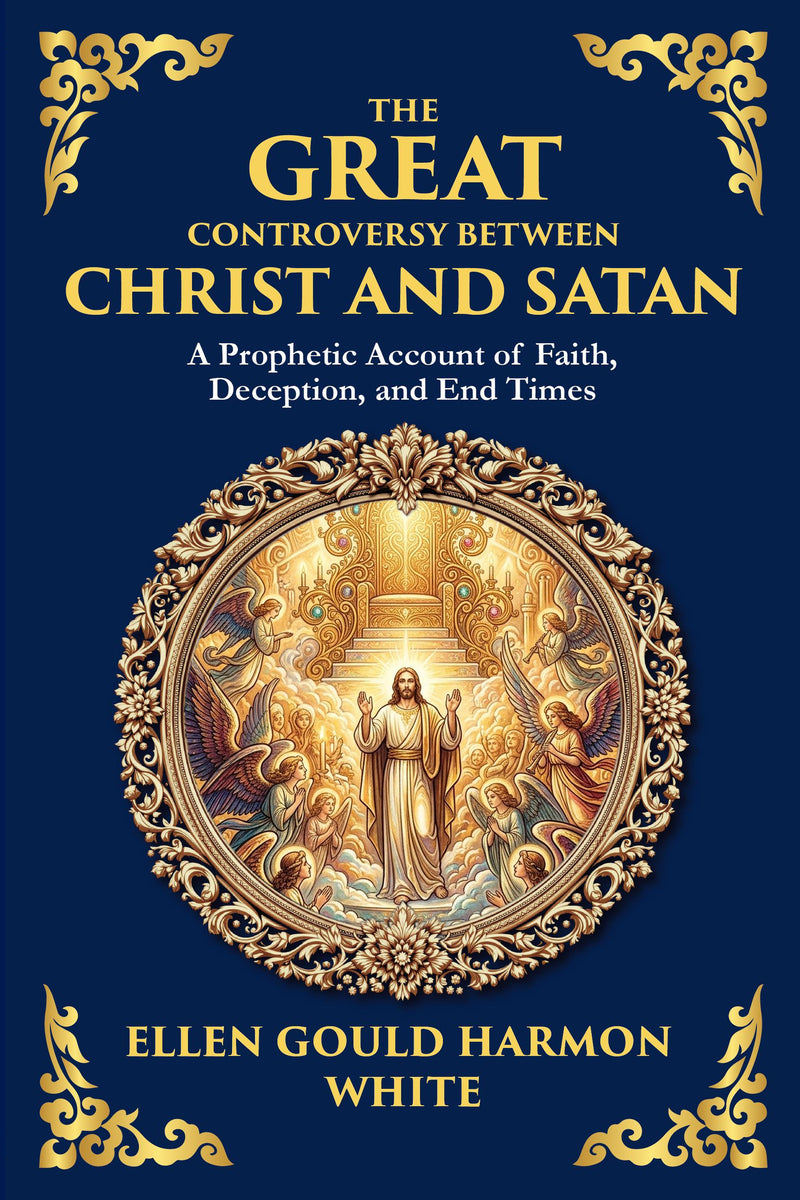
The Great Controversy Between Christ and Satan
Ellen G. White From the heavenly rebellion of Lucifer to the final judgment of humanity, The Great Controversy unveils the spiritual war raging across the ages.
or free app
10,000+ hrs library
30-day guarantee
The complete The Great Controversy Between appears in modern English through Library of Alexandria Press, available online with audiobook narration included for members.
Have you ever wondered why history seems caught in a war between light and darkness? The Great Controversy Between Christ and Satan by Ellen G. White is a prophetic chronicle of a spiritual conflict that spans heaven, earth, and the human heart. This gripping narrative begins with the fall of Lucifer and traces the thread of rebellion through biblical times, the Dark Ages, the Protestant Reformation, the rise of religious liberty, and into the final chapters of Earth's destiny.
White paints a vivid picture of how the cosmic battle between good and evil has influenced world empires, church systems, and individual souls. With historical insight and apocalyptic vision, she lays bare the strategies of deception used by Satan to lead humanity astray—and reveals how God’s truth has always shined through the darkness. This modern edition presents The Great Controversy in accessible language for today’s readers, while retaining the power, conviction, and prophetic force of the original.
It is a guidebook for those seeking clarity in a world filled with spiritual confusion and moral compromise.
What you’ll discover in this modern edition
- A Panoramic View of Salvation History – From Eden to the New Earth, follow the events that reveal the full scope of God’s redemptive plan.
- Prophetic Insight into the End Times – Explore urgent warnings about global deception, spiritual warfare, and the coming crisis of conscience.
- The Role of Liberty and Truth – Learn why religious freedom is central to the battle between Christ and Satan.
- Historical Foundations of Modern Faith – Understand how the Reformation, Great Awakening, and key historical movements shaped present-day Christianity.
- A Call to Moral Courage and Spiritual Clarity – Be equipped to stand for truth, resist compromise, and prepare for what lies ahead.
| Formats | eBook (EPUB + PDF) · Audiobook · Paperback · Hardcover · Large Print |
| Language | English |
| Trim size (print) | 6 × 9 in |
| Binding | Paperback — perfect-bound · Hardcover — casewrap |
| Large Print edition | Same text in a larger, easy-read type — a larger font, not a larger trim |
| Print pricing | Every physical book at our true cost — at-cost, no profit (members) |
| Library | 873 restored titles, always growing |
| Length | 218,744 words · ~14 hr 35 min reading |
| Reading level | Grade 6 · an easy, flowing read (this modern-English edition) |
| Edition | Modern English translation · 2026 |
Member reviews for this edition are collected as readers finish it — be the first. Across the library: 12,000+ books shipped, every plan covered by a 365-day print guarantee.
About this edition
A faithful, unabridged modern-English edition by The Library of Alexandria — carefully rendered for today's reader and verified paragraph-by-paragraph against the public-domain source. Available as eBook, audiobook, paperback, hardcover, and large print.
- Complete & unabridgedVerified paragraph by paragraph against the source — never a scan, never abridged.
- Modern English, faithfulReadable today, with the author’s meaning kept intact. Readable — not simplified.
- Every format, one membershipRead in your browser or the free app, or listen to the full audiobook.
Included free with your membership
Cancel anytime, one click · 30-day money-back guarantee
Edition last updated July 2026
What’s inside
The Great Controversy Between Christ and Satan — complete and unabridged: all 44 sections included with membership, plus the full audiobook.
Begin reading The Great Controversy Between Christ and Satan
In clear modern English — the complete text is included with membership.
Introduction
There are books that describe history, and there are books that claim to interpret it. The Great Controversy Between Christ and Satan belongs firmly to the second category, and that distinction is the first thing a thoughtful reader should understand before turning the page. Written by Ellen Gould Harmon White and presented here in a modern translation adapted for the contemporary reader, this 1917 work does not set out merely to recount the events of the past two thousand years of Christian history. It sets out to explain what those events mean, to trace the invisible threads that, in the author’s conviction, connect the fall of the Roman Empire, the burning of medieval reformers, the upheavals of the Renaissance, and the spiritual condition of the modern world to a single, cosmic conflict—a struggle between good and evil that began before human history and will conclude only at its end.
To read this book well is to read it on its own terms. White was not a detached academic surveying centuries of religious development from a neutral distance. She was a participant in one of the most remarkable religious movements of the nineteenth century, a woman who believed herself to be the recipient of prophetic visions, and a writer whose every sentence is animated by a sense of urgent moral purpose. Whether one shares her convictions, observes them with curiosity, or approaches them with skepticism, the experience of reading her is unlike the experience of reading conventional church history. She writes as someone who believes the stakes could not possibly be higher, and that intensity gives the book its peculiar power.
This introduction is intended to prepare you—not to summarize what follows, and certainly not to spoil the unfolding drama that White constructs across her chapters, but to orient you. A reader who understands where this book comes from, what tradition produced it, and how to engage with its distinctive voice will find a far richer experience than one who comes to it cold. The pages ahead contain a sweeping panorama of human faith under pressure: stories of courage and betrayal, of conviction tested by fire, of ideas that toppled empires and individuals who refused to bend. They also contain a particular and uncompromising theology that has shaped, and continues to shape, the lives of millions of believers around the world. Both dimensions deserve your attention.
Ellen Gould Harmon White was born in 1827 in Gorham, Maine, into a world that was about to be shaken by one of the great religious enthusiasms of American history. Her early life was marked by hardship. As a child she suffered a serious injury that interrupted her formal education and left her in fragile health for years afterward—a circumstance that makes the eventual scope of her literary output all the more astonishing. She produced an enormous body of writing over the course of her long life, addressing subjects that ranged from theology and prophecy to education, health, and the practical conduct of daily life.
To understand White, one must understand the spiritual climate in which she came of age. The northeastern United States in the 1830s and 1840s was a region of fervent religious revival, an area so frequently swept by waves of evangelical preaching that it earned the nickname “the burned-over district.” Out of this environment arose the Millerite movement, named for the Baptist preacher William Miller, who through intensive study of biblical prophecy became convinced that the second coming of Christ was imminent and could be calculated to a specific timeframe. Thousands of Americans embraced Miller’s predictions with profound seriousness, abandoning ordinary concerns to prepare for what they believed would be the end of the world.
The young Ellen Harmon was among those caught up in this expectation. When the anticipated date passed without the predicted return of Christ—an event that came to be known among the disappointed faithful as “the Great Disappointment”—the movement might easily have collapsed into despair and dissolution, as many such movements have throughout history. Instead, a remnant of believers sought to understand what had gone wrong, reexamining their interpretation of prophecy and arriving at new conclusions about the meaning of the events they had lived through. From this crucible emerged the religious tradition that would eventually become the Seventh-day Adventist Church, and Ellen White would become one of its most influential founding figures.
It was shortly after the Great Disappointment that White reported the first of the visionary experiences that would define her role for the rest of her life. She claimed to receive divine revelations—visions and impressions that she believed came directly from God and that she understood as guidance for the emerging church and for individual believers. Her followers came to regard her as a prophet, a designation she herself used cautiously, sometimes preferring the term “messenger.” These claims are, inevitably, a matter of faith. The reader need not accept them to appreciate the work, but understanding that White and her community sincerely believed in them is essential to reading the book as it was meant to be read. When she describes the unseen activity of angels and demons influencing the course of human affairs, she is not employing metaphor or literary device. She means it literally, and the conviction behind the words is what gives them their charge.
What is beyond dispute is the breadth of White’s influence. The church she helped to establish has grown into a global movement with many millions of adherents, and her writings remain foundational texts within that community. The Great Controversy in particular has been published in countless editions and translated into many languages, distributed across continents, and read by generations of believers. The 1917 edition presented here represents one of the mature forms of a work that White revised and expanded over the course of her career, refining her sweeping narrative as her understanding deepened and as she sought to communicate it more effectively to readers of her own time.
This modern translation is offered in that same spirit of communication. White wrote in the cadences of the late nineteenth and early twentieth centuries, a prose style that was eloquent and dignified in its day but that can present obstacles to readers more than a century later. The adaptation aims to preserve the substance, the argument, and the emotional weight of her writing while making her sentences more accessible to a contemporary audience. The goal is not to alter what she said but to ensure that what she said can still be clearly heard. Readers familiar with older editions will recognize the work; readers encountering it for the first time will find a doorway opened rather than a barrier raised.
The most important thing to grasp about this book is its governing idea, the lens through which every event it describes is interpreted. White’s title states it plainly: she is writing about a controversy—a conflict—between Christ and Satan. In her understanding, all of human history is the visible expression of an invisible war. On one side stands God, whose character is defined by love, truth, and self-giving sacrifice. On the other stands a fallen adversary, an intelligent and malevolent being who rebelled against God and who has, ever since, sought to deceive humanity, to obscure the truth about God’s nature, and to draw human beings into rebellion of their own.
This framework transforms the way historical events are presented. When White describes a moment of religious persecution, she does not treat it merely as a political or social phenomenon to be explained by ordinary causes. She sees behind it the working of spiritual forces. When she describes a courageous stand for conscience, she sees the influence of God strengthening a faithful soul. The whole of her narrative is, in this sense, double-layered: there is the surface of recorded history, the kings and councils and burnings and proclamations, and beneath it the deeper reality of the controversy that gives those events their true significance.
This approach has consequences for how the book reads. It moves with a momentum and a sense of meaning that conventional history rarely possesses, because for White nothing is accidental and nothing is trivial. Every figure she portrays is a player in a drama whose ultimate outcome has already been determined but whose individual battles are still being fought. The reformers and martyrs she celebrates are not simply interesting historical personalities; they are exemplars of fidelity in the cosmic struggle. The institutions and powers she criticizes are not simply objects of historical analysis; they are, in her view, instruments through which deception has operated.
A reader should approach this with both openness and awareness. White’s interpretation of history is shaped throughout by her particular theological commitments, and she does not pretend otherwise. She has strong and definite views about which forms of Christianity preserved the truth and which corrupted it, about the meaning of biblical prophecy, and about the direction in which the world is moving. These views were and remain controversial. Some of her interpretations have been embraced as profound insight by those who share her faith, and challenged or rejected by those who do not, including many scholars and members of other religious traditions. The honest reader will recognize that this is a work of conviction, not of neutral scholarship, and will engage with it accordingly.
That recognition need not diminish the reading experience—indeed, it can enhance it. There is something genuinely compelling about encountering a writer who believes so completely in the coherence of history, who sees pattern and purpose where others see only chaos and contingency. Whether or not one accepts her conclusions, one cannot help but be drawn into the grand architecture of her vision. The book offers the reader a way of seeing, an interpretive key that promises to unlock the meaning of everything from the persecutions of the early centuries to the moral and spiritual conditions of the modern age. For many readers across more than a century, that key has been transformative; for others it has been a fascinating window into a way of understanding the world that is utterly committed and internally consistent.
White’s account ranges widely. She returns repeatedly to moments when, in her telling, the truth of God was preserved against tremendous pressure, when individuals and communities held fast to conviction despite the threat of suffering and death. She is deeply interested in the great turning points of Christian history, in the long centuries during which she believes essential truths were obscured, and in the movements that arose to recover them. She traces threads from the ancient world through the medieval period and into the modern era, always with an eye toward the larger pattern she is convinced underlies them. And she extends her gaze forward as well, for prophecy is central to her purpose. She believes the controversy is moving toward its climax, and she writes with the conviction that her readers are living in significant times.
It is precisely because the prophetic and forward-looking dimensions of the book are so central that I will say nothing here about how the narrative develops or where it arrives. To do so would be to deprive you of the experience White intended you to have—the gradual unfolding of her vision, the accumulation of historical episodes building toward her larger argument, the sense of a great design being progressively revealed. Part of the book’s effect depends on encountering it as a whole, allowing the cumulative weight of the narrative to do its work. The reader who is told the destination in advance arrives without the journey, and it is the journey that White intended to be transformative.
Cancel anytime, one click · 30-day money-back guarantee
Founding annual rate available now — your price locks for life when you join.
Not ready? Get this free chapter by email — read it anytime.
✓ Sent — check your inbox for The Great Controversy Between Christ and Satan.
Questions about The Great Controversy Between Christ and Satan
What is The Great Controversy Between about?
Ellen G. White From the heavenly rebellion of Lucifer to the final judgment of humanity, The Great Controversy unveils the spiritual war raging across the ages. Ellen G. White’s landmark work delivers a sweeping narrative of cosmic conflict—between Christ and Satan, truth and deception, freedom and tyranny. This powerful prophetic volume explores the hidden forces shaping religious liberty, the corruption of power, and the coming trials of the last days.
Who wrote The Great Controversy Between?
The Great Controversy Between was written by Ellen Gould Harmon White. This edition presents the complete work in clear modern English, faithfully rendered from the public-domain original by Library of Alexandria Press.
Is The Great Controversy Between free to read?
The opening chapter is free to read on this page. Members read and listen to the complete work — and the entire library — free, and can order any physical book at our true print cost.
How long is The Great Controversy Between?
44 chapters (~218,744 words) — about 14 hr 35 min of reading in this modern-English edition.
Is this an abridged version of The Great Controversy Between?
No. This is the complete, unabridged The Great Controversy Between, carefully rendered into clear modern English and verified paragraph-by-paragraph against the public-domain source — nothing is cut or summarised.
What formats does The Great Controversy Between come in?
The Great Controversy Between is available as eBook, paperback and hardcover. eBook and audiobook are included with membership; printed editions ship at our true print cost.
Shipping & returns
Billing & membership
More from the library


Explore Classic & Literary
- Dream Psychology: Psychoanalysis for Beginners · Sigmund Freud
- Great Expectations · Charles Dickens
- The Brothers Karamazov · Fyodor Dostoyevsky
- The Great Gatsby · F. Scott Fitzgerald
- Wild Flowers Worth Knowing · Neltje Blanchan
- Italian Hours · Henry James
- A Popular History of France from the Earliest Times, Volume 5 · François Guizot
- A history of English literature: A practical text-book · Edward Albert
- Italian Highways and Byways from a Motor Car · M. F. Mansfield
- The Heart-Cry of Jesus · Byron J. Rees
- Castes and Tribes of Southern India. Vol. 6 of 7 · Edgar Thurston
- Against the Grain · J.-K. Huysmans
- Dombey and Son · Charles Dickens
- How to Invest Money · George Garr Henry
- One Hundred Proofs That the Earth Is Not a Globe · William Carpenter
- Southern Literature From 1579–1895 · Louise Manly
- The Renaissance: Studies in Art and Poetry · Walter Pater
- Mark Twain’s Speeches · Mark Twain
- Tacitus on Germany · Cornelius Tacitus
- The Rosary · Florence L. Barclay
- Peculiarities of American Cities · Willard W. Glazier
- Tennis for Girls · Florence A. Ballin
- The World’s Greatest Books — Volume 02 — Fiction
- Shirley · Charlotte Brontë
- Daisy Miller: A Study · Henry James
- Louis Lambert · Honoré de Balzac
- Historic Jamaica · Frank Cundall
- The Gambler · Fyodor Dostoyevsky
- The Mayor of Casterbridge · Thomas Hardy
- The International Jew: The World’s Foremost Problem
The Great Controversy Between Christ and Satan
The Great Controversy Between Christ and Satan
A Prophetic Account of Faith, Deception, and the End Times
Ellen Gould Harmon White
Contents
- Introduction
- Preface by the Author
- Chapter 1
- Chapter 2
- Chapter 3
- Chapter 4
- Chapter 5
- Chapter 6
- Chapter 7
- Chapter 8
- Chapter 9
- Chapter 10
- Chapter 11
- Chapter 12
- Chapter 13
- Chapter 14
- Chapter 15
- Chapter 16
- Chapter 17
- Chapter 18
- Chapter 19
- Chapter 20
- Chapter 21
- Chapter 22
- Chapter 23
- Chapter 24
- Chapter 25
- Chapter 26
- Chapter 27
- Chapter 28
- Chapter 29
- Chapter 30
- Chapter 31
- Chapter 32
- Chapter 33
- Chapter 34
- Chapter 35
- Chapter 36
- Chapter 37
- Chapter 38
- … and 4 more chapters
Introduction
There are books that describe history, and there are books that claim to interpret it. The Great Controversy Between Christ and Satan belongs firmly to the second category, and that distinction is the first thing a thoughtful reader should understand before turning the page. Written by Ellen Gould Harmon White and presented here in a modern translation adapted for the contemporary reader, this 1917 work does not set out merely to recount the events of the past two thousand years of Christian history. It sets out to explain what those events mean, to trace the invisible threads that, in the author’s conviction, connect the fall of the Roman Empire, the burning of medieval reformers, the upheavals of the Renaissance, and the spiritual condition of the modern world to a single, cosmic conflict—a struggle between good and evil that began before human history and will conclude only at its end.
To read this book well is to read it on its own terms. White was not a detached academic surveying centuries of religious development from a neutral distance. She was a participant in one of the most remarkable religious movements of the nineteenth century, a woman who believed herself to be the recipient of prophetic visions, and a writer whose every sentence is animated by a sense of urgent moral purpose. Whether one shares her convictions, observes them with curiosity, or approaches them with skepticism, the experience of reading her is unlike the experience of reading conventional church history. She writes as someone who believes the stakes could not possibly be higher, and that intensity gives the book its peculiar power.
This introduction is intended to prepare you—not to summarize what follows, and certainly not to spoil the unfolding drama that White constructs across her chapters, but to orient you. A reader who understands where this book comes from, what tradition produced it, and how to engage with its distinctive voice will find a far richer experience than one who comes to it cold. The pages ahead contain a sweeping panorama of human faith under pressure: stories of courage and betrayal, of conviction tested by fire, of ideas that toppled empires and individuals who refused to bend. They also contain a particular and uncompromising theology that has shaped, and continues to shape, the lives of millions of believers around the world. Both dimensions deserve your attention.
Ellen Gould Harmon White was born in 1827 in Gorham, Maine, into a world that was about to be shaken by one of the great religious enthusiasms of American history. Her early life was marked by hardship. As a child she suffered a serious injury that interrupted her formal education and left her in fragile health for years afterward—a circumstance that makes the eventual scope of her literary output all the more astonishing. She produced an enormous body of writing over the course of her long life, addressing subjects that ranged from theology and prophecy to education, health, and the practical conduct of daily life.
To understand White, one must understand the spiritual climate in which she came of age. The northeastern United States in the 1830s and 1840s was a region of fervent religious revival, an area so frequently swept by waves of evangelical preaching that it earned the nickname “the burned-over district.” Out of this environment arose the Millerite movement, named for the Baptist preacher William Miller, who through intensive study of biblical prophecy became convinced that the second coming of Christ was imminent and could be calculated to a specific timeframe. Thousands of Americans embraced Miller’s predictions with profound seriousness, abandoning ordinary concerns to prepare for what they believed would be the end of the world.
The young Ellen Harmon was among those caught up in this expectation. When the anticipated date passed without the predicted return of Christ—an event that came to be known among the disappointed faithful as “the Great Disappointment”—the movement might easily have collapsed into despair and dissolution, as many such movements have throughout history. Instead, a remnant of believers sought to understand what had gone wrong, reexamining their interpretation of prophecy and arriving at new conclusions about the meaning of the events they had lived through. From this crucible emerged the religious tradition that would eventually become the Seventh-day Adventist Church, and Ellen White would become one of its most influential founding figures.
It was shortly after the Great Disappointment that White reported the first of the visionary experiences that would define her role for the rest of her life. She claimed to receive divine revelations—visions and impressions that she believed came directly from God and that she understood as guidance for the emerging church and for individual believers. Her followers came to regard her as a prophet, a designation she herself used cautiously, sometimes preferring the term “messenger.” These claims are, inevitably, a matter of faith. The reader need not accept them to appreciate the work, but understanding that White and her community sincerely believed in them is essential to reading the book as it was meant to be read. When she describes the unseen activity of angels and demons influencing the course of human affairs, she is not employing metaphor or literary device. She means it literally, and the conviction behind the words is what gives them their charge.
What is beyond dispute is the breadth of White’s influence. The church she helped to establish has grown into a global movement with many millions of adherents, and her writings remain foundational texts within that community. The Great Controversy in particular has been published in countless editions and translated into many languages, distributed across continents, and read by generations of believers. The 1917 edition presented here represents one of the mature forms of a work that White revised and expanded over the course of her career, refining her sweeping narrative as her understanding deepened and as she sought to communicate it more effectively to readers of her own time.
This modern translation is offered in that same spirit of communication. White wrote in the cadences of the late nineteenth and early twentieth centuries, a prose style that was eloquent and dignified in its day but that can present obstacles to readers more than a century later. The adaptation aims to preserve the substance, the argument, and the emotional weight of her writing while making her sentences more accessible to a contemporary audience. The goal is not to alter what she said but to ensure that what she said can still be clearly heard. Readers familiar with older editions will recognize the work; readers encountering it for the first time will find a doorway opened rather than a barrier raised.
The most important thing to grasp about this book is its governing idea, the lens through which every event it describes is interpreted. White’s title states it plainly: she is writing about a controversy—a conflict—between Christ and Satan. In her understanding, all of human history is the visible expression of an invisible war. On one side stands God, whose character is defined by love, truth, and self-giving sacrifice. On the other stands a fallen adversary, an intelligent and malevolent being who rebelled against God and who has, ever since, sought to deceive humanity, to obscure the truth about God’s nature, and to draw human beings into rebellion of their own.
This framework transforms the way historical events are presented. When White describes a moment of religious persecution, she does not treat it merely as a political or social phenomenon to be explained by ordinary causes. She sees behind it the working of spiritual forces. When she describes a courageous stand for conscience, she sees the influence of God strengthening a faithful soul. The whole of her narrative is, in this sense, double-layered: there is the surface of recorded history, the kings and councils and burnings and proclamations, and beneath it the deeper reality of the controversy that gives those events their true significance.
This approach has consequences for how the book reads. It moves with a momentum and a sense of meaning that conventional history rarely possesses, because for White nothing is accidental and nothing is trivial. Every figure she portrays is a player in a drama whose ultimate outcome has already been determined but whose individual battles are still being fought. The reformers and martyrs she celebrates are not simply interesting historical personalities; they are exemplars of fidelity in the cosmic struggle. The institutions and powers she criticizes are not simply objects of historical analysis; they are, in her view, instruments through which deception has operated.
A reader should approach this with both openness and awareness. White’s interpretation of history is shaped throughout by her particular theological commitments, and she does not pretend otherwise. She has strong and definite views about which forms of Christianity preserved the truth and which corrupted it, about the meaning of biblical prophecy, and about the direction in which the world is moving. These views were and remain controversial. Some of her interpretations have been embraced as profound insight by those who share her faith, and challenged or rejected by those who do not, including many scholars and members of other religious traditions. The honest reader will recognize that this is a work of conviction, not of neutral scholarship, and will engage with it accordingly.
That recognition need not diminish the reading experience—indeed, it can enhance it. There is something genuinely compelling about encountering a writer who believes so completely in the coherence of history, who sees pattern and purpose where others see only chaos and contingency. Whether or not one accepts her conclusions, one cannot help but be drawn into the grand architecture of her vision. The book offers the reader a way of seeing, an interpretive key that promises to unlock the meaning of everything from the persecutions of the early centuries to the moral and spiritual conditions of the modern age. For many readers across more than a century, that key has been transformative; for others it has been a fascinating window into a way of understanding the world that is utterly committed and internally consistent.
White’s account ranges widely. She returns repeatedly to moments when, in her telling, the truth of God was preserved against tremendous pressure, when individuals and communities held fast to conviction despite the threat of suffering and death. She is deeply interested in the great turning points of Christian history, in the long centuries during which she believes essential truths were obscured, and in the movements that arose to recover them. She traces threads from the ancient world through the medieval period and into the modern era, always with an eye toward the larger pattern she is convinced underlies them. And she extends her gaze forward as well, for prophecy is central to her purpose. She believes the controversy is moving toward its climax, and she writes with the conviction that her readers are living in significant times.
It is precisely because the prophetic and forward-looking dimensions of the book are so central that I will say nothing here about how the narrative develops or where it arrives. To do so would be to deprive you of the experience White intended you to have—the gradual unfolding of her vision, the accumulation of historical episodes building toward her larger argument, the sense of a great design being progressively revealed. Part of the book’s effect depends on encountering it as a whole, allowing the cumulative weight of the narrative to do its work. The reader who is told the destination in advance arrives without the journey, and it is the journey that White intended to be transformative.
“If only you had known today the things that bring peace! But now they are hidden from you. For the days are coming when your enemies will dig a trench around you, surround you on every side, and trap you. They will level your city to the ground, along with your children, and will not leave a single stone standing on another, because you did not recognize the time when God visited you.”
From the top of the Mount of Olives, Jesus looked down at Jerusalem. The view before Him was beautiful and serene. It was the time of the Passover, and descendants of Jacob had traveled from every land to celebrate the great national holiday. Among the gardens, vineyards, and green hills dotted with pilgrims’ tents stood the terraced slopes, grand palaces, and heavy fortifications of Israel’s capital. The city seemed to boast in its pride, “I sit as a queen and will experience no sorrow.” It appeared just as lovely and as certain of God’s favor as it did centuries earlier when the royal musician sang, “Mount Zion, the city of the great King, is beautiful in its location and the joy of the entire earth.” The magnificent temple buildings were clearly visible. The rays of the setting sun illuminated the brilliant white marble walls and shimmered off the golden gates, towers, and spires. It stood as a masterpiece of beauty and the pride of the Jewish people. Any child of Israel looking at this sight would have felt a surge of joy and wonder. However, Jesus was thinking of very different things. “As He came near, He saw the city and wept over it.” While the crowds cheered His triumphal entry, waving palm branches and shouting “Hosanna” until the hills echoed, and thousands proclaimed Him king, the Savior of the world was suddenly overcome by a mysterious sadness. He, the Son of God and the Promised One of Israel—who had the power to defeat death and call prisoners from the grave—was in tears. This was not ordinary grief, but an intense, uncontrollable agony.
End of the free sample
Keep reading, free
Members read and listen to the complete book — and the entire library. Cancel anytime, one click · 30-day money-back guarantee.