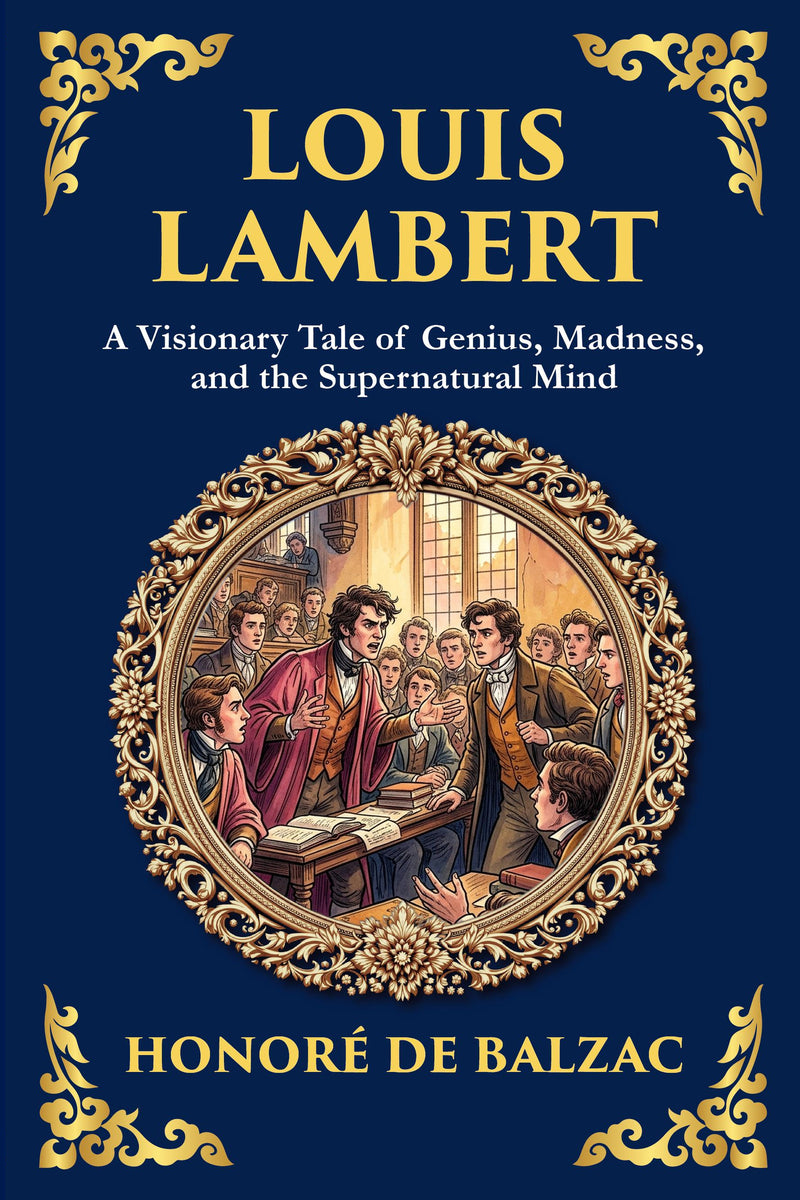
Louis Lambert
Louis Lambert is not merely a story—it is a profound exploration of the human mind at the limits of genius and madness. Based on Balzac’s own youthful experiences, this philosophical novella follows a gifted young man whose intellect transcends the ordinary, yet whose overwhelming visions of the metaphysical world lead
or free app
10,000+ hrs library
30-day guarantee
The complete Louis Lambert appears in modern English through Library of Alexandria Press, available online with audiobook narration included for members.
Have you ever wondered why brilliance so often borders on madness? In Louis Lambert, Honoré de Balzac crafts one of literature’s most compelling portraits of metaphysical genius and spiritual yearning. This semi-autobiographical novella centers on a young prodigy whose extraordinary intellect and obsession with the occult lead him to the brink of insanity.
Drawing inspiration from Swedenborgian mysticism and Balzac’s personal struggle with intellectual alienation, Louis Lambert delves into the nature of thought, the existence of the soul, and humanity’s potential to touch the divine. This modern edition brings renewed clarity to Balzac’s dense philosophical prose while preserving the passion and urgency of his vision.
What you’ll discover in this modern edition
- A Riveting Portrait of Genius and Isolation Follow the rise and decline of a young man gifted with an extraordinary mind but doomed by the very forces that make him unique.
- Exploration of Metaphysical Themes Journey through reflections on memory, magnetism, duality of thought, and the supernatural fabric of the universe.
- Balzac’s Swedenborgian Influences Discover how spiritual mysticism shapes Louis’s philosophy and fuels his obsession with transcendence.
- A Meditation on the Fine Line Between Genius and Madness Reflect on the societal and psychological pressures faced by visionaries who see what others cannot.
- A Foundational Text of French Philosophical Fiction Considered a precursor to existential and psychological literature, this novella is essential for lovers of deep, mind-expanding fiction.
| Formats | eBook (EPUB + PDF) · Audiobook · Paperback · Hardcover · Large Print |
| Language | English |
| Trim size (print) | 6 × 9 in |
| Binding | Paperback — perfect-bound · Hardcover — casewrap |
| Large Print edition | Same text in a larger, easy-read type — a larger font, not a larger trim |
| Print pricing | Every physical book at our true cost — at-cost, no profit (members) |
| Library | 873 restored titles, always growing |
| Length | 42,061 words · ~2 hr 48 min reading |
| Reading level | Grade 3 · an easy, flowing read (this modern-English edition) |
| Edition | Modern English translation · 2026 |
Member reviews for this edition are collected as readers finish it — be the first. Across the library: 12,000+ books shipped, every plan covered by a 365-day print guarantee.
About this edition
A faithful, unabridged modern-English edition by The Library of Alexandria — carefully rendered for today's reader and verified paragraph-by-paragraph against the public-domain source. Available as eBook, audiobook, paperback, hardcover, and large print.
- Complete & unabridgedVerified paragraph by paragraph against the source — never a scan, never abridged.
- Modern English, faithfulReadable today, with the author’s meaning kept intact. Readable — not simplified.
- Every format, one membershipRead in your browser or the free app, or listen to the full audiobook.
Included free with your membership
Cancel anytime, one click · 30-day money-back guarantee
Edition last updated July 2026
What’s inside
Louis Lambert — complete and unabridged, included in full with membership, plus the full audiobook.
Begin reading Louis Lambert
In clear modern English — the complete text is included with membership.
Introduction
There are books we read for entertainment, books we read for instruction, and a rare few that seem to read us in return—works that gaze back at the reader with such unsettling intimacy that we begin to wonder whether the author has somehow seen into the private chambers of our own minds. Louis Lambert is one of these rare books. Composed by Honoré de Balzac in 1832 and revised obsessively over the years that followed, it stands as one of the most personal, philosophically ambitious, and emotionally raw works in the entire vast edifice of his fiction. It is a story about thought itself—about what it means to think so deeply, so intensely, that the act of thinking threatens to consume the thinker entirely.
To approach this book is to encounter Balzac at his most exposed. Elsewhere in his monumental Human Comedy, the great novelist plays the role of the omniscient observer, cataloguing the manners, money, marriages, and machinations of nineteenth-century France with the cool precision of a naturalist pinning specimens to a board. Here, that detachment falls away. Louis Lambert is the work in which Balzac comes closest to confessing his own inner life: his childhood, his loneliness, his hunger for knowledge, and above all his conviction that the human mind possesses powers science has barely begun to glimpse. The result is not a conventional novel at all, but something stranger and more haunting—a meditation disguised as a biography, a philosophical treatise smuggled inside a tale of friendship and tragedy.
This modern translation has been prepared with a single guiding ambition: to make Balzac’s extraordinary vision accessible to the contemporary reader without sacrificing the strangeness and grandeur that make it worth reading in the first place. The nineteenth-century French original is dense, allusive, and at times deliberately difficult, written in a style that assumes a reader steeped in the intellectual debates of the Romantic era. What follows in these pages preserves the soul of that text while clearing away the obstacles that can make older translations feel like wading through a thicket. The aim throughout has been clarity in service of wonder—to let the reader feel the full electric charge of Balzac’s ideas as if encountering them for the first time.
A Mind on Fire: The Story Behind the Story
To understand why Louis Lambert feels so different from the rest of Balzac’s output, it helps to know something of the man who wrote it and the world that shaped him. Honoré de Balzac was born in 1799, into a France still trembling from the aftershocks of revolution. By the time he reached maturity, he had set himself a task of almost insane ambition: to chronicle, in a single interconnected series of novels and stories, the whole of French society in his age. This project, which he eventually titled La Comédie humaine—The Human Comedy—would run to nearly a hundred works and feature some two thousand recurring characters, a fictional universe so densely populated and intricately cross-referenced that it remains one of the supreme achievements of world literature. Balzac wrote with a feverish, almost superhuman intensity, fueled by torrents of black coffee and driven by debts that pursued him to the grave. He worked through the night, revised endlessly, and seemed to pour his entire nervous system onto the page.
Within this enormous architecture, Balzac arranged his works into categories. There were the Studies of Manners, which examined society as it appeared on the surface; and beneath them, the Philosophical Studies, which probed the hidden forces, the metaphysical and psychological currents, that he believed governed human destiny. Louis Lambert belongs to this second, more searching category. It is one of a trilogy of mystical works—alongside The Magic Skin and Séraphîta—in which Balzac turned away from the visible drama of money and ambition to confront the invisible drama of the spirit. These are the books in which he explored his lifelong fascination with the relationship between thought and matter, between the burning energy of the mind and the fragile flesh that must contain it.
The autobiographical roots of this particular work run deep. Like the title character, Balzac himself was sent away as a young boy to a boarding school run by the Oratorians at Vendôme, where he experienced a loneliness so profound it marked him for life. He, too, was a voracious and precocious reader, devouring books far beyond his years and retreating into a rich interior world while the ordinary rhythms of school life passed him by. The schoolboy isolation, the punishments endured for daydreaming, the sense of being a stranger among one’s peers—all of this Balzac knew intimately, and all of it he poured into his portrait of the boy whose extraordinary mind sets him apart from everyone around him. When you read of the young scholar lost in thought, oblivious to the world, drawing the bafflement and even the cruelty of those who cannot understand him, you are reading something very close to a transcription of Balzac’s own most painful memories.
But Louis Lambert is far more than a thinly veiled memoir. Balzac took the raw material of his own experience and used it to ask questions that obsessed the Romantic age and that still trouble us today. What is the nature of genius? Where is the line between visionary insight and madness? Can the human will, properly concentrated, exert real force upon the physical world? Is thought a kind of fluid, a substance, an energy that can be measured, transmitted, and exhausted? These were not idle speculations for Balzac. He believed, with a conviction that bordered on the religious, that thought was a tangible power, and that the great minds of history burned themselves out precisely because they could not survive the intensity of their own mental fire. The tragedy at the heart of this book grows directly out of that belief.
The intellectual atmosphere in which Balzac wrote was charged with mystical and pseudoscientific currents that can seem exotic to us now but were taken with deadly seriousness in his time. The book is steeped in the ideas of Emanuel Swedenborg, the Swedish scientist-turned-mystic who claimed direct communication with angels and described a hidden correspondence between the spiritual and material worlds. It draws too on the animal magnetism of Mesmer, the theories of invisible vital fluids, and the broader Romantic conviction that the universe was alive with hidden energies awaiting discovery. A reader today need not believe any of this to be gripped by it. What matters is the seriousness and beauty with which Balzac treats these ideas—the way he transforms them from mere occult curiosities into a profound and moving inquiry into the limits of the human mind. The young protagonist’s own philosophical system, which he labors to construct, is presented not as a crank’s delusion but as a genuine attempt to map the territory where matter shades into spirit, where the body’s chemistry gives rise to the soul’s mysteries.
It is worth dwelling for a moment on the structure of the book, because it is unlike almost anything else in fiction. Much of the narrative is delivered by a friend and schoolmate of the central character—a narrator who is transparently Balzac himself—who pieces the story together from his own memories, from fragments of letters, and from the recollections of others. This gives the whole work the quality of an investigation, a loving and grief-stricken attempt to reconstruct the life of someone the narrator could not save. Long passages consist of the protagonist’s own writings: letters, philosophical aphorisms, the outlines of his great unfinished system of thought. The effect is to make us feel that we are not simply being told a story but are sifting through the surviving relics of a remarkable mind, trying as the narrator does to understand what happened and why. This documentary intimacy is part of what makes the book so affecting. We come to know the central figure not from the outside, as a character in a plot, but from the inside, through the very products of his thinking.
Because Louis Lambert is so unconventional, a few words of guidance may enrich the experience for the reader who comes to it fresh. The first and most important thing to understand is that this is not a fast-moving narrative in the modern sense. Readers expecting the propulsive plotting of a thriller, or even the steady social drama of Balzac’s more famous works like Père Goriot or Eugénie Grandet, should adjust their expectations. The pleasures of this book are of a different order. They are the pleasures of intellectual adventure, of watching a brilliant mind grapple with the deepest questions of existence, and of following the emotional arc of a friendship and a fate that gathers tremendous power as it proceeds. The narrative is slow to build, dense with reflection, and demanding in its philosophical passages—but for the patient reader, the rewards are immense.
Let yourself sink into the philosophical sections rather than skimming them. There is a temptation, when confronted with passages about the nature of thought, the duality of inner and outer being, or the mystical correspondences of the universe, to skip ahead in search of “the story.” Resist this. The philosophy is the story. The whole tragic momentum of the book arises from ideas—from a young man’s attempt to think his way to the very foundations of reality, and from what that attempt costs him. The aphorisms and fragments that Balzac attributes to his protagonist are among the most striking things in the book, and they reward slow, contemplative reading. Some of them will strike you as dazzlingly ahead of their time; Balzac, writing in the 1830s, anticipates ideas about the unconscious, about psychosomatic illness, about the energy economy of the brain, that science would not seriously take up for many decades. To read these passages is to watch a great intuitive intelligence reaching toward truths it could sense but not yet prove.
At the same time, do not feel that you must master every philosophical claim to appreciate the book. Balzac himself acknowledged that his protagonist’s system was incomplete, fragmentary, even at times contradictory—and this is by design. We are meant to feel that we are glimpsing the unfinished work of a mind too vast and too restless to bring its visions to completion. If a particular passage of metaphysics eludes you, let it wash over you and carry you forward by its rhythm and conviction. The emotional truth of the book never depends on your following every twist of its argument. What matters is the felt experience of being in the presence of an extraordinary intelligence, and of watching the human cost of that gift.
It also helps to read the book as a study of friendship and loss. Beneath all the philosophy, Louis Lambert is the story of one person trying to understand and remember another. The narrator’s relationship with the central character—forged in the shared misery of school, deepened by intellectual kinship, and finally shadowed by helplessness and grief—gives the work its beating heart. The bond between these two boys, two outsiders who find in each other the only companionship that makes their bleak surroundings bearable, is rendered with a tenderness that anchors the book’s wilder speculations in genuine human feeling. As the narrative moves toward its later stages, this theme of devotion in the face of an incomprehensible fate becomes ever more central, and it is here that even readers who care nothing for philosophy will find themselves deeply moved.
A word, too, about the historical and cultural context that frames the action. The book opens in the years following the fall of Napoleon, in a France weary of revolution and uncertain of its future. The boarding school where much of the early action unfolds is a vividly rendered world of harsh discipline, casual cruelty, and intellectual hunger—a microcosm of a society that does not know what to do with exceptional minds. Balzac’s portrait of institutional education is scathing and unforgettable: a system designed to flatten individuality, to punish the dreamer and reward the conformist, to mistake silence for stupidity and inattention for idleness. Any reader who was ever the strange child in the back of the classroom, lost in a book or a thought, will recognize the pain of these scenes with a shock of intimacy. This is one of the great literary depictions of what it is like to be too intelligent, too sensitive, and too unworldly for the environment one is forced to endure.
Cancel anytime, one click · 30-day money-back guarantee
Founding annual rate available now — your price locks for life when you join.
Not ready? Get this free chapter by email — read it anytime.
✓ Sent — check your inbox for Louis Lambert.
Questions about Louis Lambert
What is Louis Lambert about?
Louis Lambert is not merely a story—it is a profound exploration of the human mind at the limits of genius and madness. Based on Balzac’s own youthful experiences, this philosophical novella follows a gifted young man whose intellect transcends the ordinary, yet whose overwhelming visions of the metaphysical world lead him toward isolation and tragedy. Step into the inner sanctum of a mind ablaze with cosmic ideas, spiritual hunger, and transcendental theories.
Who wrote Louis Lambert?
Louis Lambert was written by Honoré de Balzac. This edition presents the complete work in clear modern English, faithfully rendered from the public-domain original by Library of Alexandria Press.
Is Louis Lambert free to read?
The opening chapter is free to read on this page. Members read and listen to the complete work — and the entire library — free, and can order any physical book at our true print cost.
How long is Louis Lambert?
2 chapters (~42,061 words) — about 2 hr 48 min of reading in this modern-English edition.
Is this an abridged version of Louis Lambert?
No. This is the complete, unabridged Louis Lambert, carefully rendered into clear modern English and verified paragraph-by-paragraph against the public-domain source — nothing is cut or summarised.
What formats does Louis Lambert come in?
Louis Lambert is available as eBook, paperback, hardcover and large print. eBook and audiobook are included with membership; printed editions ship at our true print cost.
Shipping & returns
Billing & membership
More from the library


Explore Classic & Literary
- Dream Psychology: Psychoanalysis for Beginners · Sigmund Freud
- Great Expectations · Charles Dickens
- The Brothers Karamazov · Fyodor Dostoyevsky
- The Great Gatsby · F. Scott Fitzgerald
- Wild Flowers Worth Knowing · Neltje Blanchan
- Italian Hours · Henry James
- A Popular History of France from the Earliest Times, Volume 5 · François Guizot
- A history of English literature: A practical text-book · Edward Albert
- Italian Highways and Byways from a Motor Car · M. F. Mansfield
- The Heart-Cry of Jesus · Byron J. Rees
- Castes and Tribes of Southern India. Vol. 6 of 7 · Edgar Thurston
- Against the Grain · J.-K. Huysmans
- Dombey and Son · Charles Dickens
- How to Invest Money · George Garr Henry
- The Great Controversy Between Christ and Satan · Ellen Gould Harmon White
- One Hundred Proofs That the Earth Is Not a Globe · William Carpenter
- Southern Literature From 1579–1895 · Louise Manly
- The Renaissance: Studies in Art and Poetry · Walter Pater
- Mark Twain’s Speeches · Mark Twain
- Tacitus on Germany · Cornelius Tacitus
- The Rosary · Florence L. Barclay
- Peculiarities of American Cities · Willard W. Glazier
- Tennis for Girls · Florence A. Ballin
- The World’s Greatest Books — Volume 02 — Fiction
- Shirley · Charlotte Brontë
- Daisy Miller: A Study · Henry James
- Historic Jamaica · Frank Cundall
- The Gambler · Fyodor Dostoyevsky
- The Mayor of Casterbridge · Thomas Hardy
- The International Jew: The World’s Foremost Problem
Louis Lambert
Louis Lambert
A Visionary Tale of Genius, Madness, and the Supernatural Mind
Honoré de Balzac
Contents
- Introduction
- Louis Lambert
Introduction
There are books we read for entertainment, books we read for instruction, and a rare few that seem to read us in return—works that gaze back at the reader with such unsettling intimacy that we begin to wonder whether the author has somehow seen into the private chambers of our own minds. Louis Lambert is one of these rare books. Composed by Honoré de Balzac in 1832 and revised obsessively over the years that followed, it stands as one of the most personal, philosophically ambitious, and emotionally raw works in the entire vast edifice of his fiction. It is a story about thought itself—about what it means to think so deeply, so intensely, that the act of thinking threatens to consume the thinker entirely.
To approach this book is to encounter Balzac at his most exposed. Elsewhere in his monumental Human Comedy, the great novelist plays the role of the omniscient observer, cataloguing the manners, money, marriages, and machinations of nineteenth-century France with the cool precision of a naturalist pinning specimens to a board. Here, that detachment falls away. Louis Lambert is the work in which Balzac comes closest to confessing his own inner life: his childhood, his loneliness, his hunger for knowledge, and above all his conviction that the human mind possesses powers science has barely begun to glimpse. The result is not a conventional novel at all, but something stranger and more haunting—a meditation disguised as a biography, a philosophical treatise smuggled inside a tale of friendship and tragedy.
This modern translation has been prepared with a single guiding ambition: to make Balzac’s extraordinary vision accessible to the contemporary reader without sacrificing the strangeness and grandeur that make it worth reading in the first place. The nineteenth-century French original is dense, allusive, and at times deliberately difficult, written in a style that assumes a reader steeped in the intellectual debates of the Romantic era. What follows in these pages preserves the soul of that text while clearing away the obstacles that can make older translations feel like wading through a thicket. The aim throughout has been clarity in service of wonder—to let the reader feel the full electric charge of Balzac’s ideas as if encountering them for the first time.
A Mind on Fire: The Story Behind the Story
To understand why Louis Lambert feels so different from the rest of Balzac’s output, it helps to know something of the man who wrote it and the world that shaped him. Honoré de Balzac was born in 1799, into a France still trembling from the aftershocks of revolution. By the time he reached maturity, he had set himself a task of almost insane ambition: to chronicle, in a single interconnected series of novels and stories, the whole of French society in his age. This project, which he eventually titled La Comédie humaine—The Human Comedy—would run to nearly a hundred works and feature some two thousand recurring characters, a fictional universe so densely populated and intricately cross-referenced that it remains one of the supreme achievements of world literature. Balzac wrote with a feverish, almost superhuman intensity, fueled by torrents of black coffee and driven by debts that pursued him to the grave. He worked through the night, revised endlessly, and seemed to pour his entire nervous system onto the page.
Within this enormous architecture, Balzac arranged his works into categories. There were the Studies of Manners, which examined society as it appeared on the surface; and beneath them, the Philosophical Studies, which probed the hidden forces, the metaphysical and psychological currents, that he believed governed human destiny. Louis Lambert belongs to this second, more searching category. It is one of a trilogy of mystical works—alongside The Magic Skin and Séraphîta—in which Balzac turned away from the visible drama of money and ambition to confront the invisible drama of the spirit. These are the books in which he explored his lifelong fascination with the relationship between thought and matter, between the burning energy of the mind and the fragile flesh that must contain it.
The autobiographical roots of this particular work run deep. Like the title character, Balzac himself was sent away as a young boy to a boarding school run by the Oratorians at Vendôme, where he experienced a loneliness so profound it marked him for life. He, too, was a voracious and precocious reader, devouring books far beyond his years and retreating into a rich interior world while the ordinary rhythms of school life passed him by. The schoolboy isolation, the punishments endured for daydreaming, the sense of being a stranger among one’s peers—all of this Balzac knew intimately, and all of it he poured into his portrait of the boy whose extraordinary mind sets him apart from everyone around him. When you read of the young scholar lost in thought, oblivious to the world, drawing the bafflement and even the cruelty of those who cannot understand him, you are reading something very close to a transcription of Balzac’s own most painful memories.
But Louis Lambert is far more than a thinly veiled memoir. Balzac took the raw material of his own experience and used it to ask questions that obsessed the Romantic age and that still trouble us today. What is the nature of genius? Where is the line between visionary insight and madness? Can the human will, properly concentrated, exert real force upon the physical world? Is thought a kind of fluid, a substance, an energy that can be measured, transmitted, and exhausted? These were not idle speculations for Balzac. He believed, with a conviction that bordered on the religious, that thought was a tangible power, and that the great minds of history burned themselves out precisely because they could not survive the intensity of their own mental fire. The tragedy at the heart of this book grows directly out of that belief.
The intellectual atmosphere in which Balzac wrote was charged with mystical and pseudoscientific currents that can seem exotic to us now but were taken with deadly seriousness in his time. The book is steeped in the ideas of Emanuel Swedenborg, the Swedish scientist-turned-mystic who claimed direct communication with angels and described a hidden correspondence between the spiritual and material worlds. It draws too on the animal magnetism of Mesmer, the theories of invisible vital fluids, and the broader Romantic conviction that the universe was alive with hidden energies awaiting discovery. A reader today need not believe any of this to be gripped by it. What matters is the seriousness and beauty with which Balzac treats these ideas—the way he transforms them from mere occult curiosities into a profound and moving inquiry into the limits of the human mind. The young protagonist’s own philosophical system, which he labors to construct, is presented not as a crank’s delusion but as a genuine attempt to map the territory where matter shades into spirit, where the body’s chemistry gives rise to the soul’s mysteries.
It is worth dwelling for a moment on the structure of the book, because it is unlike almost anything else in fiction. Much of the narrative is delivered by a friend and schoolmate of the central character—a narrator who is transparently Balzac himself—who pieces the story together from his own memories, from fragments of letters, and from the recollections of others. This gives the whole work the quality of an investigation, a loving and grief-stricken attempt to reconstruct the life of someone the narrator could not save. Long passages consist of the protagonist’s own writings: letters, philosophical aphorisms, the outlines of his great unfinished system of thought. The effect is to make us feel that we are not simply being told a story but are sifting through the surviving relics of a remarkable mind, trying as the narrator does to understand what happened and why. This documentary intimacy is part of what makes the book so affecting. We come to know the central figure not from the outside, as a character in a plot, but from the inside, through the very products of his thinking.
Because Louis Lambert is so unconventional, a few words of guidance may enrich the experience for the reader who comes to it fresh. The first and most important thing to understand is that this is not a fast-moving narrative in the modern sense. Readers expecting the propulsive plotting of a thriller, or even the steady social drama of Balzac’s more famous works like Père Goriot or Eugénie Grandet, should adjust their expectations. The pleasures of this book are of a different order. They are the pleasures of intellectual adventure, of watching a brilliant mind grapple with the deepest questions of existence, and of following the emotional arc of a friendship and a fate that gathers tremendous power as it proceeds. The narrative is slow to build, dense with reflection, and demanding in its philosophical passages—but for the patient reader, the rewards are immense.
Let yourself sink into the philosophical sections rather than skimming them. There is a temptation, when confronted with passages about the nature of thought, the duality of inner and outer being, or the mystical correspondences of the universe, to skip ahead in search of “the story.” Resist this. The philosophy is the story. The whole tragic momentum of the book arises from ideas—from a young man’s attempt to think his way to the very foundations of reality, and from what that attempt costs him. The aphorisms and fragments that Balzac attributes to his protagonist are among the most striking things in the book, and they reward slow, contemplative reading. Some of them will strike you as dazzlingly ahead of their time; Balzac, writing in the 1830s, anticipates ideas about the unconscious, about psychosomatic illness, about the energy economy of the brain, that science would not seriously take up for many decades. To read these passages is to watch a great intuitive intelligence reaching toward truths it could sense but not yet prove.
At the same time, do not feel that you must master every philosophical claim to appreciate the book. Balzac himself acknowledged that his protagonist’s system was incomplete, fragmentary, even at times contradictory—and this is by design. We are meant to feel that we are glimpsing the unfinished work of a mind too vast and too restless to bring its visions to completion. If a particular passage of metaphysics eludes you, let it wash over you and carry you forward by its rhythm and conviction. The emotional truth of the book never depends on your following every twist of its argument. What matters is the felt experience of being in the presence of an extraordinary intelligence, and of watching the human cost of that gift.
It also helps to read the book as a study of friendship and loss. Beneath all the philosophy, Louis Lambert is the story of one person trying to understand and remember another. The narrator’s relationship with the central character—forged in the shared misery of school, deepened by intellectual kinship, and finally shadowed by helplessness and grief—gives the work its beating heart. The bond between these two boys, two outsiders who find in each other the only companionship that makes their bleak surroundings bearable, is rendered with a tenderness that anchors the book’s wilder speculations in genuine human feeling. As the narrative moves toward its later stages, this theme of devotion in the face of an incomprehensible fate becomes ever more central, and it is here that even readers who care nothing for philosophy will find themselves deeply moved.
A word, too, about the historical and cultural context that frames the action. The book opens in the years following the fall of Napoleon, in a France weary of revolution and uncertain of its future. The boarding school where much of the early action unfolds is a vividly rendered world of harsh discipline, casual cruelty, and intellectual hunger—a microcosm of a society that does not know what to do with exceptional minds. Balzac’s portrait of institutional education is scathing and unforgettable: a system designed to flatten individuality, to punish the dreamer and reward the conformist, to mistake silence for stupidity and inattention for idleness. Any reader who was ever the strange child in the back of the classroom, lost in a book or a thought, will recognize the pain of these scenes with a shock of intimacy. This is one of the great literary depictions of what it is like to be too intelligent, too sensitive, and too unworldly for the environment one is forced to endure.
Louis Lambert was born in Montoire, a small town in the Vendomois region. His father ran a modest tannery and expected his son to take over the business, but Louis’s early passion for learning changed his father’s mind. The tanner and his wife adored Louis, their only child, and they never denied him anything.
By the age of five, Louis had started reading the Old and New Testaments; these two volumes, which contain so many different books, decided his future. Could a child’s imagination truly grasp the mystical depths of the Bible? Was he able to follow the Holy Spirit’s journey through the universe at such a young age? Or was he simply drawn to the romantic elements found throughout those ancient Eastern poems? This story will provide the answers for some readers.
This first reading of the Bible led to one thing: Louis went everywhere in Montoire asking for books, and he got them by using that special charm children have that no one can resist. He continued these self-taught studies until he turned ten.
During that time, it was hard to find substitutes for military service; wealthy families hired them long in advance so they would be ready when the draft lottery took place. The poor tanner’s small savings weren’t enough to buy a substitute for their son, and they saw no legal way to avoid the draft other than making him a priest. So, in 1807, they sent him to his uncle, the parish priest of Mer, another small town on the Loire river near Blois. This plan satisfied both Louis’s hunger for knowledge and his parents’ desire to keep him away from the horrors of war. In fact, his love for learning and early intelligence suggested he could achieve a high position within the Church.
End of the free sample
Keep reading, free
Members read and listen to the complete book — and the entire library. Cancel anytime, one click · 30-day money-back guarantee.