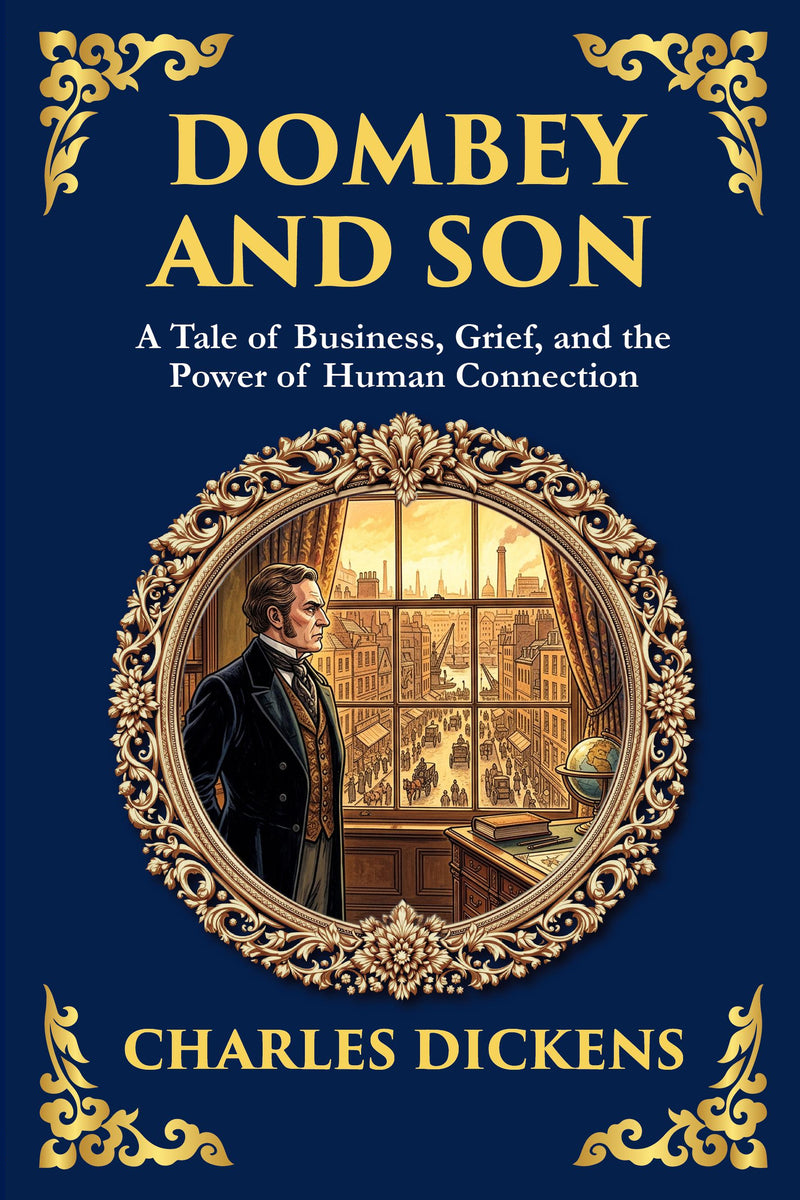
Dombey and Son
In Dombey and Son, Charles Dickens delivers one of his most poignant and socially incisive novels, centered on pride, loss, and the redemption found through human connection.
or free app
10,000+ hrs library
30-day guarantee
The complete Dombey and Son appears in modern English through Library of Alexandria Press, available online with audiobook narration included for members.
Have you ever wondered why true connection matters more than success? Dombey and Son is Charles Dickens's sweeping tale of ambition, heartbreak, and the redemptive power of love. Set in a rapidly industrializing England, this novel explores how the pursuit of wealth and reputation can blind us to the more enduring treasures of compassion and family.
The story follows Paul Dombey, a wealthy, self-important businessman who dreams of building an empire to pass on to his son. But when fate takes a cruel turn, Dombey is left with his daughter Florence—a child he barely acknowledges. Through her unwavering love and devotion, Dickens crafts a searing portrait of emotional neglect, class rigidity, and the slow, painful transformation of a man haunted by his own pride.
This edition brings Dickens's richly textured prose to a modern audience, highlighting the timeless struggles between ego and empathy, isolation and belonging, legacy and love.
What you’ll discover in this modern edition
- A Masterclass in Characterization – Meet one of Dickens’s most unforgettable casts, from the arrogant Dombey to the radiant Florence and the conniving Mr. Carker.
- Themes of Industrial Progress and Human Loss – Witness how ambition and the rise of commerce can alienate people from themselves and one another.
- A Daughter's Unbreakable Devotion – Follow Florence Dombey's journey of strength, heartbreak, and unyielding love.
- Dickens’s Signature Blend of Satire and Sentiment – Explore social injustice, family dysfunction, and ultimate redemption through Dickens’s razor-sharp narrative lens.
- A Redemption Arc for the Ages – Experience the transformation of a man who learns too late what truly matters.
| Formats | eBook (EPUB + PDF) · Audiobook · Paperback · Hardcover · Large Print |
| Language | English |
| Trim size (print) | 6 × 9 in |
| Binding | Paperback — perfect-bound · Hardcover — casewrap |
| Large Print edition | Same text in a larger, easy-read type — a larger font, not a larger trim |
| Print pricing | Every physical book at our true cost — at-cost, no profit (members) |
| Library | 873 restored titles, always growing |
| Length | 342,610 words · ~22 hr 50 min reading |
| Reading level | Grade 3 · an easy, flowing read (this modern-English edition) |
| Edition | Modern English translation · 2026 |
Member reviews for this edition are collected as readers finish it — be the first. Across the library: 12,000+ books shipped, every plan covered by a 365-day print guarantee.
About this edition
A faithful, unabridged modern-English edition by The Library of Alexandria — carefully rendered for today's reader and verified paragraph-by-paragraph against the public-domain source. Available as eBook, audiobook, paperback, hardcover, and large print.
- Complete & unabridgedVerified paragraph by paragraph against the source — never a scan, never abridged.
- Modern English, faithfulReadable today, with the author’s meaning kept intact. Readable — not simplified.
- Every format, one membershipRead in your browser or the free app, or listen to the full audiobook.
Included free with your membership
Cancel anytime, one click · 30-day money-back guarantee
Edition last updated July 2026
What’s inside
Dombey and Son — complete and unabridged: all 60 sections included with membership, plus the full audiobook.
Begin reading Dombey and Son
In clear modern English — the complete text is included with membership.
Introduction
There are novels that announce themselves quietly, gathering their power over many pages until the reader looks up, startled, to find themselves wholly absorbed. And then there are novels that strike a single, resonant chord at the very beginning and hold it, letting it deepen and complicate until it fills the whole of the story like the sound of a great bell. The book you are about to read belongs firmly to the second kind. From its opening moments, it places before us a man and his desire — a desire so absolute, so consuming, and so blind to the human cost of its fulfillment that everything else in the story arranges itself around it the way iron filings arrange themselves around a magnet.
Charles Dickens wrote this novel in the middle of his career, at a moment when he had already proven himself the most beloved storyteller of his age and was ready to attempt something more deliberate, more architecturally ambitious than the sprawling, joyously chaotic books that had made his name. What he produced was a work of remarkable concentration — a study of pride and its consequences, of the way wealth can harden the heart, of the difference between what we want and what we need, and above all of the strength that flows from human bonds when those bonds are honored, and the ruin that follows when they are not. It is a story about a business, yes, and about sorrow, as the subtitle promises. But it is most of all a story about love — love offered freely and refused, love that persists in the face of indifference, and love that arrives, when it finally arrives, almost too late to be recognized.
This edition presents the novel in a modern translation, adapted for the contemporary reader. A word about what that means, and what it does not mean, will help you settle into the experience that follows. Dickens wrote for an audience that received his work in monthly installments, that read aloud to one another in parlors by lamplight, and that delighted in the elaborate sentence structures, the period vocabulary, and the leisurely rhythms of nineteenth-century prose. Those qualities are glorious, but they can also place a barrier between the modern reader and the living heart of the story. The aim of this adaptation is to lower that barrier without lowering the story — to clear away the obstacles of archaic phrasing and dense, winding syntax so that the emotional force, the wit, the social observation, and the unforgettable characters come through with the immediacy they deserve. What you will find here is faithful to the spirit, the structure, and the substance of what Dickens created. It is the same journey; the path has simply been swept clear of brambles.
A Story Built Around a Single, Towering Theme
Most of Dickens’s great novels are populated by enormous casts and woven from many threads. This one is too — you will meet dozens of characters, from the grandest to the humblest, and Dickens lavishes upon each of them the loving, exacting attention that no other novelist has ever quite matched. But what makes this particular book stand apart in his work is the way it organizes all of that abundance around a single, dominating idea. At its center stands a wealthy man, the head of a powerful trading firm, who has built his entire sense of self upon the institution he commands and the family name he intends to carry forward. His pride is not the petty vanity of a small man; it is something colder, vaster, and more dangerous. It is a pride that mistakes itself for dignity, that confuses control for love, and that cannot conceive of any human relationship except in terms of what it owes to the great enterprise that bears his name.
The novel asks, with extraordinary patience and insight, what happens to a person who lives this way — and, just as importantly, what happens to everyone who lives within the orbit of such a person. For the great cruelty of pride like this is that it does not suffer alone. It casts a long shadow, and the most vulnerable people in the story stand directly within it. There are children here who long only to be loved and who cannot understand why love is withheld. There are women whose worth is measured against ledgers and bloodlines. There are loyal servants and friends who give freely of their hearts and ask for nothing, and whose generosity stands in luminous contrast to the chilly calculations of the powerful. Watching these forces collide — the human heart against the proud will, warmth against frost, the freely given against the coldly transacted — is one of the deepest pleasures this book has to offer.
Dickens was writing at a moment when England was being transformed, almost overnight, by industry, commerce, and the new machinery of the modern age. The railway, which appears in this novel with thrilling and sometimes terrifying power, was tearing through the old landscape and remaking the rhythms of daily life. Money was becoming, more visibly than ever before, the measure of all things. And Dickens, who understood money intimately — its allure, its tyranny, the way it could lift a family up or crush it utterly — saw in this transformation both promise and peril. The firm at the heart of this story is a symbol of the new commercial world: powerful, far-reaching, impressive in its scale, and yet capable of a monstrous indifference to the people whose lives it touches. The question the novel poses is whether the human soul can survive intact within such a world, or whether it must be either corrupted or broken.
But do not imagine, from this description, that you are about to read a dry treatise on commerce and pride. Dickens was incapable of dryness. The miracle of his art is that he could take the largest, most serious themes and render them through characters so vivid, so funny, so heartbreaking, and so alive that you feel you have met them in the street. You will laugh often as you read this book — Dickens’s comic genius is everywhere on display, in his minor characters especially, who tumble onto the page with their catchphrases and their tics and their absurd, endearing self-importance. And you will, I think, be moved more than once to set the book down for a moment, the way one does when a story has touched something true and tender. The seriousness and the comedy are not separate; they are woven together so tightly that you cannot pull them apart, and it is precisely this combination that makes the reading experience so rich.
One of the great joys awaiting you is the gallery of characters who surround the central figures. Dickens populates his world with people you will not forget: a sea captain with a heart as wide as the ocean and a manner as gentle as a lamb’s, who measures the world by his own homespun proverbs; a sharp-tongued woman who hides a fierce loyalty beneath her grumbling; a manager whose smooth, gleaming surface conceals depths of calculation that the reader senses long before the other characters do; a humble, devoted figure whose steadfastness becomes one of the moral anchors of the entire story. There is a whole world here, layered from the drawing rooms of the wealthy to the back streets and shops of working London, and Dickens moves through all of it with the assurance of a man who knew every corner of his city and loved it even when he was exposing its injustices.
The young people in the novel deserve special mention, because it is around them that the story’s emotional core is built. Dickens understood children — their fears, their loyalties, their bewilderment at the incomprehensible decisions of adults, their capacity for love that adults too often take for granted or fail to return. Some of the most affecting passages you will ever read in any novel are gathered here, in the portrayal of childhood within a household where warmth is in short supply. I will say no more about the particulars, because the experience of encountering these characters fresh, without foreknowledge, is one of the gifts this book gives, and I would not dream of spoiling it. But I will say that the bond between certain of these young people — a bond that persists against every obstacle, that asks for nothing and forgives everything — is one of the truest depictions of selfless love in all of literature.
How to Read This Book, and What to Bring to It
A word now about the experience of reading, and how you might best approach it to draw out everything this remarkable novel has to offer.
The first thing to understand is that Dickens did not write to be rushed. This is a book to be savored rather than sprinted through. Originally it reached its readers a portion at a time, month by month, over the course of a year and a half, and that mode of publication shaped the way the story unfolds. Each section was meant to satisfy on its own while propelling the reader toward the next, and so the book has a natural rhythm of rises and pauses, of tension built and partially released, of new characters introduced and old ones developed. You may find it rewarding to read in something like that original spirit — not necessarily one installment at a time, but unhurriedly, allowing yourself to dwell in each scene, to enjoy the descriptions, to listen to the distinctive voices of the characters rather than racing ahead to find out what happens. The plot will carry you forward; there is no need to push. The pleasure lies as much in the journey as in the destination.
This adaptation has been prepared with the goal of making that unhurried pleasure more accessible, not less essential. Where the original prose might have asked you to untangle a sentence that runs for half a page, here the meaning is clearer and the path more direct — but the texture, the music, and the emotional weight have been preserved. You will still feel the grandeur of Dickens’s set pieces, the precision of his irony, the warmth of his sympathy, and the sting of his anger at cruelty and injustice. The modernization is in service of the reading, not a replacement for it. Think of it as listening to a beloved piece of music performed with such clarity that every instrument can be heard distinctly, where before some of the inner voices might have been lost in the reverberation.
The second thing worth knowing is that Dickens is a writer of patterns and echoes, and part of the deep satisfaction of his work comes from noticing them. He plants images early that will bloom later. He gives characters habits of speech and gesture that recur and gather meaning across the length of the book. He sets up contrasts — between cold and warmth, between water and stone, between the natural and the mechanical, between those who give and those who take — and develops them with a composer’s sense of structure. You need not consciously hunt for these things; they will work on you whether you notice them or not. But if you read with a little attentiveness, you will begin to feel the architecture beneath the surface, the way every part of this vast story is connected to every other part, and that recognition is one of the quiet thrills of reading a master at the height of his powers.
The third thing to bring to the book is patience with its emotions. Dickens was a deeply feeling writer who wrote for a deeply feeling age, and he does not hold his emotions at a cool, ironic distance the way some modern writers do. When he wants you to feel sorrow, he reaches directly for your heart. When he wants you to feel indignation at injustice, he will not let you look away. Some readers, encountering this directness for the first time, mistake it for sentimentality. But there is a difference between sentimentality, which manufactures feeling out of nothing, and the genuine emotional power that Dickens commands, which is earned through the careful, truthful building of character and situation. Give yourself permission to feel what the book invites you to feel. It is one of the great pleasures of this kind of storytelling, and it is a pleasure our own age, with its fashionable detachment, too often denies itself. There is wisdom in allowing a story to move you, and this story has earned the right to do so.
Cancel anytime, one click · 30-day money-back guarantee
Founding annual rate available now — your price locks for life when you join.
Not ready? Get this free chapter by email — read it anytime.
✓ Sent — check your inbox for Dombey and Son.
Questions about Dombey and Son
What is Dombey and Son about?
In Dombey and Son, Charles Dickens delivers one of his most poignant and socially incisive novels, centered on pride, loss, and the redemption found through human connection. At the heart of this sweeping narrative is Paul Dombey, a proud and emotionally distant businessman who believes that success, legacy, and affection can be measured in financial terms. But when tragedy strikes and the rigid structure of his life begins to collapse, Dombey is forced to confront the coldness of his own heart.
Who wrote Dombey and Son?
Dombey and Son was written by Charles Dickens. This edition presents the complete work in clear modern English, faithfully rendered from the public-domain original by Library of Alexandria Press.
Is Dombey and Son free to read?
The opening chapter is free to read on this page. Members read and listen to the complete work — and the entire library — free, and can order any physical book at our true print cost.
How long is Dombey and Son?
60 chapters (~342,610 words) — about 22 hr 50 min of reading in this modern-English edition.
Is this an abridged version of Dombey and Son?
No. This is the complete, unabridged Dombey and Son, carefully rendered into clear modern English and verified paragraph-by-paragraph against the public-domain source — nothing is cut or summarised.
What formats does Dombey and Son come in?
Dombey and Son is available as eBook. eBook and audiobook are included with membership; printed editions ship at our true print cost.
Shipping & returns
Billing & membership
More from the library


Explore Classic & Literary
- Dream Psychology: Psychoanalysis for Beginners · Sigmund Freud
- Great Expectations · Charles Dickens
- The Brothers Karamazov · Fyodor Dostoyevsky
- The Great Gatsby · F. Scott Fitzgerald
- Wild Flowers Worth Knowing · Neltje Blanchan
- Italian Hours · Henry James
- A Popular History of France from the Earliest Times, Volume 5 · François Guizot
- A history of English literature: A practical text-book · Edward Albert
- Italian Highways and Byways from a Motor Car · M. F. Mansfield
- The Heart-Cry of Jesus · Byron J. Rees
- Castes and Tribes of Southern India. Vol. 6 of 7 · Edgar Thurston
- Against the Grain · J.-K. Huysmans
- How to Invest Money · George Garr Henry
- The Great Controversy Between Christ and Satan · Ellen Gould Harmon White
- One Hundred Proofs That the Earth Is Not a Globe · William Carpenter
- Southern Literature From 1579–1895 · Louise Manly
- The Renaissance: Studies in Art and Poetry · Walter Pater
- Mark Twain’s Speeches · Mark Twain
- Tacitus on Germany · Cornelius Tacitus
- The Rosary · Florence L. Barclay
- Peculiarities of American Cities · Willard W. Glazier
- Tennis for Girls · Florence A. Ballin
- The World’s Greatest Books — Volume 02 — Fiction
- Shirley · Charlotte Brontë
- Daisy Miller: A Study · Henry James
- Louis Lambert · Honoré de Balzac
- Historic Jamaica · Frank Cundall
- The Gambler · Fyodor Dostoyevsky
- The Mayor of Casterbridge · Thomas Hardy
- The International Jew: The World’s Foremost Problem
Dombey and Son
Dombey and Son
A Story of Business, Sorrow, and the Strength of Human Bonds
Charles Dickens
Contents
- Introduction
- Preface of 1848
- Preface of 1867
- Chapter 1
- Chapter 2
- Chapter 3
- Chapter 4
- Chapter 5
- Chapter 6
- Chapter 7
- Chapter 8
- Chapter 9
- Chapter 10
- Chapter 11
- Chapter 12
- Chapter 13
- Chapter 14
- Chapter 15
- Chapter 16
- Chapter 17
- Chapter 18
- Chapter 19
- Chapter 20
- Chapter 21
- Chapter 22
- Chapter 23
- Chapter 24
- Chapter 25
- Chapter 26
- Chapter 27
- Chapter 28
- Chapter 29
- Chapter 30
- Chapter 31
- Chapter 32
- Chapter 33
- Chapter 34
- Chapter 35
- Chapter 36
- Chapter 37
- … and 20 more chapters
Introduction
There are novels that announce themselves quietly, gathering their power over many pages until the reader looks up, startled, to find themselves wholly absorbed. And then there are novels that strike a single, resonant chord at the very beginning and hold it, letting it deepen and complicate until it fills the whole of the story like the sound of a great bell. The book you are about to read belongs firmly to the second kind. From its opening moments, it places before us a man and his desire — a desire so absolute, so consuming, and so blind to the human cost of its fulfillment that everything else in the story arranges itself around it the way iron filings arrange themselves around a magnet.
Charles Dickens wrote this novel in the middle of his career, at a moment when he had already proven himself the most beloved storyteller of his age and was ready to attempt something more deliberate, more architecturally ambitious than the sprawling, joyously chaotic books that had made his name. What he produced was a work of remarkable concentration — a study of pride and its consequences, of the way wealth can harden the heart, of the difference between what we want and what we need, and above all of the strength that flows from human bonds when those bonds are honored, and the ruin that follows when they are not. It is a story about a business, yes, and about sorrow, as the subtitle promises. But it is most of all a story about love — love offered freely and refused, love that persists in the face of indifference, and love that arrives, when it finally arrives, almost too late to be recognized.
This edition presents the novel in a modern translation, adapted for the contemporary reader. A word about what that means, and what it does not mean, will help you settle into the experience that follows. Dickens wrote for an audience that received his work in monthly installments, that read aloud to one another in parlors by lamplight, and that delighted in the elaborate sentence structures, the period vocabulary, and the leisurely rhythms of nineteenth-century prose. Those qualities are glorious, but they can also place a barrier between the modern reader and the living heart of the story. The aim of this adaptation is to lower that barrier without lowering the story — to clear away the obstacles of archaic phrasing and dense, winding syntax so that the emotional force, the wit, the social observation, and the unforgettable characters come through with the immediacy they deserve. What you will find here is faithful to the spirit, the structure, and the substance of what Dickens created. It is the same journey; the path has simply been swept clear of brambles.
A Story Built Around a Single, Towering Theme
Most of Dickens’s great novels are populated by enormous casts and woven from many threads. This one is too — you will meet dozens of characters, from the grandest to the humblest, and Dickens lavishes upon each of them the loving, exacting attention that no other novelist has ever quite matched. But what makes this particular book stand apart in his work is the way it organizes all of that abundance around a single, dominating idea. At its center stands a wealthy man, the head of a powerful trading firm, who has built his entire sense of self upon the institution he commands and the family name he intends to carry forward. His pride is not the petty vanity of a small man; it is something colder, vaster, and more dangerous. It is a pride that mistakes itself for dignity, that confuses control for love, and that cannot conceive of any human relationship except in terms of what it owes to the great enterprise that bears his name.
The novel asks, with extraordinary patience and insight, what happens to a person who lives this way — and, just as importantly, what happens to everyone who lives within the orbit of such a person. For the great cruelty of pride like this is that it does not suffer alone. It casts a long shadow, and the most vulnerable people in the story stand directly within it. There are children here who long only to be loved and who cannot understand why love is withheld. There are women whose worth is measured against ledgers and bloodlines. There are loyal servants and friends who give freely of their hearts and ask for nothing, and whose generosity stands in luminous contrast to the chilly calculations of the powerful. Watching these forces collide — the human heart against the proud will, warmth against frost, the freely given against the coldly transacted — is one of the deepest pleasures this book has to offer.
Dickens was writing at a moment when England was being transformed, almost overnight, by industry, commerce, and the new machinery of the modern age. The railway, which appears in this novel with thrilling and sometimes terrifying power, was tearing through the old landscape and remaking the rhythms of daily life. Money was becoming, more visibly than ever before, the measure of all things. And Dickens, who understood money intimately — its allure, its tyranny, the way it could lift a family up or crush it utterly — saw in this transformation both promise and peril. The firm at the heart of this story is a symbol of the new commercial world: powerful, far-reaching, impressive in its scale, and yet capable of a monstrous indifference to the people whose lives it touches. The question the novel poses is whether the human soul can survive intact within such a world, or whether it must be either corrupted or broken.
But do not imagine, from this description, that you are about to read a dry treatise on commerce and pride. Dickens was incapable of dryness. The miracle of his art is that he could take the largest, most serious themes and render them through characters so vivid, so funny, so heartbreaking, and so alive that you feel you have met them in the street. You will laugh often as you read this book — Dickens’s comic genius is everywhere on display, in his minor characters especially, who tumble onto the page with their catchphrases and their tics and their absurd, endearing self-importance. And you will, I think, be moved more than once to set the book down for a moment, the way one does when a story has touched something true and tender. The seriousness and the comedy are not separate; they are woven together so tightly that you cannot pull them apart, and it is precisely this combination that makes the reading experience so rich.
One of the great joys awaiting you is the gallery of characters who surround the central figures. Dickens populates his world with people you will not forget: a sea captain with a heart as wide as the ocean and a manner as gentle as a lamb’s, who measures the world by his own homespun proverbs; a sharp-tongued woman who hides a fierce loyalty beneath her grumbling; a manager whose smooth, gleaming surface conceals depths of calculation that the reader senses long before the other characters do; a humble, devoted figure whose steadfastness becomes one of the moral anchors of the entire story. There is a whole world here, layered from the drawing rooms of the wealthy to the back streets and shops of working London, and Dickens moves through all of it with the assurance of a man who knew every corner of his city and loved it even when he was exposing its injustices.
The young people in the novel deserve special mention, because it is around them that the story’s emotional core is built. Dickens understood children — their fears, their loyalties, their bewilderment at the incomprehensible decisions of adults, their capacity for love that adults too often take for granted or fail to return. Some of the most affecting passages you will ever read in any novel are gathered here, in the portrayal of childhood within a household where warmth is in short supply. I will say no more about the particulars, because the experience of encountering these characters fresh, without foreknowledge, is one of the gifts this book gives, and I would not dream of spoiling it. But I will say that the bond between certain of these young people — a bond that persists against every obstacle, that asks for nothing and forgives everything — is one of the truest depictions of selfless love in all of literature.
How to Read This Book, and What to Bring to It
A word now about the experience of reading, and how you might best approach it to draw out everything this remarkable novel has to offer.
The first thing to understand is that Dickens did not write to be rushed. This is a book to be savored rather than sprinted through. Originally it reached its readers a portion at a time, month by month, over the course of a year and a half, and that mode of publication shaped the way the story unfolds. Each section was meant to satisfy on its own while propelling the reader toward the next, and so the book has a natural rhythm of rises and pauses, of tension built and partially released, of new characters introduced and old ones developed. You may find it rewarding to read in something like that original spirit — not necessarily one installment at a time, but unhurriedly, allowing yourself to dwell in each scene, to enjoy the descriptions, to listen to the distinctive voices of the characters rather than racing ahead to find out what happens. The plot will carry you forward; there is no need to push. The pleasure lies as much in the journey as in the destination.
This adaptation has been prepared with the goal of making that unhurried pleasure more accessible, not less essential. Where the original prose might have asked you to untangle a sentence that runs for half a page, here the meaning is clearer and the path more direct — but the texture, the music, and the emotional weight have been preserved. You will still feel the grandeur of Dickens’s set pieces, the precision of his irony, the warmth of his sympathy, and the sting of his anger at cruelty and injustice. The modernization is in service of the reading, not a replacement for it. Think of it as listening to a beloved piece of music performed with such clarity that every instrument can be heard distinctly, where before some of the inner voices might have been lost in the reverberation.
The second thing worth knowing is that Dickens is a writer of patterns and echoes, and part of the deep satisfaction of his work comes from noticing them. He plants images early that will bloom later. He gives characters habits of speech and gesture that recur and gather meaning across the length of the book. He sets up contrasts — between cold and warmth, between water and stone, between the natural and the mechanical, between those who give and those who take — and develops them with a composer’s sense of structure. You need not consciously hunt for these things; they will work on you whether you notice them or not. But if you read with a little attentiveness, you will begin to feel the architecture beneath the surface, the way every part of this vast story is connected to every other part, and that recognition is one of the quiet thrills of reading a master at the height of his powers.
The third thing to bring to the book is patience with its emotions. Dickens was a deeply feeling writer who wrote for a deeply feeling age, and he does not hold his emotions at a cool, ironic distance the way some modern writers do. When he wants you to feel sorrow, he reaches directly for your heart. When he wants you to feel indignation at injustice, he will not let you look away. Some readers, encountering this directness for the first time, mistake it for sentimentality. But there is a difference between sentimentality, which manufactures feeling out of nothing, and the genuine emotional power that Dickens commands, which is earned through the careful, truthful building of character and situation. Give yourself permission to feel what the book invites you to feel. It is one of the great pleasures of this kind of storytelling, and it is a pleasure our own age, with its fashionable detachment, too often denies itself. There is wisdom in allowing a story to move you, and this story has earned the right to do so.
Dombey sat in a large armchair by the bed in the corner of the dimmed room. His son lay tucked in warmly in a small basket-style bed, placed carefully on a low sofa right in front of the fire. He was positioned so close to the heat that it seemed as if he were like a muffin, and it was vital to toast him golden brown while he was still fresh.
Dombey was about forty-eight years old. His son was about forty-eight minutes old. Dombey was somewhat bald and ruddy; although he was a handsome, well-built man, he looked too stern and arrogant to be truly likable. The son was very bald and very red, and while he was obviously a fine baby, he still looked a bit squashed and blotchy. Time and Care had left their marks on Dombey’s forehead, like notches on a tree destined to be cut down—they are ruthless twins who stride through the forests of humanity, marking their path. Meanwhile, the baby’s face was covered in a thousand tiny wrinkles, which that same deceptive Time would enjoy smoothing away with the flat side of his scythe, preparing the surface for deeper cuts later on.
Overjoyed by the long-awaited arrival, Dombey repeatedly jingled the heavy gold watch chain hanging from his neat blue coat, the buttons of which shimmered in the faint light of the distant fire. The son, with his tiny fists clenched, seemed in his own weak way to be fighting against existence for bringing him into the world so unexpectedly.
“The business will once again, Mrs. Dombey,” Mr. Dombey said, “be Dombey and Son in reality, not just in name.” He added, sounding deeply satisfied and with his eyes half-closed as if he were looking at the name written in a floral arrangement and smelling its scent, “Dombey and Son!”
End of the free sample
Keep reading, free
Members read and listen to the complete book — and the entire library. Cancel anytime, one click · 30-day money-back guarantee.