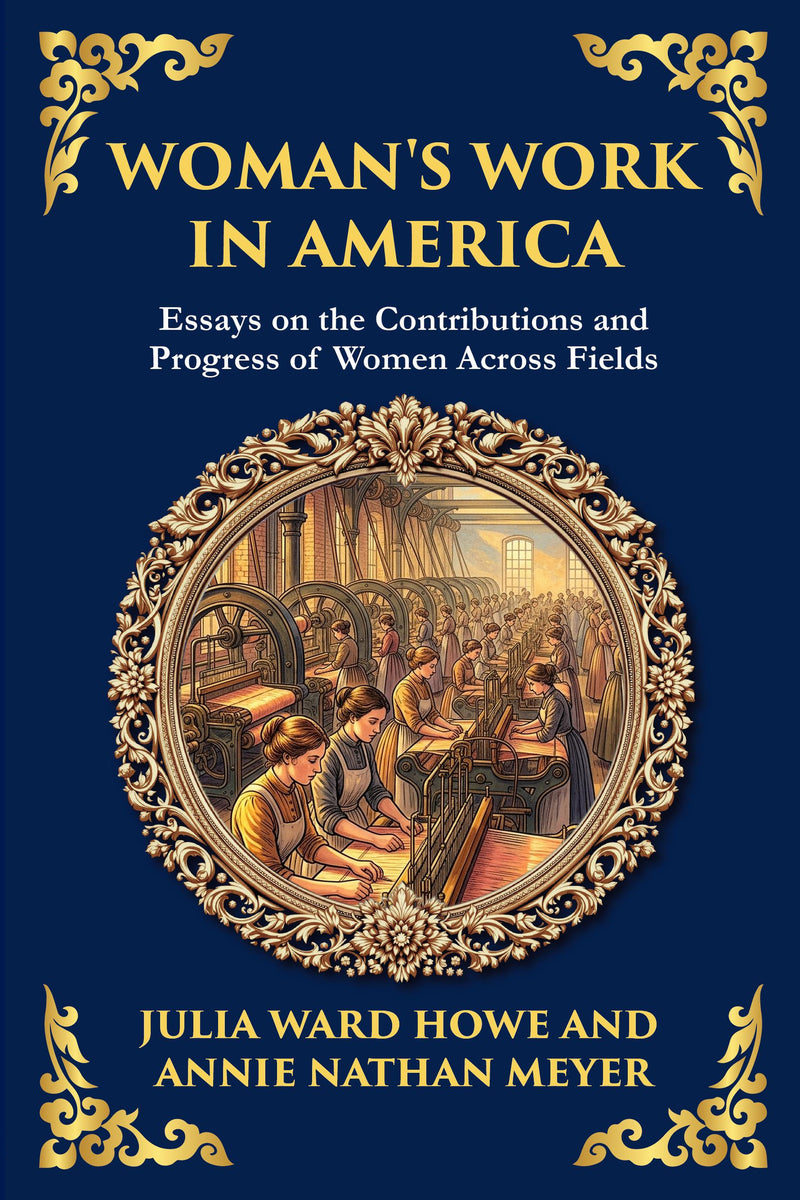
Woman’s Work in America
Julia Ward Howe What defines a woman’s role in shaping a nation? In Woman’s Work in America, pioneering thinkers Julia Ward Howe and Annie Nathan Meyer present a landmark collection of essays highlighting the indispensable impact of women in society, from education and science to literature, law, industry, and beyond.
or free app
10,000+ hrs library
30-day guarantee
The complete Woman's Work in America appears in modern English through Library of Alexandria Press, available online with audiobook narration included for members.
Have you ever wondered why the advancement of women is inseparable from the progress of civilization? Woman’s Work in America is a vital anthology of essays that celebrates the enduring strength, intellect, and resilience of women throughout American history. Edited by two of the nation’s most respected women’s rights advocates—Julia Ward Howe, author of The Battle Hymn of the Republic, and Annie Nathan Meyer, founder of Barnard College—this book presents a sweeping, multi-disciplinary portrait of women’s achievements across professions and public life.
Drawing from the voices of early activists, thinkers, and practitioners, Woman’s Work in America illuminates the stories of trailblazing women who changed the world—often without credit.
What you’ll discover in this modern edition
- Pioneering Women in Education and Academia – Learn how women revolutionized access to knowledge and shaped the institutions we depend on today.
| Formats | eBook (EPUB + PDF) · Audiobook · Paperback · Hardcover · Large Print |
| Language | English |
| Trim size (print) | 6 × 9 in |
| Binding | Paperback — perfect-bound · Hardcover — casewrap |
| Large Print edition | Same text in a larger, easy-read type — a larger font, not a larger trim |
| Print pricing | Every physical book at our true cost — at-cost, no profit (members) |
| Library | 873 restored titles, always growing |
| Length | 148,139 words · ~9 hr 53 min reading |
| Reading level | Grade 3 · an easy, flowing read (this modern-English edition) |
| Edition | Modern English translation · 2026 |
Member reviews for this edition are collected as readers finish it — be the first. Across the library: 12,000+ books shipped, every plan covered by a 365-day print guarantee.
About this edition
A faithful, unabridged modern-English edition by The Library of Alexandria — carefully rendered for today's reader and verified paragraph-by-paragraph against the public-domain source. Available as eBook, audiobook, paperback, hardcover, and large print.
- Complete & unabridgedVerified paragraph by paragraph against the source — never a scan, never abridged.
- Modern English, faithfulReadable today, with the author’s meaning kept intact. Readable — not simplified.
- Every format, one membershipRead in your browser or the free app, or listen to the full audiobook.
Included free with your membership
Cancel anytime, one click · 30-day money-back guarantee
Edition last updated July 2026
What’s inside
Woman’s Work in America — complete and unabridged: all 19 sections included with membership, plus the full audiobook.
Begin reading Woman’s Work in America
In clear modern English — the complete text is included with membership.
Introduction
There are books that record the past, and there are books that participate in making the future. The collection you are about to read belongs firmly to the second category. Assembled at the close of the nineteenth century, when the American woman stood at a threshold she could not yet fully see across, this volume gathered together the voices of those who had spent their lives pushing open doors that had long been bolted shut. It is, at once, a status report and a manifesto, a careful tallying of ground gained and an impatient gesture toward ground still to be won. To read it now is to overhear a remarkable national conversation at the precise moment it grew confident enough to speak plainly about what women had done, were doing, and intended to do.
The genius of the original undertaking lay in its method. Rather than offering a single grand argument about the abilities or destiny of women, the editors chose to let the evidence speak for itself, field by field, in the words of those best qualified to describe it. Each contributor was a practitioner or an expert in her chosen domain, asked not to theorize about what women might accomplish but to document what they had already accomplished. The result is a survey that feels less like a polemic and more like a careful map—one drawn by surveyors who had personally walked every mile of territory they described. Education, medicine, the ministry, literature, journalism, philanthropy, the law, the world of organized charity and reform—each receives its own treatment, and each chapter carries the unmistakable authority of lived experience.
This edition has been prepared as a modern translation and adaptation, meaning that the language of the original has been carefully brought forward into the rhythms and vocabulary of contemporary English. The purpose of such work is never to alter the substance of what was said, but to remove the small frictions of antique phrasing, dated reference, and circuitous Victorian sentence-building that can stand between a present-day reader and the living thought beneath them. Where the original authors built their arguments across sprawling, comma-laden periods—a fashion of their age—this version aims for clarity without sacrificing dignity. The voices remain their own; the ideas remain entirely theirs. What changes is only the ease with which those ideas reach you. You will find, I hope, that the women who wrote these essays come through with greater immediacy than ever, their wit sharper, their indignation cleaner, their pride more direct.
To understand why this collection mattered so intensely to its first readers, one must first appreciate the world into which it was launched. The America of the late nineteenth century was a society in violent, exhilarating transition. The Civil War had ended, slavery had been abolished, and the nation was reinventing itself with breathtaking speed—industrializing, urbanizing, building railroads across the continent, filling its cities with immigrants and its factories with machines. Amid all this churning change, the position of women remained, in law and in custom, strikingly fixed. A married woman in many states could not own property in her own name, could not enter into contracts, could not claim her own wages. The vote was denied her. The professions were, with rare and hard-won exceptions, closed to her. The colleges and universities that trained the nation’s leaders had only recently, and grudgingly, begun to admit her at all.
And yet, beneath this rigid legal surface, an enormous transformation was underway. Women were teaching. They were healing. They were writing. They were organizing relief efforts, founding institutions, building hospitals and schools and settlement houses, leading reform movements that reshaped public health, public education, and public morality. They were doing this work often without recognition, frequently without pay, and almost always in the face of skepticism that ranged from polite condescension to open hostility. The essays in this volume were written to make that hidden labor visible—to insist, with the irrefutable weight of fact and figure, that women were already indispensable to the life of the nation, and that the question was no longer whether they could contribute but whether the nation would have the wisdom to let them contribute fully.
This is what gives the collection its peculiar power. It is not a book of demands so much as a book of demonstrations. The contributors understood that the most persuasive argument for expanding women’s opportunities was the simple, documented record of what women had achieved when given even a sliver of opportunity. When a woman who had fought her way into the medical profession describes the founding of women’s medical colleges, the establishment of clinics, the careers of pioneering physicians, she is not asking to be believed on faith. She is presenting a chronicle. When a woman of letters surveys the achievements of American women in literature, she is not pleading for indulgence but cataloguing accomplishment. The cumulative effect, across all the chapters, is overwhelming—a portrait of energy and capability so abundant that the reader begins to wonder how anyone could ever have doubted it.
The two names that head this volume deserve a moment of particular attention, for they represent two distinct generations of the very movement the book describes. Julia Ward Howe was, by the time of this collection, a figure of almost legendary standing in American public life. She had written the words to “The Battle Hymn of the Republic,” that great surging anthem of the Union cause, and on the strength of it had become one of the most recognized voices in the country. But her significance ran far deeper than a single famous poem. She had devoted decades to the causes of abolition, of peace, of women’s rights and women’s clubs, of education and reform. She moved through the literary and reformist circles of New England as both a participant and a presiding spirit, and her presence at the head of this volume lent it an authority and a gravity that few other names could have supplied. She belonged to the founding generation of American feminism, the pioneers who had begun the work when even raising the question of women’s equality was considered scandalous.
Annie Nathan Meyer represented something different and, in its way, equally important: the next wave. Younger, sharper-edged, intensely committed to the cause of women’s higher education, she had been instrumental in the founding of an institution dedicated to giving women access to the kind of rigorous university training long reserved for men. Her involvement signaled that the movement had matured beyond its first heroic phase of agitation into a phase of building—of constructing the durable institutions through which the gains of one generation could be secured and passed to the next. The pairing of these two figures, the elder stateswoman and the energetic builder, is itself a kind of statement about the continuity and momentum of the cause. The book they helped to bring into being is a bridge between the founders and the inheritors, a deliberate act of memory and projection.
What awaits you in these pages is best understood as a series of expert testimonies, each one illuminating a different sphere of human endeavor. I will not spoil the particular arguments or the specific stories each contributor unfolds—part of the pleasure of this book lies in discovering the unexpected richness of detail in each domain—but it may help the reader to understand the architecture of the whole and the spirit that animates each part.
Consider education, the foundation upon which so much of the rest depends. For generations, the very idea of educating women beyond the rudiments of domestic accomplishment had been treated with suspicion. The prevailing medical and social wisdom of the era held, with astonishing confidence, that serious intellectual exertion would damage a woman’s health, unfit her for motherhood, and disorder the natural arrangements of society. Against this wall of received opinion, the pioneers of women’s education had to fight for every classroom, every laboratory, every degree. The chapters devoted to this struggle trace not only the founding of the great women’s colleges but the slow, contested opening of coeducational institutions, the development of teaching as a profession overwhelmingly populated by women, and the quiet revolution by which the educated woman became a fixture of American life. There is something deeply moving in reading these accounts, for they are written by people who could remember when none of this existed—who could measure, in their own lifetimes, the distance traveled.
In medicine, the story is one of perhaps even greater obstacles overcome. The woman who wished to become a physician faced not merely the ordinary rigors of medical training but the active resistance of male colleagues, the refusal of established schools to admit her, and the deep cultural conviction that the practice of medicine was inherently unsuited to her sex. And yet women persisted, founding their own colleges when they were barred from others, establishing hospitals and dispensaries to serve women and children who had often gone without adequate care, and proving, patient by patient, that competence has no sex. The account of this struggle stands as one of the most stirring in the entire collection, a testament to determination in the face of institutionalized exclusion.
The chapters on women in the ministry and in religious life explore a domain where tradition pressed perhaps most heavily of all, for here resistance could clothe itself in the language of divine ordinance. To claim the pulpit was to challenge not merely custom but, in the minds of many, scripture itself. The women who answered this call, who preached and ministered and built congregations, were pioneers in the deepest sense, opening a path that had been declared closed by the highest authority their society recognized. Their story complicates any simple narrative of secular progress, for it reminds us that women’s advancement proceeded simultaneously on many fronts, including those that touched the most sacred and contested questions of the age.
In literature and journalism, the contributions of American women had already become impossible to ignore by the time these essays were written. Women had been among the most popular and influential authors of the century, shaping public opinion, moving the national conscience, and in some cases reaching audiences far larger than their male contemporaries. The chapters devoted to these fields survey this achievement with evident pride, tracing the development of women’s writing from its early, often anonymous or pseudonymous beginnings toward the full, acknowledged professionalism of the present. They also document the entrance of women into journalism, that fast-moving and competitive world, where a new generation was carving out careers as reporters, editors, and correspondents.
Then there is the vast and varied realm of philanthropy, reform, and organized charity—perhaps the domain in which women had the longest and most unbroken record of accomplishment, precisely because it could be framed, at least initially, as an extension of women’s traditional sphere of care and moral guardianship. The chapters that treat this subject reveal how women transformed charitable impulse into systematic, professional, world-changing work. They built and ran the institutions that cared for the sick, the orphaned, the impoverished, the imprisoned. They led the great movements of moral reform. They organized themselves into clubs and associations and federations that became, in time, a formidable force in American public life. And in doing so, they developed administrative and organizational skills that gave the lie to any notion that women were unsuited to the management of large affairs.
Cancel anytime, one click · 30-day money-back guarantee
Founding annual rate available now — your price locks for life when you join.
Not ready? Get this free chapter by email — read it anytime.
✓ Sent — check your inbox for Woman’s Work in America.
Questions about Woman’s Work in America
What is Woman's Work in America about?
Julia Ward Howe What defines a woman’s role in shaping a nation? In Woman’s Work in America, pioneering thinkers Julia Ward Howe and Annie Nathan Meyer present a landmark collection of essays highlighting the indispensable impact of women in society, from education and science to literature, law, industry, and beyond. First published at the turn of the 20th century, this work remains a powerful celebration of women’s contributions—both recognized and overlooked—that have helped shape the moral, cultural, and intell
Is Woman's Work in America free to read?
The opening chapter is free to read on this page. Members read and listen to the complete work — and the entire library — free, and can order any physical book at our true print cost.
How long is Woman's Work in America?
19 chapters (~148,139 words) — about 9 hr 53 min of reading in this modern-English edition.
Is this an abridged version of Woman's Work in America?
No. This is the complete, unabridged Woman's Work in America, carefully rendered into clear modern English and verified paragraph-by-paragraph against the public-domain source — nothing is cut or summarised.
What formats does Woman's Work in America come in?
Woman's Work in America is available as eBook, paperback, hardcover and large print. eBook and audiobook are included with membership; printed editions ship at our true print cost.
Shipping & returns
Billing & membership
More from the library


Explore Classic & Literary
- Dream Psychology: Psychoanalysis for Beginners · Sigmund Freud
- Great Expectations · Charles Dickens
- The Brothers Karamazov · Fyodor Dostoyevsky
- The Great Gatsby · F. Scott Fitzgerald
- Wild Flowers Worth Knowing · Neltje Blanchan
- Italian Hours · Henry James
- A Popular History of France from the Earliest Times, Volume 5 · François Guizot
- A history of English literature: A practical text-book · Edward Albert
- Italian Highways and Byways from a Motor Car · M. F. Mansfield
- The Heart-Cry of Jesus · Byron J. Rees
- Castes and Tribes of Southern India. Vol. 6 of 7 · Edgar Thurston
- Against the Grain · J.-K. Huysmans
- Dombey and Son · Charles Dickens
- How to Invest Money · George Garr Henry
- The Great Controversy Between Christ and Satan · Ellen Gould Harmon White
- One Hundred Proofs That the Earth Is Not a Globe · William Carpenter
- Southern Literature From 1579–1895 · Louise Manly
- The Renaissance: Studies in Art and Poetry · Walter Pater
- Mark Twain’s Speeches · Mark Twain
- Tacitus on Germany · Cornelius Tacitus
- The Rosary · Florence L. Barclay
- Peculiarities of American Cities · Willard W. Glazier
- Tennis for Girls · Florence A. Ballin
- The World’s Greatest Books — Volume 02 — Fiction
- Shirley · Charlotte Brontë
- Daisy Miller: A Study · Henry James
- Louis Lambert · Honoré de Balzac
- Historic Jamaica · Frank Cundall
- The Gambler · Fyodor Dostoyevsky
- The Mayor of Casterbridge · Thomas Hardy
Woman’s Work in America
Woman’s Work in America
Essays on the Contributions and Progress of Women Across Various Fields
Anonymous
Contents
- Introduction
- Chapter 1
- Chapter 2
- Chapter 3
- Chapter 4
- Chapter 5
- Chapter 6
- Chapter 7
- Chapter 8
- Chapter 9
- Chapter 10
- Chapter 11
- Chapter 12
- Chapter 13
- Chapter 14
- Chapter 15
- Chapter 16
- Chapter 17
- Chapter 18
Introduction
There are books that record the past, and there are books that participate in making the future. The collection you are about to read belongs firmly to the second category. Assembled at the close of the nineteenth century, when the American woman stood at a threshold she could not yet fully see across, this volume gathered together the voices of those who had spent their lives pushing open doors that had long been bolted shut. It is, at once, a status report and a manifesto, a careful tallying of ground gained and an impatient gesture toward ground still to be won. To read it now is to overhear a remarkable national conversation at the precise moment it grew confident enough to speak plainly about what women had done, were doing, and intended to do.
The genius of the original undertaking lay in its method. Rather than offering a single grand argument about the abilities or destiny of women, the editors chose to let the evidence speak for itself, field by field, in the words of those best qualified to describe it. Each contributor was a practitioner or an expert in her chosen domain, asked not to theorize about what women might accomplish but to document what they had already accomplished. The result is a survey that feels less like a polemic and more like a careful map—one drawn by surveyors who had personally walked every mile of territory they described. Education, medicine, the ministry, literature, journalism, philanthropy, the law, the world of organized charity and reform—each receives its own treatment, and each chapter carries the unmistakable authority of lived experience.
This edition has been prepared as a modern translation and adaptation, meaning that the language of the original has been carefully brought forward into the rhythms and vocabulary of contemporary English. The purpose of such work is never to alter the substance of what was said, but to remove the small frictions of antique phrasing, dated reference, and circuitous Victorian sentence-building that can stand between a present-day reader and the living thought beneath them. Where the original authors built their arguments across sprawling, comma-laden periods—a fashion of their age—this version aims for clarity without sacrificing dignity. The voices remain their own; the ideas remain entirely theirs. What changes is only the ease with which those ideas reach you. You will find, I hope, that the women who wrote these essays come through with greater immediacy than ever, their wit sharper, their indignation cleaner, their pride more direct.
To understand why this collection mattered so intensely to its first readers, one must first appreciate the world into which it was launched. The America of the late nineteenth century was a society in violent, exhilarating transition. The Civil War had ended, slavery had been abolished, and the nation was reinventing itself with breathtaking speed—industrializing, urbanizing, building railroads across the continent, filling its cities with immigrants and its factories with machines. Amid all this churning change, the position of women remained, in law and in custom, strikingly fixed. A married woman in many states could not own property in her own name, could not enter into contracts, could not claim her own wages. The vote was denied her. The professions were, with rare and hard-won exceptions, closed to her. The colleges and universities that trained the nation’s leaders had only recently, and grudgingly, begun to admit her at all.
And yet, beneath this rigid legal surface, an enormous transformation was underway. Women were teaching. They were healing. They were writing. They were organizing relief efforts, founding institutions, building hospitals and schools and settlement houses, leading reform movements that reshaped public health, public education, and public morality. They were doing this work often without recognition, frequently without pay, and almost always in the face of skepticism that ranged from polite condescension to open hostility. The essays in this volume were written to make that hidden labor visible—to insist, with the irrefutable weight of fact and figure, that women were already indispensable to the life of the nation, and that the question was no longer whether they could contribute but whether the nation would have the wisdom to let them contribute fully.
This is what gives the collection its peculiar power. It is not a book of demands so much as a book of demonstrations. The contributors understood that the most persuasive argument for expanding women’s opportunities was the simple, documented record of what women had achieved when given even a sliver of opportunity. When a woman who had fought her way into the medical profession describes the founding of women’s medical colleges, the establishment of clinics, the careers of pioneering physicians, she is not asking to be believed on faith. She is presenting a chronicle. When a woman of letters surveys the achievements of American women in literature, she is not pleading for indulgence but cataloguing accomplishment. The cumulative effect, across all the chapters, is overwhelming—a portrait of energy and capability so abundant that the reader begins to wonder how anyone could ever have doubted it.
The two names that head this volume deserve a moment of particular attention, for they represent two distinct generations of the very movement the book describes. Julia Ward Howe was, by the time of this collection, a figure of almost legendary standing in American public life. She had written the words to “The Battle Hymn of the Republic,” that great surging anthem of the Union cause, and on the strength of it had become one of the most recognized voices in the country. But her significance ran far deeper than a single famous poem. She had devoted decades to the causes of abolition, of peace, of women’s rights and women’s clubs, of education and reform. She moved through the literary and reformist circles of New England as both a participant and a presiding spirit, and her presence at the head of this volume lent it an authority and a gravity that few other names could have supplied. She belonged to the founding generation of American feminism, the pioneers who had begun the work when even raising the question of women’s equality was considered scandalous.
Annie Nathan Meyer represented something different and, in its way, equally important: the next wave. Younger, sharper-edged, intensely committed to the cause of women’s higher education, she had been instrumental in the founding of an institution dedicated to giving women access to the kind of rigorous university training long reserved for men. Her involvement signaled that the movement had matured beyond its first heroic phase of agitation into a phase of building—of constructing the durable institutions through which the gains of one generation could be secured and passed to the next. The pairing of these two figures, the elder stateswoman and the energetic builder, is itself a kind of statement about the continuity and momentum of the cause. The book they helped to bring into being is a bridge between the founders and the inheritors, a deliberate act of memory and projection.
What awaits you in these pages is best understood as a series of expert testimonies, each one illuminating a different sphere of human endeavor. I will not spoil the particular arguments or the specific stories each contributor unfolds—part of the pleasure of this book lies in discovering the unexpected richness of detail in each domain—but it may help the reader to understand the architecture of the whole and the spirit that animates each part.
Consider education, the foundation upon which so much of the rest depends. For generations, the very idea of educating women beyond the rudiments of domestic accomplishment had been treated with suspicion. The prevailing medical and social wisdom of the era held, with astonishing confidence, that serious intellectual exertion would damage a woman’s health, unfit her for motherhood, and disorder the natural arrangements of society. Against this wall of received opinion, the pioneers of women’s education had to fight for every classroom, every laboratory, every degree. The chapters devoted to this struggle trace not only the founding of the great women’s colleges but the slow, contested opening of coeducational institutions, the development of teaching as a profession overwhelmingly populated by women, and the quiet revolution by which the educated woman became a fixture of American life. There is something deeply moving in reading these accounts, for they are written by people who could remember when none of this existed—who could measure, in their own lifetimes, the distance traveled.
In medicine, the story is one of perhaps even greater obstacles overcome. The woman who wished to become a physician faced not merely the ordinary rigors of medical training but the active resistance of male colleagues, the refusal of established schools to admit her, and the deep cultural conviction that the practice of medicine was inherently unsuited to her sex. And yet women persisted, founding their own colleges when they were barred from others, establishing hospitals and dispensaries to serve women and children who had often gone without adequate care, and proving, patient by patient, that competence has no sex. The account of this struggle stands as one of the most stirring in the entire collection, a testament to determination in the face of institutionalized exclusion.
The chapters on women in the ministry and in religious life explore a domain where tradition pressed perhaps most heavily of all, for here resistance could clothe itself in the language of divine ordinance. To claim the pulpit was to challenge not merely custom but, in the minds of many, scripture itself. The women who answered this call, who preached and ministered and built congregations, were pioneers in the deepest sense, opening a path that had been declared closed by the highest authority their society recognized. Their story complicates any simple narrative of secular progress, for it reminds us that women’s advancement proceeded simultaneously on many fronts, including those that touched the most sacred and contested questions of the age.
In literature and journalism, the contributions of American women had already become impossible to ignore by the time these essays were written. Women had been among the most popular and influential authors of the century, shaping public opinion, moving the national conscience, and in some cases reaching audiences far larger than their male contemporaries. The chapters devoted to these fields survey this achievement with evident pride, tracing the development of women’s writing from its early, often anonymous or pseudonymous beginnings toward the full, acknowledged professionalism of the present. They also document the entrance of women into journalism, that fast-moving and competitive world, where a new generation was carving out careers as reporters, editors, and correspondents.
Then there is the vast and varied realm of philanthropy, reform, and organized charity—perhaps the domain in which women had the longest and most unbroken record of accomplishment, precisely because it could be framed, at least initially, as an extension of women’s traditional sphere of care and moral guardianship. The chapters that treat this subject reveal how women transformed charitable impulse into systematic, professional, world-changing work. They built and ran the institutions that cared for the sick, the orphaned, the impoverished, the imprisoned. They led the great movements of moral reform. They organized themselves into clubs and associations and federations that became, in time, a formidable force in American public life. And in doing so, they developed administrative and organizational skills that gave the lie to any notion that women were unsuited to the management of large affairs.
Taking a comprehensive look at what American women have achieved this century, especially over the last fifteen years, is incredibly important and valuable. There was once a cruel philosophy that women should be provided for rather than working—that they should have influence, but not be recognized for it, and that they should observe and listen without ever appearing in public or speaking. All of this now belongs to a past that, while once true, now seems like a myth.
The idea that women should not work is a corruption of the old aristocratic system. Slaves and servants, regardless of gender, always worked. High-ranking women in the old world were not necessarily idle. For example, an eastern monarch who refused to give an army to a queen sent her a golden spinning tool instead. Only the extremes of tyranny and luxury, which destroy society and the state, could have introduced the idea that those of high birth should be idle. This unnatural suppression of a woman’s active nature led to boredom, the curse of the so-called privileged classes. From this boredom come unhealthy passions, fueled by wild imaginations. In contrast, a respect for hard work is the very foundation of a true democracy.
The changes our country has seen in this regard, and the massive rise of women entering various industries, are not just important for women, but are significant for society as a whole. These new activities destroy the foundation of a degenerate lifestyle. From the factories to the palaces, this energizing impulse is felt, and the overall social standard rises. Along with a broader intellectual perspective, women are developing a growing sympathy for one another, which does more than anything else to make collective action possible. This increasing goodwill and respect among women is a positive force that will continue to erase the harsh and unfair aspects of social and class distinctions, making everyone equal heirs to truth and servants of justice.
End of the free sample
Keep reading, free
Members read and listen to the complete book — and the entire library. Cancel anytime, one click · 30-day money-back guarantee.