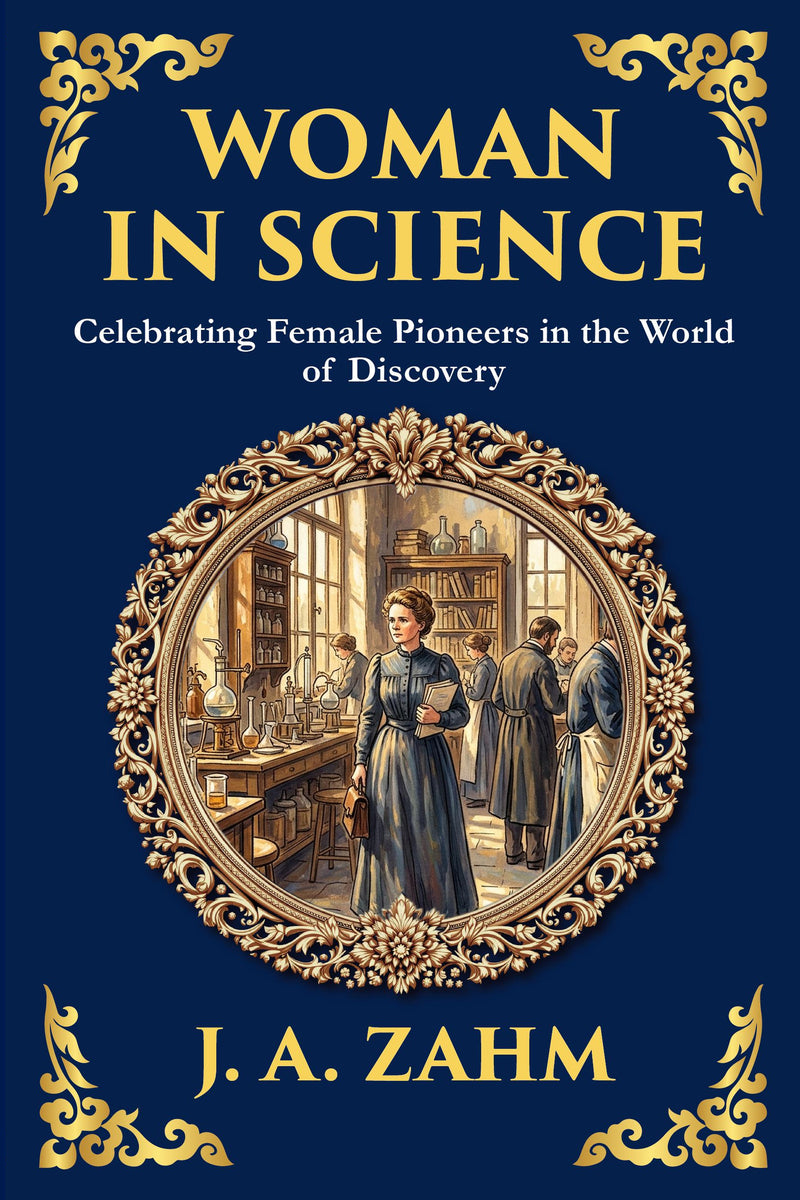
Woman in Science
At a time when women's contributions were often ignored or dismissed, Woman in Science emerged as a bold, respectful, and meticulously researched tribute to the extraordinary achievements of female scientists throughout history.
or free app
10,000+ hrs library
30-day guarantee
The complete Woman in Science appears in modern English through Library of Alexandria Press, available online with audiobook narration included for members.
Have you ever wondered why the stories of brilliant women in science were left out of history books? Originally published in the early 20th century, Woman in Science by J. A. Zahm is a compelling chronicle of women who defied the limitations of their eras to pursue truth, curiosity, and innovation in scientific fields. With elegance and precision, Zahm brings to light the legacy of remarkable women who, despite being overshadowed by societal prejudice, left an indelible mark on the progress of science.
From Hypatia of Alexandria to Marie Curie, this work offers not only biographical insight but also cultural commentary on the challenges—and triumphs—of women in the sciences. This modern edition preserves Zahm’s original passion and purpose while updating the context for a contemporary readership. Whether you're a student of science, history, feminism, or education, Woman in Science will challenge your assumptions and expand your admiration for the minds that dared to think differently.
What you’ll discover in this modern edition
- Biographies of Pioneering Women in Science Meet mathematicians, chemists, astronomers, and inventors who shaped the scientific world across centuries.
| Formats | eBook (EPUB + PDF) · Audiobook · Paperback · Hardcover · Large Print |
| Language | English |
| Trim size (print) | 6 × 9 in |
| Binding | Paperback — perfect-bound · Hardcover — casewrap |
| Large Print edition | Same text in a larger, easy-read type — a larger font, not a larger trim |
| Print pricing | Every physical book at our true cost — at-cost, no profit (members) |
| Library | 873 restored titles, always growing |
| Length | 105,557 words · ~7 hr 2 min reading |
| Reading level | Grade 3 · an easy, flowing read (this modern-English edition) |
| Edition | Modern English translation · 2026 |
Member reviews for this edition are collected as readers finish it — be the first. Across the library: 12,000+ books shipped, every plan covered by a 365-day print guarantee.
About this edition
A faithful, unabridged modern-English edition by The Library of Alexandria — carefully rendered for today's reader and verified paragraph-by-paragraph against the public-domain source. Available as eBook, audiobook, paperback, hardcover, and large print.
- Complete & unabridgedVerified paragraph by paragraph against the source — never a scan, never abridged.
- Modern English, faithfulReadable today, with the author’s meaning kept intact. Readable — not simplified.
- Every format, one membershipRead in your browser or the free app, or listen to the full audiobook.
Included free with your membership
Cancel anytime, one click · 30-day money-back guarantee
Edition last updated July 2026
What’s inside
Woman in Science — complete and unabridged: all 14 sections included with membership, plus the full audiobook.
Begin reading Woman in Science
In clear modern English — the complete text is included with membership.
Introduction
There is a particular kind of silence that history reserves for certain people. It is not the silence of forgetfulness, exactly, nor the silence of erasure, though it borders on both. It is the silence that settles over those whose contributions were folded quietly into the work of others, whose names appeared in footnotes when they appeared at all, whose intellectual labor was absorbed into the grand narrative of progress without acknowledgment. For centuries, the women of science lived in this silence. They observed the heavens and catalogued the stars; they ground lenses and dissected specimens; they translated and calculated and theorized and discovered. And then, more often than not, the credit drifted elsewhere, settling on the shoulders of fathers, husbands, brothers, and colleagues who happened to be men.
This book is an act of listening against that silence. Written by J. A. Zahm and now presented in a modern translation adapted for the contemporary reader, Woman in Science is a celebration of the female pioneers who shaped the world of discovery long before the world was prepared to celebrate them. What you hold in your hands is at once a historical document and a living argument, a record of remarkable lives and a sustained meditation on what it means to recognize genius wherever it appears, regardless of the body that houses it. To read it today is to encounter a peculiar double vision: we see the women themselves, luminous and undeniable, and we also see the author straining at the edges of his own era, reaching toward a fuller understanding of human equality than his century had yet learned to hold.
A Voice from the Threshold of the Modern Age
To understand the achievement of this book, it helps to understand something of the man who wrote it and the moment in which he wrote. John Augustine Zahm was a Catholic priest, a scientist, an educator, and a writer of considerable range and ambition. He moved through the intellectual currents of the late nineteenth and early twentieth centuries with the restless curiosity of a man who believed that knowledge and faith were not enemies but partners, and that the universe rewarded those who studied it closely. He was, in many respects, a controversial figure, willing to defend ideas that made his more cautious contemporaries uneasy. When he turned his attention to the role of women in the history of science, he was doing something genuinely unusual for a writer of his time and position.
It would be easy, from the comfortable distance of our own century, to underestimate how bold this undertaking was. In the era when Zahm composed this work, the prevailing wisdom held that women were temperamentally and intellectually unsuited to the rigors of scientific inquiry. This was not a fringe belief; it was the settled consensus of universities, learned societies, and the broader culture. Women were largely barred from the institutions where science was practiced and taught. They were denied degrees, refused membership in academies, and excluded from the laboratories and observatories where discoveries were made. The very idea that a woman might possess a mind capable of original mathematical or scientific reasoning was treated, in many quarters, as either a charming eccentricity or a dangerous delusion.
Against this backdrop, Zahm set out to do something simple and revolutionary: he gathered the evidence. He assembled the names, the achievements, the published works, the documented discoveries, and he laid them out for the reader to examine. His argument was not built on abstract appeals to fairness or sentiment, though he was capable of both. It was built on the accumulating weight of fact. Here was a woman who had calculated the return of a comet. Here was another who had discovered new species, or advanced the study of mathematics, or made contributions to physics, chemistry, astronomy, and natural history that any reasonable observer would have to acknowledge. The cumulative effect of this catalogue is its own kind of argument, and it remains persuasive precisely because it refuses to overstate its case. Zahm lets the women speak through their accomplishments, and their accomplishments are eloquent.
What makes the book particularly fascinating for the modern reader is the way it occupies a threshold. Zahm was not a twenty-first-century feminist, and it would be both anachronistic and unfair to expect him to be one. There are moments in the original text where his framing reflects the assumptions of his age, where his praise for women is couched in terms that a contemporary reader might find quaint or even constraining. But there is also something genuinely radical at the core of the project, a conviction that the historical record had been distorted by prejudice and that justice required setting it straight. He was a man reaching beyond the limits of his own time, and the strain of that reaching gives the book a particular human poignancy. We watch an honest mind working to free itself from inherited error, and we cannot help but admire the effort even where it falls short.
This modern translation and adaptation has been undertaken with great care to preserve that essential character while making the text accessible to readers who live more than a century after its composition. The language of the original, dense with the formal conventions and elaborate constructions of its period, has been rendered into prose that flows more naturally for the contemporary ear. References that would have been transparent to Zahm’s original audience but obscure to ours have been clarified. The goal throughout has been faithfulness of spirit rather than slavish reproduction of every archaic turn of phrase. What remains is the substance of the argument, the wealth of biographical detail, and the unmistakable voice of an author who cared deeply about his subject. You will find here a book that speaks across the distance of generations, and a translation designed to let that speaking come through clearly.
It is worth pausing to consider why such a project matters now, when so much has changed. We live in an age that has, at least in principle, opened the doors of science to women. The barriers that Zahm described have not vanished, but they have shifted and softened. Women lead laboratories, win the highest honors their fields can bestow, and shape the frontiers of human knowledge. One might ask, then, what a book written in such different circumstances has to offer us. The answer, I think, is twofold. First, the history matters in itself. The women whose stories Zahm tells were extraordinary, and their lives are worth knowing for the simple reason that they were remarkable human beings who did remarkable things. Second, the book offers a mirror. By showing us how recently and how thoroughly the contributions of women were ignored, it invites us to examine our own assumptions, to ask what we might still be overlooking, and to recognize that the work of seeing clearly is never finished.
At the heart of this book are the women themselves, and it is to them that we owe our attention. Zahm ranges widely across the centuries and across the disciplines, drawing his subjects from the ancient world and the medieval period as well as from the more recent past. He understood that the story of women in science did not begin in his own century, or even in the Enlightenment, but stretched back into antiquity, where learned women had studied philosophy and mathematics in the great centers of classical learning. He traces the thread forward through the convents and courts of the Middle Ages, through the salons and academies of the early modern period, and into the laboratories and universities of the nineteenth century, where the modern scientific enterprise took its recognizable shape.
What emerges from this sweep is a portrait of persistence. The women Zahm describes did not have the luxury of taking their place in the scientific community for granted. They worked, in many cases, against active opposition. They were denied formal education and had to teach themselves, or rely on the goodwill of sympathetic relatives and mentors. They published under pseudonyms or under the names of male collaborators. They conducted their research in the margins of lives crowded with domestic responsibility. And yet they persisted, driven by a curiosity and a passion for understanding that no social barrier could fully suppress. There is something deeply moving in this persistence, in the spectacle of minds that refused to be confined by the expectations placed upon them. Zahm clearly felt this, and his admiration animates every page.
The disciplines he surveys span the full range of natural philosophy as it was understood in his time. Astronomy occupies a prominent place, and rightly so, for some of the most celebrated women scientists of the modern era made their mark by scanning the heavens. The patient labor of cataloguing stars, computing orbits, and discovering comets was work to which several women devoted their lives, often achieving results that earned grudging respect even from those who doubted that women could do such things at all. Mathematics, too, features heavily, that most abstract and demanding of disciplines, in which a handful of extraordinary women produced work of genuine originality and lasting importance. Zahm gives attention to the physical sciences, to chemistry and physics, to the study of electricity and the new frontiers of experimental investigation that were transforming the understanding of matter and energy. And he does not neglect the natural sciences, the botany and zoology and geology that called for keen observation, careful description, and the patient accumulation of knowledge about the living world.
Throughout, Zahm is attentive to the particular obstacles that women faced and the particular ways they overcame them. He understands that the story is not simply one of talent triumphing over circumstance, though it is partly that. It is also a story about the structures that determined who could participate in science and on what terms. He notes the importance of family connections, the way that a scientifically inclined father or husband could open doors that would otherwise have remained firmly shut. He observes the role of the few enlightened institutions that admitted women when others would not. And he registers, with evident frustration, the countless cases in which a woman’s contribution was minimized, misattributed, or forgotten. In doing so, he was performing a service that historians would only fully take up generations later: the recovery of a hidden tradition, the restoration of names that had been allowed to fade.
One of the pleasures of reading this book is the sense of discovery it provides. Even readers well versed in the history of science are likely to encounter figures they had not known, or had known only dimly. Zahm’s research was extensive, and he drew on a wide range of sources to assemble his portraits. Some of his subjects are famous, their names familiar to anyone with an interest in the period. Others are far more obscure, and it is in the recovery of these lesser-known figures that the book performs its most valuable work. Each life he describes is a small act of restitution, a refusal to let a deserving person vanish into the undifferentiated mass of the forgotten. The cumulative effect is a kind of monument, built name by name, achievement by achievement, until the reader cannot escape the conclusion that the contributions of women to science have been vast, varied, and grievously underappreciated.
It is also worth noting the spirit in which Zahm approaches his subjects. He writes not as a detached chronicler but as an advocate, and his advocacy gives the book its warmth. He clearly delights in his discoveries, in the evidence he has gathered, in the opportunity to set the record straight. There is a generosity in his treatment of these women, a willingness to take their achievements seriously and to insist that the reader take them seriously too. He does not condescend, and he does not damn with faint praise. When a woman did important work, he says so plainly, and he marshals the evidence to support his claim. This earnestness, this evident care for the dignity and the legacy of his subjects, is one of the most appealing features of the book, and it carries the reader along even through the more detailed passages of biographical and scientific exposition.
Cancel anytime, one click · 30-day money-back guarantee
Founding annual rate available now — your price locks for life when you join.
Not ready? Get this free chapter by email — read it anytime.
✓ Sent — check your inbox for Woman in Science.
Questions about Woman in Science
What is Woman in Science about?
At a time when women's contributions were often ignored or dismissed, Woman in Science emerged as a bold, respectful, and meticulously researched tribute to the extraordinary achievements of female scientists throughout history. In this groundbreaking work, J. A. Zahm challenges societal biases and illuminates the untold stories of women who broke through the barriers of convention to expand the boundaries of human knowledge. From ancient mathematicians to pioneering astronomers, from daring explorers to laboratory
Who wrote Woman in Science?
Woman in Science was written by J. A. Zahm. This edition presents the complete work in clear modern English, faithfully rendered from the public-domain original by Library of Alexandria Press.
Is Woman in Science free to read?
The opening chapter is free to read on this page. Members read and listen to the complete work — and the entire library — free, and can order any physical book at our true print cost.
How long is Woman in Science?
14 chapters (~105,557 words) — about 7 hr 2 min of reading in this modern-English edition.
Is this an abridged version of Woman in Science?
No. This is the complete, unabridged Woman in Science, carefully rendered into clear modern English and verified paragraph-by-paragraph against the public-domain source — nothing is cut or summarised.
What formats does Woman in Science come in?
Woman in Science is available as eBook, paperback, hardcover and large print. eBook and audiobook are included with membership; printed editions ship at our true print cost.
Shipping & returns
Billing & membership
More from the library


Explore Classic & Literary
- Dream Psychology: Psychoanalysis for Beginners · Sigmund Freud
- Great Expectations · Charles Dickens
- The Brothers Karamazov · Fyodor Dostoyevsky
- The Great Gatsby · F. Scott Fitzgerald
- Wild Flowers Worth Knowing · Neltje Blanchan
- Italian Hours · Henry James
- A Popular History of France from the Earliest Times, Volume 5 · François Guizot
- A history of English literature: A practical text-book · Edward Albert
- Italian Highways and Byways from a Motor Car · M. F. Mansfield
- The Heart-Cry of Jesus · Byron J. Rees
- Castes and Tribes of Southern India. Vol. 6 of 7 · Edgar Thurston
- Against the Grain · J.-K. Huysmans
- Dombey and Son · Charles Dickens
- How to Invest Money · George Garr Henry
- The Great Controversy Between Christ and Satan · Ellen Gould Harmon White
- One Hundred Proofs That the Earth Is Not a Globe · William Carpenter
- Southern Literature From 1579–1895 · Louise Manly
- The Renaissance: Studies in Art and Poetry · Walter Pater
- Mark Twain’s Speeches · Mark Twain
- Tacitus on Germany · Cornelius Tacitus
- The Rosary · Florence L. Barclay
- Peculiarities of American Cities · Willard W. Glazier
- Tennis for Girls · Florence A. Ballin
- The World’s Greatest Books — Volume 02 — Fiction
- Shirley · Charlotte Brontë
- Daisy Miller: A Study · Henry James
- Louis Lambert · Honoré de Balzac
- Historic Jamaica · Frank Cundall
- The Gambler · Fyodor Dostoyevsky
- The Mayor of Casterbridge · Thomas Hardy
Woman in Science
Woman in Science
Celebrating Female Pioneers in the World of Discovery
J. A. Zahm
Contents
- Introduction
- Preface by the Author
- Chapter 1
- Chapter 2
- Chapter 3
- Chapter 4
- Chapter 5
- Chapter 6
- Chapter 7
- Chapter 8
- Chapter 9
- Chapter 10
- Chapter 11
- Chapter 12
Introduction
There is a particular kind of silence that history reserves for certain people. It is not the silence of forgetfulness, exactly, nor the silence of erasure, though it borders on both. It is the silence that settles over those whose contributions were folded quietly into the work of others, whose names appeared in footnotes when they appeared at all, whose intellectual labor was absorbed into the grand narrative of progress without acknowledgment. For centuries, the women of science lived in this silence. They observed the heavens and catalogued the stars; they ground lenses and dissected specimens; they translated and calculated and theorized and discovered. And then, more often than not, the credit drifted elsewhere, settling on the shoulders of fathers, husbands, brothers, and colleagues who happened to be men.
This book is an act of listening against that silence. Written by J. A. Zahm and now presented in a modern translation adapted for the contemporary reader, Woman in Science is a celebration of the female pioneers who shaped the world of discovery long before the world was prepared to celebrate them. What you hold in your hands is at once a historical document and a living argument, a record of remarkable lives and a sustained meditation on what it means to recognize genius wherever it appears, regardless of the body that houses it. To read it today is to encounter a peculiar double vision: we see the women themselves, luminous and undeniable, and we also see the author straining at the edges of his own era, reaching toward a fuller understanding of human equality than his century had yet learned to hold.
A Voice from the Threshold of the Modern Age
To understand the achievement of this book, it helps to understand something of the man who wrote it and the moment in which he wrote. John Augustine Zahm was a Catholic priest, a scientist, an educator, and a writer of considerable range and ambition. He moved through the intellectual currents of the late nineteenth and early twentieth centuries with the restless curiosity of a man who believed that knowledge and faith were not enemies but partners, and that the universe rewarded those who studied it closely. He was, in many respects, a controversial figure, willing to defend ideas that made his more cautious contemporaries uneasy. When he turned his attention to the role of women in the history of science, he was doing something genuinely unusual for a writer of his time and position.
It would be easy, from the comfortable distance of our own century, to underestimate how bold this undertaking was. In the era when Zahm composed this work, the prevailing wisdom held that women were temperamentally and intellectually unsuited to the rigors of scientific inquiry. This was not a fringe belief; it was the settled consensus of universities, learned societies, and the broader culture. Women were largely barred from the institutions where science was practiced and taught. They were denied degrees, refused membership in academies, and excluded from the laboratories and observatories where discoveries were made. The very idea that a woman might possess a mind capable of original mathematical or scientific reasoning was treated, in many quarters, as either a charming eccentricity or a dangerous delusion.
Against this backdrop, Zahm set out to do something simple and revolutionary: he gathered the evidence. He assembled the names, the achievements, the published works, the documented discoveries, and he laid them out for the reader to examine. His argument was not built on abstract appeals to fairness or sentiment, though he was capable of both. It was built on the accumulating weight of fact. Here was a woman who had calculated the return of a comet. Here was another who had discovered new species, or advanced the study of mathematics, or made contributions to physics, chemistry, astronomy, and natural history that any reasonable observer would have to acknowledge. The cumulative effect of this catalogue is its own kind of argument, and it remains persuasive precisely because it refuses to overstate its case. Zahm lets the women speak through their accomplishments, and their accomplishments are eloquent.
What makes the book particularly fascinating for the modern reader is the way it occupies a threshold. Zahm was not a twenty-first-century feminist, and it would be both anachronistic and unfair to expect him to be one. There are moments in the original text where his framing reflects the assumptions of his age, where his praise for women is couched in terms that a contemporary reader might find quaint or even constraining. But there is also something genuinely radical at the core of the project, a conviction that the historical record had been distorted by prejudice and that justice required setting it straight. He was a man reaching beyond the limits of his own time, and the strain of that reaching gives the book a particular human poignancy. We watch an honest mind working to free itself from inherited error, and we cannot help but admire the effort even where it falls short.
This modern translation and adaptation has been undertaken with great care to preserve that essential character while making the text accessible to readers who live more than a century after its composition. The language of the original, dense with the formal conventions and elaborate constructions of its period, has been rendered into prose that flows more naturally for the contemporary ear. References that would have been transparent to Zahm’s original audience but obscure to ours have been clarified. The goal throughout has been faithfulness of spirit rather than slavish reproduction of every archaic turn of phrase. What remains is the substance of the argument, the wealth of biographical detail, and the unmistakable voice of an author who cared deeply about his subject. You will find here a book that speaks across the distance of generations, and a translation designed to let that speaking come through clearly.
It is worth pausing to consider why such a project matters now, when so much has changed. We live in an age that has, at least in principle, opened the doors of science to women. The barriers that Zahm described have not vanished, but they have shifted and softened. Women lead laboratories, win the highest honors their fields can bestow, and shape the frontiers of human knowledge. One might ask, then, what a book written in such different circumstances has to offer us. The answer, I think, is twofold. First, the history matters in itself. The women whose stories Zahm tells were extraordinary, and their lives are worth knowing for the simple reason that they were remarkable human beings who did remarkable things. Second, the book offers a mirror. By showing us how recently and how thoroughly the contributions of women were ignored, it invites us to examine our own assumptions, to ask what we might still be overlooking, and to recognize that the work of seeing clearly is never finished.
At the heart of this book are the women themselves, and it is to them that we owe our attention. Zahm ranges widely across the centuries and across the disciplines, drawing his subjects from the ancient world and the medieval period as well as from the more recent past. He understood that the story of women in science did not begin in his own century, or even in the Enlightenment, but stretched back into antiquity, where learned women had studied philosophy and mathematics in the great centers of classical learning. He traces the thread forward through the convents and courts of the Middle Ages, through the salons and academies of the early modern period, and into the laboratories and universities of the nineteenth century, where the modern scientific enterprise took its recognizable shape.
What emerges from this sweep is a portrait of persistence. The women Zahm describes did not have the luxury of taking their place in the scientific community for granted. They worked, in many cases, against active opposition. They were denied formal education and had to teach themselves, or rely on the goodwill of sympathetic relatives and mentors. They published under pseudonyms or under the names of male collaborators. They conducted their research in the margins of lives crowded with domestic responsibility. And yet they persisted, driven by a curiosity and a passion for understanding that no social barrier could fully suppress. There is something deeply moving in this persistence, in the spectacle of minds that refused to be confined by the expectations placed upon them. Zahm clearly felt this, and his admiration animates every page.
The disciplines he surveys span the full range of natural philosophy as it was understood in his time. Astronomy occupies a prominent place, and rightly so, for some of the most celebrated women scientists of the modern era made their mark by scanning the heavens. The patient labor of cataloguing stars, computing orbits, and discovering comets was work to which several women devoted their lives, often achieving results that earned grudging respect even from those who doubted that women could do such things at all. Mathematics, too, features heavily, that most abstract and demanding of disciplines, in which a handful of extraordinary women produced work of genuine originality and lasting importance. Zahm gives attention to the physical sciences, to chemistry and physics, to the study of electricity and the new frontiers of experimental investigation that were transforming the understanding of matter and energy. And he does not neglect the natural sciences, the botany and zoology and geology that called for keen observation, careful description, and the patient accumulation of knowledge about the living world.
Throughout, Zahm is attentive to the particular obstacles that women faced and the particular ways they overcame them. He understands that the story is not simply one of talent triumphing over circumstance, though it is partly that. It is also a story about the structures that determined who could participate in science and on what terms. He notes the importance of family connections, the way that a scientifically inclined father or husband could open doors that would otherwise have remained firmly shut. He observes the role of the few enlightened institutions that admitted women when others would not. And he registers, with evident frustration, the countless cases in which a woman’s contribution was minimized, misattributed, or forgotten. In doing so, he was performing a service that historians would only fully take up generations later: the recovery of a hidden tradition, the restoration of names that had been allowed to fade.
One of the pleasures of reading this book is the sense of discovery it provides. Even readers well versed in the history of science are likely to encounter figures they had not known, or had known only dimly. Zahm’s research was extensive, and he drew on a wide range of sources to assemble his portraits. Some of his subjects are famous, their names familiar to anyone with an interest in the period. Others are far more obscure, and it is in the recovery of these lesser-known figures that the book performs its most valuable work. Each life he describes is a small act of restitution, a refusal to let a deserving person vanish into the undifferentiated mass of the forgotten. The cumulative effect is a kind of monument, built name by name, achievement by achievement, until the reader cannot escape the conclusion that the contributions of women to science have been vast, varied, and grievously underappreciated.
It is also worth noting the spirit in which Zahm approaches his subjects. He writes not as a detached chronicler but as an advocate, and his advocacy gives the book its warmth. He clearly delights in his discoveries, in the evidence he has gathered, in the opportunity to set the record straight. There is a generosity in his treatment of these women, a willingness to take their achievements seriously and to insist that the reader take them seriously too. He does not condescend, and he does not damn with faint praise. When a woman did important work, he says so plainly, and he marshals the evidence to support his claim. This earnestness, this evident care for the dignity and the legacy of his subjects, is one of the most appealing features of the book, and it carries the reader along even through the more detailed passages of biographical and scientific exposition.
I intend to review the progress and achievements of women in science from their earliest efforts in ancient Greece up to the present day. I will show how, in every field of natural knowledge, women have been the colleagues and rivals—and often the equals—of the most famous men who expanded human learning, provided they weren’t held back by their environment. However, to truly understand this subject, we first need to look at the many different obstacles that have blocked women’s access to general knowledge throughout history. Without this background, it is impossible to realize how intense their lifelong struggle for intellectual freedom and justice has been, or to fully appreciate the relative liberty and advantages they have now in almost every intellectual field. Furthermore, one could not understand why women’s scientific achievements have been so few and seemingly insignificant compared to those of men, especially in the past, or why we hear so little about women as students of nature or researchers in pure and applied science before the second half of the nineteenth century.
To show the difficulties women have faced in every era and every country to secure the basic intellectual rights we now take for granted, we don’t need to review the entire history of female education or every detail of their slow progress in the East and West. However, we do need to understand how the world viewed women’s education during key historical periods. We must look at the opinions held until very recently—even by scholars and leaders—about a woman’s nature, her duties, and what was considered her “proper place” in society. By understanding the cruel obstacles she endured and the opposition she faced—even during the most “enlightened” times and often from the very people who should have helped her—we can better appreciate how significant her recent intellectual liberation is and the value of what she has achieved since she was finally allowed to use her natural talents.
End of the free sample
Keep reading, free
Members read and listen to the complete book — and the entire library. Cancel anytime, one click · 30-day money-back guarantee.