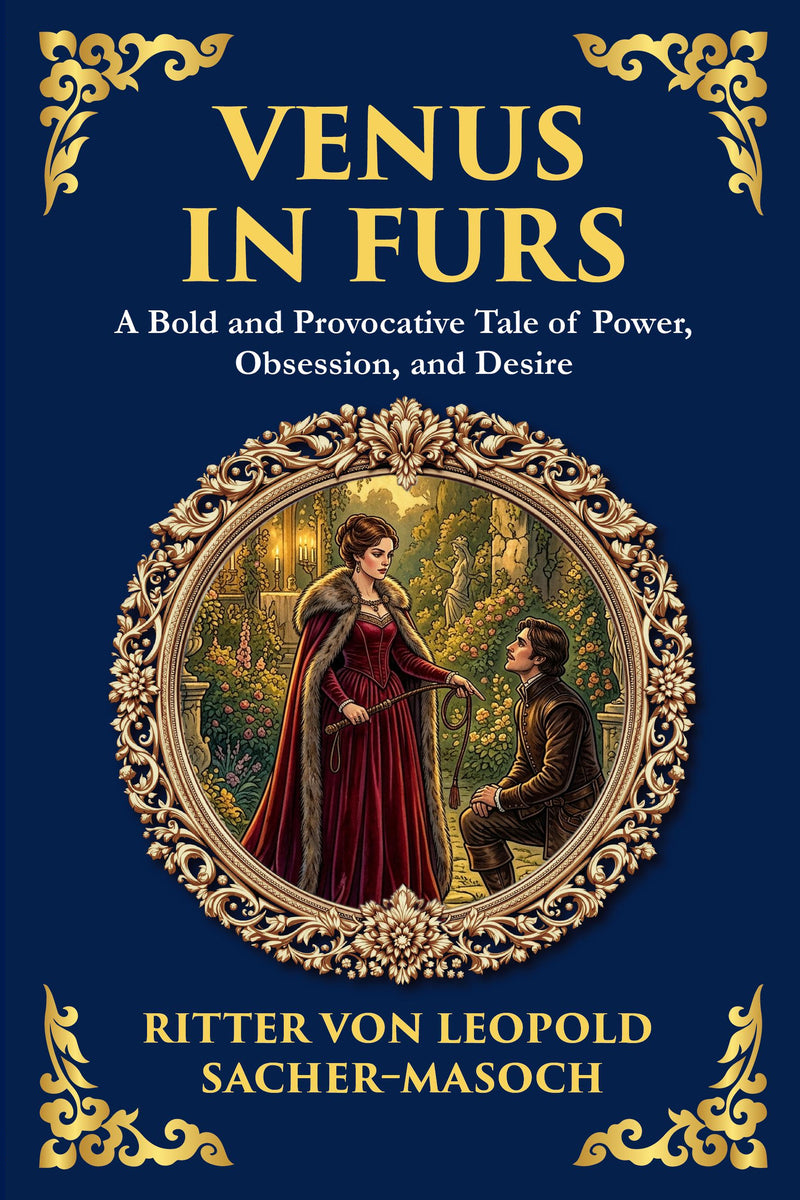
Venus in Furs
Leopold Sacher-Masoch Daring, erotic, and psychologically profound, Venus in Furs is a landmark exploration of desire, domination, and the human psyche.
or free app
10,000+ hrs library
30-day guarantee
The complete Venus in Furs appears in modern English through Library of Alexandria Press, available online with audiobook narration included for members.
Have you ever wondered why we desire the very things that hurt us most? In Venus in Furs, Ritter von Leopold Sacher-Masoch introduces us to Severin, a man possessed by an all-consuming longing: to be dominated, humiliated, and emotionally enslaved by a beautiful woman. That woman is Wanda von Dunajew—brilliant, cold, and fascinated by the power she holds.
When Severin begs to be her servant, they enter into a contract of submission that seems thrilling at first—but soon unravels into something far more dangerous. Blending eroticism with deep psychological insight, Venus in Furs is a radical novel that explores the intersection of pain and pleasure, love and control, gender roles and power dynamics. Inspired by the author’s own experiences and controversial ideas, the novel gave birth to the term masochism—forever linking Sacher-Masoch’s name with the themes he dared to bring to light.
This modern edition preserves the elegance and intensity of the original while offering clear and accessible language for today’s readers. More than a provocative romance, it is a haunting meditation on the destructive nature of unchecked desire and the fragility of human identity.
What you’ll discover in this modern edition
- The Origin of Masochism – A novel that gave rise to an entire field of psychological study.
- A Transgressive Love Story – Explore the dark seduction of surrendering power in the name of love.
- Themes of Gender, Power, and Control – Uncover how dominance and submission shape human relationships.
- A Philosophical Investigation of Desire – Examine the paradoxes of freedom, obsession, and emotional dependency.
- A Bold, Accessible Adaptation – Carefully translated and edited to make Sacher- Masoch’s vision clear for modern readers. Venus in Furs is a daring literary experience that continues to captivate and challenge readers over a century later.
| Formats | eBook (EPUB + PDF) · Audiobook · Paperback · Hardcover · Large Print |
| Language | English |
| Trim size (print) | 6 × 9 in |
| Binding | Paperback — perfect-bound · Hardcover — casewrap |
| Large Print edition | Same text in a larger, easy-read type — a larger font, not a larger trim |
| Print pricing | Every physical book at our true cost — at-cost, no profit (members) |
| Library | 873 restored titles, always growing |
| Length | 40,874 words · ~2 hr 43 min reading |
| Reading level | Grade 3 · an easy, flowing read (this modern-English edition) |
| Edition | Modern English translation · 2026 |
Member reviews for this edition are collected as readers finish it — be the first. Across the library: 12,000+ books shipped, every plan covered by a 365-day print guarantee.
About this edition
A faithful, unabridged modern-English edition by The Library of Alexandria — carefully rendered for today's reader and verified paragraph-by-paragraph against the public-domain source. Available as eBook, audiobook, paperback, hardcover, and large print.
- Complete & unabridgedVerified paragraph by paragraph against the source — never a scan, never abridged.
- Modern English, faithfulReadable today, with the author’s meaning kept intact. Readable — not simplified.
- Every format, one membershipRead in your browser or the free app, or listen to the full audiobook.
Included free with your membership
Cancel anytime, one click · 30-day money-back guarantee
Edition last updated July 2026
What’s inside
Venus in Furs — complete and unabridged, included in full with membership, plus the full audiobook.
Begin reading Venus in Furs
In clear modern English — the complete text is included with membership.
Introduction
There are books that whisper, and there are books that confess. Venus in Furs belongs unmistakably to the latter category. First published in 1870 as part of a larger, ambitious literary project, this slender yet impossibly dense novella has done something that almost no other work of nineteenth-century European fiction has managed: it has given its author’s name to an entire dimension of human psychology. The word “masochism,” coined by the pioneering psychiatrist Richard von Krafft-Ebing in his landmark Psychopathia Sexualis, was drawn directly from the surname of the man who wrote this book — Leopold von Sacher-Masoch. It is a strange and uncomfortable kind of immortality, one that the author himself reportedly resented, feeling that his rich and varied literary output had been reduced to a single clinical label. And yet, here we are, more than a century and a half later, still drawn to the smoldering, tormented, almost unbearably intimate world he created.
To open these pages is to step into a confessional chamber. The story unfolds with a frame narrative — a structure beloved by the Romantics and Gothic writers who preceded Sacher-Masoch — in which a narrator encounters a manuscript that recounts the experiences of a man named Severin. What follows is not merely a tale of love, nor even of obsession, but an anatomy of surrender. It is the dissection of a soul that longs to be possessed, to be mastered, to abandon the burdens of will and autonomy in favor of an ecstatic, agonizing servitude. The novella poses a question that remains as provocative today as it was in the salons and reading rooms of the late Austro-Hungarian Empire: what does it mean to want to be ruled? And what happens to both the ruler and the ruled when desire and power become entangled beyond separation?
This modern translation, adapted for the contemporary reader, has been prepared with the conviction that Venus in Furs deserves to be experienced freshly, without the brittle scaffolding of antiquated phrasing that can make nineteenth-century prose feel like a museum exhibit behind glass. The original German is lush, philosophical, sometimes deliberately archaic, steeped in classical allusion and the cadences of Romantic reverie. Earlier English translations, while valuable, often preserved a stiffness that obscured the genuine heat and psychological acuity of the work. The aim here has been to honor the spirit, the music, and the moral seriousness of Sacher-Masoch’s writing while rendering it in language that breathes naturally for readers of our own century. Nothing essential has been softened or sanitized; the intent has been to make the book’s astonishing intensity more accessible, not less.
To understand Venus in Furs, it helps to understand something of the remarkable figure who wrote it. Leopold von Sacher-Masoch was born in 1836 in Lemberg, then the capital of the Austrian crown land of Galicia — a city known today as Lviv, in Ukraine. He came from a family of administrative officials and aristocratic lineage; his father was the chief of police, and young Leopold grew up amid the multicultural ferment of a borderland region where Polish, Ruthenian, German, and Jewish communities lived side by side. This early exposure to a tapestry of cultures, folk traditions, and ethnic tensions would later infuse his writing with a distinctive ethnographic richness. Sacher-Masoch was, in his lifetime, a celebrated and prolific author, esteemed across Europe for his historical fiction, his sympathetic portraits of Galician peasant life, and his contributions to a sprawling literary cycle he called The Legacy of Cain — an unfinished project meant to explore the great forces governing human existence: love, property, the state, war, work, and death. Venus in Furs was conceived as part of the “Love” volume of this grand design.
It is worth pausing on this point, because it reframes everything. This was not the casual production of a provocateur looking to titillate. Sacher-Masoch was a serious literary craftsman with philosophical ambitions, a man who saw in the dynamics of erotic submission something fundamental about the human condition. He believed that the relationship between the sexes was, in its essence, a relationship of conflict — a perpetual struggle in which one party must always dominate and the other submit. Venus in Furs is his most concentrated and unflinching meditation on this idea, and its power derives precisely from the fact that he treated it not as a curiosity but as a window into something universal and disturbing.
His own life, famously, mirrored the themes of his fiction. Sacher-Masoch entered into contractual arrangements with women — most notably with his first wife — in which he formally bound himself to their service and pleasure, complete with written agreements that specified the terms of his submission. He had a particular fascination with the image of a woman in furs wielding a whip, an image that recurs throughout his work like a leitmotif. The biographical resonances between the author and his protagonist Severin are unmistakable and have fascinated readers, critics, and psychologists for generations. Yet to read the novella as mere autobiography would be a disservice. Sacher-Masoch was an artist transmuting private compulsion into a structured, deliberate work of literature, one shaped by the intellectual currents of his age.
And what an age it was. The nineteenth century in Central Europe was a period of immense philosophical and cultural ferment. The shadow of German idealism — Hegel, Schopenhauer, and the great debates about will, freedom, and the nature of the self — loomed large over educated minds. Schopenhauer’s pessimistic vision of existence as governed by a blind, insatiable will found echoes in Sacher-Masoch’s portrayal of desire as a force that enslaves and consumes. The Romantic obsession with the femme fatale, the enchantress, the cruel beloved who tortures her admirer, was reaching its apotheosis in art and literature across the continent. The figure of Venus — the goddess of love, but also a pagan emblem of overpowering, amoral sensuality — had become a recurring symbol of the irreconcilable tension between Christian morality and the irrepressible demands of the flesh. Sacher-Masoch drew all of these threads together and wove them into something startlingly new.
The book also engages, perhaps unexpectedly, with the cultural mythology of classical antiquity and the so-called “pagan” worldview. Severin and the woman who becomes the object of his obsession spend a great deal of their early conversation discussing the contrast between the serene, sensual hedonism they associate with ancient Greece and the guilt-ridden, body-denying spirituality of Christian modernity. This is not idle chatter; it is the philosophical engine of the entire narrative. Sacher-Masoch was wrestling with one of the great anxieties of his century — the question of whether modern, “civilized” men and women had become alienated from their own natures, severed from the frank physicality and emotional honesty that earlier ages were imagined to have possessed. The fur-clad goddess of the title is, among many other things, a vision of nature reclaimed, of a femininity unburdened by the suffocating proprieties of bourgeois respectability.
A Story of Power, Desire, and the Architecture of Surrender
What makes Venus in Furs endure is not its scandal but its psychological precision. Long before Freud built his systematic theories of the unconscious, before the entire vocabulary of modern sexual psychology existed, Sacher-Masoch had intuited something profound about the way desire and power intertwine in the human heart. He understood that submission can be a form of agency, that the apparent weakness of the one who kneels may conceal a will more obsessive and demanding than that of the one who commands. He grasped that the line between pleasure and pain, between worship and degradation, between love and cruelty, is far more porous than we like to admit.
The relationship at the center of the book is, in this sense, a kind of laboratory. Severin does not simply fall under the spell of a domineering woman; he actively, painstakingly constructs the very dynamic that will torment him. He persuades, cajoles, and ultimately contracts his beloved into the role of his mistress and tormentor. The book is acutely interested in this process of construction — in the way that fantasy must be negotiated into reality, in the discomfort and reluctance of the woman who is asked to become something she is not naturally inclined to be, and in the gradual, almost imperceptible shift that occurs once a role is performed long enough to become real. There is a profound and troubling insight buried here: that we may get exactly what we ask for, and that the getting may transform us in ways we never anticipated.
Modern readers will find in these pages an unexpected complexity around questions of gender and power that feels strikingly relevant to our own ongoing cultural conversations. The woman at the heart of the story is no mere fantasy figure; Sacher-Masoch grants her a voice, a will, and a perspective. She frequently questions the strange game she has been drawn into, expresses her own ambivalence, and articulates her own theories about men and women, freedom and bondage. Some of her speeches are among the most provocative in the book — observations about the nature of love, the impossibility of equality between lovers, and the corrupting effects of granting one person total power over another. Whether one agrees with these pronouncements or not, they crackle with a kind of dangerous intelligence that refuses easy dismissal. This is not a book that allows the reader to remain comfortable.
It would be reductive to read Venus in Furs simply as a celebration of a particular erotic inclination. The novella is, in fact, deeply ambivalent about the very desires it explores. There is genuine suffering in these pages, genuine reflection on the costs of obsession, and a hard-won, even cautionary wisdom by the story’s end. Sacher-Masoch does not flinch from depicting the corrosive effects of an arrangement in which one person abdicates their dignity and another is invited to exercise unchecked dominion. The book asks whether such a relationship can sustain itself, whether desire that depends on humiliation can coexist with love, and what becomes of a man who stakes everything on his fantasy. These are not the questions of a mere sensationalist. They are the questions of a moralist — a strange, conflicted, courageous moralist who was willing to peer into the most shadowed corners of his own heart and report honestly on what he found there.
The setting and atmosphere of the novel contribute enormously to its hypnotic effect. Much of the action takes place against a backdrop of Italian splendor and Carpathian wildness, in landscapes that mirror the inner states of the characters. Sacher-Masoch had a painter’s eye for sensual detail — the play of light on marble, the texture and weight of fur, the lazy heat of a southern afternoon, the gleam of an antique statue in a garden. The famous image of Venus wrapped in dark fur, both goddess and woman, both ideal and flesh, recurs throughout the book with an almost obsessive insistence, accreting layers of meaning as the story progresses. Fur itself becomes a symbol charged with electricity — at once a sign of luxury and wealth, of animal nature, of warmth and cruelty, of the predatory and the protective. The careful reader will notice how Sacher-Masoch returns again and again to certain visual motifs, building a private symbolic language that gives the work its dreamlike, incantatory quality.
It is also worth noting the book’s remarkable formal sophistication. The frame narrative, in which a manuscript is read and then discussed, allows Sacher-Masoch to introduce multiple layers of interpretation and to hold his own subject matter at a certain critical distance. The story we read is presented as a confession, a document of self-examination, and this confessional quality lends it an intimacy and an emotional rawness that few novels of its era can match. We are not simply observing Severin from the outside; we are inside his fevered consciousness, privy to his rationalizations, his ecstasies, his terrors, and his eventual reckoning. The result is a reading experience of unusual closeness, one that implicates the reader in the protagonist’s psychology in ways that can be genuinely uncomfortable. We are made complicit, asked to understand desires we may not share, to inhabit a worldview that may unsettle us.
Cancel anytime, one click · 30-day money-back guarantee
Founding annual rate available now — your price locks for life when you join.
Not ready? Get this free chapter by email — read it anytime.
✓ Sent — check your inbox for Venus in Furs.
Questions about Venus in Furs
What is Venus in Furs about?
Leopold Sacher-Masoch Daring, erotic, and psychologically profound, Venus in Furs is a landmark exploration of desire, domination, and the human psyche. When a man pleads to be enslaved by the woman he adores, their relationship spirals into an intoxicating performance of submission and control— one that will test the limits of love, identity, and sanity. This is not merely a tale of taboo—it is a philosophical and emotional journey into the nature of obsession and the intoxicating danger of surrendering one's will
Who wrote Venus in Furs?
Venus in Furs was written by Ritter von Leopold Sacher-Masoch. This edition presents the complete work in clear modern English, faithfully rendered from the public-domain original by Library of Alexandria Press.
Is Venus in Furs free to read?
The opening chapter is free to read on this page. Members read and listen to the complete work — and the entire library — free, and can order any physical book at our true print cost.
How long is Venus in Furs?
2 chapters (~40,874 words) — about 2 hr 43 min of reading in this modern-English edition.
Is this an abridged version of Venus in Furs?
No. This is the complete, unabridged Venus in Furs, carefully rendered into clear modern English and verified paragraph-by-paragraph against the public-domain source — nothing is cut or summarised.
What formats does Venus in Furs come in?
Venus in Furs is available as eBook, paperback, hardcover and large print. eBook and audiobook are included with membership; printed editions ship at our true print cost.
Shipping & returns
Billing & membership
More from the library


Explore Classic & Literary
- Dream Psychology: Psychoanalysis for Beginners · Sigmund Freud
- Great Expectations · Charles Dickens
- The Brothers Karamazov · Fyodor Dostoyevsky
- The Great Gatsby · F. Scott Fitzgerald
- Wild Flowers Worth Knowing · Neltje Blanchan
- Italian Hours · Henry James
- A Popular History of France from the Earliest Times, Volume 5 · François Guizot
- A history of English literature: A practical text-book · Edward Albert
- Italian Highways and Byways from a Motor Car · M. F. Mansfield
- The Heart-Cry of Jesus · Byron J. Rees
- Castes and Tribes of Southern India. Vol. 6 of 7 · Edgar Thurston
- Against the Grain · J.-K. Huysmans
- Dombey and Son · Charles Dickens
- How to Invest Money · George Garr Henry
- The Great Controversy Between Christ and Satan · Ellen Gould Harmon White
- One Hundred Proofs That the Earth Is Not a Globe · William Carpenter
- Southern Literature From 1579–1895 · Louise Manly
- The Renaissance: Studies in Art and Poetry · Walter Pater
- Mark Twain’s Speeches · Mark Twain
- Tacitus on Germany · Cornelius Tacitus
- The Rosary · Florence L. Barclay
- Peculiarities of American Cities · Willard W. Glazier
- Tennis for Girls · Florence A. Ballin
- The World’s Greatest Books — Volume 02 — Fiction
- Shirley · Charlotte Brontë
- Daisy Miller: A Study · Henry James
- Louis Lambert · Honoré de Balzac
- Historic Jamaica · Frank Cundall
- The Gambler · Fyodor Dostoyevsky
- The Mayor of Casterbridge · Thomas Hardy
Venus in Furs
Venus in Furs
A Bold and Provocative Tale of Power, Obsession, and Desire
Ritter von Leopold Sacher-Masoch
Contents
- Introduction
- Venus in Furs
Introduction
There are books that whisper, and there are books that confess. Venus in Furs belongs unmistakably to the latter category. First published in 1870 as part of a larger, ambitious literary project, this slender yet impossibly dense novella has done something that almost no other work of nineteenth-century European fiction has managed: it has given its author’s name to an entire dimension of human psychology. The word “masochism,” coined by the pioneering psychiatrist Richard von Krafft-Ebing in his landmark Psychopathia Sexualis, was drawn directly from the surname of the man who wrote this book — Leopold von Sacher-Masoch. It is a strange and uncomfortable kind of immortality, one that the author himself reportedly resented, feeling that his rich and varied literary output had been reduced to a single clinical label. And yet, here we are, more than a century and a half later, still drawn to the smoldering, tormented, almost unbearably intimate world he created.
To open these pages is to step into a confessional chamber. The story unfolds with a frame narrative — a structure beloved by the Romantics and Gothic writers who preceded Sacher-Masoch — in which a narrator encounters a manuscript that recounts the experiences of a man named Severin. What follows is not merely a tale of love, nor even of obsession, but an anatomy of surrender. It is the dissection of a soul that longs to be possessed, to be mastered, to abandon the burdens of will and autonomy in favor of an ecstatic, agonizing servitude. The novella poses a question that remains as provocative today as it was in the salons and reading rooms of the late Austro-Hungarian Empire: what does it mean to want to be ruled? And what happens to both the ruler and the ruled when desire and power become entangled beyond separation?
This modern translation, adapted for the contemporary reader, has been prepared with the conviction that Venus in Furs deserves to be experienced freshly, without the brittle scaffolding of antiquated phrasing that can make nineteenth-century prose feel like a museum exhibit behind glass. The original German is lush, philosophical, sometimes deliberately archaic, steeped in classical allusion and the cadences of Romantic reverie. Earlier English translations, while valuable, often preserved a stiffness that obscured the genuine heat and psychological acuity of the work. The aim here has been to honor the spirit, the music, and the moral seriousness of Sacher-Masoch’s writing while rendering it in language that breathes naturally for readers of our own century. Nothing essential has been softened or sanitized; the intent has been to make the book’s astonishing intensity more accessible, not less.
To understand Venus in Furs, it helps to understand something of the remarkable figure who wrote it. Leopold von Sacher-Masoch was born in 1836 in Lemberg, then the capital of the Austrian crown land of Galicia — a city known today as Lviv, in Ukraine. He came from a family of administrative officials and aristocratic lineage; his father was the chief of police, and young Leopold grew up amid the multicultural ferment of a borderland region where Polish, Ruthenian, German, and Jewish communities lived side by side. This early exposure to a tapestry of cultures, folk traditions, and ethnic tensions would later infuse his writing with a distinctive ethnographic richness. Sacher-Masoch was, in his lifetime, a celebrated and prolific author, esteemed across Europe for his historical fiction, his sympathetic portraits of Galician peasant life, and his contributions to a sprawling literary cycle he called The Legacy of Cain — an unfinished project meant to explore the great forces governing human existence: love, property, the state, war, work, and death. Venus in Furs was conceived as part of the “Love” volume of this grand design.
It is worth pausing on this point, because it reframes everything. This was not the casual production of a provocateur looking to titillate. Sacher-Masoch was a serious literary craftsman with philosophical ambitions, a man who saw in the dynamics of erotic submission something fundamental about the human condition. He believed that the relationship between the sexes was, in its essence, a relationship of conflict — a perpetual struggle in which one party must always dominate and the other submit. Venus in Furs is his most concentrated and unflinching meditation on this idea, and its power derives precisely from the fact that he treated it not as a curiosity but as a window into something universal and disturbing.
His own life, famously, mirrored the themes of his fiction. Sacher-Masoch entered into contractual arrangements with women — most notably with his first wife — in which he formally bound himself to their service and pleasure, complete with written agreements that specified the terms of his submission. He had a particular fascination with the image of a woman in furs wielding a whip, an image that recurs throughout his work like a leitmotif. The biographical resonances between the author and his protagonist Severin are unmistakable and have fascinated readers, critics, and psychologists for generations. Yet to read the novella as mere autobiography would be a disservice. Sacher-Masoch was an artist transmuting private compulsion into a structured, deliberate work of literature, one shaped by the intellectual currents of his age.
And what an age it was. The nineteenth century in Central Europe was a period of immense philosophical and cultural ferment. The shadow of German idealism — Hegel, Schopenhauer, and the great debates about will, freedom, and the nature of the self — loomed large over educated minds. Schopenhauer’s pessimistic vision of existence as governed by a blind, insatiable will found echoes in Sacher-Masoch’s portrayal of desire as a force that enslaves and consumes. The Romantic obsession with the femme fatale, the enchantress, the cruel beloved who tortures her admirer, was reaching its apotheosis in art and literature across the continent. The figure of Venus — the goddess of love, but also a pagan emblem of overpowering, amoral sensuality — had become a recurring symbol of the irreconcilable tension between Christian morality and the irrepressible demands of the flesh. Sacher-Masoch drew all of these threads together and wove them into something startlingly new.
The book also engages, perhaps unexpectedly, with the cultural mythology of classical antiquity and the so-called “pagan” worldview. Severin and the woman who becomes the object of his obsession spend a great deal of their early conversation discussing the contrast between the serene, sensual hedonism they associate with ancient Greece and the guilt-ridden, body-denying spirituality of Christian modernity. This is not idle chatter; it is the philosophical engine of the entire narrative. Sacher-Masoch was wrestling with one of the great anxieties of his century — the question of whether modern, “civilized” men and women had become alienated from their own natures, severed from the frank physicality and emotional honesty that earlier ages were imagined to have possessed. The fur-clad goddess of the title is, among many other things, a vision of nature reclaimed, of a femininity unburdened by the suffocating proprieties of bourgeois respectability.
A Story of Power, Desire, and the Architecture of Surrender
What makes Venus in Furs endure is not its scandal but its psychological precision. Long before Freud built his systematic theories of the unconscious, before the entire vocabulary of modern sexual psychology existed, Sacher-Masoch had intuited something profound about the way desire and power intertwine in the human heart. He understood that submission can be a form of agency, that the apparent weakness of the one who kneels may conceal a will more obsessive and demanding than that of the one who commands. He grasped that the line between pleasure and pain, between worship and degradation, between love and cruelty, is far more porous than we like to admit.
The relationship at the center of the book is, in this sense, a kind of laboratory. Severin does not simply fall under the spell of a domineering woman; he actively, painstakingly constructs the very dynamic that will torment him. He persuades, cajoles, and ultimately contracts his beloved into the role of his mistress and tormentor. The book is acutely interested in this process of construction — in the way that fantasy must be negotiated into reality, in the discomfort and reluctance of the woman who is asked to become something she is not naturally inclined to be, and in the gradual, almost imperceptible shift that occurs once a role is performed long enough to become real. There is a profound and troubling insight buried here: that we may get exactly what we ask for, and that the getting may transform us in ways we never anticipated.
Modern readers will find in these pages an unexpected complexity around questions of gender and power that feels strikingly relevant to our own ongoing cultural conversations. The woman at the heart of the story is no mere fantasy figure; Sacher-Masoch grants her a voice, a will, and a perspective. She frequently questions the strange game she has been drawn into, expresses her own ambivalence, and articulates her own theories about men and women, freedom and bondage. Some of her speeches are among the most provocative in the book — observations about the nature of love, the impossibility of equality between lovers, and the corrupting effects of granting one person total power over another. Whether one agrees with these pronouncements or not, they crackle with a kind of dangerous intelligence that refuses easy dismissal. This is not a book that allows the reader to remain comfortable.
It would be reductive to read Venus in Furs simply as a celebration of a particular erotic inclination. The novella is, in fact, deeply ambivalent about the very desires it explores. There is genuine suffering in these pages, genuine reflection on the costs of obsession, and a hard-won, even cautionary wisdom by the story’s end. Sacher-Masoch does not flinch from depicting the corrosive effects of an arrangement in which one person abdicates their dignity and another is invited to exercise unchecked dominion. The book asks whether such a relationship can sustain itself, whether desire that depends on humiliation can coexist with love, and what becomes of a man who stakes everything on his fantasy. These are not the questions of a mere sensationalist. They are the questions of a moralist — a strange, conflicted, courageous moralist who was willing to peer into the most shadowed corners of his own heart and report honestly on what he found there.
The setting and atmosphere of the novel contribute enormously to its hypnotic effect. Much of the action takes place against a backdrop of Italian splendor and Carpathian wildness, in landscapes that mirror the inner states of the characters. Sacher-Masoch had a painter’s eye for sensual detail — the play of light on marble, the texture and weight of fur, the lazy heat of a southern afternoon, the gleam of an antique statue in a garden. The famous image of Venus wrapped in dark fur, both goddess and woman, both ideal and flesh, recurs throughout the book with an almost obsessive insistence, accreting layers of meaning as the story progresses. Fur itself becomes a symbol charged with electricity — at once a sign of luxury and wealth, of animal nature, of warmth and cruelty, of the predatory and the protective. The careful reader will notice how Sacher-Masoch returns again and again to certain visual motifs, building a private symbolic language that gives the work its dreamlike, incantatory quality.
It is also worth noting the book’s remarkable formal sophistication. The frame narrative, in which a manuscript is read and then discussed, allows Sacher-Masoch to introduce multiple layers of interpretation and to hold his own subject matter at a certain critical distance. The story we read is presented as a confession, a document of self-examination, and this confessional quality lends it an intimacy and an emotional rawness that few novels of its era can match. We are not simply observing Severin from the outside; we are inside his fevered consciousness, privy to his rationalizations, his ecstasies, his terrors, and his eventual reckoning. The result is a reading experience of unusual closeness, one that implicates the reader in the protagonist’s psychology in ways that can be genuinely uncomfortable. We are made complicit, asked to understand desires we may not share, to inhabit a worldview that may unsettle us.
“But the Almighty Lord has struck him down and delivered him into the hands of a woman.”
Venus sat across from me by the massive Renaissance fireplace. She wasn’t some common woman of the demi-monde using a pseudonym to wage war on men, like Mademoiselle Cleopatra; she was the real, true goddess of love.
She sat in an armchair and had started a crackling fire. The red flames reflected across her pale face and white eyes, and occasionally flickered over her feet as she tried to warm them.
Despite her cold, stony eyes, her head was beautiful; it was the only part of her I could see. She had wrapped her marble-like body in a huge fur, curling up and trembling like a cat.
“I don’t understand it,” I exclaimed. “It isn’t really cold anymore. We’ve had perfect spring weather for two weeks. You must be nervous.”
“Thanks for your spring,” she replied in a low, stony voice, then immediately let out two divine sneezes in a row. “I really can’t stand it here much longer, and I’m starting to realize—”
“I’m starting to believe the unbelievable and understand the incomprehensible. Suddenly, I understand the virtue of German women and German philosophy. I’m no longer surprised that you Northerners don’t know how to love—you don’t even have a concept of what love is.”
“But, madame,” I replied, getting defensive, “I certainly haven’t given you any reason to think that.”
“Oh, you—” The goddess sneezed a third time and shrugged her shoulders with effortless grace. “That’s why I’ve always been nice to you, and why I still visit you occasionally, even though I catch a cold every time despite all my furs. Do you remember the first time we met?”
End of the free sample
Keep reading, free
Members read and listen to the complete book — and the entire library. Cancel anytime, one click · 30-day money-back guarantee.