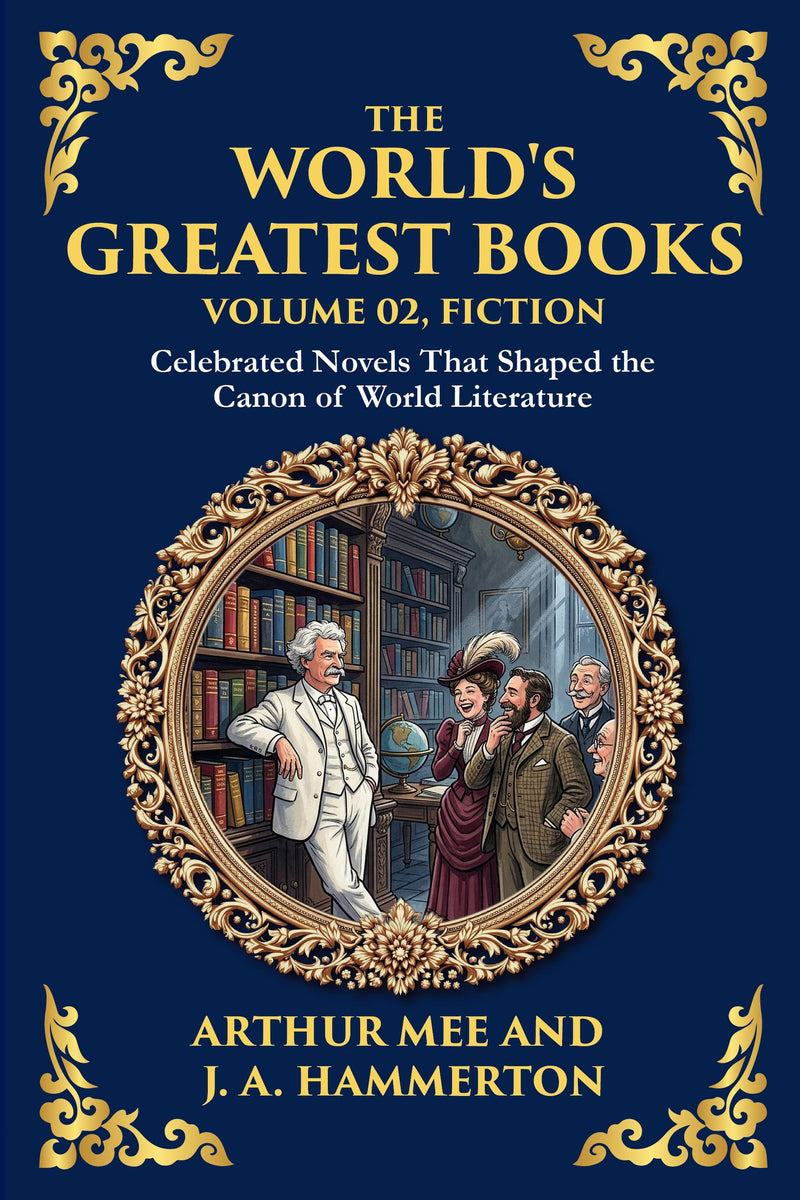
The World’s Greatest Books — Volume 02 — Fiction — Large Print
William Styron In The World’s Greatest Books — Volume 02 — Fiction, editors Arthur Mee and J. A. Hammerton gather together timeless works of imagination and artistry that have shaped generations of readers.
or free app
10,000+ hrs library
30-day guarantee
The complete The World’s Greatest Books — Volume 02 — Fiction appears in modern English through Library of Alexandria Press, available online with audiobook narration included for members.
Have you ever wondered why certain novels stand the test of time, becoming pillars of world literature? The World’s Greatest Books — Volume 02 — Fiction, compiled by Arthur Mee and J. A. Hammerton, is a landmark anthology that presents readers with a sweeping panorama of celebrated novels that have defined the very essence of storytelling. This collection captures the breadth of human experience—love and betrayal, honor and sacrifice, triumph and despair— woven into narratives that continue to resonate across centuries.
Carefully curated to showcase both diversity of culture and unity of artistic vision, this volume places side by side masterpieces of English, Russian, French, Spanish, and other literary traditions. The result is not just a library of classics, but a guided journey through the very soul of fiction itself.
What you’ll discover in this modern edition
- Treasured Classics of English Literature – Encounter works that probe morality, human weakness, and social justice through unforgettable characters.
- The Power of Russian Storytelling – Step into narratives that wrestle with existential despair, redemption, and the search for meaning.
- French and Continental Masterpieces – Explore tales of passion, revolution, and timeless romance that influenced the course of European fiction.
- The Voice of Global Literature – See how stories from across the world connect through shared themes of love, loss, faith, and struggle.
- An Indispensable Anthology – A perfect companion for students, literature lovers, and anyone seeking to understand the novels that shaped civilization.
| Formats | eBook (EPUB + PDF) · Audiobook · Paperback · Hardcover · Large Print |
| Language | English |
| Trim size (print) | 6 × 9 in |
| Binding | Paperback — perfect-bound · Hardcover — casewrap |
| Large Print edition | Same text in a larger, easy-read type — a larger font, not a larger trim |
| Print pricing | Every physical book at our true cost — at-cost, no profit (members) |
| Library | 873 restored titles, always growing |
| Length | 109,374 words · ~7 hr 17 min reading |
| Reading level | Grade 3 · an easy, flowing read (this modern-English edition) |
| Edition | Modern English translation · 2026 |
Member reviews for this edition are collected as readers finish it — be the first. Across the library: 12,000+ books shipped, every plan covered by a 365-day print guarantee.
About this edition
A faithful, unabridged modern-English edition by The Library of Alexandria — carefully rendered for today's reader and verified paragraph-by-paragraph against the public-domain source. Available as eBook, audiobook, paperback, hardcover, and large print.
- Complete & unabridgedVerified paragraph by paragraph against the source — never a scan, never abridged.
- Modern English, faithfulReadable today, with the author’s meaning kept intact. Readable — not simplified.
- Every format, one membershipRead in your browser or the free app, or listen to the full audiobook.
Included free with your membership
Cancel anytime, one click · 30-day money-back guarantee
Edition last updated July 2026
What’s inside
The World’s Greatest Books — Volume 02 — Fiction — Large Print — complete and unabridged: all 6 sections included with membership, plus the full audiobook.
Begin reading The World’s Greatest Books — Volume 02 — Fiction — Large Print
In clear modern English — the complete text is included with membership.
Introduction
There is a particular kind of pleasure that comes from standing at the threshold of a great library, knowing that within its walls live a thousand worlds waiting to be entered. Most of us, however, will never have the time to walk every aisle, to read every spine, to open every cover and lose ourselves in the slow unfolding of every masterpiece ever written. Life is short, and the shelf of human literature is impossibly long. It was precisely this tension — between the boundless richness of the world’s storytelling and the finite hours of a single human life — that gave rise to the remarkable enterprise you now hold in your hands. This volume gathers together the essence of some of the most celebrated novels ever composed, distilling them into forms that can be savored, understood, and treasured by the reader of today.
The two figures responsible for the original vision behind this collection, Arthur Mee and J. A. Hammerton, were among the great popularizers of knowledge in the English-speaking world. They believed, with an almost evangelical fervor, that the finest fruits of human thought and imagination should not be locked away in scholarly towers or reserved for the leisured few. They believed that the working man and woman, the curious young student, the busy parent, and the lifelong learner all deserved access to the treasures of civilization. Their life’s work was animated by a democratic faith in the power of literature to enlarge the soul, to broaden sympathy, and to lift the ordinary mind to extraordinary heights. This collection of fiction, devoted as it is to the famous novels that defined the world’s literary classics, stands as one of the purest expressions of that faith.
What you are about to read, then, is not merely a sampling of stories. It is an invitation into a grand conversation that has been carried on across centuries and continents, among the greatest storytellers who ever set pen to paper. Within these pages you will encounter the imaginative energies of authors who shaped the very idea of what a novel could be — who taught humanity how to dream on the page, how to feel deeply through the lives of invented characters, and how to discover profound truths through the lens of fiction. To read them, even in concentrated form, is to participate in an inheritance that belongs to all of us.
To understand the unique value of what follows, it helps to understand the philosophy that shaped it. In an age when so much information arrives in fragments and so many stories are consumed in haste, there is something quietly radical about a collection that aims to give the reader the heart of a great work without the burden of its full length. This is not an act of diminishment but of devotion. The editors who first conceived this project understood that many of the world’s greatest novels were written for a different rhythm of life — for long winter evenings by the fire, for sea voyages that lasted months, for a world in which the printed page was one of the few sources of entertainment and instruction. They understood, too, that the modern reader lives differently, moves faster, and faces a thousand competing claims upon attention.
And so they undertook a task of extraordinary delicacy: to preserve the soul of each masterpiece while removing the digressions, the dated conventions, and the dense underbrush that can discourage a contemporary reader from ever reaching the glory at the center of the work. This is a labor of love and judgment. It requires not merely the ability to summarize but the capacity to recognize what truly matters in a story — the moments that pierce the heart, the characters who refuse to be forgotten, the ideas that continue to challenge and console us long after we have turned the final page. When this work is done well, the result is something marvelous: a doorway through which a reader who might never have approached the original can suddenly step into the company of immortal characters and feel, with full force, why these books have endured.
This present volume turns its attention specifically to fiction, and that focus is significant. Of all the forms of literature, the novel may be the one that speaks most directly to our shared humanity. History informs us, philosophy instructs us, poetry moves us — but the novel does something singular. It allows us to live, for a time, inside another person’s experience. It lets us inhabit a consciousness not our own, to suffer and rejoice alongside men and women who never existed yet feel more real to us than half the people we meet in our daily lives. Through fiction we travel across class and country and century. We become, by turns, the orphan and the aristocrat, the criminal and the saint, the lover and the betrayed, the young and the dying. No other art form so completely dissolves the boundaries between one human heart and another.
The “Modern Translation” promised in this volume’s subtitle reflects a sensitivity to the way language itself ages and shifts. Words that once rang clear can grow muffled with the passage of time; phrases that once sparkled can gather dust. The aim here has been to let the brilliance of these stories shine through to a generation that did not grow up with the cadences of earlier centuries. This is a tender and difficult balance. To modernize too aggressively is to strip a work of its character and atmosphere; to preserve too rigidly is to leave a barrier between the reader and the wonder beyond. The careful middle path — honoring the spirit while easing the passage — is what allows these adaptations to feel both faithful and fresh, both rooted in their origins and alive in the present moment.
It is worth pausing to appreciate just how generous this kind of collection truly is. Imagine attempting, on your own, to assemble the wisdom and beauty contained here. You would need to acquire dozens of separate volumes, to puzzle over which editions to trust, to find your way through prefaces and footnotes and scholarly apparatus, and then to commit months or even years to the reading of them all. What this volume offers instead is a kind of curated grand tour — a guided journey through some of the highest peaks of literary achievement, arranged so that you may ascend one summit after another without ever losing your footing. For the reader who wishes to become deeply acquainted with the landscape of the world’s fiction, there could hardly be a more welcoming starting point.
There is also a special joy in the variety such a collection provides. Within a single sitting, you may pass from the drawing rooms of one nation to the wild frontiers of another, from the sweeping romance of one era to the searching realism of the next. You may meet a tragic heroine on one page and a comic rogue on the facing one. This juxtaposition is not a defect but a delight. It reveals the astonishing range of the human imagination and the countless ways in which storytellers have sought to capture the truth of existence. Reading these works in proximity to one another, you begin to perceive the great themes that recur across all literature — love and loss, ambition and downfall, the struggle for justice, the longing for meaning, the eternal contest between the individual and the world that would shape or break them. You begin to sense, in other words, the deep unity beneath the dazzling diversity of human storytelling.
A collection of this nature rewards a particular kind of reading, and it may be useful to offer a few thoughts on how to approach it so that you may draw from it the fullest measure of enjoyment. The first and most important counsel is this: read with openness. These stories were born in different times and places, shaped by customs, beliefs, and assumptions that may differ from your own. Rather than measuring them against the standards of the present moment, allow yourself to enter their worlds on their own terms. Let the unfamiliar become an invitation to wonder rather than a cause for impatience. Some of the deepest pleasures of reading old and foreign literature come precisely from this encounter with difference — from discovering that people separated from us by centuries nonetheless loved and feared and hoped much as we do, and from noticing the surprising ways in which their lives diverged from ours.
The second counsel is to read slowly enough to feel. Because these are condensed forms, there may be a temptation to race through them as one might skim a summary. Resist this temptation. The whole purpose of fiction is to be experienced, not merely noted. When a character faces a moment of crisis, pause and imagine yourself in their place. When a passage of description paints a scene, allow it to form before your inner eye. When an author offers an observation about human nature, sit with it and ask whether it rings true in your own experience. The richness of these works lies not in the bare facts of their plots but in the texture of their feeling and thought. A condensed masterpiece is still a masterpiece, and it deserves to be met with attention and care.
The third counsel is to treat each work as a beginning rather than an end. One of the most beautiful gifts this volume can give you is the discovery of an author or a story that captures your heart so completely that you find yourself longing for more. When that happens — and it surely will — let it lead you onward. Seek out the full work in its original form. Learn about the life of the author who created it. Explore the other books they wrote. In this way, the collection becomes not a substitute for deeper reading but a magnificent gateway to it, a map of treasures that you may then choose to unearth in their entirety. Many a lifelong love affair with great literature has begun with exactly this kind of introduction, this first taste that awakens a hunger for the feast.
It is also worth remembering, as you read, that these particular novels were not chosen at random. They earned their places through the verdict of generations. A book becomes a classic not because a single critic praised it or a single season celebrated it, but because readers across many decades — and often many centuries — kept returning to it, kept finding in it something that spoke to their condition, kept pressing it into the hands of friends and children with the words, “You must read this.” The works gathered here have survived the most rigorous test imaginable: the test of time. They have outlived the fashions of their day, the controversies that may once have surrounded them, and the very civilizations that produced them. When you read them, you are reading what humanity itself has decided to keep.
This longevity is no accident. The greatest fiction possesses a kind of inexhaustibility. A truly great novel is not used up by a single reading; it offers something new each time you return to it, revealing different facets at different stages of your own life. The story that thrills you in youth may move you to tears in middle age and console you in your later years. The character you judged harshly at first may, upon reflection, earn your understanding and even your love. This is the secret of the classics: they grow with us, they meet us where we are, and they accompany us along the whole length of our journey. Even in the concentrated form presented here, this quality shines through, and you may find that a passage which strikes you one way today will resonate quite differently when you recall it tomorrow.
There is, too, a particular companionship that comes from reading the books that countless others have loved before us. When you take up one of these stories, you join an immense and invisible fellowship — every reader, in every land, across every generation, who has ever been touched by the same words. You become part of a continuity that stretches backward through time and forward into a future you will never see. The young person reading this collection today shares something genuine with the readers who wept over these same characters a hundred or two hundred years ago, and with the readers who will weep over them a hundred years hence. Literature is one of the few human creations that truly binds the living and the dead and the not-yet-born into a single community of feeling. To read these works is to take your place in that community.
Cancel anytime, one click · 30-day money-back guarantee
Founding annual rate available now — your price locks for life when you join.
Not ready? Get this free chapter by email — read it anytime.
✓ Sent — check your inbox for The World’s Greatest Books — Volume 02 — Fiction — Large Print.
Questions about The World’s Greatest Books — Volume 02 — Fiction — Large Print
What is The World’s Greatest Books — Volume 02 — Fiction about?
William Styron In The World’s Greatest Books — Volume 02 — Fiction, editors Arthur Mee and J. A. Hammerton gather together timeless works of imagination and artistry that have shaped generations of readers. This anthology celebrates the finest novels from across centuries and cultures, offering both enduring masterpieces and lesser-known gems that embody the spirit of world literature. From the psychological depths of Russian classics to the sweeping passion of French romances and the moral questions raised by Engl
Is The World’s Greatest Books — Volume 02 — Fiction free to read?
The opening chapter is free to read on this page. Members read and listen to the complete work — and the entire library — free, and can order any physical book at our true print cost.
How long is The World’s Greatest Books — Volume 02 — Fiction?
6 chapters (~109,374 words) — about 7 hr 17 min of reading in this modern-English edition.
Is this an abridged version of The World’s Greatest Books — Volume 02 — Fiction?
No. This is the complete, unabridged The World’s Greatest Books — Volume 02 — Fiction, carefully rendered into clear modern English and verified paragraph-by-paragraph against the public-domain source — nothing is cut or summarised.
What formats does The World’s Greatest Books — Volume 02 — Fiction come in?
The World’s Greatest Books — Volume 02 — Fiction is available as eBook, paperback, hardcover and large print. eBook and audiobook are included with membership; printed editions ship at our true print cost.
Shipping & returns
Billing & membership
More from the library


Explore Classic & Literary
- Dream Psychology: Psychoanalysis for Beginners · Sigmund Freud
- Great Expectations · Charles Dickens
- The Brothers Karamazov · Fyodor Dostoyevsky
- The Great Gatsby · F. Scott Fitzgerald
- Wild Flowers Worth Knowing · Neltje Blanchan
- Italian Hours · Henry James
- A Popular History of France from the Earliest Times, Volume 5 · François Guizot
- A history of English literature: A practical text-book · Edward Albert
- Italian Highways and Byways from a Motor Car · M. F. Mansfield
- The Heart-Cry of Jesus · Byron J. Rees
- Castes and Tribes of Southern India. Vol. 6 of 7 · Edgar Thurston
- Against the Grain · J.-K. Huysmans
- Dombey and Son · Charles Dickens
- How to Invest Money · George Garr Henry
- The Great Controversy Between Christ and Satan · Ellen Gould Harmon White
- One Hundred Proofs That the Earth Is Not a Globe · William Carpenter
- Southern Literature From 1579–1895 · Louise Manly
- The Renaissance: Studies in Art and Poetry · Walter Pater
- Mark Twain’s Speeches · Mark Twain
- Tacitus on Germany · Cornelius Tacitus
- The Rosary · Florence L. Barclay
- Peculiarities of American Cities · Willard W. Glazier
- Tennis for Girls · Florence A. Ballin
- The World’s Greatest Books — Volume 02 — Fiction
- Shirley · Charlotte Brontë
- Daisy Miller: A Study · Henry James
- Louis Lambert · Honoré de Balzac
- Historic Jamaica · Frank Cundall
- The Gambler · Fyodor Dostoyevsky
- The Mayor of Casterbridge · Thomas Hardy
The World’s Greatest Books — Volume 02 — Fiction — Large Print
The World’s Greatest Books — Volume 02 — Fiction — Large Print
Famous Novels That Defined the World’s Literary Classics
Anonymous
Contents
- Introduction
- Chapter 1
- Chapter 2
- Chapter 3
- Chapter 4
- Chapter 5
Introduction
There is a particular kind of pleasure that comes from standing at the threshold of a great library, knowing that within its walls live a thousand worlds waiting to be entered. Most of us, however, will never have the time to walk every aisle, to read every spine, to open every cover and lose ourselves in the slow unfolding of every masterpiece ever written. Life is short, and the shelf of human literature is impossibly long. It was precisely this tension — between the boundless richness of the world’s storytelling and the finite hours of a single human life — that gave rise to the remarkable enterprise you now hold in your hands. This volume gathers together the essence of some of the most celebrated novels ever composed, distilling them into forms that can be savored, understood, and treasured by the reader of today.
The two figures responsible for the original vision behind this collection, Arthur Mee and J. A. Hammerton, were among the great popularizers of knowledge in the English-speaking world. They believed, with an almost evangelical fervor, that the finest fruits of human thought and imagination should not be locked away in scholarly towers or reserved for the leisured few. They believed that the working man and woman, the curious young student, the busy parent, and the lifelong learner all deserved access to the treasures of civilization. Their life’s work was animated by a democratic faith in the power of literature to enlarge the soul, to broaden sympathy, and to lift the ordinary mind to extraordinary heights. This collection of fiction, devoted as it is to the famous novels that defined the world’s literary classics, stands as one of the purest expressions of that faith.
What you are about to read, then, is not merely a sampling of stories. It is an invitation into a grand conversation that has been carried on across centuries and continents, among the greatest storytellers who ever set pen to paper. Within these pages you will encounter the imaginative energies of authors who shaped the very idea of what a novel could be — who taught humanity how to dream on the page, how to feel deeply through the lives of invented characters, and how to discover profound truths through the lens of fiction. To read them, even in concentrated form, is to participate in an inheritance that belongs to all of us.
To understand the unique value of what follows, it helps to understand the philosophy that shaped it. In an age when so much information arrives in fragments and so many stories are consumed in haste, there is something quietly radical about a collection that aims to give the reader the heart of a great work without the burden of its full length. This is not an act of diminishment but of devotion. The editors who first conceived this project understood that many of the world’s greatest novels were written for a different rhythm of life — for long winter evenings by the fire, for sea voyages that lasted months, for a world in which the printed page was one of the few sources of entertainment and instruction. They understood, too, that the modern reader lives differently, moves faster, and faces a thousand competing claims upon attention.
And so they undertook a task of extraordinary delicacy: to preserve the soul of each masterpiece while removing the digressions, the dated conventions, and the dense underbrush that can discourage a contemporary reader from ever reaching the glory at the center of the work. This is a labor of love and judgment. It requires not merely the ability to summarize but the capacity to recognize what truly matters in a story — the moments that pierce the heart, the characters who refuse to be forgotten, the ideas that continue to challenge and console us long after we have turned the final page. When this work is done well, the result is something marvelous: a doorway through which a reader who might never have approached the original can suddenly step into the company of immortal characters and feel, with full force, why these books have endured.
This present volume turns its attention specifically to fiction, and that focus is significant. Of all the forms of literature, the novel may be the one that speaks most directly to our shared humanity. History informs us, philosophy instructs us, poetry moves us — but the novel does something singular. It allows us to live, for a time, inside another person’s experience. It lets us inhabit a consciousness not our own, to suffer and rejoice alongside men and women who never existed yet feel more real to us than half the people we meet in our daily lives. Through fiction we travel across class and country and century. We become, by turns, the orphan and the aristocrat, the criminal and the saint, the lover and the betrayed, the young and the dying. No other art form so completely dissolves the boundaries between one human heart and another.
The “Modern Translation” promised in this volume’s subtitle reflects a sensitivity to the way language itself ages and shifts. Words that once rang clear can grow muffled with the passage of time; phrases that once sparkled can gather dust. The aim here has been to let the brilliance of these stories shine through to a generation that did not grow up with the cadences of earlier centuries. This is a tender and difficult balance. To modernize too aggressively is to strip a work of its character and atmosphere; to preserve too rigidly is to leave a barrier between the reader and the wonder beyond. The careful middle path — honoring the spirit while easing the passage — is what allows these adaptations to feel both faithful and fresh, both rooted in their origins and alive in the present moment.
It is worth pausing to appreciate just how generous this kind of collection truly is. Imagine attempting, on your own, to assemble the wisdom and beauty contained here. You would need to acquire dozens of separate volumes, to puzzle over which editions to trust, to find your way through prefaces and footnotes and scholarly apparatus, and then to commit months or even years to the reading of them all. What this volume offers instead is a kind of curated grand tour — a guided journey through some of the highest peaks of literary achievement, arranged so that you may ascend one summit after another without ever losing your footing. For the reader who wishes to become deeply acquainted with the landscape of the world’s fiction, there could hardly be a more welcoming starting point.
There is also a special joy in the variety such a collection provides. Within a single sitting, you may pass from the drawing rooms of one nation to the wild frontiers of another, from the sweeping romance of one era to the searching realism of the next. You may meet a tragic heroine on one page and a comic rogue on the facing one. This juxtaposition is not a defect but a delight. It reveals the astonishing range of the human imagination and the countless ways in which storytellers have sought to capture the truth of existence. Reading these works in proximity to one another, you begin to perceive the great themes that recur across all literature — love and loss, ambition and downfall, the struggle for justice, the longing for meaning, the eternal contest between the individual and the world that would shape or break them. You begin to sense, in other words, the deep unity beneath the dazzling diversity of human storytelling.
A collection of this nature rewards a particular kind of reading, and it may be useful to offer a few thoughts on how to approach it so that you may draw from it the fullest measure of enjoyment. The first and most important counsel is this: read with openness. These stories were born in different times and places, shaped by customs, beliefs, and assumptions that may differ from your own. Rather than measuring them against the standards of the present moment, allow yourself to enter their worlds on their own terms. Let the unfamiliar become an invitation to wonder rather than a cause for impatience. Some of the deepest pleasures of reading old and foreign literature come precisely from this encounter with difference — from discovering that people separated from us by centuries nonetheless loved and feared and hoped much as we do, and from noticing the surprising ways in which their lives diverged from ours.
The second counsel is to read slowly enough to feel. Because these are condensed forms, there may be a temptation to race through them as one might skim a summary. Resist this temptation. The whole purpose of fiction is to be experienced, not merely noted. When a character faces a moment of crisis, pause and imagine yourself in their place. When a passage of description paints a scene, allow it to form before your inner eye. When an author offers an observation about human nature, sit with it and ask whether it rings true in your own experience. The richness of these works lies not in the bare facts of their plots but in the texture of their feeling and thought. A condensed masterpiece is still a masterpiece, and it deserves to be met with attention and care.
The third counsel is to treat each work as a beginning rather than an end. One of the most beautiful gifts this volume can give you is the discovery of an author or a story that captures your heart so completely that you find yourself longing for more. When that happens — and it surely will — let it lead you onward. Seek out the full work in its original form. Learn about the life of the author who created it. Explore the other books they wrote. In this way, the collection becomes not a substitute for deeper reading but a magnificent gateway to it, a map of treasures that you may then choose to unearth in their entirety. Many a lifelong love affair with great literature has begun with exactly this kind of introduction, this first taste that awakens a hunger for the feast.
It is also worth remembering, as you read, that these particular novels were not chosen at random. They earned their places through the verdict of generations. A book becomes a classic not because a single critic praised it or a single season celebrated it, but because readers across many decades — and often many centuries — kept returning to it, kept finding in it something that spoke to their condition, kept pressing it into the hands of friends and children with the words, “You must read this.” The works gathered here have survived the most rigorous test imaginable: the test of time. They have outlived the fashions of their day, the controversies that may once have surrounded them, and the very civilizations that produced them. When you read them, you are reading what humanity itself has decided to keep.
This longevity is no accident. The greatest fiction possesses a kind of inexhaustibility. A truly great novel is not used up by a single reading; it offers something new each time you return to it, revealing different facets at different stages of your own life. The story that thrills you in youth may move you to tears in middle age and console you in your later years. The character you judged harshly at first may, upon reflection, earn your understanding and even your love. This is the secret of the classics: they grow with us, they meet us where we are, and they accompany us along the whole length of our journey. Even in the concentrated form presented here, this quality shines through, and you may find that a passage which strikes you one way today will resonate quite differently when you recall it tomorrow.
There is, too, a particular companionship that comes from reading the books that countless others have loved before us. When you take up one of these stories, you join an immense and invisible fellowship — every reader, in every land, across every generation, who has ever been touched by the same words. You become part of a continuity that stretches backward through time and forward into a future you will never see. The young person reading this collection today shares something genuine with the readers who wept over these same characters a hundred or two hundred years ago, and with the readers who will weep over them a hundred years hence. Literature is one of the few human creations that truly binds the living and the dead and the not-yet-born into a single community of feeling. To read these works is to take your place in that community.
George Henry Borrow was born on July 5, 1803, in East Dereham, Norfolk, England. Since his father was an army captain, Borrow spent his childhood at various military posts across the country. From a very young age, he loved wandering and socializing with Romani people and other travelers. In 1819, he started working at a lawyer’s office in Norwich. After a long period of hard work and writing, he moved to London in 1824, though he left a year later, and his whereabouts remained unclear for a while. For about five years starting in 1835, he worked as an agent for the Bible Society, selling and distributing Bibles in Spain. In 1842, he published “The Bible in Spain,” which is featured in another volume of THE WORLD’S GREATEST BOOKS. (See TRAVEL AND ADVENTURE.) His 1851 book, “Lavengro,” increased the fame he had already gained from his previous writings. The book is full of character sketches based on real people from secluded communities that few others could access; while these characters are often very eccentric, they never feel like caricatures or fake inventions. Every now and then, the story is interrupted by insightful, philosophical reflections that vividly show how Borrow thought. As in all his books, his knowledge of languages is extraordinary. Even though the wild and passionate scenes make the story feel like a surreal dream, his writing is never overly wordy or bogged down by complex sentences. Borrow died in Oulton, Suffolk, on July 26, 1881. A powerful athlete, a lifelong wanderer, a language enthusiast, and a man of generous simplicity who also held strong prejudices, he was one of the most unique and captivating figures in nineteenth-century English literature.
End of the free sample
Keep reading, free
Members read and listen to the complete book — and the entire library. Cancel anytime, one click · 30-day money-back guarantee.