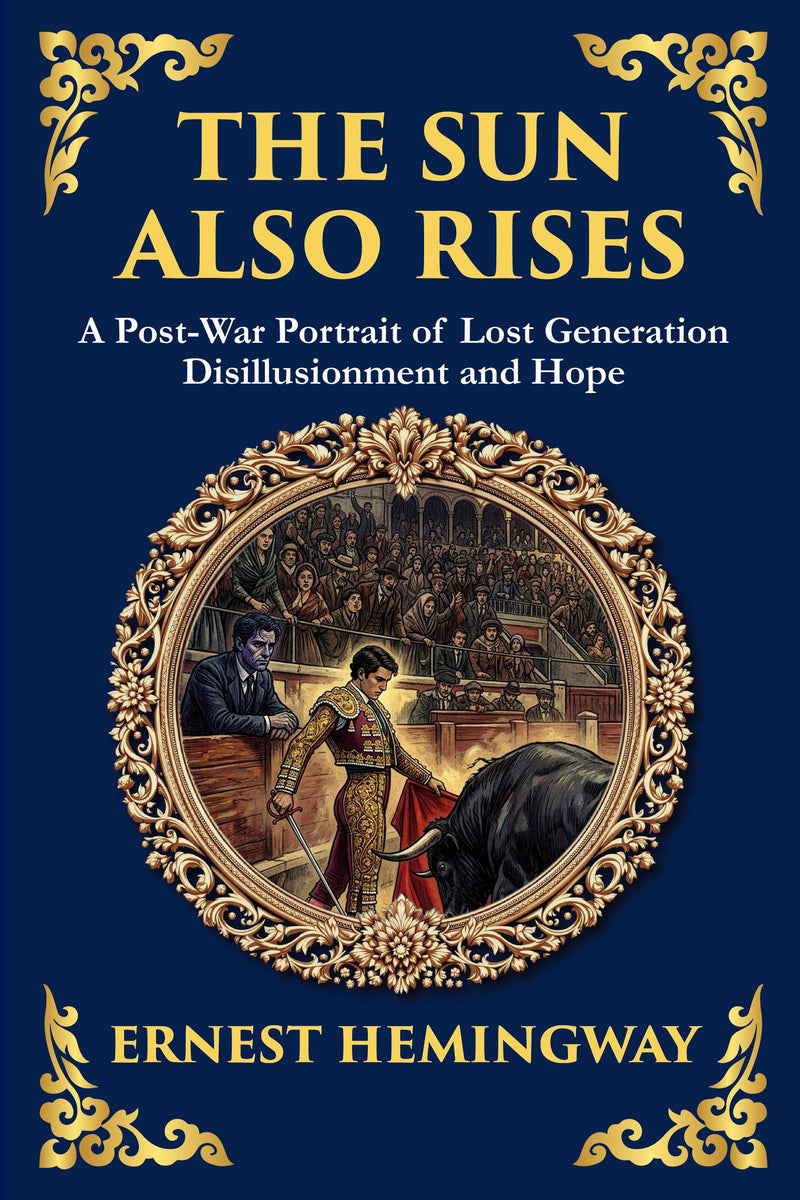
The Sun Also Rises
Set in the restless aftermath of World War I, The Sun Also Rises follows a group of expatriates as they drift across the cafés of Paris to the bullrings of Spain, seeking meaning, connection, and escape.
or free app
10,000+ hrs library
30-day guarantee
The complete The Sun Also Rises appears in modern English through Library of Alexandria Press, available online with audiobook narration included for members.
Have you ever wondered why some people feel lost even when surrounded by everything they ever wanted? The Sun Also Rises: A Post-War Portrait of Lost Generation Disillusionment and Hope is Ernest Hemingway’s brilliant meditation on identity, trauma, and the search for meaning in a broken world. In the years following the Great War, a generation of young expatriates finds themselves alienated, emotionally scarred, and spiritually adrift.
Among them is Jake Barnes, a journalist unable to physically consummate the love he feels for the enchanting Lady Brett Ashley. As they circle through the cafés of Paris and the sun-drenched streets of Pamplona, Hemingway reveals a story not just of romance, but of the internal battles fought long after the war ends. It is a novel of restraint, where what’s left unsaid cuts deeper than what is spoken.
A novel of elegance and economy, where the human heart bleeds quietly beneath the surface.
What you’ll discover in this modern edition
- A Powerful Reflection of the Lost Generation – Discover the post-war disillusionment of artists, lovers, and wanderers in the 1920s.
- Timeless Themes of Love and Alienation – Experience a doomed romance between Jake and Brett, where emotion clashes with reality.
- Hemingway’s Signature Style – Admire the stark beauty of minimalist prose, which influenced generations of writers to come.
- Cultural and Historical Insight – Step into the decadent Parisian nightlife and the raw energy of Spanish bullfighting festivals.
- A Novel That Still Resonates – Find echoes of modern emotional struggles in this century-old masterpiece.
| Formats | eBook (EPUB + PDF) · Audiobook · Paperback · Hardcover · Large Print |
| Language | English |
| Trim size (print) | 6 × 9 in |
| Binding | Paperback — perfect-bound · Hardcover — casewrap |
| Large Print edition | Same text in a larger, easy-read type — a larger font, not a larger trim |
| Print pricing | Every physical book at our true cost — at-cost, no profit (members) |
| Library | 873 restored titles, always growing |
| Length | 63,948 words · ~4 hr 16 min reading |
| Reading level | Grade 4 · an easy, flowing read (this modern-English edition) |
| Edition | Modern English translation · 2026 |
Member reviews for this edition are collected as readers finish it — be the first. Across the library: 12,000+ books shipped, every plan covered by a 365-day print guarantee.
About this edition
A faithful, unabridged modern-English edition by The Library of Alexandria — carefully rendered for today's reader and verified paragraph-by-paragraph against the public-domain source. Available as eBook, audiobook, paperback, hardcover, and large print.
- Complete & unabridgedVerified paragraph by paragraph against the source — never a scan, never abridged.
- Modern English, faithfulReadable today, with the author’s meaning kept intact. Readable — not simplified.
- Every format, one membershipRead in your browser or the free app, or listen to the full audiobook.
Included free with your membership
Cancel anytime, one click · 30-day money-back guarantee
Edition last updated July 2026
What’s inside
The Sun Also Rises — complete and unabridged: all 23 sections included with membership, plus the full audiobook.
Begin reading The Sun Also Rises
In clear modern English — the complete text is included with membership.
Introduction
There are books that announce themselves with thunder, and there are books that move quietly across the page like a person crossing a crowded café, glimpsed for only a moment but somehow impossible to forget. Ernest Hemingway’s first true novel belongs to the second kind. When it first appeared in 1926, it did not arrive with the grand sweep of the nineteenth-century epics that still dominated bookshelves. Instead, it slipped in sideways, speaking in short sentences and unspoken sorrows, describing a generation that had survived a war only to discover that survival itself could become a kind of wound. Readers had encountered nothing quite like it. The prose seemed almost stripped bare, as though every adjective that could be removed had been removed, and yet beneath that surface ran a current of feeling so strong that it has carried the book across nearly a century without losing its force.
To open these pages today is to step into a world that is at once foreign and startlingly familiar. The places—Paris in the gray light of early morning, the dusty roads of northern Spain, the noise and color of a festival that does not stop for days—are rendered with such precision that you can almost smell the coffee and the dust and the wine. Yet the people who move through these settings carry something inside them that any modern reader will recognize at once: a restlessness, a hunger for meaning, a suspicion that the old certainties no longer hold, and a determination to keep going anyway. They drink too much and say too little. They love the wrong people and chase the wrong pleasures. They wound each other and then bind the wounds, sometimes in the same gesture. And through it all they are searching, even when they would never use that word, for some reason to believe that the sun will rise again tomorrow as it always has.
This edition has been prepared with the contemporary reader in mind, and it is worth pausing to explain what that means and what it does not mean. The aim has never been to flatten or simplify the distinctive voice that made this book famous. Hemingway’s style is not an obstacle to be cleared away; it is the very heart of the experience, and to tamper with it carelessly would be to betray the work itself. What this modern presentation offers instead is a gentle smoothing of the small frictions that can, over the span of nearly a hundred years, place distance between a reader and a text. Certain references that would have been instantly understood by an audience in the 1920s now require a moment of orientation. Certain rhythms of speech, certain turns of phrase, have aged in ways that can momentarily pull a reader out of the dream. The intention here is to keep you inside that dream, to let the story breathe and move as Hemingway intended, while ensuring that nothing trivial stands between you and the deep emotional truth he was reaching toward. You are meant to feel, not to translate.
To understand why this novel struck its first readers with such force, and why it continues to move us now, it helps to understand the moment from which it emerged. The years following the First World War were unlike anything the modern world had seen. An entire generation of young men had marched off to a conflict that promised glory and delivered instead an industrialized slaughter on a scale no one had imagined possible. They came home—those who came home—changed in ways that the people who had stayed behind could not always understand. The old language of honor and sacrifice and duty had been used to send millions to their deaths, and so that language now rang false in the ears of those who had survived. They had been raised to believe in certain things: in nation, in faith, in the steady promise of progress. The war had cracked those beliefs, and many young people emerging from it found themselves standing in the rubble, unsure what to build in their place.
The writer Gertrude Stein, who would become an important figure in Hemingway’s early Paris years, is said to have remarked that these young people were a “lost generation,” and the phrase stuck because it captured something essential. They were lost not in the sense of being aimless fools, but in the sense of having lost the map. The familiar routes to a meaningful life seemed to lead nowhere, or to lead back to the very illusions that had cost so much. And so they gathered in the cafés of Paris and the cities of Europe, expatriates and wanderers, drinking and talking and trying to fill the silence where their old certainties had been. They were not lazy, though they could appear so. They were not simply pleasure-seekers, though pleasure was often what they pursued. They were people trying to live in a world that had been hollowed out, and trying to find some private reason to keep faith with life itself.
The characters you will meet in this novel are members of that wounded tribe. Some carry visible scars and some carry invisible ones, but all of them are marked by what they have lived through. There is a hard-won wisdom in the way they treat one another, a kind of code that emerges in the absence of the old codes that failed them. They believe in courage, in loyalty among friends, in doing a thing well for its own sake, in facing pain without flinching and without complaint. These are not the grand virtues of the books they grew up reading, but they are virtues nonetheless, perhaps the only ones that could survive the experience of the trenches. Watching these people try to live by their own hard rules, and watching them fail and forgive and try again, is one of the great quiet pleasures of the reading experience that awaits you.
It would be a mistake, though, to think of this as a book solely about war and its aftermath, as if it were a historical document of interest only to those curious about a vanished era. The genius of the work lies in how it transforms a specific historical wound into something timeless. Every generation faces its own version of disillusionment—its own moment of discovering that the world is not what it was promised to be, that the institutions and beliefs handed down to us cannot bear the full weight of human longing. Anyone who has ever felt adrift, who has ever wondered whether the things they were taught to value are worth valuing, who has ever sought to fill an inner emptiness with motion and noise and company, will find their own reflection somewhere in these pages. The “lost generation” was the name given to a particular group at a particular time, but the condition it describes is one that returns again and again, wearing different clothes, speaking different slang, but feeling, underneath, very much the same.
What makes the experience of reading this book so unexpectedly hopeful, despite its reputation for melancholy, is the way it refuses to surrender to despair. The title itself comes from an ancient source, a passage that observes that one generation passes away and another comes, but the earth abides forever; that the sun rises and the sun goes down and hastens to the place where it rose. There is sorrow in that observation—the sorrow of human smallness against the vastness of time—but there is also a strange consolation. The sun does rise. The world does continue. Whatever has been lost, the morning comes again, and with it the possibility of carrying on. This is not the cheap optimism of a happy ending. It is something tougher and more durable: the conviction that life is worth living even when, perhaps especially when, we cannot say exactly why. That conviction runs beneath every page of this novel like an underground river, and it is what has kept readers returning to it long after the particular sorrows of the 1920s have faded into history.
It is impossible to talk honestly about this book without talking about the way it is written, because the way it is written is inseparable from what it means. Hemingway came to fiction by way of journalism, and he carried into his novels a reporter’s distrust of inflated language and a reporter’s faith in the concrete detail. He believed that the most powerful emotions could not be stated directly without cheapening them, and so he developed a method of leaving things out. He compared his technique to an iceberg: only a small portion is visible above the surface, while the great mass of meaning lies submerged beneath. When you read a scene in which two characters speak of nothing in particular—of what to order, of where to go, of the weather or the wine—you are watching the visible tip of something enormous. The real subject of the conversation is almost never the words themselves. It is the longing and the grief and the tenderness that the words are carefully avoiding.
This is why the style can feel deceptively simple at first. The sentences are short. The vocabulary is plain. There are few of the elaborate metaphors and rolling clauses that earlier generations of readers had been taught to admire as marks of literary seriousness. A reader coming to this book for the first time might be tempted to wonder where the artistry lies. The answer is that it lies everywhere, but it lies in what is withheld as much as in what is given. Hemingway trusts you. He trusts you to feel what his characters cannot say. He trusts you to understand that when a man notices the precise color of the water in a river, or the exact way the light falls across a hillside, he is often noticing these things because he cannot bear to think about something else. The surfaces in this book are luminous and exact, and they are always pointing toward depths.
There is a particular kind of pleasure in reading this way, a pleasure of active participation. The book does not hand you its meanings; it invites you to discover them. When a character says something flat and ordinary in a moment of great emotional weight, the gap between the smallness of the words and the largeness of the feeling becomes the very place where the reader’s heart is engaged. You lean in. You fill the silence. You become, in a sense, a collaborator in the creation of meaning. This is one of the reasons the book rewards rereading so generously. On a first pass, you follow the story and absorb its atmosphere. On a second, you begin to notice all the things that were always there beneath the surface, the careful repetitions, the loaded silences, the way a single word recurs at crucial moments and gathers significance each time. Few books are built with such precision, and fewer still wear that precision so lightly.
The dialogue in particular deserves special mention, because Hemingway changed the way characters in fiction were allowed to talk. Before him, conversation in novels tended toward eloquence, even when it was supposed to represent ordinary speech. His characters speak the way people actually speak—in fragments, in evasions, in repetitions, in jokes that conceal pain and small cruelties that conceal affection. They talk around what matters rather than toward it. The result is dialogue that feels astonishingly alive, even now, after the techniques he pioneered have been absorbed and imitated by thousands of writers who came after him. When you read these exchanges, you are reading something that still feels fresh, still feels true to the way human beings deflect and protect and reach toward one another with their words. This modern edition has taken particular care to preserve the cadence and texture of that dialogue, because to alter it would be to lose one of the book’s greatest gifts.
A word should be said, too, about the descriptions of place, which are among the most celebrated in modern literature. Hemingway loved the physical world with an intensity that comes through in every landscape he describes. The rivers, the mountains, the streets of the cities, the fields and roads of the countryside—all of these are rendered with a clarity that makes them seem more real than the places we actually inhabit. There is a famous fishing sequence in this book, set in the cool green country away from the noise and confusion of the festival, that many readers remember long after they have forgotten the details of the plot. It functions almost as an island of peace in the turbulent sea of the story, a place where one of the characters can briefly recover something clean and true. Hemingway understood that for people whose inner lives have been damaged, the physical world can become a refuge and a teacher. To stand in cold water, to do a simple task well, to eat good food and drink good wine and sleep without dreams—these things can hold a person together when everything else has fallen apart. The book honors these simple pleasures without ever sentimentalizing them, and in doing so it offers a quiet kind of wisdom about how to survive a difficult life.
Cancel anytime, one click · 30-day money-back guarantee
Founding annual rate available now — your price locks for life when you join.
Not ready? Get this free chapter by email — read it anytime.
✓ Sent — check your inbox for The Sun Also Rises.
Questions about The Sun Also Rises
What is The Sun Also Rises about?
Set in the restless aftermath of World War I, The Sun Also Rises follows a group of expatriates as they drift across the cafés of Paris to the bullrings of Spain, seeking meaning, connection, and escape. Ernest Hemingway’s breakthrough novel captures the voice of a generation disillusioned by war, romance, and society itself. Told through the eyes of the quietly wounded Jake Barnes, this is a haunting story of love and longing—of men and women chasing life in the ruins of what once was.
Who wrote The Sun Also Rises?
The Sun Also Rises was written by Ernest Hemingway. This edition presents the complete work in clear modern English, faithfully rendered from the public-domain original by Library of Alexandria Press.
Is The Sun Also Rises free to read?
The opening chapter is free to read on this page. Members read and listen to the complete work — and the entire library — free, and can order any physical book at our true print cost.
How long is The Sun Also Rises?
23 chapters (~63,948 words) — about 4 hr 16 min of reading in this modern-English edition.
Is this an abridged version of The Sun Also Rises?
No. This is the complete, unabridged The Sun Also Rises, carefully rendered into clear modern English and verified paragraph-by-paragraph against the public-domain source — nothing is cut or summarised.
What formats does The Sun Also Rises come in?
The Sun Also Rises is available as eBook, paperback, hardcover and large print. eBook and audiobook are included with membership; printed editions ship at our true print cost.
Shipping & returns
Billing & membership
More from the library


Explore Classic & Literary
- Resurrection · Leo Tolstoy
- Crime and Punishment · Fyodor Dostoyevsky
- Anna Karenina · Leo Tolstoy
- Moby-Dick · Herman Melville
- Great Expectations · Charles Dickens
- The Brothers Karamazov · Fyodor Dostoyevsky
- The Great Gatsby · F. Scott Fitzgerald
- McTeague: A Story of San Francisco — Large Print · Frank Norris
- McTeague: A Story of San Francisco · Frank Norris
- The Country House — Large Print · John Galsworthy
- Ethan Frome — Large Print · Edith Wharton
- Bartleby, the Scrivener: A Story of Wall-Street · Herman Melville
- Mrs. Dalloway — Large Print · Virginia Woolf
- Resurrection — Large Print · Leo Tolstoy
- Against the Grain — Large Print · Joris-Karl Huysmans
- The Red Badge of Courage: An Episode of the American Civil War · Stephen Crane
- Bartleby, the Scrivener: A Story of Wall-Street — Large Print · Herman Melville
- The Red Badge of Courage: An Episode of the American Civil War — Large Print · Stephen Crane
- North and South · Elizabeth Gaskell
- Barry Lyndon · William Makepeace Thackeray
- Barry Lyndon — Large Print · William Makepeace Thackeray
- North and South — Large Print · Elizabeth Gaskell
- Dombey and Son — Large Print · Charles Dickens
- My Ántonia — Large Print · Willa Cather
- Jane Eyre: An Autobiography · Charlotte Brontë
- Penrod — Large Print · Booth Tarkington
- Tess of the d'Urbervilles: A Pure Woman — Large Print · Thomas Hardy
- The Belle of Bowling Green · Amelia E. Barr
- The Possessed: Or, The Devils — Large Print · Fyodor Dostoyevsky
- Penrod · Booth Tarkington
The Sun Also Rises
The Sun Also Rises
A Post-War Portrait of Lost Generation Disillusionment and Hope
Ernest Hemingway
Contents
- Introduction
- Book 1
- Chapter 1
- Chapter 2
- Chapter 3
- Chapter 4
- Chapter 5
- Chapter 6
- Chapter 7
- Book 2
- Chapter 8
- Chapter 9
- Chapter 10
- Chapter 11
- Chapter 12
- Chapter 13
- Chapter 14
- Chapter 15
- Chapter 16
- Chapter 17
- Chapter 18
- Book 3
- Chapter 19
Introduction
There are books that announce themselves with thunder, and there are books that move quietly across the page like a person crossing a crowded café, glimpsed for only a moment but somehow impossible to forget. Ernest Hemingway’s first true novel belongs to the second kind. When it first appeared in 1926, it did not arrive with the grand sweep of the nineteenth-century epics that still dominated bookshelves. Instead, it slipped in sideways, speaking in short sentences and unspoken sorrows, describing a generation that had survived a war only to discover that survival itself could become a kind of wound. Readers had encountered nothing quite like it. The prose seemed almost stripped bare, as though every adjective that could be removed had been removed, and yet beneath that surface ran a current of feeling so strong that it has carried the book across nearly a century without losing its force.
To open these pages today is to step into a world that is at once foreign and startlingly familiar. The places—Paris in the gray light of early morning, the dusty roads of northern Spain, the noise and color of a festival that does not stop for days—are rendered with such precision that you can almost smell the coffee and the dust and the wine. Yet the people who move through these settings carry something inside them that any modern reader will recognize at once: a restlessness, a hunger for meaning, a suspicion that the old certainties no longer hold, and a determination to keep going anyway. They drink too much and say too little. They love the wrong people and chase the wrong pleasures. They wound each other and then bind the wounds, sometimes in the same gesture. And through it all they are searching, even when they would never use that word, for some reason to believe that the sun will rise again tomorrow as it always has.
This edition has been prepared with the contemporary reader in mind, and it is worth pausing to explain what that means and what it does not mean. The aim has never been to flatten or simplify the distinctive voice that made this book famous. Hemingway’s style is not an obstacle to be cleared away; it is the very heart of the experience, and to tamper with it carelessly would be to betray the work itself. What this modern presentation offers instead is a gentle smoothing of the small frictions that can, over the span of nearly a hundred years, place distance between a reader and a text. Certain references that would have been instantly understood by an audience in the 1920s now require a moment of orientation. Certain rhythms of speech, certain turns of phrase, have aged in ways that can momentarily pull a reader out of the dream. The intention here is to keep you inside that dream, to let the story breathe and move as Hemingway intended, while ensuring that nothing trivial stands between you and the deep emotional truth he was reaching toward. You are meant to feel, not to translate.
To understand why this novel struck its first readers with such force, and why it continues to move us now, it helps to understand the moment from which it emerged. The years following the First World War were unlike anything the modern world had seen. An entire generation of young men had marched off to a conflict that promised glory and delivered instead an industrialized slaughter on a scale no one had imagined possible. They came home—those who came home—changed in ways that the people who had stayed behind could not always understand. The old language of honor and sacrifice and duty had been used to send millions to their deaths, and so that language now rang false in the ears of those who had survived. They had been raised to believe in certain things: in nation, in faith, in the steady promise of progress. The war had cracked those beliefs, and many young people emerging from it found themselves standing in the rubble, unsure what to build in their place.
The writer Gertrude Stein, who would become an important figure in Hemingway’s early Paris years, is said to have remarked that these young people were a “lost generation,” and the phrase stuck because it captured something essential. They were lost not in the sense of being aimless fools, but in the sense of having lost the map. The familiar routes to a meaningful life seemed to lead nowhere, or to lead back to the very illusions that had cost so much. And so they gathered in the cafés of Paris and the cities of Europe, expatriates and wanderers, drinking and talking and trying to fill the silence where their old certainties had been. They were not lazy, though they could appear so. They were not simply pleasure-seekers, though pleasure was often what they pursued. They were people trying to live in a world that had been hollowed out, and trying to find some private reason to keep faith with life itself.
The characters you will meet in this novel are members of that wounded tribe. Some carry visible scars and some carry invisible ones, but all of them are marked by what they have lived through. There is a hard-won wisdom in the way they treat one another, a kind of code that emerges in the absence of the old codes that failed them. They believe in courage, in loyalty among friends, in doing a thing well for its own sake, in facing pain without flinching and without complaint. These are not the grand virtues of the books they grew up reading, but they are virtues nonetheless, perhaps the only ones that could survive the experience of the trenches. Watching these people try to live by their own hard rules, and watching them fail and forgive and try again, is one of the great quiet pleasures of the reading experience that awaits you.
It would be a mistake, though, to think of this as a book solely about war and its aftermath, as if it were a historical document of interest only to those curious about a vanished era. The genius of the work lies in how it transforms a specific historical wound into something timeless. Every generation faces its own version of disillusionment—its own moment of discovering that the world is not what it was promised to be, that the institutions and beliefs handed down to us cannot bear the full weight of human longing. Anyone who has ever felt adrift, who has ever wondered whether the things they were taught to value are worth valuing, who has ever sought to fill an inner emptiness with motion and noise and company, will find their own reflection somewhere in these pages. The “lost generation” was the name given to a particular group at a particular time, but the condition it describes is one that returns again and again, wearing different clothes, speaking different slang, but feeling, underneath, very much the same.
What makes the experience of reading this book so unexpectedly hopeful, despite its reputation for melancholy, is the way it refuses to surrender to despair. The title itself comes from an ancient source, a passage that observes that one generation passes away and another comes, but the earth abides forever; that the sun rises and the sun goes down and hastens to the place where it rose. There is sorrow in that observation—the sorrow of human smallness against the vastness of time—but there is also a strange consolation. The sun does rise. The world does continue. Whatever has been lost, the morning comes again, and with it the possibility of carrying on. This is not the cheap optimism of a happy ending. It is something tougher and more durable: the conviction that life is worth living even when, perhaps especially when, we cannot say exactly why. That conviction runs beneath every page of this novel like an underground river, and it is what has kept readers returning to it long after the particular sorrows of the 1920s have faded into history.
It is impossible to talk honestly about this book without talking about the way it is written, because the way it is written is inseparable from what it means. Hemingway came to fiction by way of journalism, and he carried into his novels a reporter’s distrust of inflated language and a reporter’s faith in the concrete detail. He believed that the most powerful emotions could not be stated directly without cheapening them, and so he developed a method of leaving things out. He compared his technique to an iceberg: only a small portion is visible above the surface, while the great mass of meaning lies submerged beneath. When you read a scene in which two characters speak of nothing in particular—of what to order, of where to go, of the weather or the wine—you are watching the visible tip of something enormous. The real subject of the conversation is almost never the words themselves. It is the longing and the grief and the tenderness that the words are carefully avoiding.
This is why the style can feel deceptively simple at first. The sentences are short. The vocabulary is plain. There are few of the elaborate metaphors and rolling clauses that earlier generations of readers had been taught to admire as marks of literary seriousness. A reader coming to this book for the first time might be tempted to wonder where the artistry lies. The answer is that it lies everywhere, but it lies in what is withheld as much as in what is given. Hemingway trusts you. He trusts you to feel what his characters cannot say. He trusts you to understand that when a man notices the precise color of the water in a river, or the exact way the light falls across a hillside, he is often noticing these things because he cannot bear to think about something else. The surfaces in this book are luminous and exact, and they are always pointing toward depths.
There is a particular kind of pleasure in reading this way, a pleasure of active participation. The book does not hand you its meanings; it invites you to discover them. When a character says something flat and ordinary in a moment of great emotional weight, the gap between the smallness of the words and the largeness of the feeling becomes the very place where the reader’s heart is engaged. You lean in. You fill the silence. You become, in a sense, a collaborator in the creation of meaning. This is one of the reasons the book rewards rereading so generously. On a first pass, you follow the story and absorb its atmosphere. On a second, you begin to notice all the things that were always there beneath the surface, the careful repetitions, the loaded silences, the way a single word recurs at crucial moments and gathers significance each time. Few books are built with such precision, and fewer still wear that precision so lightly.
The dialogue in particular deserves special mention, because Hemingway changed the way characters in fiction were allowed to talk. Before him, conversation in novels tended toward eloquence, even when it was supposed to represent ordinary speech. His characters speak the way people actually speak—in fragments, in evasions, in repetitions, in jokes that conceal pain and small cruelties that conceal affection. They talk around what matters rather than toward it. The result is dialogue that feels astonishingly alive, even now, after the techniques he pioneered have been absorbed and imitated by thousands of writers who came after him. When you read these exchanges, you are reading something that still feels fresh, still feels true to the way human beings deflect and protect and reach toward one another with their words. This modern edition has taken particular care to preserve the cadence and texture of that dialogue, because to alter it would be to lose one of the book’s greatest gifts.
A word should be said, too, about the descriptions of place, which are among the most celebrated in modern literature. Hemingway loved the physical world with an intensity that comes through in every landscape he describes. The rivers, the mountains, the streets of the cities, the fields and roads of the countryside—all of these are rendered with a clarity that makes them seem more real than the places we actually inhabit. There is a famous fishing sequence in this book, set in the cool green country away from the noise and confusion of the festival, that many readers remember long after they have forgotten the details of the plot. It functions almost as an island of peace in the turbulent sea of the story, a place where one of the characters can briefly recover something clean and true. Hemingway understood that for people whose inner lives have been damaged, the physical world can become a refuge and a teacher. To stand in cold water, to do a simple task well, to eat good food and drink good wine and sleep without dreams—these things can hold a person together when everything else has fallen apart. The book honors these simple pleasures without ever sentimentalizing them, and in doing so it offers a quiet kind of wisdom about how to survive a difficult life.
Robert Cohn was once the middleweight boxing champion at Princeton. I’m not particularly impressed by that title, but it meant a lot to him. He didn’t actually care for boxing—in fact, he hated it—but he worked hard to master it to overcome the shyness and inferiority he felt as a Jew at Princeton. It gave him a sense of inner peace knowing he could knock out anyone who looked down on him, though because he was shy and a genuinely nice guy, he only ever fought in the gym. He was the star student of Spider Kelly, who taught all his clients to box like featherweights, regardless of whether they weighed 105 or 205 pounds. This style suited Cohn perfectly because he was incredibly fast. He became so skilled that Spider eventually matched him against a superior opponent, which resulted in Cohn’s nose being permanently flattened. This only made him dislike boxing more, but it gave him a strange kind of satisfaction, and it certainly improved the look of his nose. During his senior year, he spent too much time reading and started wearing glasses. I’ve never met anyone from his class who remembered him. They didn’t even remember that he had been the middleweight boxing champion.
I don’t trust people who seem too open and honest, especially when their stories are too perfect. I always suspected that Robert Cohn might not have actually been a middleweight boxing champion. I figured maybe a horse had stepped on his face, or his mother had been terrified during pregnancy, or perhaps he’d just hit his head as a toddler. But eventually, I had Spider Kelly verify the story. Spider Kelly didn’t just remember Cohn; he had often wondered what had happened to him.
End of the free sample
Keep reading, free
Members read and listen to the complete book — and the entire library. Cancel anytime, one click · 30-day money-back guarantee.