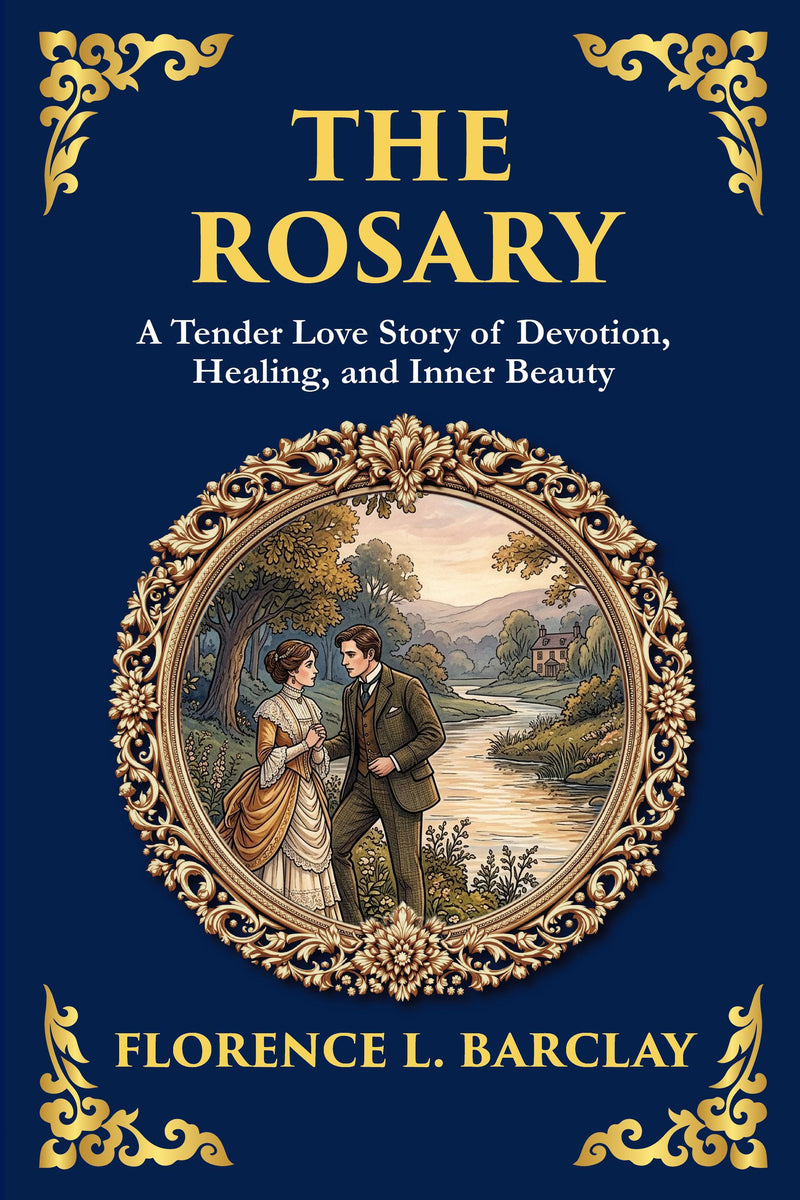
The Rosary — Large Print
A tale that captivated generations, The Rosary is a deeply moving story of love, sacrifice, and the beauty that lies within.
or free app
10,000+ hrs library
30-day guarantee
The complete The Rosary appears in modern English through Library of Alexandria Press, available online with audiobook narration included for members.
Have you ever wondered why some loves endure beyond appearances, status, and time itself? The Rosary by Florence L. Barclay is one of the most beloved romantic novels of the early 20th century—a compelling portrait of inner beauty, spiritual devotion, and the redemptive power of love. When renowned artist Garth Dalmain declares his love for Jane Champion—a woman known not for her looks but for her intellect and grace—he stirs both admiration and disbelief.
Jane, loyal yet modest, cannot bear the thought that she is not the woman he deserves. After rejecting his proposal, fate intervenes, and an accident leaves Garth blind. In a twist of loyalty and selflessness, Jane reenters his life under an assumed name to care for him, hiding her identity while helping him heal.
What unfolds is a profoundly emotional journey—of a man rediscovering what truly matters and of a woman choosing compassion over pride, and love over vanity.
What you’ll discover in this modern edition
- A Story of Inner Beauty and Devotion – An unforgettable romance that challenges societal norms and values the soul over appearance.
- Themes of Healing, Faith, and Sacrifice – Explore how emotional and physical healing are tied to faith, humility, and resilience.
- One of the Most Enduring Edwardian Love Stories – This bestseller remains a favorite among readers seeking depth, romance, and spiritual reflection.
- A Powerful Female Protagonist – Jane Champion’s strength, intellect, and selflessness make her one of literature’s most admirable heroines.
| Formats | eBook (EPUB + PDF) · Audiobook · Paperback · Hardcover · Large Print |
| Language | English |
| Trim size (print) | 6 × 9 in |
| Binding | Paperback — perfect-bound · Hardcover — casewrap |
| Large Print edition | Same text in a larger, easy-read type — a larger font, not a larger trim |
| Print pricing | Every physical book at our true cost — at-cost, no profit (members) |
| Library | 873 restored titles, always growing |
| Length | 106,556 words · ~7 hr 6 min reading |
| Reading level | Grade 6 · an easy, flowing read (this modern-English edition) |
| Edition | Modern English translation · 2026 |
Member reviews for this edition are collected as readers finish it — be the first. Across the library: 12,000+ books shipped, every plan covered by a 365-day print guarantee.
About this edition
A faithful, unabridged modern-English edition by The Library of Alexandria — carefully rendered for today's reader and verified paragraph-by-paragraph against the public-domain source. Available as eBook, audiobook, paperback, hardcover, and large print.
- Complete & unabridgedVerified paragraph by paragraph against the source — never a scan, never abridged.
- Modern English, faithfulReadable today, with the author’s meaning kept intact. Readable — not simplified.
- Every format, one membershipRead in your browser or the free app, or listen to the full audiobook.
Included free with your membership
Cancel anytime, one click · 30-day money-back guarantee
Edition last updated July 2026
What’s inside
The Rosary — Large Print — complete and unabridged: all 39 sections included with membership, plus the full audiobook.
Begin reading The Rosary — Large Print
In clear modern English — the complete text is included with membership.
Introduction
Some books arrive quietly and slip away. Others detonate across their era, capturing the imagination of an entire generation before fading into the background hum of literary history. The Rosary belongs firmly to the second category. When Florence L. Barclay’s novel first appeared in 1909, it did not merely sell well—it became a phenomenon. Within a few short years it had sold over a million copies, an almost unthinkable figure for the time, and was translated into numerous languages, devoured on both sides of the Atlantic and far beyond. Readers wept over it, recommended it to friends, pressed it into the hands of relatives, and returned to it again and again. For a brief but luminous moment, this was one of the most beloved stories in the English-speaking world.
To understand why requires us to step back into the world that produced it. The early years of the twentieth century were a peculiar hinge in history. The certainties of the Victorian age were beginning to loosen, yet the great upheaval of the First World War had not yet arrived to shatter them entirely. It was an era of drawing rooms and country houses, of social codes both rigid and tender, of faith taken seriously and beauty held in high esteem. Into this world came a novelist who understood, perhaps better than almost any of her contemporaries, what ordinary readers longed to feel when they opened a book. They wanted to be moved. They wanted to believe in love that endured. They wanted reassurance that the heart’s deepest hopes were not foolish.
Barclay gave them exactly that, and she did so with a sincerity that has rarely been matched. There is nothing cynical in her writing, nothing calculated to flatter the jaded or amuse the worldly. She wrote from the conviction that love is real, that the soul matters more than the surface, and that human beings are capable of extraordinary tenderness toward one another. These are not fashionable ideas, then or now. But they are perennial ones, and they account for the remarkable hold this story exercised over its first readers—and the hold it can still exercise over those willing to surrender to its rhythms.
The author herself is worth pausing over. Florence Louisa Barclay was born in England in 1862, the daughter of a clergyman, and she married a clergyman as well. Her life was steeped in the language and atmosphere of the church, in the cadences of scripture and hymn, in a moral seriousness that nonetheless coexisted with a warm appreciation for music, art, and human happiness. She did not begin writing for publication until she was already a mature woman with a family, and when she did, she brought to the page the accumulated wisdom of a full life lived. This is not the work of a clever young person eager to impress. It is the work of someone who had loved and suffered and watched others love and suffer, and who had thought long and hard about what holds a human relationship together when the easy charms of youth have faded.
That maturity is one of the secrets of the book’s enduring appeal. Barclay was unembarrassed by emotion, but she was never merely sentimental in the cheap sense. Her feeling was earned. She believed that the deepest beauty in a person lies not in the arrangement of their features but in the quality of their spirit, and she set out to dramatize that conviction in a story that would make readers feel it in their bones rather than simply nod at it as an abstraction. The title itself, drawn from a famous song of the period, gestures toward this theme of devotion, of counting one’s treasures, of holding fast to what truly matters across the long passage of time.
It is also worth noting how unusual it was, in that era, for a woman to achieve such commercial triumph as a novelist while remaining utterly true to her own vision. Barclay did not write to scandalize or provoke. She wrote what she believed, and the world rewarded her for it with an embrace so warm and so wide that her name became a household word. There is something deeply heartening in that fact. It reminds us that audiences, for all their fickleness, are capable of recognizing genuine feeling when they encounter it, and of rewarding the author brave enough to wear her heart on her sleeve.
On This Modern Translation and What Awaits You
The volume you now hold is described as a modern translation, adapted for the contemporary reader, and a word of explanation about what that means—and what it does not mean—will help you settle into the reading experience with confidence and pleasure.
The English of 1909 is not a foreign language, but it can sometimes feel like a distant cousin. The prose of Barclay’s day moved at a more leisurely pace than our own. Sentences could be long and winding, studded with constructions that have since fallen out of common use. Forms of address, social assumptions, turns of phrase, even the rhythm of conversation—all of these carry the unmistakable flavor of a world more than a century gone. For some readers, that flavor is precisely the appeal; for others, it can become a barrier that stands between them and the living heart of the story. This edition has been carefully prepared with the latter reader in mind, while striving always to honor the spirit and substance of the original.
What this means in practice is that the language has been gently brought forward into a more accessible idiom, smoothing the passages that might otherwise cause a modern reader to stumble, clarifying constructions that have grown obscure, and ensuring that the emotional current of the narrative flows without unnecessary obstruction. The aim throughout has been to preserve everything that made the original beloved—its warmth, its sincerity, its tenderness, its moral seriousness—while removing the small frictions that can accumulate over a century of linguistic drift.
What this most emphatically does not mean is that the soul of the book has been altered. The characters remain who they always were. The setting remains the gracious, ordered world of Edwardian England, with its country houses and its concert halls, its codes of conduct and its quiet intensities of feeling. The central emotional journey—the thing for which readers loved this story in the first place—remains entirely intact. You are not reading a different book. You are reading the same book, with the dust of a century carefully wiped from its surface so that its colors can shine through to you as vividly as they shone for its first admirers.
This is an important distinction, because there is a kind of reader who quite reasonably worries that modernization means dilution—that to make a classic more readable is to rob it of its authenticity. That worry is understandable, but in this case it can be set aside. The intention here has been one of stewardship, not of reinvention. Think of it as the careful restoration of a beloved old painting: the grime is removed, the varnish is renewed, but the painting itself—the vision of the artist who created it—is precisely what we labor to reveal more clearly. Barclay’s vision was generous and full-hearted, and it deserves to reach a new generation of readers without being obscured by the accidents of period style.
As for what awaits you in these pages, I will be careful, for your story is best discovered fresh, with the surprises and the gradual deepening that the author so skillfully arranged. I will not tell you where the narrative goes or how it resolves. To do so would be to rob you of the very pleasure this introduction exists to enhance. But I can tell you something about the kind of experience you are about to have, and I can offer a few gentle suggestions about how to read it for the greatest reward.
This is, first and foremost, a love story—but it is a love story of a particular and unusual kind. It is not the breathless, instantaneous infatuation that fills so many novels. It is something slower, deeper, and more demanding. It concerns the question of what we truly love when we love another person. Is it their beauty? Their charm? The pleasure they give us? Or is it something else, something that endures even when the surface is altered, something rooted in the soul rather than the senses? Barclay poses this question with great delicacy and then proceeds to dramatize it through a series of situations that will test her characters—and, in a sense, test you, the reader—to the very depths.
It is also a story about faith and about healing, as the subtitle suggests. The faith here is not preachy or doctrinaire; it is woven into the fabric of the characters’ lives as naturally as breathing, the way it was for so many people of that era and for Barclay herself. And the healing is both physical and spiritual, both of the body and of the heart. There are wounds in this story that go deeper than any flesh, and the long process by which they are addressed forms much of the book’s emotional architecture. If you allow yourself to enter into the experience of these characters, you may find that their healing speaks to wounds of your own.
The music that runs through the book deserves a special word. The title itself comes from a song, and music is not merely a decorative element here but a profound force in the lives of the characters and in the unfolding of their story. Barclay clearly loved music deeply and understood its power to express what words cannot, to reach the soul directly, to carry memory and longing and devotion. As you read, pay attention to the moments when music enters the narrative. They are never accidental. They are among the most charged and revealing passages in the entire book, and they reward a slow, attentive reading.
How to Read This Book for the Richest Experience
Having spoken of the book’s themes and the nature of this edition, I want to offer some practical guidance—not because the story is difficult to follow, for it is not, but because certain habits of reading will allow you to receive its gifts more fully. This is a book that rewards a particular kind of attention, and a few words on the subject will, I hope, deepen your pleasure.
The first thing to say is this: slow down. We live in an age of distraction, of skimming and scrolling, of stories consumed at speed and forgotten almost as quickly. The Rosary was written for a different rhythm of life, and it asks for a different rhythm of reading. This is not a book to be rushed through in search of plot twists. Its pleasures unfold gradually, like a piece of music that builds through repetition and variation toward a culminating emotion. If you race through it impatiently, you will miss much of what makes it beautiful. But if you allow yourself to settle into its pace—to read perhaps a chapter at a sitting, in a quiet hour, with your full attention—you will find that it draws you into a state of feeling that faster reading simply cannot provide.
The second suggestion is to read with your heart open. This is not a book for the determinedly ironic or the relentlessly skeptical. Barclay wrote in earnest, and she asks to be read in earnest. The modern temperament is often suspicious of strong emotion, quick to dismiss it as sentimentality, eager to maintain a protective distance. If you bring that armor to this book, you will find it impenetrable, and you will wonder what all the fuss was about. But if you are willing to lower your guard—to let yourself care about these people, to feel what they feel, to be moved by their joys and sorrows—you will discover why a million readers wept over this story and treasured it for the rest of their lives. The book asks for a certain emotional generosity, and it repays that generosity many times over.
This brings me to a related point about the historical context. You are reading a story set in a world very different from our own, written according to assumptions and values that were taken for granted then but that we have since questioned or abandoned. The social arrangements of Edwardian England, the roles assigned to men and women, the prevailing attitudes toward class and propriety—all of these will, at moments, feel foreign, perhaps even strange. This is not a flaw in the book; it is an opportunity. One of the great pleasures of reading older literature is precisely this encounter with a different way of seeing the world. Rather than measuring these characters against contemporary standards and finding them wanting, try to enter imaginatively into their world, to understand what they valued and why, to feel the weight of the constraints under which they lived and loved. Doing so will not only deepen your appreciation of this particular story; it will enlarge your sympathies more generally, which is among the highest things that reading can do for us.
Cancel anytime, one click · 30-day money-back guarantee
Founding annual rate available now — your price locks for life when you join.
Not ready? Get this free chapter by email — read it anytime.
✓ Sent — check your inbox for The Rosary — Large Print.
Questions about The Rosary — Large Print
What is The Rosary about?
A tale that captivated generations, The Rosary is a deeply moving story of love, sacrifice, and the beauty that lies within. When Garth Dalmain, a gifted artist, falls in love with Jane Champion —an intelligent, plain-looking woman of great character—the world is quick to dismiss their bond. But when fate alters their lives and Jane must make a painful choice, the depth of her love and loyalty will be tested beyond measure.
Who wrote The Rosary?
The Rosary was written by Florence L. Barclay. This edition presents the complete work in clear modern English, faithfully rendered from the public-domain original by Library of Alexandria Press.
Is The Rosary free to read?
The opening chapter is free to read on this page. Members read and listen to the complete work — and the entire library — free, and can order any physical book at our true print cost.
How long is The Rosary?
39 chapters (~106,556 words) — about 7 hr 6 min of reading in this modern-English edition.
Is this an abridged version of The Rosary?
No. This is the complete, unabridged The Rosary, carefully rendered into clear modern English and verified paragraph-by-paragraph against the public-domain source — nothing is cut or summarised.
What formats does The Rosary come in?
The Rosary is available as eBook, paperback, hardcover and large print. eBook and audiobook are included with membership; printed editions ship at our true print cost.
Shipping & returns
Billing & membership
More from the library


Explore Classic & Literary
- Dream Psychology: Psychoanalysis for Beginners · Sigmund Freud
- Great Expectations · Charles Dickens
- The Brothers Karamazov · Fyodor Dostoyevsky
- The Great Gatsby · F. Scott Fitzgerald
- Wild Flowers Worth Knowing · Neltje Blanchan
- Italian Hours · Henry James
- A Popular History of France from the Earliest Times, Volume 5 · François Guizot
- A history of English literature: A practical text-book · Edward Albert
- Italian Highways and Byways from a Motor Car · M. F. Mansfield
- The Heart-Cry of Jesus · Byron J. Rees
- Castes and Tribes of Southern India. Vol. 6 of 7 · Edgar Thurston
- Against the Grain · J.-K. Huysmans
- Dombey and Son · Charles Dickens
- How to Invest Money · George Garr Henry
- The Great Controversy Between Christ and Satan · Ellen Gould Harmon White
- One Hundred Proofs That the Earth Is Not a Globe · William Carpenter
- Southern Literature From 1579–1895 · Louise Manly
- The Renaissance: Studies in Art and Poetry · Walter Pater
- Mark Twain’s Speeches · Mark Twain
- Tacitus on Germany · Cornelius Tacitus
- The Rosary · Florence L. Barclay
- Peculiarities of American Cities · Willard W. Glazier
- Tennis for Girls · Florence A. Ballin
- The World’s Greatest Books — Volume 02 — Fiction
- Shirley · Charlotte Brontë
- Daisy Miller: A Study · Henry James
- Louis Lambert · Honoré de Balzac
- Historic Jamaica · Frank Cundall
- The Gambler · Fyodor Dostoyevsky
- The Mayor of Casterbridge · Thomas Hardy
The Rosary — Large Print
The Rosary — Large Print
A touching love story about faith, healing, and inner beauty
Florence L. Barclay
Contents
- Introduction
- Chapter 1
- Chapter 2
- Chapter 3
- Chapter 4
- Chapter 5
- Chapter 6
- Chapter 7
- Chapter 8
- Chapter 9
- Chapter 10
- Chapter 11
- Chapter 12
- Chapter 13
- Chapter 14
- Chapter 15
- Chapter 16
- Chapter 17
- Chapter 18
- Chapter 19
- Chapter 20
- Chapter 21
- Chapter 22
- Chapter 23
- Chapter 24
- Chapter 25
- Chapter 26
- Chapter 27
- Chapter 28
- Chapter 29
- Chapter 30
- Chapter 31
- Chapter 32
- Chapter 33
- Chapter 34
- Chapter 35
- Chapter 36
- Chapter 37
- Chapter 38
Introduction
Some books arrive quietly and slip away. Others detonate across their era, capturing the imagination of an entire generation before fading into the background hum of literary history. The Rosary belongs firmly to the second category. When Florence L. Barclay’s novel first appeared in 1909, it did not merely sell well—it became a phenomenon. Within a few short years it had sold over a million copies, an almost unthinkable figure for the time, and was translated into numerous languages, devoured on both sides of the Atlantic and far beyond. Readers wept over it, recommended it to friends, pressed it into the hands of relatives, and returned to it again and again. For a brief but luminous moment, this was one of the most beloved stories in the English-speaking world.
To understand why requires us to step back into the world that produced it. The early years of the twentieth century were a peculiar hinge in history. The certainties of the Victorian age were beginning to loosen, yet the great upheaval of the First World War had not yet arrived to shatter them entirely. It was an era of drawing rooms and country houses, of social codes both rigid and tender, of faith taken seriously and beauty held in high esteem. Into this world came a novelist who understood, perhaps better than almost any of her contemporaries, what ordinary readers longed to feel when they opened a book. They wanted to be moved. They wanted to believe in love that endured. They wanted reassurance that the heart’s deepest hopes were not foolish.
Barclay gave them exactly that, and she did so with a sincerity that has rarely been matched. There is nothing cynical in her writing, nothing calculated to flatter the jaded or amuse the worldly. She wrote from the conviction that love is real, that the soul matters more than the surface, and that human beings are capable of extraordinary tenderness toward one another. These are not fashionable ideas, then or now. But they are perennial ones, and they account for the remarkable hold this story exercised over its first readers—and the hold it can still exercise over those willing to surrender to its rhythms.
The author herself is worth pausing over. Florence Louisa Barclay was born in England in 1862, the daughter of a clergyman, and she married a clergyman as well. Her life was steeped in the language and atmosphere of the church, in the cadences of scripture and hymn, in a moral seriousness that nonetheless coexisted with a warm appreciation for music, art, and human happiness. She did not begin writing for publication until she was already a mature woman with a family, and when she did, she brought to the page the accumulated wisdom of a full life lived. This is not the work of a clever young person eager to impress. It is the work of someone who had loved and suffered and watched others love and suffer, and who had thought long and hard about what holds a human relationship together when the easy charms of youth have faded.
That maturity is one of the secrets of the book’s enduring appeal. Barclay was unembarrassed by emotion, but she was never merely sentimental in the cheap sense. Her feeling was earned. She believed that the deepest beauty in a person lies not in the arrangement of their features but in the quality of their spirit, and she set out to dramatize that conviction in a story that would make readers feel it in their bones rather than simply nod at it as an abstraction. The title itself, drawn from a famous song of the period, gestures toward this theme of devotion, of counting one’s treasures, of holding fast to what truly matters across the long passage of time.
It is also worth noting how unusual it was, in that era, for a woman to achieve such commercial triumph as a novelist while remaining utterly true to her own vision. Barclay did not write to scandalize or provoke. She wrote what she believed, and the world rewarded her for it with an embrace so warm and so wide that her name became a household word. There is something deeply heartening in that fact. It reminds us that audiences, for all their fickleness, are capable of recognizing genuine feeling when they encounter it, and of rewarding the author brave enough to wear her heart on her sleeve.
On This Modern Translation and What Awaits You
The volume you now hold is described as a modern translation, adapted for the contemporary reader, and a word of explanation about what that means—and what it does not mean—will help you settle into the reading experience with confidence and pleasure.
The English of 1909 is not a foreign language, but it can sometimes feel like a distant cousin. The prose of Barclay’s day moved at a more leisurely pace than our own. Sentences could be long and winding, studded with constructions that have since fallen out of common use. Forms of address, social assumptions, turns of phrase, even the rhythm of conversation—all of these carry the unmistakable flavor of a world more than a century gone. For some readers, that flavor is precisely the appeal; for others, it can become a barrier that stands between them and the living heart of the story. This edition has been carefully prepared with the latter reader in mind, while striving always to honor the spirit and substance of the original.
What this means in practice is that the language has been gently brought forward into a more accessible idiom, smoothing the passages that might otherwise cause a modern reader to stumble, clarifying constructions that have grown obscure, and ensuring that the emotional current of the narrative flows without unnecessary obstruction. The aim throughout has been to preserve everything that made the original beloved—its warmth, its sincerity, its tenderness, its moral seriousness—while removing the small frictions that can accumulate over a century of linguistic drift.
What this most emphatically does not mean is that the soul of the book has been altered. The characters remain who they always were. The setting remains the gracious, ordered world of Edwardian England, with its country houses and its concert halls, its codes of conduct and its quiet intensities of feeling. The central emotional journey—the thing for which readers loved this story in the first place—remains entirely intact. You are not reading a different book. You are reading the same book, with the dust of a century carefully wiped from its surface so that its colors can shine through to you as vividly as they shone for its first admirers.
This is an important distinction, because there is a kind of reader who quite reasonably worries that modernization means dilution—that to make a classic more readable is to rob it of its authenticity. That worry is understandable, but in this case it can be set aside. The intention here has been one of stewardship, not of reinvention. Think of it as the careful restoration of a beloved old painting: the grime is removed, the varnish is renewed, but the painting itself—the vision of the artist who created it—is precisely what we labor to reveal more clearly. Barclay’s vision was generous and full-hearted, and it deserves to reach a new generation of readers without being obscured by the accidents of period style.
As for what awaits you in these pages, I will be careful, for your story is best discovered fresh, with the surprises and the gradual deepening that the author so skillfully arranged. I will not tell you where the narrative goes or how it resolves. To do so would be to rob you of the very pleasure this introduction exists to enhance. But I can tell you something about the kind of experience you are about to have, and I can offer a few gentle suggestions about how to read it for the greatest reward.
This is, first and foremost, a love story—but it is a love story of a particular and unusual kind. It is not the breathless, instantaneous infatuation that fills so many novels. It is something slower, deeper, and more demanding. It concerns the question of what we truly love when we love another person. Is it their beauty? Their charm? The pleasure they give us? Or is it something else, something that endures even when the surface is altered, something rooted in the soul rather than the senses? Barclay poses this question with great delicacy and then proceeds to dramatize it through a series of situations that will test her characters—and, in a sense, test you, the reader—to the very depths.
It is also a story about faith and about healing, as the subtitle suggests. The faith here is not preachy or doctrinaire; it is woven into the fabric of the characters’ lives as naturally as breathing, the way it was for so many people of that era and for Barclay herself. And the healing is both physical and spiritual, both of the body and of the heart. There are wounds in this story that go deeper than any flesh, and the long process by which they are addressed forms much of the book’s emotional architecture. If you allow yourself to enter into the experience of these characters, you may find that their healing speaks to wounds of your own.
The music that runs through the book deserves a special word. The title itself comes from a song, and music is not merely a decorative element here but a profound force in the lives of the characters and in the unfolding of their story. Barclay clearly loved music deeply and understood its power to express what words cannot, to reach the soul directly, to carry memory and longing and devotion. As you read, pay attention to the moments when music enters the narrative. They are never accidental. They are among the most charged and revealing passages in the entire book, and they reward a slow, attentive reading.
How to Read This Book for the Richest Experience
Having spoken of the book’s themes and the nature of this edition, I want to offer some practical guidance—not because the story is difficult to follow, for it is not, but because certain habits of reading will allow you to receive its gifts more fully. This is a book that rewards a particular kind of attention, and a few words on the subject will, I hope, deepen your pleasure.
The first thing to say is this: slow down. We live in an age of distraction, of skimming and scrolling, of stories consumed at speed and forgotten almost as quickly. The Rosary was written for a different rhythm of life, and it asks for a different rhythm of reading. This is not a book to be rushed through in search of plot twists. Its pleasures unfold gradually, like a piece of music that builds through repetition and variation toward a culminating emotion. If you race through it impatiently, you will miss much of what makes it beautiful. But if you allow yourself to settle into its pace—to read perhaps a chapter at a sitting, in a quiet hour, with your full attention—you will find that it draws you into a state of feeling that faster reading simply cannot provide.
The second suggestion is to read with your heart open. This is not a book for the determinedly ironic or the relentlessly skeptical. Barclay wrote in earnest, and she asks to be read in earnest. The modern temperament is often suspicious of strong emotion, quick to dismiss it as sentimentality, eager to maintain a protective distance. If you bring that armor to this book, you will find it impenetrable, and you will wonder what all the fuss was about. But if you are willing to lower your guard—to let yourself care about these people, to feel what they feel, to be moved by their joys and sorrows—you will discover why a million readers wept over this story and treasured it for the rest of their lives. The book asks for a certain emotional generosity, and it repays that generosity many times over.
This brings me to a related point about the historical context. You are reading a story set in a world very different from our own, written according to assumptions and values that were taken for granted then but that we have since questioned or abandoned. The social arrangements of Edwardian England, the roles assigned to men and women, the prevailing attitudes toward class and propriety—all of these will, at moments, feel foreign, perhaps even strange. This is not a flaw in the book; it is an opportunity. One of the great pleasures of reading older literature is precisely this encounter with a different way of seeing the world. Rather than measuring these characters against contemporary standards and finding them wanting, try to enter imaginatively into their world, to understand what they valued and why, to feel the weight of the constraints under which they lived and loved. Doing so will not only deepen your appreciation of this particular story; it will enlarge your sympathies more generally, which is among the highest things that reading can do for us.
A peaceful silence settled over the park and gardens at Overdene on a quiet English summer afternoon. Soft sunlight and growing shadows drifted across the lawn, and the shade of the massive cedar tree looked inviting, promising a refreshing break from the heat.
The old stone house was sturdy and plain, suggesting a spacious and comfortable interior. While the exterior was almost ugly, it was made beautiful by years of growth from ivy, magnolia trees, and wisteria. These plants climbed the simple walls, covering the house in a blanket of soft green leaves, large white flowers, and falling clusters of purple blossoms.
A terrace stretched across the entire length of the house, bordered by a large greenhouse on one side and a birdhouse on the other. At various points, wide stone steps led down from the terrace to the soft, springy grass of the lawn. Beyond that lay the expansive park, where groups of ancient trees sheltered shy brown deer. Through the branches, the river appeared in occasional glimmers, looking like a narrow silver ribbon winding gracefully through tall grass, buttercups, and daisies.
The birds had fallen silent. No songs drifted from the gently swaying leaves, and there wasn’t a single chirp or twitter. The silence felt almost heavy. The only bright splash of color in the scenery was a large scarlet macaw, sleeping on its perch beneath a cedar tree.
Finally, the sound of a door opening broke the silence. An eccentric old woman stepped out onto the terrace, walked all the way to the right, and vanished into the rose garden. The Duchess of Meldrum had gone to pick her roses.
End of the free sample
Keep reading, free
Members read and listen to the complete book — and the entire library. Cancel anytime, one click · 30-day money-back guarantee.