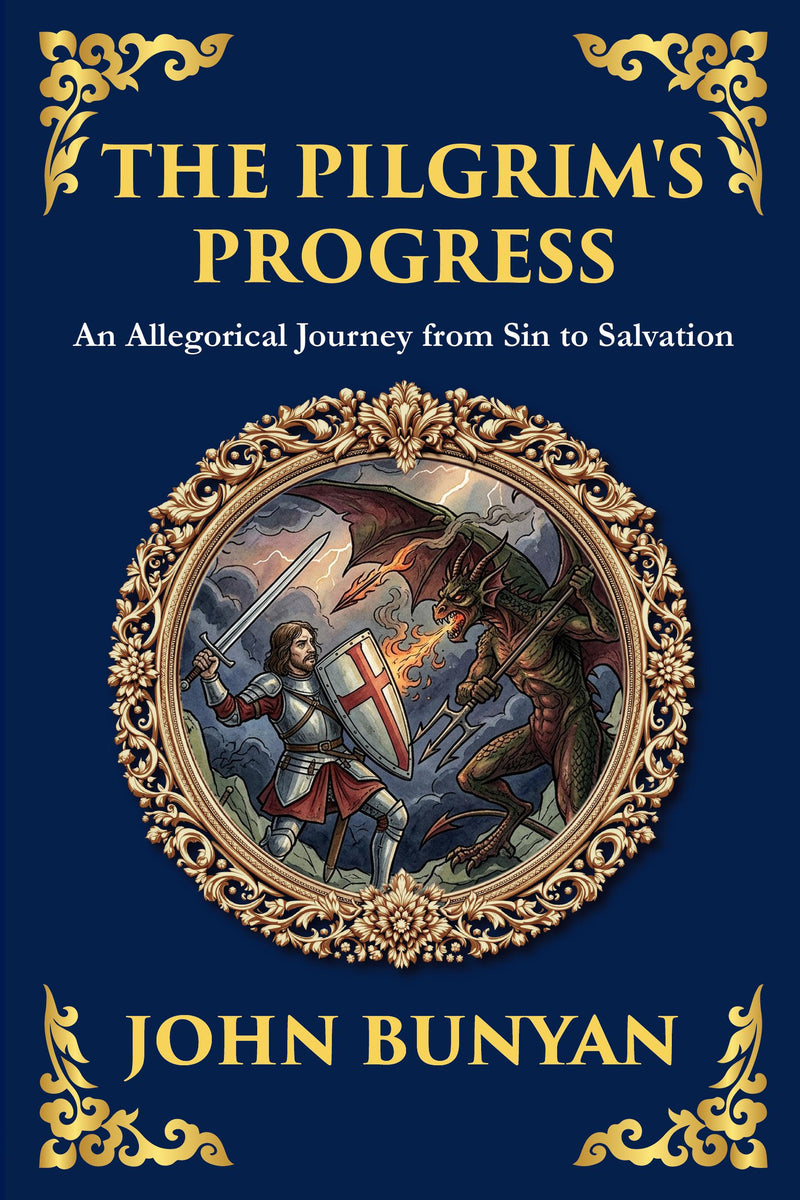
The Pilgrim’s Progress from this world to that which is to come
One of the most influential Christian allegories ever written, The Pilgrim’s Progress follows the epic spiritual journey of Christian, an ordinary man searching for truth, redemption, and the Celestial City.
or free app
10,000+ hrs library
30-day guarantee
The complete The Pilgrim's Progress appears in modern English through Library of Alexandria Press, available online with audiobook narration included for members.
Have you ever wondered why the path to truth is often the hardest road to travel? Embark on a spiritual odyssey with The Pilgrim’s Progress: An Allegorical Journey from Sin to Salvation, a classic that has captivated readers since 1678. Written by John Bunyan during his imprisonment, this visionary allegory tells the tale of Christian, an everyman figure burdened by sin and driven by the hope of eternal life.
As he leaves behind the City of Destruction, Christian encounters trials that test his faith, companions who bolster or betray him, and ultimate revelations that change his soul. In this beautifully formatted modern edition, Bunyan’s rich prose is made accessible to contemporary readers without losing its poetic and spiritual depth. The story’s allegorical power continues to inspire those walking their own paths of purpose, struggle, and salvation.
What you’ll discover in this modern edition
- A Journey from Despair to Deliverance Witness Christian’s transformative pilgrimage from spiritual burden to divine grace as he navigates the Valley of Humiliation, Vanity Fair, and the River of Death.
- Timeless Allegorical Characters Meet Hopeful, Faithful, Evangelist, and others whose names reflect their spiritual roles, offering lessons in trust, loyalty, and resilience.
- Symbolism That Speaks Across Centuries Understand how Bunyan’s metaphors resonate with universal human struggles— temptation, fear, doubt—and the longing for redemption.
- Spiritual Wisdom and Moral Insight Reflect on enduring themes of sin, grace, perseverance, and salvation relevant to every generation.
- A Literary and Religious Masterpiece Explore one of the most published and translated books in the world—a cornerstone of Christian literature and allegorical fiction.
| Formats | eBook (EPUB + PDF) · Audiobook · Paperback · Hardcover · Large Print |
| Language | English |
| Trim size (print) | 6 × 9 in |
| Binding | Paperback — perfect-bound · Hardcover — casewrap |
| Large Print edition | Same text in a larger, easy-read type — a larger font, not a larger trim |
| Print pricing | Every physical book at our true cost — at-cost, no profit (members) |
| Library | 873 restored titles, always growing |
| Length | 54,810 words · ~3 hr 39 min reading |
| Reading level | Grade 3 · an easy, flowing read (this modern-English edition) |
| Edition | Modern English translation · 2026 |
Member reviews for this edition are collected as readers finish it — be the first. Across the library: 12,000+ books shipped, every plan covered by a 365-day print guarantee.
About this edition
A faithful, unabridged modern-English edition by The Library of Alexandria — carefully rendered for today's reader and verified paragraph-by-paragraph against the public-domain source. Available as eBook, audiobook, paperback, hardcover, and large print.
- Complete & unabridgedVerified paragraph by paragraph against the source — never a scan, never abridged.
- Modern English, faithfulReadable today, with the author’s meaning kept intact. Readable — not simplified.
- Every format, one membershipRead in your browser or the free app, or listen to the full audiobook.
Included free with your membership
Cancel anytime, one click · 30-day money-back guarantee
Edition last updated July 2026
What’s inside
The Pilgrim’s Progress from this world to that which is to come — complete and unabridged: all 4 sections included with membership, plus the full audiobook.
Begin reading The Pilgrim’s Progress from this world to that which is to come
In clear modern English — the complete text is included with membership.
Introduction
Few books have traveled as far, or lived as long, as the one you now hold. Written more than three hundred years ago by a man who composed much of it inside the cold stone walls of an English prison, it has since crossed oceans, been translated into more than two hundred languages, and found its way into the hands of kings and farmers, scholars and children, missionaries and skeptics alike. For generations it sat on shelves beside only one other book in countless households — the Bible itself. To call it merely influential would be an understatement; it is woven into the very fabric of how the English-speaking world has imagined the spiritual life, the inner struggle, and the long, uncertain road toward meaning.
And yet, for all its fame, this is at heart a remarkably simple thing: a story about a man on a journey. He sets out from one place, hoping to reach another. Along the way he meets companions both faithful and false, faces dangers that test his courage, stumbles into traps that nearly undo him, and discovers — sometimes to his joy, sometimes to his sorrow — what he is truly made of. Strip away the centuries of reverence and commentary, and what remains is an adventure tale of the oldest and most universal kind: the quest. We recognize its shape instinctively, because it is the shape of our own lives.
What you are about to read is a modern rendering, carefully adapted so that the language no longer stands as a barrier between you and the story. The original was written in the rich, rolling English of the seventeenth century — magnificent in its rhythms, but increasingly remote to ears tuned to the speech of today. Words have shifted in meaning, sentence structures have grown unfamiliar, and turns of phrase that once landed with immediate force now require footnotes and patience. This edition seeks to honor the spirit and substance of the original while clearing away the underbrush of archaic expression, so that the journey reads as freshly and vividly as it did to those who first encountered it. The aim is not to replace the classic but to open a door to it — to let a contemporary reader feel the same urgency, the same wonder, and the same flashes of recognition that have moved readers across the centuries.
It is worth understanding, before you begin, that this is an allegory. That word can sound forbidding, conjuring images of dry symbolism and homework-like decoding. But allegory, at its best, is one of the most delightful and accessible of literary forms. It works the way a dream works, or the way a fable works. People and places are given names that announce their nature — a character called Faithful, a town called Vanity, a slough called Despond — and so the inner landscape of the human heart is made visible, walkable, dramatic. We do not have to guess what a struggle “feels like”; here, the struggle becomes a hill to climb, a monster to fight, a swamp to wade through. The genius of this approach is that it externalizes what is usually hidden. The doubts that gnaw at us in the dark, the temptations that whisper in idle moments, the friends who lift us and the acquaintances who lead us astray — all of these are given bodies and voices and roads of their own. To read this book is to watch your own interior life staged as a grand and perilous expedition.
This means you can read it on more than one level at once, and that is part of its enduring pleasure. You may read it purely as a story — following the hero from peril to peril, eager to know whether he will survive, who will betray him, and what waits at the end of the road. Or you may read it as a map of the soul, pausing at each encounter to ask what it reveals about your own fears, hopes, failures, and longings. Most readers find themselves doing both at the same time, and discover that the two readings enrich each other. The adventure gives the meaning its weight; the meaning gives the adventure its stakes. There is something deeply satisfying about a story in which the obstacles are not arbitrary — in which every danger means something, and every choice carries consequence.
To appreciate why this particular journey has touched so many, it helps to know a little about the extraordinary man who wrote it. John Bunyan was not a learned theologian writing from a comfortable study, nor a poet of leisured circumstances. He was a tinker by trade — a mender of pots and pans — born in 1628 in a small village in Bedfordshire, England, into a family of modest means. His formal education was slight; by his own account he had little book-learning and came from what he frankly described as a low and humble background. He served as a young soldier during the turbulent years of England’s civil wars, an experience that surely left its mark on a man who would later write so vividly of armed conflict and besieged souls.
But the great drama of Bunyan’s life was not external. It was the long, agonizing wrestling match within his own conscience. As a young man he passed through a period of intense spiritual torment — a years-long struggle with guilt, doubt, and the terror of damnation that he would later chronicle in a searing spiritual autobiography. He described himself as having been a reckless and careless youth, and then as a man seized by a conviction of his own sinfulness so overwhelming that it nearly broke him. He heard voices of accusation in his mind, felt himself alternately lifted by hope and plunged into despair, and emerged at last into a hard-won peace that became the bedrock of everything he afterward wrote. When you read of the hero’s burden, his fears, his moments of paralyzing doubt, and his eventual relief, you are reading the distilled experience of a man who lived every step of that inner journey himself. This is why the book rings so true. It is not the invention of a clever mind imagining what struggle might feel like; it is the testimony of someone who walked through fire and came out the other side.
Bunyan became a preacher — and an unlicensed one, which in the England of his day was a crime. The authorities demanded that religious teaching be conducted only within the approved channels of the established church, and Bunyan, a man of fierce conviction and a member of a dissenting congregation, refused to stop preaching to ordinary people in fields and barns and homes. For this he was arrested and imprisoned, spending the better part of twelve years confined in the Bedford county jail. He could have walked free at almost any time simply by promising to stop preaching. He would not. And it was during these long years of confinement — separated from his family, including a beloved blind daughter, deprived of his livelihood, uncertain of his future — that the seed of this great book took root and grew. There is a profound and moving irony in the fact that the most famous story of a journey ever written in English was composed by a man who could not leave a small cell. Imprisoned in body, he set his imagination loose to walk the longest road of all.
Understanding this background changes how the book reads. The figure of the pilgrim is not a distant invention but very nearly a self-portrait — or at least a portrait of the spiritual condition Bunyan knew most intimately. The hardships the traveler faces, the imprisonments and persecutions, the temptation to give up and turn back, the loneliness of holding to a path that others mock — all of these flowed from a well of genuine experience. Bunyan knew what it was to be locked away for his convictions. He knew what it was to be told that the easy road lay open if only he would compromise. And he chose the hard road, the narrow way, the journey that promised difficulty now in exchange for something greater later. That choice is the beating heart of this book, and it is what gives the story its remarkable moral authority. The author is not asking his hero to endure anything he himself was unwilling to endure.
It is also worth noting that Bunyan wrote in the plain, direct, vivid speech of common people. He was not aiming at the educated elite; he was writing for the very tinkers and farmers and tradespeople among whom he had lived and preached. This is one of the great strengths of the work and one of the reasons it has remained so beloved. The dialogue crackles with the rhythms of ordinary conversation. The characters speak the way real people speak — arguing, boasting, complaining, encouraging, deceiving. The descriptions are concrete and earthy: mud you can feel sucking at your boots, a hill steep enough to make your lungs burn, a valley dark enough to lose your way in. Even in translation across the centuries, that vividness comes through. Bunyan had the storyteller’s instinct for the telling detail, and the preacher’s instinct for the moment of crisis. He knew how to hold an audience, and that gift survives on every page.
This modern adaptation aims to preserve exactly that quality — the plainness, the directness, the warmth — while making the language transparent to a present-day reader. Where the original used a word that has since changed meaning or fallen out of use, this edition substitutes its closest modern equivalent. Where a sentence wound through clause after clause in the elaborate style of its era, it has been gently restructured for clarity. But the goal throughout has been faithfulness, not modernization for its own sake. The characters’ names, the names of places, the sequence of events, the substance of the conversations — all remain. What changes is only the surface of the prose, smoothed just enough that nothing stands between you and the experience Bunyan intended you to have. You should feel, reading this, that a wise and earnest companion is telling you a story directly, with no museum glass between you.
How to Read This Book, and What to Watch for
A few words of guidance may enhance your journey, much as a good traveling companion can point out features of the landscape you might otherwise pass without noticing.
First, pay attention to the names. In this kind of allegory, names are not decoration; they are descriptions. Every character the pilgrim meets is, in a sense, a quality made flesh — a virtue, a vice, a state of mind, a type of person we have all encountered. When you meet someone whose name signals their nature, you are meeting not just an individual but a whole category of human experience. Some of these figures are companions who help the traveler along; others are obstacles in disguise, all the more dangerous for their pleasant appearances. Part of the pleasure and the wisdom of the book lies in learning, alongside the hero, to tell the difference — and in recognizing how often we ourselves are fooled by the very same disguises. You may find that certain characters remind you painfully of people you know, or, more uncomfortably still, of yourself in certain moods. That recognition is precisely the point. Bunyan held up a mirror, and the reflection has remained startlingly accurate across the centuries.
Second, notice the places. The geography of this story is the geography of the inner life. There are low places of discouragement and high places of vision; there are pleasant meadows that tempt the traveler to linger when he should press on, and dark passages that must be crossed in fear and trembling. There are towns full of people going about their business, oblivious to the journey entirely, and there are way-stations of rest and refreshment that arrive just when the traveler — and the reader — most needs them. The rhythm of the book mirrors the rhythm of any long and meaningful undertaking: exertion followed by rest, danger followed by relief, loneliness followed by companionship, and always the road stretching onward. Bunyan understood that a journey is not a single heroic burst but a sustained act of will, repeated day after day, through good terrain and bad. This is one of the book’s quietest but deepest lessons: that perseverance, the simple refusal to turn back, is itself a kind of heroism.
Cancel anytime, one click · 30-day money-back guarantee
Founding annual rate available now — your price locks for life when you join.
Not ready? Get this free chapter by email — read it anytime.
✓ Sent — check your inbox for The Pilgrim’s Progress from this world to that which is to come.
Questions about The Pilgrim’s Progress from this world to that which is to come
What is The Pilgrim's Progress about?
One of the most influential Christian allegories ever written, The Pilgrim’s Progress follows the epic spiritual journey of Christian, an ordinary man searching for truth, redemption, and the Celestial City. Facing trials, temptations, and inner battles, he encounters unforgettable characters—Evangelist, Faithful, Hopeful, and Apollyon—each representing the challenges and triumphs of the soul’s journey to salvation. John Bunyan’s timeless masterpiece, born from his imprisonment for preaching without a license, has
Who wrote The Pilgrim's Progress?
The Pilgrim's Progress was written by John Bunyan. This edition presents the complete work in clear modern English, faithfully rendered from the public-domain original by Library of Alexandria Press.
Is The Pilgrim's Progress free to read?
The opening chapter is free to read on this page. Members read and listen to the complete work — and the entire library — free, and can order any physical book at our true print cost.
How long is The Pilgrim's Progress?
4 chapters (~54,810 words) — about 3 hr 39 min of reading in this modern-English edition.
Is this an abridged version of The Pilgrim's Progress?
No. This is the complete, unabridged The Pilgrim's Progress, carefully rendered into clear modern English and verified paragraph-by-paragraph against the public-domain source — nothing is cut or summarised.
What formats does The Pilgrim's Progress come in?
The Pilgrim's Progress is available as eBook, paperback, hardcover and large print. eBook and audiobook are included with membership; printed editions ship at our true print cost.
Shipping & returns
Billing & membership
More from the library


Explore Classic & Literary
- Dream Psychology: Psychoanalysis for Beginners · Sigmund Freud
- Great Expectations · Charles Dickens
- The Brothers Karamazov · Fyodor Dostoyevsky
- The Great Gatsby · F. Scott Fitzgerald
- Wild Flowers Worth Knowing · Neltje Blanchan
- Italian Hours · Henry James
- A Popular History of France from the Earliest Times, Volume 5 · François Guizot
- A history of English literature: A practical text-book · Edward Albert
- Italian Highways and Byways from a Motor Car · M. F. Mansfield
- The Heart-Cry of Jesus · Byron J. Rees
- Castes and Tribes of Southern India. Vol. 6 of 7 · Edgar Thurston
- Against the Grain · J.-K. Huysmans
- Dombey and Son · Charles Dickens
- How to Invest Money · George Garr Henry
- The Great Controversy Between Christ and Satan · Ellen Gould Harmon White
- One Hundred Proofs That the Earth Is Not a Globe · William Carpenter
- Southern Literature From 1579–1895 · Louise Manly
- The Renaissance: Studies in Art and Poetry · Walter Pater
- Mark Twain’s Speeches · Mark Twain
- Tacitus on Germany · Cornelius Tacitus
- The Rosary · Florence L. Barclay
- Peculiarities of American Cities · Willard W. Glazier
- Tennis for Girls · Florence A. Ballin
- The World’s Greatest Books — Volume 02 — Fiction
- Shirley · Charlotte Brontë
- Daisy Miller: A Study · Henry James
- Louis Lambert · Honoré de Balzac
- Historic Jamaica · Frank Cundall
- The Gambler · Fyodor Dostoyevsky
- The Mayor of Casterbridge · Thomas Hardy
The Pilgrim’s Progress from this world to that which is to come
The Pilgrim’s Progress from this world to that which is to come
An Allegorical Journey from Sin to Salvation
John Bunyan
Contents
- Introduction
- Part 1
- Chapter 1
- Chapter 2
Introduction
Few books have traveled as far, or lived as long, as the one you now hold. Written more than three hundred years ago by a man who composed much of it inside the cold stone walls of an English prison, it has since crossed oceans, been translated into more than two hundred languages, and found its way into the hands of kings and farmers, scholars and children, missionaries and skeptics alike. For generations it sat on shelves beside only one other book in countless households — the Bible itself. To call it merely influential would be an understatement; it is woven into the very fabric of how the English-speaking world has imagined the spiritual life, the inner struggle, and the long, uncertain road toward meaning.
And yet, for all its fame, this is at heart a remarkably simple thing: a story about a man on a journey. He sets out from one place, hoping to reach another. Along the way he meets companions both faithful and false, faces dangers that test his courage, stumbles into traps that nearly undo him, and discovers — sometimes to his joy, sometimes to his sorrow — what he is truly made of. Strip away the centuries of reverence and commentary, and what remains is an adventure tale of the oldest and most universal kind: the quest. We recognize its shape instinctively, because it is the shape of our own lives.
What you are about to read is a modern rendering, carefully adapted so that the language no longer stands as a barrier between you and the story. The original was written in the rich, rolling English of the seventeenth century — magnificent in its rhythms, but increasingly remote to ears tuned to the speech of today. Words have shifted in meaning, sentence structures have grown unfamiliar, and turns of phrase that once landed with immediate force now require footnotes and patience. This edition seeks to honor the spirit and substance of the original while clearing away the underbrush of archaic expression, so that the journey reads as freshly and vividly as it did to those who first encountered it. The aim is not to replace the classic but to open a door to it — to let a contemporary reader feel the same urgency, the same wonder, and the same flashes of recognition that have moved readers across the centuries.
It is worth understanding, before you begin, that this is an allegory. That word can sound forbidding, conjuring images of dry symbolism and homework-like decoding. But allegory, at its best, is one of the most delightful and accessible of literary forms. It works the way a dream works, or the way a fable works. People and places are given names that announce their nature — a character called Faithful, a town called Vanity, a slough called Despond — and so the inner landscape of the human heart is made visible, walkable, dramatic. We do not have to guess what a struggle “feels like”; here, the struggle becomes a hill to climb, a monster to fight, a swamp to wade through. The genius of this approach is that it externalizes what is usually hidden. The doubts that gnaw at us in the dark, the temptations that whisper in idle moments, the friends who lift us and the acquaintances who lead us astray — all of these are given bodies and voices and roads of their own. To read this book is to watch your own interior life staged as a grand and perilous expedition.
This means you can read it on more than one level at once, and that is part of its enduring pleasure. You may read it purely as a story — following the hero from peril to peril, eager to know whether he will survive, who will betray him, and what waits at the end of the road. Or you may read it as a map of the soul, pausing at each encounter to ask what it reveals about your own fears, hopes, failures, and longings. Most readers find themselves doing both at the same time, and discover that the two readings enrich each other. The adventure gives the meaning its weight; the meaning gives the adventure its stakes. There is something deeply satisfying about a story in which the obstacles are not arbitrary — in which every danger means something, and every choice carries consequence.
To appreciate why this particular journey has touched so many, it helps to know a little about the extraordinary man who wrote it. John Bunyan was not a learned theologian writing from a comfortable study, nor a poet of leisured circumstances. He was a tinker by trade — a mender of pots and pans — born in 1628 in a small village in Bedfordshire, England, into a family of modest means. His formal education was slight; by his own account he had little book-learning and came from what he frankly described as a low and humble background. He served as a young soldier during the turbulent years of England’s civil wars, an experience that surely left its mark on a man who would later write so vividly of armed conflict and besieged souls.
But the great drama of Bunyan’s life was not external. It was the long, agonizing wrestling match within his own conscience. As a young man he passed through a period of intense spiritual torment — a years-long struggle with guilt, doubt, and the terror of damnation that he would later chronicle in a searing spiritual autobiography. He described himself as having been a reckless and careless youth, and then as a man seized by a conviction of his own sinfulness so overwhelming that it nearly broke him. He heard voices of accusation in his mind, felt himself alternately lifted by hope and plunged into despair, and emerged at last into a hard-won peace that became the bedrock of everything he afterward wrote. When you read of the hero’s burden, his fears, his moments of paralyzing doubt, and his eventual relief, you are reading the distilled experience of a man who lived every step of that inner journey himself. This is why the book rings so true. It is not the invention of a clever mind imagining what struggle might feel like; it is the testimony of someone who walked through fire and came out the other side.
Bunyan became a preacher — and an unlicensed one, which in the England of his day was a crime. The authorities demanded that religious teaching be conducted only within the approved channels of the established church, and Bunyan, a man of fierce conviction and a member of a dissenting congregation, refused to stop preaching to ordinary people in fields and barns and homes. For this he was arrested and imprisoned, spending the better part of twelve years confined in the Bedford county jail. He could have walked free at almost any time simply by promising to stop preaching. He would not. And it was during these long years of confinement — separated from his family, including a beloved blind daughter, deprived of his livelihood, uncertain of his future — that the seed of this great book took root and grew. There is a profound and moving irony in the fact that the most famous story of a journey ever written in English was composed by a man who could not leave a small cell. Imprisoned in body, he set his imagination loose to walk the longest road of all.
Understanding this background changes how the book reads. The figure of the pilgrim is not a distant invention but very nearly a self-portrait — or at least a portrait of the spiritual condition Bunyan knew most intimately. The hardships the traveler faces, the imprisonments and persecutions, the temptation to give up and turn back, the loneliness of holding to a path that others mock — all of these flowed from a well of genuine experience. Bunyan knew what it was to be locked away for his convictions. He knew what it was to be told that the easy road lay open if only he would compromise. And he chose the hard road, the narrow way, the journey that promised difficulty now in exchange for something greater later. That choice is the beating heart of this book, and it is what gives the story its remarkable moral authority. The author is not asking his hero to endure anything he himself was unwilling to endure.
It is also worth noting that Bunyan wrote in the plain, direct, vivid speech of common people. He was not aiming at the educated elite; he was writing for the very tinkers and farmers and tradespeople among whom he had lived and preached. This is one of the great strengths of the work and one of the reasons it has remained so beloved. The dialogue crackles with the rhythms of ordinary conversation. The characters speak the way real people speak — arguing, boasting, complaining, encouraging, deceiving. The descriptions are concrete and earthy: mud you can feel sucking at your boots, a hill steep enough to make your lungs burn, a valley dark enough to lose your way in. Even in translation across the centuries, that vividness comes through. Bunyan had the storyteller’s instinct for the telling detail, and the preacher’s instinct for the moment of crisis. He knew how to hold an audience, and that gift survives on every page.
This modern adaptation aims to preserve exactly that quality — the plainness, the directness, the warmth — while making the language transparent to a present-day reader. Where the original used a word that has since changed meaning or fallen out of use, this edition substitutes its closest modern equivalent. Where a sentence wound through clause after clause in the elaborate style of its era, it has been gently restructured for clarity. But the goal throughout has been faithfulness, not modernization for its own sake. The characters’ names, the names of places, the sequence of events, the substance of the conversations — all remain. What changes is only the surface of the prose, smoothed just enough that nothing stands between you and the experience Bunyan intended you to have. You should feel, reading this, that a wise and earnest companion is telling you a story directly, with no museum glass between you.
How to Read This Book, and What to Watch for
A few words of guidance may enhance your journey, much as a good traveling companion can point out features of the landscape you might otherwise pass without noticing.
First, pay attention to the names. In this kind of allegory, names are not decoration; they are descriptions. Every character the pilgrim meets is, in a sense, a quality made flesh — a virtue, a vice, a state of mind, a type of person we have all encountered. When you meet someone whose name signals their nature, you are meeting not just an individual but a whole category of human experience. Some of these figures are companions who help the traveler along; others are obstacles in disguise, all the more dangerous for their pleasant appearances. Part of the pleasure and the wisdom of the book lies in learning, alongside the hero, to tell the difference — and in recognizing how often we ourselves are fooled by the very same disguises. You may find that certain characters remind you painfully of people you know, or, more uncomfortably still, of yourself in certain moods. That recognition is precisely the point. Bunyan held up a mirror, and the reflection has remained startlingly accurate across the centuries.
Second, notice the places. The geography of this story is the geography of the inner life. There are low places of discouragement and high places of vision; there are pleasant meadows that tempt the traveler to linger when he should press on, and dark passages that must be crossed in fear and trembling. There are towns full of people going about their business, oblivious to the journey entirely, and there are way-stations of rest and refreshment that arrive just when the traveler — and the reader — most needs them. The rhythm of the book mirrors the rhythm of any long and meaningful undertaking: exertion followed by rest, danger followed by relief, loneliness followed by companionship, and always the road stretching onward. Bunyan understood that a journey is not a single heroic burst but a sustained act of will, repeated day after day, through good terrain and bad. This is one of the book’s quietest but deepest lessons: that perseverance, the simple refusal to turn back, is itself a kind of heroism.
A different project; but when that was almost finished,
Without even noticing, I began this one instead.
And that is how it happened: while I was writing about the lives and paths of the saints in these gospel times, I suddenly found myself using an allegory to describe their journey and the road to glory, listing more than twenty different points. Once I finished those, twenty more came to mind; then they began to multiply even further, like sparks flying off a burning coal.
No, I thought, if you multiply this quickly, I’ll isolate you. Otherwise, you might keep growing forever and devour the very book I’m currently writing.
Well, that’s what I did; but I didn’t intend To show everyone my writing In this way. I just wanted to create something—I’m not even sure what. I wasn’t trying to impress my neighbors; no, I wasn’t. I did it simply to satisfy myself.
{2} I didn’t spend my free time just writing these scribbles; I only intended to distract myself with this work from the darker thoughts that lead me astray.
So, I happily started writing, and quickly put my thoughts on paper. Since I had finally figured out my method, the ideas kept flowing as I pulled them out, and I wrote them down. Eventually, the work grew to the size and length you see here.
Once I had finished putting the pieces together, I showed them to others to see if they would criticize the work or approve of it. Some said, “Keep it”; others said, “Throw it away.” Some said, “John, publish it”; others said, “Don’t do it.” Some thought it might be helpful; others disagreed.
Now I was in a tight spot and didn’t know the best way to handle the situation. Finally, I thought, since you can’t agree, I’ll decide to print it, and that settled the matter.
End of the free sample
Keep reading, free
Members read and listen to the complete book — and the entire library. Cancel anytime, one click · 30-day money-back guarantee.