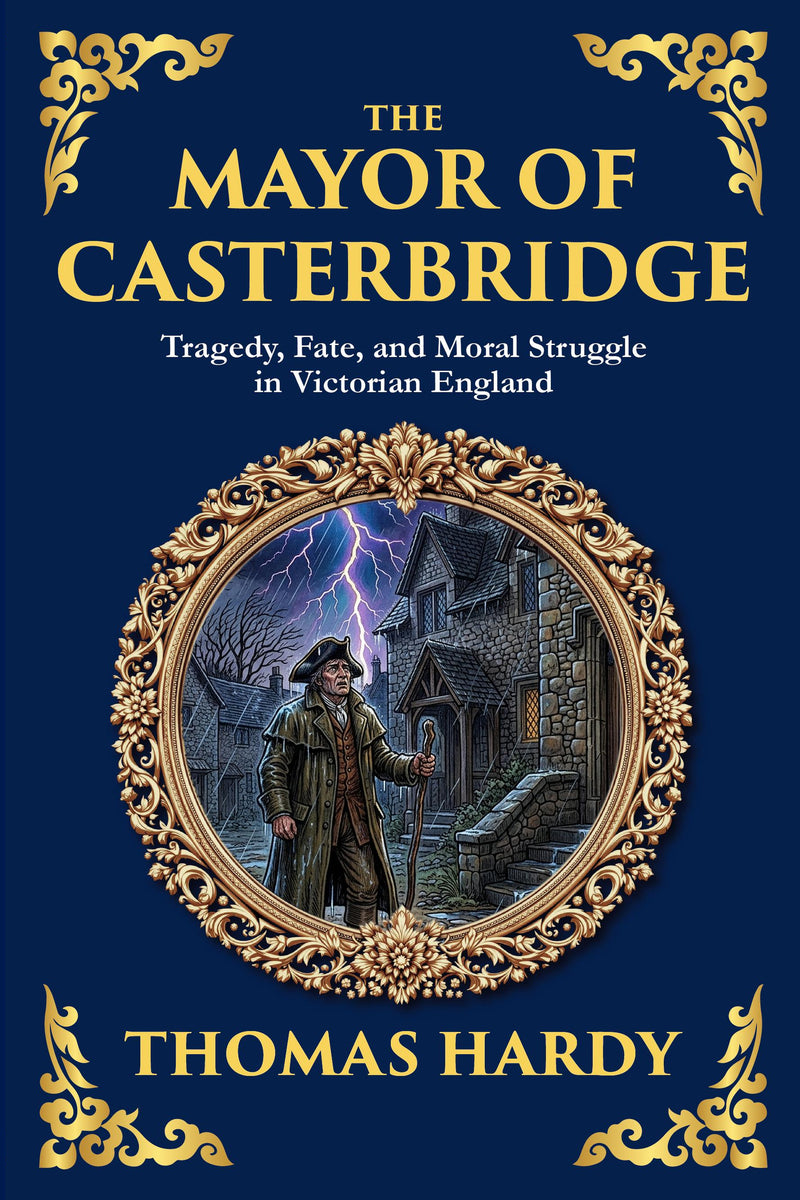
The Mayor of Casterbridge — Large Print
Michael Henchard, a man of pride and passion, makes a single drunken decision that seals his tragic destiny: selling his wife and child at a country fair.
or free app
10,000+ hrs library
30-day guarantee
The complete The Mayor of Casterbridge appears in modern English through Library of Alexandria Press, available online with audiobook narration included for members.
Have you ever wondered why some mistakes haunt us forever—even when we try to change? The Mayor of Casterbridge is a searing exploration of human frailty, ambition, and the unforgiving nature of destiny. In this enduring novel by Thomas Hardy, a rash act sets into motion a lifelong chain of sorrow, redemption, and eventual ruin.
Michael Henchard, a hay-trusser turned successful mayor, is a man tormented by guilt and pride. After selling his wife and infant daughter during a drunken outburst, he tries to rebuild his life with strict moral resolve. But when his family re-enters his life years later, his attempts at redemption are met with a series of moral tests that pit him against old rivals, new betrayals, and his own unchecked emotions.
Hardy’s compelling narrative unfolds in the fictional town of Casterbridge, richly painted with the textures of rural England and infused with the inevitability of classical tragedy. This modern edition revives Hardy’s deeply psychological portrait of a man’s fall from grace with vivid clarity and emotional depth.
What you’ll discover in this modern edition
- A Gripping Tale of Moral Consequences Follow Henchard's rise and fall as he grapples with guilt, pride, and forgiveness.
- Themes of Fate vs. Free Will Witness the heartbreaking tension between choice and destiny in the shaping of a man’s life.
- Rich, Atmospheric Setting Explore the evocative world of Casterbridge, a backdrop teeming with Victorian values, rustic beauty, and societal change.
- A Study in Human Emotion and Regret Delve into the psychology of one of Hardy’s most tragic and complex characters.
- A Respected Classic in Modern Language This updated presentation retains the soul of Hardy’s work while offering a fluid reading experience for today’s audience.
| Formats | eBook (EPUB + PDF) · Audiobook · Paperback · Hardcover · Large Print |
| Language | English |
| Trim size (print) | 6 × 9 in |
| Binding | Paperback — perfect-bound · Hardcover — casewrap |
| Large Print edition | Same text in a larger, easy-read type — a larger font, not a larger trim |
| Print pricing | Every physical book at our true cost — at-cost, no profit (members) |
| Library | 873 restored titles, always growing |
| Length | 116,354 words · ~7 hr 45 min reading |
| Reading level | Grade 9 · a comfortable read (this modern-English edition) |
| Edition | Modern English translation · 2026 |
Member reviews for this edition are collected as readers finish it — be the first. Across the library: 12,000+ books shipped, every plan covered by a 365-day print guarantee.
About this edition
A faithful, unabridged modern-English edition by The Library of Alexandria — carefully rendered for today's reader and verified paragraph-by-paragraph against the public-domain source. Available as eBook, audiobook, paperback, hardcover, and large print.
- Complete & unabridgedVerified paragraph by paragraph against the source — never a scan, never abridged.
- Modern English, faithfulReadable today, with the author’s meaning kept intact. Readable — not simplified.
- Every format, one membershipRead in your browser or the free app, or listen to the full audiobook.
Included free with your membership
Cancel anytime, one click · 30-day money-back guarantee
Edition last updated July 2026
What’s inside
The Mayor of Casterbridge — Large Print — complete and unabridged: all 46 sections included with membership, plus the full audiobook.
Begin reading The Mayor of Casterbridge — Large Print
In clear modern English — the complete text is included with membership.
Introduction
There is a particular kind of story that refuses to release its grip on the reader, even years after the final page has been turned. It is the kind of story in which a single human being, flawed and forceful, becomes the lens through which we examine our deepest questions about character, consequence, and the strange machinery of a life unfolding over time. The Mayor of Casterbridge is precisely such a story. Written by Thomas Hardy and first published in 1886, it stands among the most psychologically penetrating and emotionally devastating novels of the Victorian era, and it remains, more than a century later, a work of astonishing relevance to anyone who has ever made a decision they could not take back.
This edition presents Hardy’s masterpiece in a modern translation, carefully adapted for the contemporary reader. The aim of this adaptation is not to diminish or simplify the extraordinary depth of Hardy’s vision, but to clear away the obstacles of dated phrasing, archaic syntax, and unfamiliar idiom that can stand between a modern reader and the full emotional force of the narrative. What remains is the story itself, in all its tragic power, rendered in language that flows naturally to the twenty-first-century ear while preserving the gravity, the texture, and the moral seriousness that have always defined Hardy’s work. You are invited, in other words, to encounter one of literature’s great tragedies without the friction that sometimes keeps modern readers at arm’s length from the classics.
What follows in these pages is a study of a man, a community, and the inexorable workings of fate—a story that begins with a startling act and proceeds with the implacable logic of a Greek tragedy transplanted to the rolling fields and market towns of rural England. But before you begin, it is worth pausing to consider what makes this novel so enduring, why Hardy chose to tell this particular story in the way that he did, and how you might read it to draw out its richest rewards.
The World of Wessex and the Mind of Thomas Hardy
To understand The Mayor of Casterbridge, it helps first to understand the imaginative world from which it springs. Thomas Hardy was born in 1840 in a small cottage in Higher Bockhampton, in the county of Dorset, in the southwest of England. This region, with its ancient hills, its Roman ruins, its weathered market towns and isolated farms, would become the heart of his literary universe. Hardy gave this region a name of his own invention—Wessex—borrowing the term from the old Anglo-Saxon kingdom that once occupied the same stretch of England. Across more than a dozen novels and countless short stories and poems, Hardy populated his fictional Wessex with characters whose lives were shaped by the land, by tradition, and by the slow, grinding transformations of a society moving from an agricultural past into an industrial future.
Casterbridge, the town at the center of this novel, is Hardy’s reimagining of Dorchester, the county town of Dorset, where he spent much of his life. It is a place where the rhythms of the harvest still governed the fortunes of men, where the price of grain could lift a family into prosperity or cast it into ruin, and where the old ways of buying, selling, and bargaining were beginning to give way to newer, more rational methods of commerce. This tension—between the old and the new, the instinctive and the calculated, the rooted and the mobile—runs like a deep current beneath the surface of the novel and gives it much of its dramatic energy.
Hardy himself was a man caught between worlds. Trained as an architect before he turned to writing, he possessed an exacting eye for structure, both in buildings and in human lives. He came from humble origins but rose to mingle with the literary elite of London. He cherished the rural traditions of his childhood while remaining acutely aware that they were vanishing. And though he was steeped in the Bible and the rhythms of country churchgoing, he had grown skeptical of conventional religious consolation, developing instead a darker and more questioning view of the universe—a view in which human beings struggle valiantly against forces they cannot fully comprehend or control. This sensibility, sometimes described as fatalism or pessimism, is everywhere in his fiction, and it is nowhere more powerfully expressed than in the tragic arc of the man whose story you are about to read.
It is important to recognize, however, that Hardy’s so-called pessimism is not a cold or detached thing. On the contrary, it is shot through with profound compassion. Hardy looks unflinchingly at human suffering, but he never looks away in indifference. He grieves for his characters even as he subjects them to their fates. He understands their weaknesses and their longings, their pride and their tenderness, and he asks us to understand them too. This combination of clear-eyed severity and deep human sympathy is one of the qualities that elevates Hardy above so many of his contemporaries and that makes the experience of reading him so emotionally resonant. You will find, as you proceed, that even the characters who do terrible things, who hurt themselves and others, who seem at times almost willfully destructive, remain understandable, even lovable, because Hardy has rendered them with such fullness of feeling.
The original subtitle of the novel offers an essential clue to Hardy’s intentions. He called it The Life and Death of a Man of Character. That phrase—“a man of character”—is deliberately double-edged. On one reading, it suggests admiration: here is a man of substance, of strength, of moral seriousness, a man who matters. On another reading, it points to the central tragedy of the book, for it is precisely the man’s character—his temperament, his stubbornness, his impulsiveness, his pride—that determines the shape of his destiny. Hardy is drawing here on an idea as old as the ancient Greek dramatists, who held that character is fate: that the deepest forces shaping a human life are not external accidents but the qualities woven into a person’s very nature. The events of the novel may seem at times to be the work of cruel coincidence or blind chance, but again and again we are made to see that the protagonist’s misfortunes flow inevitably from who he is. This is the essence of tragedy, and it is what gives the novel its terrible momentum.
When the book first appeared, Hardy was already an established and successful novelist, but he would later look back on this period of his career with a certain dissatisfaction. The novel was first published in serial form, appearing in installments, and the demands of serialization—the need to end each segment on a note of suspense or incident—led Hardy to pack the story with more dramatic turns and coincidences than he might otherwise have included. He later revised the text for its publication in book form, and the version that has come down to us bears the marks of his careful reworking. Whatever reservations Hardy may have harbored, generations of readers and critics have come to regard The Mayor of Casterbridge as one of his finest achievements—a tightly constructed, emotionally overwhelming tragedy that ranks alongside his other great novels such as Tess of the d’Urbervilles and Far from the Madding Crowd.
What distinguishes this novel from much of Hardy’s other work is its concentration. Where some of his books spread their attention across multiple characters and storylines, this one fixes its gaze relentlessly upon a single figure. We follow this man from a moment of catastrophic decision through the long aftermath of his attempts to rebuild and atone, watching as the consequences of his actions ripple outward across the years and gradually close in upon him. The effect is something like watching a great tree grow and then, slowly, inexorably, topple. It is a story about ambition and self-reproach, about the impossibility of escaping one’s past, and about the painful gap between who we wish to be and who we actually are.
The Art of Tragedy and the Question of Fate
To read The Mayor of Casterbridge fully is to engage with one of the oldest and most profound questions in all of literature: How much of our lives is determined by our own choices, and how much by forces beyond our control? Hardy poses this question with extraordinary subtlety and refuses to offer any easy answer. As you move through the novel, you will encounter moments that seem to be pure accident—chance encounters, unexpected arrivals, secrets revealed at exactly the wrong moment, fortunes that turn on the weather or the price of grain. And yet, layered beneath these apparent coincidences, you will sense the deeper workings of character, the way the protagonist’s own temperament draws disaster toward him as surely as a magnet draws iron.
This is the great paradox at the heart of Hardy’s tragic vision, and it is what makes the novel so endlessly discussable and so emotionally complex. We watch a man struggle against his circumstances with genuine courage and determination. We see him perform acts of real generosity and self-discipline. We witness his sincere efforts to make amends for the wrongs of his past. And still, the catastrophe gathers. Hardy seems to suggest that we are caught in a web partly of our own weaving and partly woven for us by an indifferent universe—a universe that does not actively hate us but that does not particularly care for us either. There is no comforting providence in Hardy’s world, no benevolent hand guiding events toward a just conclusion. There is only the spectacle of a human being meeting his destiny with whatever strength and dignity he can muster.
And yet, paradoxically, this bleak vision produces something that is not bleak at all but strangely exalting. There is a grandeur in watching a flawed man face his fate without flinching. The protagonist of this novel is no saint—he is, in many respects, deeply difficult, prone to fits of temper and obstinacy, capable of cruelty as well as kindness. But he possesses a fierce vitality, an enormous capacity for both error and remorse, that makes him one of the most compellingly human figures in all of Victorian fiction. We do not always like him, but we cannot stop caring about what happens to him. And as the novel moves toward its conclusion, we find ourselves moved to a kind of pity and awe that is the hallmark of genuine tragedy—the feeling the ancient Greeks called catharsis, the purging of emotion that comes from witnessing a great fall.
It is worth saying a word here about the supporting characters who surround the central figure, for they are essential to the novel’s tragic design. Hardy populates his story with a cast of vividly drawn individuals, each of whom serves as a kind of mirror or counterpoint to the protagonist. There is a younger man whose smooth competence and modern sensibility stand in sharp contrast to the older man’s volcanic temperament. There are women whose patience, loyalty, and quiet endurance throw the protagonist’s volatility into relief. There are figures from the past who reappear to disturb the present, and there are humble townsfolk whose gossip and commentary form a kind of chorus, observing and judging the great drama unfolding before them. Hardy is a master of social texture, and the world of Casterbridge feels utterly real—its taverns and markets, its rituals and rivalries, its hierarchies and its hidden tensions all rendered with the precision of an artist who knew this world intimately.
Pay particular attention, as you read, to the role of the natural world and the passage of the seasons. Hardy was a poet as well as a novelist, and his prose is alive with the moods of the landscape—the brooding skies, the swelling rivers, the harvests that fail or flourish. In Hardy’s fiction, nature is never merely a backdrop; it is an active presence, sometimes seeming to echo the emotions of the characters, sometimes seeming to mock them with its indifference. The weather itself becomes a character in this story, with consequences that are at once economic, dramatic, and symbolic. Watch, too, for the recurring images and motifs that Hardy weaves through the narrative—the ways in which objects, places, and events from early in the story return, transformed, to reverberate later on. Hardy was a writer of remarkable structural sophistication, and much of the novel’s power lies in the patterns of repetition and echo that bind its beginning to its end.
Cancel anytime, one click · 30-day money-back guarantee
Founding annual rate available now — your price locks for life when you join.
Not ready? Get this free chapter by email — read it anytime.
✓ Sent — check your inbox for The Mayor of Casterbridge — Large Print.
Questions about The Mayor of Casterbridge — Large Print
What is The Mayor of Casterbridge about?
Michael Henchard, a man of pride and passion, makes a single drunken decision that seals his tragic destiny: selling his wife and child at a country fair. Years later, having risen to prominence as the respected Mayor of Casterbridge, his past returns to haunt him. In this riveting tale of guilt, pride, and redemption, Thomas Hardy exposes the profound consequences of one’s choices and the relentless grip of fate.
Who wrote The Mayor of Casterbridge?
The Mayor of Casterbridge was written by Thomas Hardy. This edition presents the complete work in clear modern English, faithfully rendered from the public-domain original by Library of Alexandria Press.
Is The Mayor of Casterbridge free to read?
The opening chapter is free to read on this page. Members read and listen to the complete work — and the entire library — free, and can order any physical book at our true print cost.
How long is The Mayor of Casterbridge?
46 chapters (~116,354 words) — about 7 hr 45 min of reading in this modern-English edition.
Is this an abridged version of The Mayor of Casterbridge?
No. This is the complete, unabridged The Mayor of Casterbridge, carefully rendered into clear modern English and verified paragraph-by-paragraph against the public-domain source — nothing is cut or summarised.
What formats does The Mayor of Casterbridge come in?
The Mayor of Casterbridge is available as eBook, paperback, hardcover and large print. eBook and audiobook are included with membership; printed editions ship at our true print cost.
Shipping & returns
Billing & membership
More from the library


Explore Classic & Literary
- Dream Psychology: Psychoanalysis for Beginners · Sigmund Freud
- Great Expectations · Charles Dickens
- The Brothers Karamazov · Fyodor Dostoyevsky
- The Great Gatsby · F. Scott Fitzgerald
- Wild Flowers Worth Knowing · Neltje Blanchan
- Italian Hours · Henry James
- A Popular History of France from the Earliest Times, Volume 5 · François Guizot
- A history of English literature: A practical text-book · Edward Albert
- Italian Highways and Byways from a Motor Car · M. F. Mansfield
- The Heart-Cry of Jesus · Byron J. Rees
- Castes and Tribes of Southern India. Vol. 6 of 7 · Edgar Thurston
- Against the Grain · J.-K. Huysmans
- Dombey and Son · Charles Dickens
- How to Invest Money · George Garr Henry
- The Great Controversy Between Christ and Satan · Ellen Gould Harmon White
- One Hundred Proofs That the Earth Is Not a Globe · William Carpenter
- Southern Literature From 1579–1895 · Louise Manly
- The Renaissance: Studies in Art and Poetry · Walter Pater
- Mark Twain’s Speeches · Mark Twain
- Tacitus on Germany · Cornelius Tacitus
- The Rosary · Florence L. Barclay
- Peculiarities of American Cities · Willard W. Glazier
- Tennis for Girls · Florence A. Ballin
- The World’s Greatest Books — Volume 02 — Fiction
- Shirley · Charlotte Brontë
- Daisy Miller: A Study · Henry James
- Louis Lambert · Honoré de Balzac
- Historic Jamaica · Frank Cundall
- The Gambler · Fyodor Dostoyevsky
- The Mayor of Casterbridge · Thomas Hardy
The Mayor of Casterbridge — Large Print
The Mayor of Casterbridge — Large Print
Tragedy, Fate, and Moral Struggle in Victorian England
Thomas Hardy
Contents
- Introduction
- Chapter 1
- Chapter 2
- Part 3
- Chapter 4
- Chapter 5
- Chapter 6
- Chapter 7
- Chapter 8
- Chapter 9
- Chapter 10
- Chapter 11
- Chapter 12
- Chapter 13
- Chapter 14
- Chapter 15
- Chapter 16
- Chapter 17
- Chapter 18
- Chapter 19
- Chapter 20
- Chapter 21
- Chapter 22
- Chapter 23
- Chapter 24
- Chapter 25
- Chapter 26
- Chapter 27
- Chapter 28
- Chapter 29
- Chapter 30
- Chapter 31
- Chapter 32
- Chapter 33
- Chapter 34
- Chapter 35
- Chapter 36
- Chapter 37
- Chapter 38
- Chapter 39
- … and 6 more chapters
Introduction
There is a particular kind of story that refuses to release its grip on the reader, even years after the final page has been turned. It is the kind of story in which a single human being, flawed and forceful, becomes the lens through which we examine our deepest questions about character, consequence, and the strange machinery of a life unfolding over time. The Mayor of Casterbridge is precisely such a story. Written by Thomas Hardy and first published in 1886, it stands among the most psychologically penetrating and emotionally devastating novels of the Victorian era, and it remains, more than a century later, a work of astonishing relevance to anyone who has ever made a decision they could not take back.
This edition presents Hardy’s masterpiece in a modern translation, carefully adapted for the contemporary reader. The aim of this adaptation is not to diminish or simplify the extraordinary depth of Hardy’s vision, but to clear away the obstacles of dated phrasing, archaic syntax, and unfamiliar idiom that can stand between a modern reader and the full emotional force of the narrative. What remains is the story itself, in all its tragic power, rendered in language that flows naturally to the twenty-first-century ear while preserving the gravity, the texture, and the moral seriousness that have always defined Hardy’s work. You are invited, in other words, to encounter one of literature’s great tragedies without the friction that sometimes keeps modern readers at arm’s length from the classics.
What follows in these pages is a study of a man, a community, and the inexorable workings of fate—a story that begins with a startling act and proceeds with the implacable logic of a Greek tragedy transplanted to the rolling fields and market towns of rural England. But before you begin, it is worth pausing to consider what makes this novel so enduring, why Hardy chose to tell this particular story in the way that he did, and how you might read it to draw out its richest rewards.
The World of Wessex and the Mind of Thomas Hardy
To understand The Mayor of Casterbridge, it helps first to understand the imaginative world from which it springs. Thomas Hardy was born in 1840 in a small cottage in Higher Bockhampton, in the county of Dorset, in the southwest of England. This region, with its ancient hills, its Roman ruins, its weathered market towns and isolated farms, would become the heart of his literary universe. Hardy gave this region a name of his own invention—Wessex—borrowing the term from the old Anglo-Saxon kingdom that once occupied the same stretch of England. Across more than a dozen novels and countless short stories and poems, Hardy populated his fictional Wessex with characters whose lives were shaped by the land, by tradition, and by the slow, grinding transformations of a society moving from an agricultural past into an industrial future.
Casterbridge, the town at the center of this novel, is Hardy’s reimagining of Dorchester, the county town of Dorset, where he spent much of his life. It is a place where the rhythms of the harvest still governed the fortunes of men, where the price of grain could lift a family into prosperity or cast it into ruin, and where the old ways of buying, selling, and bargaining were beginning to give way to newer, more rational methods of commerce. This tension—between the old and the new, the instinctive and the calculated, the rooted and the mobile—runs like a deep current beneath the surface of the novel and gives it much of its dramatic energy.
Hardy himself was a man caught between worlds. Trained as an architect before he turned to writing, he possessed an exacting eye for structure, both in buildings and in human lives. He came from humble origins but rose to mingle with the literary elite of London. He cherished the rural traditions of his childhood while remaining acutely aware that they were vanishing. And though he was steeped in the Bible and the rhythms of country churchgoing, he had grown skeptical of conventional religious consolation, developing instead a darker and more questioning view of the universe—a view in which human beings struggle valiantly against forces they cannot fully comprehend or control. This sensibility, sometimes described as fatalism or pessimism, is everywhere in his fiction, and it is nowhere more powerfully expressed than in the tragic arc of the man whose story you are about to read.
It is important to recognize, however, that Hardy’s so-called pessimism is not a cold or detached thing. On the contrary, it is shot through with profound compassion. Hardy looks unflinchingly at human suffering, but he never looks away in indifference. He grieves for his characters even as he subjects them to their fates. He understands their weaknesses and their longings, their pride and their tenderness, and he asks us to understand them too. This combination of clear-eyed severity and deep human sympathy is one of the qualities that elevates Hardy above so many of his contemporaries and that makes the experience of reading him so emotionally resonant. You will find, as you proceed, that even the characters who do terrible things, who hurt themselves and others, who seem at times almost willfully destructive, remain understandable, even lovable, because Hardy has rendered them with such fullness of feeling.
The original subtitle of the novel offers an essential clue to Hardy’s intentions. He called it The Life and Death of a Man of Character. That phrase—“a man of character”—is deliberately double-edged. On one reading, it suggests admiration: here is a man of substance, of strength, of moral seriousness, a man who matters. On another reading, it points to the central tragedy of the book, for it is precisely the man’s character—his temperament, his stubbornness, his impulsiveness, his pride—that determines the shape of his destiny. Hardy is drawing here on an idea as old as the ancient Greek dramatists, who held that character is fate: that the deepest forces shaping a human life are not external accidents but the qualities woven into a person’s very nature. The events of the novel may seem at times to be the work of cruel coincidence or blind chance, but again and again we are made to see that the protagonist’s misfortunes flow inevitably from who he is. This is the essence of tragedy, and it is what gives the novel its terrible momentum.
When the book first appeared, Hardy was already an established and successful novelist, but he would later look back on this period of his career with a certain dissatisfaction. The novel was first published in serial form, appearing in installments, and the demands of serialization—the need to end each segment on a note of suspense or incident—led Hardy to pack the story with more dramatic turns and coincidences than he might otherwise have included. He later revised the text for its publication in book form, and the version that has come down to us bears the marks of his careful reworking. Whatever reservations Hardy may have harbored, generations of readers and critics have come to regard The Mayor of Casterbridge as one of his finest achievements—a tightly constructed, emotionally overwhelming tragedy that ranks alongside his other great novels such as Tess of the d’Urbervilles and Far from the Madding Crowd.
What distinguishes this novel from much of Hardy’s other work is its concentration. Where some of his books spread their attention across multiple characters and storylines, this one fixes its gaze relentlessly upon a single figure. We follow this man from a moment of catastrophic decision through the long aftermath of his attempts to rebuild and atone, watching as the consequences of his actions ripple outward across the years and gradually close in upon him. The effect is something like watching a great tree grow and then, slowly, inexorably, topple. It is a story about ambition and self-reproach, about the impossibility of escaping one’s past, and about the painful gap between who we wish to be and who we actually are.
The Art of Tragedy and the Question of Fate
To read The Mayor of Casterbridge fully is to engage with one of the oldest and most profound questions in all of literature: How much of our lives is determined by our own choices, and how much by forces beyond our control? Hardy poses this question with extraordinary subtlety and refuses to offer any easy answer. As you move through the novel, you will encounter moments that seem to be pure accident—chance encounters, unexpected arrivals, secrets revealed at exactly the wrong moment, fortunes that turn on the weather or the price of grain. And yet, layered beneath these apparent coincidences, you will sense the deeper workings of character, the way the protagonist’s own temperament draws disaster toward him as surely as a magnet draws iron.
This is the great paradox at the heart of Hardy’s tragic vision, and it is what makes the novel so endlessly discussable and so emotionally complex. We watch a man struggle against his circumstances with genuine courage and determination. We see him perform acts of real generosity and self-discipline. We witness his sincere efforts to make amends for the wrongs of his past. And still, the catastrophe gathers. Hardy seems to suggest that we are caught in a web partly of our own weaving and partly woven for us by an indifferent universe—a universe that does not actively hate us but that does not particularly care for us either. There is no comforting providence in Hardy’s world, no benevolent hand guiding events toward a just conclusion. There is only the spectacle of a human being meeting his destiny with whatever strength and dignity he can muster.
And yet, paradoxically, this bleak vision produces something that is not bleak at all but strangely exalting. There is a grandeur in watching a flawed man face his fate without flinching. The protagonist of this novel is no saint—he is, in many respects, deeply difficult, prone to fits of temper and obstinacy, capable of cruelty as well as kindness. But he possesses a fierce vitality, an enormous capacity for both error and remorse, that makes him one of the most compellingly human figures in all of Victorian fiction. We do not always like him, but we cannot stop caring about what happens to him. And as the novel moves toward its conclusion, we find ourselves moved to a kind of pity and awe that is the hallmark of genuine tragedy—the feeling the ancient Greeks called catharsis, the purging of emotion that comes from witnessing a great fall.
It is worth saying a word here about the supporting characters who surround the central figure, for they are essential to the novel’s tragic design. Hardy populates his story with a cast of vividly drawn individuals, each of whom serves as a kind of mirror or counterpoint to the protagonist. There is a younger man whose smooth competence and modern sensibility stand in sharp contrast to the older man’s volcanic temperament. There are women whose patience, loyalty, and quiet endurance throw the protagonist’s volatility into relief. There are figures from the past who reappear to disturb the present, and there are humble townsfolk whose gossip and commentary form a kind of chorus, observing and judging the great drama unfolding before them. Hardy is a master of social texture, and the world of Casterbridge feels utterly real—its taverns and markets, its rituals and rivalries, its hierarchies and its hidden tensions all rendered with the precision of an artist who knew this world intimately.
Pay particular attention, as you read, to the role of the natural world and the passage of the seasons. Hardy was a poet as well as a novelist, and his prose is alive with the moods of the landscape—the brooding skies, the swelling rivers, the harvests that fail or flourish. In Hardy’s fiction, nature is never merely a backdrop; it is an active presence, sometimes seeming to echo the emotions of the characters, sometimes seeming to mock them with its indifference. The weather itself becomes a character in this story, with consequences that are at once economic, dramatic, and symbolic. Watch, too, for the recurring images and motifs that Hardy weaves through the narrative—the ways in which objects, places, and events from early in the story return, transformed, to reverberate later on. Hardy was a writer of remarkable structural sophistication, and much of the novel’s power lies in the patterns of repetition and echo that bind its beginning to its end.
One late summer evening, in the early 1800s, a young man and woman were walking toward the large village of Weydon-Priors in Upper Wessex; the woman was carrying a child. Their clothes were simple but decent, although the thick layer of dust from their long journey made them look shabbier than they actually were.
The man had a strong build, dark skin, and a stern expression; his profile was so sharp that his face appeared almost vertical. He wore a short brown corduroy jacket that looked newer than the rest of his outfit, which consisted of a fustian vest with white horn buttons, matching trousers, leather leggings, and a straw hat covered in black glazed canvas. A rush basket hung from his back by a strap, with the handle of a hay-knife and a tool for tying hay sticking out of the opening. He walked with a steady, efficient pace—the gait of an experienced farmer rather than the aimless shuffle of a common laborer. Furthermore, there was a stubborn, cynical indifference in the way he stepped, visible even in the rhythmic folding and unfolding of his trousers as he walked.
What was truly strange about this couple’s journey, and would have caught the eye of any observer who wasn’t ignoring them, was their complete silence. From a distance, they walked side by side in a way that suggested a quiet, comfortable conversation between two people who knew each other well. However, looking closer, it was clear that the man was reading, or pretending to read, a broadside ballad, which he struggled to hold up with the hand threaded through the basket strap. Whether this was the real reason for his silence, or just an excuse to avoid a conversation he found annoying, only he knew for sure. Regardless, he remained silent, and the woman received no companionship from him. In every way, she was walking the road alone, except for the child she carried. Occasionally, the man’s bent elbow nearly brushed her shoulder because she stayed as close to him as possible without actually touching, but she never tried to take his arm, and he never offered it. Rather than being surprised by his cold silence, she seemed to accept it as normal. If anyone in the group spoke at all, it was only the woman occasionally whispering to the child—a little girl in short clothes and blue knitted boots—and the child’s murmured babbling in response.
End of the free sample
Keep reading, free
Members read and listen to the complete book — and the entire library. Cancel anytime, one click · 30-day money-back guarantee.