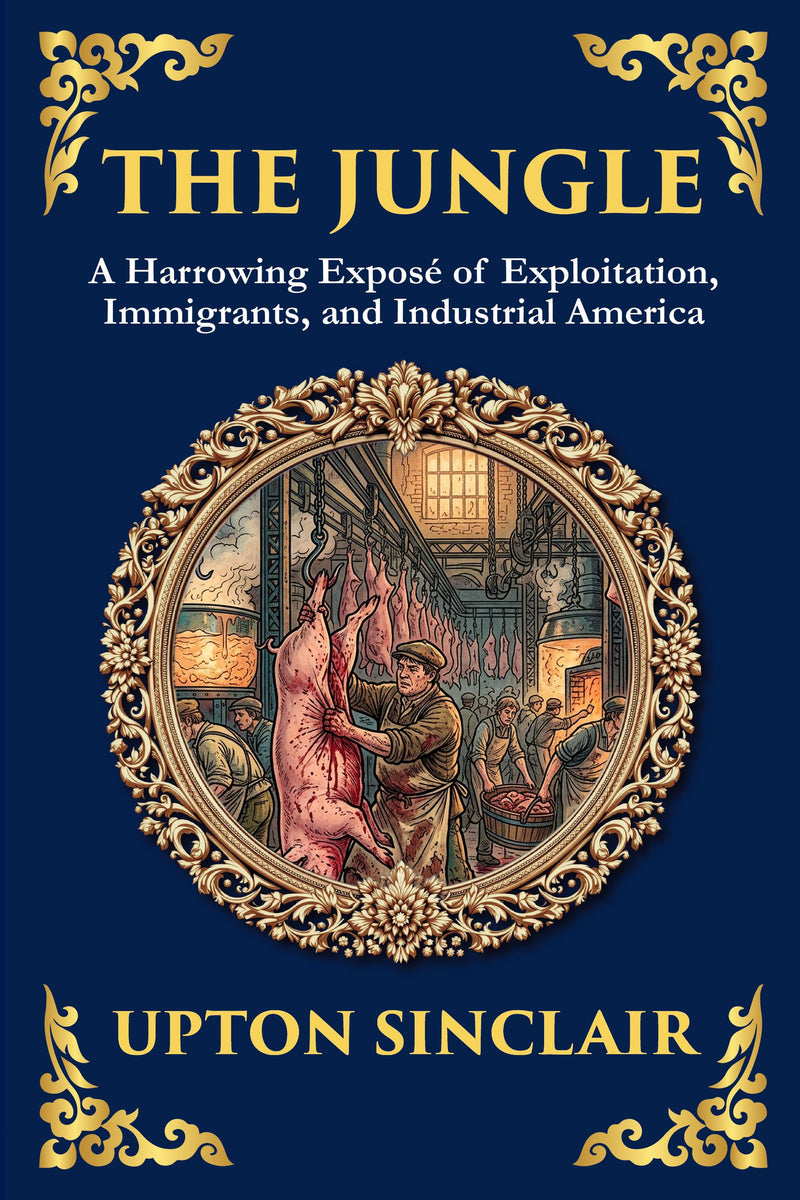
The Jungle
Step into the smoke-filled streets and filthy factories of early 20th-century Chicago, where dreams of a better life collide with the brutal realities of industrial capitalism.
or free app
10,000+ hrs library
30-day guarantee
The complete The Jungle appears in modern English through Library of Alexandria Press, available online with audiobook narration included for members.
Have you ever wondered why the American Dream can become a nightmare for those who seek it most? Upton Sinclair’s The Jungle is a searing masterpiece that pulls back the curtain on the hidden world of industrial America at the dawn of the 20th century. Combining gripping storytelling with relentless social critique, Sinclair gives readers an unflinching look at the lives of immigrants who came to America with hope—only to face unimaginable hardship.
The novel follows Jurgis Rudkus, a young Lithuanian immigrant determined to build a new life for his family. Upon arriving in Chicago, Jurgis encounters a city driven by factories, railroads, and slaughterhouses. At first, he believes that hard work will bring success, but as he witnesses the harsh realities of corruption, poverty, and exploitation, his dreams begin to unravel.
The meatpacking industry—grimy, dangerous, and rife with corruption—serves as the backdrop for Jurgis’s descent into despair and his eventual awakening to the need for collective action. Sinclair’s vivid descriptions not only expose the horrors of contaminated food and unsafe labor conditions but also highlight the broader social injustices at the heart of America’s rapid industrial growth.
What you’ll discover in this modern edition
- The Immigrant Experience – Follow Jurgis and his family as they struggle to survive in a new land filled with both promise and peril.
- The Shocking Truth About Industrialization – Explore Sinclair’s harrowing depictions of the meatpacking industry and its impact on workers and consumers alike.
- Themes of Corruption and Reform – Witness how greed and unchecked power destroy lives while sparking movements for justice and change.
- A Story of Despair and Hope – Journey through Jurgis’s darkest moments and his eventual discovery of solidarity and purpose.
- A Timeless Call for Social Justice – Understand why this novel still resonates today as a critique of inequality and systemic oppression.
| Formats | eBook (EPUB + PDF) · Audiobook · Paperback · Hardcover · Large Print |
| Language | English |
| Trim size (print) | 6 × 9 in |
| Binding | Paperback — perfect-bound · Hardcover — casewrap |
| Large Print edition | Same text in a larger, easy-read type — a larger font, not a larger trim |
| Print pricing | Every physical book at our true cost — at-cost, no profit (members) |
| Library | 873 restored titles, always growing |
| Length | 136,898 words · ~9 hr 8 min reading |
| Reading level | Grade 6 · an easy, flowing read (this modern-English edition) |
| Edition | Modern English translation · 2026 |
Member reviews for this edition are collected as readers finish it — be the first. Across the library: 12,000+ books shipped, every plan covered by a 365-day print guarantee.
About this edition
A faithful, unabridged modern-English edition by The Library of Alexandria — carefully rendered for today's reader and verified paragraph-by-paragraph against the public-domain source. Available as eBook, audiobook, paperback, hardcover, and large print.
- Complete & unabridgedVerified paragraph by paragraph against the source — never a scan, never abridged.
- Modern English, faithfulReadable today, with the author’s meaning kept intact. Readable — not simplified.
- Every format, one membershipRead in your browser or the free app, or listen to the full audiobook.
Included free with your membership
Cancel anytime, one click · 30-day money-back guarantee
Edition last updated July 2026
What’s inside
The Jungle — complete and unabridged: all 32 sections included with membership, plus the full audiobook.
Begin reading The Jungle
In clear modern English — the complete text is included with membership.
Introduction
There are books that entertain us, books that instruct us, and books that change the course of a nation. Every so often, a novel arrives that does all three at once, and in doing so refuses to remain confined to the page. It spills out into the streets, into the halls of government, into the conscience of an entire people. The work you are about to read belongs to that rare and remarkable category. Published in 1906 by a young, ferociously idealistic writer named Upton Sinclair, it landed in the heart of American life with the force of a thunderclap. Readers wept. Politicians scrambled. Industries trembled. And within months, the laws of a great nation had been rewritten. Few novels in the history of literature can claim such a direct and immediate impact on the world that produced them.
Yet to think of this book merely as a piece of legislation-in-disguise is to miss the deeper truth of what Sinclair accomplished. Beneath the muckraking, beneath the exposé, beneath the political fury, there beats the heart of a profoundly human story. It is the story of people who came to a new land carrying nothing but their hopes and their willingness to work, who believed in the promise that effort and honesty would be rewarded, and who discovered instead a vast and pitiless machine designed to grind them into dust. It is a story about dreams and the price of dreams, about dignity and the assault upon it, about the human spirit’s astonishing capacity to endure even when everything conspires to break it. This is why the book has survived long after the specific scandals it exposed have faded into history. Reforms can be legislated. The human condition cannot be legislated away.
This edition has been prepared as a modern translation, carefully adapted for the contemporary reader. Before we go further, it is worth explaining what that means and why it matters. Sinclair wrote in the idiom of his time—the early twentieth century—and while his prose was always direct and urgent, it carried with it the rhythms, vocabulary, and assumptions of a world more than a century removed from our own. Certain phrases have aged into obscurity. Certain references that every reader of 1906 would have grasped instantly now require explanation. The goal of this adaptation is not to dilute the power of the original, nor to sand away its sharp edges, but to ensure that nothing stands between you and the raw emotional and moral force of the narrative. The intent has been to preserve the spirit, the intensity, and the unflinching honesty of Sinclair’s vision while making the journey through his pages as immediate and gripping for you as it was for his first readers. The fire remains; only the obscuring smoke has been cleared away.
To understand this novel, it helps to understand the extraordinary young man who wrote it. Upton Sinclair was twenty-seven years old when the book was published, and he was already a writer of fierce conviction and tireless energy. Born in Baltimore in 1878 into a family of declining fortunes—his father struggled with drink, and the household oscillated uneasily between genteel poverty and the borrowed comforts of wealthier relatives—Sinclair grew up acutely aware of the gulf between the haves and the have-nots. This early experience of inequality, observed from both sides of the divide, would shape his entire life and work. He understood, in a way that more comfortably situated writers could not, how thin the line was between security and ruin, and how easily a family could tumble from one to the other.
Sinclair was a precociously gifted student and a voracious reader. He paid his way through college by churning out cheap fiction—dime novels, adventure stories, jokes, and serialized tales—writing at a furious pace that would have exhausted most men. But he hungered for something more meaningful than the formulaic entertainment he produced to survive. He wanted his writing to matter, to do good in the world, to expose injustice and move readers to action. He had absorbed the socialist ideas that were sweeping through intellectual circles of the era, and he came to believe that literature could be a weapon in the struggle for a fairer society.
The opportunity to wield that weapon came when a socialist newspaper commissioned him to investigate the conditions of workers in the great industrial centers of America. Sinclair chose to focus on the stockyards and meatpacking plants of Chicago, then the beating, bloody heart of American industry. To research the book, he did something remarkable for a writer of his time: he went and lived among the people he wanted to write about. For seven weeks in the autumn of 1904, he immersed himself in the world of the packing district. He wandered through the factories in his shabby workingman’s clothes, carrying a lunch pail to blend in. He talked to laborers, to their families, to settlement workers, to doctors, to lawyers, to anyone who could tell him the truth of how things really were. He saw the kill floors and the rendering rooms with his own eyes. He sat in the cramped tenements where entire families lived in single rooms. He listened, and he remembered, and he wrote it all down.
What emerged from this immersion was not journalism in the dry, detached sense, but something far more powerful: a work of fiction grounded so deeply in observed reality that it carried the unanswerable authority of witnessed truth. Sinclair understood instinctively that statistics and reports, however damning, would never move the public the way a story could. People do not weep over numbers. They weep over characters they have come to love. And so he built his exposé not as an argument but as a narrative, embodying the vast, abstract forces of industrial exploitation in the flesh and blood of human beings whose hopes and sufferings the reader would come to feel as if they were his own.
The phrase “muckraker” entered the American vocabulary around this time, used to describe the crusading journalists and writers who dug into the filth of corruption and injustice to expose it to public view. Sinclair was perhaps the most famous of them all, and this book became the most celebrated and consequential work of the entire muckraking movement. He went on to write more than ninety books over a long and astonishingly productive career, winning the Pulitzer Prize late in life and even running for governor of California on a platform to end poverty. But nothing he ever wrote again matched the seismic impact of this early masterpiece. It defined him, and it defined an era.
There is a famous and rather wry observation that Sinclair himself made about the reception of his book. He had written it to awaken the public to the plight of the workers—the human beings being destroyed by the system. But the public, reading his vivid descriptions of the unsanitary and adulterated processes by which their food was produced, reacted with horror not primarily for the workers, but for their own dinner tables. “I aimed at the public’s heart,” he later said, “and by accident I hit it in the stomach.” There is genuine disappointment in that remark, but also, perhaps, a recognition that any awakening is better than none. The book changed the world, even if it changed it in a direction slightly different from the one its author intended.
A World Transformed and a Story That Endures
The America in which this novel is set was a nation in the throes of a vast and violent transformation. The closing decades of the nineteenth century and the opening years of the twentieth saw the United States surge into the front rank of industrial powers. Railroads stitched the continent together. Factories rose like dark fortresses in the cities. Fortunes of almost incomprehensible size were amassed by a small handful of men who controlled the great trusts and monopolies—the giants of steel, oil, railroads, and meatpacking. It was an age of dazzling progress and breathtaking wealth, but it was also an age of staggering inequality and brutal exploitation.
Fueling this engine of industry was an immense tide of human labor, much of it supplied by immigrants. They came by the millions, pouring out of Europe—from Ireland, Italy, Poland, Lithuania, Russia, and a dozen other nations—drawn across the ocean by the irresistible promise of America. They had heard that here a man could work and prosper, that here the streets were paved with opportunity, that here a family could build a life free from the oppressions of the old world. They arrived with little more than the clothes on their backs and a desperate, shining hope in their hearts. And they were fed into the machine.
The conditions they encountered are difficult for the modern reader to fully comprehend. There were no laws protecting workers from being maimed by dangerous machinery, and no compensation when they were. There was no minimum wage, no limit on the hours a person could be forced to labor, no protection against being fired the moment one’s strength gave out. Children worked alongside adults in conditions of appalling danger. Wages were kept deliberately low, often barely enough to survive, and a single illness, injury, or stretch of unemployment could plunge an entire family into catastrophe. The workers had almost no power. If they complained, they were replaced. If they tried to organize, they were crushed. They were, in the cold calculus of the system, simply another raw material to be consumed and discarded.
It was into this world that Sinclair plunged his characters, and it is into this world that you, the reader, are about to descend. The Chicago stockyards he depicts were a genuine wonder of the age, an industrial marvel that processed the nation’s meat on a scale never before imagined. Visitors came from around the world to tour the facilities and marvel at their efficiency. But beneath the gleaming surface of progress lay a reality of unimaginable squalor, danger, and human suffering. Sinclair pulls back the curtain on that reality with an unflinching gaze. He shows us the men who labored on the killing floors, the women who toiled in the canning rooms, the families packed into rotting tenements, the corruption that infected every level of the system from the lowliest foreman to the highest political offices. He shows us a world in which everything—labor, justice, dignity, even truth itself—is for sale to the highest bidder.
And yet, for all its specificity to a particular time and place, the novel speaks with undiminished power to our own age. The names of the industries may have changed, but the questions it raises remain hauntingly relevant. What do we owe to the people whose labor sustains our comfort? What is the true cost of the things we consume, and who pays that cost? How do societies allow the exploitation of the vulnerable to continue in plain sight? What happens to the human soul when it is treated as nothing more than a unit of production? These are not questions of 1906. They are questions of every age, including our own. When you read of the workers in these pages, you may find yourself thinking of the unseen hands that produce the goods filling your own home, of the global supply chains that stretch across continents, of the persistent gap between those who labor and those who profit. The novel holds up a mirror, and the reflection it shows is uncomfortably familiar.
What ultimately elevates this book above mere propaganda or period exposé is the depth of its humanity. Sinclair never lets us forget that the people he writes about are not abstractions, not statistics, not symbols, but living, breathing human beings with families they love and dreams they cherish. We come to know them intimately. We share their early hopes and small joys—the simple pleasures of a family gathered together, the pride of honest work, the dream of a home of their own. And then we watch, with mounting dread and sorrow, as the great machine begins to grind them down. It is a testament to Sinclair’s skill as a storyteller that we feel each blow as if it had fallen upon ourselves. The book is, in the end, a profound meditation on the resilience of the human spirit and on the conditions under which even the strongest spirit can be broken.
Cancel anytime, one click · 30-day money-back guarantee
Founding annual rate available now — your price locks for life when you join.
Not ready? Get this free chapter by email — read it anytime.
✓ Sent — check your inbox for The Jungle.
Questions about The Jungle
What is The Jungle about?
Step into the smoke-filled streets and filthy factories of early 20th-century Chicago, where dreams of a better life collide with the brutal realities of industrial capitalism. In The Jungle, Upton Sinclair tells the unforgettable story of Jurgis Rudkus, a Lithuanian immigrant who arrives in America seeking freedom and prosperity. Instead, he and his family are thrust into a nightmarish world of grueling labor, crushing poverty, corruption, and heartbreak.
Who wrote The Jungle?
The Jungle was written by Upton Sinclair. This edition presents the complete work in clear modern English, faithfully rendered from the public-domain original by Library of Alexandria Press.
Is The Jungle free to read?
The opening chapter is free to read on this page. Members read and listen to the complete work — and the entire library — free, and can order any physical book at our true print cost.
How long is The Jungle?
32 chapters (~136,898 words) — about 9 hr 8 min of reading in this modern-English edition.
Is this an abridged version of The Jungle?
No. This is the complete, unabridged The Jungle, carefully rendered into clear modern English and verified paragraph-by-paragraph against the public-domain source — nothing is cut or summarised.
What formats does The Jungle come in?
The Jungle is available as eBook, paperback, hardcover and large print. eBook and audiobook are included with membership; printed editions ship at our true print cost.
Shipping & returns
Billing & membership
More from the library


Explore Classic & Literary
- Dream Psychology: Psychoanalysis for Beginners · Sigmund Freud
- Great Expectations · Charles Dickens
- The Brothers Karamazov · Fyodor Dostoyevsky
- The Great Gatsby · F. Scott Fitzgerald
- Wild Flowers Worth Knowing · Neltje Blanchan
- Italian Hours · Henry James
- A Popular History of France from the Earliest Times, Volume 5 · François Guizot
- A history of English literature: A practical text-book · Edward Albert
- Italian Highways and Byways from a Motor Car · M. F. Mansfield
- The Heart-Cry of Jesus · Byron J. Rees
- Castes and Tribes of Southern India. Vol. 6 of 7 · Edgar Thurston
- Against the Grain · J.-K. Huysmans
- Dombey and Son · Charles Dickens
- How to Invest Money · George Garr Henry
- The Great Controversy Between Christ and Satan · Ellen Gould Harmon White
- One Hundred Proofs That the Earth Is Not a Globe · William Carpenter
- Southern Literature From 1579–1895 · Louise Manly
- The Renaissance: Studies in Art and Poetry · Walter Pater
- Mark Twain’s Speeches · Mark Twain
- Tacitus on Germany · Cornelius Tacitus
- The Rosary · Florence L. Barclay
- Peculiarities of American Cities · Willard W. Glazier
- Tennis for Girls · Florence A. Ballin
- The World’s Greatest Books — Volume 02 — Fiction
- Shirley · Charlotte Brontë
- Daisy Miller: A Study · Henry James
- Louis Lambert · Honoré de Balzac
- Historic Jamaica · Frank Cundall
- The Gambler · Fyodor Dostoyevsky
- The Mayor of Casterbridge · Thomas Hardy
The Jungle
The Jungle
A Harrowing Exposé of Exploitation, Immigrants, and Industrial America
Upton Sinclair
Contents
- Introduction
- Chapter 1
- Chapter 2
- Chapter 3
- Chapter 4
- Chapter 5
- Chapter 6
- Chapter 7
- Chapter 8
- Chapter 9
- Chapter 10
- Chapter 11
- Chapter 12
- Chapter 13
- Chapter 14
- Chapter 15
- Chapter 16
- Chapter 17
- Chapter 18
- Chapter 19
- Chapter 20
- Chapter 21
- Chapter 22
- Chapter 23
- Chapter 24
- Chapter 25
- Chapter 26
- Chapter 27
- Chapter 28
- Chapter 29
- Chapter 30
- Chapter 31
Introduction
There are books that entertain us, books that instruct us, and books that change the course of a nation. Every so often, a novel arrives that does all three at once, and in doing so refuses to remain confined to the page. It spills out into the streets, into the halls of government, into the conscience of an entire people. The work you are about to read belongs to that rare and remarkable category. Published in 1906 by a young, ferociously idealistic writer named Upton Sinclair, it landed in the heart of American life with the force of a thunderclap. Readers wept. Politicians scrambled. Industries trembled. And within months, the laws of a great nation had been rewritten. Few novels in the history of literature can claim such a direct and immediate impact on the world that produced them.
Yet to think of this book merely as a piece of legislation-in-disguise is to miss the deeper truth of what Sinclair accomplished. Beneath the muckraking, beneath the exposé, beneath the political fury, there beats the heart of a profoundly human story. It is the story of people who came to a new land carrying nothing but their hopes and their willingness to work, who believed in the promise that effort and honesty would be rewarded, and who discovered instead a vast and pitiless machine designed to grind them into dust. It is a story about dreams and the price of dreams, about dignity and the assault upon it, about the human spirit’s astonishing capacity to endure even when everything conspires to break it. This is why the book has survived long after the specific scandals it exposed have faded into history. Reforms can be legislated. The human condition cannot be legislated away.
This edition has been prepared as a modern translation, carefully adapted for the contemporary reader. Before we go further, it is worth explaining what that means and why it matters. Sinclair wrote in the idiom of his time—the early twentieth century—and while his prose was always direct and urgent, it carried with it the rhythms, vocabulary, and assumptions of a world more than a century removed from our own. Certain phrases have aged into obscurity. Certain references that every reader of 1906 would have grasped instantly now require explanation. The goal of this adaptation is not to dilute the power of the original, nor to sand away its sharp edges, but to ensure that nothing stands between you and the raw emotional and moral force of the narrative. The intent has been to preserve the spirit, the intensity, and the unflinching honesty of Sinclair’s vision while making the journey through his pages as immediate and gripping for you as it was for his first readers. The fire remains; only the obscuring smoke has been cleared away.
To understand this novel, it helps to understand the extraordinary young man who wrote it. Upton Sinclair was twenty-seven years old when the book was published, and he was already a writer of fierce conviction and tireless energy. Born in Baltimore in 1878 into a family of declining fortunes—his father struggled with drink, and the household oscillated uneasily between genteel poverty and the borrowed comforts of wealthier relatives—Sinclair grew up acutely aware of the gulf between the haves and the have-nots. This early experience of inequality, observed from both sides of the divide, would shape his entire life and work. He understood, in a way that more comfortably situated writers could not, how thin the line was between security and ruin, and how easily a family could tumble from one to the other.
Sinclair was a precociously gifted student and a voracious reader. He paid his way through college by churning out cheap fiction—dime novels, adventure stories, jokes, and serialized tales—writing at a furious pace that would have exhausted most men. But he hungered for something more meaningful than the formulaic entertainment he produced to survive. He wanted his writing to matter, to do good in the world, to expose injustice and move readers to action. He had absorbed the socialist ideas that were sweeping through intellectual circles of the era, and he came to believe that literature could be a weapon in the struggle for a fairer society.
The opportunity to wield that weapon came when a socialist newspaper commissioned him to investigate the conditions of workers in the great industrial centers of America. Sinclair chose to focus on the stockyards and meatpacking plants of Chicago, then the beating, bloody heart of American industry. To research the book, he did something remarkable for a writer of his time: he went and lived among the people he wanted to write about. For seven weeks in the autumn of 1904, he immersed himself in the world of the packing district. He wandered through the factories in his shabby workingman’s clothes, carrying a lunch pail to blend in. He talked to laborers, to their families, to settlement workers, to doctors, to lawyers, to anyone who could tell him the truth of how things really were. He saw the kill floors and the rendering rooms with his own eyes. He sat in the cramped tenements where entire families lived in single rooms. He listened, and he remembered, and he wrote it all down.
What emerged from this immersion was not journalism in the dry, detached sense, but something far more powerful: a work of fiction grounded so deeply in observed reality that it carried the unanswerable authority of witnessed truth. Sinclair understood instinctively that statistics and reports, however damning, would never move the public the way a story could. People do not weep over numbers. They weep over characters they have come to love. And so he built his exposé not as an argument but as a narrative, embodying the vast, abstract forces of industrial exploitation in the flesh and blood of human beings whose hopes and sufferings the reader would come to feel as if they were his own.
The phrase “muckraker” entered the American vocabulary around this time, used to describe the crusading journalists and writers who dug into the filth of corruption and injustice to expose it to public view. Sinclair was perhaps the most famous of them all, and this book became the most celebrated and consequential work of the entire muckraking movement. He went on to write more than ninety books over a long and astonishingly productive career, winning the Pulitzer Prize late in life and even running for governor of California on a platform to end poverty. But nothing he ever wrote again matched the seismic impact of this early masterpiece. It defined him, and it defined an era.
There is a famous and rather wry observation that Sinclair himself made about the reception of his book. He had written it to awaken the public to the plight of the workers—the human beings being destroyed by the system. But the public, reading his vivid descriptions of the unsanitary and adulterated processes by which their food was produced, reacted with horror not primarily for the workers, but for their own dinner tables. “I aimed at the public’s heart,” he later said, “and by accident I hit it in the stomach.” There is genuine disappointment in that remark, but also, perhaps, a recognition that any awakening is better than none. The book changed the world, even if it changed it in a direction slightly different from the one its author intended.
A World Transformed and a Story That Endures
The America in which this novel is set was a nation in the throes of a vast and violent transformation. The closing decades of the nineteenth century and the opening years of the twentieth saw the United States surge into the front rank of industrial powers. Railroads stitched the continent together. Factories rose like dark fortresses in the cities. Fortunes of almost incomprehensible size were amassed by a small handful of men who controlled the great trusts and monopolies—the giants of steel, oil, railroads, and meatpacking. It was an age of dazzling progress and breathtaking wealth, but it was also an age of staggering inequality and brutal exploitation.
Fueling this engine of industry was an immense tide of human labor, much of it supplied by immigrants. They came by the millions, pouring out of Europe—from Ireland, Italy, Poland, Lithuania, Russia, and a dozen other nations—drawn across the ocean by the irresistible promise of America. They had heard that here a man could work and prosper, that here the streets were paved with opportunity, that here a family could build a life free from the oppressions of the old world. They arrived with little more than the clothes on their backs and a desperate, shining hope in their hearts. And they were fed into the machine.
The conditions they encountered are difficult for the modern reader to fully comprehend. There were no laws protecting workers from being maimed by dangerous machinery, and no compensation when they were. There was no minimum wage, no limit on the hours a person could be forced to labor, no protection against being fired the moment one’s strength gave out. Children worked alongside adults in conditions of appalling danger. Wages were kept deliberately low, often barely enough to survive, and a single illness, injury, or stretch of unemployment could plunge an entire family into catastrophe. The workers had almost no power. If they complained, they were replaced. If they tried to organize, they were crushed. They were, in the cold calculus of the system, simply another raw material to be consumed and discarded.
It was into this world that Sinclair plunged his characters, and it is into this world that you, the reader, are about to descend. The Chicago stockyards he depicts were a genuine wonder of the age, an industrial marvel that processed the nation’s meat on a scale never before imagined. Visitors came from around the world to tour the facilities and marvel at their efficiency. But beneath the gleaming surface of progress lay a reality of unimaginable squalor, danger, and human suffering. Sinclair pulls back the curtain on that reality with an unflinching gaze. He shows us the men who labored on the killing floors, the women who toiled in the canning rooms, the families packed into rotting tenements, the corruption that infected every level of the system from the lowliest foreman to the highest political offices. He shows us a world in which everything—labor, justice, dignity, even truth itself—is for sale to the highest bidder.
And yet, for all its specificity to a particular time and place, the novel speaks with undiminished power to our own age. The names of the industries may have changed, but the questions it raises remain hauntingly relevant. What do we owe to the people whose labor sustains our comfort? What is the true cost of the things we consume, and who pays that cost? How do societies allow the exploitation of the vulnerable to continue in plain sight? What happens to the human soul when it is treated as nothing more than a unit of production? These are not questions of 1906. They are questions of every age, including our own. When you read of the workers in these pages, you may find yourself thinking of the unseen hands that produce the goods filling your own home, of the global supply chains that stretch across continents, of the persistent gap between those who labor and those who profit. The novel holds up a mirror, and the reflection it shows is uncomfortably familiar.
What ultimately elevates this book above mere propaganda or period exposé is the depth of its humanity. Sinclair never lets us forget that the people he writes about are not abstractions, not statistics, not symbols, but living, breathing human beings with families they love and dreams they cherish. We come to know them intimately. We share their early hopes and small joys—the simple pleasures of a family gathered together, the pride of honest work, the dream of a home of their own. And then we watch, with mounting dread and sorrow, as the great machine begins to grind them down. It is a testament to Sinclair’s skill as a storyteller that we feel each blow as if it had fallen upon ourselves. The book is, in the end, a profound meditation on the resilience of the human spirit and on the conditions under which even the strongest spirit can be broken.
The ceremony ended at four o’clock, and the carriages began to arrive. A crowd had followed them the entire way, mostly because of Marija Berczynskas’s high energy. The success of the event rested entirely on Marija’s broad shoulders. It was her job to make sure everything was done properly and according to the best family traditions. She spent the day rushing wildly back and forth, knocking people out of her way, and shouting orders in her booming voice. Marija was so obsessed with making sure everyone else followed the rules of etiquette that she completely ignored them herself. She was the last to leave the church, and since she wanted to be the first to arrive at the hall, she ordered the driver to go faster. When the driver decided to push back, Marija leaned out the carriage window and told him exactly what she thought of him—first in Lithuanian, which he didn’t understand, and then in Polish, which he did. Because he was taller than her, the driver stood his ground and even tried to argue back. This led to a furious shouting match that lasted all the way down Ashland Avenue, attracting a growing swarm of street kids at every intersection for half a mile.
This was a problem, because a crowd had already gathered at the door. The music had started, and from half a block away, you could hear the dull thrum of a cello and the screeching of two violins competing to see who could play the most complex, high-pitched notes. Seeing the crowd, Marija abruptly stopped arguing about the driver’s ancestors, jumped from the moving carriage, and dove in to clear a path to the hall. Once inside, she turned around and began pushing people back, roaring, “Eik! Eik! Uzdaryk-duris!” in a voice that made the orchestral noise sound like a lullaby.
End of the free sample
Keep reading, free
Members read and listen to the complete book — and the entire library. Cancel anytime, one click · 30-day money-back guarantee.