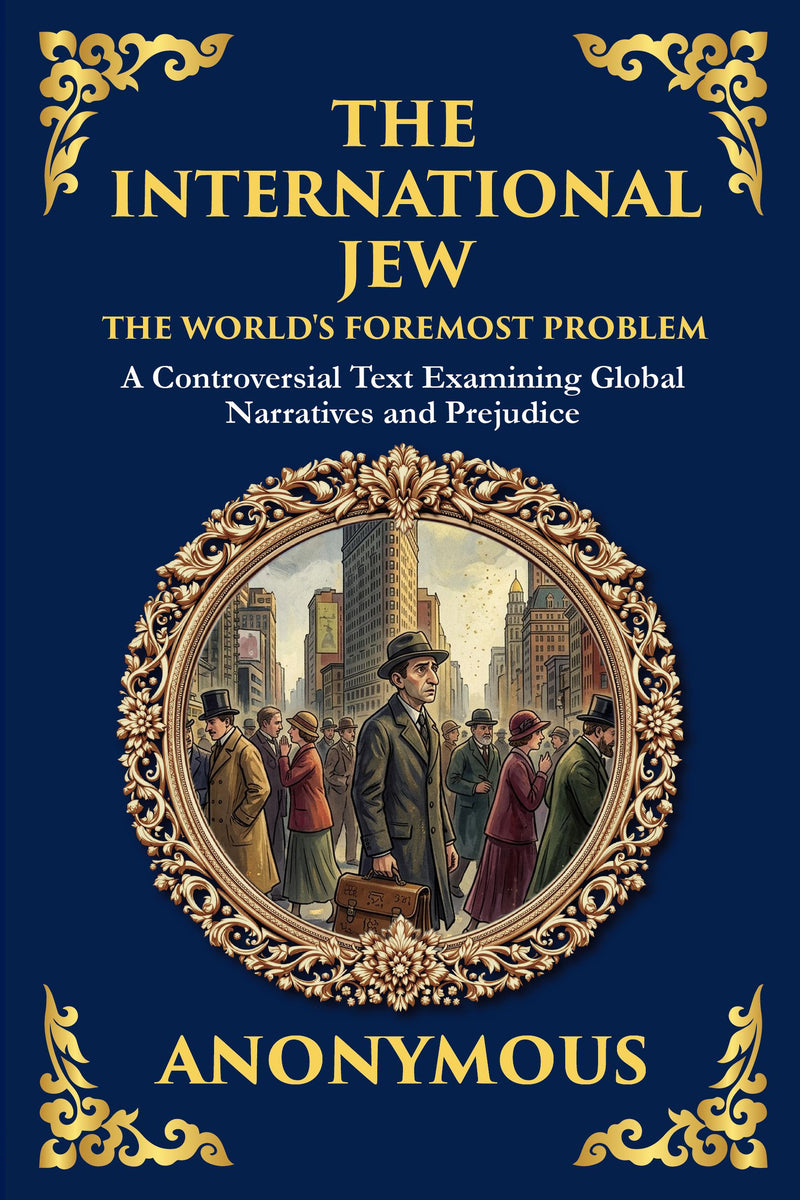
The International Jew: The World’s Foremost Problem — Large Print
Originally serialized in the early 1920s, The International Jew ignited intense debate across the globe. Presented as a critique of alleged global influences, this controversial collection of essays confronts deeply rooted cultural anxieties and conspiratorial narratives from a particular historical perspective.
or free app
10,000+ hrs library
30-day guarantee
The complete The International Jew: The World's appears in modern English through Library of Alexandria Press, available online with audiobook narration included for members.
Have you ever wondered why certain ideas endure despite overwhelming evidence to the contrary? The International Jew: The World's Foremost Problem is a compilation of articles that first appeared in The Dearborn Independent, a newspaper once owned by the American industrialist Henry Ford. The anonymous authorship lent the work a pseudo-objectivity that helped fuel widespread dissemination and controversy.
While the text has been widely discredited and denounced for promoting conspiracy theories and bigotry, it remains an essential reference point in the study of propaganda, xenophobia, and extremist ideology. This edition is presented in the spirit of historical transparency, allowing readers to examine and confront the ideas that shaped—and continue to influence—certain political and social undercurrents.
What you’ll discover in this modern edition
- A Notorious Series of Essays Explore the original articles that gave rise to a powerful and troubling narrative about global control and manipulation.
- Insight Into the Spread of Propaganda Understand how misinformation and pseudoscience were weaponized to stir fear and division.
- A Case Study in Media Influence Learn how mass publications can serve as vehicles for prejudice—and how their legacies echo through time.
- A Cautionary Tale of Unchecked Bias Reflect on the cultural, ethical, and political impact of texts that promote hatred under the guise of "truth-seeking."
| Formats | eBook (EPUB + PDF) · Audiobook · Paperback · Hardcover · Large Print |
| Language | English |
| Trim size (print) | 6 × 9 in |
| Binding | Paperback — perfect-bound · Hardcover — casewrap |
| Large Print edition | Same text in a larger, easy-read type — a larger font, not a larger trim |
| Print pricing | Every physical book at our true cost — at-cost, no profit (members) |
| Library | 873 restored titles, always growing |
| Length | 76,404 words · ~5 hr 6 min reading |
| Reading level | Grade 12 · a confident, adult read (this modern-English edition) |
| Edition | Modern English translation · 2026 |
Member reviews for this edition are collected as readers finish it — be the first. Across the library: 12,000+ books shipped, every plan covered by a 365-day print guarantee.
About this edition
A faithful, unabridged modern-English edition by The Library of Alexandria — carefully rendered for today's reader and verified paragraph-by-paragraph against the public-domain source. Available as eBook, audiobook, paperback, hardcover, and large print.
- Complete & unabridgedVerified paragraph by paragraph against the source — never a scan, never abridged.
- Modern English, faithfulReadable today, with the author’s meaning kept intact. Readable — not simplified.
- Every format, one membershipRead in your browser or the free app, or listen to the full audiobook.
Included free with your membership
Cancel anytime, one click · 30-day money-back guarantee
Edition last updated July 2026
What’s inside
The International Jew: The World’s Foremost Problem — Large Print — complete and unabridged: all 22 sections included with membership, plus the full audiobook.
Begin reading The International Jew: The World’s Foremost Problem — Large Print
In clear modern English — the complete text is included with membership.
Introduction
The book you are about to read is one of the most notorious and consequential documents of the early twentieth century. It is essential to state plainly, at the very outset, what kind of text this is and why it has been preserved, studied, and republished in critical editions: The International Jew is a work of antisemitic propaganda. It is a collection of articles that originally appeared in a newspaper owned by one of America’s most powerful industrialists, and it advanced false, defamatory, and dangerous claims about Jewish people. To read it today is not to encounter wisdom or hidden truth. It is to encounter, in unfiltered form, the machinery of a hatred that helped pave the road toward some of the darkest events in human history.
This modern edition is presented for study, historical understanding, and critical examination. It is offered to students, scholars, educators, and serious readers who wish to understand how prejudice is constructed, how conspiracy theories spread, and how a respectable institution can lend its name to ideas that would later be invoked to justify mass murder. It is not offered as an endorsement of a single sentence within it. The purpose of this introduction is to give you the tools—historical, intellectual, and moral—to read this material responsibly, to recognize its methods, and to inoculate yourself against the patterns of thought it represents. Reading a document like this requires a particular kind of vigilance, and the pages that follow are intended to prepare you for that work.
To understand this book, you must understand where it came from. In the years immediately following the First World War, the United States was a nation in turmoil. The war had ended, but its aftershocks were everywhere. Soldiers returned to a changed economy. Inflation soared. Labor strikes erupted across the country. The Russian Revolution of 1917 had toppled an empire and installed a Communist government, and a wave of fear about revolution—the so-called “Red Scare”—gripped the American imagination. Immigration had transformed American cities over the preceding decades, bringing millions of people from Southern and Eastern Europe, many of them Catholic or Jewish, into a country whose dominant culture had long been white and Protestant. Anxiety about change, about modernity, about who belonged and who did not, was thick in the air.
It was in this atmosphere that the articles collected here first appeared. They were published in a newspaper called The Dearborn Independent, which was owned by Henry Ford—the same Henry Ford who had revolutionized manufacturing with the assembly line and the Model T automobile, who was among the wealthiest and most admired men in the world, and whose name was synonymous with American ingenuity and progress. Ford was not a fringe figure. He was a national hero, a folk legend, a man whose opinions carried extraordinary weight precisely because he had achieved so much. When his newspaper began, in 1920, to publish a long series of articles claiming that a secret Jewish conspiracy lay behind the world’s problems, those articles reached an audience that no obscure pamphleteer could have hoped to command.
The series ran for many weeks and was later gathered into volumes and distributed widely, eventually reaching readers far beyond the United States. The articles were anonymous in their byline, though they emerged from Ford’s organization and reflected his obsessions; the authorship of the individual pieces has been attributed to writers working under his direction, and Ford himself bore ultimate responsibility for them. This is why the present edition lists the author as “Anonymous”—the text deliberately obscured the specific hands that wrote it, lending it a false aura of impersonal, institutional authority, as though it were simply reporting facts that any honest investigator would have discovered.
That aura was a deception. The central source on which much of this material drew was a forged document called The Protocols of the Elders of Zion, which purported to be the minutes of a secret meeting of Jewish leaders plotting to seize control of the world. The Protocols were a fabrication, cobbled together by agents of the Russian Tsar’s secret police in the early years of the twentieth century, partly plagiarized from an earlier French political satire that had nothing whatsoever to do with Jews. By the 1920s, the forgery had already been exposed in some quarters, and it would be definitively and publicly debunked in a famous series of investigations by the London Times in 1921 and in a later court case in Switzerland. Yet the lie continued to circulate, because lies of this kind do not survive on the strength of their evidence. They survive because they tell frightened, resentful people that their troubles are not random, not their own fault, and not the product of impersonal historical forces, but instead the work of a hidden enemy who can be named, blamed, and ultimately attacked.
This is the engine that drives the entire text you are about to read. Whatever its specific claims—and they range across finance, entertainment, politics, agriculture, and culture—the underlying structure is always the same. A problem is identified. The problem is then attributed, through insinuation, selective evidence, and outright invention, to a single group of people. The reader is invited to feel that they have been let in on a secret, that they now understand the true shape of the world while the unsuspecting masses remain deceived. This sense of secret knowledge is intoxicating, and it is precisely what makes conspiracy theories so durable and so dangerous.
If this book is so harmful, why read it at all? Why not let it disappear? These are reasonable questions, and they deserve a serious answer.
The first reason is historical. This text did not remain confined to the pages of an American newspaper. It was translated into many languages and distributed internationally during the 1920s and 1930s. In Germany, it found an eager readership among the rising National Socialist movement. Adolf Hitler kept a portrait of Henry Ford on his wall and praised him in Mein Kampf; the Nazi regime drew on the same conspiratorial myths that fill these pages. The ideas in this book were not abstract. They were part of the intellectual atmosphere that made the Holocaust thinkable—that allowed ordinary people, in their millions, to accept or participate in the systematic murder of six million Jewish men, women, and children. To understand how that catastrophe became possible, one must understand the lies that prepared the ground for it. This book is one of those lies, preserved in its original form. Studying it is part of how humanity keeps its promise never to forget.
The second reason is that the methods on display here have not disappeared. The specific target may have been Jewish people in 1920, but the techniques of scapegoating, of conspiratorial thinking, of dividing the world into a virtuous “us” and a malevolent, all-controlling “them,” are perennial. They reappear in every generation, aimed at different groups, dressed in different language, spread through different media. A reader who learns to recognize these techniques in their historical form will be far better equipped to recognize them when they surface again, whether in political speeches, in online forums, or in the rhetoric of demagogues. There is no better way to develop an immunity to propaganda than to examine a clear, well-documented specimen of it under controlled conditions, with full awareness of what it is.
So how should you read this text? With a particular set of habits firmly in mind.
Read it with constant skepticism toward its claims of evidence. Propaganda of this kind often adopts the tone and apparatus of serious journalism or scholarship. It cites figures, names institutions, references documents, and assumes an air of patient, fact-finding reasonableness. This is a deliberate strategy. The calm, authoritative voice is meant to disarm you, to make outrageous claims seem like the sober conclusions of an honest investigation. When you encounter such passages, ask yourself: What is the actual source? Is it verifiable? Does the conclusion follow from the evidence, or has the conclusion been decided in advance, with the “evidence” selected, distorted, or invented to support it? You will find, again and again, that the latter is the case.
Read it with attention to the logical structure of its arguments. A favorite device of conspiratorial thinking is the unfalsifiable claim—an assertion constructed so that no possible evidence could ever disprove it. If a group of people is wealthy, that proves they control the economy. If they are poor, that proves they are hiding their wealth. If they are visible in public life, that proves their dangerous influence. If they are absent, that proves they work in secret. If they assimilate into the broader culture, that proves they are infiltrating it; if they maintain their distinct traditions, that proves they refuse to belong. Notice how this works. Any fact can be made to fit the theory, because the theory was never based on facts in the first place. It was based on a prior decision about whom to blame. Watch for this pattern. Once you see it, you cannot unsee it, and it will protect you for the rest of your life.
Read it with an awareness of the human beings it slanders. The “International Jew” of this book’s title is not a real person. It is a phantom, a composite monster assembled from fear and prejudice. Real Jewish people—then as now—were and are simply people: families, workers, artists, scholars, parents, children, neighbors, citizens, individuals as varied in their virtues and flaws as any other group of human beings. The book’s central crime is that it takes this ordinary human diversity and replaces it with a malevolent caricature, then treats that caricature as though it were real. Every time the text speaks of “the Jew” as a unified, scheming agent, remember that it is describing something that does not exist, and that the cost of believing in this fiction was, ultimately, measured in millions of murdered lives.
Read it, finally, with moral clarity. This is not a “both sides” matter. The question of whether Jewish people were secretly controlling the world’s finance, governments, and culture is not a legitimate subject of debate with arguments to be weighed on either side. It is a lie, full stop, and a lie that did monstrous harm. Engaging critically with this text does not mean granting its premises a respectful hearing. It means examining how the lie was built, how it spread, and why it found an audience, so that we may better resist its descendants. The intellectual exercise of analysis must never slide into the moral confusion of false equivalence.
The Aftermath, the Adaptation, and the Reader's Responsibility
It is worth knowing how this story ended for the man whose name and fortune launched it. By the middle of the 1920s, Henry Ford faced mounting consequences for what his newspaper had published. A lawsuit brought by a Jewish lawyer and farm cooperative organizer, who had been personally defamed in the Independent, brought the matter into the courts and the headlines. Facing the prospect of testifying under oath and confronting the damage to his reputation and his business, Ford issued a public retraction and apology in 1927. He claimed, somewhat implausibly, that he had been unaware of the content published under his ownership, and he expressed regret for the harm done to Jewish people. The Dearborn Independent ceased publication that same year.
Whether Ford’s apology was sincere remains a matter of historical debate, and his later conduct gave critics ample reason for doubt. But the retraction is itself historically significant. It is an acknowledgment, by the very man most responsible for spreading this material, that the material was false and harmful. The author of these articles—or rather the owner who put his immense authority behind them—ultimately disavowed them. That fact should travel with the text wherever it goes. The book was repudiated by its own sponsor, even as it continued, tragically, to circulate and to do its damage in other countries and other decades, beyond the reach of any American apology.
Cancel anytime, one click · 30-day money-back guarantee
Founding annual rate available now — your price locks for life when you join.
Not ready? Get this free chapter by email — read it anytime.
✓ Sent — check your inbox for The International Jew: The World’s Foremost Problem — Large Print.
Questions about The International Jew: The World’s Foremost Problem — Large Print
What is The International Jew: The World's about?
Originally serialized in the early 1920s, The International Jew ignited intense debate across the globe. Presented as a critique of alleged global influences, this controversial collection of essays confronts deeply rooted cultural anxieties and conspiratorial narratives from a particular historical perspective. While condemned by many for promoting antisemitic ideology, the text remains an important document for those seeking to understand the roots and ramifications of prejudice, propaganda, and the dangerous man
Is The International Jew: The World's free to read?
The opening chapter is free to read on this page. Members read and listen to the complete work — and the entire library — free, and can order any physical book at our true print cost.
How long is The International Jew: The World's?
22 chapters (~76,404 words) — about 5 hr 6 min of reading in this modern-English edition.
Is this an abridged version of The International Jew: The World's?
No. This is the complete, unabridged The International Jew: The World's, carefully rendered into clear modern English and verified paragraph-by-paragraph against the public-domain source — nothing is cut or summarised.
What formats does The International Jew: The World's come in?
The International Jew: The World's is available as eBook, paperback, hardcover and large print. eBook and audiobook are included with membership; printed editions ship at our true print cost.
Shipping & returns
Billing & membership
More from the library


Explore Classic & Literary
- Dream Psychology: Psychoanalysis for Beginners · Sigmund Freud
- Great Expectations · Charles Dickens
- The Brothers Karamazov · Fyodor Dostoyevsky
- The Great Gatsby · F. Scott Fitzgerald
- Wild Flowers Worth Knowing · Neltje Blanchan
- Italian Hours · Henry James
- A Popular History of France from the Earliest Times, Volume 5 · François Guizot
- A history of English literature: A practical text-book · Edward Albert
- Italian Highways and Byways from a Motor Car · M. F. Mansfield
- The Heart-Cry of Jesus · Byron J. Rees
- Castes and Tribes of Southern India. Vol. 6 of 7 · Edgar Thurston
- Against the Grain · J.-K. Huysmans
- Dombey and Son · Charles Dickens
- How to Invest Money · George Garr Henry
- The Great Controversy Between Christ and Satan · Ellen Gould Harmon White
- One Hundred Proofs That the Earth Is Not a Globe · William Carpenter
- Southern Literature From 1579–1895 · Louise Manly
- The Renaissance: Studies in Art and Poetry · Walter Pater
- Mark Twain’s Speeches · Mark Twain
- Tacitus on Germany · Cornelius Tacitus
- The Rosary · Florence L. Barclay
- Peculiarities of American Cities · Willard W. Glazier
- Tennis for Girls · Florence A. Ballin
- The World’s Greatest Books — Volume 02 — Fiction
- Shirley · Charlotte Brontë
- Daisy Miller: A Study · Henry James
- Louis Lambert · Honoré de Balzac
- Historic Jamaica · Frank Cundall
- The Gambler · Fyodor Dostoyevsky
- The Mayor of Casterbridge · Thomas Hardy
The International Jew: The World’s Foremost Problem — Large Print
The International Jew: The World’s Foremost Problem — Large Print
A Controversial Text Examining Global Narratives and Prejudice
Anonymous
Contents
- Introduction
- Preface by the Author
- Chapter 1
- Chapter 2
- Chapter 3
- Chapter 4
- Chapter 5
- Chapter 6
- Chapter 7
- Chapter 8
- Chapter 9
- Chapter 10
- Chapter 11
- Chapter 12
- Chapter 13
- Chapter 14
- Chapter 15
- Chapter 16
- Chapter 17
- Chapter 18
- Chapter 19
- Chapter 20
Introduction
The book you are about to read is one of the most notorious and consequential documents of the early twentieth century. It is essential to state plainly, at the very outset, what kind of text this is and why it has been preserved, studied, and republished in critical editions: The International Jew is a work of antisemitic propaganda. It is a collection of articles that originally appeared in a newspaper owned by one of America’s most powerful industrialists, and it advanced false, defamatory, and dangerous claims about Jewish people. To read it today is not to encounter wisdom or hidden truth. It is to encounter, in unfiltered form, the machinery of a hatred that helped pave the road toward some of the darkest events in human history.
This modern edition is presented for study, historical understanding, and critical examination. It is offered to students, scholars, educators, and serious readers who wish to understand how prejudice is constructed, how conspiracy theories spread, and how a respectable institution can lend its name to ideas that would later be invoked to justify mass murder. It is not offered as an endorsement of a single sentence within it. The purpose of this introduction is to give you the tools—historical, intellectual, and moral—to read this material responsibly, to recognize its methods, and to inoculate yourself against the patterns of thought it represents. Reading a document like this requires a particular kind of vigilance, and the pages that follow are intended to prepare you for that work.
To understand this book, you must understand where it came from. In the years immediately following the First World War, the United States was a nation in turmoil. The war had ended, but its aftershocks were everywhere. Soldiers returned to a changed economy. Inflation soared. Labor strikes erupted across the country. The Russian Revolution of 1917 had toppled an empire and installed a Communist government, and a wave of fear about revolution—the so-called “Red Scare”—gripped the American imagination. Immigration had transformed American cities over the preceding decades, bringing millions of people from Southern and Eastern Europe, many of them Catholic or Jewish, into a country whose dominant culture had long been white and Protestant. Anxiety about change, about modernity, about who belonged and who did not, was thick in the air.
It was in this atmosphere that the articles collected here first appeared. They were published in a newspaper called The Dearborn Independent, which was owned by Henry Ford—the same Henry Ford who had revolutionized manufacturing with the assembly line and the Model T automobile, who was among the wealthiest and most admired men in the world, and whose name was synonymous with American ingenuity and progress. Ford was not a fringe figure. He was a national hero, a folk legend, a man whose opinions carried extraordinary weight precisely because he had achieved so much. When his newspaper began, in 1920, to publish a long series of articles claiming that a secret Jewish conspiracy lay behind the world’s problems, those articles reached an audience that no obscure pamphleteer could have hoped to command.
The series ran for many weeks and was later gathered into volumes and distributed widely, eventually reaching readers far beyond the United States. The articles were anonymous in their byline, though they emerged from Ford’s organization and reflected his obsessions; the authorship of the individual pieces has been attributed to writers working under his direction, and Ford himself bore ultimate responsibility for them. This is why the present edition lists the author as “Anonymous”—the text deliberately obscured the specific hands that wrote it, lending it a false aura of impersonal, institutional authority, as though it were simply reporting facts that any honest investigator would have discovered.
That aura was a deception. The central source on which much of this material drew was a forged document called The Protocols of the Elders of Zion, which purported to be the minutes of a secret meeting of Jewish leaders plotting to seize control of the world. The Protocols were a fabrication, cobbled together by agents of the Russian Tsar’s secret police in the early years of the twentieth century, partly plagiarized from an earlier French political satire that had nothing whatsoever to do with Jews. By the 1920s, the forgery had already been exposed in some quarters, and it would be definitively and publicly debunked in a famous series of investigations by the London Times in 1921 and in a later court case in Switzerland. Yet the lie continued to circulate, because lies of this kind do not survive on the strength of their evidence. They survive because they tell frightened, resentful people that their troubles are not random, not their own fault, and not the product of impersonal historical forces, but instead the work of a hidden enemy who can be named, blamed, and ultimately attacked.
This is the engine that drives the entire text you are about to read. Whatever its specific claims—and they range across finance, entertainment, politics, agriculture, and culture—the underlying structure is always the same. A problem is identified. The problem is then attributed, through insinuation, selective evidence, and outright invention, to a single group of people. The reader is invited to feel that they have been let in on a secret, that they now understand the true shape of the world while the unsuspecting masses remain deceived. This sense of secret knowledge is intoxicating, and it is precisely what makes conspiracy theories so durable and so dangerous.
If this book is so harmful, why read it at all? Why not let it disappear? These are reasonable questions, and they deserve a serious answer.
The first reason is historical. This text did not remain confined to the pages of an American newspaper. It was translated into many languages and distributed internationally during the 1920s and 1930s. In Germany, it found an eager readership among the rising National Socialist movement. Adolf Hitler kept a portrait of Henry Ford on his wall and praised him in Mein Kampf; the Nazi regime drew on the same conspiratorial myths that fill these pages. The ideas in this book were not abstract. They were part of the intellectual atmosphere that made the Holocaust thinkable—that allowed ordinary people, in their millions, to accept or participate in the systematic murder of six million Jewish men, women, and children. To understand how that catastrophe became possible, one must understand the lies that prepared the ground for it. This book is one of those lies, preserved in its original form. Studying it is part of how humanity keeps its promise never to forget.
The second reason is that the methods on display here have not disappeared. The specific target may have been Jewish people in 1920, but the techniques of scapegoating, of conspiratorial thinking, of dividing the world into a virtuous “us” and a malevolent, all-controlling “them,” are perennial. They reappear in every generation, aimed at different groups, dressed in different language, spread through different media. A reader who learns to recognize these techniques in their historical form will be far better equipped to recognize them when they surface again, whether in political speeches, in online forums, or in the rhetoric of demagogues. There is no better way to develop an immunity to propaganda than to examine a clear, well-documented specimen of it under controlled conditions, with full awareness of what it is.
So how should you read this text? With a particular set of habits firmly in mind.
Read it with constant skepticism toward its claims of evidence. Propaganda of this kind often adopts the tone and apparatus of serious journalism or scholarship. It cites figures, names institutions, references documents, and assumes an air of patient, fact-finding reasonableness. This is a deliberate strategy. The calm, authoritative voice is meant to disarm you, to make outrageous claims seem like the sober conclusions of an honest investigation. When you encounter such passages, ask yourself: What is the actual source? Is it verifiable? Does the conclusion follow from the evidence, or has the conclusion been decided in advance, with the “evidence” selected, distorted, or invented to support it? You will find, again and again, that the latter is the case.
Read it with attention to the logical structure of its arguments. A favorite device of conspiratorial thinking is the unfalsifiable claim—an assertion constructed so that no possible evidence could ever disprove it. If a group of people is wealthy, that proves they control the economy. If they are poor, that proves they are hiding their wealth. If they are visible in public life, that proves their dangerous influence. If they are absent, that proves they work in secret. If they assimilate into the broader culture, that proves they are infiltrating it; if they maintain their distinct traditions, that proves they refuse to belong. Notice how this works. Any fact can be made to fit the theory, because the theory was never based on facts in the first place. It was based on a prior decision about whom to blame. Watch for this pattern. Once you see it, you cannot unsee it, and it will protect you for the rest of your life.
Read it with an awareness of the human beings it slanders. The “International Jew” of this book’s title is not a real person. It is a phantom, a composite monster assembled from fear and prejudice. Real Jewish people—then as now—were and are simply people: families, workers, artists, scholars, parents, children, neighbors, citizens, individuals as varied in their virtues and flaws as any other group of human beings. The book’s central crime is that it takes this ordinary human diversity and replaces it with a malevolent caricature, then treats that caricature as though it were real. Every time the text speaks of “the Jew” as a unified, scheming agent, remember that it is describing something that does not exist, and that the cost of believing in this fiction was, ultimately, measured in millions of murdered lives.
Read it, finally, with moral clarity. This is not a “both sides” matter. The question of whether Jewish people were secretly controlling the world’s finance, governments, and culture is not a legitimate subject of debate with arguments to be weighed on either side. It is a lie, full stop, and a lie that did monstrous harm. Engaging critically with this text does not mean granting its premises a respectful hearing. It means examining how the lie was built, how it spread, and why it found an audience, so that we may better resist its descendants. The intellectual exercise of analysis must never slide into the moral confusion of false equivalence.
The Aftermath, the Adaptation, and the Reader's Responsibility
It is worth knowing how this story ended for the man whose name and fortune launched it. By the middle of the 1920s, Henry Ford faced mounting consequences for what his newspaper had published. A lawsuit brought by a Jewish lawyer and farm cooperative organizer, who had been personally defamed in the Independent, brought the matter into the courts and the headlines. Facing the prospect of testifying under oath and confronting the damage to his reputation and his business, Ford issued a public retraction and apology in 1927. He claimed, somewhat implausibly, that he had been unaware of the content published under his ownership, and he expressed regret for the harm done to Jewish people. The Dearborn Independent ceased publication that same year.
Whether Ford’s apology was sincere remains a matter of historical debate, and his later conduct gave critics ample reason for doubt. But the retraction is itself historically significant. It is an acknowledgment, by the very man most responsible for spreading this material, that the material was false and harmful. The author of these articles—or rather the owner who put his immense authority behind them—ultimately disavowed them. That fact should travel with the text wherever it goes. The book was repudiated by its own sponsor, even as it continued, tragically, to circulate and to do its damage in other countries and other decades, beyond the reach of any American apology.
People around the world are once again focusing their critical attention on the Jew. Since the war, his rise in financial, political, and social circles has been so complete and striking that his role, power, and goals are being closely examined, often with hostility. While persecution is nothing new for the Jew, this intense study of his nature and his status as a global citizen is. For over 2,000 years, he has suffered from what could be called the instinctive anti-Semitism of other races, but that hatred was never based on logic or explained clearly. Today, however, the Jew is being placed under an economic microscope so that the reasons for his power, his isolation, and his suffering can be clearly defined and understood.
In Russia, he is accused of being the source of Bolshevism—a charge that is seen as either serious or trivial depending on who is making it; those of us in America, hearing the passionate speeches and prophetic zeal of young Jewish advocates for social and industrial reform, can easily judge how true this might be. In Germany, he is blamed for the collapse of the Empire, and a large amount of writing has appeared providing circumstantial evidence that makes any thinker stop and consider. In England, he is accused of being the true ruler of the world, governing as a super-nation over all other nations through the power of money, playing countries against one another for his own gain while remaining quietly in the background. In America, people are pointing out how many wealthy older Jews and ambitious younger Jews filled the ranks of war organizations—especially those departments handling the commercial and industrial side of the war—and how they have held onto the advantages gained from their experience as government agents.
End of the free sample
Keep reading, free
Members read and listen to the complete book — and the entire library. Cancel anytime, one click · 30-day money-back guarantee.