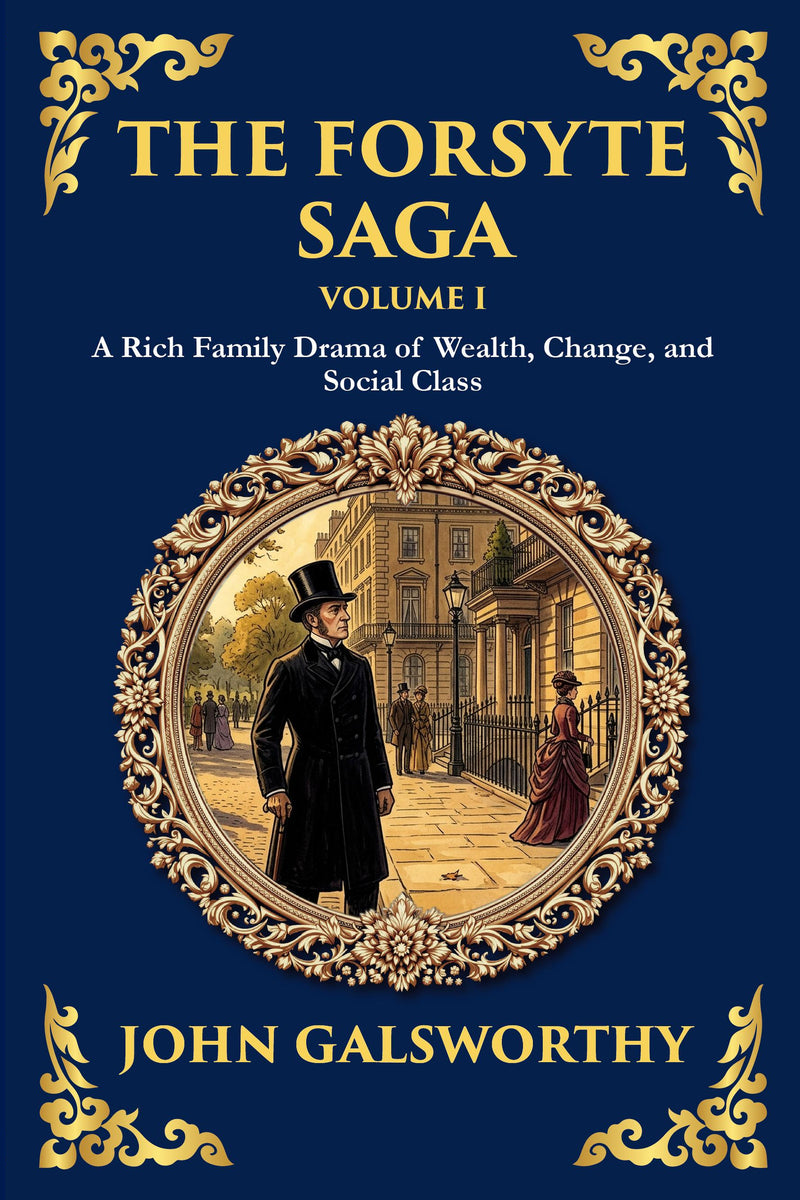
The Forsyte Saga, Volume 1
In an age of empire and elegance, the Forsytes stand as pillars of English upper-middle-class society—successful, respectable, and deeply entangled in their own illusions.
or free app
10,000+ hrs library
30-day guarantee
The complete The Forsyte Saga, Volume I appears in modern English through Library of Alexandria Press, available online with audiobook narration included for members.
Have you ever wondered why wealth can’t protect the heart from breaking? The Forsyte Saga, Volume I is the unforgettable beginning of John Galsworthy’s masterwork: a rich, immersive portrait of an English family caught between Victorian values and the oncoming tide of the modern world. Set in the late 19th century, this first volume—containing The Man of Property and Indian Summer of a Forsyte—chronicles the tensions that simmer beneath the surface of wealth and respectability.
At the heart of the story is Soames Forsyte, a solicitor obsessed with control, ownership, and his beautiful, distant wife, Irene. As his grip tightens, so does the cost—to love, dignity, and the family name. This modern edition brings new clarity to Galsworthy’s elegant prose, making the novel’s emotional resonance and biting social critique accessible to contemporary readers.
What you’ll discover in this modern edition
- A Gripping Tale of Passion and Power – Watch how one man’s desire to possess what cannot be owned destroys what he loves most.
- A Vivid Portrait of a Changing Era – Explore the crumbling certainties of the Victorian elite as new ideas of art, love, and freedom emerge.
- A Story of Women’s Resistance and Quiet Strength – Irene’s silence speaks louder than words in a world that denies her voice.
- A Literary Masterpiece That Sparked a Generation – Galsworthy’s legacy endures through his keen eye for hypocrisy and humanity.
- A Fully Updated and Accessible Edition – Carefully formatted for modern readers without losing the poetic nuance of Galsworthy’s original style.
| Formats | eBook (EPUB + PDF) · Audiobook · Paperback · Hardcover · Large Print |
| Language | English |
| Trim size (print) | 6 × 9 in |
| Binding | Paperback — perfect-bound · Hardcover — casewrap |
| Large Print edition | Same text in a larger, easy-read type — a larger font, not a larger trim |
| Print pricing | Every physical book at our true cost — at-cost, no profit (members) |
| Library | 873 restored titles, always growing |
| Length | 109,410 words · ~7 hr 18 min reading |
| Reading level | Grade 7 · an easy, flowing read (this modern-English edition) |
| Edition | Modern English translation · 2026 |
Member reviews for this edition are collected as readers finish it — be the first. Across the library: 12,000+ books shipped, every plan covered by a 365-day print guarantee.
About this edition
A faithful, unabridged modern-English edition by The Library of Alexandria — carefully rendered for today's reader and verified paragraph-by-paragraph against the public-domain source. Available as eBook, audiobook, paperback, hardcover, and large print.
- Complete & unabridgedVerified paragraph by paragraph against the source — never a scan, never abridged.
- Modern English, faithfulReadable today, with the author’s meaning kept intact. Readable — not simplified.
- Every format, one membershipRead in your browser or the free app, or listen to the full audiobook.
Included free with your membership
Cancel anytime, one click · 30-day money-back guarantee
Edition last updated July 2026
What’s inside
The Forsyte Saga, Volume 1 — complete and unabridged: all 20 sections included with membership, plus the full audiobook.
Begin reading The Forsyte Saga, Volume 1
In clear modern English — the complete text is included with membership.
Introduction
There are some books that capture a single moment in time so vividly that they become a kind of preserved amber, holding within them an entire world we might otherwise have lost. The Forsyte Saga is one of these rare achievements. When John Galsworthy first sat down to chronicle the lives of his fictional Forsyte family, he could hardly have imagined that he was creating one of the most enduring portraits of an entire social class in all of English literature. What began as a single novel grew, over years, into a sprawling chronicle of a family and its fortunes, and in doing so it captured the precise texture of a society at the very edge of transformation. This first volume invites you into that world, and what awaits you is a story that is at once intimate and panoramic, sharply observed and deeply humane.
The version you hold in your hands has been carefully adapted for the contemporary reader. This means that the sometimes dense and elaborate prose of the original Edwardian period has been thoughtfully modernized so that the rhythms of the language feel natural to a modern ear, while the essential character, wit, and emotional power of Galsworthy’s storytelling remain fully intact. The aim has been to remove the small obstacles of dated phrasing and overly ornate sentence construction that can sometimes stand between a reader and the heart of a great story, without ever sacrificing the depth, nuance, and beauty that made this work a classic in the first place. The result is a reading experience that flows smoothly, allowing you to become absorbed in the lives of the Forsytes without ever feeling that you must work to decode the prose. You will find here all the richness, all the irony, and all the quiet devastation that earned Galsworthy the Nobel Prize in Literature — but presented in a way that feels alive and accessible today.
To approach this book is to step into a particular England, one that was wealthy, confident, and utterly convinced of its own permanence, even as the ground was beginning to shift beneath its feet. The late Victorian and early Edwardian world that Galsworthy depicts was a society obsessed with property, propriety, and position. It was a world of solid houses and solid incomes, of family dinners conducted according to unspoken rules, of marriages arranged with an eye toward both affection and advantage, and of a deep, almost religious faith in the value of things one could own. The Forsytes are the perfect embodiment of this world. They are an upper-middle-class family who have risen, over the course of a generation or two, from modest origins to considerable comfort and even prosperity. They are solicitors and merchants, investors and collectors, men who understand the value of a pound and women who understand the value of a respectable appearance. And they are, in their own minds, the very pillars of a stable, sensible civilization.
What makes the Forsytes so fascinating, and what has made readers return to them again and again across more than a century, is the way Galsworthy renders them with such loving precision and such unflinching honesty. He does not flatter them, but neither does he condemn them. Instead, he understands them, and through that understanding he allows us to understand them too. The Forsytes possess what Galsworthy famously called the “sense of property” — an instinct so deeply ingrained that it shapes not only how they handle their money and their houses, but how they regard their wives, their children, their friends, and even beauty itself. To a Forsyte, the highest compliment is to find something worth owning, and the deepest anxiety is the fear of losing what one possesses. This instinct is not malicious. It is simply who they are, the product of their upbringing and their era. And yet, as the novel unfolds, we begin to see how this seemingly harmless trait can curdle into something colder and more troubling when it is applied to the things that should never be owned at all — namely, the hearts and freedoms of other human beings.
At the center of this story stands Soames Forsyte, one of the most memorable and complex characters in modern fiction. Soames is the embodiment of the Forsyte spirit taken to its logical conclusion. He is intelligent, capable, scrupulous in his dealings, and proud of his solidity. He is also a man whose entire understanding of the world is filtered through the language of ownership. When Soames looks at the things in his life, he sees assets — and tragically, this includes the people he loves. His relationship with his beautiful wife becomes the emotional engine of the entire narrative, and it is here that Galsworthy poses some of his most penetrating and uncomfortable questions. What does it mean to possess another person? Can love survive when it is mistaken for property? What happens when something — or someone — refuses to be owned? These questions ripple outward through the entire family and the entire story, and they remain as relevant and as provocative today as they were when Galsworthy first posed them.
Around Soames revolves an entire constellation of Forsytes, each rendered with such distinctness and such humanity that you will soon feel you know them as well as members of your own extended family. There are the elder Forsytes, the patriarchs and matriarchs of the clan, who watch over their descendants with a mixture of pride, concern, and proprietary interest. There is old Jolyon, perhaps the most sympathetic and quietly moving figure in the whole gallery, a man of business who nonetheless harbors a tender and even romantic heart, and whose growing awareness of the limitations of the Forsyte way of life provides some of the novel’s most affecting moments. There are the various aunts and uncles, cousins and in-laws, each with their own peculiarities and preoccupations, who together form a kind of chorus commenting on the central drama. And there is young Jolyon, the family member who has, in a sense, fallen away from the strict Forsyte code, and who therefore occupies a unique position as both insider and outsider, able to see his relatives with a clarity that they cannot achieve about themselves.
Galsworthy’s genius lies in the way he weaves these many lives together into a single, coherent tapestry. He moves effortlessly from the grand sweep of the family’s collective destiny to the smallest, most telling details of individual lives — a particular gesture, a turn of phrase, an item of furniture, a glance exchanged across a dinner table. He understands that character is revealed not only in great dramatic moments but in the accumulation of tiny choices and habits. The result is a portrait that feels astonishingly real, as though these people had actually lived and breathed and loved and quarreled. You will find yourself caring about them, worrying for them, becoming frustrated with them, and ultimately recognizing in them the same hopes and fears and contradictions that animate all human beings, regardless of their era or their wealth.
It is worth pausing to appreciate the historical moment that this story captures, because part of the pleasure of reading it lies in the awareness that we are witnessing a world on the cusp of profound change. The society of the Forsytes seemed, to those who lived within it, utterly secure and permanent. The British Empire was at the height of its power, money flowed freely among the propertied classes, and the established order of things appeared as fixed as the laws of nature. And yet, as we now know with the benefit of hindsight, this entire world was about to be swept away by the cataclysms of the twentieth century. Galsworthy, writing with one foot in the old world and one in the new, was acutely aware of this impending transformation. Throughout the narrative, there are intimations of change — new ideas about art and beauty, new attitudes toward marriage and personal freedom, new generations who would no longer be content to live by the rules of their elders. The tension between the old certainties and the emerging new world gives the entire story a poignant, elegiac quality. We are watching not only a family drama but the slow, dignified twilight of an entire way of life.
This sense of standing at a threshold between two eras is one of the things that makes the work feel so resonant for modern readers. We too live in a time of rapid and disorienting change, when the assumptions of one generation are constantly being questioned and overturned by the next. The Forsytes’ struggle to hold onto their world, their bewilderment in the face of forces they cannot fully understand, their stubborn insistence on the rightness of their own values even as those values are being challenged — all of this speaks directly to our own experience. There is something deeply moving about watching people cling to the things they believe in, even when we, as readers, can see that those things are passing away. Galsworthy treats this human tendency not with mockery but with a kind of tender sorrow, and that sorrow is one of the great emotional currents that runs beneath the surface of the entire narrative.
John Galsworthy was, in many ways, the ideal author to tell this story, because he wrote from within the very world he was depicting. Born into a prosperous upper-middle-class family himself, he understood the Forsytes from the inside out. He knew their houses and their habits, their pleasures and their anxieties, their unspoken assumptions about how life should be lived. And yet he also possessed the critical distance necessary to see his own class clearly, to perceive both its admirable qualities and its profound limitations. This combination of intimate knowledge and critical perspective is what gives his portrait its remarkable depth and balance. He is never a propagandist, never crudely attacking or defending the people he describes. Instead, he holds them up to the light and turns them slowly, allowing us to see them from every angle, in all their complexity and contradiction.
Galsworthy’s own life experiences fed directly into the emotional truth of this work. He knew the pressures of social conformity, the weight of family expectation, and the agonizing conflict that can arise when personal desire collides with social duty. He understood from personal experience the way that love can be complicated by questions of respectability and the way that society can punish those who dare to step outside its prescribed boundaries. This personal understanding infuses the central romantic conflicts of the story with an authenticity and an emotional power that could only have come from someone who had genuinely grappled with these dilemmas himself. When you read the most charged and painful scenes in this book, you are reading the work of a man who knew, in his own heart, what was at stake.
As a craftsman, Galsworthy possessed a particular gift for irony — not the cheap, sneering irony of the satirist, but a deep, structural irony that arises from the gap between how his characters see themselves and how they truly are. The Forsytes believe themselves to be reasonable, generous, and just. They believe that their pursuit of property is simply common sense, that their adherence to convention is simply good manners, that their treatment of the people around them is simply what is right and proper. And yet, again and again, Galsworthy gently and devastatingly reveals the ways in which their self-image fails to match reality. He does this without ever lecturing the reader or breaking the spell of the story. He simply shows us what happens, lets the characters speak and act, and trusts us to perceive the deeper truths that lie beneath the surface. This is the mark of a truly confident and accomplished storyteller, one who respects the intelligence of his readers and invites them to participate in the act of understanding.
Another of Galsworthy’s great strengths is his ability to render physical detail in a way that brings his world vividly to life. He has an extraordinary eye for the texture of upper-middle-class existence — the furnishings of a drawing room, the cut of a suit, the arrangement of a dinner table, the architecture of a house. These details are never mere decoration. They are charged with meaning, expressing the values, aspirations, and anxieties of the people who surround themselves with them. In Galsworthy’s world, the house a man builds, the paintings he buys, the way he furnishes his rooms — all of these are expressions of his soul, or sometimes of his soul’s emptiness. There is one storyline in this volume concerning the building of a house that becomes a profound meditation on the conflict between art and ownership, between the creative spirit and the possessive instinct, and it stands as one of the most beautifully realized sequences in all of Galsworthy’s work. Through such episodes, the author transforms the seemingly mundane materials of domestic life into vehicles for the deepest questions about how we should live.
Cancel anytime, one click · 30-day money-back guarantee
Founding annual rate available now — your price locks for life when you join.
Not ready? Get this free chapter by email — read it anytime.
✓ Sent — check your inbox for The Forsyte Saga, Volume 1.
Questions about The Forsyte Saga, Volume 1
What is The Forsyte Saga, Volume I about?
In an age of empire and elegance, the Forsytes stand as pillars of English upper-middle-class society—successful, respectable, and deeply entangled in their own illusions. In The Forsyte Saga, Volume I, Galsworthy introduces us to a family bound by tradition and pride, but fractured by love, desire, and the unstoppable winds of change. Through the powerful figure of Soames Forsyte—a man who views his wife as property—this story becomes not just a domestic drama, but a critique of materialism, marriage, and moral de
Who wrote The Forsyte Saga, Volume I?
The Forsyte Saga, Volume I was written by John Galsworthy. This edition presents the complete work in clear modern English, faithfully rendered from the public-domain original by Library of Alexandria Press.
Is The Forsyte Saga, Volume I free to read?
The opening chapter is free to read on this page. Members read and listen to the complete work — and the entire library — free, and can order any physical book at our true print cost.
How long is The Forsyte Saga, Volume I?
20 chapters (~109,410 words) — about 7 hr 18 min of reading in this modern-English edition.
Is this an abridged version of The Forsyte Saga, Volume I?
No. This is the complete, unabridged The Forsyte Saga, Volume I, carefully rendered into clear modern English and verified paragraph-by-paragraph against the public-domain source — nothing is cut or summarised.
What formats does The Forsyte Saga, Volume I come in?
The Forsyte Saga, Volume I is available as eBook, paperback, hardcover and large print. eBook and audiobook are included with membership; printed editions ship at our true print cost.
Shipping & returns
Billing & membership
More from the library


Explore Classic & Literary
- Dream Psychology: Psychoanalysis for Beginners · Sigmund Freud
- Great Expectations · Charles Dickens
- The Brothers Karamazov · Fyodor Dostoyevsky
- The Great Gatsby · F. Scott Fitzgerald
- Wild Flowers Worth Knowing · Neltje Blanchan
- Italian Hours · Henry James
- A Popular History of France from the Earliest Times, Volume 5 · François Guizot
- A history of English literature: A practical text-book · Edward Albert
- Italian Highways and Byways from a Motor Car · M. F. Mansfield
- The Heart-Cry of Jesus · Byron J. Rees
- Castes and Tribes of Southern India. Vol. 6 of 7 · Edgar Thurston
- Against the Grain · J.-K. Huysmans
- Dombey and Son · Charles Dickens
- How to Invest Money · George Garr Henry
- The Great Controversy Between Christ and Satan · Ellen Gould Harmon White
- One Hundred Proofs That the Earth Is Not a Globe · William Carpenter
- Southern Literature From 1579–1895 · Louise Manly
- The Renaissance: Studies in Art and Poetry · Walter Pater
- Mark Twain’s Speeches · Mark Twain
- Tacitus on Germany · Cornelius Tacitus
- The Rosary · Florence L. Barclay
- Peculiarities of American Cities · Willard W. Glazier
- Tennis for Girls · Florence A. Ballin
- The World’s Greatest Books — Volume 02 — Fiction
- Shirley · Charlotte Brontë
- Daisy Miller: A Study · Henry James
- Louis Lambert · Honoré de Balzac
- Historic Jamaica · Frank Cundall
- The Gambler · Fyodor Dostoyevsky
- The Mayor of Casterbridge · Thomas Hardy
The Forsyte Saga, Volume 1
The Forsyte Saga, Volume 1
A Rich Family Drama of Wealth, Change, and Social Class
John Galsworthy
Contents
- Introduction
- Preface by the Author
- The Man of Property
- Part 1
- Chapter 1
- Chapter 2
- Chapter 3
- Chapter 4
- Chapter 5
- Chapter 6
- Chapter 7
- Chapter 8
- Chapter 9
- Part 2
- Chapter 10
- Chapter 11
- Chapter 12
- Chapter 13
- Chapter 14
- Part 3
Introduction
There are some books that capture a single moment in time so vividly that they become a kind of preserved amber, holding within them an entire world we might otherwise have lost. The Forsyte Saga is one of these rare achievements. When John Galsworthy first sat down to chronicle the lives of his fictional Forsyte family, he could hardly have imagined that he was creating one of the most enduring portraits of an entire social class in all of English literature. What began as a single novel grew, over years, into a sprawling chronicle of a family and its fortunes, and in doing so it captured the precise texture of a society at the very edge of transformation. This first volume invites you into that world, and what awaits you is a story that is at once intimate and panoramic, sharply observed and deeply humane.
The version you hold in your hands has been carefully adapted for the contemporary reader. This means that the sometimes dense and elaborate prose of the original Edwardian period has been thoughtfully modernized so that the rhythms of the language feel natural to a modern ear, while the essential character, wit, and emotional power of Galsworthy’s storytelling remain fully intact. The aim has been to remove the small obstacles of dated phrasing and overly ornate sentence construction that can sometimes stand between a reader and the heart of a great story, without ever sacrificing the depth, nuance, and beauty that made this work a classic in the first place. The result is a reading experience that flows smoothly, allowing you to become absorbed in the lives of the Forsytes without ever feeling that you must work to decode the prose. You will find here all the richness, all the irony, and all the quiet devastation that earned Galsworthy the Nobel Prize in Literature — but presented in a way that feels alive and accessible today.
To approach this book is to step into a particular England, one that was wealthy, confident, and utterly convinced of its own permanence, even as the ground was beginning to shift beneath its feet. The late Victorian and early Edwardian world that Galsworthy depicts was a society obsessed with property, propriety, and position. It was a world of solid houses and solid incomes, of family dinners conducted according to unspoken rules, of marriages arranged with an eye toward both affection and advantage, and of a deep, almost religious faith in the value of things one could own. The Forsytes are the perfect embodiment of this world. They are an upper-middle-class family who have risen, over the course of a generation or two, from modest origins to considerable comfort and even prosperity. They are solicitors and merchants, investors and collectors, men who understand the value of a pound and women who understand the value of a respectable appearance. And they are, in their own minds, the very pillars of a stable, sensible civilization.
What makes the Forsytes so fascinating, and what has made readers return to them again and again across more than a century, is the way Galsworthy renders them with such loving precision and such unflinching honesty. He does not flatter them, but neither does he condemn them. Instead, he understands them, and through that understanding he allows us to understand them too. The Forsytes possess what Galsworthy famously called the “sense of property” — an instinct so deeply ingrained that it shapes not only how they handle their money and their houses, but how they regard their wives, their children, their friends, and even beauty itself. To a Forsyte, the highest compliment is to find something worth owning, and the deepest anxiety is the fear of losing what one possesses. This instinct is not malicious. It is simply who they are, the product of their upbringing and their era. And yet, as the novel unfolds, we begin to see how this seemingly harmless trait can curdle into something colder and more troubling when it is applied to the things that should never be owned at all — namely, the hearts and freedoms of other human beings.
At the center of this story stands Soames Forsyte, one of the most memorable and complex characters in modern fiction. Soames is the embodiment of the Forsyte spirit taken to its logical conclusion. He is intelligent, capable, scrupulous in his dealings, and proud of his solidity. He is also a man whose entire understanding of the world is filtered through the language of ownership. When Soames looks at the things in his life, he sees assets — and tragically, this includes the people he loves. His relationship with his beautiful wife becomes the emotional engine of the entire narrative, and it is here that Galsworthy poses some of his most penetrating and uncomfortable questions. What does it mean to possess another person? Can love survive when it is mistaken for property? What happens when something — or someone — refuses to be owned? These questions ripple outward through the entire family and the entire story, and they remain as relevant and as provocative today as they were when Galsworthy first posed them.
Around Soames revolves an entire constellation of Forsytes, each rendered with such distinctness and such humanity that you will soon feel you know them as well as members of your own extended family. There are the elder Forsytes, the patriarchs and matriarchs of the clan, who watch over their descendants with a mixture of pride, concern, and proprietary interest. There is old Jolyon, perhaps the most sympathetic and quietly moving figure in the whole gallery, a man of business who nonetheless harbors a tender and even romantic heart, and whose growing awareness of the limitations of the Forsyte way of life provides some of the novel’s most affecting moments. There are the various aunts and uncles, cousins and in-laws, each with their own peculiarities and preoccupations, who together form a kind of chorus commenting on the central drama. And there is young Jolyon, the family member who has, in a sense, fallen away from the strict Forsyte code, and who therefore occupies a unique position as both insider and outsider, able to see his relatives with a clarity that they cannot achieve about themselves.
Galsworthy’s genius lies in the way he weaves these many lives together into a single, coherent tapestry. He moves effortlessly from the grand sweep of the family’s collective destiny to the smallest, most telling details of individual lives — a particular gesture, a turn of phrase, an item of furniture, a glance exchanged across a dinner table. He understands that character is revealed not only in great dramatic moments but in the accumulation of tiny choices and habits. The result is a portrait that feels astonishingly real, as though these people had actually lived and breathed and loved and quarreled. You will find yourself caring about them, worrying for them, becoming frustrated with them, and ultimately recognizing in them the same hopes and fears and contradictions that animate all human beings, regardless of their era or their wealth.
It is worth pausing to appreciate the historical moment that this story captures, because part of the pleasure of reading it lies in the awareness that we are witnessing a world on the cusp of profound change. The society of the Forsytes seemed, to those who lived within it, utterly secure and permanent. The British Empire was at the height of its power, money flowed freely among the propertied classes, and the established order of things appeared as fixed as the laws of nature. And yet, as we now know with the benefit of hindsight, this entire world was about to be swept away by the cataclysms of the twentieth century. Galsworthy, writing with one foot in the old world and one in the new, was acutely aware of this impending transformation. Throughout the narrative, there are intimations of change — new ideas about art and beauty, new attitudes toward marriage and personal freedom, new generations who would no longer be content to live by the rules of their elders. The tension between the old certainties and the emerging new world gives the entire story a poignant, elegiac quality. We are watching not only a family drama but the slow, dignified twilight of an entire way of life.
This sense of standing at a threshold between two eras is one of the things that makes the work feel so resonant for modern readers. We too live in a time of rapid and disorienting change, when the assumptions of one generation are constantly being questioned and overturned by the next. The Forsytes’ struggle to hold onto their world, their bewilderment in the face of forces they cannot fully understand, their stubborn insistence on the rightness of their own values even as those values are being challenged — all of this speaks directly to our own experience. There is something deeply moving about watching people cling to the things they believe in, even when we, as readers, can see that those things are passing away. Galsworthy treats this human tendency not with mockery but with a kind of tender sorrow, and that sorrow is one of the great emotional currents that runs beneath the surface of the entire narrative.
John Galsworthy was, in many ways, the ideal author to tell this story, because he wrote from within the very world he was depicting. Born into a prosperous upper-middle-class family himself, he understood the Forsytes from the inside out. He knew their houses and their habits, their pleasures and their anxieties, their unspoken assumptions about how life should be lived. And yet he also possessed the critical distance necessary to see his own class clearly, to perceive both its admirable qualities and its profound limitations. This combination of intimate knowledge and critical perspective is what gives his portrait its remarkable depth and balance. He is never a propagandist, never crudely attacking or defending the people he describes. Instead, he holds them up to the light and turns them slowly, allowing us to see them from every angle, in all their complexity and contradiction.
Galsworthy’s own life experiences fed directly into the emotional truth of this work. He knew the pressures of social conformity, the weight of family expectation, and the agonizing conflict that can arise when personal desire collides with social duty. He understood from personal experience the way that love can be complicated by questions of respectability and the way that society can punish those who dare to step outside its prescribed boundaries. This personal understanding infuses the central romantic conflicts of the story with an authenticity and an emotional power that could only have come from someone who had genuinely grappled with these dilemmas himself. When you read the most charged and painful scenes in this book, you are reading the work of a man who knew, in his own heart, what was at stake.
As a craftsman, Galsworthy possessed a particular gift for irony — not the cheap, sneering irony of the satirist, but a deep, structural irony that arises from the gap between how his characters see themselves and how they truly are. The Forsytes believe themselves to be reasonable, generous, and just. They believe that their pursuit of property is simply common sense, that their adherence to convention is simply good manners, that their treatment of the people around them is simply what is right and proper. And yet, again and again, Galsworthy gently and devastatingly reveals the ways in which their self-image fails to match reality. He does this without ever lecturing the reader or breaking the spell of the story. He simply shows us what happens, lets the characters speak and act, and trusts us to perceive the deeper truths that lie beneath the surface. This is the mark of a truly confident and accomplished storyteller, one who respects the intelligence of his readers and invites them to participate in the act of understanding.
Another of Galsworthy’s great strengths is his ability to render physical detail in a way that brings his world vividly to life. He has an extraordinary eye for the texture of upper-middle-class existence — the furnishings of a drawing room, the cut of a suit, the arrangement of a dinner table, the architecture of a house. These details are never mere decoration. They are charged with meaning, expressing the values, aspirations, and anxieties of the people who surround themselves with them. In Galsworthy’s world, the house a man builds, the paintings he buys, the way he furnishes his rooms — all of these are expressions of his soul, or sometimes of his soul’s emptiness. There is one storyline in this volume concerning the building of a house that becomes a profound meditation on the conflict between art and ownership, between the creative spirit and the possessive instinct, and it stands as one of the most beautifully realized sequences in all of Galsworthy’s work. Through such episodes, the author transforms the seemingly mundane materials of domestic life into vehicles for the deepest questions about how we should live.
Anyone lucky enough to attend a Forsyte family gathering has seen that charming and revealing sight: an upper-middle-class family in all its glory. But those among them with a knack for psychological analysis—a skill that has no monetary value and is therefore ignored by the Forsytes—have seen something more. They have witnessed a scene that is not only entertaining but also illustrates a hidden human problem. To put it simply, by watching this family—where no branch actually liked the others and no three members shared any real sympathy—one can see the mysterious, stubborn bond that makes a family such a powerful social unit and a perfect miniature version of society itself. Such an observer gains a glimpse into the slow evolution of social progress, the nature of patriarchal life, the movement of ancient tribes, and the rise and fall of nations. It is like watching a tree grow from a seedling—a model of persistence and success that survives while a hundred weaker plants die around it—until one day it stands in overwhelming prosperity, fully grown and flourishing.
Around four in the afternoon on June 15, 1886, anyone visiting old Jolyon Forsyte’s house at Stanhope Gate would have seen the Forsyte family at the peak of their prestige.
The family was holding a party to celebrate the engagement of old Jolyon’s granddaughter, June Forsyte, to Mr. Philip Bosinney. Everyone was dressed to impress in light gloves, buff waistcoats, feathers, and fancy dresses. Even Aunt Ann attended, though she rarely left the corner of her brother Timothy’s green drawing room. Usually, she spent her days reading and knitting under a plume of dyed pampas grass in a light blue vase, surrounded by portraits of three generations of Forsytes. Even Aunt Ann was there; her stiff back and the dignity of her calm, aged face embodied the family’s rigid sense of ownership.
End of the free sample
Keep reading, free
Members read and listen to the complete book — and the entire library. Cancel anytime, one click · 30-day money-back guarantee.