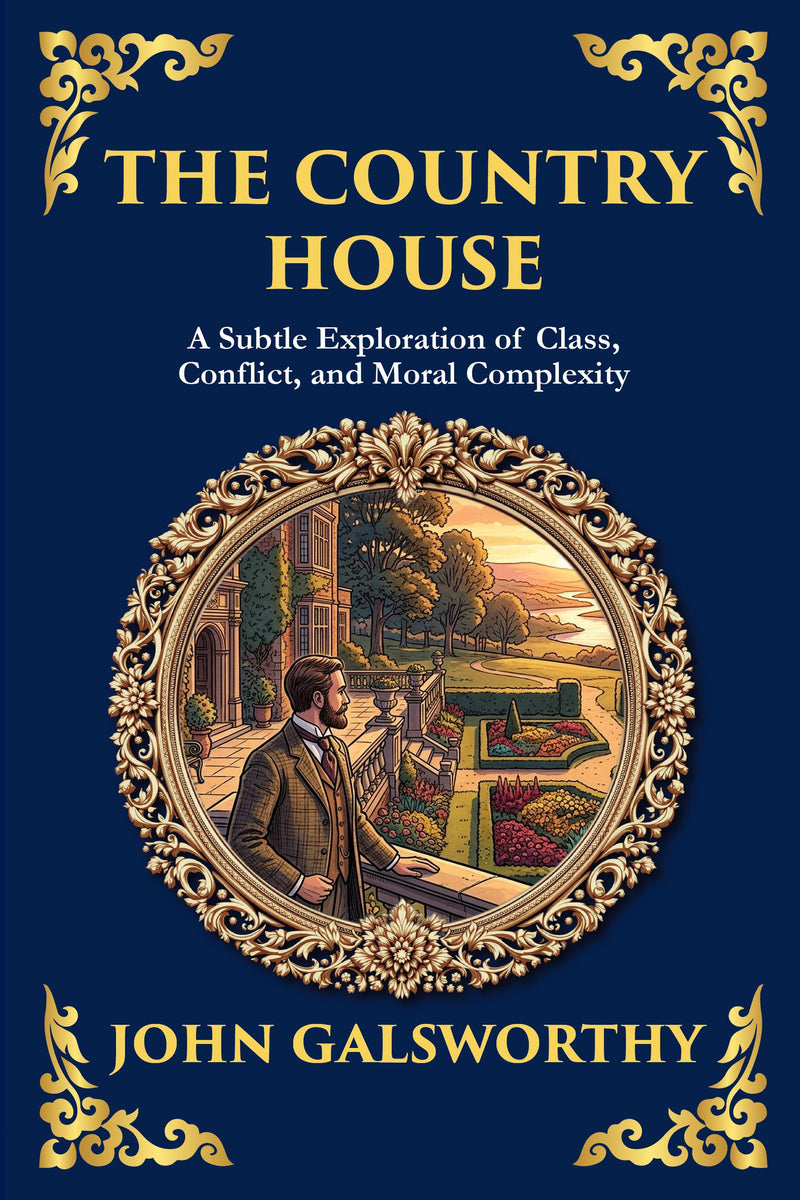
The Country House
In a world cloaked in civility and class, what happens when tradition collides with truth? In The Country House, Nobel Prize-winning author John Galsworthy unveils a world of quiet elegance and buried tensions.
or free app
10,000+ hrs library
30-day guarantee
The complete The Country House appears in modern English through Library of Alexandria Press, available online with audiobook narration included for members.
Have you ever wondered why silence can speak louder than scandal? In The Country House, John Galsworthy delivers a masterful and quietly powerful examination of class, family honor, and moral ambiguity. Set against the backdrop of rural England’s genteel estates, the story centers on the Darrant family, whose sense of social standing is threatened by an ugly public lawsuit involving a family connection.
The scandal shakes their foundations—not because of what was done, but because of what must now be seen. As the case unfolds, the characters are drawn into a conflict between preserving their good name and acknowledging uncomfortable truths. Through the character of Mr.
Horace Pendyce, a country gentleman steeped in tradition, Galsworthy offers a poignant meditation on personal integrity, generational change, and the limits of social propriety.
What you’ll discover in this modern edition
- A Subtle Exposé of Upper-Class Morality Galsworthy peels back the facade of polite society to reveal the tensions beneath its surface.
| Formats | eBook (EPUB + PDF) · Audiobook · Paperback · Hardcover · Large Print |
| Language | English |
| Trim size (print) | 6 × 9 in |
| Binding | Paperback — perfect-bound · Hardcover — casewrap |
| Large Print edition | Same text in a larger, easy-read type — a larger font, not a larger trim |
| Print pricing | Every physical book at our true cost — at-cost, no profit (members) |
| Library | 873 restored titles, always growing |
| Length | 79,041 words · ~5 hr 16 min reading |
| Reading level | Grade 7 · an easy, flowing read (this modern-English edition) |
| Edition | Modern English translation · 2026 |
Member reviews for this edition are collected as readers finish it — be the first. Across the library: 12,000+ books shipped, every plan covered by a 365-day print guarantee.
About this edition
A faithful, unabridged modern-English edition by The Library of Alexandria — carefully rendered for today's reader and verified paragraph-by-paragraph against the public-domain source. Available as eBook, audiobook, paperback, hardcover, and large print.
- Complete & unabridgedVerified paragraph by paragraph against the source — never a scan, never abridged.
- Modern English, faithfulReadable today, with the author’s meaning kept intact. Readable — not simplified.
- Every format, one membershipRead in your browser or the free app, or listen to the full audiobook.
Included free with your membership
Cancel anytime, one click · 30-day money-back guarantee
Edition last updated July 2026
What’s inside
The Country House — complete and unabridged: all 16 sections included with membership, plus the full audiobook.
Begin reading The Country House
In clear modern English — the complete text is included with membership.
Introduction
There is a particular kind of pleasure in opening a novel that knows exactly what it is doing—one that moves with the quiet confidence of a writer who has studied his subject so closely that he can render it with both affection and merciless precision. John Galsworthy’s The Country House, first published in 1907, is such a book. It is a portrait of a vanishing world, painted at the very moment that world was beginning to sense, however dimly, its own impermanence. To read it now, more than a century after its first appearance, is to be granted a kind of double vision: we see the people of the English country house as they saw themselves, and we see them as Galsworthy invited his contemporaries to see them—with sympathy, with irony, and with a moral seriousness that never tips into preaching.
This edition has been prepared as a modern translation, adapted for the contemporary reader. That phrase deserves a moment of explanation, because it might suggest something more drastic than what has actually taken place. Galsworthy wrote in elegant, supple English, but it was the English of the Edwardian drawing room, dense at times with the idioms, social shorthand, and rhetorical rhythms of a society that took its assumptions for granted. The aim of this adaptation is not to flatten that voice or to strip away its period flavor, but to clear away the small obstructions that can stand between a present-day reader and the living heart of the story. Where a phrase has grown opaque with age, where a reference has faded into obscurity, where a sentence has folded in on itself in a way that obscures rather than reveals, gentle adjustments have been made. The intention throughout has been to honor Galsworthy’s intelligence and his music while ensuring that nothing distracts you from the deeper currents he set in motion. What remains is the essential book: its characters, its conflicts, its long, patient gaze upon the comfortable cruelties of respectable life.
To understand why The Country House matters, it helps to know something of the man who wrote it and the world he was anatomizing. John Galsworthy was born in 1867 into precisely the class he would spend his career observing—the prosperous, propertied upper-middle class of late Victorian England. His family had made its money in property and law; he himself was educated at Harrow and Oxford, called to the bar, and equipped by birth and training to step seamlessly into the role of a comfortable English gentleman. He had, in other words, every reason to accept the values of his caste without question. Many men of his background did exactly that, living out their lives in untroubled enjoyment of the privileges they had inherited.
Galsworthy did something rarer. He turned and looked at his own people with a clear and unflinching eye. This is the quality that gives his fiction its peculiar authority. He was not an outsider hurling stones at a world he did not understand, nor a bitter exile settling scores. He was a man writing from within, who knew the country house from the inside out—its rituals, its silences, its unspoken codes, its way of mistaking comfort for virtue and convention for morality. When he criticized, he criticized with the precision of intimate knowledge, and when he sympathized, he sympathized because he genuinely understood how the trap had been built and how difficult it was to step outside it.
A pivotal experience in his life sharpened this vision. In his twenties and thirties, Galsworthy fell in love with Ada Cooper, the wife of one of his cousins—a woman trapped in an unhappy marriage from which the conventions of the time offered no graceful escape. Their long, secret relationship, conducted under the constant threat of scandal, gave Galsworthy a personal and painful education in the ways that respectable society could imprison the human spirit beneath a polished surface of propriety. He learned firsthand how the machinery of class, marriage, and reputation could grind down individual happiness in the name of keeping up appearances. That knowledge runs like an underground river beneath all his best work, and it surfaces with particular force in The Country House.
Galsworthy is best remembered today as the author of The Forsyte Saga, that sprawling chronicle of a prosperous English family across several generations, which brought him enormous popular success and, eventually, the Nobel Prize for Literature in 1932. The Country House belongs to the same imaginative territory and was written in the same productive period that produced the first Forsyte novels. Indeed, readers who know and love the Forsytes will recognize in this book the same preoccupations, the same sharp social observation, the same gift for revealing an entire moral universe through the smallest of domestic details. If The Forsyte Saga is the grand symphony, The Country House is a tightly constructed chamber piece—more concentrated, more focused, and in some ways more searching, precisely because its scope is narrower and its gaze more intense.
It is worth remembering, too, when this book was written. The Edwardian era was a golden afternoon for the English upper classes, a period of apparent stability and confidence that masked enormous strains beneath the surface. The old certainties of land, lineage, and inherited authority were already being challenged by new money, new ideas, and new social pressures. Within a decade of this novel’s publication, the catastrophe of the First World War would shatter that world forever, sweeping away an entire way of life along with a generation of young men. Galsworthy could not have known what was coming, but he sensed, with the antennae of a true artist, that something was wrong at the foundations—that the magnificent edifice of English respectability rested upon assumptions that could no longer bear close scrutiny. Reading the novel now, with the knowledge of what lay just ahead, lends its quiet drama an almost elegiac quality. We are watching a world that does not yet know it is ending.
What makes Galsworthy so rewarding for the modern reader is that his critique never hardens into caricature. He had the dramatist’s instinct—he was, after all, also a successful playwright—for giving every character their due, for understanding that even the most exasperating people act according to a logic that makes sense to them. He does not invite us to despise his subjects. He invites us to understand them, and in understanding them, to recognize something of ourselves. The tribal loyalties, the fear of change, the substitution of social form for genuine feeling, the small daily compromises by which people surrender their better selves to the demands of conformity—these are not faults confined to Edwardian England. They are human faults, and Galsworthy’s great achievement is to make us see them with fresh eyes.
At the center of The Country House stands the institution named in its title—not merely a building, but a whole way of life, a system of values, a self-contained universe with its own laws and its own gods. The English country house was far more than a residence. It was the physical embodiment of an entire social order: a place where land conferred status, where family name carried weight, where the rituals of hospitality and the rhythms of the seasons organized human existence into comfortable, predictable patterns. To belong to such a house was to belong to a tradition that stretched back across generations and that claimed, implicitly, to stretch forward indefinitely into the future.
Galsworthy understood the seductive power of this world. He renders its pleasures with genuine appreciation: the well-ordered estate, the loyalty of long service, the sense of continuity and rootedness, the easy intimacy of a family that has shared the same rooms and the same routines for decades. There is real beauty here, and the author does not pretend otherwise. But he also understood the price that such order exacts—the way that the demand for continuity can become a tyranny over the living, the way that respect for tradition can curdle into a fear of anything new or unsettling, the way that the smooth surface of gentility can conceal an iron rigidity beneath.
The drama of the novel emerges from precisely this tension. Into the settled world of the country house comes the disruptive force of individual feeling—of desire, of conscience, of the human heart’s stubborn refusal to be governed entirely by social convention. What happens when a member of this charmed circle wants something that the rules of the circle forbid? What happens when private longing collides with public expectation, when the demands of love or principle run counter to the demands of property and reputation? These are the questions that animate the book, and Galsworthy explores them with extraordinary subtlety. He is interested not in melodrama but in the quieter, more insidious forms of conflict—the battle of wills conducted in polite conversation, the war waged through silence and disapproval, the slow attrition by which a family closes ranks against a threat to its order.
The genius of the novel lies in how much it accomplishes through indirection. Galsworthy was a master of implication, of the meaningful pause and the loaded gesture. Much of the most important action takes place beneath the surface of the dialogue, in the gap between what characters say and what they actually mean, between the masks they present and the feelings they conceal. To read this book attentively is to become a kind of detective of human behavior, learning to notice the small signs—a hesitation, an averted glance, an excessive insistence on some trivial point—that betray the turbulence beneath the calm. This is a novel that rewards patience and close attention, and the modern reader who slows down to savor its texture will find it richer with every page.
The characters who populate this world are drawn with remarkable economy and precision. There are those who embody the values of the country house so completely that they cannot imagine any other way of living—who genuinely believe that the preservation of their order is synonymous with virtue itself, and who therefore experience any challenge to that order as a kind of moral outrage. There are those caught uneasily between worlds, who feel the pull of older loyalties even as they sense their inadequacy. And there are those who, whether by temperament or circumstance, find themselves on the outside, looking in at a system that excludes or constrains them. Galsworthy moves among these figures with a sympathy that does not preclude judgment and a judgment that never loses its sympathy. He shows us how decent people can do unkind things, how good intentions can produce cruel results, how the very loyalty and devotion that make a family admirable can also make it merciless when its sense of self is threatened.
The “moral complexity” promised in this book’s subtitle is no idle phrase. Galsworthy refuses the easy comforts of clear villains and obvious heroes. The people who do harm in this story are not monsters; they are men and women acting according to principles they sincerely hold, principles that have been honored by their society for generations. This is what makes their behavior so much more troubling—and so much more illuminating—than any simple villainy could be. We watch, with a kind of fascinated dismay, as characters convince themselves that selfishness is duty, that cruelty is necessity, that the suppression of another person’s happiness is somehow required by honor and decency. And because Galsworthy has made us understand these characters from within, we cannot simply condemn them. We are forced, instead, to ask uncomfortable questions about our own assumptions, our own loyalties, the unexamined codes by which we ourselves might be living.
The theme of class runs through every page, but again, Galsworthy handles it with characteristic subtlety. He is not writing a political tract or a manifesto. He is interested in class as a lived reality, as a force that shapes the way people see one another, that determines who is visible and who is invisible, who matters and who does not. The novel is acutely aware of the human beings who exist at the margins of the country house world—the servants, the dependents, the social inferiors whose labor and deference make the whole system possible but who are scarcely acknowledged as full persons by those they serve. Galsworthy notices these people, and in noticing them, he asks us to notice them too. He shows how the comfortable assumptions of the propertied class depend upon a vast apparatus of human service that those who benefit from it prefer not to examine too closely.
Cancel anytime, one click · 30-day money-back guarantee
Founding annual rate available now — your price locks for life when you join.
Not ready? Get this free chapter by email — read it anytime.
✓ Sent — check your inbox for The Country House.
Questions about The Country House
What is The Country House about?
In a world cloaked in civility and class, what happens when tradition collides with truth? In The Country House, Nobel Prize-winning author John Galsworthy unveils a world of quiet elegance and buried tensions. Behind the manicured hedgerows and polished drawing rooms of English society lies a web of conflict—between progress and preservation, duty and desire, appearances and authenticity.
Who wrote The Country House?
The Country House was written by John Galsworthy. This edition presents the complete work in clear modern English, faithfully rendered from the public-domain original by Library of Alexandria Press.
Is The Country House free to read?
The opening chapter is free to read on this page. Members read and listen to the complete work — and the entire library — free, and can order any physical book at our true print cost.
How long is The Country House?
16 chapters (~79,041 words) — about 5 hr 16 min of reading in this modern-English edition.
Is this an abridged version of The Country House?
No. This is the complete, unabridged The Country House, carefully rendered into clear modern English and verified paragraph-by-paragraph against the public-domain source — nothing is cut or summarised.
What formats does The Country House come in?
The Country House is available as eBook, paperback, hardcover and large print. eBook and audiobook are included with membership; printed editions ship at our true print cost.
Shipping & returns
Billing & membership
More from the library


Explore Classic & Literary
- Dream Psychology: Psychoanalysis for Beginners · Sigmund Freud
- Great Expectations · Charles Dickens
- The Brothers Karamazov · Fyodor Dostoyevsky
- The Great Gatsby · F. Scott Fitzgerald
- Wild Flowers Worth Knowing · Neltje Blanchan
- Italian Hours · Henry James
- A Popular History of France from the Earliest Times, Volume 5 · François Guizot
- A history of English literature: A practical text-book · Edward Albert
- Italian Highways and Byways from a Motor Car · M. F. Mansfield
- The Heart-Cry of Jesus · Byron J. Rees
- Castes and Tribes of Southern India. Vol. 6 of 7 · Edgar Thurston
- Against the Grain · J.-K. Huysmans
- Dombey and Son · Charles Dickens
- How to Invest Money · George Garr Henry
- The Great Controversy Between Christ and Satan · Ellen Gould Harmon White
- One Hundred Proofs That the Earth Is Not a Globe · William Carpenter
- Southern Literature From 1579–1895 · Louise Manly
- The Renaissance: Studies in Art and Poetry · Walter Pater
- Mark Twain’s Speeches · Mark Twain
- Tacitus on Germany · Cornelius Tacitus
- The Rosary · Florence L. Barclay
- Peculiarities of American Cities · Willard W. Glazier
- Tennis for Girls · Florence A. Ballin
- The World’s Greatest Books — Volume 02 — Fiction
- Shirley · Charlotte Brontë
- Daisy Miller: A Study · Henry James
- Louis Lambert · Honoré de Balzac
- Historic Jamaica · Frank Cundall
- The Gambler · Fyodor Dostoyevsky
- The Mayor of Casterbridge · Thomas Hardy
The Country House
The Country House
A Subtle Exploration of Class, Conflict, and Moral Complexity
John Galsworthy
Contents
- Introduction
- Part 1
- Chapter 1
- Chapter 2
- Chapter 3
- Chapter 4
- Chapter 5
- Chapter 6
- Chapter 7
- Chapter 8
- Chapter 9
- Chapter 10
- Part 2
- Chapter 11
- Chapter 12
- Part 3
Introduction
There is a particular kind of pleasure in opening a novel that knows exactly what it is doing—one that moves with the quiet confidence of a writer who has studied his subject so closely that he can render it with both affection and merciless precision. John Galsworthy’s The Country House, first published in 1907, is such a book. It is a portrait of a vanishing world, painted at the very moment that world was beginning to sense, however dimly, its own impermanence. To read it now, more than a century after its first appearance, is to be granted a kind of double vision: we see the people of the English country house as they saw themselves, and we see them as Galsworthy invited his contemporaries to see them—with sympathy, with irony, and with a moral seriousness that never tips into preaching.
This edition has been prepared as a modern translation, adapted for the contemporary reader. That phrase deserves a moment of explanation, because it might suggest something more drastic than what has actually taken place. Galsworthy wrote in elegant, supple English, but it was the English of the Edwardian drawing room, dense at times with the idioms, social shorthand, and rhetorical rhythms of a society that took its assumptions for granted. The aim of this adaptation is not to flatten that voice or to strip away its period flavor, but to clear away the small obstructions that can stand between a present-day reader and the living heart of the story. Where a phrase has grown opaque with age, where a reference has faded into obscurity, where a sentence has folded in on itself in a way that obscures rather than reveals, gentle adjustments have been made. The intention throughout has been to honor Galsworthy’s intelligence and his music while ensuring that nothing distracts you from the deeper currents he set in motion. What remains is the essential book: its characters, its conflicts, its long, patient gaze upon the comfortable cruelties of respectable life.
To understand why The Country House matters, it helps to know something of the man who wrote it and the world he was anatomizing. John Galsworthy was born in 1867 into precisely the class he would spend his career observing—the prosperous, propertied upper-middle class of late Victorian England. His family had made its money in property and law; he himself was educated at Harrow and Oxford, called to the bar, and equipped by birth and training to step seamlessly into the role of a comfortable English gentleman. He had, in other words, every reason to accept the values of his caste without question. Many men of his background did exactly that, living out their lives in untroubled enjoyment of the privileges they had inherited.
Galsworthy did something rarer. He turned and looked at his own people with a clear and unflinching eye. This is the quality that gives his fiction its peculiar authority. He was not an outsider hurling stones at a world he did not understand, nor a bitter exile settling scores. He was a man writing from within, who knew the country house from the inside out—its rituals, its silences, its unspoken codes, its way of mistaking comfort for virtue and convention for morality. When he criticized, he criticized with the precision of intimate knowledge, and when he sympathized, he sympathized because he genuinely understood how the trap had been built and how difficult it was to step outside it.
A pivotal experience in his life sharpened this vision. In his twenties and thirties, Galsworthy fell in love with Ada Cooper, the wife of one of his cousins—a woman trapped in an unhappy marriage from which the conventions of the time offered no graceful escape. Their long, secret relationship, conducted under the constant threat of scandal, gave Galsworthy a personal and painful education in the ways that respectable society could imprison the human spirit beneath a polished surface of propriety. He learned firsthand how the machinery of class, marriage, and reputation could grind down individual happiness in the name of keeping up appearances. That knowledge runs like an underground river beneath all his best work, and it surfaces with particular force in The Country House.
Galsworthy is best remembered today as the author of The Forsyte Saga, that sprawling chronicle of a prosperous English family across several generations, which brought him enormous popular success and, eventually, the Nobel Prize for Literature in 1932. The Country House belongs to the same imaginative territory and was written in the same productive period that produced the first Forsyte novels. Indeed, readers who know and love the Forsytes will recognize in this book the same preoccupations, the same sharp social observation, the same gift for revealing an entire moral universe through the smallest of domestic details. If The Forsyte Saga is the grand symphony, The Country House is a tightly constructed chamber piece—more concentrated, more focused, and in some ways more searching, precisely because its scope is narrower and its gaze more intense.
It is worth remembering, too, when this book was written. The Edwardian era was a golden afternoon for the English upper classes, a period of apparent stability and confidence that masked enormous strains beneath the surface. The old certainties of land, lineage, and inherited authority were already being challenged by new money, new ideas, and new social pressures. Within a decade of this novel’s publication, the catastrophe of the First World War would shatter that world forever, sweeping away an entire way of life along with a generation of young men. Galsworthy could not have known what was coming, but he sensed, with the antennae of a true artist, that something was wrong at the foundations—that the magnificent edifice of English respectability rested upon assumptions that could no longer bear close scrutiny. Reading the novel now, with the knowledge of what lay just ahead, lends its quiet drama an almost elegiac quality. We are watching a world that does not yet know it is ending.
What makes Galsworthy so rewarding for the modern reader is that his critique never hardens into caricature. He had the dramatist’s instinct—he was, after all, also a successful playwright—for giving every character their due, for understanding that even the most exasperating people act according to a logic that makes sense to them. He does not invite us to despise his subjects. He invites us to understand them, and in understanding them, to recognize something of ourselves. The tribal loyalties, the fear of change, the substitution of social form for genuine feeling, the small daily compromises by which people surrender their better selves to the demands of conformity—these are not faults confined to Edwardian England. They are human faults, and Galsworthy’s great achievement is to make us see them with fresh eyes.
At the center of The Country House stands the institution named in its title—not merely a building, but a whole way of life, a system of values, a self-contained universe with its own laws and its own gods. The English country house was far more than a residence. It was the physical embodiment of an entire social order: a place where land conferred status, where family name carried weight, where the rituals of hospitality and the rhythms of the seasons organized human existence into comfortable, predictable patterns. To belong to such a house was to belong to a tradition that stretched back across generations and that claimed, implicitly, to stretch forward indefinitely into the future.
Galsworthy understood the seductive power of this world. He renders its pleasures with genuine appreciation: the well-ordered estate, the loyalty of long service, the sense of continuity and rootedness, the easy intimacy of a family that has shared the same rooms and the same routines for decades. There is real beauty here, and the author does not pretend otherwise. But he also understood the price that such order exacts—the way that the demand for continuity can become a tyranny over the living, the way that respect for tradition can curdle into a fear of anything new or unsettling, the way that the smooth surface of gentility can conceal an iron rigidity beneath.
The drama of the novel emerges from precisely this tension. Into the settled world of the country house comes the disruptive force of individual feeling—of desire, of conscience, of the human heart’s stubborn refusal to be governed entirely by social convention. What happens when a member of this charmed circle wants something that the rules of the circle forbid? What happens when private longing collides with public expectation, when the demands of love or principle run counter to the demands of property and reputation? These are the questions that animate the book, and Galsworthy explores them with extraordinary subtlety. He is interested not in melodrama but in the quieter, more insidious forms of conflict—the battle of wills conducted in polite conversation, the war waged through silence and disapproval, the slow attrition by which a family closes ranks against a threat to its order.
The genius of the novel lies in how much it accomplishes through indirection. Galsworthy was a master of implication, of the meaningful pause and the loaded gesture. Much of the most important action takes place beneath the surface of the dialogue, in the gap between what characters say and what they actually mean, between the masks they present and the feelings they conceal. To read this book attentively is to become a kind of detective of human behavior, learning to notice the small signs—a hesitation, an averted glance, an excessive insistence on some trivial point—that betray the turbulence beneath the calm. This is a novel that rewards patience and close attention, and the modern reader who slows down to savor its texture will find it richer with every page.
The characters who populate this world are drawn with remarkable economy and precision. There are those who embody the values of the country house so completely that they cannot imagine any other way of living—who genuinely believe that the preservation of their order is synonymous with virtue itself, and who therefore experience any challenge to that order as a kind of moral outrage. There are those caught uneasily between worlds, who feel the pull of older loyalties even as they sense their inadequacy. And there are those who, whether by temperament or circumstance, find themselves on the outside, looking in at a system that excludes or constrains them. Galsworthy moves among these figures with a sympathy that does not preclude judgment and a judgment that never loses its sympathy. He shows us how decent people can do unkind things, how good intentions can produce cruel results, how the very loyalty and devotion that make a family admirable can also make it merciless when its sense of self is threatened.
The “moral complexity” promised in this book’s subtitle is no idle phrase. Galsworthy refuses the easy comforts of clear villains and obvious heroes. The people who do harm in this story are not monsters; they are men and women acting according to principles they sincerely hold, principles that have been honored by their society for generations. This is what makes their behavior so much more troubling—and so much more illuminating—than any simple villainy could be. We watch, with a kind of fascinated dismay, as characters convince themselves that selfishness is duty, that cruelty is necessity, that the suppression of another person’s happiness is somehow required by honor and decency. And because Galsworthy has made us understand these characters from within, we cannot simply condemn them. We are forced, instead, to ask uncomfortable questions about our own assumptions, our own loyalties, the unexamined codes by which we ourselves might be living.
The theme of class runs through every page, but again, Galsworthy handles it with characteristic subtlety. He is not writing a political tract or a manifesto. He is interested in class as a lived reality, as a force that shapes the way people see one another, that determines who is visible and who is invisible, who matters and who does not. The novel is acutely aware of the human beings who exist at the margins of the country house world—the servants, the dependents, the social inferiors whose labor and deference make the whole system possible but who are scarcely acknowledged as full persons by those they serve. Galsworthy notices these people, and in noticing them, he asks us to notice them too. He shows how the comfortable assumptions of the propertied class depend upon a vast apparatus of human service that those who benefit from it prefer not to examine too closely.
It was a Monday in October 1891. Outside the Worsted Skeynes railway station, the darkness was filled by Mr. Horace Pendyce’s vehicles: his omnibus, his brougham, and his luggage cart. The light from the lone station lamp shone directly on the face of Mr. Pendyce’s coachman. With his ruddy complexion, short grey whiskers, and mysteriously tight lips, he sat high up in the cool air, looking like a symbol of the old class system. Inside on the platform, Mr. Pendyce’s head footman and second groom waited for the 6:15 train, wearing long livery coats with silver buttons and top hats tilted at a jaunty angle.
The head footman pulled a piece of stamped, crested stationery from his pocket, which was covered in Mr. Pendyce’s small, neat handwriting. He read it aloud in a nasal, mocking tone:
“The Honorable Geoff and Mrs. Winlow, blue room and dressing room; maid, small brown room. Mr. George, white room. Mrs. Jaspar Bellew, gold room. The Captain, red room. General Pendyce, pink room; valet, back attic. That’s everyone.”
The groom, a red-cheeked young man, wasn’t listening.
“If this Ambler horse of Mr. George’s wins on Wednesday,” he said, “I might as well have five pounds in my pocket. Who is betting for Mr. George?”
“I’ll try to find out how much he’s betting tomorrow. Are you in, Tom?”
“There’s another name on the back. Green room, right wing—that’s Foxleigh; he’s a piece of work. The kind of man who takes everything and gives nothing back! But he can certainly shoot! That’s why they invite him!”
The train pulled in from behind a row of dark trees.
The first passengers stepped onto the platform—two cattlemen in heavy wool coats carrying long sticks, smelling of livestock and strong tobacco. Then came a couple and several individuals, all keeping as much distance from one another as possible: the guests of Mr. Horace Pendyce. One by one, they slowly stepped toward the waiting carriages, staring straight ahead as if they were afraid of recognizing each other. A tall man in a fur coat, whose tall wife carried a small silver and shagreen bag, spoke to the coachman:
End of the free sample
Keep reading, free
Members read and listen to the complete book — and the entire library. Cancel anytime, one click · 30-day money-back guarantee.