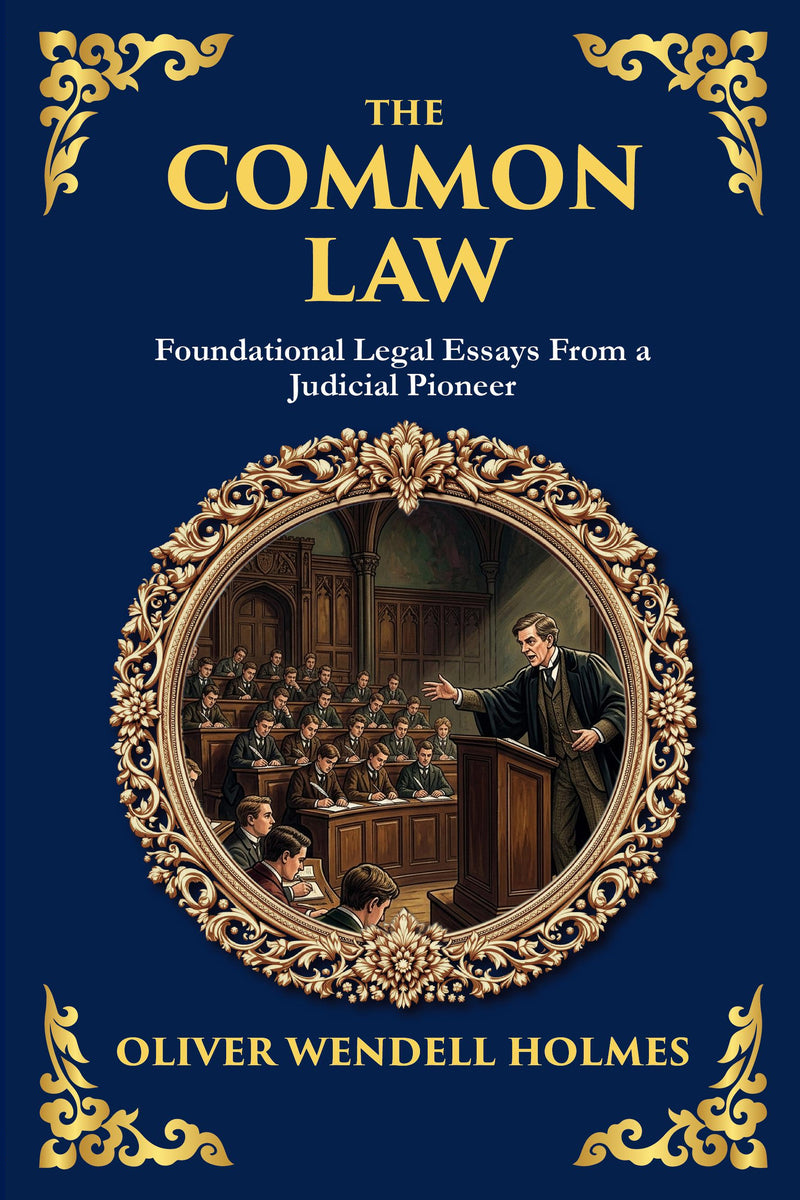
The Common Law
What defines justice, and how has our understanding of it evolved across centuries? In The Common Law, one of the most influential legal minds in American history offers a penetrating exploration into the origins, philosophy, and structure of law as a living institution.
or free app
10,000+ hrs library
30-day guarantee
The complete The Common Law appears in modern English through Library of Alexandria Press, available online with audiobook narration included for members.
Have you ever wondered why legal systems evolve—and who truly shapes them? In this foundational work, Supreme Court Justice Oliver Wendell Holmes charts the intellectual evolution of the common law and lays out a bold argument: the law is not a rigid system of rules, but a dynamic organism molded by human experience, public policy, and historical necessity. First delivered as a series of lectures in 1881, The Common Law breaks away from formalist interpretations and shows how real-world pressures—war, commerce, custom, and social change—shape the courts more than logic or precedent alone.
Holmes critiques conventional assumptions and reconstructs a vision of the law that reflects the realities of society, not merely abstract theory. This modern edition makes Holmes’s text accessible to today’s reader while preserving the brilliance of his insights. Whether you are a legal professional, historian, or curious thinker, The Common Law offers deep and enduring relevance to how we understand justice.
What you’ll discover in this modern edition
- A Revolutionary Legal Philosophy Holmes argues that law is experience, not abstract deduction—a radical stance that shaped modern legal realism.
- Historical Foundations of Legal Institutions Learn how torts, contracts, property, and criminal law developed from early medieval origins to modern practices.
- A Pioneering Work in Legal Realism Holmes rejects rigid formalism and instead promotes a practical, adaptable understanding of law.
- A Classic Text Reimagined for Modern Readers This version preserves Holmes’s eloquence while offering clarity and context for 21st- century audiences.
| Formats | eBook (EPUB + PDF) · Audiobook · Paperback · Hardcover · Large Print |
| Language | English |
| Trim size (print) | 6 × 9 in |
| Binding | Paperback — perfect-bound · Hardcover — casewrap |
| Large Print edition | Same text in a larger, easy-read type — a larger font, not a larger trim |
| Print pricing | Every physical book at our true cost — at-cost, no profit (members) |
| Library | 873 restored titles, always growing |
| Length | 111,204 words · ~7 hr 25 min reading |
| Reading level | Grade 3 · an easy, flowing read (this modern-English edition) |
| Edition | Modern English translation · 2026 |
Member reviews for this edition are collected as readers finish it — be the first. Across the library: 12,000+ books shipped, every plan covered by a 365-day print guarantee.
About this edition
A faithful, unabridged modern-English edition by The Library of Alexandria — carefully rendered for today's reader and verified paragraph-by-paragraph against the public-domain source. Available as eBook, audiobook, paperback, hardcover, and large print.
- Complete & unabridgedVerified paragraph by paragraph against the source — never a scan, never abridged.
- Modern English, faithfulReadable today, with the author’s meaning kept intact. Readable — not simplified.
- Every format, one membershipRead in your browser or the free app, or listen to the full audiobook.
Included free with your membership
Cancel anytime, one click · 30-day money-back guarantee
Edition last updated July 2026
What’s inside
The Common Law — complete and unabridged: all 13 sections included with membership, plus the full audiobook.
Begin reading The Common Law
In clear modern English — the complete text is included with membership.
Introduction
There are books that explain the law, and there are books that change how we understand it. This one belongs firmly to the second category. When it first appeared in 1881, written by a man who had not yet turned forty and who would not reach the United States Supreme Court for another two decades, it announced something that few legal thinkers of the time were prepared to hear: that the law is not a perfect logical machine handed down from on high, but a living, breathing, evolving response to the needs, fears, and convictions of human beings. The famous opening declaration — that the life of the law has not been logic but experience — has echoed across more than a century of legal scholarship, courtrooms, and classrooms. It remains one of the most quoted sentences in the entire literature of jurisprudence, and the pages that follow it justify the reputation many times over.
What you hold in your hands is a modern adaptation of that landmark work, carefully prepared so that today’s reader can encounter Holmes’s ideas without stumbling over the dense Victorian sentences, the untranslated Latin tags, and the assumed familiarity with nineteenth-century legal practice that once made the original a formidable challenge even for trained lawyers. The aim has been to preserve the architecture of the argument and the bracing intelligence of its author while clearing away the underbrush that obscures it for the contemporary mind. The result is meant to be read, enjoyed, and absorbed by anyone curious about how the rules that govern our lives actually came to be — not only law students and practicing attorneys, but historians, philosophers, citizens, and anyone who has ever wondered why we punish, why we hold people to their promises, and why we make some people pay for accidents they never intended to cause.
To understand why this work matters so much, it helps to picture the intellectual world into which it arrived. In the late nineteenth century, the dominant view among legal thinkers, especially in England and on the European continent, treated the law as a closed system of principles. Once you knew the foundational rules, the theory went, you could deduce the correct answer to any legal question with the certainty of a geometric proof. Law was thought to be discovered rather than made, a body of timeless truths waiting to be applied by judges who functioned as little more than living calculators. Holmes looked at this comfortable picture and saw that it was false. He had read deeply in legal history — Roman law, early Germanic codes, medieval English custom, the slow accumulation of precedent over centuries — and what he found there was not a smooth unfolding of logic but a record of struggle, accident, borrowed forms, and the gradual repurposing of old rules to serve new ends. Doctrines survived long after the reasons for them had vanished, and judges, often without realizing it, smuggled in their own intuitions about what was fair and useful, then dressed those intuitions in the language of pure reason.
This insight may sound obvious to a modern reader, but that is precisely a measure of how thoroughly Holmes won the argument. The way we now talk about law — as something shaped by policy, by social need, by the changing convictions of communities, by the human beings who interpret it — owes an enormous debt to the case he made here. He is rightly regarded as a founder of the school of thought that came to be called legal realism, the movement that insisted on looking at what courts actually do rather than what they claim to do. He did not invent every idea he expressed, but he gathered them, sharpened them, and stated them with a force and clarity that made them impossible to ignore. When you read this book, you are reading one of the headwaters from which a great deal of modern legal thinking flows.
A Mind Forged in War and Sharpened by History
It is worth pausing to consider the man behind these pages, because the force of his prose is inseparable from the force of his life. Oliver Wendell Holmes Jr. was born in Boston in 1841 into one of the most distinguished families in America. His father, also named Oliver Wendell Holmes, was a celebrated physician, poet, and essayist — the kind of literary celebrity whose dinner table hosted the brightest minds of the age. The younger Holmes grew up surrounded by books, conversation, and the expectation of achievement. But the experience that marked him most deeply was not literary at all. It was the Civil War.
Holmes enlisted in the Union Army and served through some of the bloodiest fighting of that terrible conflict. He was wounded three times — at Ball’s Bluff, at Antietam, and at Chancellorsville — and on more than one occasion came close to death. He watched friends die. He saw the gap between noble ideals and the brutal facts of the battlefield. This experience burned away whatever romantic illusions he might have carried into adulthood and left him with a hard, unsentimental view of human affairs. He emerged from the war convinced that certainty was usually an illusion, that men killed and died for beliefs they could not prove, and that survival in this world meant making the best judgments one could amid permanent uncertainty. This skepticism, this refusal to mistake confident assertion for truth, runs through everything he later wrote. When he tells us that the law grows out of experience rather than logic, he speaks as a man who had learned the difference at the cost of his own blood.
After the war he returned to Harvard, studied law, and threw himself into a punishing regime of reading and writing. He practiced law in Boston, edited a major legal treatise, and lectured at Harvard, but his real passion was scholarship of a deeper kind. He wanted to understand the law not as a collection of rules to be memorized but as a historical phenomenon to be explained. He spent years tracing doctrines back to their origins, reading the oldest sources he could find in several languages, asking again and again the question that animates this entire work: why is the law the way it is? The lectures that became this book were delivered in late 1880, the fruit of more than a decade of this relentless inquiry. They represent the summing-up of his early intellectual life, and they launched him toward the judicial career for which he is now most famous.
That career was extraordinary. Holmes served on the highest court of Massachusetts, then was appointed to the Supreme Court of the United States in 1902, where he sat for nearly thirty years, retiring at the age of ninety. He became known as the Great Dissenter for his willingness to break with his colleagues and defend positions that often took decades to be vindicated. His opinions on free speech, in particular, helped lay the foundation for the modern understanding of the First Amendment. But all of that lay in the future when he wrote this book. Here we meet Holmes the scholar, the historian, the philosopher of law, before the robes and the title — a brilliant young man determined to overturn the conventional wisdom of his age and replace it with something truer.
Knowing this background changes how the book reads. The unsentimental tone, the impatience with empty abstraction, the insistence on facing facts as they are rather than as we wish them to be — all of this comes from a particular man who had been tested in ways most of his contemporaries had not. There is steel in these pages, and also a kind of wisdom that can only be earned, not taught. Holmes does not flatter the reader or pretend that the law is nobler than it is. He shows us the machinery, the gears and levers, the historical accidents and the moral compromises. And in doing so he gives us something far more valuable than a comforting myth: he gives us understanding.
What the Book Argues and Why It Still Speaks to Us
The work moves through several great themes, and it helps to have a map before setting out, because Holmes does not always pause to signpost where he is going. He assumes an attentive reader and rewards one. The adaptation you are about to read smooths the path considerably, but the underlying journey remains demanding in the best sense — it asks you to think.
He begins with the problem of criminal liability and the early history of how societies responded to wrongdoing. One of his most striking observations is that the origins of legal liability lie not in reasoned moral judgment but in the raw human impulse toward vengeance. When a person was harmed, the instinct was to strike back, to make someone pay, and the earliest legal systems were essentially attempts to channel and regulate that desire for revenge so that it would not tear communities apart. Astonishingly, this impulse even extended to inanimate objects and animals. If a man was killed by a falling tree or a goring ox, the early law would sometimes hold the tree or the ox itself responsible, surrendering it to the victim’s family. To the modern mind this seems absurd, and Holmes uses it precisely because it is absurd: it reveals that the law did not start from a clear theory of fault or intention but from something much more primitive, and that many of the doctrines we now rationalize with sophisticated arguments are in fact survivals of these ancient and irrational practices.
From this foundation he builds toward one of his central and most influential ideas: that the law, as it matured, gradually shifted from asking what was inside a person’s head to asking how a reasonable person would have behaved. The law, he argues, increasingly judges people by external standards rather than by their actual intentions or moral guilt. It does not much care, in many cases, whether you meant to cause harm; it cares whether your conduct fell below the standard that the community expects of an ordinary, prudent person. This is the origin of the famous reasonable person standard that anyone who has studied law will recognize, and that shapes countless legal outcomes to this day. Holmes saw that this external standard served practical social purposes — it was workable, predictable, and it set incentives for careful behavior — even though it sometimes meant holding people liable who were not morally blameworthy at all.
This leads to perhaps his most provocative and lasting contribution: a way of thinking about law from the point of view of what he later called the bad man. The bad man, in Holmes’s famous formulation, does not care about morality or the majesty of the law in the abstract. He wants to know one thing: what will happen to him if he does a particular act? Will he be fined, imprisoned, forced to pay damages? For Holmes, this cold and practical perspective cuts through a great deal of confusion. A legal duty, he suggests, is nothing more mysterious than a prediction that you will suffer certain consequences if you behave in a certain way. This reframing strips away the moralizing fog that often surrounds legal concepts and lets us see them clearly as predictions about the behavior of courts. It is a deeply pragmatic vision, and it remains one of the most discussed and debated ideas in all of legal philosophy.
Having established these foundations, the book ranges widely across the major fields of the common law. Holmes examines the law of torts — the rules governing accidents, injuries, and civil wrongs — and shows how the concepts of negligence and liability developed out of those primitive origins into something resembling a coherent system. He explores the law of possession and ownership, asking what it really means to possess something and tracing how the law has handled these questions across centuries and across different legal traditions. He devotes substantial attention to the law of contracts, dissecting what it means to make a binding promise, what happens when a promise is broken, and why the law treats certain agreements as enforceable and others as empty words. Throughout, his method is consistent: take a doctrine that lawyers accept without question, dig down into its history, show where it really came from, and then ask whether the reasons that produced it still apply or whether it has become a hollow form preserved only by inertia.
Cancel anytime, one click · 30-day money-back guarantee
Founding annual rate available now — your price locks for life when you join.
Not ready? Get this free chapter by email — read it anytime.
✓ Sent — check your inbox for The Common Law.
Questions about The Common Law
What is The Common Law about?
What defines justice, and how has our understanding of it evolved across centuries? In The Common Law, one of the most influential legal minds in American history offers a penetrating exploration into the origins, philosophy, and structure of law as a living institution. Holmes blends history, legal theory, and social context in a series of essays that forever transformed legal thought.
Who wrote The Common Law?
The Common Law was written by Oliver Wendell Holmes. This edition presents the complete work in clear modern English, faithfully rendered from the public-domain original by Library of Alexandria Press.
Is The Common Law free to read?
The opening chapter is free to read on this page. Members read and listen to the complete work — and the entire library — free, and can order any physical book at our true print cost.
How long is The Common Law?
13 chapters (~111,204 words) — about 7 hr 25 min of reading in this modern-English edition.
Is this an abridged version of The Common Law?
No. This is the complete, unabridged The Common Law, carefully rendered into clear modern English and verified paragraph-by-paragraph against the public-domain source — nothing is cut or summarised.
What formats does The Common Law come in?
The Common Law is available as eBook, paperback, hardcover and large print. eBook and audiobook are included with membership; printed editions ship at our true print cost.
Shipping & returns
Billing & membership
More from the library


Explore Classic & Literary
- Dream Psychology: Psychoanalysis for Beginners · Sigmund Freud
- Great Expectations · Charles Dickens
- The Brothers Karamazov · Fyodor Dostoyevsky
- The Great Gatsby · F. Scott Fitzgerald
- Wild Flowers Worth Knowing · Neltje Blanchan
- Italian Hours · Henry James
- A Popular History of France from the Earliest Times, Volume 5 · François Guizot
- A history of English literature: A practical text-book · Edward Albert
- Italian Highways and Byways from a Motor Car · M. F. Mansfield
- The Heart-Cry of Jesus · Byron J. Rees
- Castes and Tribes of Southern India. Vol. 6 of 7 · Edgar Thurston
- Against the Grain · J.-K. Huysmans
- Dombey and Son · Charles Dickens
- How to Invest Money · George Garr Henry
- The Great Controversy Between Christ and Satan · Ellen Gould Harmon White
- One Hundred Proofs That the Earth Is Not a Globe · William Carpenter
- Southern Literature From 1579–1895 · Louise Manly
- The Renaissance: Studies in Art and Poetry · Walter Pater
- Mark Twain’s Speeches · Mark Twain
- Tacitus on Germany · Cornelius Tacitus
- The Rosary · Florence L. Barclay
- Peculiarities of American Cities · Willard W. Glazier
- Tennis for Girls · Florence A. Ballin
- The World’s Greatest Books — Volume 02 — Fiction
- Shirley · Charlotte Brontë
- Daisy Miller: A Study · Henry James
- Louis Lambert · Honoré de Balzac
- Historic Jamaica · Frank Cundall
- The Gambler · Fyodor Dostoyevsky
- The Mayor of Casterbridge · Thomas Hardy
The Common Law
The Common Law
Essential Legal Essays From a Judicial Pioneer
Oliver Wendell Holmes
Contents
- Introduction
- Chapter 1
- Chapter 2
- Chapter 3
- Chapter 4
- Chapter 5
- Chapter 6
- Chapter 7
- Chapter 8
- Chapter 9
- Chapter 10
- Chapter 11
- Chapter 12
Introduction
There are books that explain the law, and there are books that change how we understand it. This one belongs firmly to the second category. When it first appeared in 1881, written by a man who had not yet turned forty and who would not reach the United States Supreme Court for another two decades, it announced something that few legal thinkers of the time were prepared to hear: that the law is not a perfect logical machine handed down from on high, but a living, breathing, evolving response to the needs, fears, and convictions of human beings. The famous opening declaration — that the life of the law has not been logic but experience — has echoed across more than a century of legal scholarship, courtrooms, and classrooms. It remains one of the most quoted sentences in the entire literature of jurisprudence, and the pages that follow it justify the reputation many times over.
What you hold in your hands is a modern adaptation of that landmark work, carefully prepared so that today’s reader can encounter Holmes’s ideas without stumbling over the dense Victorian sentences, the untranslated Latin tags, and the assumed familiarity with nineteenth-century legal practice that once made the original a formidable challenge even for trained lawyers. The aim has been to preserve the architecture of the argument and the bracing intelligence of its author while clearing away the underbrush that obscures it for the contemporary mind. The result is meant to be read, enjoyed, and absorbed by anyone curious about how the rules that govern our lives actually came to be — not only law students and practicing attorneys, but historians, philosophers, citizens, and anyone who has ever wondered why we punish, why we hold people to their promises, and why we make some people pay for accidents they never intended to cause.
To understand why this work matters so much, it helps to picture the intellectual world into which it arrived. In the late nineteenth century, the dominant view among legal thinkers, especially in England and on the European continent, treated the law as a closed system of principles. Once you knew the foundational rules, the theory went, you could deduce the correct answer to any legal question with the certainty of a geometric proof. Law was thought to be discovered rather than made, a body of timeless truths waiting to be applied by judges who functioned as little more than living calculators. Holmes looked at this comfortable picture and saw that it was false. He had read deeply in legal history — Roman law, early Germanic codes, medieval English custom, the slow accumulation of precedent over centuries — and what he found there was not a smooth unfolding of logic but a record of struggle, accident, borrowed forms, and the gradual repurposing of old rules to serve new ends. Doctrines survived long after the reasons for them had vanished, and judges, often without realizing it, smuggled in their own intuitions about what was fair and useful, then dressed those intuitions in the language of pure reason.
This insight may sound obvious to a modern reader, but that is precisely a measure of how thoroughly Holmes won the argument. The way we now talk about law — as something shaped by policy, by social need, by the changing convictions of communities, by the human beings who interpret it — owes an enormous debt to the case he made here. He is rightly regarded as a founder of the school of thought that came to be called legal realism, the movement that insisted on looking at what courts actually do rather than what they claim to do. He did not invent every idea he expressed, but he gathered them, sharpened them, and stated them with a force and clarity that made them impossible to ignore. When you read this book, you are reading one of the headwaters from which a great deal of modern legal thinking flows.
A Mind Forged in War and Sharpened by History
It is worth pausing to consider the man behind these pages, because the force of his prose is inseparable from the force of his life. Oliver Wendell Holmes Jr. was born in Boston in 1841 into one of the most distinguished families in America. His father, also named Oliver Wendell Holmes, was a celebrated physician, poet, and essayist — the kind of literary celebrity whose dinner table hosted the brightest minds of the age. The younger Holmes grew up surrounded by books, conversation, and the expectation of achievement. But the experience that marked him most deeply was not literary at all. It was the Civil War.
Holmes enlisted in the Union Army and served through some of the bloodiest fighting of that terrible conflict. He was wounded three times — at Ball’s Bluff, at Antietam, and at Chancellorsville — and on more than one occasion came close to death. He watched friends die. He saw the gap between noble ideals and the brutal facts of the battlefield. This experience burned away whatever romantic illusions he might have carried into adulthood and left him with a hard, unsentimental view of human affairs. He emerged from the war convinced that certainty was usually an illusion, that men killed and died for beliefs they could not prove, and that survival in this world meant making the best judgments one could amid permanent uncertainty. This skepticism, this refusal to mistake confident assertion for truth, runs through everything he later wrote. When he tells us that the law grows out of experience rather than logic, he speaks as a man who had learned the difference at the cost of his own blood.
After the war he returned to Harvard, studied law, and threw himself into a punishing regime of reading and writing. He practiced law in Boston, edited a major legal treatise, and lectured at Harvard, but his real passion was scholarship of a deeper kind. He wanted to understand the law not as a collection of rules to be memorized but as a historical phenomenon to be explained. He spent years tracing doctrines back to their origins, reading the oldest sources he could find in several languages, asking again and again the question that animates this entire work: why is the law the way it is? The lectures that became this book were delivered in late 1880, the fruit of more than a decade of this relentless inquiry. They represent the summing-up of his early intellectual life, and they launched him toward the judicial career for which he is now most famous.
That career was extraordinary. Holmes served on the highest court of Massachusetts, then was appointed to the Supreme Court of the United States in 1902, where he sat for nearly thirty years, retiring at the age of ninety. He became known as the Great Dissenter for his willingness to break with his colleagues and defend positions that often took decades to be vindicated. His opinions on free speech, in particular, helped lay the foundation for the modern understanding of the First Amendment. But all of that lay in the future when he wrote this book. Here we meet Holmes the scholar, the historian, the philosopher of law, before the robes and the title — a brilliant young man determined to overturn the conventional wisdom of his age and replace it with something truer.
Knowing this background changes how the book reads. The unsentimental tone, the impatience with empty abstraction, the insistence on facing facts as they are rather than as we wish them to be — all of this comes from a particular man who had been tested in ways most of his contemporaries had not. There is steel in these pages, and also a kind of wisdom that can only be earned, not taught. Holmes does not flatter the reader or pretend that the law is nobler than it is. He shows us the machinery, the gears and levers, the historical accidents and the moral compromises. And in doing so he gives us something far more valuable than a comforting myth: he gives us understanding.
What the Book Argues and Why It Still Speaks to Us
The work moves through several great themes, and it helps to have a map before setting out, because Holmes does not always pause to signpost where he is going. He assumes an attentive reader and rewards one. The adaptation you are about to read smooths the path considerably, but the underlying journey remains demanding in the best sense — it asks you to think.
He begins with the problem of criminal liability and the early history of how societies responded to wrongdoing. One of his most striking observations is that the origins of legal liability lie not in reasoned moral judgment but in the raw human impulse toward vengeance. When a person was harmed, the instinct was to strike back, to make someone pay, and the earliest legal systems were essentially attempts to channel and regulate that desire for revenge so that it would not tear communities apart. Astonishingly, this impulse even extended to inanimate objects and animals. If a man was killed by a falling tree or a goring ox, the early law would sometimes hold the tree or the ox itself responsible, surrendering it to the victim’s family. To the modern mind this seems absurd, and Holmes uses it precisely because it is absurd: it reveals that the law did not start from a clear theory of fault or intention but from something much more primitive, and that many of the doctrines we now rationalize with sophisticated arguments are in fact survivals of these ancient and irrational practices.
From this foundation he builds toward one of his central and most influential ideas: that the law, as it matured, gradually shifted from asking what was inside a person’s head to asking how a reasonable person would have behaved. The law, he argues, increasingly judges people by external standards rather than by their actual intentions or moral guilt. It does not much care, in many cases, whether you meant to cause harm; it cares whether your conduct fell below the standard that the community expects of an ordinary, prudent person. This is the origin of the famous reasonable person standard that anyone who has studied law will recognize, and that shapes countless legal outcomes to this day. Holmes saw that this external standard served practical social purposes — it was workable, predictable, and it set incentives for careful behavior — even though it sometimes meant holding people liable who were not morally blameworthy at all.
This leads to perhaps his most provocative and lasting contribution: a way of thinking about law from the point of view of what he later called the bad man. The bad man, in Holmes’s famous formulation, does not care about morality or the majesty of the law in the abstract. He wants to know one thing: what will happen to him if he does a particular act? Will he be fined, imprisoned, forced to pay damages? For Holmes, this cold and practical perspective cuts through a great deal of confusion. A legal duty, he suggests, is nothing more mysterious than a prediction that you will suffer certain consequences if you behave in a certain way. This reframing strips away the moralizing fog that often surrounds legal concepts and lets us see them clearly as predictions about the behavior of courts. It is a deeply pragmatic vision, and it remains one of the most discussed and debated ideas in all of legal philosophy.
Having established these foundations, the book ranges widely across the major fields of the common law. Holmes examines the law of torts — the rules governing accidents, injuries, and civil wrongs — and shows how the concepts of negligence and liability developed out of those primitive origins into something resembling a coherent system. He explores the law of possession and ownership, asking what it really means to possess something and tracing how the law has handled these questions across centuries and across different legal traditions. He devotes substantial attention to the law of contracts, dissecting what it means to make a binding promise, what happens when a promise is broken, and why the law treats certain agreements as enforceable and others as empty words. Throughout, his method is consistent: take a doctrine that lawyers accept without question, dig down into its history, show where it really came from, and then ask whether the reasons that produced it still apply or whether it has become a hollow form preserved only by inertia.
The goal of this book is to provide a general overview of the Common Law. To do this, we need more than just logic. While it is useful to show that a system’s consistency requires a specific outcome, that isn’t everything. The law has not evolved through logic, but through experience. The urgent needs of the era, dominant moral and political theories, instincts regarding public policy—whether admitted or unconscious—and even the personal biases that judges share with everyone else, have played a much larger role than formal logic in shaping the rules that govern people. The law represents the story of a nation’s growth over many centuries; it cannot be treated as if it were simply a math textbook full of axioms and theorems. To understand what the law is, we must understand what it was and where it is headed. We must look both at history and at current legal theories. However, the hardest part will be understanding how these two elements merged to create new results at every stage. The actual content of the law at any given time generally aligns with what is considered practical at that moment, but its structure, its processes, and its ability to achieve desired results depend heavily on its past.
In modern Massachusetts, there are many rules that make perfect sense on their own. At the same time, there are others that can only be understood by looking back at the early legal customs of German tribes or the social state of Rome under the Decemvirs.
I will use legal history only when it is necessary to explain a concept or interpret a rule, and no more than that. In this process, both the writer and the reader must avoid two equal mistakes. The first is assuming that because an idea seems obvious and natural to us now, it has always been that way. Many things we take for granted were hard-won or carefully debated in the past. The second mistake is the opposite: expecting too much from history. We tend to view the past through the lens of a fully developed adult. We should assume that the earliest barbarians whose customs we study experienced many of the same feelings and passions that we do.
End of the free sample
Keep reading, free
Members read and listen to the complete book — and the entire library. Cancel anytime, one click · 30-day money-back guarantee.