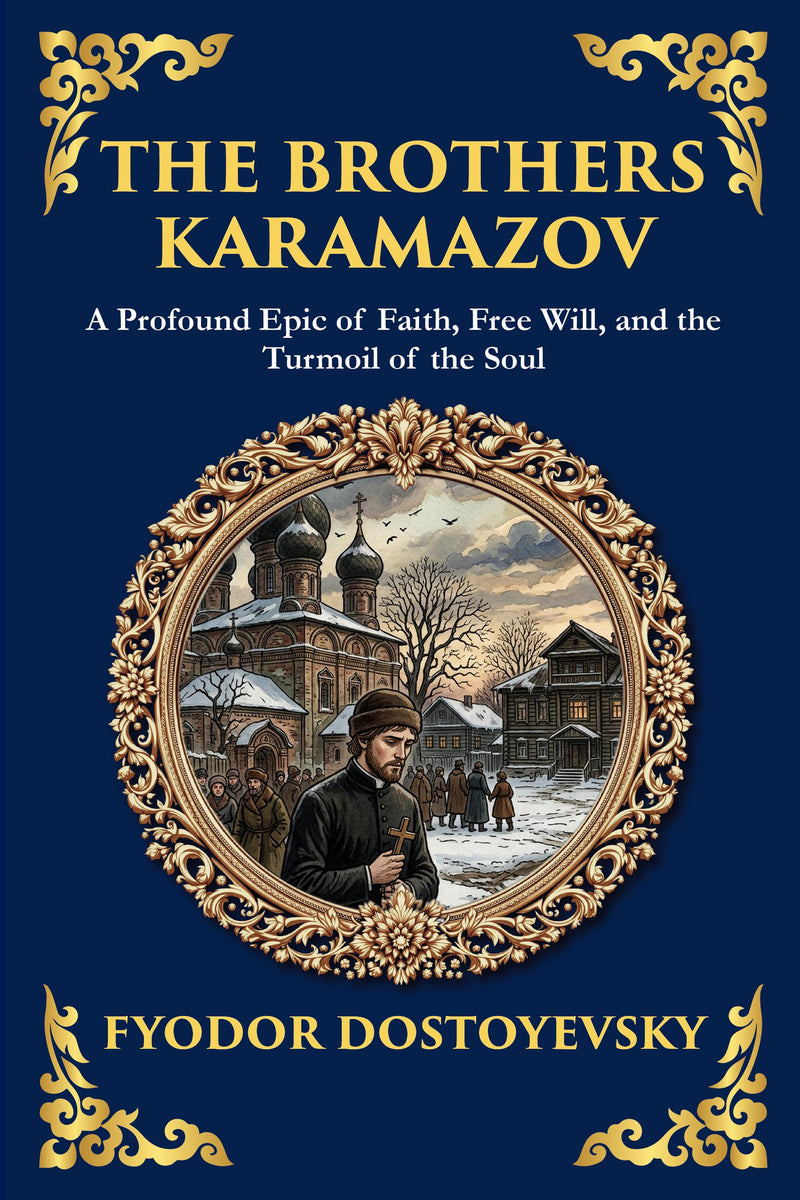
The Brothers Karamazov — Large Print
A father murdered. Three sons haunted by guilt, passion, and doubt. In The Brothers Karamazov, Fyodor Dostoyevsky crafts one of literature’s most powerful explorations of faith, morality, and the fractured nature of the human soul.
or free app
10,000+ hrs library
30-day guarantee
The complete The Brothers Karamazov appears in modern English through Library of Alexandria Press, available online with audiobook narration included for members.
Have you ever wondered why the greatest battles are fought not in the world—but within ourselves? The Brothers Karamazov is Fyodor Dostoyevsky’s final and most profound novel—a towering work of moral philosophy, psychological insight, and spiritual confrontation. Combining an intense family drama with some of the most penetrating questions of existence, this modern edition brings new clarity and power to a classic that remains as urgent and vital today as it was in the 19th century.
At the heart of the novel is the Karamazov family: the coarse and hedonistic father Fyodor, and his three sons—Dmitri, the passionate and impulsive soldier; Ivan, the rational and tormented intellectual; and Alyosha, the gentle novice monk seeking spiritual truth. When Fyodor is found murdered, suspicion and accusation unravel each of the brothers' lives, exposing the deep rifts in their beliefs and identities. Yet The Brothers Karamazov is more than a whodunit.
It is a philosophical battlefield—where ideas of God, free will, justice, and love collide. Through courtroom drama, inner monologues, and transcendent visions, Dostoyevsky leads the reader through a narrative as thrilling as it is spiritually searching.
What you’ll discover in this modern edition
- A Riveting Murder Mystery with Eternal Stakes – The search for truth in a brutal crime opens the door to questions of justice, guilt, and forgiveness.
- Three Brothers, Three Paths – Experience the rich contrast between sensualism, skepticism, and faith through characters that embody humanity’s moral dilemmas.
- Existential and Spiritual Depth – Engage with timeless questions about God, suffering, redemption, and the nature of evil.
- An Immersive Russian Landscape – Discover 19th-century Russia through Dostoyevsky’s vivid depictions of its society, religion, and emotional intensity.
- A Definitive Work of World Literature – Regarded by many as the greatest novel ever written, this modern translation makes Dostoyevsky’s voice accessible without sacrificing depth.
| Formats | eBook (EPUB + PDF) · Audiobook · Paperback · Hardcover · Large Print |
| Language | English |
| Trim size (print) | 6 × 9 in |
| Binding | Paperback — perfect-bound · Hardcover — casewrap |
| Large Print edition | Same text in a larger, easy-read type — a larger font, not a larger trim |
| Print pricing | Every physical book at our true cost — at-cost, no profit (members) |
| Library | 873 restored titles, always growing |
| Length | 326,178 words · ~21 hr 45 min reading |
| Reading level | Grade 5 · an easy, flowing read (this modern-English edition) |
| Edition | Modern English translation · 2026 |
Member reviews for this edition are collected as readers finish it — be the first. Across the library: 12,000+ books shipped, every plan covered by a 365-day print guarantee.
About this edition
A faithful, unabridged modern-English edition by The Library of Alexandria — carefully rendered for today's reader and verified paragraph-by-paragraph against the public-domain source. Available as eBook, audiobook, paperback, hardcover, and large print.
- Complete & unabridgedVerified paragraph by paragraph against the source — never a scan, never abridged.
- Modern English, faithfulReadable today, with the author’s meaning kept intact. Readable — not simplified.
- Every format, one membershipRead in your browser or the free app, or listen to the full audiobook.
Included free with your membership
Cancel anytime, one click · 30-day money-back guarantee
Edition last updated July 2026
What’s inside
The Brothers Karamazov — Large Print — complete and unabridged: all 39 sections included with membership, plus the full audiobook.
Begin reading The Brothers Karamazov — Large Print
In clear modern English — the complete text is included with membership.
Introduction
There are books we read, and there are books that read us. Fyodor Dostoyevsky’s final masterpiece belongs unmistakably to the second category. To open its pages is to enter a vast cathedral of the human spirit, one whose vaulted ceilings stretch into questions so immense that no single lifetime can fully answer them. Here, in the story of one fractured family in a provincial Russian town, the author gathered everything he had learned across decades of suffering, doubt, imprisonment, faith, and creative struggle, and poured it into a final, towering work. What emerges is not merely a novel but an experience—a confrontation with the deepest dilemmas that have haunted human consciousness since we first looked up at the stars and wondered whether anyone was looking back.
Completed in 1880, only months before its author’s death, this was the book Dostoyevsky considered the summation of his entire artistic and philosophical vision. He had spent his life circling its central themes, and at last, near the end, he found the structure capable of containing them. The result has been called by countless thinkers, novelists, philosophers, and psychologists one of the supreme achievements of literature. Albert Einstein kept returning to it. Sigmund Freud wrote an entire essay grappling with it. Friedrich Nietzsche, who agreed with Dostoyevsky about almost nothing, declared him the only psychologist from whom he had anything to learn. The novel has shaped how we think about morality, guilt, freedom, and the silence of the heavens. And yet, for all its philosophical weight, it remains, at its core, a gripping, suspenseful, deeply human story—one filled with passion, scandal, love, rage, tenderness, and the kind of dramatic intensity that keeps the pages turning late into the night.
This particular edition has been prepared as a modern translation, adapted for the contemporary reader. That phrase deserves a word of explanation, because it speaks directly to the experience you are about to have. Dostoyevsky wrote in a Russian that was urgent, fevered, and alive—a prose that tumbled out of him under enormous pressure, often dictated aloud in a race against deadlines and creditors. Earlier English translations, many produced more than a century ago, sometimes draped his raw, breathing sentences in the heavy formal velvet of Victorian English, creating a distance between the reader and the volcanic emotion underneath. The aim of a contemporary adaptation is to clear away that accumulated dust, to let the immediacy and the heat of the original come through, so that the characters speak to you not as figures behind museum glass but as living people whose struggles feel startlingly close to your own. The goal is not to simplify Dostoyevsky’s ideas—those remain as challenging and rewarding as ever—but to remove the unnecessary barriers between you and his genius, so that the only difficulty you face is the magnificent difficulty of the questions themselves.
To understand why this novel carries such overwhelming force, it helps to know something of the man who wrote it, for few books in history are so intimately bound to the biography of their creator. Dostoyevsky did not write about suffering, doubt, and redemption as abstractions observed from a safe distance. He wrote about them because he had lived them, sometimes to the very edge of annihilation.
Born in Moscow in 1821, the son of a doctor, he came of age in a Russia trembling between tradition and revolution, between the ancient Orthodox faith and the new gospels of European rationalism, socialism, and atheism. As a young man, he was drawn into a circle of idealistic intellectuals who dreamed of reforming their nation. For this, he was arrested. In one of the most extraordinary episodes in any writer’s life, he was sentenced to death and led out before a firing squad. The soldiers raised their rifles. The command to fire was moments away. And then, at the last possible instant, a messenger arrived with news that the sentence had been commuted to imprisonment in Siberia. The entire execution had been a cruel piece of theater, a psychological torment staged by the authorities. Dostoyevsky stood there, having genuinely believed he had only minutes left to live, and then was told he would live after all.
No human being passes through such an experience unchanged. The man who emerged spent four years in a Siberian prison camp among murderers, thieves, and the wretched of the earth, sharing their black bread and their chains, observing the human soul stripped to its rawest condition. There, paradoxically, he found something he had not expected: not despair, but a deepened reverence for life, for ordinary people, for the Russian common man, and for the faith that sustained the simplest among his fellow prisoners. He came out of Siberia having shed his youthful political idealism and having discovered instead a conviction that would animate all his later work—that the great battles of human existence are fought not in parliaments or revolutions but in the secret chambers of the individual heart.
The decades that followed were a tumult of genius and chaos. He battled epilepsy, whose seizures he would later transfigure into some of the most haunting passages in literature. He gambled compulsively, often plunging himself and his family into ruinous debt. He buried loved ones. He fell in love, lost in love, and finally found a steadying companion in a young stenographer who became his wife and his salvation. He produced, in this fevered condition, a sequence of novels that redefined what fiction could do: works that descended into the underground of human motivation, that dramatized the agonies of conscience, that placed murderers and saints, sensualists and ascetics, in the same room and forced them to speak honestly to one another.
By the time he came to write this final novel, he was an old man by the standards of his era and his constitution, worn down by illness and grief—he had recently lost a beloved young son—but possessed of a clarity and ambition unlike anything he had attempted before. He intended this to be the first part of an even larger work that he would never live to complete. What we have, then, is both a complete and self-sufficient masterpiece and, poignantly, the foundation of an unfinished cathedral. Knowing this lends the reading a particular quality: you are holding the final, fullest testament of a man who had stared into the abyss more often than most, and who refused, against everything, to look away.
Without revealing the events that propel the narrative—for discovering them is among the great pleasures awaiting you—it is worth preparing you for the territory you are about to enter, so that you can read with your senses fully alert to what is at stake.
At the surface, the novel tells the story of a family: a coarse, dissolute, self-indulgent father and his sons, each of whom embodies a different way of being human, a different response to the predicament of existence. There is the passionate, sensual brother, all impulse and torment and wild generosity, capable of both cruelty and noble self-sacrifice within the same hour. There is the intellectual brother, brilliant and proud, whose mind has led him into a cold and lonely place where he questions whether anything at all can be forbidden if there is no higher power to forbid it. There is the youngest brother, gentle and luminous, drawn toward faith and toward the monastery, who moves through the corruption of the world like a figure of grace, beloved by nearly everyone he meets. And there are others, too—a mysterious figure on the margins, women of fierce pride and wounded tenderness, a saintly old monk whose words become a kind of spiritual center for the entire book, and a cast of townspeople, children, lawyers, and onlookers who together form a complete portrait of a society.
But the family drama, gripping as it is, is only the vessel. What Dostoyevsky pours into it is nothing less than the central argument of human civilization. The novel asks, with a directness and a fearlessness that few books before or since have matched: If there is no God, is everything permitted? Can morality survive the death of faith? Why does an innocent child suffer, and what kind of universe—or what kind of Creator—could allow it? Is human freedom a gift or a curse? Would we even want to be free, or do we secretly long to surrender our freedom to anyone who will relieve us of its terrible weight? Can love—real, active, self-sacrificing love—answer the case that reason builds against the goodness of existence?
These are not questions the author resolves for you with a tidy lecture. This is the crucial thing to understand, and it is the source of the book’s enduring power. Dostoyevsky was a believer, a man of deep Orthodox faith, but he was also the most honest doubter who ever lived. He gives the case against God, against faith, against the meaningfulness of the universe, in language so powerful, so seductive, so logically devastating, that generations of atheists have quoted it approvingly, never quite noticing that they were quoting a Christian author who deliberately built the strongest possible argument against his own deepest convictions. He does this because he believed that a faith which had not honestly confronted the worst objections to it was not worth having. He refuses to win cheaply. He puts the most eloquent words into the mouths of those who reject hope, and then he answers them not with counter-arguments but with the slow, accumulating weight of lived human experience—with acts of mercy, with the quiet testimony of a holy life, with the redemptive possibility hidden in suffering itself.
This is why so many readers describe the novel as a turning point in their lives. It does not tell you what to think. It enacts the great debate inside your own mind and heart, giving full and fair voice to every side, and then it trusts you—respects you enough—to live with the questions yourself. One famous chapter in particular, a parable told by one brother to another, is regularly cited as among the most profound philosophical passages in all of literature, a meditation on freedom, authority, and the burden of human conscience so penetrating that it has been studied by theologians, political philosophers, and psychologists for nearly a century and a half. When you reach it, you will know. Slow down. Read it twice. It is one of the summits of the human mind.
Yet I do not want to leave you with the impression that this is a dry or forbidding book of ideas. Nothing could be further from the truth. It pulses with life. There is a murder mystery at its center, with genuine suspense, a courtroom drama, secrets, false suspicions, and revelations. There is romance—jealous, obsessive, exalted, comic, and heartbreaking by turns. There are scenes of riotous humor, of grotesque comedy, of social embarrassment so excruciating you will wince and laugh at once. There are children whose stories will break your heart and mend it again. There are scandalous public confrontations, drunken confessions, fevered visions, and moments of tenderness so pure they seem to shine off the page. Dostoyevsky understood that the loftiest ideas live not in the clouds but in the messy, ridiculous, passionate texture of ordinary human life, and so he embedded his philosophy in flesh and blood, in dinner parties and tavern brawls and sickbeds and bedroom quarrels. You will come for the ideas, perhaps, but you will stay for the people—because by the time you finish, these characters will feel like members of your own family, infuriating and beloved in equal measure.
How to Read This Book and What It May Give You
A word now about the experience of reading, and how to make it as rich as possible, for this is a substantial work that rewards a particular kind of attention.
First, give yourself permission to go slowly. This is not a book to be rushed through or consumed in a hurry between other tasks. It unfolds at the pace of life itself, with long conversations, gradual revelations, and characters who circle their own dilemmas the way real people do, approaching and retreating, contradicting themselves, surprising us and themselves. If you try to race toward the plot, you will miss what makes the novel immortal. Let the conversations breathe. Some of the most important “action” in this book happens entirely in dialogue—two people sitting in a room, talking, while the foundations of their souls shift beneath them. Trust that Dostoyevsky knows exactly what he is doing, even in the long stretches that may at first seem like digressions. There are no wasted pages here; every seemingly minor episode, every secondary character’s story, is laying groundwork for an effect that will only become clear later.
Cancel anytime, one click · 30-day money-back guarantee
Founding annual rate available now — your price locks for life when you join.
Not ready? Get this free chapter by email — read it anytime.
✓ Sent — check your inbox for The Brothers Karamazov — Large Print.
Questions about The Brothers Karamazov — Large Print
What is The Brothers Karamazov about?
A father murdered. Three sons haunted by guilt, passion, and doubt. In The Brothers Karamazov, Fyodor Dostoyevsky crafts one of literature’s most powerful explorations of faith, morality, and the fractured nature of the human soul.
Who wrote The Brothers Karamazov?
The Brothers Karamazov was written by Fyodor Dostoyevsky. This edition presents the complete work in clear modern English, faithfully rendered from the public-domain original by Library of Alexandria Press.
Is The Brothers Karamazov free to read?
The opening chapter is free to read on this page. Members read and listen to the complete work — and the entire library — free, and can order any physical book at our true print cost.
How long is The Brothers Karamazov?
39 chapters (~326,178 words) — about 21 hr 45 min of reading in this modern-English edition.
Is this an abridged version of The Brothers Karamazov?
No. This is the complete, unabridged The Brothers Karamazov, carefully rendered into clear modern English and verified paragraph-by-paragraph against the public-domain source — nothing is cut or summarised.
What formats does The Brothers Karamazov come in?
The Brothers Karamazov is available as eBook. eBook and audiobook are included with membership; printed editions ship at our true print cost.
Shipping & returns
Billing & membership
More from the library


Explore Classic & Literary
- Dream Psychology: Psychoanalysis for Beginners · Sigmund Freud
- Great Expectations · Charles Dickens
- The Brothers Karamazov · Fyodor Dostoyevsky
- The Great Gatsby · F. Scott Fitzgerald
- Wild Flowers Worth Knowing · Neltje Blanchan
- Italian Hours · Henry James
- A Popular History of France from the Earliest Times, Volume 5 · François Guizot
- A history of English literature: A practical text-book · Edward Albert
- Italian Highways and Byways from a Motor Car · M. F. Mansfield
- The Heart-Cry of Jesus · Byron J. Rees
- Castes and Tribes of Southern India. Vol. 6 of 7 · Edgar Thurston
- Against the Grain · J.-K. Huysmans
- Dombey and Son · Charles Dickens
- How to Invest Money · George Garr Henry
- The Great Controversy Between Christ and Satan · Ellen Gould Harmon White
- One Hundred Proofs That the Earth Is Not a Globe · William Carpenter
- Southern Literature From 1579–1895 · Louise Manly
- The Renaissance: Studies in Art and Poetry · Walter Pater
- Mark Twain’s Speeches · Mark Twain
- Tacitus on Germany · Cornelius Tacitus
- The Rosary · Florence L. Barclay
- Peculiarities of American Cities · Willard W. Glazier
- Tennis for Girls · Florence A. Ballin
- The World’s Greatest Books — Volume 02 — Fiction
- Shirley · Charlotte Brontë
- Daisy Miller: A Study · Henry James
- Louis Lambert · Honoré de Balzac
- Historic Jamaica · Frank Cundall
- The Gambler · Fyodor Dostoyevsky
- The Mayor of Casterbridge · Thomas Hardy
The Brothers Karamazov — Large Print
The Brothers Karamazov — Large Print
A Profound Epic of Faith, Free Will, and the Turmoil of the Soul
Fyodor Dostoyevsky
Contents
- Introduction
- Part 1
- Chapter 1
- Chapter 2
- Chapter 3
- Chapter 4
- Chapter 5
- Chapter 6
- Chapter 7
- Chapter 8
- Chapter 9
- Chapter 10
- Chapter 11
- Chapter 12
- Chapter 13
- Chapter 14
- Chapter 15
- Chapter 16
- Chapter 17
- Chapter 18
- Chapter 19
- Chapter 20
- Chapter 21
- Chapter 22
- Chapter 23
- Chapter 24
- Part 2
- Part 3
- Part 4
- Chapter 25
- Chapter 26
- Chapter 27
- Chapter 28
- Chapter 29
- Chapter 30
- Chapter 31
- Chapter 32
- Chapter 33
- Chapter 34
Introduction
There are books we read, and there are books that read us. Fyodor Dostoyevsky’s final masterpiece belongs unmistakably to the second category. To open its pages is to enter a vast cathedral of the human spirit, one whose vaulted ceilings stretch into questions so immense that no single lifetime can fully answer them. Here, in the story of one fractured family in a provincial Russian town, the author gathered everything he had learned across decades of suffering, doubt, imprisonment, faith, and creative struggle, and poured it into a final, towering work. What emerges is not merely a novel but an experience—a confrontation with the deepest dilemmas that have haunted human consciousness since we first looked up at the stars and wondered whether anyone was looking back.
Completed in 1880, only months before its author’s death, this was the book Dostoyevsky considered the summation of his entire artistic and philosophical vision. He had spent his life circling its central themes, and at last, near the end, he found the structure capable of containing them. The result has been called by countless thinkers, novelists, philosophers, and psychologists one of the supreme achievements of literature. Albert Einstein kept returning to it. Sigmund Freud wrote an entire essay grappling with it. Friedrich Nietzsche, who agreed with Dostoyevsky about almost nothing, declared him the only psychologist from whom he had anything to learn. The novel has shaped how we think about morality, guilt, freedom, and the silence of the heavens. And yet, for all its philosophical weight, it remains, at its core, a gripping, suspenseful, deeply human story—one filled with passion, scandal, love, rage, tenderness, and the kind of dramatic intensity that keeps the pages turning late into the night.
This particular edition has been prepared as a modern translation, adapted for the contemporary reader. That phrase deserves a word of explanation, because it speaks directly to the experience you are about to have. Dostoyevsky wrote in a Russian that was urgent, fevered, and alive—a prose that tumbled out of him under enormous pressure, often dictated aloud in a race against deadlines and creditors. Earlier English translations, many produced more than a century ago, sometimes draped his raw, breathing sentences in the heavy formal velvet of Victorian English, creating a distance between the reader and the volcanic emotion underneath. The aim of a contemporary adaptation is to clear away that accumulated dust, to let the immediacy and the heat of the original come through, so that the characters speak to you not as figures behind museum glass but as living people whose struggles feel startlingly close to your own. The goal is not to simplify Dostoyevsky’s ideas—those remain as challenging and rewarding as ever—but to remove the unnecessary barriers between you and his genius, so that the only difficulty you face is the magnificent difficulty of the questions themselves.
To understand why this novel carries such overwhelming force, it helps to know something of the man who wrote it, for few books in history are so intimately bound to the biography of their creator. Dostoyevsky did not write about suffering, doubt, and redemption as abstractions observed from a safe distance. He wrote about them because he had lived them, sometimes to the very edge of annihilation.
Born in Moscow in 1821, the son of a doctor, he came of age in a Russia trembling between tradition and revolution, between the ancient Orthodox faith and the new gospels of European rationalism, socialism, and atheism. As a young man, he was drawn into a circle of idealistic intellectuals who dreamed of reforming their nation. For this, he was arrested. In one of the most extraordinary episodes in any writer’s life, he was sentenced to death and led out before a firing squad. The soldiers raised their rifles. The command to fire was moments away. And then, at the last possible instant, a messenger arrived with news that the sentence had been commuted to imprisonment in Siberia. The entire execution had been a cruel piece of theater, a psychological torment staged by the authorities. Dostoyevsky stood there, having genuinely believed he had only minutes left to live, and then was told he would live after all.
No human being passes through such an experience unchanged. The man who emerged spent four years in a Siberian prison camp among murderers, thieves, and the wretched of the earth, sharing their black bread and their chains, observing the human soul stripped to its rawest condition. There, paradoxically, he found something he had not expected: not despair, but a deepened reverence for life, for ordinary people, for the Russian common man, and for the faith that sustained the simplest among his fellow prisoners. He came out of Siberia having shed his youthful political idealism and having discovered instead a conviction that would animate all his later work—that the great battles of human existence are fought not in parliaments or revolutions but in the secret chambers of the individual heart.
The decades that followed were a tumult of genius and chaos. He battled epilepsy, whose seizures he would later transfigure into some of the most haunting passages in literature. He gambled compulsively, often plunging himself and his family into ruinous debt. He buried loved ones. He fell in love, lost in love, and finally found a steadying companion in a young stenographer who became his wife and his salvation. He produced, in this fevered condition, a sequence of novels that redefined what fiction could do: works that descended into the underground of human motivation, that dramatized the agonies of conscience, that placed murderers and saints, sensualists and ascetics, in the same room and forced them to speak honestly to one another.
By the time he came to write this final novel, he was an old man by the standards of his era and his constitution, worn down by illness and grief—he had recently lost a beloved young son—but possessed of a clarity and ambition unlike anything he had attempted before. He intended this to be the first part of an even larger work that he would never live to complete. What we have, then, is both a complete and self-sufficient masterpiece and, poignantly, the foundation of an unfinished cathedral. Knowing this lends the reading a particular quality: you are holding the final, fullest testament of a man who had stared into the abyss more often than most, and who refused, against everything, to look away.
Without revealing the events that propel the narrative—for discovering them is among the great pleasures awaiting you—it is worth preparing you for the territory you are about to enter, so that you can read with your senses fully alert to what is at stake.
At the surface, the novel tells the story of a family: a coarse, dissolute, self-indulgent father and his sons, each of whom embodies a different way of being human, a different response to the predicament of existence. There is the passionate, sensual brother, all impulse and torment and wild generosity, capable of both cruelty and noble self-sacrifice within the same hour. There is the intellectual brother, brilliant and proud, whose mind has led him into a cold and lonely place where he questions whether anything at all can be forbidden if there is no higher power to forbid it. There is the youngest brother, gentle and luminous, drawn toward faith and toward the monastery, who moves through the corruption of the world like a figure of grace, beloved by nearly everyone he meets. And there are others, too—a mysterious figure on the margins, women of fierce pride and wounded tenderness, a saintly old monk whose words become a kind of spiritual center for the entire book, and a cast of townspeople, children, lawyers, and onlookers who together form a complete portrait of a society.
But the family drama, gripping as it is, is only the vessel. What Dostoyevsky pours into it is nothing less than the central argument of human civilization. The novel asks, with a directness and a fearlessness that few books before or since have matched: If there is no God, is everything permitted? Can morality survive the death of faith? Why does an innocent child suffer, and what kind of universe—or what kind of Creator—could allow it? Is human freedom a gift or a curse? Would we even want to be free, or do we secretly long to surrender our freedom to anyone who will relieve us of its terrible weight? Can love—real, active, self-sacrificing love—answer the case that reason builds against the goodness of existence?
These are not questions the author resolves for you with a tidy lecture. This is the crucial thing to understand, and it is the source of the book’s enduring power. Dostoyevsky was a believer, a man of deep Orthodox faith, but he was also the most honest doubter who ever lived. He gives the case against God, against faith, against the meaningfulness of the universe, in language so powerful, so seductive, so logically devastating, that generations of atheists have quoted it approvingly, never quite noticing that they were quoting a Christian author who deliberately built the strongest possible argument against his own deepest convictions. He does this because he believed that a faith which had not honestly confronted the worst objections to it was not worth having. He refuses to win cheaply. He puts the most eloquent words into the mouths of those who reject hope, and then he answers them not with counter-arguments but with the slow, accumulating weight of lived human experience—with acts of mercy, with the quiet testimony of a holy life, with the redemptive possibility hidden in suffering itself.
This is why so many readers describe the novel as a turning point in their lives. It does not tell you what to think. It enacts the great debate inside your own mind and heart, giving full and fair voice to every side, and then it trusts you—respects you enough—to live with the questions yourself. One famous chapter in particular, a parable told by one brother to another, is regularly cited as among the most profound philosophical passages in all of literature, a meditation on freedom, authority, and the burden of human conscience so penetrating that it has been studied by theologians, political philosophers, and psychologists for nearly a century and a half. When you reach it, you will know. Slow down. Read it twice. It is one of the summits of the human mind.
Yet I do not want to leave you with the impression that this is a dry or forbidding book of ideas. Nothing could be further from the truth. It pulses with life. There is a murder mystery at its center, with genuine suspense, a courtroom drama, secrets, false suspicions, and revelations. There is romance—jealous, obsessive, exalted, comic, and heartbreaking by turns. There are scenes of riotous humor, of grotesque comedy, of social embarrassment so excruciating you will wince and laugh at once. There are children whose stories will break your heart and mend it again. There are scandalous public confrontations, drunken confessions, fevered visions, and moments of tenderness so pure they seem to shine off the page. Dostoyevsky understood that the loftiest ideas live not in the clouds but in the messy, ridiculous, passionate texture of ordinary human life, and so he embedded his philosophy in flesh and blood, in dinner parties and tavern brawls and sickbeds and bedroom quarrels. You will come for the ideas, perhaps, but you will stay for the people—because by the time you finish, these characters will feel like members of your own family, infuriating and beloved in equal measure.
How to Read This Book and What It May Give You
A word now about the experience of reading, and how to make it as rich as possible, for this is a substantial work that rewards a particular kind of attention.
First, give yourself permission to go slowly. This is not a book to be rushed through or consumed in a hurry between other tasks. It unfolds at the pace of life itself, with long conversations, gradual revelations, and characters who circle their own dilemmas the way real people do, approaching and retreating, contradicting themselves, surprising us and themselves. If you try to race toward the plot, you will miss what makes the novel immortal. Let the conversations breathe. Some of the most important “action” in this book happens entirely in dialogue—two people sitting in a room, talking, while the foundations of their souls shift beneath them. Trust that Dostoyevsky knows exactly what he is doing, even in the long stretches that may at first seem like digressions. There are no wasted pages here; every seemingly minor episode, every secondary character’s story, is laying groundwork for an effect that will only become clear later.
Alexey Fyodorovitch Karamazov was the third son of Fyodor Pavlovitch Karamazov. Fyodor was a landowner well known in our district in his time, and people still remember him because of his grim and tragic death thirteen years ago, which I will describe when the time is right. For now, I will only say that this “landowner”—as we called him, even though he barely spent a single day on his own estate—was a strange character. He was the kind of person you see fairly often: pathetic, vicious, and completely mindless. However, he was one of those mindless people who are perfectly capable of managing their financial affairs, and apparently nothing else. For example, Fyodor Pavlovitch started with almost nothing and owned a tiny estate. He used to crash other people’s dinners and act as a parasite, yet by the time he died, it turned out he had a hundred thousand rubles in cash. At the same time, he was one of the most erratic and absurd men in the entire district. To be clear, he wasn’t stupid—most of these eccentric types are actually quite shrewd and intelligent—he was simply senseless, in a way that is peculiarly common in our culture.
He was married twice and had three sons: the eldest, Dmitri, from his first marriage, and Ivan and Alexey from his second. Fyodor Pavlovitch’s first wife, Adelaïda Ivanovna, came from the Miüsovs, a wealthy and distinguished noble family who also owned land in our district. I won’t even try to explain how a beautiful heiress—one of those energetic, intelligent young women common in this generation and occasionally found in the last—could have married such a worthless, puny weakling. I once knew a young woman from the previous “romantic” generation who had a mysterious passion for a gentleman she could have easily married at any time. Instead, she invented impossible obstacles to their union and ended up throwing herself off a high cliff into a deep, fast river one stormy night. She died simply to satisfy a whim and to be like Shakespeare’s Ophelia. In fact, if that cliff—her favorite spot—had been less picturesque and just a boring, flat bank, she probably would never have committed suicide. This is a fact, and there have likely been many similar cases over the last few generations. Adelaïda Ivanovna Miüsov’s choice was undoubtedly an echo of these kinds of ideas, driven by the frustration of having no mental freedom. Perhaps she wanted to prove her independence as a woman, defying her social class and her family’s control. We can assume her imaginative mind briefly convinced her that Fyodor Pavlovitch, despite being a parasite, was one of the bold, ironic spirits of the progressive era, when in reality he was nothing more than a mean-spirited buffoon. What made the marriage exciting was that they eloped, which really appealed to Adelaïda Ivanovna’s imagination. Given his situation at the time, Fyodor Pavlovitch was eager for such an opportunity because he was desperate to make a name for himself. The prospect of joining a good family and getting a dowry was very tempting. As for love, there didn’t seem to be any on either side, despite Adelaïda Ivanovna’s beauty. This was perhaps the only time in Fyodor Pavlovitch’s life—a man of lustful nature who would chase any woman who gave him the slightest hint—that he wasn’t physically attracted to his partner. She seems to have been the only woman who didn’t appeal to his senses.
End of the free sample
Keep reading, free
Members read and listen to the complete book — and the entire library. Cancel anytime, one click · 30-day money-back guarantee.