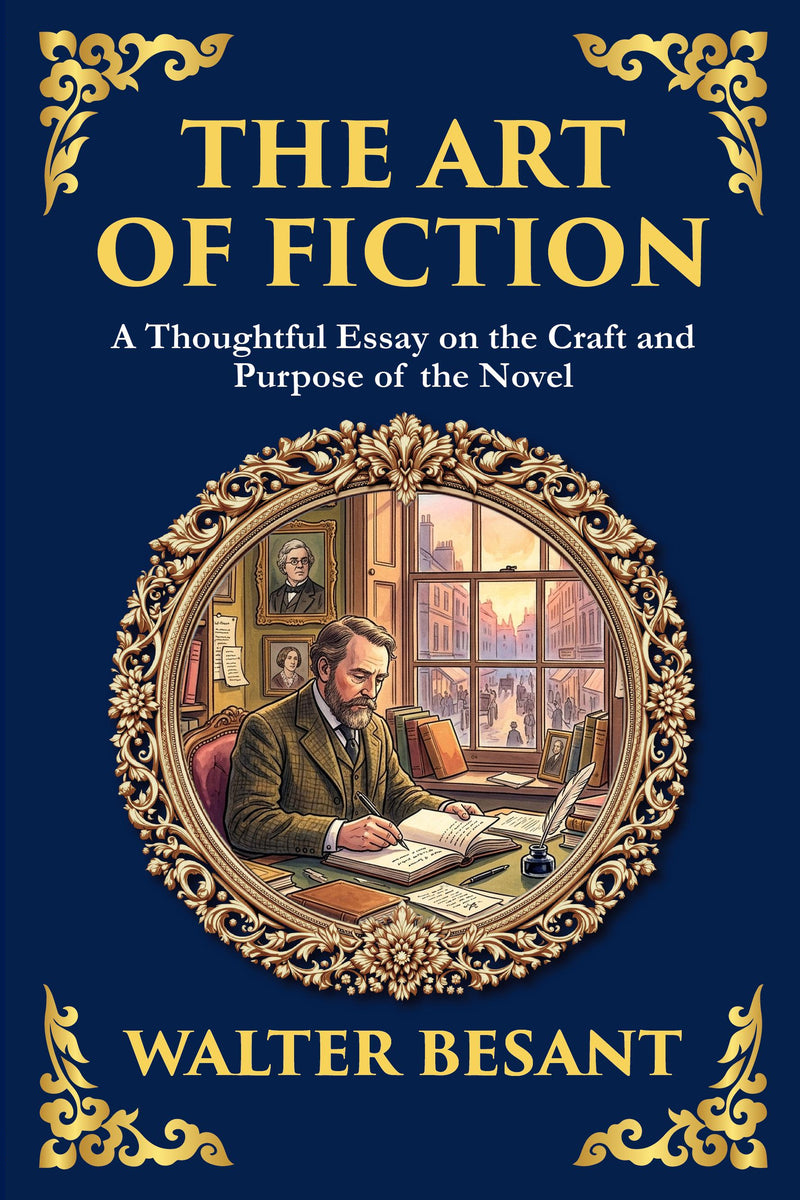
The Art of Fiction — Large Print
In this passionate and articulate essay, Walter Besant argues for the dignity and importance of the novel as a true form of art.
or free app
10,000+ hrs library
30-day guarantee
The complete The Art of Fiction appears in modern English through Library of Alexandria Press, available online with audiobook narration included for members.
Have you ever wondered why fiction holds such power to shape our understanding of life? The Art of Fiction by Walter Besant is more than a literary essay—it’s a bold declaration that fiction is not merely entertainment, but a vital artistic force capable of enriching society and reflecting the deepest truths of the human experience. Originally delivered as a lecture in 1884, this landmark work was a turning point in literary criticism.
Besant, a novelist and public intellectual, sought to raise the status of fiction and its creators, championing the novel as a legitimate art form. His insights resonate even today, as debates over literary merit, commercial success, and the writer's role in society continue to evolve. This elegantly argued essay touches on everything from the moral responsibility of the novelist to the techniques that make fiction compelling.
It remains a key text for understanding not just how fiction works—but why it matters.
What you’ll discover in this modern edition
- A Visionary Defense of the Novel – Learn why Besant believed fiction deserved the same respect as other arts.
- Literary Theory Grounded in Practice – Explore Besant’s insights on character development, setting, plot, and realism.
- Historical Significance in Literary Debate – Understand how this essay sparked responses from major writers like Henry James, shaping modern ideas of fiction.
- A Call to Artistic Responsibility – Reflect on the novelist’s role in moral, cultural, and imaginative life.
- Timeless Wisdom for Writers and Readers Alike – Find inspiration and guidance whether you're crafting your own stories or seeking to read more deeply.
| Formats | eBook (EPUB + PDF) · Audiobook · Paperback · Hardcover · Large Print |
| Language | English |
| Trim size (print) | 6 × 9 in |
| Binding | Paperback — perfect-bound · Hardcover — casewrap |
| Large Print edition | Same text in a larger, easy-read type — a larger font, not a larger trim |
| Print pricing | Every physical book at our true cost — at-cost, no profit (members) |
| Library | 873 restored titles, always growing |
| Length | 13,410 words · ~54 min reading |
| Reading level | Grade 5 · an easy, flowing read (this modern-English edition) |
| Edition | Modern English translation · 2026 |
Member reviews for this edition are collected as readers finish it — be the first. Across the library: 12,000+ books shipped, every plan covered by a 365-day print guarantee.
About this edition
A faithful, unabridged modern-English edition by The Library of Alexandria — carefully rendered for today's reader and verified paragraph-by-paragraph against the public-domain source. Available as eBook, audiobook, paperback, hardcover, and large print.
- Complete & unabridgedVerified paragraph by paragraph against the source — never a scan, never abridged.
- Modern English, faithfulReadable today, with the author’s meaning kept intact. Readable — not simplified.
- Every format, one membershipRead in your browser or the free app, or listen to the full audiobook.
Included free with your membership
Cancel anytime, one click · 30-day money-back guarantee
Edition last updated July 2026
What’s inside
The Art of Fiction — Large Print — complete and unabridged: all 3 sections included with membership, plus the full audiobook.
Begin reading The Art of Fiction — Large Print
In clear modern English — the complete text is included with membership.
Introduction
In April of 1884, a distinguished and immensely popular English novelist stood before the Royal Institution in London and delivered a lecture that would reverberate far beyond the walls of that lecture hall. His title was bold, almost provocative in its confidence: “The Art of Fiction.” With those four words, Walter Besant set out to make a claim that, in his own time, was anything but obvious—that the writing of novels was a serious art, governed by principles, deserving of study, and worthy of the same respect granted to painting, sculpture, music, and poetry.
To us, more than a century later, this proposition may seem almost too modest to argue. We live in an age that takes the novel for granted as one of the central achievements of human culture. University departments dissect fiction with scholarly rigor; bookstores devote entire floors to it; readers form passionate communities around favorite authors; and the question of whether fiction is “art” strikes most of us as already settled. But this was emphatically not the world in which Besant spoke. In Victorian Britain, the novel occupied an uneasy and frequently disreputable position. It was popular, yes—wildly so—but popularity itself was suspect among the cultured classes. Fiction was often regarded as mere entertainment, a frivolous amusement for idle hours, a guilty pleasure to be indulged but not respected. Serious people read history, philosophy, theology, and poetry. The novel, by contrast, was something one might consume in private and apologize for in company.
It is against this backdrop that Besant’s essay must be understood. He was not merely describing the craft of fiction; he was defending its very dignity. He was arguing, with the assurance of a man who had built a successful career writing the very thing he championed, that the novelist was an artist in the fullest sense—that the act of creating believable characters, of constructing a compelling narrative, of rendering scenes with vividness and truth, demanded as much skill, discipline, and inspired labor as any of the more traditionally honored arts. This was a fighting position, and Besant took it up with gusto.
What makes the essay so engaging, even now, is the personality that animates it. Besant writes not as a remote theorist but as a working professional who knows the trade from the inside. He had spent years at his desk, producing novels both alone and in his famous collaboration with James Rice, and he speaks with the practical authority of someone who has actually faced the blank page and wrestled it into submission. His advice is concrete, his observations grounded in experience, his enthusiasm contagious. He wants to share what he has learned, and he wants to convince the skeptical that what he does for a living is honorable, demanding, and important.
The reader approaching this short work for the first time should know that it is, at heart, a manifesto. Besant lays out what he believes to be the laws of fiction—the principles that, in his view, govern good novel-writing as surely as the laws of perspective govern good painting. He insists that fiction can be taught, at least in part; that it has rules; that a young writer can learn the craft through study and practice rather than relying solely on some mysterious inborn genius. At the same time, he is careful to acknowledge the role of natural gift, of that indefinable quality that separates the merely competent from the truly inspired. The tension between the teachable and the innate runs throughout the essay and gives it much of its intellectual texture.
Among the principles Besant advances, several stand out for their continuing relevance. He argues that the novelist must above all observe reality closely—that fiction draws its power from truthful representation of life, from accurate detail, from a sympathetic understanding of human character. He stresses the importance of personal experience and direct knowledge, cautioning the would-be writer against describing what he has not seen or felt. He emphasizes that fiction should not merely entertain but should also serve a moral and humanizing purpose, expanding the reader’s sympathies and deepening his understanding of his fellow human beings. And he maintains, perhaps most strikingly, that the novel is the most democratic and accessible of all the arts—reaching more people, touching more lives, and exercising a greater influence over the public mind than any other form of literature.
These ideas, taken together, form a coherent and surprisingly comprehensive theory of fiction. They reflect the confidence of an age that believed in progress, in the improving power of art, and in the capacity of literature to make the world better. There is something bracing in Besant’s certainty, something that the more anxious and self-doubting literary culture of our own time might find both quaint and refreshing. He does not hedge or qualify endlessly; he states his convictions plainly and defends them with vigor. Whether or not one ultimately agrees with him, one cannot help but admire the clarity and force of his argument.
No account of this essay would be complete without mention of the remarkable dialogue it provoked. For Besant’s lecture did not vanish into the air after he finished speaking. It was published, and it caught the attention of one of the greatest novelists then writing in the English language: Henry James. James, who was at that point developing the subtle and demanding theory of fiction that would shape the modern novel, responded with an essay of his own—also titled “The Art of Fiction”—in which he engaged directly with Besant’s arguments, agreeing with some, gently dismantling others, and using the occasion to articulate his own profound vision of what the novel could be.
This exchange has become one of the celebrated moments in the history of literary criticism, and it lends Besant’s essay a significance beyond its own intrinsic merits. To read Besant is, in a sense, to overhear the opening statement of a conversation that helped to define how we think about fiction to this day. James took Besant’s confident “rules” and questioned whether such rules could really exist; he argued that the novel was too living, too various, too free a form to be bound by prescriptions. Where Besant offered a list of dos and don’ts, James insisted that the only obligation of the novel was to be interesting, and that the means by which it achieved this were as boundless as life itself. The novelist, James suggested, should be granted complete freedom of choice in subject and method, to be judged only by the results.
Yet it would be a mistake to read Besant merely as a foil for James, as the lesser figure whose pronouncements served chiefly to draw out the genius of his more celebrated respondent. That is the verdict that literary history has too often handed down, but it is unjust. Besant’s essay has its own integrity and its own wisdom. His insistence that fiction is a serious art was the necessary first step, the bold assertion that opened the door for James’s more refined elaborations. Without Besant’s manifesto, there would have been no occasion for James’s masterpiece of criticism. And on many points—the importance of observation, the value of personal experience, the moral dimension of fiction, the democratic reach of the novel—Besant’s views remain entirely defensible, even compelling.
There is also a generosity and a humanity in Besant’s writing that deserves recognition. He genuinely wanted to help younger writers; he believed that the art he loved could be shared and taught; he saw fiction as a force for good in the world. His was the temperament of a builder, a popularizer, an enthusiast—a man who wanted to throw open the gates of his craft and invite others in. James, by contrast, was the supreme aesthete, the connoisseur of subtlety, the writer for writers. The two men represented two enduring poles of literary thought: the one emphasizing rules, accessibility, and moral purpose; the other emphasizing freedom, complexity, and the autonomy of art. Their debate has never really ended, and every reader of fiction today instinctively takes a side, whether or not he knows it.
For the modern reader, then, this essay offers a rare opportunity to witness the foundations of literary theory being laid in real time, by a practitioner who cared deeply about getting it right. It is a primary document, a piece of living history, a snapshot of a moment when the very status of the novel was being negotiated and contested. To read it is to understand something about how the books we love came to be taken seriously, about the long struggle to establish fiction as a legitimate and honorable form of human expression.
It is worth pausing, too, on the question of why these debates mattered so urgently in Besant’s era. The Victorian period saw an explosion in literacy, in the production of cheap books and periodicals, in the circulating libraries that put novels into the hands of millions. Fiction was becoming a mass phenomenon, a commercial enterprise of staggering scale. With this came anxiety: anxiety about the quality of what was being read, about the moral influence of fiction on impressionable minds, about whether the flood of popular novels was elevating or degrading the public taste. Besant’s defense of fiction as art was, in part, a response to these anxieties. He wanted to insist that the novel, properly understood and practiced, was not a threat to culture but one of its greatest ornaments—that it could and should aspire to the highest standards, that the writer bore a real responsibility to his readers and to his art. These were not abstract concerns for Besant; they touched directly on his livelihood and on the dignity of the profession to which he had devoted his life.
Indeed, Besant was more than a theorist of fiction’s dignity—he was one of its most active practical champions. He devoted enormous energy to improving the lot of authors as a class, fighting for their professional and economic interests, and helping to establish institutions to protect them. This practical concern for the working writer infuses his essay with a particular flavor. When he speaks of fiction as an art, he is also thinking of it as a trade, a profession, a way of earning an honest living through honest labor. There is no false romanticism in his account, no pretense that the writer is some ethereal being above the marketplace. The novelist, in Besant’s view, is a craftsman who deserves respect, fair compensation, and proper recognition. This grounded, professional sensibility is one of the most attractive features of the essay, and it sets Besant apart from many other theorists of art who preferred to keep their hands clean of such mundane considerations.
This volume presents Besant’s essay in a modern translation, adapted for the contemporary reader. A word about what this means, and why it matters, may help to set expectations and to enrich the experience that follows.
Besant wrote in the prose of the late nineteenth century—elegant, formal, often elaborate in its constructions, and studded with allusions and assumptions that would have been instantly familiar to his original audience but that can present obstacles to readers today. The Victorian sentence could be a magnificent and stately thing, but it could also wind and double back upon itself in ways that test the patience of those accustomed to more direct modern prose. References to figures, controversies, and cultural touchstones of the 1880s, perfectly clear to Besant’s listeners, may now require explanation or fall flat for want of context. The purpose of this modern adaptation is to bridge that gap—to render Besant’s ideas in language that flows naturally for the present-day reader while preserving the substance, the spirit, and the force of his original argument.
This is a delicate task, and it should be approached with both gratitude and a measure of awareness. The goal of such an adaptation is not to replace Besant’s voice with something bland or anonymous, but to clear away the incidental difficulties of period style so that the genuine intelligence and passion of the work can shine through unobstructed. The reader who comes to this edition should think of it as a guided introduction—a way into Besant’s thought that does not demand prior familiarity with Victorian prose conventions or with the now-forgotten controversies of his day. Those who find themselves captivated, as many will, may wish afterward to seek out the original text and experience Besant’s words in their authentic period form, with all the texture and flavor that the nineteenth-century idiom provides. But for a first encounter, and for the general reader who wants to grasp what Besant actually argued and why it mattered, a thoughtful modern rendering offers an ideal point of entry.
Cancel anytime, one click · 30-day money-back guarantee
Founding annual rate available now — your price locks for life when you join.
Not ready? Get this free chapter by email — read it anytime.
✓ Sent — check your inbox for The Art of Fiction — Large Print.
Questions about The Art of Fiction — Large Print
What is The Art of Fiction about?
In this passionate and articulate essay, Walter Besant argues for the dignity and importance of the novel as a true form of art. The Art of Fiction is both a defense of the novelist's craft and a rallying cry for authors to treat fiction not merely as entertainment but as a serious means of understanding life, character, and society. Written during a time when the literary establishment often dismissed fiction as inferior to poetry or history, Besant’s work helped define the future of the English novel.
Who wrote The Art of Fiction?
The Art of Fiction was written by Walter Besant. This edition presents the complete work in clear modern English, faithfully rendered from the public-domain original by Library of Alexandria Press.
Is The Art of Fiction free to read?
The opening chapter is free to read on this page. Members read and listen to the complete work — and the entire library — free, and can order any physical book at our true print cost.
How long is The Art of Fiction?
3 chapters (~13,410 words) — about 54 min of reading in this modern-English edition.
Is this an abridged version of The Art of Fiction?
No. This is the complete, unabridged The Art of Fiction, carefully rendered into clear modern English and verified paragraph-by-paragraph against the public-domain source — nothing is cut or summarised.
What formats does The Art of Fiction come in?
The Art of Fiction is available as eBook, paperback, hardcover and large print. eBook and audiobook are included with membership; printed editions ship at our true print cost.
Shipping & returns
Billing & membership
More from the library


Explore Classic & Literary
- Dream Psychology: Psychoanalysis for Beginners · Sigmund Freud
- Great Expectations · Charles Dickens
- The Brothers Karamazov · Fyodor Dostoyevsky
- The Great Gatsby · F. Scott Fitzgerald
- Wild Flowers Worth Knowing · Neltje Blanchan
- Italian Hours · Henry James
- A Popular History of France from the Earliest Times, Volume 5 · François Guizot
- A history of English literature: A practical text-book · Edward Albert
- Italian Highways and Byways from a Motor Car · M. F. Mansfield
- The Heart-Cry of Jesus · Byron J. Rees
- Castes and Tribes of Southern India. Vol. 6 of 7 · Edgar Thurston
- Against the Grain · J.-K. Huysmans
- Dombey and Son · Charles Dickens
- How to Invest Money · George Garr Henry
- The Great Controversy Between Christ and Satan · Ellen Gould Harmon White
- One Hundred Proofs That the Earth Is Not a Globe · William Carpenter
- Southern Literature From 1579–1895 · Louise Manly
- The Renaissance: Studies in Art and Poetry · Walter Pater
- Mark Twain’s Speeches · Mark Twain
- Tacitus on Germany · Cornelius Tacitus
- The Rosary · Florence L. Barclay
- Peculiarities of American Cities · Willard W. Glazier
- Tennis for Girls · Florence A. Ballin
- The World’s Greatest Books — Volume 02 — Fiction
- Shirley · Charlotte Brontë
- Daisy Miller: A Study · Henry James
- Louis Lambert · Honoré de Balzac
- Historic Jamaica · Frank Cundall
- The Gambler · Fyodor Dostoyevsky
- The Mayor of Casterbridge · Thomas Hardy
The Art of Fiction — Large Print
The Art of Fiction — Large Print
A Thoughtful Essay on the Craft and Purpose of the Novel
Walter Besant
Contents
- Introduction
- The Art of Fiction
- Appendix
Introduction
In April of 1884, a distinguished and immensely popular English novelist stood before the Royal Institution in London and delivered a lecture that would reverberate far beyond the walls of that lecture hall. His title was bold, almost provocative in its confidence: “The Art of Fiction.” With those four words, Walter Besant set out to make a claim that, in his own time, was anything but obvious—that the writing of novels was a serious art, governed by principles, deserving of study, and worthy of the same respect granted to painting, sculpture, music, and poetry.
To us, more than a century later, this proposition may seem almost too modest to argue. We live in an age that takes the novel for granted as one of the central achievements of human culture. University departments dissect fiction with scholarly rigor; bookstores devote entire floors to it; readers form passionate communities around favorite authors; and the question of whether fiction is “art” strikes most of us as already settled. But this was emphatically not the world in which Besant spoke. In Victorian Britain, the novel occupied an uneasy and frequently disreputable position. It was popular, yes—wildly so—but popularity itself was suspect among the cultured classes. Fiction was often regarded as mere entertainment, a frivolous amusement for idle hours, a guilty pleasure to be indulged but not respected. Serious people read history, philosophy, theology, and poetry. The novel, by contrast, was something one might consume in private and apologize for in company.
It is against this backdrop that Besant’s essay must be understood. He was not merely describing the craft of fiction; he was defending its very dignity. He was arguing, with the assurance of a man who had built a successful career writing the very thing he championed, that the novelist was an artist in the fullest sense—that the act of creating believable characters, of constructing a compelling narrative, of rendering scenes with vividness and truth, demanded as much skill, discipline, and inspired labor as any of the more traditionally honored arts. This was a fighting position, and Besant took it up with gusto.
What makes the essay so engaging, even now, is the personality that animates it. Besant writes not as a remote theorist but as a working professional who knows the trade from the inside. He had spent years at his desk, producing novels both alone and in his famous collaboration with James Rice, and he speaks with the practical authority of someone who has actually faced the blank page and wrestled it into submission. His advice is concrete, his observations grounded in experience, his enthusiasm contagious. He wants to share what he has learned, and he wants to convince the skeptical that what he does for a living is honorable, demanding, and important.
The reader approaching this short work for the first time should know that it is, at heart, a manifesto. Besant lays out what he believes to be the laws of fiction—the principles that, in his view, govern good novel-writing as surely as the laws of perspective govern good painting. He insists that fiction can be taught, at least in part; that it has rules; that a young writer can learn the craft through study and practice rather than relying solely on some mysterious inborn genius. At the same time, he is careful to acknowledge the role of natural gift, of that indefinable quality that separates the merely competent from the truly inspired. The tension between the teachable and the innate runs throughout the essay and gives it much of its intellectual texture.
Among the principles Besant advances, several stand out for their continuing relevance. He argues that the novelist must above all observe reality closely—that fiction draws its power from truthful representation of life, from accurate detail, from a sympathetic understanding of human character. He stresses the importance of personal experience and direct knowledge, cautioning the would-be writer against describing what he has not seen or felt. He emphasizes that fiction should not merely entertain but should also serve a moral and humanizing purpose, expanding the reader’s sympathies and deepening his understanding of his fellow human beings. And he maintains, perhaps most strikingly, that the novel is the most democratic and accessible of all the arts—reaching more people, touching more lives, and exercising a greater influence over the public mind than any other form of literature.
These ideas, taken together, form a coherent and surprisingly comprehensive theory of fiction. They reflect the confidence of an age that believed in progress, in the improving power of art, and in the capacity of literature to make the world better. There is something bracing in Besant’s certainty, something that the more anxious and self-doubting literary culture of our own time might find both quaint and refreshing. He does not hedge or qualify endlessly; he states his convictions plainly and defends them with vigor. Whether or not one ultimately agrees with him, one cannot help but admire the clarity and force of his argument.
No account of this essay would be complete without mention of the remarkable dialogue it provoked. For Besant’s lecture did not vanish into the air after he finished speaking. It was published, and it caught the attention of one of the greatest novelists then writing in the English language: Henry James. James, who was at that point developing the subtle and demanding theory of fiction that would shape the modern novel, responded with an essay of his own—also titled “The Art of Fiction”—in which he engaged directly with Besant’s arguments, agreeing with some, gently dismantling others, and using the occasion to articulate his own profound vision of what the novel could be.
This exchange has become one of the celebrated moments in the history of literary criticism, and it lends Besant’s essay a significance beyond its own intrinsic merits. To read Besant is, in a sense, to overhear the opening statement of a conversation that helped to define how we think about fiction to this day. James took Besant’s confident “rules” and questioned whether such rules could really exist; he argued that the novel was too living, too various, too free a form to be bound by prescriptions. Where Besant offered a list of dos and don’ts, James insisted that the only obligation of the novel was to be interesting, and that the means by which it achieved this were as boundless as life itself. The novelist, James suggested, should be granted complete freedom of choice in subject and method, to be judged only by the results.
Yet it would be a mistake to read Besant merely as a foil for James, as the lesser figure whose pronouncements served chiefly to draw out the genius of his more celebrated respondent. That is the verdict that literary history has too often handed down, but it is unjust. Besant’s essay has its own integrity and its own wisdom. His insistence that fiction is a serious art was the necessary first step, the bold assertion that opened the door for James’s more refined elaborations. Without Besant’s manifesto, there would have been no occasion for James’s masterpiece of criticism. And on many points—the importance of observation, the value of personal experience, the moral dimension of fiction, the democratic reach of the novel—Besant’s views remain entirely defensible, even compelling.
There is also a generosity and a humanity in Besant’s writing that deserves recognition. He genuinely wanted to help younger writers; he believed that the art he loved could be shared and taught; he saw fiction as a force for good in the world. His was the temperament of a builder, a popularizer, an enthusiast—a man who wanted to throw open the gates of his craft and invite others in. James, by contrast, was the supreme aesthete, the connoisseur of subtlety, the writer for writers. The two men represented two enduring poles of literary thought: the one emphasizing rules, accessibility, and moral purpose; the other emphasizing freedom, complexity, and the autonomy of art. Their debate has never really ended, and every reader of fiction today instinctively takes a side, whether or not he knows it.
For the modern reader, then, this essay offers a rare opportunity to witness the foundations of literary theory being laid in real time, by a practitioner who cared deeply about getting it right. It is a primary document, a piece of living history, a snapshot of a moment when the very status of the novel was being negotiated and contested. To read it is to understand something about how the books we love came to be taken seriously, about the long struggle to establish fiction as a legitimate and honorable form of human expression.
It is worth pausing, too, on the question of why these debates mattered so urgently in Besant’s era. The Victorian period saw an explosion in literacy, in the production of cheap books and periodicals, in the circulating libraries that put novels into the hands of millions. Fiction was becoming a mass phenomenon, a commercial enterprise of staggering scale. With this came anxiety: anxiety about the quality of what was being read, about the moral influence of fiction on impressionable minds, about whether the flood of popular novels was elevating or degrading the public taste. Besant’s defense of fiction as art was, in part, a response to these anxieties. He wanted to insist that the novel, properly understood and practiced, was not a threat to culture but one of its greatest ornaments—that it could and should aspire to the highest standards, that the writer bore a real responsibility to his readers and to his art. These were not abstract concerns for Besant; they touched directly on his livelihood and on the dignity of the profession to which he had devoted his life.
Indeed, Besant was more than a theorist of fiction’s dignity—he was one of its most active practical champions. He devoted enormous energy to improving the lot of authors as a class, fighting for their professional and economic interests, and helping to establish institutions to protect them. This practical concern for the working writer infuses his essay with a particular flavor. When he speaks of fiction as an art, he is also thinking of it as a trade, a profession, a way of earning an honest living through honest labor. There is no false romanticism in his account, no pretense that the writer is some ethereal being above the marketplace. The novelist, in Besant’s view, is a craftsman who deserves respect, fair compensation, and proper recognition. This grounded, professional sensibility is one of the most attractive features of the essay, and it sets Besant apart from many other theorists of art who preferred to keep their hands clean of such mundane considerations.
This volume presents Besant’s essay in a modern translation, adapted for the contemporary reader. A word about what this means, and why it matters, may help to set expectations and to enrich the experience that follows.
Besant wrote in the prose of the late nineteenth century—elegant, formal, often elaborate in its constructions, and studded with allusions and assumptions that would have been instantly familiar to his original audience but that can present obstacles to readers today. The Victorian sentence could be a magnificent and stately thing, but it could also wind and double back upon itself in ways that test the patience of those accustomed to more direct modern prose. References to figures, controversies, and cultural touchstones of the 1880s, perfectly clear to Besant’s listeners, may now require explanation or fall flat for want of context. The purpose of this modern adaptation is to bridge that gap—to render Besant’s ideas in language that flows naturally for the present-day reader while preserving the substance, the spirit, and the force of his original argument.
This is a delicate task, and it should be approached with both gratitude and a measure of awareness. The goal of such an adaptation is not to replace Besant’s voice with something bland or anonymous, but to clear away the incidental difficulties of period style so that the genuine intelligence and passion of the work can shine through unobstructed. The reader who comes to this edition should think of it as a guided introduction—a way into Besant’s thought that does not demand prior familiarity with Victorian prose conventions or with the now-forgotten controversies of his day. Those who find themselves captivated, as many will, may wish afterward to seek out the original text and experience Besant’s words in their authentic period form, with all the texture and flavor that the nineteenth-century idiom provides. But for a first encounter, and for the general reader who wants to grasp what Besant actually argued and why it mattered, a thoughtful modern rendering offers an ideal point of entry.
Tonight, I want to discuss fiction as one of the fine arts. To do this, I first need to present a few ideas. These concepts aren’t new, and they probably aren’t controversial, but they haven’t yet become a common part of the public’s general understanding. There are three of these points, although the final two follow directly from the first. They are:
1. Fiction is an art form that deserves to be considered equal to painting, sculpture, music, and poetry. Its scope is just as limitless, its potential just as immense, and its achievements just as admirable as those of any other fine art.
2. Like those other arts, fiction is guided and controlled by general principles. These rules can be defined and taught with the same precision and accuracy as the laws of harmony, perspective, and proportion.
3. Like the other fine arts, fiction is far more than just a technical skill; no amount of rules or guidelines can teach it to someone who lacks the necessary natural talent.
These are the three points I intend to discuss. It follows logically that if we accept these premises, those who practice the art of fiction must be recognized as true artists, in every sense of the word, just like those who have inspired and uplifted humanity through music and painting. Consequently, the great masters of fiction should be held in the same regard as the great masters of other arts. In other words, anyone who reaches the absolute peak of this craft is one of the world’s greatest individuals.
I imagine that everyone in this room would agree with these points; in fact, most of you probably find them obvious. However, applying these theories to real-life situations and people can be more challenging. For example, people admire great masters like Raphael or Mozart so much that most would be shocked if someone suggested that Thackeray should be ranked on the same level as an equal. I am not claiming that Thackeray’s skill is similar to Raphael’s, or that their work is alike in any way. I am simply saying that since fiction and painting are both arts—and closely related ones at that—those who reach the absolute peak of achievement in either field are equals.
End of the free sample
Keep reading, free
Members read and listen to the complete book — and the entire library. Cancel anytime, one click · 30-day money-back guarantee.