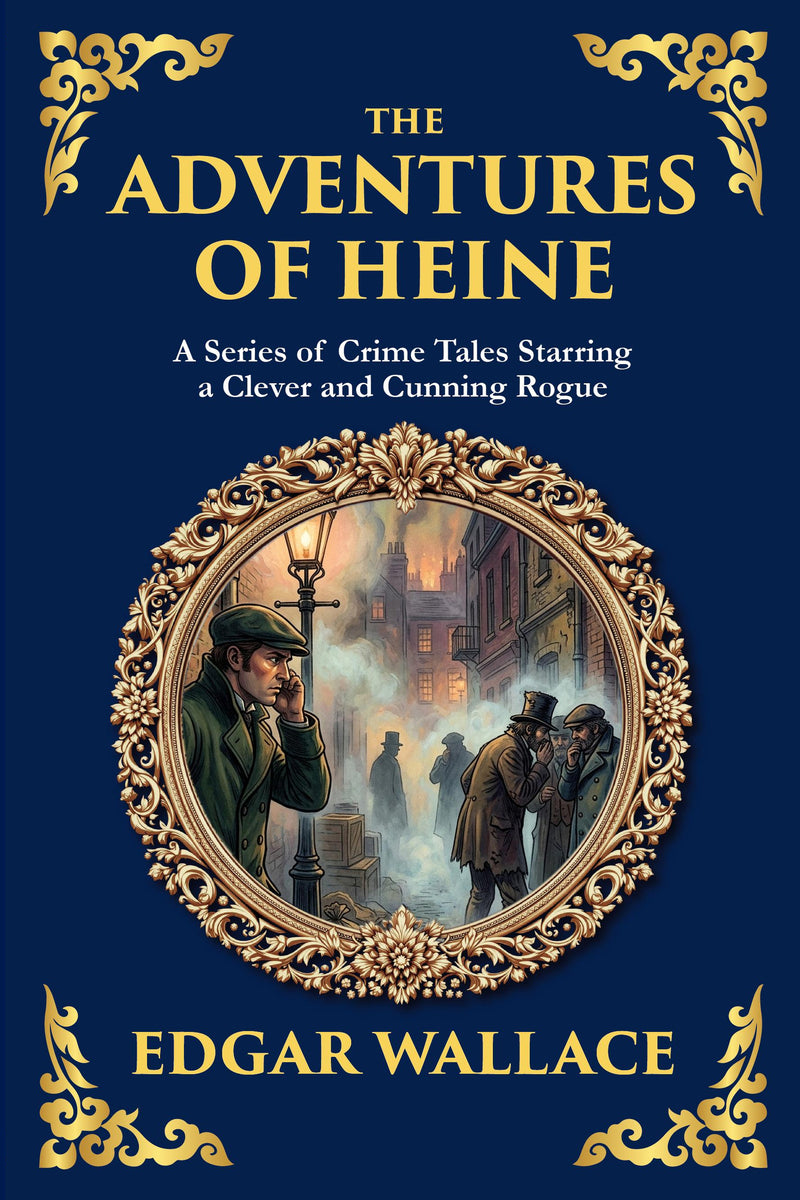
The Adventures of Heine — Large Print
Step into the underworld of wit, charm, and audacious schemes. In The Adventures of Heine, Edgar Wallace crafts a captivating series of crime stories featuring one of literature’s most charming rogues—a conman with a code, a gentleman with a crooked smile, and a criminal mind blessed with a dazzling wit.
or free app
10,000+ hrs library
30-day guarantee
The complete The Adventures of Heine appears in modern English through Library of Alexandria Press, available online with audiobook narration included for members.
Have you ever wondered why we love the rogue more than the hero? The Adventures of Heine by Edgar Wallace delivers an unforgettable gallery of thrilling escapades, all starring the magnetic and mischievous Heine—a master of disguise, deception, and dodging the law. Known for his sharp tongue and sharper mind, Heine lives by wit, not weapons, as he dances through a world of crime with flair and finesse.
Wallace, a prolific writer and journalist, brings his signature pacing and suspense to this collection of fast-paced tales. These stories capture the essence of early 20th-century crime fiction, blending action, irony, and a touch of philosophy. But at their core, they are character studies of a man who refuses to play by the rules—but makes his own with style.
What you’ll discover in this modern edition
- A Mastermind of Mischief and Morality Meet Heine—no ordinary crook, but a witty outlaw with principles and panache.
- A Series of Clever, Self-Contained Crime Adventures Follow Heine through ingenious schemes, each story a compact gem of plot twists and reversals.
- Psychological Insight Behind the Humor and Hijinks Explore the thin line between good and evil, and why we’re drawn to those who blur it.
- Edgar Wallace’s Signature Blend of Suspense and Satire Experience the brisk storytelling and sly social commentary that made Wallace a bestselling author of his day.
- A Literary Antihero Who Stands the Test of Time Heine joins the ranks of classic rogues like Raffles, Arsène Lupin, and Simon Templar— men who break the law, but not your heart.
| Formats | eBook (EPUB + PDF) · Audiobook · Paperback · Hardcover · Large Print |
| Language | English |
| Trim size (print) | 6 × 9 in |
| Binding | Paperback — perfect-bound · Hardcover — casewrap |
| Large Print edition | Same text in a larger, easy-read type — a larger font, not a larger trim |
| Print pricing | Every physical book at our true cost — at-cost, no profit (members) |
| Library | 873 restored titles, always growing |
| Length | 86,081 words · ~5 hr 44 min reading |
| Reading level | Grade 6 · an easy, flowing read (this modern-English edition) |
| Edition | Modern English translation · 2026 |
Member reviews for this edition are collected as readers finish it — be the first. Across the library: 12,000+ books shipped, every plan covered by a 365-day print guarantee.
About this edition
A faithful, unabridged modern-English edition by The Library of Alexandria — carefully rendered for today's reader and verified paragraph-by-paragraph against the public-domain source. Available as eBook, audiobook, paperback, hardcover, and large print.
- Complete & unabridgedVerified paragraph by paragraph against the source — never a scan, never abridged.
- Modern English, faithfulReadable today, with the author’s meaning kept intact. Readable — not simplified.
- Every format, one membershipRead in your browser or the free app, or listen to the full audiobook.
Included free with your membership
Cancel anytime, one click · 30-day money-back guarantee
Edition last updated July 2026
What’s inside
The Adventures of Heine — Large Print — complete and unabridged: all 19 sections included with membership, plus the full audiobook.
Begin reading The Adventures of Heine — Large Print
In clear modern English — the complete text is included with membership.
Introduction
There is a particular pleasure in encountering a rogue who is cleverer than the men who hunt him, more charming than the victims he relieves of their burdens, and possessed of a moral compass that, while bent in fascinating directions, never quite snaps in two. Such is the figure who waits in the pages ahead, and such is the singular delight of the collected escapades that comprise this volume. Before stepping into that world, however, it is worth pausing to understand the hand that shaped these stories, the era from which they sprang, and the qualities that have allowed them to endure long after their first appearance in print.
Edgar Wallace stands among the most extraordinary figures in the history of popular fiction. Born in Greenwich, London, in 1875, he entered the world under circumstances that gave no hint of the towering literary output to come. The illegitimate son of two actors, he was handed over to be raised by a Billingsgate fish porter and his wife, a working-class family who gave the boy a home if not a fortune. From these unpromising beginnings emerged one of the most prolific and commercially successful authors the English language has ever produced. By the time of his death in 1932, Wallace had written well over a hundred and fifty novels, countless short stories, numerous plays, screenplays, and reams of journalism. At the height of his fame it was said, only half in jest, that one in every four books read in England had been written by him. He was a phenomenon, a one-man publishing industry, a writer whose name on a cover was a guarantee of entertainment.
Wallace’s path to literary celebrity wound through a great many trades. He left school young, worked as a newsboy, a printer’s assistant, a milk-delivery boy, a plasterer, and a shoe shop attendant before enlisting in the army. Posted to South Africa, he found his calling in words, first as a writer of verse and then as a war correspondent during the Boer War. This journalistic apprenticeship proved decisive. It taught him to write fast, to write clearly, and above all to write with an eye trained on the reader’s appetite for incident and excitement. The newspaperman’s instinct for what grabs attention and what holds it never left him, and it pulses through every page of his fiction. When he turned to crime writing in earnest, he brought with him the reporter’s gift for pace, for the telling detail, and for the kind of cliffhanger that makes a reader turn just one more page before bed, and then another, and then another still.
It was this restless energy that made Wallace not merely popular but pioneering. He is rightly credited as one of the architects of the modern thriller, that genre of breathless pursuit, hidden identities, daring crimes, and last-minute reversals that has since become a staple of bookshelves and cinema screens around the globe. Where some of his contemporaries built their reputations on the slow-burning puzzle of the classic detective story — the country-house murder, the locked room, the gathering of suspects in the drawing room for the great unveiling — Wallace preferred velocity. His tales move. They crackle with momentum and surprise. He understood, perhaps better than anyone of his generation, that the reader of popular fiction wants above all to be carried away, to be swept into a current of events that does not let go until the final line.
The collection you now hold belongs to a particularly beloved strand of Wallace’s enormous output: his stories of charming criminals and the cat-and-mouse games they play with the forces of law and order. Wallace had a deep and abiding fascination with the figure of the gentleman crook, the polished offender whose crimes are committed not with brute force but with intelligence, audacity, and a kind of theatrical flourish. These were not the desperate, brutal villains of the penny dreadfuls, but men of wit and style, often more sympathetic than the stuffy authorities arrayed against them. In creating such characters, Wallace tapped into something timeless in the reading public’s imagination — that secret admiration we all harbour for the clever rule-breaker, the trickster who outsmarts a system we ourselves often find rigid, hypocritical, or absurd.
What makes a fictional criminal so endlessly appealing? It is a question worth considering as you prepare to enter these pages, because the answer goes to the very heart of why these stories have delighted generations of readers. The brilliant crook occupies a peculiar and privileged place in our collective imagination. He lives outside the law, yet we root for him. He takes what is not his, yet we forgive him. He deceives, manipulates, and outwits, yet we find ourselves cheering at his every triumph and wincing at his every near-miss. There is something deliciously subversive in this arrangement, and Wallace understood it perfectly.
Part of the appeal lies in competence. We are drawn to mastery in any form, and there is a particular thrill in watching someone who is simply better at what he does than everyone around him. The crook who is always one step ahead, who anticipates the moves of his pursuers, who turns apparent disaster into opportunity with a flick of his clever mind — this is a figure who satisfies our deep hunger to see intelligence rewarded. In a world that so often seems to favour the dull, the plodding, and the merely persistent, the brilliant rogue is a fantasy of cleverness triumphant. He reminds us that wits can beat brawn, that imagination can outmanoeuvre authority, and that the underdog with a quick mind need never bow to the lumbering machinery of officialdom.
But competence alone is not enough to earn our affection. There must also be charm, and here Wallace’s creations excel. The successful literary crook is invariably a man of manners, of humour, of a certain irresistible style. He is the kind of person you would want at your dinner table, the guest who tells the best stories and makes everyone laugh, even as you find yourself instinctively checking that your wallet is still in your pocket. This combination of danger and delight is intoxicating. We are simultaneously attracted to and wary of such a figure, and that tension is precisely what makes him so compelling to read about. We can enjoy his company from the safe distance of the page, savouring his audacity without suffering the consequences of his crimes.
There is, too, a moral dimension to the appeal that should not be overlooked. The most beloved fictional rogues are rarely entirely villainous. They operate according to their own code, often targeting those who deserve to be relieved of their ill-gotten wealth — the corrupt financier, the bullying aristocrat, the swindler who has himself swindled others. In this way, the crook becomes a kind of rough instrument of justice, redistributing fortune and humbling the proud in ways that the official law seems unable or unwilling to do. He is the trickster of folklore reborn in modern dress, the descendant of Robin Hood and Reynard the Fox, the figure who exposes the gap between the law as written and justice as felt. When such a character outwits a pompous official or fleeces a deserving target, we feel not guilt but satisfaction, a sense that the moral order has been restored even as the legal one has been flouted.
Wallace was a master at calibrating this delicate balance. He knew exactly how far to push his crooked protagonists before they crossed from charming into repellent, and he knew how to surround them with antagonists worthy of our scorn or our grudging respect. The result is fiction that engages not only our appetite for excitement but our sense of fair play, our love of the underdog, and our delight in seeing cleverness rewarded. The cat-and-mouse dynamic that animates these stories — the perpetual contest between the crook who must always be inventing new schemes and the pursuers who must always be one beat behind — is a structure of almost infinite renewability. Each encounter is a fresh puzzle, a new test of ingenuity, a contest of wits in which the stakes are freedom, fortune, and reputation.
It is also worth noting the distinctly modern flavour of the world these stories inhabit. Wallace wrote at a time of rapid change, when the old certainties of Victorian England were giving way to the speed and complexity of the twentieth century. His criminals move through a recognisably modern landscape of telegrams and trains, of banks and brokers, of newspapers and the new machinery of policing. This was a world in which crime itself was becoming more sophisticated, more dependent on information and intelligence than on mere force. The brilliant crook is in many ways the perfect protagonist for this new age — a man whose weapon is his mind, who understands the systems of modern life well enough to exploit their weaknesses, who treats the whole apparatus of commerce and law as a vast and intricate game to be played for profit and pleasure.
Reading these stories today, one is struck by how fresh they remain. The technology may have changed, the fashions may have dated, but the essential dynamics — the contest of wits, the thrill of the audacious scheme, the pleasure of watching a clever mind at work — are as engaging now as they were when first these tales appeared. There is a reason that the figure of the gentleman thief has never gone out of style, that he reappears in every generation in new guises, from the literary creations of Wallace’s contemporaries to the suave criminals of modern film and television. He answers a need in us that does not fade, and Wallace gave us one of the most entertaining incarnations of the type.
This particular volume comes to you as a modern translation, adapted for the contemporary reader, and a few words about what that means and why it matters will help you make the most of the experience ahead. The fiction of the early twentieth century, however brilliant in conception and execution, was written for an audience whose habits, references, and expectations differed in many ways from our own. The pace of prose was sometimes more leisurely, the vocabulary occasionally more ornate, the cultural references frequently tied to a world that has long since passed into history. While there is great pleasure to be had in encountering these works in their original form, there is also a real value in presenting them afresh, in language and rhythm attuned to the modern ear, so that the essential genius of the storytelling can shine through unobscured.
The aim of such an adaptation is never to diminish or to dumb down, but rather to clear away the incidental obstacles that can stand between a contemporary reader and the timeless pleasures of a great story. Idioms that have fallen out of use, sentence structures that now feel cumbersome, allusions that require a footnote to decode — these can, for the modern reader, become small frictions that slow the momentum and dilute the enjoyment. By smoothing these elements while preserving the heart of the narrative, a thoughtful adaptation allows the reader to experience the work much as its original audience did: not as a museum piece to be studied at arm’s length, but as a living, breathing entertainment to be devoured with delight.
This is especially important for an author like Wallace, whose entire genius lay in accessibility and momentum. He was never a writer who courted difficulty for its own sake. He wrote to be read, to be enjoyed, to be consumed in great gulps by readers who craved excitement and could not put his books down. To present his work in a form that recaptures that immediacy for a new generation is, in a sense, to honour his original intention more faithfully than a slavish reproduction of every dated turn of phrase might do. The spirit of these stories — their wit, their pace, their cunning, their delight in the clever scheme — is what matters, and it is that spirit which this edition seeks to convey with the fullest possible force.
Cancel anytime, one click · 30-day money-back guarantee
Founding annual rate available now — your price locks for life when you join.
Not ready? Get this free chapter by email — read it anytime.
✓ Sent — check your inbox for The Adventures of Heine — Large Print.
Questions about The Adventures of Heine — Large Print
What is The Adventures of Heine about?
Step into the underworld of wit, charm, and audacious schemes. In The Adventures of Heine, Edgar Wallace crafts a captivating series of crime stories featuring one of literature’s most charming rogues—a conman with a code, a gentleman with a crooked smile, and a criminal mind blessed with a dazzling wit. From clever scams to near-escapes, Heine outwits the law, befuddles his enemies, and walks the fine line between villainy and anti-heroism.
Who wrote The Adventures of Heine?
The Adventures of Heine was written by Edgar Wallace. This edition presents the complete work in clear modern English, faithfully rendered from the public-domain original by Library of Alexandria Press.
Is The Adventures of Heine free to read?
The opening chapter is free to read on this page. Members read and listen to the complete work — and the entire library — free, and can order any physical book at our true print cost.
How long is The Adventures of Heine?
19 chapters (~86,081 words) — about 5 hr 44 min of reading in this modern-English edition.
Is this an abridged version of The Adventures of Heine?
No. This is the complete, unabridged The Adventures of Heine, carefully rendered into clear modern English and verified paragraph-by-paragraph against the public-domain source — nothing is cut or summarised.
What formats does The Adventures of Heine come in?
The Adventures of Heine is available as eBook, paperback, hardcover and large print. eBook and audiobook are included with membership; printed editions ship at our true print cost.
Shipping & returns
Billing & membership
More from the library


Explore Military & Strategy
- The War of the Worlds · H. G. Wells
- The Belle of Bowling Green · Amelia E. Barr
- Give Me Liberty or Give Me Death · Patrick Henry
- The Thirty-Nine Steps · John Buchan
- Julius Caesar · William Shakespeare
- Rilla of Ingleside · L. M. Montgomery
- Troilus and Criseyde · Geoffrey Chaucer
- The Adventures of Heine · Edgar Wallace
- The Declaration of Independence of the United States of America · Thomas Jefferson
- Armageddon—2419 A.D. · Philip Francis Nowlan
- The Variable Man · Philip K. Dick
- Arms and the Man · Bernard Shaw
- South Africa and the Transvaal War, Vol. 2 (of 8) · Louis Creswicke
- The Red Badge of Courage: An Episode of the American Civil War · Stephen Crane
- Second Variety · Philip K. Dick
- Lysistrata · Aristophanes
- The Iliad · Homer
- A Matter of Proportion · Anne Walker
- This Side of Paradise · F. Scott Fitzgerald
The Adventures of Heine — Large Print
The Adventures of Heine — Large Print
A series of crime stories featuring a brilliant and crafty crook
Edgar Wallace
Contents
- Introduction
- Chapter 1
- Chapter 2
- Chapter 3
- Chapter 4
- Chapter 5
- Chapter 6
- Chapter 7
- Chapter 8
- Chapter 9
- Chapter 10
- Chapter 11
- Chapter 12
- Chapter 13
- Chapter 14
- Chapter 15
- Chapter 16
- Chapter 17
- Chapter 18
Introduction
There is a particular pleasure in encountering a rogue who is cleverer than the men who hunt him, more charming than the victims he relieves of their burdens, and possessed of a moral compass that, while bent in fascinating directions, never quite snaps in two. Such is the figure who waits in the pages ahead, and such is the singular delight of the collected escapades that comprise this volume. Before stepping into that world, however, it is worth pausing to understand the hand that shaped these stories, the era from which they sprang, and the qualities that have allowed them to endure long after their first appearance in print.
Edgar Wallace stands among the most extraordinary figures in the history of popular fiction. Born in Greenwich, London, in 1875, he entered the world under circumstances that gave no hint of the towering literary output to come. The illegitimate son of two actors, he was handed over to be raised by a Billingsgate fish porter and his wife, a working-class family who gave the boy a home if not a fortune. From these unpromising beginnings emerged one of the most prolific and commercially successful authors the English language has ever produced. By the time of his death in 1932, Wallace had written well over a hundred and fifty novels, countless short stories, numerous plays, screenplays, and reams of journalism. At the height of his fame it was said, only half in jest, that one in every four books read in England had been written by him. He was a phenomenon, a one-man publishing industry, a writer whose name on a cover was a guarantee of entertainment.
Wallace’s path to literary celebrity wound through a great many trades. He left school young, worked as a newsboy, a printer’s assistant, a milk-delivery boy, a plasterer, and a shoe shop attendant before enlisting in the army. Posted to South Africa, he found his calling in words, first as a writer of verse and then as a war correspondent during the Boer War. This journalistic apprenticeship proved decisive. It taught him to write fast, to write clearly, and above all to write with an eye trained on the reader’s appetite for incident and excitement. The newspaperman’s instinct for what grabs attention and what holds it never left him, and it pulses through every page of his fiction. When he turned to crime writing in earnest, he brought with him the reporter’s gift for pace, for the telling detail, and for the kind of cliffhanger that makes a reader turn just one more page before bed, and then another, and then another still.
It was this restless energy that made Wallace not merely popular but pioneering. He is rightly credited as one of the architects of the modern thriller, that genre of breathless pursuit, hidden identities, daring crimes, and last-minute reversals that has since become a staple of bookshelves and cinema screens around the globe. Where some of his contemporaries built their reputations on the slow-burning puzzle of the classic detective story — the country-house murder, the locked room, the gathering of suspects in the drawing room for the great unveiling — Wallace preferred velocity. His tales move. They crackle with momentum and surprise. He understood, perhaps better than anyone of his generation, that the reader of popular fiction wants above all to be carried away, to be swept into a current of events that does not let go until the final line.
The collection you now hold belongs to a particularly beloved strand of Wallace’s enormous output: his stories of charming criminals and the cat-and-mouse games they play with the forces of law and order. Wallace had a deep and abiding fascination with the figure of the gentleman crook, the polished offender whose crimes are committed not with brute force but with intelligence, audacity, and a kind of theatrical flourish. These were not the desperate, brutal villains of the penny dreadfuls, but men of wit and style, often more sympathetic than the stuffy authorities arrayed against them. In creating such characters, Wallace tapped into something timeless in the reading public’s imagination — that secret admiration we all harbour for the clever rule-breaker, the trickster who outsmarts a system we ourselves often find rigid, hypocritical, or absurd.
What makes a fictional criminal so endlessly appealing? It is a question worth considering as you prepare to enter these pages, because the answer goes to the very heart of why these stories have delighted generations of readers. The brilliant crook occupies a peculiar and privileged place in our collective imagination. He lives outside the law, yet we root for him. He takes what is not his, yet we forgive him. He deceives, manipulates, and outwits, yet we find ourselves cheering at his every triumph and wincing at his every near-miss. There is something deliciously subversive in this arrangement, and Wallace understood it perfectly.
Part of the appeal lies in competence. We are drawn to mastery in any form, and there is a particular thrill in watching someone who is simply better at what he does than everyone around him. The crook who is always one step ahead, who anticipates the moves of his pursuers, who turns apparent disaster into opportunity with a flick of his clever mind — this is a figure who satisfies our deep hunger to see intelligence rewarded. In a world that so often seems to favour the dull, the plodding, and the merely persistent, the brilliant rogue is a fantasy of cleverness triumphant. He reminds us that wits can beat brawn, that imagination can outmanoeuvre authority, and that the underdog with a quick mind need never bow to the lumbering machinery of officialdom.
But competence alone is not enough to earn our affection. There must also be charm, and here Wallace’s creations excel. The successful literary crook is invariably a man of manners, of humour, of a certain irresistible style. He is the kind of person you would want at your dinner table, the guest who tells the best stories and makes everyone laugh, even as you find yourself instinctively checking that your wallet is still in your pocket. This combination of danger and delight is intoxicating. We are simultaneously attracted to and wary of such a figure, and that tension is precisely what makes him so compelling to read about. We can enjoy his company from the safe distance of the page, savouring his audacity without suffering the consequences of his crimes.
There is, too, a moral dimension to the appeal that should not be overlooked. The most beloved fictional rogues are rarely entirely villainous. They operate according to their own code, often targeting those who deserve to be relieved of their ill-gotten wealth — the corrupt financier, the bullying aristocrat, the swindler who has himself swindled others. In this way, the crook becomes a kind of rough instrument of justice, redistributing fortune and humbling the proud in ways that the official law seems unable or unwilling to do. He is the trickster of folklore reborn in modern dress, the descendant of Robin Hood and Reynard the Fox, the figure who exposes the gap between the law as written and justice as felt. When such a character outwits a pompous official or fleeces a deserving target, we feel not guilt but satisfaction, a sense that the moral order has been restored even as the legal one has been flouted.
Wallace was a master at calibrating this delicate balance. He knew exactly how far to push his crooked protagonists before they crossed from charming into repellent, and he knew how to surround them with antagonists worthy of our scorn or our grudging respect. The result is fiction that engages not only our appetite for excitement but our sense of fair play, our love of the underdog, and our delight in seeing cleverness rewarded. The cat-and-mouse dynamic that animates these stories — the perpetual contest between the crook who must always be inventing new schemes and the pursuers who must always be one beat behind — is a structure of almost infinite renewability. Each encounter is a fresh puzzle, a new test of ingenuity, a contest of wits in which the stakes are freedom, fortune, and reputation.
It is also worth noting the distinctly modern flavour of the world these stories inhabit. Wallace wrote at a time of rapid change, when the old certainties of Victorian England were giving way to the speed and complexity of the twentieth century. His criminals move through a recognisably modern landscape of telegrams and trains, of banks and brokers, of newspapers and the new machinery of policing. This was a world in which crime itself was becoming more sophisticated, more dependent on information and intelligence than on mere force. The brilliant crook is in many ways the perfect protagonist for this new age — a man whose weapon is his mind, who understands the systems of modern life well enough to exploit their weaknesses, who treats the whole apparatus of commerce and law as a vast and intricate game to be played for profit and pleasure.
Reading these stories today, one is struck by how fresh they remain. The technology may have changed, the fashions may have dated, but the essential dynamics — the contest of wits, the thrill of the audacious scheme, the pleasure of watching a clever mind at work — are as engaging now as they were when first these tales appeared. There is a reason that the figure of the gentleman thief has never gone out of style, that he reappears in every generation in new guises, from the literary creations of Wallace’s contemporaries to the suave criminals of modern film and television. He answers a need in us that does not fade, and Wallace gave us one of the most entertaining incarnations of the type.
This particular volume comes to you as a modern translation, adapted for the contemporary reader, and a few words about what that means and why it matters will help you make the most of the experience ahead. The fiction of the early twentieth century, however brilliant in conception and execution, was written for an audience whose habits, references, and expectations differed in many ways from our own. The pace of prose was sometimes more leisurely, the vocabulary occasionally more ornate, the cultural references frequently tied to a world that has long since passed into history. While there is great pleasure to be had in encountering these works in their original form, there is also a real value in presenting them afresh, in language and rhythm attuned to the modern ear, so that the essential genius of the storytelling can shine through unobscured.
The aim of such an adaptation is never to diminish or to dumb down, but rather to clear away the incidental obstacles that can stand between a contemporary reader and the timeless pleasures of a great story. Idioms that have fallen out of use, sentence structures that now feel cumbersome, allusions that require a footnote to decode — these can, for the modern reader, become small frictions that slow the momentum and dilute the enjoyment. By smoothing these elements while preserving the heart of the narrative, a thoughtful adaptation allows the reader to experience the work much as its original audience did: not as a museum piece to be studied at arm’s length, but as a living, breathing entertainment to be devoured with delight.
This is especially important for an author like Wallace, whose entire genius lay in accessibility and momentum. He was never a writer who courted difficulty for its own sake. He wrote to be read, to be enjoyed, to be consumed in great gulps by readers who craved excitement and could not put his books down. To present his work in a form that recaptures that immediacy for a new generation is, in a sense, to honour his original intention more faithfully than a slavish reproduction of every dated turn of phrase might do. The spirit of these stories — their wit, their pace, their cunning, their delight in the clever scheme — is what matters, and it is that spirit which this edition seeks to convey with the fullest possible force.
Working for the Secret Service is a joke during peacetime, and the pay reflects that. People often talk about the massive amounts of money the government spends on this type of work, and I’m sure a lot is spent every year, but it has to be stretched thin. Even Herr Kressler, from the Bremen-America Line, who gave me my monthly check, would nod and wink whenever he handed me my two hundred marks.
“Ah, my dear Heine,” he would say, rubbing his stubbly beard, “the government is making a fool of me, but I suppose I shouldn’t ask who else is paying you?”
“Herr Kressler,” I replied sincerely, “I promise you that this is the only money I get from the government.”
“I see!” he would say, shaking his head. “You’re all very secretive, and I’m not allowed to ask any questions!”
There wasn’t much to do except occasionally track a few criminals, radical Socialists, or men fleeing Germany to avoid the draft. I often wished there were more of them, as it would have allowed me to make a bit of extra money on top of my expenses. Luckily, a few powerful men in New York and Chicago knew about my work and believed I earned much more than I actually did. Having a reputation for being wealthy is very helpful; in my case, it led to various commissions and small tips that I could use to make a profit on Wall Street. One way or another, I lived comfortably, kept a nice apartment on Riverside Drive, bet on horses, and enjoyed the occasional trip to Washington, paid for by my government.
I first realized war was likely in July. I believe we Germans understood the situation in Europe far better than the English did, and certainly better than the Americans. We knew that the event in Sarajevo would trigger the war that Austria had been expecting or searching for an excuse to start for two years. By the way, poor Klein—a member of our service and an old colleague of mine—was killed by the bomb meant for the Archduke, though it seems no one noticed.
End of the free sample
Keep reading, free
Members read and listen to the complete book — and the entire library. Cancel anytime, one click · 30-day money-back guarantee.