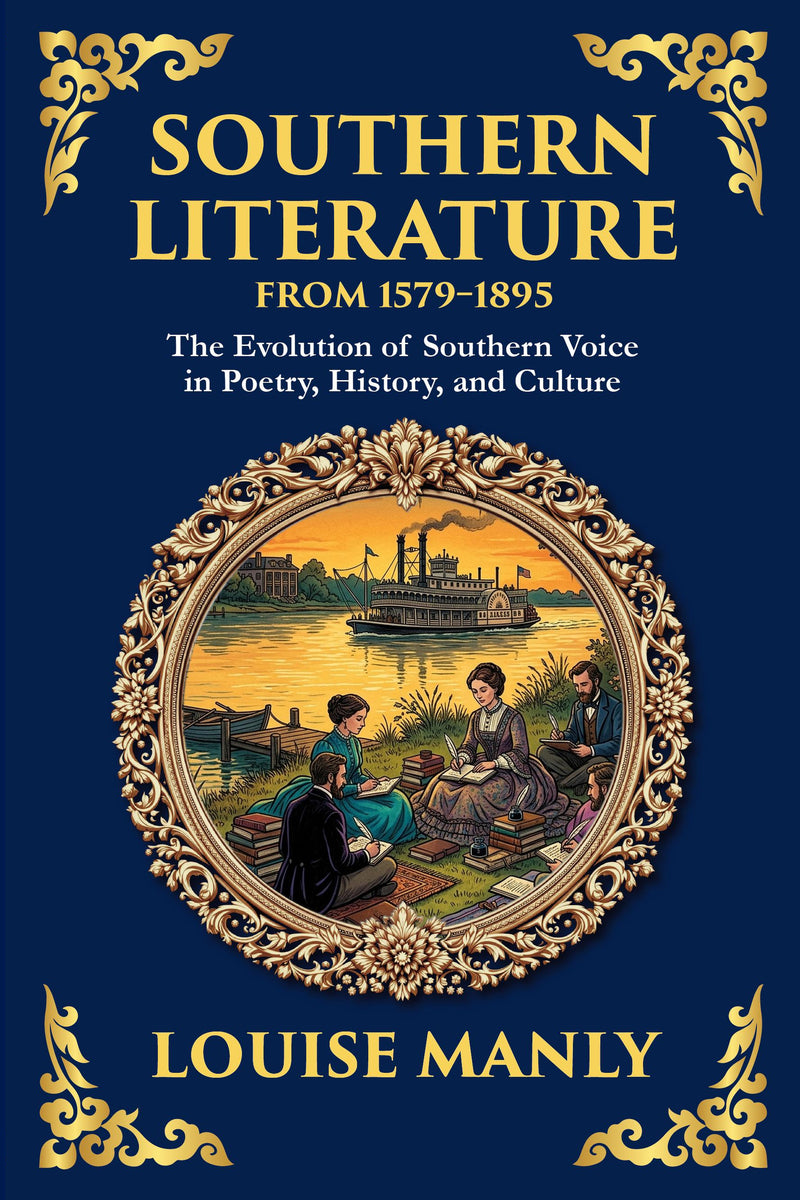
Southern Literature From 1579–1895 — Large Print
Spanning over three centuries of thought, verse, and identity, Southern Literature From 1579– 1895 is a monumental anthology that traces the rise of the Southern voice in American letters.
or free app
10,000+ hrs library
30-day guarantee
The complete Southern Literature From 1579–1895 appears in modern English through Library of Alexandria Press, available online with audiobook narration included for members.
Have you ever wondered why Southern literature holds such a unique place in American history? Southern Literature From 1579–1895 is a sweeping, deeply curated chronicle of the Southern literary tradition. Compiled by Louise Manly and first published at the close of the 19th century, this anthology provides an unmatched exploration of the intellectual and artistic development of the American South—told through its most powerful voices.
From early colonial writings and revolutionary tracts to the spiritual reflections of preachers, the fiery oratory of statesmen, and the lyrical expressions of poets, this work captures the shifting values, inner conflicts, and cultural richness of a region at the heart of American identity. Spanning over 300 years, this edition includes voices both famous and forgotten, capturing the heartbeat of Southern heritage as it evolved through war, expansion, and transformation.
What you’ll discover in this modern edition
- Literary Origins From the Colonial South Discover sermons, journals, and narratives from the earliest European settlers in the Southern colonies.
- Poetic Traditions and Musical Language Explore works from Southern poets such as Edgar Allan Poe, Paul Hamilton Hayne, and Sidney Lanier.
- Oratory and Statesmanship Read stirring speeches and writings from Southern leaders, capturing the passions and principles of their time.
- Cultural and Religious Identity Examine how themes of faith, morality, and agrarian life permeated Southern writing.
- Voices of Conflict and Change Encounter literary reactions to slavery, the Civil War, and Reconstruction through firsthand accounts and reflections.
- A Comprehensive Editorial Vision by Louise Manly With thoughtful introductions and notes, Manly provides historical context and commentary that make the work accessible and educational.
| Formats | eBook (EPUB + PDF) · Audiobook · Paperback · Hardcover · Large Print |
| Language | English |
| Trim size (print) | 6 × 9 in |
| Binding | Paperback — perfect-bound · Hardcover — casewrap |
| Large Print edition | Same text in a larger, easy-read type — a larger font, not a larger trim |
| Print pricing | Every physical book at our true cost — at-cost, no profit (members) |
| Library | 873 restored titles, always growing |
| Length | 119,338 words · ~7 hr 57 min reading |
| Reading level | Grade 5 · an easy, flowing read (this modern-English edition) |
| Edition | Modern English translation · 2026 |
Member reviews for this edition are collected as readers finish it — be the first. Across the library: 12,000+ books shipped, every plan covered by a 365-day print guarantee.
About this edition
A faithful, unabridged modern-English edition by The Library of Alexandria — carefully rendered for today's reader and verified paragraph-by-paragraph against the public-domain source. Available as eBook, audiobook, paperback, hardcover, and large print.
- Complete & unabridgedVerified paragraph by paragraph against the source — never a scan, never abridged.
- Modern English, faithfulReadable today, with the author’s meaning kept intact. Readable — not simplified.
- Every format, one membershipRead in your browser or the free app, or listen to the full audiobook.
Included free with your membership
Cancel anytime, one click · 30-day money-back guarantee
Edition last updated July 2026
What’s inside
Southern Literature From 1579–1895 — Large Print — complete and unabridged: all 60 sections included with membership, plus the full audiobook.
Begin reading Southern Literature From 1579–1895 — Large Print
In clear modern English — the complete text is included with membership.
Introduction
When Southern Literature from 1579 to 1895 first appeared, it arrived as something more ambitious than a simple anthology. Louise Manly set out to do what few had attempted before her: to gather, organize, and present the literary voice of a vast and complicated region across more than three centuries, and to argue—quietly but persistently, through her selections and her framing—that this voice deserved to be studied, preserved, and celebrated on its own terms. The volume you are about to read is, in its original form, a teaching instrument, a cultural argument, and an act of preservation all at once. It is also a window into the way one nineteenth-century educator understood the relationship between place, identity, and the written word. To read it today is to encounter both the literature it contains and the worldview that assembled it, and the richest reading experience comes from holding both of those things in mind at once.
This modern edition has been carefully adapted for the contemporary reader. Manly’s nineteenth-century prose, with its long periodic sentences, its assumed familiarity with classical references, and its occasionally dense scholarly apparatus, has been rendered into language that flows more naturally for a twenty-first-century audience. The goal throughout has been faithfulness rather than alteration: to make the meaning clear and the reading pleasurable without smoothing away the distinctive texture of the original. Where Manly’s enthusiasms or her assumptions reveal the time in which she wrote, those moments have been preserved rather than erased, because they are part of the story this book tells. What follows is an attempt to prepare you for that story—to give you the context, the cautions, and the curiosity you will need to get the most out of the pages ahead.
To understand what Louise Manly was doing, it helps to understand when she was doing it. The closing decades of the nineteenth century were a period of intense self-examination across the American South. The Civil War had ended in 1865, Reconstruction had come and gone, and the region was engaged in the long, fraught, and often painful work of redefining itself. Out of this came a powerful cultural movement, frequently described by historians as the literature of the “New South” alongside a parallel and competing impulse to memorialize the old one. Writers, educators, and publishers were preoccupied with questions of regional identity. What did it mean to be Southern? Was there a distinct Southern literary tradition, separate from the dominant New England voices—the Emersons, the Hawthornes, the Longfellows—who had largely defined “American literature” in the national imagination? And if such a tradition existed, who would document it, and to what end?
Louise Manly belonged to a family deeply embedded in Southern education and letters. The Manly name carried weight in academic and Baptist circles, and Louise herself worked as an educator and writer attentive to the needs of students. This anthology grew directly out of that vocation. It was designed, in large part, for use in schools and colleges throughout the South, where teachers wanted material that would introduce young readers to authors connected to their own region and history. In an era when textbooks overwhelmingly featured Northern writers, Manly’s compilation answered a felt need: a desire among Southern educators to show their students that their part of the country had produced poets, orators, historians, novelists, and essayists worthy of study.
This origin shapes the book in ways the reader should keep in view. It is organized partly along chronological lines and partly along thematic and biographical ones. Manly does not simply reprint texts; she introduces her authors, sketches their lives, situates them in their times, and offers her own commentary on their significance. The result is a hybrid form—part anthology, part literary history, part biographical dictionary. For the modern reader, this structure is one of the book’s great pleasures. You are never simply handed a poem or a passage and left to your own devices. Instead, you are guided, accompanied, and frequently nudged toward a particular way of seeing. Manly is a present narrator, and getting to know her sensibility is one of the quieter joys of the journey.
The chronological sweep is genuinely remarkable. By beginning in 1579, Manly reaches back to the earliest European encounters with the region that would become the American South—the age of exploration narratives, of accounts written by men who described a land that was, to their eyes, new and strange and full of promise and peril. From these foundational documents she moves forward through the colonial period, the Revolutionary era, the early republic, the antebellum decades, the cataclysm of the Civil War, and into the literary flowering of the years that followed. To traverse this span is to watch a culture’s written voice mature in real time. The reader can trace how the rough, practical, often urgently descriptive prose of explorers and settlers gradually gives way to more self-conscious literary ambition—to poetry that aspires to beauty for its own sake, to oratory crafted for political and emotional effect, to fiction that seeks to capture the texture of a particular way of life.
What emerges across these pages is not a single, unified “Southern voice” but a chorus of many voices, sometimes harmonizing and sometimes in tension. There is the voice of the frontier and the voice of the plantation, the voice of the pulpit and the voice of the political platform, the voice of the romantic poet and the voice of the dry-eyed historian. Manly’s achievement is to bring these together into a single volume and to suggest, through their juxtaposition, that they belong to a shared tradition. Whether or not you ultimately agree with that thesis—and part of the fun of reading critically is deciding for yourself—you cannot help but be impressed by the breadth of material she assembled, much of it from sources that would otherwise be difficult for a general reader to access.
It is worth pausing here to appreciate the sheer labor of compilation that this book represents. In an age before digital archives, before searchable databases, before the easy reproduction of texts, gathering material that spanned three centuries and dozens of authors required enormous effort. Manly had to locate rare volumes, track down obscure periodicals, verify biographical details, and make countless decisions about what to include and what to leave out. Every anthology is, in a sense, an argument made through selection, and the choices Manly made tell us a great deal about her values and her vision. She gives generous space to poets, reflecting the high cultural status that poetry held in the nineteenth century. She includes orators, recognizing that in the South, as elsewhere in nineteenth-century America, the spoken word delivered from a platform was itself a major literary form. She does not neglect the historians and essayists who documented the region’s past and debated its future.
Any book written more than a century ago asks something of its modern readers, and this one asks a particular kind of attentiveness. The most rewarding way to approach Southern Literature from 1579 to 1895 is as a kind of double text: it is simultaneously a collection of older writings and a document of the moment in which those writings were collected. Both layers reward careful reading, but they reward it differently, and a thoughtful reader will move between them.
The first and most important thing to understand is that this book reflects the perspective and the prejudices of the world that produced it. Louise Manly was a white Southern woman writing in the 1890s, and her selections, her commentary, and her underlying assumptions are shaped by that identity and that era. The South she celebrates was a society built, for much of the period she covers, on the institution of slavery, and the decades after the Civil War in which she wrote were marked by the rise of segregation, disenfranchisement, and the systematic mythologizing of the antebellum past—what later historians would call the “Lost Cause.” A modern reader will notice that the literature Manly chose to preserve, and the way she frames it, often reflects these realities. The voices of enslaved and formerly enslaved people, of Black Southerners whose experience of the region was radically different from that of the planter class, are largely absent from her account, as they were absent from most mainstream anthologies of her day.
This is not a reason to set the book aside. It is, rather, a reason to read it with open eyes. To engage honestly with the literature of the past—any literature, from any region—requires that we recognize what it includes and what it omits, whose stories it tells and whose it overlooks. Manly’s anthology is valuable precisely because it shows us how a particular community understood itself and constructed its own literary heritage. The gaps and silences in such a work are themselves historically significant; they reveal the boundaries of what was considered “literature” and who was considered worthy of inclusion. The contemporary reader, equipped with this awareness, can appreciate the genuine literary merit of much that Manly preserves while also reading against the grain, noticing the assumptions embedded in her framing and asking the questions she did not ask.
This dual awareness is not a burden but an opportunity. There is a particular intellectual pleasure in reading an old book well—in entering imaginatively into a vanished worldview while keeping one’s own critical faculties fully engaged. You will encounter sentiments and attitudes that no longer command assent, and you may find yourself disagreeing sharply with Manly’s judgments or her omissions. That disagreement is part of the experience, and it need not diminish your enjoyment of the genuine treasures the book contains. Indeed, the friction between the text’s perspective and our own can sharpen our attention, making us more alert readers than we might be with a work that simply confirmed everything we already believed.
The language itself deserves a word. Although this edition has been adapted to read more smoothly for a modern audience, it preserves the dignity and the cadence of the originals. Nineteenth-century prose moved at a different pace than ours. It savored elaboration; it built long arguments through careful subordination; it was unembarrassed by ornament and unhurried in its progress toward a point. The poetry, especially, follows conventions of meter, rhyme, and diction that may at first feel formal or remote. Give these forms a chance to work on you. Read the poems slowly, perhaps aloud, allowing their rhythms to settle. Much of the verse Manly collected was written to be heard as much as read, and a great deal of it rewards the patience required to attune oneself to its music. The orations, too, gain force when you imagine them spoken before a live audience, their periods rising and falling, their appeals to emotion and principle delivered with the full weight of a practiced speaker’s art.
You will also notice that Manly’s sense of what makes literature important is not always identical to our own. She tends to value moral elevation, patriotic feeling, religious sentiment, and refinement of expression. She is drawn to writing that ennobles, that instructs, that confirms a sense of regional pride and cultural belonging. Modern readers, schooled in different critical traditions, may bring other criteria—an interest in psychological complexity, in formal experimentation, in social critique, in the voices of the marginalized. Neither set of values is simply right or wrong; they are products of different times and different needs. Part of the rich experience of reading this book is becoming aware of your own assumptions about what literature is for, brought into focus by contrast with Manly’s.
Cancel anytime, one click · 30-day money-back guarantee
Founding annual rate available now — your price locks for life when you join.
Not ready? Get this free chapter by email — read it anytime.
✓ Sent — check your inbox for Southern Literature From 1579–1895 — Large Print.
Questions about Southern Literature From 1579–1895 — Large Print
What is Southern Literature From 1579–1895 about?
Spanning over three centuries of thought, verse, and identity, Southern Literature From 1579– 1895 is a monumental anthology that traces the rise of the Southern voice in American letters. Edited and introduced by Louise Manly, this rich collection gathers sermons, speeches, poems, and essays that illuminate the moral, cultural, and historical evolution of the American South— from its colonial beginnings to the post-Civil War years. This definitive volume brings together writers from diverse backgrounds and time pe
Who wrote Southern Literature From 1579–1895?
Southern Literature From 1579–1895 was written by Louise Manly. This edition presents the complete work in clear modern English, faithfully rendered from the public-domain original by Library of Alexandria Press.
Is Southern Literature From 1579–1895 free to read?
The opening chapter is free to read on this page. Members read and listen to the complete work — and the entire library — free, and can order any physical book at our true print cost.
How long is Southern Literature From 1579–1895?
60 chapters (~119,338 words) — about 7 hr 57 min of reading in this modern-English edition.
Is this an abridged version of Southern Literature From 1579–1895?
No. This is the complete, unabridged Southern Literature From 1579–1895, carefully rendered into clear modern English and verified paragraph-by-paragraph against the public-domain source — nothing is cut or summarised.
What formats does Southern Literature From 1579–1895 come in?
Southern Literature From 1579–1895 is available as eBook, paperback and hardcover. eBook and audiobook are included with membership; printed editions ship at our true print cost.
Shipping & returns
Billing & membership
More from the library


Explore Classic & Literary
- Dream Psychology: Psychoanalysis for Beginners · Sigmund Freud
- Great Expectations · Charles Dickens
- The Brothers Karamazov · Fyodor Dostoyevsky
- The Great Gatsby · F. Scott Fitzgerald
- Wild Flowers Worth Knowing · Neltje Blanchan
- Italian Hours · Henry James
- A Popular History of France from the Earliest Times, Volume 5 · François Guizot
- A history of English literature: A practical text-book · Edward Albert
- Italian Highways and Byways from a Motor Car · M. F. Mansfield
- The Heart-Cry of Jesus · Byron J. Rees
- Castes and Tribes of Southern India. Vol. 6 of 7 · Edgar Thurston
- Against the Grain · J.-K. Huysmans
- Dombey and Son · Charles Dickens
- How to Invest Money · George Garr Henry
- The Great Controversy Between Christ and Satan · Ellen Gould Harmon White
- One Hundred Proofs That the Earth Is Not a Globe · William Carpenter
- Southern Literature From 1579–1895 · Louise Manly
- The Renaissance: Studies in Art and Poetry · Walter Pater
- Mark Twain’s Speeches · Mark Twain
- Tacitus on Germany · Cornelius Tacitus
- The Rosary · Florence L. Barclay
- Peculiarities of American Cities · Willard W. Glazier
- Tennis for Girls · Florence A. Ballin
- The World’s Greatest Books — Volume 02 — Fiction
- Shirley · Charlotte Brontë
- Daisy Miller: A Study · Henry James
- Louis Lambert · Honoré de Balzac
- Historic Jamaica · Frank Cundall
- The Gambler · Fyodor Dostoyevsky
- The Mayor of Casterbridge · Thomas Hardy
Southern Literature From 1579–1895 — Large Print
Southern Literature From 1579–1895 — Large Print
How the Southern Voice Evolved in Poetry, History, and Culture
Louise Manly
Contents
- Introduction
- Preface by the Author
- Chapter 1
- Chapter 2
- Chapter 3
- Chapter 4
- Chapter 5
- Chapter 6
- Chapter 7
- Chapter 8
- Chapter 9
- Chapter 10
- Chapter 11
- Chapter 12
- Chapter 13
- Chapter 14
- Chapter 15
- Chapter 16
- Chapter 17
- Chapter 18
- Chapter 19
- Chapter 20
- Chapter 21
- Chapter 22
- Chapter 23
- Chapter 24
- Chapter 25
- Chapter 26
- Chapter 27
- Chapter 28
- Chapter 29
- Chapter 30
- Chapter 31
- Chapter 32
- Chapter 33
- Chapter 34
- Chapter 35
- Chapter 36
- Chapter 37
- Chapter 38
- … and 20 more chapters
Introduction
When Southern Literature from 1579 to 1895 first appeared, it arrived as something more ambitious than a simple anthology. Louise Manly set out to do what few had attempted before her: to gather, organize, and present the literary voice of a vast and complicated region across more than three centuries, and to argue—quietly but persistently, through her selections and her framing—that this voice deserved to be studied, preserved, and celebrated on its own terms. The volume you are about to read is, in its original form, a teaching instrument, a cultural argument, and an act of preservation all at once. It is also a window into the way one nineteenth-century educator understood the relationship between place, identity, and the written word. To read it today is to encounter both the literature it contains and the worldview that assembled it, and the richest reading experience comes from holding both of those things in mind at once.
This modern edition has been carefully adapted for the contemporary reader. Manly’s nineteenth-century prose, with its long periodic sentences, its assumed familiarity with classical references, and its occasionally dense scholarly apparatus, has been rendered into language that flows more naturally for a twenty-first-century audience. The goal throughout has been faithfulness rather than alteration: to make the meaning clear and the reading pleasurable without smoothing away the distinctive texture of the original. Where Manly’s enthusiasms or her assumptions reveal the time in which she wrote, those moments have been preserved rather than erased, because they are part of the story this book tells. What follows is an attempt to prepare you for that story—to give you the context, the cautions, and the curiosity you will need to get the most out of the pages ahead.
To understand what Louise Manly was doing, it helps to understand when she was doing it. The closing decades of the nineteenth century were a period of intense self-examination across the American South. The Civil War had ended in 1865, Reconstruction had come and gone, and the region was engaged in the long, fraught, and often painful work of redefining itself. Out of this came a powerful cultural movement, frequently described by historians as the literature of the “New South” alongside a parallel and competing impulse to memorialize the old one. Writers, educators, and publishers were preoccupied with questions of regional identity. What did it mean to be Southern? Was there a distinct Southern literary tradition, separate from the dominant New England voices—the Emersons, the Hawthornes, the Longfellows—who had largely defined “American literature” in the national imagination? And if such a tradition existed, who would document it, and to what end?
Louise Manly belonged to a family deeply embedded in Southern education and letters. The Manly name carried weight in academic and Baptist circles, and Louise herself worked as an educator and writer attentive to the needs of students. This anthology grew directly out of that vocation. It was designed, in large part, for use in schools and colleges throughout the South, where teachers wanted material that would introduce young readers to authors connected to their own region and history. In an era when textbooks overwhelmingly featured Northern writers, Manly’s compilation answered a felt need: a desire among Southern educators to show their students that their part of the country had produced poets, orators, historians, novelists, and essayists worthy of study.
This origin shapes the book in ways the reader should keep in view. It is organized partly along chronological lines and partly along thematic and biographical ones. Manly does not simply reprint texts; she introduces her authors, sketches their lives, situates them in their times, and offers her own commentary on their significance. The result is a hybrid form—part anthology, part literary history, part biographical dictionary. For the modern reader, this structure is one of the book’s great pleasures. You are never simply handed a poem or a passage and left to your own devices. Instead, you are guided, accompanied, and frequently nudged toward a particular way of seeing. Manly is a present narrator, and getting to know her sensibility is one of the quieter joys of the journey.
The chronological sweep is genuinely remarkable. By beginning in 1579, Manly reaches back to the earliest European encounters with the region that would become the American South—the age of exploration narratives, of accounts written by men who described a land that was, to their eyes, new and strange and full of promise and peril. From these foundational documents she moves forward through the colonial period, the Revolutionary era, the early republic, the antebellum decades, the cataclysm of the Civil War, and into the literary flowering of the years that followed. To traverse this span is to watch a culture’s written voice mature in real time. The reader can trace how the rough, practical, often urgently descriptive prose of explorers and settlers gradually gives way to more self-conscious literary ambition—to poetry that aspires to beauty for its own sake, to oratory crafted for political and emotional effect, to fiction that seeks to capture the texture of a particular way of life.
What emerges across these pages is not a single, unified “Southern voice” but a chorus of many voices, sometimes harmonizing and sometimes in tension. There is the voice of the frontier and the voice of the plantation, the voice of the pulpit and the voice of the political platform, the voice of the romantic poet and the voice of the dry-eyed historian. Manly’s achievement is to bring these together into a single volume and to suggest, through their juxtaposition, that they belong to a shared tradition. Whether or not you ultimately agree with that thesis—and part of the fun of reading critically is deciding for yourself—you cannot help but be impressed by the breadth of material she assembled, much of it from sources that would otherwise be difficult for a general reader to access.
It is worth pausing here to appreciate the sheer labor of compilation that this book represents. In an age before digital archives, before searchable databases, before the easy reproduction of texts, gathering material that spanned three centuries and dozens of authors required enormous effort. Manly had to locate rare volumes, track down obscure periodicals, verify biographical details, and make countless decisions about what to include and what to leave out. Every anthology is, in a sense, an argument made through selection, and the choices Manly made tell us a great deal about her values and her vision. She gives generous space to poets, reflecting the high cultural status that poetry held in the nineteenth century. She includes orators, recognizing that in the South, as elsewhere in nineteenth-century America, the spoken word delivered from a platform was itself a major literary form. She does not neglect the historians and essayists who documented the region’s past and debated its future.
Any book written more than a century ago asks something of its modern readers, and this one asks a particular kind of attentiveness. The most rewarding way to approach Southern Literature from 1579 to 1895 is as a kind of double text: it is simultaneously a collection of older writings and a document of the moment in which those writings were collected. Both layers reward careful reading, but they reward it differently, and a thoughtful reader will move between them.
The first and most important thing to understand is that this book reflects the perspective and the prejudices of the world that produced it. Louise Manly was a white Southern woman writing in the 1890s, and her selections, her commentary, and her underlying assumptions are shaped by that identity and that era. The South she celebrates was a society built, for much of the period she covers, on the institution of slavery, and the decades after the Civil War in which she wrote were marked by the rise of segregation, disenfranchisement, and the systematic mythologizing of the antebellum past—what later historians would call the “Lost Cause.” A modern reader will notice that the literature Manly chose to preserve, and the way she frames it, often reflects these realities. The voices of enslaved and formerly enslaved people, of Black Southerners whose experience of the region was radically different from that of the planter class, are largely absent from her account, as they were absent from most mainstream anthologies of her day.
This is not a reason to set the book aside. It is, rather, a reason to read it with open eyes. To engage honestly with the literature of the past—any literature, from any region—requires that we recognize what it includes and what it omits, whose stories it tells and whose it overlooks. Manly’s anthology is valuable precisely because it shows us how a particular community understood itself and constructed its own literary heritage. The gaps and silences in such a work are themselves historically significant; they reveal the boundaries of what was considered “literature” and who was considered worthy of inclusion. The contemporary reader, equipped with this awareness, can appreciate the genuine literary merit of much that Manly preserves while also reading against the grain, noticing the assumptions embedded in her framing and asking the questions she did not ask.
This dual awareness is not a burden but an opportunity. There is a particular intellectual pleasure in reading an old book well—in entering imaginatively into a vanished worldview while keeping one’s own critical faculties fully engaged. You will encounter sentiments and attitudes that no longer command assent, and you may find yourself disagreeing sharply with Manly’s judgments or her omissions. That disagreement is part of the experience, and it need not diminish your enjoyment of the genuine treasures the book contains. Indeed, the friction between the text’s perspective and our own can sharpen our attention, making us more alert readers than we might be with a work that simply confirmed everything we already believed.
The language itself deserves a word. Although this edition has been adapted to read more smoothly for a modern audience, it preserves the dignity and the cadence of the originals. Nineteenth-century prose moved at a different pace than ours. It savored elaboration; it built long arguments through careful subordination; it was unembarrassed by ornament and unhurried in its progress toward a point. The poetry, especially, follows conventions of meter, rhyme, and diction that may at first feel formal or remote. Give these forms a chance to work on you. Read the poems slowly, perhaps aloud, allowing their rhythms to settle. Much of the verse Manly collected was written to be heard as much as read, and a great deal of it rewards the patience required to attune oneself to its music. The orations, too, gain force when you imagine them spoken before a live audience, their periods rising and falling, their appeals to emotion and principle delivered with the full weight of a practiced speaker’s art.
You will also notice that Manly’s sense of what makes literature important is not always identical to our own. She tends to value moral elevation, patriotic feeling, religious sentiment, and refinement of expression. She is drawn to writing that ennobles, that instructs, that confirms a sense of regional pride and cultural belonging. Modern readers, schooled in different critical traditions, may bring other criteria—an interest in psychological complexity, in formal experimentation, in social critique, in the voices of the marginalized. Neither set of values is simply right or wrong; they are products of different times and different needs. Part of the rich experience of reading this book is becoming aware of your own assumptions about what literature is for, brought into focus by contrast with Manly’s.
For the era of discovery and early settlement, read Irving’s “Columbus,” Simms’ “Vasconselos” (which covers De Soto’s Expedition) and “Yemassee,” the life and writings of John Smith, Longfellow’s “Hiawatha” and “Miles Standish,” Kennedy’s “Rob of the Bowl,” the works of Strachey, Mrs. Preston’s “Colonial Ballads,” and other similar texts.
For the Revolutionary period, read the Revolutionary novels by Simms and Cooper, as well as Kennedy’s “Horse-Shoe Robinson.” Study the great statesmen of that time, such as Jefferson, Adams, Patrick Henry, Hamilton, and Washington. Read Cooke’s “Fairfax,” where Washington is portrayed as a young surveyor, and “Virginia Comedians,” which features Patrick Henry, along with Thackeray’s “Virginians” and other related works.
Every teacher should create their own list based on their available time and the books they have. Additionally, each state or region of our vast country will spend more time on its own specific history and literature. This is the correct approach, because knowledge, much like kindness, starts at home and gradually expands until it encompasses the entire world.
While gathering reading materials for American History classes using this method, it was easy to find affordable editions of authors from the North, such as Irving, Longfellow, and Cooper. However, it was nearly impossible to find works by Southern writers, whether in cheap or expensive versions. This book was created to help fill that gap. To align with the suggested plan, I have included the dates the authors wrote and the general style and era of their work. I have also included some excerpts for reading—though I worry there are too few to be truly comprehensive, I hope there are enough to spark further interest and study.
End of the free sample
Keep reading, free
Members read and listen to the complete book — and the entire library. Cancel anytime, one click · 30-day money-back guarantee.