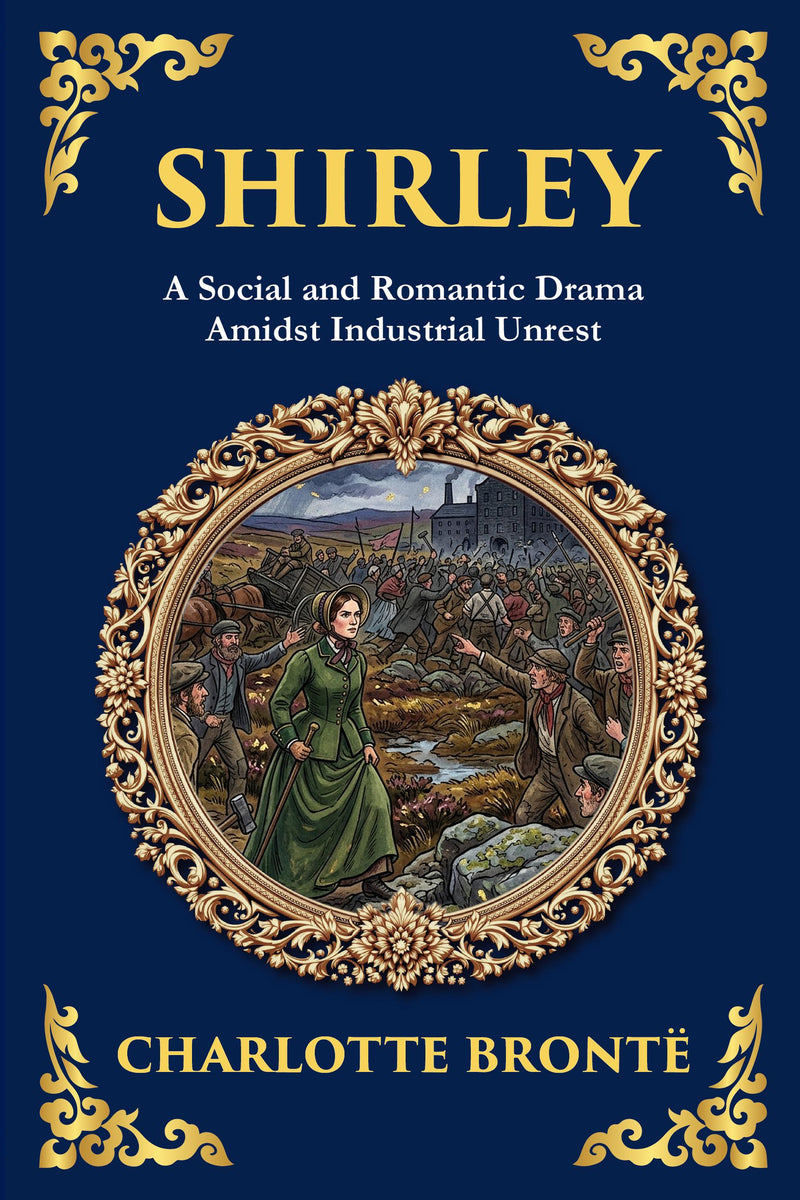
Shirley — Large Print
Set against the turbulence of the Industrial Revolution, Shirley is Charlotte Brontë’s bold exploration of class conflict, gender roles, and the fight for independence.
or free app
10,000+ hrs library
30-day guarantee
The complete Shirley appears in modern English through Library of Alexandria Press, available online with audiobook narration included for members.
Have you ever wondered why some voices are silenced while others rise against the storm? In Shirley, Charlotte Brontë moves beyond the confines of the personal and delves into the sweeping social unrest of early 19th-century England. This powerful novel interweaves the lives of two contrasting heroines—Caroline Helstone, the gentle and reserved niece of a clergyman, and Shirley Keeldar, a wealthy, independent woman who defies every expectation of her time.
As mill workers revolt against economic hardship and women grapple with their place in a patriarchal world, Brontë crafts a deeply human drama that blends political unrest with emotional intimacy. The novel is as much about industrial discontent as it is about personal awakening, self-reliance, and friendship between women. This modern edition of Shirley makes Brontë’s nuanced language accessible for today’s readers while preserving the fire of her message: that identity, freedom, and justice are worth fighting for.
What you’ll discover in this modern edition
- Two Distinct Yet Intertwined Female Protagonists Explore the lives of Caroline and Shirley as they navigate friendship, heartbreak, and societal pressure.
- Themes of Class Struggle and Industrial Change Gain insight into the tensions between mill owners and workers during England’s early industrial era.
- A Bold Feminist Undercurrent Witness Brontë’s critique of gender norms and her portrayal of female empowerment in an oppressive society.
- Romance Grounded in Realism Experience love stories complicated by economics, identity, and integrity—not fantasy.
- Historical and Social Relevance Discover how Shirley continues to resonate in today’s conversations around social justice, labor rights, and gender equality.
| Formats | eBook (EPUB + PDF) · Audiobook · Paperback · Hardcover · Large Print |
| Language | English |
| Trim size (print) | 6 × 9 in |
| Binding | Paperback — perfect-bound · Hardcover — casewrap |
| Large Print edition | Same text in a larger, easy-read type — a larger font, not a larger trim |
| Print pricing | Every physical book at our true cost — at-cost, no profit (members) |
| Library | 873 restored titles, always growing |
| Length | 215,745 words · ~14 hr 23 min reading |
| Reading level | Grade 3 · an easy, flowing read (this modern-English edition) |
| Edition | Modern English translation · 2026 |
Member reviews for this edition are collected as readers finish it — be the first. Across the library: 12,000+ books shipped, every plan covered by a 365-day print guarantee.
About this edition
A faithful, unabridged modern-English edition by The Library of Alexandria — carefully rendered for today's reader and verified paragraph-by-paragraph against the public-domain source. Available as eBook, audiobook, paperback, hardcover, and large print.
- Complete & unabridgedVerified paragraph by paragraph against the source — never a scan, never abridged.
- Modern English, faithfulReadable today, with the author’s meaning kept intact. Readable — not simplified.
- Every format, one membershipRead in your browser or the free app, or listen to the full audiobook.
Included free with your membership
Cancel anytime, one click · 30-day money-back guarantee
Edition last updated July 2026
What’s inside
Shirley — Large Print — complete and unabridged: all 38 sections included with membership, plus the full audiobook.
Begin reading Shirley — Large Print
In clear modern English — the complete text is included with membership.
Introduction
When Charlotte Brontë sat down to write the novel that would follow her astonishing debut, she carried with her both the weight of unexpected fame and the fresh grief of profound loss. The author who had introduced the world to a small, plain governess of fierce moral conviction now turned her gaze outward—away from the intimate confessions of a single passionate heart and toward the broader canvas of a community, a region, a moment in history when an entire way of life trembled on the edge of transformation. The result is a work unlike anything else she produced: expansive where her first novel was concentrated, populated where the earlier book was solitary, and rooted in the hard soil of economic reality even as it blossoms into one of the most tender meditations on friendship, independence, and the longing for a meaningful life ever written by a woman in the nineteenth century.
This edition presents that remarkable achievement in a fresh, modern translation, carefully adapted for the contemporary reader. The aim of such an adaptation is never to diminish or simplify the author’s genius, but rather to clear away the linguistic underbrush that two centuries can deposit across even the finest prose—the archaic constructions, the now-obscure references, the dense thickets of mid-Victorian phrasing that can leave a present-day reader straining to hear the voice beneath the words. What remains is the essential Brontë: her wit, her ferocity, her tenderness, her almost geological sense of how human lives are shaped by the forces of their time. The story unfolds with all its original power, but it speaks now in a register that the twenty-first-century reader can receive without friction, allowing the emotional and intellectual currents of the book to flow unimpeded.
To understand the singular character of this book, it helps to know something of the circumstances under which it came into being. Charlotte Brontë was the daughter of an Irish-born clergyman who held the perpetual curacy of a parish in the West Riding of Yorkshire, a landscape of windswept moors, stone villages, and—crucially for this novel—mills. The Brontë children grew up in the shadow of the industrial revolution that was reshaping the north of England, transforming a region of cottage weavers and small farmers into a roaring engine of textile manufacture. The clatter of the loom, the smoke of the factory chimney, the migration of laborers, the boom and bust of trade tied to distant wars and shifting markets: these were not abstractions to the author, but the very texture of the world outside her door.
The novel is set during a particular and turbulent chapter of that history—the early years of the nineteenth century, when England was locked in a long and exhausting war with Napoleonic France. The conflict, combined with trade restrictions and the relentless march of new machinery, threw the textile districts into crisis. Mills stood idle; orders dried up; men who had earned their bread by skilled hand labor found themselves replaced by machines that could do the work faster and cheaper. Out of this desperation arose one of the most dramatic episodes of working-class resistance in British history: the Luddite movement, in which bands of laborers, often masked and operating by night, attacked the factories and smashed the very machines they believed were stealing their livelihoods. These were not mindless vandals, as the popular caricature would later suggest, but men driven to extremity by hunger and the collapse of everything they had known. The author drew her account of these events from contemporary newspapers, from the recollections of those who had lived through them, and from the deep regional memory that still lingered in Yorkshire during her own lifetime.
It is striking that a woman so often associated with the interior drama of the soul should choose to anchor a novel in the gritty machinery of economics and class conflict. Yet the choice was deliberate and meaningful. Having been criticized in some quarters for the supposed narrowness of her first book—its relentless focus on a single consciousness—she set out to prove that she could command a wider field. She wanted to write about the public world as well as the private one, about communities and currents of history, about the way that great impersonal forces press down upon ordinary lives. The book that emerged is in part a state-of-the-nation novel, a serious attempt to grapple with questions of labor and capital, of progress and its human cost, of how a society manages the violent dislocations of change. These questions, of course, are anything but antique. Anyone who has lived through an era of technological upheaval—who has watched industries vanish, skills become obsolete, and entire communities cast adrift by economic transformation—will find in these pages a strange and arresting familiarity. The anxieties of the early industrial age are, in many respects, the anxieties of our own.
But it would be a grave mistake to imagine that the novel is merely a sociological document, however vivid. The author was incapable of writing anything that did not pulse with feeling, and the public drama of mill and machine is interwoven from the first page with the private dramas of the human heart. There are the struggles of the men who own and run the mills, caught between their financial obligations and the suffering of the workers they employ. There are the clergymen whose comic squabbling and self-importance the author skewers with a satirical edge sharper than anything in her other books. And, at the very center of the novel, there are two extraordinary young women whose friendship, ambitions, disappointments, and hopes form the true emotional spine of the story.
These two heroines represent one of the author’s most daring and original creations. In an age when fiction so often confined its women to the narrow roles of marriageable maiden, dutiful wife, or cautionary fallen woman, she gave us instead a pair of female characters of remarkable complexity and force. One is gentle, dependent, and quietly suffering, her circumstances constraining her at every turn, her inner life rich with feeling that the world gives her few opportunities to express. The other is wealthy, spirited, independent, and unconventional—a woman who owns property, runs her own affairs, speaks her mind, and refuses to be governed by the expectations of those around her. The contrast between them, and the deep bond that grows between them, gives the novel much of its emotional richness. Through these two figures, the author explores with extraordinary sensitivity the predicament of women in her society: the limitations placed upon their education, their occupations, their freedom of choice; the agonizing dependence of unmarried women upon the goodwill of male relatives; the suffocating expectation that a woman’s entire destiny should be determined by whether and whom she marries.
It is worth dwelling on this dimension of the book, because it is here that the author’s voice rises to some of its most powerful and prophetic moments. There are passages in this novel—meditations on the wasted lives of women who have no useful work to occupy them, on the cruelty of a system that treats unmarried daughters as burdens, on the spiritual hunger of intelligent women given nothing worthy to do with their minds—that read like manifestos. The author understood this predicament from the inside; she had herself endured the grinding tedium and humiliation of working as a governess, one of the few occupations open to a respectable but impoverished woman, and she had felt the desperate frustration of possessing a great talent and finding almost no outlet for it. That personal knowledge burns through the pages whenever the subject of women’s work and women’s worth arises. The reader will find these reflections astonishingly modern—not because the author was somehow ahead of her time in a way that detaches her from it, but because the injustices she identified were real, and because the questions she raised about how women might live full and meaningful lives have not yet been entirely answered, even now.
The Shadow of Grief and the Triumph of Art
No account of this novel can be complete without acknowledging the extraordinary circumstances of its composition, for they are written invisibly into its every chapter. When the author began the book, she was one of three remarkable sisters, all of them writers, who lived together in their father’s parsonage on the edge of the moors. The household had known its share of sorrow, but the years during which this novel took shape brought a cascade of devastation almost too cruel to contemplate. Within a span of mere months, the author lost her brother, then one sister, then the other—the two siblings who had been her closest companions, her fellow writers, the partners in the imaginative world that had sustained them all since childhood.
She had begun the novel before these deaths; she completed it in the wake of them, working through a grief so profound that one wonders how she found the strength to continue at all. And yet she did continue, returning to her manuscript in part because the act of creation offered some refuge from despair, some discipline to hold the days together, some way of honoring the memory of those she had lost. The effect of this tragedy upon the book is unmistakable to anyone who reads it with knowledge of the author’s life. There are sections in the latter part of the novel touched by a darkness, a sense of mortality and loss, that the earlier chapters do not contain. A certain character’s illness and the long, tender vigil that surrounds it are widely understood to have drawn upon the author’s experience of watching her sisters die. There is grief woven into the very grain of the prose.
But here lies one of the most moving things about the book: it is not, finally, a despairing work. The author did not allow her sorrow to extinguish the warmth, the humor, the generosity of spirit that animate the novel. If anything, the experience of loss seems to have deepened her tenderness toward her characters and toward the fragile, precious business of human happiness. The book is full of laughter—genuine, sharp, observant comedy, particularly in its portraits of the local clergymen and the small social vanities of provincial life. It is full of warmth in its depiction of friendship and affection. And it moves, with an absolute and hard-won conviction, toward resolution and hope. To write a novel of such fundamental generosity in the midst of personal catastrophe is itself a kind of heroism, and the reader who carries this knowledge into the book will find its moments of joy all the more affecting for having been wrested from such darkness.
This biographical dimension also helps explain the novel’s distinctive structure, which differs markedly from the tightly focused, first-person intensity of the author’s most famous work. Here she adopts a more expansive, panoramic mode of storytelling, moving among multiple characters and storylines, broadening her view to encompass an entire community rather than the consciousness of a single narrator. Some readers, conditioned by the headlong momentum of more conventional plots, may at first find this approach more leisurely, more digressive, less driven by a single propulsive question. It rewards a different kind of attention—the patience to settle into a world, to come to know its many inhabitants, to appreciate the gradual accumulation of detail and incident that builds, in time, into something rich and full. Think of it less as a single arrow loosed at a target and more as a great tapestry, woven thread by thread, in which the full pattern emerges only when one steps back to take in the whole. The author was experimenting, stretching herself, attempting something larger and more socially ambitious than she had done before. The modern reader who approaches the book in this spirit—open to its breadth, willing to let it unfold at its own pace—will be amply rewarded.
Cancel anytime, one click · 30-day money-back guarantee
Founding annual rate available now — your price locks for life when you join.
Not ready? Get this free chapter by email — read it anytime.
✓ Sent — check your inbox for Shirley — Large Print.
Questions about Shirley — Large Print
What is Shirley about?
Set against the turbulence of the Industrial Revolution, Shirley is Charlotte Brontë’s bold exploration of class conflict, gender roles, and the fight for independence. In a world dominated by mill owners and political upheaval, two women—one quiet and introspective, the other bold and unconventional—forge a friendship that challenges Victorian norms and ignites personal and social transformation. Rich with complex characters and stirring commentary, Shirley is more than a romance—it is a call for strength, solidar
Who wrote Shirley?
Shirley was written by Charlotte Brontë. This edition presents the complete work in clear modern English, faithfully rendered from the public-domain original by Library of Alexandria Press.
Is Shirley free to read?
The opening chapter is free to read on this page. Members read and listen to the complete work — and the entire library — free, and can order any physical book at our true print cost.
How long is Shirley?
38 chapters (~215,745 words) — about 14 hr 23 min of reading in this modern-English edition.
Is this an abridged version of Shirley?
No. This is the complete, unabridged Shirley, carefully rendered into clear modern English and verified paragraph-by-paragraph against the public-domain source — nothing is cut or summarised.
What formats does Shirley come in?
Shirley is available as eBook, paperback and hardcover. eBook and audiobook are included with membership; printed editions ship at our true print cost.
Shipping & returns
Billing & membership
More from the library


Explore Classic & Literary
- Dream Psychology: Psychoanalysis for Beginners · Sigmund Freud
- Great Expectations · Charles Dickens
- The Brothers Karamazov · Fyodor Dostoyevsky
- The Great Gatsby · F. Scott Fitzgerald
- Wild Flowers Worth Knowing · Neltje Blanchan
- Italian Hours · Henry James
- A Popular History of France from the Earliest Times, Volume 5 · François Guizot
- A history of English literature: A practical text-book · Edward Albert
- Italian Highways and Byways from a Motor Car · M. F. Mansfield
- The Heart-Cry of Jesus · Byron J. Rees
- Castes and Tribes of Southern India. Vol. 6 of 7 · Edgar Thurston
- Against the Grain · J.-K. Huysmans
- Dombey and Son · Charles Dickens
- How to Invest Money · George Garr Henry
- The Great Controversy Between Christ and Satan · Ellen Gould Harmon White
- One Hundred Proofs That the Earth Is Not a Globe · William Carpenter
- Southern Literature From 1579–1895 · Louise Manly
- The Renaissance: Studies in Art and Poetry · Walter Pater
- Mark Twain’s Speeches · Mark Twain
- Tacitus on Germany · Cornelius Tacitus
- The Rosary · Florence L. Barclay
- Peculiarities of American Cities · Willard W. Glazier
- Tennis for Girls · Florence A. Ballin
- The World’s Greatest Books — Volume 02 — Fiction
- Shirley · Charlotte Brontë
- Daisy Miller: A Study · Henry James
- Louis Lambert · Honoré de Balzac
- Historic Jamaica · Frank Cundall
- The Gambler · Fyodor Dostoyevsky
- The Mayor of Casterbridge · Thomas Hardy
Shirley — Large Print
Shirley — Large Print
A Social and Romantic Drama Set During Industrial Unrest
Charlotte Brontë
Contents
- Introduction
- Chapter 1
- Chapter 2
- Chapter 3
- Chapter 4
- Chapter 5
- Chapter 6
- Chapter 7
- Chapter 8
- Chapter 9
- Chapter 10
- Chapter 11
- Chapter 12
- Chapter 13
- Chapter 14
- Chapter 15
- Chapter 16
- Chapter 17
- Chapter 18
- Chapter 19
- Chapter 20
- Chapter 21
- Chapter 22
- Chapter 23
- Chapter 24
- Chapter 25
- Chapter 26
- Chapter 27
- Chapter 28
- Chapter 29
- Chapter 30
- Chapter 31
- Chapter 32
- Chapter 33
- Chapter 34
- Chapter 35
- Chapter 36
- Chapter 37
Introduction
When Charlotte Brontë sat down to write the novel that would follow her astonishing debut, she carried with her both the weight of unexpected fame and the fresh grief of profound loss. The author who had introduced the world to a small, plain governess of fierce moral conviction now turned her gaze outward—away from the intimate confessions of a single passionate heart and toward the broader canvas of a community, a region, a moment in history when an entire way of life trembled on the edge of transformation. The result is a work unlike anything else she produced: expansive where her first novel was concentrated, populated where the earlier book was solitary, and rooted in the hard soil of economic reality even as it blossoms into one of the most tender meditations on friendship, independence, and the longing for a meaningful life ever written by a woman in the nineteenth century.
This edition presents that remarkable achievement in a fresh, modern translation, carefully adapted for the contemporary reader. The aim of such an adaptation is never to diminish or simplify the author’s genius, but rather to clear away the linguistic underbrush that two centuries can deposit across even the finest prose—the archaic constructions, the now-obscure references, the dense thickets of mid-Victorian phrasing that can leave a present-day reader straining to hear the voice beneath the words. What remains is the essential Brontë: her wit, her ferocity, her tenderness, her almost geological sense of how human lives are shaped by the forces of their time. The story unfolds with all its original power, but it speaks now in a register that the twenty-first-century reader can receive without friction, allowing the emotional and intellectual currents of the book to flow unimpeded.
To understand the singular character of this book, it helps to know something of the circumstances under which it came into being. Charlotte Brontë was the daughter of an Irish-born clergyman who held the perpetual curacy of a parish in the West Riding of Yorkshire, a landscape of windswept moors, stone villages, and—crucially for this novel—mills. The Brontë children grew up in the shadow of the industrial revolution that was reshaping the north of England, transforming a region of cottage weavers and small farmers into a roaring engine of textile manufacture. The clatter of the loom, the smoke of the factory chimney, the migration of laborers, the boom and bust of trade tied to distant wars and shifting markets: these were not abstractions to the author, but the very texture of the world outside her door.
The novel is set during a particular and turbulent chapter of that history—the early years of the nineteenth century, when England was locked in a long and exhausting war with Napoleonic France. The conflict, combined with trade restrictions and the relentless march of new machinery, threw the textile districts into crisis. Mills stood idle; orders dried up; men who had earned their bread by skilled hand labor found themselves replaced by machines that could do the work faster and cheaper. Out of this desperation arose one of the most dramatic episodes of working-class resistance in British history: the Luddite movement, in which bands of laborers, often masked and operating by night, attacked the factories and smashed the very machines they believed were stealing their livelihoods. These were not mindless vandals, as the popular caricature would later suggest, but men driven to extremity by hunger and the collapse of everything they had known. The author drew her account of these events from contemporary newspapers, from the recollections of those who had lived through them, and from the deep regional memory that still lingered in Yorkshire during her own lifetime.
It is striking that a woman so often associated with the interior drama of the soul should choose to anchor a novel in the gritty machinery of economics and class conflict. Yet the choice was deliberate and meaningful. Having been criticized in some quarters for the supposed narrowness of her first book—its relentless focus on a single consciousness—she set out to prove that she could command a wider field. She wanted to write about the public world as well as the private one, about communities and currents of history, about the way that great impersonal forces press down upon ordinary lives. The book that emerged is in part a state-of-the-nation novel, a serious attempt to grapple with questions of labor and capital, of progress and its human cost, of how a society manages the violent dislocations of change. These questions, of course, are anything but antique. Anyone who has lived through an era of technological upheaval—who has watched industries vanish, skills become obsolete, and entire communities cast adrift by economic transformation—will find in these pages a strange and arresting familiarity. The anxieties of the early industrial age are, in many respects, the anxieties of our own.
But it would be a grave mistake to imagine that the novel is merely a sociological document, however vivid. The author was incapable of writing anything that did not pulse with feeling, and the public drama of mill and machine is interwoven from the first page with the private dramas of the human heart. There are the struggles of the men who own and run the mills, caught between their financial obligations and the suffering of the workers they employ. There are the clergymen whose comic squabbling and self-importance the author skewers with a satirical edge sharper than anything in her other books. And, at the very center of the novel, there are two extraordinary young women whose friendship, ambitions, disappointments, and hopes form the true emotional spine of the story.
These two heroines represent one of the author’s most daring and original creations. In an age when fiction so often confined its women to the narrow roles of marriageable maiden, dutiful wife, or cautionary fallen woman, she gave us instead a pair of female characters of remarkable complexity and force. One is gentle, dependent, and quietly suffering, her circumstances constraining her at every turn, her inner life rich with feeling that the world gives her few opportunities to express. The other is wealthy, spirited, independent, and unconventional—a woman who owns property, runs her own affairs, speaks her mind, and refuses to be governed by the expectations of those around her. The contrast between them, and the deep bond that grows between them, gives the novel much of its emotional richness. Through these two figures, the author explores with extraordinary sensitivity the predicament of women in her society: the limitations placed upon their education, their occupations, their freedom of choice; the agonizing dependence of unmarried women upon the goodwill of male relatives; the suffocating expectation that a woman’s entire destiny should be determined by whether and whom she marries.
It is worth dwelling on this dimension of the book, because it is here that the author’s voice rises to some of its most powerful and prophetic moments. There are passages in this novel—meditations on the wasted lives of women who have no useful work to occupy them, on the cruelty of a system that treats unmarried daughters as burdens, on the spiritual hunger of intelligent women given nothing worthy to do with their minds—that read like manifestos. The author understood this predicament from the inside; she had herself endured the grinding tedium and humiliation of working as a governess, one of the few occupations open to a respectable but impoverished woman, and she had felt the desperate frustration of possessing a great talent and finding almost no outlet for it. That personal knowledge burns through the pages whenever the subject of women’s work and women’s worth arises. The reader will find these reflections astonishingly modern—not because the author was somehow ahead of her time in a way that detaches her from it, but because the injustices she identified were real, and because the questions she raised about how women might live full and meaningful lives have not yet been entirely answered, even now.
The Shadow of Grief and the Triumph of Art
No account of this novel can be complete without acknowledging the extraordinary circumstances of its composition, for they are written invisibly into its every chapter. When the author began the book, she was one of three remarkable sisters, all of them writers, who lived together in their father’s parsonage on the edge of the moors. The household had known its share of sorrow, but the years during which this novel took shape brought a cascade of devastation almost too cruel to contemplate. Within a span of mere months, the author lost her brother, then one sister, then the other—the two siblings who had been her closest companions, her fellow writers, the partners in the imaginative world that had sustained them all since childhood.
She had begun the novel before these deaths; she completed it in the wake of them, working through a grief so profound that one wonders how she found the strength to continue at all. And yet she did continue, returning to her manuscript in part because the act of creation offered some refuge from despair, some discipline to hold the days together, some way of honoring the memory of those she had lost. The effect of this tragedy upon the book is unmistakable to anyone who reads it with knowledge of the author’s life. There are sections in the latter part of the novel touched by a darkness, a sense of mortality and loss, that the earlier chapters do not contain. A certain character’s illness and the long, tender vigil that surrounds it are widely understood to have drawn upon the author’s experience of watching her sisters die. There is grief woven into the very grain of the prose.
But here lies one of the most moving things about the book: it is not, finally, a despairing work. The author did not allow her sorrow to extinguish the warmth, the humor, the generosity of spirit that animate the novel. If anything, the experience of loss seems to have deepened her tenderness toward her characters and toward the fragile, precious business of human happiness. The book is full of laughter—genuine, sharp, observant comedy, particularly in its portraits of the local clergymen and the small social vanities of provincial life. It is full of warmth in its depiction of friendship and affection. And it moves, with an absolute and hard-won conviction, toward resolution and hope. To write a novel of such fundamental generosity in the midst of personal catastrophe is itself a kind of heroism, and the reader who carries this knowledge into the book will find its moments of joy all the more affecting for having been wrested from such darkness.
This biographical dimension also helps explain the novel’s distinctive structure, which differs markedly from the tightly focused, first-person intensity of the author’s most famous work. Here she adopts a more expansive, panoramic mode of storytelling, moving among multiple characters and storylines, broadening her view to encompass an entire community rather than the consciousness of a single narrator. Some readers, conditioned by the headlong momentum of more conventional plots, may at first find this approach more leisurely, more digressive, less driven by a single propulsive question. It rewards a different kind of attention—the patience to settle into a world, to come to know its many inhabitants, to appreciate the gradual accumulation of detail and incident that builds, in time, into something rich and full. Think of it less as a single arrow loosed at a target and more as a great tapestry, woven thread by thread, in which the full pattern emerges only when one steps back to take in the whole. The author was experimenting, stretching herself, attempting something larger and more socially ambitious than she had done before. The modern reader who approaches the book in this spirit—open to its breadth, willing to let it unfold at its own pace—will be amply rewarded.
In recent years, a huge number of curates have flooded into Northern England; they are found everywhere across the hills, with every parish having at least one. They are young and energetic enough to be very active, and they should be doing a lot of good. However, we aren’t talking about recent times; we are going back to the start of this century. The recent years—the present days—are dusty, scorched by the sun, hot, and dry; we will avoid the midday heat, forget it during a nap, spend the afternoon sleeping, and dream of the dawn.
If this introduction makes you think a romance is about to unfold, reader, you couldn’t be more wrong. Are you expecting emotion, poetry, and daydreaming? Do you anticipate passion, excitement, and melodrama? Lower your expectations; bring them down to a modest level. What lies ahead of you is something real, cool, and solid; it is as unromantic as a Monday morning, when everyone with a job wakes up knowing they have to get out of bed and go to work. I won’t explicitly promise that you won’t get a taste of something exciting, perhaps toward the middle or end of the story, but it has been decided that the first course served will be something a Catholic—yes, even an Anglo-Catholic—would eat on Good Friday during Passion Week: it will be cold lentils and vinegar without oil; it will be unleavened bread with bitter herbs, and certainly no roast lamb.
I mean to say that in recent years, there has been an abundance of curates in Northern England; however, back around 1811 or 1812, that flood of clergy had not yet arrived. Curates were hard to find back then. There were no organizations like Pastoral Aid or the Additional Curates’ Society to support exhausted old rectors and incumbents, providing them with the funds to hire an energetic young colleague from Oxford or Cambridge. The modern successors of the apostles—the followers of Dr. Pusey and agents of the Propaganda—were, at that time, still infants in cradles or being baptized in wash-basins. Looking at any of them, you would never have guessed that the frills of a baby’s net cap surrounded the forehead of a future, specially sanctified successor to St. Paul, St. Peter, or St. John. Nor could you have seen, within the folds of a long nightgown, the white surplice they would later wear while strictly managing the souls of their parishioners. You could not have predicted how they would eventually baffle their old-fashioned vicars by waving shirt-like robes high in the pulpit—garments that had previously never been raised higher than the reading desk.
End of the free sample
Keep reading, free
Members read and listen to the complete book — and the entire library. Cancel anytime, one click · 30-day money-back guarantee.