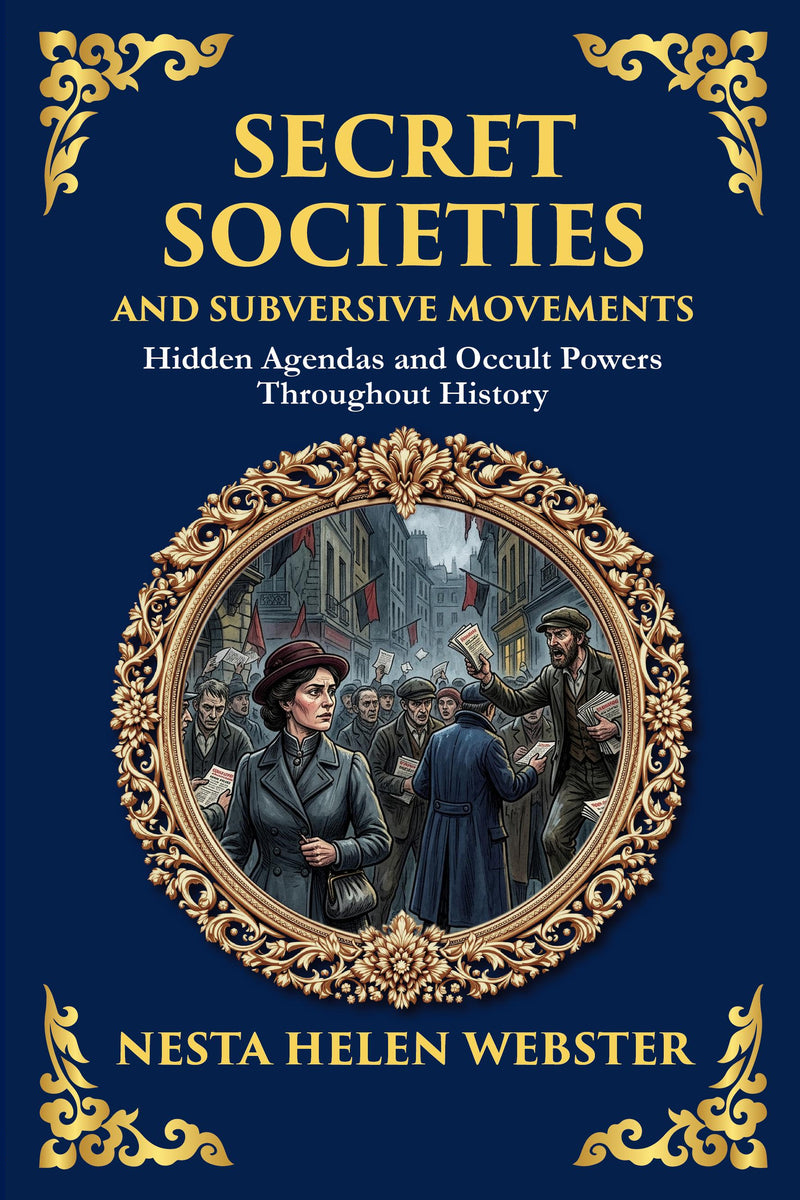
Secret Societies and Subversive Movements
Nesta H. Webster Dive deep into the shadows of history with Nesta Webster’s controversial and thought- provoking study of covert networks and their unseen influence on world events.
or free app
10,000+ hrs library
30-day guarantee
The complete Secret Societies and Subversive appears in modern English through Library of Alexandria Press, available online with audiobook narration included for members.
Have you ever wondered why secret societies have endured across centuries, shaping the world from behind the curtain? In Secret Societies and Subversive Movements, Nesta Helen Webster offers a gripping examination of hidden forces that have influenced revolutions, religious upheavals, and social transformations throughout modern history. This meticulously researched exposé connects the dots between mystical cults, underground brotherhoods, and revolutionary ideologies that have challenged institutions and destabilized nations.
Webster’s controversial yet fascinating analysis reveals a consistent thread of esoteric teachings, clandestine rituals, and radical objectives stretching from the Gnostics and Templars to the French Revolution and Bolshevism. Whether regarded as dangerous conspiracy or alternative insight into the undercurrents of power, this book has captivated and alarmed readers for over a century.
What you’ll discover in this modern edition
- The Historical Roots of Secret Societies – Explore the early mystics, heretics, and cults that formed the foundation for later underground movements.
- The Role of the Illuminati and Freemasonry – Uncover the philosophies, structures, and alleged ambitions of the most famous secret orders.
- Subversion Cloaked as Enlightenment – Learn how intellectual ideals have been co- opted for radical and revolutionary purposes.
- Occult Symbols and Esoteric Teachings – Understand how ancient mysticism interweaves with political subversion.
- Revolution as Ritual – Examine how upheavals in France, Russia, and beyond mirror initiatory mythologies.
| Formats | eBook (EPUB + PDF) · Audiobook · Paperback · Hardcover · Large Print |
| Language | English |
| Trim size (print) | 6 × 9 in |
| Binding | Paperback — perfect-bound · Hardcover — casewrap |
| Large Print edition | Same text in a larger, easy-read type — a larger font, not a larger trim |
| Print pricing | Every physical book at our true cost — at-cost, no profit (members) |
| Library | 873 restored titles, always growing |
| Length | 143,422 words · ~9 hr 34 min reading |
| Reading level | Grade 3 · an easy, flowing read (this modern-English edition) |
| Edition | Modern English translation · 2026 |
Member reviews for this edition are collected as readers finish it — be the first. Across the library: 12,000+ books shipped, every plan covered by a 365-day print guarantee.
About this edition
A faithful, unabridged modern-English edition by The Library of Alexandria — carefully rendered for today's reader and verified paragraph-by-paragraph against the public-domain source. Available as eBook, audiobook, paperback, hardcover, and large print.
- Complete & unabridgedVerified paragraph by paragraph against the source — never a scan, never abridged.
- Modern English, faithfulReadable today, with the author’s meaning kept intact. Readable — not simplified.
- Every format, one membershipRead in your browser or the free app, or listen to the full audiobook.
Included free with your membership
Cancel anytime, one click · 30-day money-back guarantee
Edition last updated July 2026
What’s inside
Secret Societies and Subversive Movements — complete and unabridged: all 21 sections included with membership, plus the full audiobook.
Begin reading Secret Societies and Subversive Movements
In clear modern English — the complete text is included with membership.
Introduction
When Secret Societies and Subversive Movements first appeared in 1924, it landed in a world still reeling from the shocks of a global war, a series of revolutions, and the collapse of empires that had seemed, only a decade earlier, as permanent as mountains. Readers of that era were hungry for explanations. How had the comfortable certainties of the nineteenth century dissolved so quickly into chaos? Why had thrones toppled, why had old orders crumbled, why did the air itself seem charged with a restlessness that no one could quite name? Into this atmosphere stepped Nesta Helen Webster, a writer who claimed to have traced a single thread running through centuries of upheaval — a thread connecting medieval heresies, Renaissance occultists, Enlightenment philosophers, and the revolutionary firebrands of her own day. Her thesis was bold, sweeping, and deeply controversial. Nearly a century later, the book remains one of the most discussed, debated, and dissected works of its kind ever written.
This modern translation has been prepared with a single goal in mind: to make Webster’s dense, allusion-rich prose accessible to the contemporary reader without sacrificing the force of her argument or the texture of her voice. The original text was written for an educated audience steeped in classical references, fluent in the vocabulary of early twentieth-century scholarship, and familiar with the political controversies of the interwar years. Today’s reader, however curious and well-informed, lives in a different world. Names that Webster expected her audience to recognize instantly now require explanation. Sentences that once flowed with Edwardian elegance can read as labyrinthine to a generation raised on shorter rhythms. This edition smooths those difficulties while preserving the substance of what Webster wrote. The aim is not to modernize her into someone she was not, but to clear away the obstacles of time so that her ideas can be encountered, weighed, and judged on their own terms.
Before you begin, it is worth pausing to understand who Nesta Webster was, what she set out to accomplish, and how this book should be read in the twenty-first century. For this is not a simple work, nor an innocent one. It is a book that demands engagement, skepticism, and a willingness to hold competing truths in tension. It rewards the careful reader and punishes the careless one. To approach it well is to approach it as a historical document, a window into a particular mind and a particular moment, as much as a set of claims about the past.
Nesta Helen Webster was born in 1876 into a prosperous and well-connected English family. Her father was a partner in a major banking house, and her upbringing was one of comfort, travel, and intellectual cultivation. She was, by the standards of her day, an unusually educated woman, and she possessed a restless, inquiring mind that ranged across history, philosophy, religion, and politics. In her early adulthood she traveled widely — to India, to the Far East, to the continent of Europe — and these journeys shaped her thinking in ways that would later surface in her writing. She was drawn to questions of belief and meaning, and for a time she explored the spiritual and mystical currents that ran through both Eastern and Western traditions.
It was, by her own account, the study of the French Revolution that transformed her into the writer the world would come to know. Researching the period in depth, she became convinced that the conventional histories had missed something essential — that beneath the surface narrative of grievances, reforms, and popular uprisings there lay a hidden mechanism, an organizing intelligence that had directed events toward predetermined ends. From this conviction grew a body of work that occupied the rest of her life: a series of books examining what she believed to be a continuous tradition of conspiracy stretching across the centuries. The French Revolution: A Study in Democracy appeared in 1919, followed by World Revolution in 1921, and then, in 1924, the present volume, which she conceived as the most comprehensive and historically deep of all her investigations.
To understand the book, one must understand the world that produced it. The years immediately following the First World War were years of profound anxiety and dislocation. The Russian Revolution of 1917 had brought to power a regime explicitly committed to the overthrow of the existing global order, and its leaders made no secret of their ambition to export revolution everywhere. Across Europe, communist uprisings flared and were suppressed; in Germany, in Hungary, in Italy, the old structures of authority seemed to be everywhere under siege. The collapse of four great empires — Russian, German, Austro-Hungarian, and Ottoman — had left a continent in turmoil, and the sense that civilization itself stood on a precipice was widespread, shared by people across the political spectrum.
In this climate, the impulse to find a unifying explanation was powerful. If the world was falling apart, surely there must be a cause, a hand behind the curtain, a design within the apparent chaos. Webster was far from alone in seeking such an explanation, and her work must be read against the backdrop of an entire genre of conspiracy literature that flourished in these years. What distinguished her from many of her contemporaries was the seriousness of her research, the breadth of her reading, and the relative care with which she constructed her arguments. She was not a crank scribbling in obscurity; she was a respected author whose books were reviewed in mainstream publications, who lectured to attentive audiences, and who was taken seriously even by those who disagreed with her. Winston Churchill himself referenced ideas similar to hers in his journalism of the period, a sign of how far such thinking had penetrated into respectable discourse.
Yet it is precisely here that the modern reader must exercise the greatest care. Webster’s work cannot be separated from the darker currents of its time. Some of the conclusions she drew, and some of the sources she relied upon, have rightly been challenged and discredited in the decades since. Her writing at times reflects prejudices and assumptions that were widespread in her era but that we now recognize as both factually false and morally indefensible. This edition does not erase those elements, because to do so would be to falsify the historical record and to deprive the reader of the ability to understand the book as it truly was. Instead, it presents them within their context, trusting the reader to bring discernment, critical judgment, and a clear moral compass to the encounter. We will return to this crucial point shortly, for it is impossible to read this book responsibly without confronting it directly.
What can be said unequivocally is that Webster was a gifted writer and an indefatigable researcher. Whatever one makes of her conclusions, the sheer scope of her undertaking is remarkable. She set out to trace the history of secret organizations, mystical brotherhoods, heretical sects, and revolutionary cabals from the ancient world through to her own century — a project that required her to read across many languages, to consult original documents, and to synthesize an enormous body of material into a coherent narrative. The result is a book that is, at the very least, an extraordinary achievement of compilation and synthesis, a vast tour through the hidden byways of history that few writers before or since have attempted on such a scale.
At its heart, this is a book about the idea that history has a secret history — that alongside the public record of kings and parliaments, wars and treaties, there runs a parallel current of hidden activity, carried on by organizations that conceal their true purposes and operate beyond the view of ordinary observers. Webster’s central contention is that this hidden current is not a series of disconnected episodes but a continuous tradition, passed down through generations, with recurring patterns, recurring methods, and recurring aims.
The book opens by examining the ancient world, exploring the mystery religions and esoteric traditions that Webster believed contained the seeds of later developments. From there it moves through the medieval period, considering the various heretical movements that challenged the established Church, and the orders of knighthood whose suppression gave rise to centuries of legend and speculation. It examines the rise of occult philosophy in the Renaissance, the emergence of organizations devoted to hidden knowledge, and the gradual development of brotherhoods that combined ritual, secrecy, and a sense of mission to remake the world.
A substantial portion of the book is devoted to the eighteenth century, which Webster regarded as a pivotal moment. Here she explores the relationship between secret organizations and the intellectual ferment of the Enlightenment, arguing that certain groups exploited the era’s enthusiasm for reason and reform to advance agendas of their own. She gives particular attention to the events leading up to the French Revolution, building on the research that had first drawn her into this field of study. And she carries the narrative forward into the nineteenth and twentieth centuries, tracing what she saw as the evolution of subversive movements into the revolutionary politics of her own day.
Throughout, Webster is concerned with patterns. She looks for the recurrence of certain ideas — the rejection of traditional religion, the dissolution of established social bonds, the elevation of human reason or human will above inherited authority, the use of secrecy and gradual infiltration as methods of advancing change. She argues that these patterns are not coincidental but represent the persistence of an underlying impulse, transmitted across the centuries by organizations that understood themselves as heirs to a long tradition. Whether or not one accepts this thesis, the act of following her argument is intellectually engaging, for it forces the reader to consider connections that conventional history often leaves unexamined.
It is important to be clear about what the book does and does not offer. It is not a work of dispassionate academic history in the modern sense. Webster wrote with a thesis firmly in mind, and she marshaled her evidence in service of that thesis. She was an advocate as well as a chronicler, and the reader will find that her conclusions are often stated with a confidence that the evidence does not always fully support. This is not a flaw to be hidden but a feature to be understood. The book is most valuable not as a final authority on the matters it discusses but as a provocation — a challenge to think more deeply, to question received narratives, and to investigate further. The best way to read it is with a notebook and an open browser, ready to test her claims, to follow up on her sources, and to form one’s own judgments.
There is also a genuine fascination in the material itself. The history of secret societies, mystical brotherhoods, and underground movements is a subject of perennial human interest, and Webster’s book is a treasure trove of stories, characters, and episodes that the general reader is unlikely to have encountered elsewhere. The shadowy figures who move through her pages — the mystics and adventurers, the philosophers and revolutionaries, the charlatans and true believers — make for compelling reading. Even where her interpretations are questionable, the raw material she presents is often genuinely intriguing, and the book can be enjoyed simply as a guided tour through some of the strangest and least-traveled corners of European history.
A book like this one demands a particular kind of reading — engaged but critical, open but skeptical, curious but discerning. It would be easy to read Webster in either of two unhelpful ways: to accept her conclusions uncritically, swept along by the confidence of her prose and the apparent weight of her evidence; or to dismiss her entirely, refusing to engage with anything she says because of the problematic elements in her work. Both approaches miss the opportunity that the book offers. The richer reading lies between these extremes.
Cancel anytime, one click · 30-day money-back guarantee
Founding annual rate available now — your price locks for life when you join.
Not ready? Get this free chapter by email — read it anytime.
✓ Sent — check your inbox for Secret Societies and Subversive Movements.
Questions about Secret Societies and Subversive Movements
What is Secret Societies and Subversive about?
Nesta H. Webster Dive deep into the shadows of history with Nesta Webster’s controversial and thought- provoking study of covert networks and their unseen influence on world events. From the Illuminati to the Freemasons, from Jacobin radicals to mystical brotherhoods, Webster weaves a compelling narrative that explores the subversive forces often hidden behind the façades of political change, revolution, and societal evolution. Whether you're a skeptic or a seeker of truth, this provocative work challenges you to q
Who wrote Secret Societies and Subversive?
Secret Societies and Subversive was written by Nesta Helen Webster. This edition presents the complete work in clear modern English, faithfully rendered from the public-domain original by Library of Alexandria Press.
Is Secret Societies and Subversive free to read?
The opening chapter is free to read on this page. Members read and listen to the complete work — and the entire library — free, and can order any physical book at our true print cost.
How long is Secret Societies and Subversive?
21 chapters (~143,422 words) — about 9 hr 34 min of reading in this modern-English edition.
Is this an abridged version of Secret Societies and Subversive?
No. This is the complete, unabridged Secret Societies and Subversive, carefully rendered into clear modern English and verified paragraph-by-paragraph against the public-domain source — nothing is cut or summarised.
What formats does Secret Societies and Subversive come in?
Secret Societies and Subversive is available as eBook, paperback, hardcover and large print. eBook and audiobook are included with membership; printed editions ship at our true print cost.
Shipping & returns
Billing & membership
More from the library


Explore Classic & Literary
- Dream Psychology: Psychoanalysis for Beginners · Sigmund Freud
- Great Expectations · Charles Dickens
- The Brothers Karamazov · Fyodor Dostoyevsky
- The Great Gatsby · F. Scott Fitzgerald
- Wild Flowers Worth Knowing · Neltje Blanchan
- Italian Hours · Henry James
- A Popular History of France from the Earliest Times, Volume 5 · François Guizot
- A history of English literature: A practical text-book · Edward Albert
- Italian Highways and Byways from a Motor Car · M. F. Mansfield
- The Heart-Cry of Jesus · Byron J. Rees
- Castes and Tribes of Southern India. Vol. 6 of 7 · Edgar Thurston
- Against the Grain · J.-K. Huysmans
- Dombey and Son · Charles Dickens
- How to Invest Money · George Garr Henry
- The Great Controversy Between Christ and Satan · Ellen Gould Harmon White
- One Hundred Proofs That the Earth Is Not a Globe · William Carpenter
- Southern Literature From 1579–1895 · Louise Manly
- The Renaissance: Studies in Art and Poetry · Walter Pater
- Mark Twain’s Speeches · Mark Twain
- Tacitus on Germany · Cornelius Tacitus
- The Rosary · Florence L. Barclay
- Peculiarities of American Cities · Willard W. Glazier
- Tennis for Girls · Florence A. Ballin
- The World’s Greatest Books — Volume 02 — Fiction
- Shirley · Charlotte Brontë
- Daisy Miller: A Study · Henry James
- Louis Lambert · Honoré de Balzac
- Historic Jamaica · Frank Cundall
- The Gambler · Fyodor Dostoyevsky
- The Mayor of Casterbridge · Thomas Hardy
Secret Societies and Subversive Movements
Secret Societies and Subversive Movements
Hidden Agendas and Occult Powers Throughout History
Nesta Helen Webster
Contents
- Introduction
- Preface by the Author
- Part 1
- Chapter 1
- Chapter 2
- Chapter 3
- Chapter 4
- Chapter 5
- Chapter 6
- Chapter 7
- Chapter 8
- Chapter 9
- Chapter 10
- Chapter 11
- Part 2
- Chapter 12
- Chapter 13
- Chapter 14
- Chapter 15
- Conclusion
- Appendix
Introduction
When Secret Societies and Subversive Movements first appeared in 1924, it landed in a world still reeling from the shocks of a global war, a series of revolutions, and the collapse of empires that had seemed, only a decade earlier, as permanent as mountains. Readers of that era were hungry for explanations. How had the comfortable certainties of the nineteenth century dissolved so quickly into chaos? Why had thrones toppled, why had old orders crumbled, why did the air itself seem charged with a restlessness that no one could quite name? Into this atmosphere stepped Nesta Helen Webster, a writer who claimed to have traced a single thread running through centuries of upheaval — a thread connecting medieval heresies, Renaissance occultists, Enlightenment philosophers, and the revolutionary firebrands of her own day. Her thesis was bold, sweeping, and deeply controversial. Nearly a century later, the book remains one of the most discussed, debated, and dissected works of its kind ever written.
This modern translation has been prepared with a single goal in mind: to make Webster’s dense, allusion-rich prose accessible to the contemporary reader without sacrificing the force of her argument or the texture of her voice. The original text was written for an educated audience steeped in classical references, fluent in the vocabulary of early twentieth-century scholarship, and familiar with the political controversies of the interwar years. Today’s reader, however curious and well-informed, lives in a different world. Names that Webster expected her audience to recognize instantly now require explanation. Sentences that once flowed with Edwardian elegance can read as labyrinthine to a generation raised on shorter rhythms. This edition smooths those difficulties while preserving the substance of what Webster wrote. The aim is not to modernize her into someone she was not, but to clear away the obstacles of time so that her ideas can be encountered, weighed, and judged on their own terms.
Before you begin, it is worth pausing to understand who Nesta Webster was, what she set out to accomplish, and how this book should be read in the twenty-first century. For this is not a simple work, nor an innocent one. It is a book that demands engagement, skepticism, and a willingness to hold competing truths in tension. It rewards the careful reader and punishes the careless one. To approach it well is to approach it as a historical document, a window into a particular mind and a particular moment, as much as a set of claims about the past.
Nesta Helen Webster was born in 1876 into a prosperous and well-connected English family. Her father was a partner in a major banking house, and her upbringing was one of comfort, travel, and intellectual cultivation. She was, by the standards of her day, an unusually educated woman, and she possessed a restless, inquiring mind that ranged across history, philosophy, religion, and politics. In her early adulthood she traveled widely — to India, to the Far East, to the continent of Europe — and these journeys shaped her thinking in ways that would later surface in her writing. She was drawn to questions of belief and meaning, and for a time she explored the spiritual and mystical currents that ran through both Eastern and Western traditions.
It was, by her own account, the study of the French Revolution that transformed her into the writer the world would come to know. Researching the period in depth, she became convinced that the conventional histories had missed something essential — that beneath the surface narrative of grievances, reforms, and popular uprisings there lay a hidden mechanism, an organizing intelligence that had directed events toward predetermined ends. From this conviction grew a body of work that occupied the rest of her life: a series of books examining what she believed to be a continuous tradition of conspiracy stretching across the centuries. The French Revolution: A Study in Democracy appeared in 1919, followed by World Revolution in 1921, and then, in 1924, the present volume, which she conceived as the most comprehensive and historically deep of all her investigations.
To understand the book, one must understand the world that produced it. The years immediately following the First World War were years of profound anxiety and dislocation. The Russian Revolution of 1917 had brought to power a regime explicitly committed to the overthrow of the existing global order, and its leaders made no secret of their ambition to export revolution everywhere. Across Europe, communist uprisings flared and were suppressed; in Germany, in Hungary, in Italy, the old structures of authority seemed to be everywhere under siege. The collapse of four great empires — Russian, German, Austro-Hungarian, and Ottoman — had left a continent in turmoil, and the sense that civilization itself stood on a precipice was widespread, shared by people across the political spectrum.
In this climate, the impulse to find a unifying explanation was powerful. If the world was falling apart, surely there must be a cause, a hand behind the curtain, a design within the apparent chaos. Webster was far from alone in seeking such an explanation, and her work must be read against the backdrop of an entire genre of conspiracy literature that flourished in these years. What distinguished her from many of her contemporaries was the seriousness of her research, the breadth of her reading, and the relative care with which she constructed her arguments. She was not a crank scribbling in obscurity; she was a respected author whose books were reviewed in mainstream publications, who lectured to attentive audiences, and who was taken seriously even by those who disagreed with her. Winston Churchill himself referenced ideas similar to hers in his journalism of the period, a sign of how far such thinking had penetrated into respectable discourse.
Yet it is precisely here that the modern reader must exercise the greatest care. Webster’s work cannot be separated from the darker currents of its time. Some of the conclusions she drew, and some of the sources she relied upon, have rightly been challenged and discredited in the decades since. Her writing at times reflects prejudices and assumptions that were widespread in her era but that we now recognize as both factually false and morally indefensible. This edition does not erase those elements, because to do so would be to falsify the historical record and to deprive the reader of the ability to understand the book as it truly was. Instead, it presents them within their context, trusting the reader to bring discernment, critical judgment, and a clear moral compass to the encounter. We will return to this crucial point shortly, for it is impossible to read this book responsibly without confronting it directly.
What can be said unequivocally is that Webster was a gifted writer and an indefatigable researcher. Whatever one makes of her conclusions, the sheer scope of her undertaking is remarkable. She set out to trace the history of secret organizations, mystical brotherhoods, heretical sects, and revolutionary cabals from the ancient world through to her own century — a project that required her to read across many languages, to consult original documents, and to synthesize an enormous body of material into a coherent narrative. The result is a book that is, at the very least, an extraordinary achievement of compilation and synthesis, a vast tour through the hidden byways of history that few writers before or since have attempted on such a scale.
At its heart, this is a book about the idea that history has a secret history — that alongside the public record of kings and parliaments, wars and treaties, there runs a parallel current of hidden activity, carried on by organizations that conceal their true purposes and operate beyond the view of ordinary observers. Webster’s central contention is that this hidden current is not a series of disconnected episodes but a continuous tradition, passed down through generations, with recurring patterns, recurring methods, and recurring aims.
The book opens by examining the ancient world, exploring the mystery religions and esoteric traditions that Webster believed contained the seeds of later developments. From there it moves through the medieval period, considering the various heretical movements that challenged the established Church, and the orders of knighthood whose suppression gave rise to centuries of legend and speculation. It examines the rise of occult philosophy in the Renaissance, the emergence of organizations devoted to hidden knowledge, and the gradual development of brotherhoods that combined ritual, secrecy, and a sense of mission to remake the world.
A substantial portion of the book is devoted to the eighteenth century, which Webster regarded as a pivotal moment. Here she explores the relationship between secret organizations and the intellectual ferment of the Enlightenment, arguing that certain groups exploited the era’s enthusiasm for reason and reform to advance agendas of their own. She gives particular attention to the events leading up to the French Revolution, building on the research that had first drawn her into this field of study. And she carries the narrative forward into the nineteenth and twentieth centuries, tracing what she saw as the evolution of subversive movements into the revolutionary politics of her own day.
Throughout, Webster is concerned with patterns. She looks for the recurrence of certain ideas — the rejection of traditional religion, the dissolution of established social bonds, the elevation of human reason or human will above inherited authority, the use of secrecy and gradual infiltration as methods of advancing change. She argues that these patterns are not coincidental but represent the persistence of an underlying impulse, transmitted across the centuries by organizations that understood themselves as heirs to a long tradition. Whether or not one accepts this thesis, the act of following her argument is intellectually engaging, for it forces the reader to consider connections that conventional history often leaves unexamined.
It is important to be clear about what the book does and does not offer. It is not a work of dispassionate academic history in the modern sense. Webster wrote with a thesis firmly in mind, and she marshaled her evidence in service of that thesis. She was an advocate as well as a chronicler, and the reader will find that her conclusions are often stated with a confidence that the evidence does not always fully support. This is not a flaw to be hidden but a feature to be understood. The book is most valuable not as a final authority on the matters it discusses but as a provocation — a challenge to think more deeply, to question received narratives, and to investigate further. The best way to read it is with a notebook and an open browser, ready to test her claims, to follow up on her sources, and to form one’s own judgments.
There is also a genuine fascination in the material itself. The history of secret societies, mystical brotherhoods, and underground movements is a subject of perennial human interest, and Webster’s book is a treasure trove of stories, characters, and episodes that the general reader is unlikely to have encountered elsewhere. The shadowy figures who move through her pages — the mystics and adventurers, the philosophers and revolutionaries, the charlatans and true believers — make for compelling reading. Even where her interpretations are questionable, the raw material she presents is often genuinely intriguing, and the book can be enjoyed simply as a guided tour through some of the strangest and least-traveled corners of European history.
A book like this one demands a particular kind of reading — engaged but critical, open but skeptical, curious but discerning. It would be easy to read Webster in either of two unhelpful ways: to accept her conclusions uncritically, swept along by the confidence of her prose and the apparent weight of her evidence; or to dismiss her entirely, refusing to engage with anything she says because of the problematic elements in her work. Both approaches miss the opportunity that the book offers. The richer reading lies between these extremes.
Secret societies began in the East. Regardless of their goals, the inspiration and techniques of most mysterious groups that have influenced world history behind the scenes originated in the regions where human civilization first began—Egypt, Babylon, Syria, and Persia. These systems, which were later brought to the West with massive and lasting effects, were shaped by a combination of Eastern mysticism and an Oriental fondness for intrigue.
When studying secret societies, we must follow two distinct paths: those groups that keep secrets to pursue hidden spiritual knowledge, and those that use secrecy for hidden, usually political, goals.
However, the pursuit of hidden knowledge also has two sides. As in every part of human life, there is another side to the coin—light and dark, good and evil, the heaven and hell of the human mind. The search for secret knowledge can lead either to the discovery of divine truths or to dark and hateful cults. No one knows what forces they might encounter once they cross that threshold. Because initiation allows a person to use spiritual powers—whether benevolent or malicious—it can either lift a person to incredible heights or sink them to depths far lower than they would have reached by staying focused only on the physical world. When people join together in these organizations, they create a collective power that can exert a huge influence on the world. This is why secret societies are so significant.
Let’s be clear: secret societies haven’t always been created for bad reasons. In fact, many started from the noblest human goals—the search for eternal truths. The harm caused by these groups usually came from twisting principles that were originally pure and sacred. I won’t dwell on this further because so many books have already been written about it that only a brief mention is needed here.
End of the free sample
Keep reading, free
Members read and listen to the complete book — and the entire library. Cancel anytime, one click · 30-day money-back guarantee.