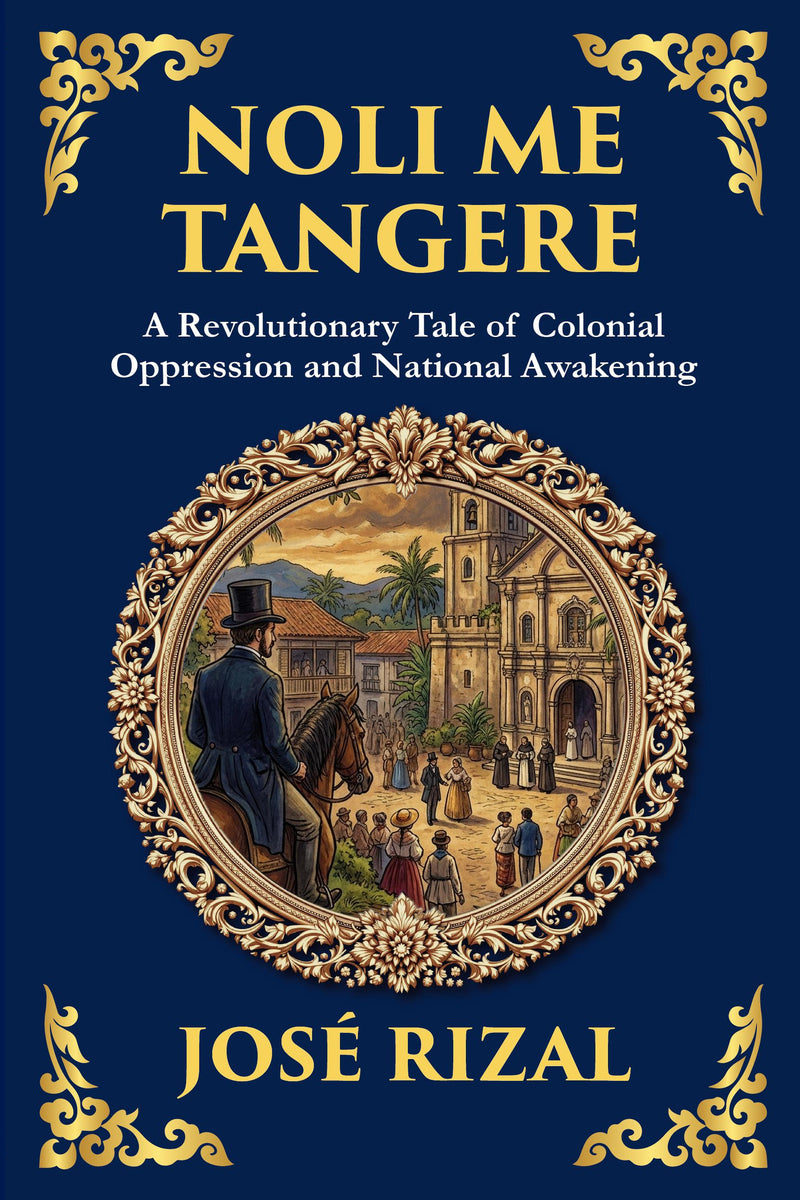
Noli Me Tangere
Set in the Philippines during the height of Spanish colonial rule, Noli Me Tangere is a searing social and political novel that dares to expose the injustices of an oppressive regime.
or free app
10,000+ hrs library
30-day guarantee
The complete Noli Me Tangere appears in modern English through Library of Alexandria Press, available online with audiobook narration included for members.
Have you ever wondered why truth is the most dangerous weapon in a land ruled by lies? Noli Me Tangere is not just a novel—it is a declaration of resistance, a literary spark that ignited a nation’s fight for independence. Written by José Rizal, the national hero of the Philippines, this landmark work offers an unflinching look at colonial power, clerical abuse, and social decay under the rule of the Spanish friars.
The story follows Crisóstomo Ibarra, a young man returning from Europe, full of hope and ideas for reform. But as he reunites with his country, he discovers a society poisoned by greed, fear, and cruelty. With his love for María Clara threatened, and his ideals challenged, Ibarra must choose between peaceful change and revolutionary defiance.
Noli Me Tangere is a tale of patriotism, heartbreak, and the fierce urgency of justice. Written in beautiful prose and brimming with political insight, it remains a foundational work of anti-colonial literature that continues to resonate far beyond the Philippines.
What you’ll discover in this modern edition
- A Nation in Chains – Expose the mechanisms of colonial oppression through the eyes of the oppressed.
- A Hero’s Moral Awakening – Witness Ibarra’s transformation from reformist to radical as he confronts injustice.
- A Haunting Love Story – Feel the pain and longing of María Clara, torn between personal love and national duty.
- A Fierce Critique of Clerical Power – Rizal shines a light on the abuses of the church that dominated Filipino life.
- A Testament to the Power of the Written Word – Discover the book that Spanish authorities tried to ban and that inspired a revolution. Noli Me Tangere is a literary cry for freedom—urgent, tragic, and unforgettable.
| Formats | eBook (EPUB + PDF) · Audiobook · Paperback · Hardcover · Large Print |
| Language | English |
| Trim size (print) | 6 × 9 in |
| Binding | Paperback — perfect-bound · Hardcover — casewrap |
| Large Print edition | Same text in a larger, easy-read type — a larger font, not a larger trim |
| Print pricing | Every physical book at our true cost — at-cost, no profit (members) |
| Library | 873 restored titles, always growing |
| Length | 149,527 words · ~9 hr 58 min reading |
| Reading level | Grade 8 · an easy, flowing read (this modern-English edition) |
| Edition | Modern English translation · 2026 |
Member reviews for this edition are collected as readers finish it — be the first. Across the library: 12,000+ books shipped, every plan covered by a 365-day print guarantee.
About this edition
A faithful, unabridged modern-English edition by The Library of Alexandria — carefully rendered for today's reader and verified paragraph-by-paragraph against the public-domain source. Available as eBook, audiobook, paperback, hardcover, and large print.
- Complete & unabridgedVerified paragraph by paragraph against the source — never a scan, never abridged.
- Modern English, faithfulReadable today, with the author’s meaning kept intact. Readable — not simplified.
- Every format, one membershipRead in your browser or the free app, or listen to the full audiobook.
Included free with your membership
Cancel anytime, one click · 30-day money-back guarantee
Edition last updated July 2026
What’s inside
Noli Me Tangere — complete and unabridged: all 60 sections included with membership, plus the full audiobook.
Begin reading Noli Me Tangere
In clear modern English — the complete text is included with membership.
Introduction
There are books that entertain, books that instruct, and a rare few books that change the course of a nation’s history. Noli Me Tangere belongs to that final, extraordinary category. When José Rizal published this novel in Berlin in 1887, he could not have known with certainty that he was lighting a fuse that would burn through the Philippine islands and help ignite a revolution against three centuries of Spanish colonial rule. Yet that is precisely what he accomplished. This is not merely a great novel from a particular place and time; it is one of the foundational documents of a people’s awakening, a work so dangerous to the established order that owning a copy could mark a person for arrest, and so beloved by the oppressed that it was passed hand to hand in secret like contraband. To open these pages is to step into a story that did not simply describe history—it made history.
The title itself carries a weight that rewards a moment’s reflection. Noli Me Tangere is Latin, drawn from the Gospel of John, where the risen Christ speaks the words to Mary Magdalene: “Touch me not.” Rizal chose this phrase deliberately, and in doing so he announced his ambitions and his fears in a single stroke. He intended to touch the untouchable—to expose the corruptions and cruelties of a colonial system protected by both Church and State, the very things that no one in polite or pious society was permitted to question. The wound he meant to examine was a social cancer, raw and festering, too painful and too sacred in the eyes of the powerful to be probed by ordinary hands. By naming his book after the warning not to touch, Rizal made clear that he was reaching out toward the forbidden anyway, fully aware of the consequences such an act would invite. That this modern translation arrives subtitled “A Revolutionary Tale of Colonial Oppression and National Awakening” is therefore not an exaggeration but a faithful summary of what the author set out to achieve.
To understand the novel, it helps to understand the astonishing human being who created it. José Protasio Rizal Mercado y Alonso Realonda was born in 1861 in Calamba, in the province of Laguna, into a relatively prosperous family of mixed Filipino, Chinese, and Spanish heritage. From an early age he displayed a brilliance that bordered on the prodigious. He was a physician—specifically an ophthalmologist who would later perform surgery to restore his own mother’s sight—but to call him merely a doctor is to capture only a sliver of the man. He was a poet, a novelist, a sculptor, a painter, a fencer, a linguist who could read and write in more than twenty languages, an ethnographer, a historian, and a tireless correspondent who maintained friendships and intellectual exchanges across Europe and Asia. He studied in Manila and then in Madrid, traveled through France, Germany, England, Austria, and beyond, and absorbed the currents of European liberal thought even as he turned his gaze constantly homeward toward the islands of his birth.
It was during his years abroad, primarily in Europe, that Rizal wrote Noli Me Tangere. This circumstance is essential to appreciating both the courage and the strategy behind the book. The censorship apparatus of the colonial Philippines, dominated by powerful religious orders, would never have permitted such a work to be printed at home. Rizal labored over the manuscript in conditions of genuine hardship, often short of money, sometimes near despair, financing the printing in Berlin with the help of a loyal friend when his own funds ran out. He poured into it everything he had observed, suffered, and dreamed. The novel is in many ways an act of love—love for a homeland he saw being slowly strangled, love for a people he believed deserved dignity, education, and self-respect. But it is also an act of profound moral courage, written by a young man in his mid-twenties who understood that he was making himself a target.
The Philippines that Rizal knew had been under Spanish dominion since the sixteenth century. The colonial enterprise had been justified and administered in large part through the Catholic Church, and over the generations the religious orders—the Franciscans, Dominicans, Augustinians, and others—had accumulated enormous landholdings, political influence, and social authority. The friar, in many towns, was the most powerful figure of all, controlling not only spiritual life but education, local governance, and the flow of information. This concentration of power, Rizal believed, had become deeply corrupt. The native Filipino population, derisively labeled indios, were systematically denied education, kept ignorant by design, taxed and exploited, and subjected to arbitrary cruelty against which they had almost no recourse. To criticize a friar was to invite ruin; to be suspected of subversive thinking—of filibusterismo—could mean exile, imprisonment, or death.
Into this charged and dangerous world Rizal launched his novel. He was not, at the time of its writing, calling for armed revolution. His aims were reformist: he wanted the Philippines to be recognized as a province of Spain with representation in the Spanish parliament, he wanted Filipinos to enjoy equal rights and access to education, and above all he wanted the abuses of the colonial system exposed to the light of public conscience. The deepest irony of his life is that his measured, reform-minded writings would help to inspire the very revolution he did not initially advocate, and that the Spanish authorities, by executing him in 1896 at the age of thirty-five, would transform a brilliant writer into an immortal martyr and the supreme national hero of the Philippines. His final hours produced one last masterpiece, the poem “Mi último adiós,” written in his prison cell on the eve of his death. But it was Noli Me Tangere, the book you now hold, that first revealed his power to set a nation alight.
The novel transports us to the Philippines of Rizal’s own era, and it does so with a vividness that is one of its greatest pleasures. Rizal had a novelist’s gift for the living detail—the heat and color of a fiesta, the murmur of gossip in a drawing room, the particular textures of provincial life, the layered hierarchies of a colonial society in which a person’s status could be read in the way they were addressed, the company they kept, and the deference they were owed or denied. He populates his pages with an unforgettable gallery of characters drawn from every level of that society, and herein lies one of the book’s enduring strengths: it is not a dry political tract but a richly human drama, alive with love and grief, ambition and cowardice, idealism and betrayal.
At the heart of the story is a young man who returns to his homeland after years of study in Europe, full of hope and forward-looking ideas, eager to contribute to the betterment of his people. Through his eyes we are invited to see the country anew—both its beauty and its sickness—and to feel the collision between the bright dreams of a returning idealist and the entrenched realities of a system that has no intention of changing. Around him Rizal arranges a constellation of other figures whose lives intersect with his in ways that gradually reveal the full machinery of colonial oppression: how it crushes some, corrupts others, and forces nearly everyone into compromises that erode the soul. I will say no more about the particulars of the plot, because the experience of discovering how these threads weave together—and where they ultimately lead—is one that should belong wholly to you as a first-time reader. Rizal was a careful builder of suspense and emotional consequence, and the journey he constructs deserves to unfold without interference.
What can be said without spoiling anything is that the novel operates simultaneously on several levels, and part of its genius is how seamlessly it moves between them. On one level it is an intimate human story of love, loyalty, and the tragic costs of injustice. On another it is a sweeping social panorama, a portrait of an entire society rendered with the eye of a skilled observer. And on yet another level it is a moral and political argument, a sustained indictment of specific abuses delivered through the medium of fiction rather than the pamphlet. Rizal was a profound admirer of the great European realists, and the influence of writers such as the Spanish novelist Benito Pérez Galdós and the French masters of social realism can be felt in his work. Yet Noli Me Tangere is no mere imitation of European models. It is unmistakably and proudly Filipino, rooted in the soil, the speech, the faith, and the suffering of a particular people in a particular place.
One of the most striking features of the book is its tone, which shifts with remarkable agility. Rizal could be tender, even lyrical, in his depictions of love and natural beauty. He could be searingly, devastatingly satirical when he turned his pen on hypocrisy, pretension, and abuse of power; some of the novel’s sharpest passages skewer their targets with a wit that draws blood. And he could be deeply, unbearably moving when he portrayed human suffering—the helplessness of the poor before the powerful, the destruction of innocence, the silencing of those who dared to speak. This emotional range is part of what has kept the book alive for well over a century. It is not a sermon, though it has a moral purpose. It is a story that makes you laugh and then makes you ache, that lulls you with charm and then strikes you with horror, and that ultimately leaves you understanding, in your bones rather than merely your intellect, why this work moved a people toward revolution.
It is worth pausing to consider the figure of the friar in the novel, since the religious establishment was Rizal’s central target. Modern readers should understand an important distinction that Rizal himself was careful to maintain, even as his enemies refused to see it. His attack was not upon faith itself, nor upon the Catholic religion as a matter of belief, but upon the abuse of religious authority for worldly power and the cruelty committed in religion’s name. Rizal was a complex man whose own relationship with the Church was fraught and much debated to this day, but the novel’s critique is aimed squarely at the corruption of an institution that had, in his view, betrayed its sacred mission to serve and protect the people. This is a vital point for the contemporary reader to hold in mind, because it reveals the novel’s surprising relevance far beyond its original setting. Wherever power dresses itself in the language of the sacred to escape accountability, wherever the guardians of the powerless become their oppressors, the warnings of Noli Me Tangere still resound.
This brings us to a question that thoughtful readers often raise: why should anyone outside the Philippines, more than a century after the events that inspired it, care about this book? The answer is that Noli Me Tangere, while intensely specific in its setting, treats themes that are utterly universal and perpetually urgent. It is about the relationship between the powerful and the powerless. It is about the way injustice perpetuates itself, generation after generation, by keeping the oppressed ignorant and afraid. It is about the courage required to tell the truth in a society built on comfortable lies, and the terrible price often demanded of those who tell it. It is about whether meaningful change can come through reform and reason, or whether entrenched power must finally be confronted by force—a question the novel raises with genuine anguish and refuses to answer cheaply. These are not the concerns of one nation in one century. They are the concerns of every people who have ever lived under an unjust order and dreamed of something better. To read this book is to encounter a mind grappling with questions that remain as alive today as they were when Rizal first set them down.
Cancel anytime, one click · 30-day money-back guarantee
Founding annual rate available now — your price locks for life when you join.
Not ready? Get this free chapter by email — read it anytime.
✓ Sent — check your inbox for Noli Me Tangere.
Questions about Noli Me Tangere
What is Noli Me Tangere about?
Set in the Philippines during the height of Spanish colonial rule, Noli Me Tangere is a searing social and political novel that dares to expose the injustices of an oppressive regime. Through the journey of the idealistic Crisóstomo Ibarra, Rizal paints a vivid and haunting picture of a nation shackled by corruption, abuse, and spiritual decay. This novel, which sparked the fire of Philippine revolution, is both a love story and a call to arms—a cry for dignity, truth, and national awakening.
Who wrote Noli Me Tangere?
Noli Me Tangere was written by José Rizal. This edition presents the complete work in clear modern English, faithfully rendered from the public-domain original by Library of Alexandria Press.
Is Noli Me Tangere free to read?
The opening chapter is free to read on this page. Members read and listen to the complete work — and the entire library — free, and can order any physical book at our true print cost.
How long is Noli Me Tangere?
60 chapters (~149,527 words) — about 9 hr 58 min of reading in this modern-English edition.
Is this an abridged version of Noli Me Tangere?
No. This is the complete, unabridged Noli Me Tangere, carefully rendered into clear modern English and verified paragraph-by-paragraph against the public-domain source — nothing is cut or summarised.
What formats does Noli Me Tangere come in?
Noli Me Tangere is available as eBook, paperback, hardcover and large print. eBook and audiobook are included with membership; printed editions ship at our true print cost.
Shipping & returns
Billing & membership
More from the library


Explore Classic & Literary
- Dream Psychology: Psychoanalysis for Beginners · Sigmund Freud
- Great Expectations · Charles Dickens
- The Brothers Karamazov · Fyodor Dostoyevsky
- The Great Gatsby · F. Scott Fitzgerald
- Wild Flowers Worth Knowing · Neltje Blanchan
- Italian Hours · Henry James
- A Popular History of France from the Earliest Times, Volume 5 · François Guizot
- A history of English literature: A practical text-book · Edward Albert
- Italian Highways and Byways from a Motor Car · M. F. Mansfield
- The Heart-Cry of Jesus · Byron J. Rees
- Castes and Tribes of Southern India. Vol. 6 of 7 · Edgar Thurston
- Against the Grain · J.-K. Huysmans
- Dombey and Son · Charles Dickens
- How to Invest Money · George Garr Henry
- The Great Controversy Between Christ and Satan · Ellen Gould Harmon White
- One Hundred Proofs That the Earth Is Not a Globe · William Carpenter
- Southern Literature From 1579–1895 · Louise Manly
- The Renaissance: Studies in Art and Poetry · Walter Pater
- Mark Twain’s Speeches · Mark Twain
- Tacitus on Germany · Cornelius Tacitus
- The Rosary · Florence L. Barclay
- Peculiarities of American Cities · Willard W. Glazier
- Tennis for Girls · Florence A. Ballin
- The World’s Greatest Books — Volume 02 — Fiction
- Shirley · Charlotte Brontë
- Daisy Miller: A Study · Henry James
- Louis Lambert · Honoré de Balzac
- Historic Jamaica · Frank Cundall
- The Gambler · Fyodor Dostoyevsky
- The Mayor of Casterbridge · Thomas Hardy
Noli Me Tangere
Noli Me Tangere
A Revolutionary Tale of Colonial Oppression and National Awakening
José Rizal
Contents
- Introduction
- Chapter 1
- Chapter 2
- Chapter 3
- Chapter 4
- Chapter 5
- Chapter 6
- Chapter 7
- Chapter 8
- Chapter 9
- Chapter 10
- Chapter 11
- Chapter 12
- Chapter 13
- Chapter 14
- Chapter 15
- Chapter 16
- Chapter 17
- Chapter 18
- Chapter 19
- Chapter 20
- Chapter 21
- Chapter 22
- Chapter 23
- Chapter 24
- Chapter 25
- Chapter 26
- Chapter 27
- Chapter 28
- Chapter 29
- Chapter 30
- Chapter 31
- Chapter 32
- Chapter 33
- Chapter 34
- Chapter 35
- Chapter 36
- Chapter 37
- Chapter 38
- Chapter 39
- … and 20 more chapters
Introduction
There are books that entertain, books that instruct, and a rare few books that change the course of a nation’s history. Noli Me Tangere belongs to that final, extraordinary category. When José Rizal published this novel in Berlin in 1887, he could not have known with certainty that he was lighting a fuse that would burn through the Philippine islands and help ignite a revolution against three centuries of Spanish colonial rule. Yet that is precisely what he accomplished. This is not merely a great novel from a particular place and time; it is one of the foundational documents of a people’s awakening, a work so dangerous to the established order that owning a copy could mark a person for arrest, and so beloved by the oppressed that it was passed hand to hand in secret like contraband. To open these pages is to step into a story that did not simply describe history—it made history.
The title itself carries a weight that rewards a moment’s reflection. Noli Me Tangere is Latin, drawn from the Gospel of John, where the risen Christ speaks the words to Mary Magdalene: “Touch me not.” Rizal chose this phrase deliberately, and in doing so he announced his ambitions and his fears in a single stroke. He intended to touch the untouchable—to expose the corruptions and cruelties of a colonial system protected by both Church and State, the very things that no one in polite or pious society was permitted to question. The wound he meant to examine was a social cancer, raw and festering, too painful and too sacred in the eyes of the powerful to be probed by ordinary hands. By naming his book after the warning not to touch, Rizal made clear that he was reaching out toward the forbidden anyway, fully aware of the consequences such an act would invite. That this modern translation arrives subtitled “A Revolutionary Tale of Colonial Oppression and National Awakening” is therefore not an exaggeration but a faithful summary of what the author set out to achieve.
To understand the novel, it helps to understand the astonishing human being who created it. José Protasio Rizal Mercado y Alonso Realonda was born in 1861 in Calamba, in the province of Laguna, into a relatively prosperous family of mixed Filipino, Chinese, and Spanish heritage. From an early age he displayed a brilliance that bordered on the prodigious. He was a physician—specifically an ophthalmologist who would later perform surgery to restore his own mother’s sight—but to call him merely a doctor is to capture only a sliver of the man. He was a poet, a novelist, a sculptor, a painter, a fencer, a linguist who could read and write in more than twenty languages, an ethnographer, a historian, and a tireless correspondent who maintained friendships and intellectual exchanges across Europe and Asia. He studied in Manila and then in Madrid, traveled through France, Germany, England, Austria, and beyond, and absorbed the currents of European liberal thought even as he turned his gaze constantly homeward toward the islands of his birth.
It was during his years abroad, primarily in Europe, that Rizal wrote Noli Me Tangere. This circumstance is essential to appreciating both the courage and the strategy behind the book. The censorship apparatus of the colonial Philippines, dominated by powerful religious orders, would never have permitted such a work to be printed at home. Rizal labored over the manuscript in conditions of genuine hardship, often short of money, sometimes near despair, financing the printing in Berlin with the help of a loyal friend when his own funds ran out. He poured into it everything he had observed, suffered, and dreamed. The novel is in many ways an act of love—love for a homeland he saw being slowly strangled, love for a people he believed deserved dignity, education, and self-respect. But it is also an act of profound moral courage, written by a young man in his mid-twenties who understood that he was making himself a target.
The Philippines that Rizal knew had been under Spanish dominion since the sixteenth century. The colonial enterprise had been justified and administered in large part through the Catholic Church, and over the generations the religious orders—the Franciscans, Dominicans, Augustinians, and others—had accumulated enormous landholdings, political influence, and social authority. The friar, in many towns, was the most powerful figure of all, controlling not only spiritual life but education, local governance, and the flow of information. This concentration of power, Rizal believed, had become deeply corrupt. The native Filipino population, derisively labeled indios, were systematically denied education, kept ignorant by design, taxed and exploited, and subjected to arbitrary cruelty against which they had almost no recourse. To criticize a friar was to invite ruin; to be suspected of subversive thinking—of filibusterismo—could mean exile, imprisonment, or death.
Into this charged and dangerous world Rizal launched his novel. He was not, at the time of its writing, calling for armed revolution. His aims were reformist: he wanted the Philippines to be recognized as a province of Spain with representation in the Spanish parliament, he wanted Filipinos to enjoy equal rights and access to education, and above all he wanted the abuses of the colonial system exposed to the light of public conscience. The deepest irony of his life is that his measured, reform-minded writings would help to inspire the very revolution he did not initially advocate, and that the Spanish authorities, by executing him in 1896 at the age of thirty-five, would transform a brilliant writer into an immortal martyr and the supreme national hero of the Philippines. His final hours produced one last masterpiece, the poem “Mi último adiós,” written in his prison cell on the eve of his death. But it was Noli Me Tangere, the book you now hold, that first revealed his power to set a nation alight.
The novel transports us to the Philippines of Rizal’s own era, and it does so with a vividness that is one of its greatest pleasures. Rizal had a novelist’s gift for the living detail—the heat and color of a fiesta, the murmur of gossip in a drawing room, the particular textures of provincial life, the layered hierarchies of a colonial society in which a person’s status could be read in the way they were addressed, the company they kept, and the deference they were owed or denied. He populates his pages with an unforgettable gallery of characters drawn from every level of that society, and herein lies one of the book’s enduring strengths: it is not a dry political tract but a richly human drama, alive with love and grief, ambition and cowardice, idealism and betrayal.
At the heart of the story is a young man who returns to his homeland after years of study in Europe, full of hope and forward-looking ideas, eager to contribute to the betterment of his people. Through his eyes we are invited to see the country anew—both its beauty and its sickness—and to feel the collision between the bright dreams of a returning idealist and the entrenched realities of a system that has no intention of changing. Around him Rizal arranges a constellation of other figures whose lives intersect with his in ways that gradually reveal the full machinery of colonial oppression: how it crushes some, corrupts others, and forces nearly everyone into compromises that erode the soul. I will say no more about the particulars of the plot, because the experience of discovering how these threads weave together—and where they ultimately lead—is one that should belong wholly to you as a first-time reader. Rizal was a careful builder of suspense and emotional consequence, and the journey he constructs deserves to unfold without interference.
What can be said without spoiling anything is that the novel operates simultaneously on several levels, and part of its genius is how seamlessly it moves between them. On one level it is an intimate human story of love, loyalty, and the tragic costs of injustice. On another it is a sweeping social panorama, a portrait of an entire society rendered with the eye of a skilled observer. And on yet another level it is a moral and political argument, a sustained indictment of specific abuses delivered through the medium of fiction rather than the pamphlet. Rizal was a profound admirer of the great European realists, and the influence of writers such as the Spanish novelist Benito Pérez Galdós and the French masters of social realism can be felt in his work. Yet Noli Me Tangere is no mere imitation of European models. It is unmistakably and proudly Filipino, rooted in the soil, the speech, the faith, and the suffering of a particular people in a particular place.
One of the most striking features of the book is its tone, which shifts with remarkable agility. Rizal could be tender, even lyrical, in his depictions of love and natural beauty. He could be searingly, devastatingly satirical when he turned his pen on hypocrisy, pretension, and abuse of power; some of the novel’s sharpest passages skewer their targets with a wit that draws blood. And he could be deeply, unbearably moving when he portrayed human suffering—the helplessness of the poor before the powerful, the destruction of innocence, the silencing of those who dared to speak. This emotional range is part of what has kept the book alive for well over a century. It is not a sermon, though it has a moral purpose. It is a story that makes you laugh and then makes you ache, that lulls you with charm and then strikes you with horror, and that ultimately leaves you understanding, in your bones rather than merely your intellect, why this work moved a people toward revolution.
It is worth pausing to consider the figure of the friar in the novel, since the religious establishment was Rizal’s central target. Modern readers should understand an important distinction that Rizal himself was careful to maintain, even as his enemies refused to see it. His attack was not upon faith itself, nor upon the Catholic religion as a matter of belief, but upon the abuse of religious authority for worldly power and the cruelty committed in religion’s name. Rizal was a complex man whose own relationship with the Church was fraught and much debated to this day, but the novel’s critique is aimed squarely at the corruption of an institution that had, in his view, betrayed its sacred mission to serve and protect the people. This is a vital point for the contemporary reader to hold in mind, because it reveals the novel’s surprising relevance far beyond its original setting. Wherever power dresses itself in the language of the sacred to escape accountability, wherever the guardians of the powerless become their oppressors, the warnings of Noli Me Tangere still resound.
This brings us to a question that thoughtful readers often raise: why should anyone outside the Philippines, more than a century after the events that inspired it, care about this book? The answer is that Noli Me Tangere, while intensely specific in its setting, treats themes that are utterly universal and perpetually urgent. It is about the relationship between the powerful and the powerless. It is about the way injustice perpetuates itself, generation after generation, by keeping the oppressed ignorant and afraid. It is about the courage required to tell the truth in a society built on comfortable lies, and the terrible price often demanded of those who tell it. It is about whether meaningful change can come through reform and reason, or whether entrenched power must finally be confronted by force—a question the novel raises with genuine anguish and refuses to answer cheaply. These are not the concerns of one nation in one century. They are the concerns of every people who have ever lived under an unjust order and dreamed of something better. To read this book is to encounter a mind grappling with questions that remain as alive today as they were when Rizal first set them down.
On the last day of October, Don Santiago de los Santos — widely known as Capitan Tiago — gave a dinner. He had announced it only that afternoon, which was unusual for him, yet it was already the only thing people were talking about in Binondo and the surrounding districts, and even in the Walled City. Capitan Tiago was considered one of the most hospitable men around. His house, like his country, closed its doors to nothing except commerce and any new or daring ideas. The news spread like an electric shock through the world of parasites, bores, and hangers-on that God in His infinite bounty creates and so kindly multiplies in Manila. Some immediately went looking for shoe polish, others for buttons and cravats. But everyone was most concerned with how to greet the master of the house in the most familiar tone possible — to give the impression of an old friendship, or, if the need arose, to excuse arriving late.
The dinner was held in a house on Calle Anloague. We don’t remember the number, but we will describe it well enough that it can still be recognized, provided the earthquakes have not destroyed it. We don’t believe the owner has had it torn down, since such work is generally left to God or nature — the same Powers that hold the contracts for many of our government’s projects. It is a fairly large building, typical of many in the country, and it faces the arm of the Pasig known to some as the Binondo River. Like all the streams in Manila, this river serves many roles at once: bath, sewer, laundry, fishery, means of transportation and communication, and even drinking water when the Chinese water-carrier finds it convenient. It is worth noting that along nearly a mile of this important artery — where traffic is densest and the noise most deafening — there is only one wooden bridge. One side of it is out of repair for six months of the year, and the other side is impassable for the remaining six. During the hot season, horses take advantage of this permanent state of affairs by jumping off the bridge into the water, to the great surprise of any distracted soul dozing inside a carriage or philosophizing about the progress of the age.
End of the free sample
Keep reading, free
Members read and listen to the complete book — and the entire library. Cancel anytime, one click · 30-day money-back guarantee.