
 1 h 8 minAudiobook13 minSummaryRead it, hear it, the 15-minute summary, and print and large print at cost
 Audiobook edition · 1 h 8 minPaperback · 6 × 9 in · printing soonHardcover · 6 × 9 in · printing soon
About this book
When a city praises its fallen soldiers, does it honor the dead—or flatter the living?
In Plato’s Menexenus, Socrates meets a young man with political ambitions, fresh from the council chamber in Athens. The city must choose someone to speak at a public funeral for citizens killed in war. Menexenus asks whether Socrates could deliver such a speech himself.
Socrates answers with a long funeral oration he says he learned from Aspasia, the partner of Pericles. It praises Athenian birth, upbringing, and deeds. But its purpose remains a puzzle: sincere tribute or pointed parody? Behind the praise lies Plato’s concern about speakers who please a crowd without caring for truth.
What you’ll discover
- Praise and political ambition Meet Menexenus as public mourning becomes a question of who gets to speak.
- Socrates in an unfamiliar role Hear the philosopher deliver an extended speech rather than pursue his usual questions.
- A city praising itself Follow an oration that turns Athenian origins and wartime deeds into public glory.
- Words for grieving families Encounter the speech’s imagined voices of the dead addressing their children and parents.
- A puzzle of tone Weigh tribute against parody, and ask where moving words leave room for truth.
Who will love it
This is for readers who enjoy ancient Athens, Socrates in a playful mood, and the craft of public speaking. It suits anyone curious about how cities remember their war dead.
What’s inside
The key ideas, in the 15-minute summary
- Public praise enchants its own audience
- Aspasia stands behind the borrowed speech
- Shared birth becomes an argument for equality
- Victories place Athens at the center
- Defeat becomes another reason for praise
- The dead turn mourning toward duty
- Tenderness and mockery remain in tension
- Listen beyond the pleasure of praise
Formats and delivery
- eBook
- On your phone, tablet or computer, once the book texts are online.
- Large-print eBook
- The same book in bigger, clearer type, once the book texts are online.
- Audiobook
- Read by Lucas Linden, complete. It opens once the recording is online.
- 15-minute summary
- The key ideas in about 13 minutes, to read today.
- Paperback
- 6 × 9 in. Printing soon: leave your email under Paperback or Hardcover above.
- Hardcover
- 6 × 9 in. Printing soon: leave your email under Paperback or Hardcover above.
- Large print paperback
- 8.5 × 11 in. Printing soon: leave your email under Paperback or Hardcover above.
- Large print hardcover
- 8.5 × 11 in. Printing soon: leave your email under Paperback or Hardcover above.
Every printed copy is made when you order it and shipped worldwide; shipping is shown at checkout. The eBook and the audiobook open when the book texts go online.
How it works
- Start free. Nothing to pay today; the eBook of this book is yours to keep.
- Read, listen and print. 200,000+ classics as eBook, large-print eBook, audiobook and 15-minute summary, and any book printed at cost as a paperback, hardcover or large print, 5 accounts for the price of one.
- We remind you first. Free for 3 months, and we email you 7 days before your first payment. Then USD 0.14 a day in your first year on the yearly plan and USD 0.27 a day after, or USD 0.66 a day on the monthly plan. Cancel online in two clicks.
Bought on its own? Every eBook, audiobook and printed book you buy without the plan carries our 30-day money-back guarantee.

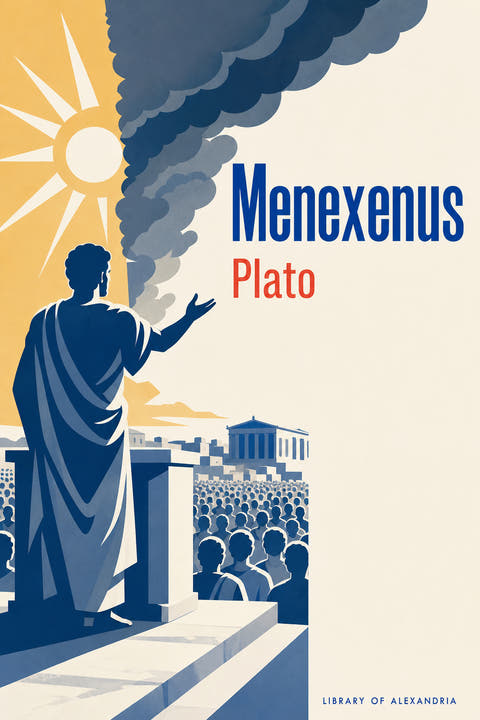
Menexenus
 by Plato
Socrates recites a funeral speech he credits to Aspasia, saying orators’ praise enchants him for over three days.
ChallengingUnder 2 hours to readEnglish
Learn a language with challenging classicsSpanishFrenchGermanItalianJapanesePortugueseEnglishHow we measure levels
Excellent
Free for 3 months · starts right away, on any device
Read free3 months free · cancel anytimeFree for 3 months, then USD 0.14 a dayCancel anytimeHow it works


- Read or listen
- Print and large print at cost
- 5 accounts for the price of one
In short
What if a speech could make you feel taller, nobler and wiser for days, even though you know it is only words? Socrates says that is what happens to him whenever an orator praises the Athenian dead.
Menexenus at a glance
- Reading time
- About 35 min25 min fast, 40 min slow
- Length
- 7,960 words
- Library level
- Challenging long sentences, a rich vocabulary
- First published
- about 380 BCby Plato
Reading time at 238 words a minute (fast 300, slow 200). How long the classics take to read · Updated
From the 15-minute summary · Key idea 1
Praise aimed at a crowd can enchant it
Plato opens with a simple question. Where have you been, Socrates asks Menexenus, and the young man answers that he has been at the Council. The city is about to choose a speaker for the public funeral of men killed in war.
Then Socrates tells what funeral speeches do to him. A dead man gets a splendid burial, even if he was poor. A learned speaker praises him, though the man may not have been good for much. The speakers praise the city, the ancestors and the living who stand listening. Socrates feels enchanted and imagines himself greater and finer than he was.
Free for 3 months · Cancel anytime
You looked at
Which edition is right for me
- 15-minute summary
- The key ideas of the whole book in about 13 minutes. A good first look, or a refresher.
Details
- Language
- English
- Reading time
- 40 min
- Level
- Challenging
Cite this edition
Plato. Menexenus. Library of Alexandria, 2026, libraryofalexandria.com/products/menexenus.
Plato. (2026). Menexenus. Library of Alexandria. https://libraryofalexandria.com/products/menexenus (Original work published ca. 380 B.C.E.)
Plato. Menexenus. Library of Alexandria, 2026. https://libraryofalexandria.com/products/menexenus.
@book{plato2026menexenus,
  author = {Plato},
  title = {Menexenus},
  publisher = {Library of Alexandria},
  year = {2026},
  url = {https://libraryofalexandria.com/products/menexenus},
  note = {First published ca. 380 BCE}
}
Free gifts
USD 580 in free gifts when you start
Every book in every format and in 25 languages, 5 accounts for the price of one. Nothing to pay today.
- 200,000+ classic eBooksIn 25 languages, side by side
USD 170FREE - Every audiobookIn 25 languages, any device
USD 120FREE - 15-minute summariesRead or listen, in 25 languages
USD 60FREE - Print at cost, no markupPaperback, hardcover, large print
USD 60FREE - 5 accounts for the price of oneA shelf for everyone at home
USD 170FREE - A part in rebuilding the libraryNew languages and books for all
FREE
Questions about Menexenus
Can I read it free?
Yes. The first key idea of the 15-minute summary is free with no sign-up. Start free and the whole book is yours for 3 months, with the eBook to keep, plus 200,000+ more classics and any book printed at cost as a paperback, hardcover or large print. Nothing to pay today: we email you 7 days before your first payment, and you can cancel online in two clicks.
Can I buy the printed book?
Soon. The paperback, hardcover and large print editions are being prepared. Choose Paperback or Hardcover above, leave your email, and we tell you the day you can order it, printed at cost.
How many accounts do I get?
Five, for the price of one: you and 4 more people, each with their own login, shelf and their own place in every book.
Can I cancel anytime?
Yes. Cancel online in two clicks at any time and nothing more is charged. Nothing is charged in your first 3 months, and we email you 7 days before your first payment.
What is Menexenus about?
Menexenus is a short dialogue in which Socrates tells a young man about the spell of funeral speeches, then recites one he says Aspasia composed. It praises Athens and its war dead and consoles their families.
Who is Aspasia in Menexenus?
Aspasia is the woman Socrates names as his teacher of rhetoric and as the teacher of Pericles. In the dialogue she is the supposed author of the funeral oration Socrates recites from memory.
Is the funeral speech in Menexenus serious or a parody?
Readers disagree. Some see a sincere model oration, others see playful mimicry of orators, and others see a warning about flattering a city. The light frame and the speech's boasts support each reading.

More by Plato
See all their booksMore like this
Our mission
The library burned once. We are building it back.
Every great book, in every language and every format, for every family. Every plan helps pay for new languages, new audiobooks and books for readers who have never had them. Join the movement.
Read our story- Every language25 languages today, side by side, and more every year
- No wastePrinted on demand: no warehouses, no unsold stock, no pulped copies
- For everyonePaperback, hardcover and large print at the cost of printing





