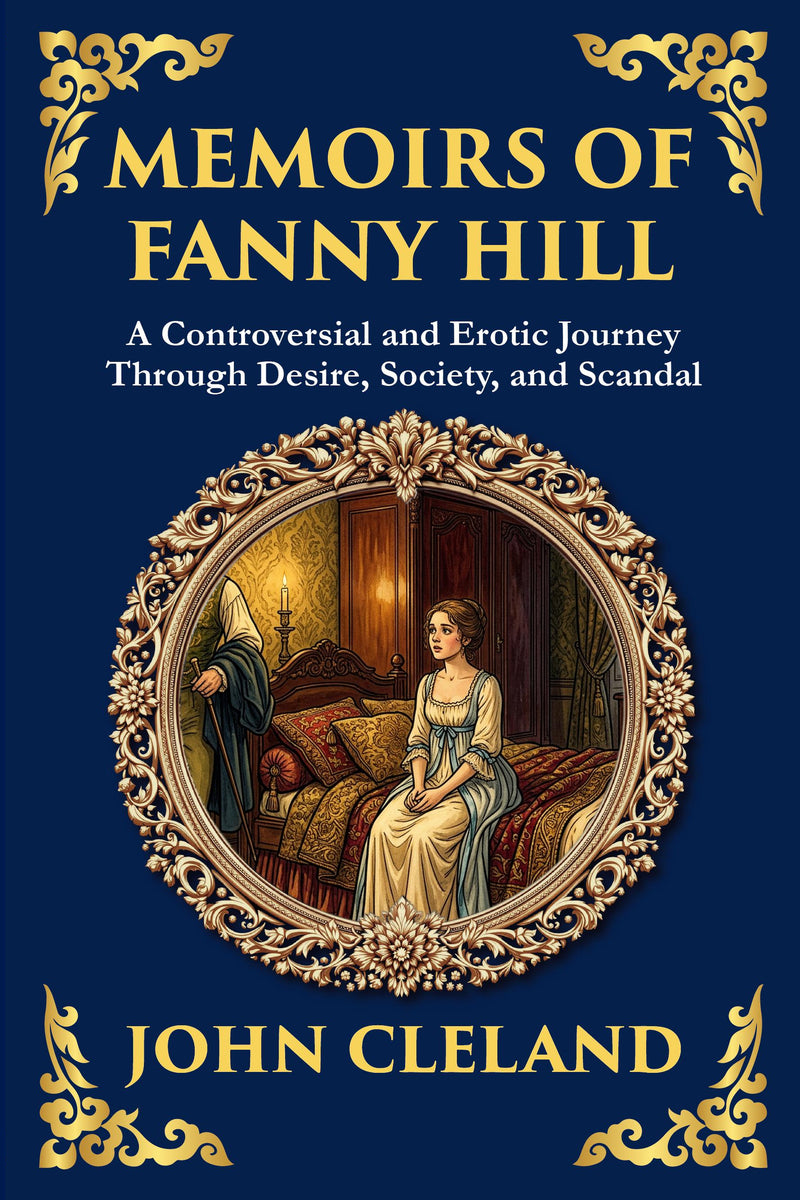
Memoirs of Fanny Hill
Banned, censored, and whispered about for centuries—Memoirs of Fanny Hill is one of the most infamous works in English literature.
or free app
10,000+ hrs library
30-day guarantee
The complete Memoirs of Fanny Hill appears in modern English through Library of Alexandria Press, available online with audiobook narration included for members.
Have you ever wondered why forbidden stories endure the longest? Memoirs of Fanny Hill, also known as Fanny Hill: Memoirs of a Woman of Pleasure, remains one of the most controversial and enduring erotic novels ever written. First published in 1748, it scandalized the literary world for its open portrayal of sexual desire, yet beneath its provocative surface lies a complex narrative about agency, transformation, and social critique.
Told through a series of reflective letters from a reformed courtesan to a young acquaintance, the story follows Fanny Hill’s rise from orphaned country girl to sought-after woman in the dazzling (and dangerous) heart of London’s libertine society. Through encounters with noble patrons, deceptive lovers, and unexpected heartbreaks, Fanny’s voice emerges as one of clarity, humor, and hard-won wisdom. Though long censored, Fanny Hill is more than erotica—it is a story of survival, identity, and reclaiming control in a world eager to exploit innocence.
Cleland’s prose is rich, lyrical, and shockingly modern in its unapologetic embrace of female perspective and sexual autonomy.
What you’ll discover in this modern edition
- A Landmark of Erotic Literature – One of the first English novels to explore female sexuality with frankness and artistry
- A Voice of Defiant Honesty – Fanny’s narration blends raw experience with eloquent reflection
- Social Commentary Hidden in Seduction – Sharp critique of class, exploitation, and Victorian hypocrisy
- A Character of Resilience and Growth – Witness Fanny’s journey from naïveté to empowered womanhood
- A Work Once Silenced, Now Celebrated – Explore why this once-banned novel continues to challenge, charm, and endure
| Formats | eBook (EPUB + PDF) · Audiobook · Paperback · Hardcover · Large Print |
| Language | English |
| Trim size (print) | 6 × 9 in |
| Binding | Paperback — perfect-bound · Hardcover — casewrap |
| Large Print edition | Same text in a larger, easy-read type — a larger font, not a larger trim |
| Print pricing | Every physical book at our true cost — at-cost, no profit (members) |
| Library | 873 restored titles, always growing |
| Length | 76,491 words · ~5 hr 6 min reading |
| Reading level | Grade 3 · an easy, flowing read (this modern-English edition) |
| Edition | Modern English translation · 2026 |
Member reviews for this edition are collected as readers finish it — be the first. Across the library: 12,000+ books shipped, every plan covered by a 365-day print guarantee.
About this edition
A faithful, unabridged modern-English edition by The Library of Alexandria — carefully rendered for today's reader and verified paragraph-by-paragraph against the public-domain source. Available as eBook, audiobook, paperback, hardcover, and large print.
- Complete & unabridgedVerified paragraph by paragraph against the source — never a scan, never abridged.
- Modern English, faithfulReadable today, with the author’s meaning kept intact. Readable — not simplified.
- Every format, one membershipRead in your browser or the free app, or listen to the full audiobook.
Included free with your membership
Cancel anytime, one click · 30-day money-back guarantee
Edition last updated July 2026
What’s inside
Memoirs of Fanny Hill — complete and unabridged: all 3 sections included with membership, plus the full audiobook.
Begin reading Memoirs of Fanny Hill
In clear modern English — the complete text is included with membership.
Introduction
When Memoirs of a Woman of Pleasure—the novel the world has come to know simply as Fanny Hill—first appeared in London in two slim installments during the winter of 1748 and the following spring, it set in motion a chain of events that would echo across more than two and a half centuries of literary history. Its author, John Cleland, was at the time a man of dwindling fortune, languishing in a debtor’s prison, and few could have predicted that the work he produced under such constrained circumstances would become one of the most persistently censored, fiercely litigated, and quietly influential books ever written in the English language. To open this novel today is to step into a story that has outlived nearly all of its contemporaries, surviving bans, burnings, courtroom battles, and the disapproval of generations, only to emerge in the modern era as a recognized landmark of English prose. This edition, adapted and modernized for the contemporary reader, offers an opportunity to encounter that landmark not as a forbidden curiosity but as the remarkable piece of writing it has always been.
The novel’s reputation precedes it, and that reputation is, in many ways, both deserved and misleading. Fanny Hill is frankly and unapologetically a work about desire—about the body, about pleasure, about the awakening and education of a young woman’s senses. It does not flinch from its subject, and any reader who arrives expecting either coy evasion or moralistic hand-wringing will be surprised. Yet to reduce the book to its erotic content alone is to miss what made it endure when so many similar productions of its era vanished into obscurity. Cleland was a writer of genuine, almost startling, gifts. His prose possesses a musicality, a wit, and an architectural elegance that elevate the material far above the crude pamphlets and bawdy ballads that circulated alongside it in eighteenth-century London. He wrote, famously, without recourse to a single coarse or vulgar word, choosing instead an extravagant, metaphor-laden style that transformed the explicit into something almost baroque in its ornamentation. The result is a novel that has fascinated critics and scholars precisely because it occupies such an unusual position: a book of undeniable sensual intent rendered in language of considerable artistry.
This introduction is intended to prepare you, the reader, for the experience ahead—to provide the context that will allow you to appreciate the novel’s place in literary history, to understand the world from which it emerged, and to approach its pages with the kind of informed curiosity that yields the richest reading experience. It will not reveal the particulars of the story itself, for those are best discovered in Cleland’s own unfolding. Instead, it will illuminate the circumstances of the book’s creation, the controversies that shaped its long afterlife, and the qualities that justify its continued presence on the shelves of serious readers today.
To understand Fanny Hill, one must first understand something of the man who wrote it and the strange, precarious conditions under which it came into being. John Cleland was born in 1709 into a family of some standing and connection; his father had served in the army and moved in respectable literary and political circles, counting among his acquaintances figures such as Alexander Pope. The younger Cleland received an education at Westminster School, one of the most prestigious institutions of its day, and seemed destined for a life of conventional respectability. He spent years abroad in the service of the East India Company, rising to positions of responsibility in Bombay, and might have remained a colonial administrator had circumstances not turned against him. By the mid-1740s, having returned to England, he found himself in financial ruin, pursued by creditors and ultimately confined to the Fleet Prison in London—a notorious institution where debtors were held until their obligations could be settled.
It was within these walls, according to the traditional account, that Cleland composed or completed the work that would define his name forever after. The story has an irresistible irony to it: a man imprisoned for his debts producing, in his confinement, a book whose profits and notoriety would shadow him for the rest of his days. Whatever the precise details of its composition—and scholars have debated whether the work was begun earlier, perhaps even during his years abroad—the novel that emerged bore the unmistakable stamp of a writer determined to demonstrate his command of the English language. Cleland was no hack scribbling for quick money, though money was undoubtedly his motivation. He was a classically educated man, fluent in several languages, deeply read in the literature of antiquity and of his own age, and possessed of a stylistic ambition that announces itself on every page.
The eighteenth century in which Cleland wrote was, paradoxically, both an age of remarkable literary flowering and one of considerable license. This was the era of the novel’s emergence as a dominant literary form. Samuel Richardson had published Pamela in 1740 and Clarissa in 1748, the very year of Fanny Hill’s first appearance; Henry Fielding’s Tom Jones would arrive in 1749. The reading public was expanding, the printing trade was booming, and a great appetite had developed for stories told in the form of letters, confessions, and first-person narratives that promised intimate access to the lives and feelings of their protagonists. Cleland’s novel borrowed openly from this fashionable epistolary mode, presenting itself as a confession written by its narrator to an unnamed correspondent. In this sense, the book is very much a product of its literary moment, engaging with and parodying the conventions that Richardson and others had popularized. Where Richardson’s Pamela told the story of a virtuous servant girl who preserves her chastity and is rewarded with marriage, Cleland offered something deliberately, provocatively different—a counter-narrative that turned the era’s moral assumptions inside out.
It is worth pausing on this point, because it reveals one of the more sophisticated dimensions of the novel. Fanny Hill is not merely an erotic entertainment; it is also, in part, a literary response to and commentary upon the dominant fiction of its day. Cleland was acutely aware of the conventions he was working within and against, and the wit of his book lies as much in its engagement with contemporary literary culture as in its sensual descriptions. The novel plays knowingly with the language of sentiment and virtue that suffused the popular fiction of the 1740s, applying that vocabulary to subject matter that polite society preferred to keep hidden. This tension—between elevated diction and earthy subject—is central to the book’s distinctive character and to the peculiar pleasure of reading it.
The immediate consequences of publication were swift and severe. The book sold well, as such books tend to, but it also attracted the attention of the authorities. Cleland and his publisher were summoned before the Privy Council in 1749 to answer for the work’s content. Cleland, characteristically, disavowed responsibility and blamed his financial desperation, and he was eventually granted a small pension by a sympathetic official on the condition that he abandon such writing in the future. He largely complied, going on to produce other works—novels, plays, philological studies, and journalism—none of which would achieve anything like the fame, or infamy, of his first effort. He died in 1789, having spent four decades watching his most famous creation circulate beneath the surface of respectable culture, banned and pirated in equal measure, a book everyone knew of but few would openly admit to reading.
The Long Shadow of Scandal and the Triumph of Endurance
Few books in the history of English literature have led so dramatic an underground existence as this one. From the moment of its publication, Fanny Hill became a contraband object, suppressed by the authorities yet impossible to extinguish. It was reprinted, pirated, abridged, and smuggled across continents for the better part of two hundred years. An expurgated version appeared not long after the original, attempting to satisfy demand while reducing the legal risk, but the complete text continued to circulate clandestinely, passed from hand to hand, hidden in private libraries, and printed by those willing to risk prosecution. The book became, in a very real sense, the archetypal forbidden text—the volume invoked whenever discussions of censorship and obscenity arose, the example to which moralists and reformers returned again and again.
The legal saga surrounding the novel constitutes a fascinating chapter in the history of free expression. In the United States, the book was at the center of one of the most significant obscenity cases of the twentieth century. In 1821, it had already earned the distinction of being the subject of the first obscenity prosecution in American history, in Massachusetts. More than a century later, in 1966, the United States Supreme Court took up the question in the landmark case of Memoirs v. Massachusetts. The Court’s decision, which found that the book could not be deemed obscene because it could not be proven to be “utterly without redeeming social value,” marked a watershed moment in the evolution of American obscenity law. The ruling effectively cleared the way for the legal publication of the work and helped reshape the legal standards governing literature and expression for years to come. A similar liberalization occurred in the United Kingdom, where the book had remained officially suppressed; legal publication finally became possible in the wake of the broader reforms that followed the famous trials of other previously banned works.
What is remarkable about this history is not merely that the book was repeatedly suppressed, but that it so consistently survived suppression. There is a lesson in this endurance. Many works of erotic intent from the same period have been utterly forgotten, their titles preserved only in the footnotes of specialist scholarship. Fanny Hill persisted because it possessed qualities beyond its capacity to titillate—qualities of style, of structure, of psychological insight—that gave it value to readers and, eventually, to the scholars and jurists who fought for its right to exist. The very effort expended in trying to ban the book testifies, in a curious way, to its power. A trivial or forgettable work would never have provoked such sustained anxiety. The authorities who sought to suppress it understood, perhaps better than they cared to admit, that they were dealing with something formidable.
The cultural significance of this long battle extends far beyond the fate of a single novel. The struggles over Fanny Hill helped to define the very terms by which societies debate the boundaries between art and obscenity, between private freedom and public morality, between the individual reader’s right to choose and the state’s claim to protect. These are questions that remain alive and contested in our own time, and the history of this book offers a valuable vantage point from which to consider them. When you hold this novel in your hands, you hold an object that has been at the center of these debates for centuries—a book that has tested and ultimately expanded the limits of what may be written and read.
For the modern reader approaching the work in this adapted edition, it is helpful to set aside the weight of this scandalous reputation and to consider what actually awaits within. The book is, above all, a narrative of a life—the story of a young woman who comes to London from the countryside, alone and without resources, and who must make her way through a world that offers her few paths and many perils. The novel charts her experiences, her education in the ways of the world, her encounters with a range of vividly drawn characters, and her gradual progress toward an understanding of herself and her circumstances. It is, in its broadest outline, a story of survival and self-discovery, told with humor, energy, and a frank attention to the realities of physical and emotional life that few writers of the period dared to match.
Cancel anytime, one click · 30-day money-back guarantee
Founding annual rate available now — your price locks for life when you join.
Not ready? Get this free chapter by email — read it anytime.
✓ Sent — check your inbox for Memoirs of Fanny Hill.
Questions about Memoirs of Fanny Hill
What is Memoirs of Fanny Hill about?
Banned, censored, and whispered about for centuries—Memoirs of Fanny Hill is one of the most infamous works in English literature. Told through the letters of a young woman navigating the glittering underworld of 18th-century London, Fanny Hill’s candid tale is a bold, provocative exploration of pleasure, passion, and personal awakening. From innocence lost to self-discovery gained, her story offers not only erotic revelation but also sharp commentary on class, power, and hypocrisy.
Who wrote Memoirs of Fanny Hill?
Memoirs of Fanny Hill was written by John Cleland. This edition presents the complete work in clear modern English, faithfully rendered from the public-domain original by Library of Alexandria Press.
Is Memoirs of Fanny Hill free to read?
The opening chapter is free to read on this page. Members read and listen to the complete work — and the entire library — free, and can order any physical book at our true print cost.
How long is Memoirs of Fanny Hill?
3 chapters (~76,491 words) — about 5 hr 6 min of reading in this modern-English edition.
Is this an abridged version of Memoirs of Fanny Hill?
No. This is the complete, unabridged Memoirs of Fanny Hill, carefully rendered into clear modern English and verified paragraph-by-paragraph against the public-domain source — nothing is cut or summarised.
What formats does Memoirs of Fanny Hill come in?
Memoirs of Fanny Hill is available as eBook, paperback, hardcover and large print. eBook and audiobook are included with membership; printed editions ship at our true print cost.
Shipping & returns
Billing & membership
More from the library


Explore Classic & Literary
- Dream Psychology: Psychoanalysis for Beginners · Sigmund Freud
- Great Expectations · Charles Dickens
- The Brothers Karamazov · Fyodor Dostoyevsky
- The Great Gatsby · F. Scott Fitzgerald
- Wild Flowers Worth Knowing · Neltje Blanchan
- Italian Hours · Henry James
- A Popular History of France from the Earliest Times, Volume 5 · François Guizot
- A history of English literature: A practical text-book · Edward Albert
- Italian Highways and Byways from a Motor Car · M. F. Mansfield
- The Heart-Cry of Jesus · Byron J. Rees
- Castes and Tribes of Southern India. Vol. 6 of 7 · Edgar Thurston
- Against the Grain · J.-K. Huysmans
- Dombey and Son · Charles Dickens
- How to Invest Money · George Garr Henry
- The Great Controversy Between Christ and Satan · Ellen Gould Harmon White
- One Hundred Proofs That the Earth Is Not a Globe · William Carpenter
- Southern Literature From 1579–1895 · Louise Manly
- The Renaissance: Studies in Art and Poetry · Walter Pater
- Mark Twain’s Speeches · Mark Twain
- Tacitus on Germany · Cornelius Tacitus
- The Rosary · Florence L. Barclay
- Peculiarities of American Cities · Willard W. Glazier
- Tennis for Girls · Florence A. Ballin
- The World’s Greatest Books — Volume 02 — Fiction
- Shirley · Charlotte Brontë
- Daisy Miller: A Study · Henry James
- Louis Lambert · Honoré de Balzac
- Historic Jamaica · Frank Cundall
- The Gambler · Fyodor Dostoyevsky
- The Mayor of Casterbridge · Thomas Hardy
Memoirs of Fanny Hill
Memoirs of Fanny Hill
A Controversial and Erotic Journey Through Desire, Society, and Scandal
John Cleland
Contents
- Introduction
- Letter 1
- Letter 2
Introduction
When Memoirs of a Woman of Pleasure—the novel the world has come to know simply as Fanny Hill—first appeared in London in two slim installments during the winter of 1748 and the following spring, it set in motion a chain of events that would echo across more than two and a half centuries of literary history. Its author, John Cleland, was at the time a man of dwindling fortune, languishing in a debtor’s prison, and few could have predicted that the work he produced under such constrained circumstances would become one of the most persistently censored, fiercely litigated, and quietly influential books ever written in the English language. To open this novel today is to step into a story that has outlived nearly all of its contemporaries, surviving bans, burnings, courtroom battles, and the disapproval of generations, only to emerge in the modern era as a recognized landmark of English prose. This edition, adapted and modernized for the contemporary reader, offers an opportunity to encounter that landmark not as a forbidden curiosity but as the remarkable piece of writing it has always been.
The novel’s reputation precedes it, and that reputation is, in many ways, both deserved and misleading. Fanny Hill is frankly and unapologetically a work about desire—about the body, about pleasure, about the awakening and education of a young woman’s senses. It does not flinch from its subject, and any reader who arrives expecting either coy evasion or moralistic hand-wringing will be surprised. Yet to reduce the book to its erotic content alone is to miss what made it endure when so many similar productions of its era vanished into obscurity. Cleland was a writer of genuine, almost startling, gifts. His prose possesses a musicality, a wit, and an architectural elegance that elevate the material far above the crude pamphlets and bawdy ballads that circulated alongside it in eighteenth-century London. He wrote, famously, without recourse to a single coarse or vulgar word, choosing instead an extravagant, metaphor-laden style that transformed the explicit into something almost baroque in its ornamentation. The result is a novel that has fascinated critics and scholars precisely because it occupies such an unusual position: a book of undeniable sensual intent rendered in language of considerable artistry.
This introduction is intended to prepare you, the reader, for the experience ahead—to provide the context that will allow you to appreciate the novel’s place in literary history, to understand the world from which it emerged, and to approach its pages with the kind of informed curiosity that yields the richest reading experience. It will not reveal the particulars of the story itself, for those are best discovered in Cleland’s own unfolding. Instead, it will illuminate the circumstances of the book’s creation, the controversies that shaped its long afterlife, and the qualities that justify its continued presence on the shelves of serious readers today.
To understand Fanny Hill, one must first understand something of the man who wrote it and the strange, precarious conditions under which it came into being. John Cleland was born in 1709 into a family of some standing and connection; his father had served in the army and moved in respectable literary and political circles, counting among his acquaintances figures such as Alexander Pope. The younger Cleland received an education at Westminster School, one of the most prestigious institutions of its day, and seemed destined for a life of conventional respectability. He spent years abroad in the service of the East India Company, rising to positions of responsibility in Bombay, and might have remained a colonial administrator had circumstances not turned against him. By the mid-1740s, having returned to England, he found himself in financial ruin, pursued by creditors and ultimately confined to the Fleet Prison in London—a notorious institution where debtors were held until their obligations could be settled.
It was within these walls, according to the traditional account, that Cleland composed or completed the work that would define his name forever after. The story has an irresistible irony to it: a man imprisoned for his debts producing, in his confinement, a book whose profits and notoriety would shadow him for the rest of his days. Whatever the precise details of its composition—and scholars have debated whether the work was begun earlier, perhaps even during his years abroad—the novel that emerged bore the unmistakable stamp of a writer determined to demonstrate his command of the English language. Cleland was no hack scribbling for quick money, though money was undoubtedly his motivation. He was a classically educated man, fluent in several languages, deeply read in the literature of antiquity and of his own age, and possessed of a stylistic ambition that announces itself on every page.
The eighteenth century in which Cleland wrote was, paradoxically, both an age of remarkable literary flowering and one of considerable license. This was the era of the novel’s emergence as a dominant literary form. Samuel Richardson had published Pamela in 1740 and Clarissa in 1748, the very year of Fanny Hill’s first appearance; Henry Fielding’s Tom Jones would arrive in 1749. The reading public was expanding, the printing trade was booming, and a great appetite had developed for stories told in the form of letters, confessions, and first-person narratives that promised intimate access to the lives and feelings of their protagonists. Cleland’s novel borrowed openly from this fashionable epistolary mode, presenting itself as a confession written by its narrator to an unnamed correspondent. In this sense, the book is very much a product of its literary moment, engaging with and parodying the conventions that Richardson and others had popularized. Where Richardson’s Pamela told the story of a virtuous servant girl who preserves her chastity and is rewarded with marriage, Cleland offered something deliberately, provocatively different—a counter-narrative that turned the era’s moral assumptions inside out.
It is worth pausing on this point, because it reveals one of the more sophisticated dimensions of the novel. Fanny Hill is not merely an erotic entertainment; it is also, in part, a literary response to and commentary upon the dominant fiction of its day. Cleland was acutely aware of the conventions he was working within and against, and the wit of his book lies as much in its engagement with contemporary literary culture as in its sensual descriptions. The novel plays knowingly with the language of sentiment and virtue that suffused the popular fiction of the 1740s, applying that vocabulary to subject matter that polite society preferred to keep hidden. This tension—between elevated diction and earthy subject—is central to the book’s distinctive character and to the peculiar pleasure of reading it.
The immediate consequences of publication were swift and severe. The book sold well, as such books tend to, but it also attracted the attention of the authorities. Cleland and his publisher were summoned before the Privy Council in 1749 to answer for the work’s content. Cleland, characteristically, disavowed responsibility and blamed his financial desperation, and he was eventually granted a small pension by a sympathetic official on the condition that he abandon such writing in the future. He largely complied, going on to produce other works—novels, plays, philological studies, and journalism—none of which would achieve anything like the fame, or infamy, of his first effort. He died in 1789, having spent four decades watching his most famous creation circulate beneath the surface of respectable culture, banned and pirated in equal measure, a book everyone knew of but few would openly admit to reading.
The Long Shadow of Scandal and the Triumph of Endurance
Few books in the history of English literature have led so dramatic an underground existence as this one. From the moment of its publication, Fanny Hill became a contraband object, suppressed by the authorities yet impossible to extinguish. It was reprinted, pirated, abridged, and smuggled across continents for the better part of two hundred years. An expurgated version appeared not long after the original, attempting to satisfy demand while reducing the legal risk, but the complete text continued to circulate clandestinely, passed from hand to hand, hidden in private libraries, and printed by those willing to risk prosecution. The book became, in a very real sense, the archetypal forbidden text—the volume invoked whenever discussions of censorship and obscenity arose, the example to which moralists and reformers returned again and again.
The legal saga surrounding the novel constitutes a fascinating chapter in the history of free expression. In the United States, the book was at the center of one of the most significant obscenity cases of the twentieth century. In 1821, it had already earned the distinction of being the subject of the first obscenity prosecution in American history, in Massachusetts. More than a century later, in 1966, the United States Supreme Court took up the question in the landmark case of Memoirs v. Massachusetts. The Court’s decision, which found that the book could not be deemed obscene because it could not be proven to be “utterly without redeeming social value,” marked a watershed moment in the evolution of American obscenity law. The ruling effectively cleared the way for the legal publication of the work and helped reshape the legal standards governing literature and expression for years to come. A similar liberalization occurred in the United Kingdom, where the book had remained officially suppressed; legal publication finally became possible in the wake of the broader reforms that followed the famous trials of other previously banned works.
What is remarkable about this history is not merely that the book was repeatedly suppressed, but that it so consistently survived suppression. There is a lesson in this endurance. Many works of erotic intent from the same period have been utterly forgotten, their titles preserved only in the footnotes of specialist scholarship. Fanny Hill persisted because it possessed qualities beyond its capacity to titillate—qualities of style, of structure, of psychological insight—that gave it value to readers and, eventually, to the scholars and jurists who fought for its right to exist. The very effort expended in trying to ban the book testifies, in a curious way, to its power. A trivial or forgettable work would never have provoked such sustained anxiety. The authorities who sought to suppress it understood, perhaps better than they cared to admit, that they were dealing with something formidable.
The cultural significance of this long battle extends far beyond the fate of a single novel. The struggles over Fanny Hill helped to define the very terms by which societies debate the boundaries between art and obscenity, between private freedom and public morality, between the individual reader’s right to choose and the state’s claim to protect. These are questions that remain alive and contested in our own time, and the history of this book offers a valuable vantage point from which to consider them. When you hold this novel in your hands, you hold an object that has been at the center of these debates for centuries—a book that has tested and ultimately expanded the limits of what may be written and read.
For the modern reader approaching the work in this adapted edition, it is helpful to set aside the weight of this scandalous reputation and to consider what actually awaits within. The book is, above all, a narrative of a life—the story of a young woman who comes to London from the countryside, alone and without resources, and who must make her way through a world that offers her few paths and many perils. The novel charts her experiences, her education in the ways of the world, her encounters with a range of vividly drawn characters, and her gradual progress toward an understanding of herself and her circumstances. It is, in its broadest outline, a story of survival and self-discovery, told with humor, energy, and a frank attention to the realities of physical and emotional life that few writers of the period dared to match.
I am writing this to prove that I take your requests as absolute commands. Even though it is unpleasant, I will look back at the scandalous parts of my life. Eventually, I emerged from that chaos to enjoy every blessing that love, health, and wealth could provide. While I was still young, and with plenty of free time thanks to my riches, I decided to develop my mind. My intellect was naturally decent, and even while I was caught up in a whirlwind of reckless pleasure, I observed the characters and habits of people more closely than most in my unfortunate profession. Most people in my line of work view thought and reflection as the enemy; they avoid thinking as much as possible or crush any spark of it without mercy.
I absolutely hate long, pointless introductions, so I won’t waste your time. My only warning is this: I’ve written about the wilder parts of my life with the same lack of restraint that I lived them.
The truth—the raw, naked truth—is what matters here. I won’t even bother to sugarcoat it or hide it behind a thin veil. Instead, I’ll describe things exactly as I experienced them in real life, ignoring the usual rules of modesty. Those rules were never meant for an intimacy as open as ours. You’re too smart and know the real versions of these stories too well to act prudish or offended by how I describe them. Even the most sophisticated men, those with the finest taste, don’t hesitate to keep nude art in their private rooms, even if they think such things are too scandalous for the hallway or the living room.
With that enough of an introduction, I’ll dive straight into my own history. My maiden name was Frances Hill. I was born in a small village near Liverpool, in Lancashire, to parents who were very poor but, I truly believe, very honest.
End of the free sample
Keep reading, free
Members read and listen to the complete book — and the entire library. Cancel anytime, one click · 30-day money-back guarantee.