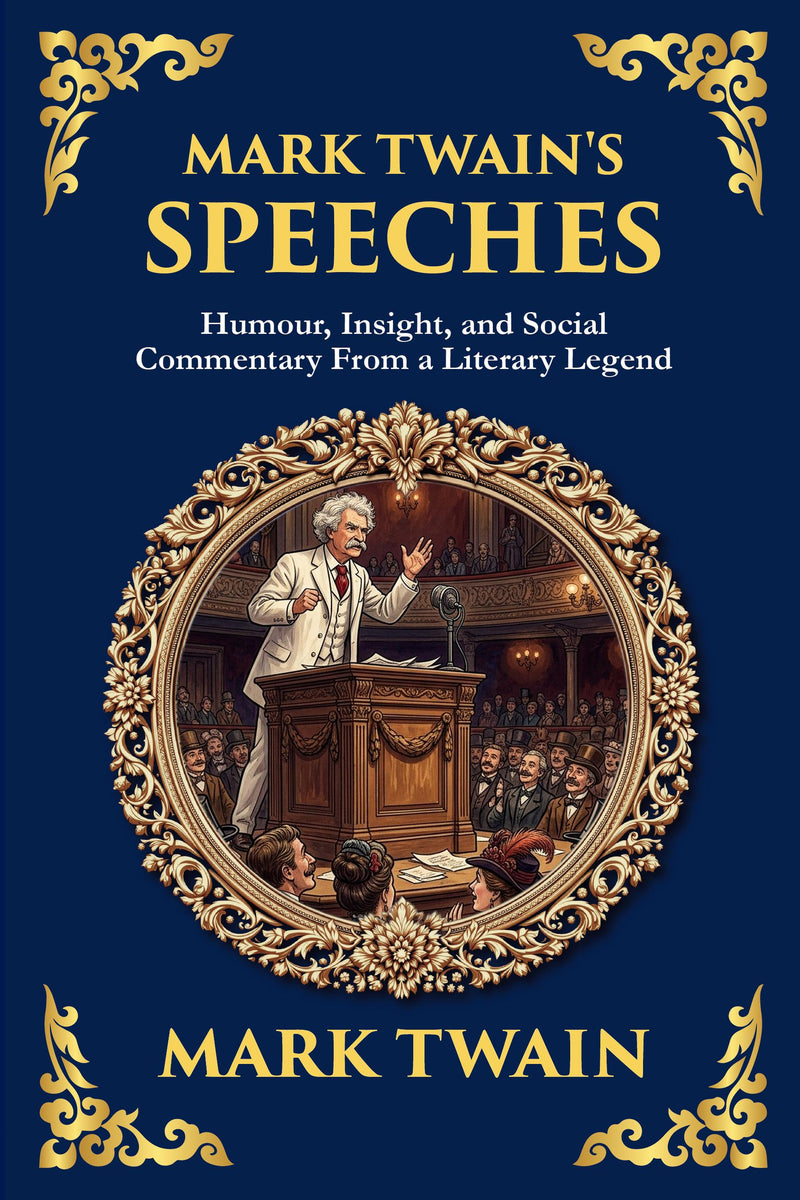
Mark Twain’s Speeches — Large Print
From biting satire to laugh-out-loud jests, Mark Twain's Speeches capture the legendary wit, wisdom, and sharp social observation of one of America’s greatest literary voices.
or free app
10,000+ hrs library
30-day guarantee
The complete Mark Twain's Speeches appears in modern English through Library of Alexandria Press, available online with audiobook narration included for members.
Have you ever wondered why Mark Twain remains one of the most quoted voices in American history? Mark Twain's Speeches: Humour, Insight, and Social Commentary From a Literary Legend offers a front-row seat to the razor-sharp tongue and twinkling intellect of Samuel Clemens. Gathered here are some of his most iconic and lesser-known speeches, revealing not only his genius for storytelling, but also his gift for entertaining, educating, and provoking thought—all at once.
From roasts and toasts to philosophical musings and biting political jabs, Twain used the platform of the podium to delight and disarm. His speeches are rich with irony, self-deprecation, and deep humanity—combining comedic timing with moral critique in a way no one else could. Whether addressing royalty, college students, or the press, Twain always left his mark.
For lovers of American humor, literature, and history, this is a collection to treasure. It reveals the man behind the novels, delivering his ideas not through characters, but in his own indelible voice.
What you’ll discover in this modern edition
- Hilarious Tales and Observations Twain’s famous barbs on politics, human folly, and American society
- A Masterclass in Public Speaking Learn from one of the greatest orators how to entertain with insight
- Speeches to Live (and Laugh) By Includes “Advice to Youth,” “The Babies,” “On the Weather,” and many more
- A Voice as Relevant as Ever Twain’s wit skewers hypocrisy, deflates arrogance, and reminds us not to take life too seriously
- For Fans of Humor, History, and Humanity This is Twain uncensored, unfiltered, and unforgettable More than a book of speeches, this is a living portrait of Twain himself—humorous, honest, and endlessly insightful.
| Formats | eBook (EPUB + PDF) · Audiobook · Paperback · Hardcover · Large Print |
| Language | English |
| Trim size (print) | 6 × 9 in |
| Binding | Paperback — perfect-bound · Hardcover — casewrap |
| Large Print edition | Same text in a larger, easy-read type — a larger font, not a larger trim |
| Print pricing | Every physical book at our true cost — at-cost, no profit (members) |
| Library | 873 restored titles, always growing |
| Length | 91,761 words · ~6 hr 7 min reading |
| Reading level | Grade 9 · a comfortable read (this modern-English edition) |
| Edition | Modern English translation · 2026 |
Member reviews for this edition are collected as readers finish it — be the first. Across the library: 12,000+ books shipped, every plan covered by a 365-day print guarantee.
About this edition
A faithful, unabridged modern-English edition by The Library of Alexandria — carefully rendered for today's reader and verified paragraph-by-paragraph against the public-domain source. Available as eBook, audiobook, paperback, hardcover, and large print.
- Complete & unabridgedVerified paragraph by paragraph against the source — never a scan, never abridged.
- Modern English, faithfulReadable today, with the author’s meaning kept intact. Readable — not simplified.
- Every format, one membershipRead in your browser or the free app, or listen to the full audiobook.
Included free with your membership
Cancel anytime, one click · 30-day money-back guarantee
Edition last updated July 2026
What’s inside
Mark Twain’s Speeches — Large Print — complete and unabridged: all 60 sections included with membership, plus the full audiobook.
Begin reading Mark Twain’s Speeches — Large Print
In clear modern English — the complete text is included with membership.
Introduction
There is a particular kind of silence that falls over a room just before laughter erupts—a held breath, a leaning forward, a collective anticipation. Mark Twain knew that silence better than almost anyone who ever stood before an audience. He cultivated it, stretched it, teased it out until the tension became almost unbearable, and then, with a single understated remark delivered in his famous slow drawl, he would release it into a flood of helpless laughter. The speeches gathered here are the record of a master at work: a man who understood that the spoken word, delivered to a crowd of living, breathing, expectant people, was an art form every bit as demanding and rewarding as the written page.
We tend to remember Twain primarily as a novelist, the creator of Tom Sawyer and Huckleberry Finn, the chronicler of the Mississippi and the American frontier. But to his contemporaries, Samuel Langhorne Clemens was equally celebrated as a performer—one of the most sought-after speakers of his age. He lectured across the United States, toured the lecture halls of England, addressed dinners and banquets and ceremonial gatherings on three continents, and earned, through these appearances, both a substantial portion of his income and an enormous measure of his fame. To hear Mark Twain speak was an event, something people remembered for the rest of their lives and described to their grandchildren. This collection preserves that voice, allowing modern readers to step into those rooms and feel, however faintly across the gulf of more than a century, the warmth and electricity of his presence.
What you hold in your hands has been thoughtfully adapted for the contemporary reader. The original speeches, with their dense thickets of period references, their nods to forgotten dignitaries, and their now-obscure topical jokes, can be challenging for a modern audience to navigate without a small army of footnotes. This edition smooths the path. The language has been gently modernized, the most impenetrable allusions clarified or set in context, and the rhythm preserved so that the unmistakable Twain cadence still rings through. The goal has never been to sanitize or simplify the man—Twain resists both—but rather to clear away the underbrush of time so that his wit, his wisdom, and his fierce moral intelligence can reach you as directly as they reached his original listeners.
It is worth pausing to consider what made Mark Twain such a formidable speaker, because the qualities that distinguished him at the podium are precisely the qualities that make these texts such a pleasure to read today. First and foremost was his command of timing. Twain understood, perhaps more intuitively than any humorist before him, that comedy lives in the pause as much as in the punchline. He once explained that the “pause” was the most valuable tool in a storyteller’s kit—too short and the joke fell flat, too long and the audience grew restless, but struck exactly right and it produced an explosion of mirth. Reading these speeches, you can almost feel where those pauses were meant to fall, those little hollows of silence into which the laughter would tumble.
He was also a magnificent practitioner of the deadpan. Twain rarely laughed at his own jokes; indeed, much of his comic genius lay in the contrast between the absurdity of what he was saying and the perfect solemnity with which he said it. He would advance the most preposterous propositions—claims about his own laziness, his moral failings, his utter incompetence—with the grave dignity of a man delivering a eulogy. The effect was irresistible. The audience, watching this dour and dignified figure utter outrageous things without cracking a smile, found themselves doing the laughing he refused to do himself. On the page, this same quality translates into a wonderfully dry irony, a sense that the author is always one step ahead of you, watching with a glint in his eye to see when you will catch on.
But to reduce Twain to a mere maker of jokes would be a grave injustice, and reading these speeches makes that injustice impossible to commit. Humor was, for him, a vehicle rather than a destination. He used laughter the way a skilled physician uses a sweetener to make a bitter medicine palatable. Beneath the comedy ran a deep current of seriousness—about human nature, about hypocrisy, about cruelty and folly, about the gap between what people profess to believe and how they actually behave. He could be tender and he could be savage, sometimes within the space of a single paragraph. He used the goodwill that his humor created as a kind of license, earning the right to say difficult things by first making people laugh. An audience that is laughing has lowered its defenses, and into that lowered guard Twain could slip an observation that, stated plainly and without the comedy, might have provoked anger or rejection.
This is why his speeches reward attention. A reader skimming for jokes will certainly find them, and will be richly entertained. But a reader who slows down, who lingers over the turns of phrase and considers what Twain is really getting at, will discover layer upon layer of meaning. A speech that begins as a lighthearted after-dinner trifle may, by its conclusion, have delivered a quietly devastating verdict on greed, vanity, or self-deception. He had a way of smuggling profound truths past the customs officers of polite society, wrapped in the harmless-looking packaging of comedy.
There is also, throughout these pieces, a quality that can only be called intimacy. Twain spoke to his audiences as though to old friends. He confided in them, teased them, flattered them, occasionally insulted them—but always with the affection of someone who liked people, even when he despaired of them. This conversational warmth is one of the great gifts of the collection. Reading these speeches feels less like studying a historical document and more like being invited to a lively dinner party where the most entertaining guest in the world has been seated beside you, leaning close to share his observations on everything under the sun. He treats you as an equal, as a confidant, as someone clever enough to appreciate the joke and wise enough to recognize the truth beneath it.
It helps to remember the circumstances under which most of these speeches were delivered. The after-dinner address was a central ritual of nineteenth-century social life, particularly among the clubs, societies, and professional associations that proliferated in that era. A great banquet would be held; the food would be consumed; and then a succession of speakers would rise to offer toasts, tributes, and reflections on a designated theme. These were occasions of high ceremony but also of conviviality, lubricated by good food and good drink, and the audience expected to be both honored and amused. Twain mastered this form completely. He learned to read a room, to gauge its mood, to adjust his delivery to the particular crowd before him. He could be appropriately reverent when the occasion demanded reverence, and he could puncture pomposity when pomposity needed puncturing—often in the same evening.
The range of subjects covered in these speeches is astonishing, and it testifies to the breadth of Twain’s mind and the variety of his experience. He addressed gatherings of journalists and writers, drawing on his own years in the rough-and-tumble world of frontier newspapers. He spoke to military men, to politicians, to businessmen, to scientists, to fellow authors, and to ordinary citizens who simply wanted an evening’s entertainment. He honored the famous and the forgotten, the living and the dead. He offered tributes that managed to be genuinely moving and genuinely funny at once—a combination few writers have ever achieved.
Some of these speeches concern themselves with the great public questions of the day, while others address themes that are timeless and universal. He had much to say about the press and the responsibilities of those who wield it, having known the newspaper trade from the inside. He had opinions, often pungent ones, about politics and politicians, about the corruptions of power and the gullibility of voters. He reflected on the nature of education, on the value of reading, on the proper raising of children, on the relations between men and women, on the follies of fashion and the pretensions of high society. He spoke about money and the curious moral distortions it produces. He spoke about death, about which he had thought deeply and which he treated with a mixture of dread, defiance, and dark humor.
He was, above all, a moralist—though he would have winced at the word, associating it as he did with the sanctimonious preachers and reformers he loved to mock. His morality was of a peculiar and bracing kind. He had no patience for hypocrisy, for the comfortable lies that societies tell themselves, for the cruelties committed in the name of righteousness. He despised cant in all its forms. When he saw injustice, he named it. When he saw foolishness dressed up as wisdom, he stripped away the disguise. And yet he was no mere cynic. Behind his sharpest barbs lay a profound sympathy for the human creature in all its weakness and absurdity. He could be hard on humanity precisely because he expected so much of it, because he was perpetually disappointed by the gulf between what people might be and what they actually were.
Several recurring preoccupations surface again and again in these pages, and recognizing them enriches the reading. One is his fascination with the relationship between truth and lying. Twain returned obsessively to the subject of lies—not to condemn them, exactly, but to examine them with the curiosity of a naturalist studying some endlessly varied species. He distinguished between lies of malice and lies of kindness, between the lies we tell others and the far more dangerous lies we tell ourselves. He could deliver an entire mock-philosophical disquisition on the art of lying that is at once hilarious and unsettling, because by the end you are no longer entirely sure where the joke ends and the genuine insight begins.
Another preoccupation is the matter of reputation and self-regard—both his own and other people’s. Twain was endlessly amused by the human appetite for praise and by the elaborate social machinery built to dispense it. He poked fun at the very banquets and ceremonies at which he was speaking, gently mocking the conventions of tribute even as he participated in them. He was particularly fond of self-deprecation, presenting himself as lazy, vain, dishonest, and generally disreputable—a comic persona that allowed him enormous freedom. By making himself the butt of his own jokes, he disarmed his listeners and earned the right to make jokes at their expense as well.
There is also throughout these speeches a deep vein of memory and nostalgia. Twain had lived an extraordinary life, from his boyhood on the Mississippi to his years as a riverboat pilot, a prospector, a journalist, and finally a world-famous author. He had traveled to the far corners of the earth and met the great figures of his age. When he reflected on the past—on lost friends, on vanished ways of life, on the country and the world as they had been in his youth—he could be deeply affecting. The humorist’s mask slips, and we glimpse the older man looking back across the decades with a complex mixture of fondness, regret, and wonder. These passages give the collection an emotional depth that pure comedy could never achieve.
It would be a mistake, too, to overlook Twain’s sheer craftsmanship as a stylist. He labored over his sentences. He had strong opinions about words, about the difference between the right word and the almost-right word, which he famously compared to the difference between lightning and a lightning bug. His prose has a deceptive simplicity; it reads as though it were spoken effortlessly, off the cuff, when in fact much of it was carefully composed and rehearsed. He understood that the appearance of spontaneity is itself a high art, requiring meticulous preparation. The seemingly casual aside, the apparently improvised digression, the off-hand remark that lands like a thunderclap—these effects were engineered with the precision of a master craftsman. Reading slowly, you begin to appreciate the architecture beneath the conversational surface, the way each sentence is built to deliver its meaning at exactly the right moment and with exactly the right force.
Cancel anytime, one click · 30-day money-back guarantee
Founding annual rate available now — your price locks for life when you join.
Not ready? Get this free chapter by email — read it anytime.
✓ Sent — check your inbox for Mark Twain’s Speeches — Large Print.
Questions about Mark Twain’s Speeches — Large Print
What is Mark Twain's Speeches about?
From biting satire to laugh-out-loud jests, Mark Twain's Speeches capture the legendary wit, wisdom, and sharp social observation of one of America’s greatest literary voices. This collection reveals Twain not just as a novelist, but as a master orator—irreverent, wisecracking, and often profound. In these speeches, Twain pokes fun at politics, honors friendship, critiques society, and reflects on life’s absurdities, all while dazzling audiences with his iconic humor.
Who wrote Mark Twain's Speeches?
Mark Twain's Speeches was written by Mark Twain. This edition presents the complete work in clear modern English, faithfully rendered from the public-domain original by Library of Alexandria Press.
Is Mark Twain's Speeches free to read?
The opening chapter is free to read on this page. Members read and listen to the complete work — and the entire library — free, and can order any physical book at our true print cost.
How long is Mark Twain's Speeches?
60 chapters (~91,761 words) — about 6 hr 7 min of reading in this modern-English edition.
Is this an abridged version of Mark Twain's Speeches?
No. This is the complete, unabridged Mark Twain's Speeches, carefully rendered into clear modern English and verified paragraph-by-paragraph against the public-domain source — nothing is cut or summarised.
What formats does Mark Twain's Speeches come in?
Mark Twain's Speeches is available as eBook, paperback, hardcover and large print. eBook and audiobook are included with membership; printed editions ship at our true print cost.
Shipping & returns
Billing & membership
More from the library


Explore Classic & Literary
- Dream Psychology: Psychoanalysis for Beginners · Sigmund Freud
- Great Expectations · Charles Dickens
- The Brothers Karamazov · Fyodor Dostoyevsky
- The Great Gatsby · F. Scott Fitzgerald
- Wild Flowers Worth Knowing · Neltje Blanchan
- Italian Hours · Henry James
- A Popular History of France from the Earliest Times, Volume 5 · François Guizot
- A history of English literature: A practical text-book · Edward Albert
- Italian Highways and Byways from a Motor Car · M. F. Mansfield
- The Heart-Cry of Jesus · Byron J. Rees
- Castes and Tribes of Southern India. Vol. 6 of 7 · Edgar Thurston
- Against the Grain · J.-K. Huysmans
- Dombey and Son · Charles Dickens
- How to Invest Money · George Garr Henry
- The Great Controversy Between Christ and Satan · Ellen Gould Harmon White
- One Hundred Proofs That the Earth Is Not a Globe · William Carpenter
- Southern Literature From 1579–1895 · Louise Manly
- The Renaissance: Studies in Art and Poetry · Walter Pater
- Mark Twain’s Speeches · Mark Twain
- Tacitus on Germany · Cornelius Tacitus
- The Rosary · Florence L. Barclay
- Peculiarities of American Cities · Willard W. Glazier
- Tennis for Girls · Florence A. Ballin
- The World’s Greatest Books — Volume 02 — Fiction
- Shirley · Charlotte Brontë
- Daisy Miller: A Study · Henry James
- Louis Lambert · Honoré de Balzac
- Historic Jamaica · Frank Cundall
- The Gambler · Fyodor Dostoyevsky
- The Mayor of Casterbridge · Thomas Hardy
Mark Twain’s Speeches — Large Print
Mark Twain’s Speeches — Large Print
Wit, Wisdom, and Social Critique From a Literary Icon
Mark Twain
Contents
- Introduction
- Preface by the Author
- Chapter 1
- Chapter 2
- Chapter 3
- Chapter 4
- Chapter 5
- Chapter 6
- Chapter 7
- Chapter 8
- Chapter 9
- Chapter 10
- Chapter 11
- Chapter 12
- Chapter 13
- Chapter 14
- Chapter 15
- Chapter 16
- Chapter 17
- Chapter 18
- Chapter 19
- Chapter 20
- Chapter 21
- Chapter 22
- Chapter 23
- Chapter 24
- Chapter 25
- Chapter 26
- Chapter 27
- Chapter 28
- Chapter 29
- Chapter 30
- Chapter 31
- Chapter 32
- Chapter 33
- Chapter 34
- Chapter 35
- Chapter 36
- Chapter 37
- Chapter 38
- … and 20 more chapters
Introduction
There is a particular kind of silence that falls over a room just before laughter erupts—a held breath, a leaning forward, a collective anticipation. Mark Twain knew that silence better than almost anyone who ever stood before an audience. He cultivated it, stretched it, teased it out until the tension became almost unbearable, and then, with a single understated remark delivered in his famous slow drawl, he would release it into a flood of helpless laughter. The speeches gathered here are the record of a master at work: a man who understood that the spoken word, delivered to a crowd of living, breathing, expectant people, was an art form every bit as demanding and rewarding as the written page.
We tend to remember Twain primarily as a novelist, the creator of Tom Sawyer and Huckleberry Finn, the chronicler of the Mississippi and the American frontier. But to his contemporaries, Samuel Langhorne Clemens was equally celebrated as a performer—one of the most sought-after speakers of his age. He lectured across the United States, toured the lecture halls of England, addressed dinners and banquets and ceremonial gatherings on three continents, and earned, through these appearances, both a substantial portion of his income and an enormous measure of his fame. To hear Mark Twain speak was an event, something people remembered for the rest of their lives and described to their grandchildren. This collection preserves that voice, allowing modern readers to step into those rooms and feel, however faintly across the gulf of more than a century, the warmth and electricity of his presence.
What you hold in your hands has been thoughtfully adapted for the contemporary reader. The original speeches, with their dense thickets of period references, their nods to forgotten dignitaries, and their now-obscure topical jokes, can be challenging for a modern audience to navigate without a small army of footnotes. This edition smooths the path. The language has been gently modernized, the most impenetrable allusions clarified or set in context, and the rhythm preserved so that the unmistakable Twain cadence still rings through. The goal has never been to sanitize or simplify the man—Twain resists both—but rather to clear away the underbrush of time so that his wit, his wisdom, and his fierce moral intelligence can reach you as directly as they reached his original listeners.
It is worth pausing to consider what made Mark Twain such a formidable speaker, because the qualities that distinguished him at the podium are precisely the qualities that make these texts such a pleasure to read today. First and foremost was his command of timing. Twain understood, perhaps more intuitively than any humorist before him, that comedy lives in the pause as much as in the punchline. He once explained that the “pause” was the most valuable tool in a storyteller’s kit—too short and the joke fell flat, too long and the audience grew restless, but struck exactly right and it produced an explosion of mirth. Reading these speeches, you can almost feel where those pauses were meant to fall, those little hollows of silence into which the laughter would tumble.
He was also a magnificent practitioner of the deadpan. Twain rarely laughed at his own jokes; indeed, much of his comic genius lay in the contrast between the absurdity of what he was saying and the perfect solemnity with which he said it. He would advance the most preposterous propositions—claims about his own laziness, his moral failings, his utter incompetence—with the grave dignity of a man delivering a eulogy. The effect was irresistible. The audience, watching this dour and dignified figure utter outrageous things without cracking a smile, found themselves doing the laughing he refused to do himself. On the page, this same quality translates into a wonderfully dry irony, a sense that the author is always one step ahead of you, watching with a glint in his eye to see when you will catch on.
But to reduce Twain to a mere maker of jokes would be a grave injustice, and reading these speeches makes that injustice impossible to commit. Humor was, for him, a vehicle rather than a destination. He used laughter the way a skilled physician uses a sweetener to make a bitter medicine palatable. Beneath the comedy ran a deep current of seriousness—about human nature, about hypocrisy, about cruelty and folly, about the gap between what people profess to believe and how they actually behave. He could be tender and he could be savage, sometimes within the space of a single paragraph. He used the goodwill that his humor created as a kind of license, earning the right to say difficult things by first making people laugh. An audience that is laughing has lowered its defenses, and into that lowered guard Twain could slip an observation that, stated plainly and without the comedy, might have provoked anger or rejection.
This is why his speeches reward attention. A reader skimming for jokes will certainly find them, and will be richly entertained. But a reader who slows down, who lingers over the turns of phrase and considers what Twain is really getting at, will discover layer upon layer of meaning. A speech that begins as a lighthearted after-dinner trifle may, by its conclusion, have delivered a quietly devastating verdict on greed, vanity, or self-deception. He had a way of smuggling profound truths past the customs officers of polite society, wrapped in the harmless-looking packaging of comedy.
There is also, throughout these pieces, a quality that can only be called intimacy. Twain spoke to his audiences as though to old friends. He confided in them, teased them, flattered them, occasionally insulted them—but always with the affection of someone who liked people, even when he despaired of them. This conversational warmth is one of the great gifts of the collection. Reading these speeches feels less like studying a historical document and more like being invited to a lively dinner party where the most entertaining guest in the world has been seated beside you, leaning close to share his observations on everything under the sun. He treats you as an equal, as a confidant, as someone clever enough to appreciate the joke and wise enough to recognize the truth beneath it.
It helps to remember the circumstances under which most of these speeches were delivered. The after-dinner address was a central ritual of nineteenth-century social life, particularly among the clubs, societies, and professional associations that proliferated in that era. A great banquet would be held; the food would be consumed; and then a succession of speakers would rise to offer toasts, tributes, and reflections on a designated theme. These were occasions of high ceremony but also of conviviality, lubricated by good food and good drink, and the audience expected to be both honored and amused. Twain mastered this form completely. He learned to read a room, to gauge its mood, to adjust his delivery to the particular crowd before him. He could be appropriately reverent when the occasion demanded reverence, and he could puncture pomposity when pomposity needed puncturing—often in the same evening.
The range of subjects covered in these speeches is astonishing, and it testifies to the breadth of Twain’s mind and the variety of his experience. He addressed gatherings of journalists and writers, drawing on his own years in the rough-and-tumble world of frontier newspapers. He spoke to military men, to politicians, to businessmen, to scientists, to fellow authors, and to ordinary citizens who simply wanted an evening’s entertainment. He honored the famous and the forgotten, the living and the dead. He offered tributes that managed to be genuinely moving and genuinely funny at once—a combination few writers have ever achieved.
Some of these speeches concern themselves with the great public questions of the day, while others address themes that are timeless and universal. He had much to say about the press and the responsibilities of those who wield it, having known the newspaper trade from the inside. He had opinions, often pungent ones, about politics and politicians, about the corruptions of power and the gullibility of voters. He reflected on the nature of education, on the value of reading, on the proper raising of children, on the relations between men and women, on the follies of fashion and the pretensions of high society. He spoke about money and the curious moral distortions it produces. He spoke about death, about which he had thought deeply and which he treated with a mixture of dread, defiance, and dark humor.
He was, above all, a moralist—though he would have winced at the word, associating it as he did with the sanctimonious preachers and reformers he loved to mock. His morality was of a peculiar and bracing kind. He had no patience for hypocrisy, for the comfortable lies that societies tell themselves, for the cruelties committed in the name of righteousness. He despised cant in all its forms. When he saw injustice, he named it. When he saw foolishness dressed up as wisdom, he stripped away the disguise. And yet he was no mere cynic. Behind his sharpest barbs lay a profound sympathy for the human creature in all its weakness and absurdity. He could be hard on humanity precisely because he expected so much of it, because he was perpetually disappointed by the gulf between what people might be and what they actually were.
Several recurring preoccupations surface again and again in these pages, and recognizing them enriches the reading. One is his fascination with the relationship between truth and lying. Twain returned obsessively to the subject of lies—not to condemn them, exactly, but to examine them with the curiosity of a naturalist studying some endlessly varied species. He distinguished between lies of malice and lies of kindness, between the lies we tell others and the far more dangerous lies we tell ourselves. He could deliver an entire mock-philosophical disquisition on the art of lying that is at once hilarious and unsettling, because by the end you are no longer entirely sure where the joke ends and the genuine insight begins.
Another preoccupation is the matter of reputation and self-regard—both his own and other people’s. Twain was endlessly amused by the human appetite for praise and by the elaborate social machinery built to dispense it. He poked fun at the very banquets and ceremonies at which he was speaking, gently mocking the conventions of tribute even as he participated in them. He was particularly fond of self-deprecation, presenting himself as lazy, vain, dishonest, and generally disreputable—a comic persona that allowed him enormous freedom. By making himself the butt of his own jokes, he disarmed his listeners and earned the right to make jokes at their expense as well.
There is also throughout these speeches a deep vein of memory and nostalgia. Twain had lived an extraordinary life, from his boyhood on the Mississippi to his years as a riverboat pilot, a prospector, a journalist, and finally a world-famous author. He had traveled to the far corners of the earth and met the great figures of his age. When he reflected on the past—on lost friends, on vanished ways of life, on the country and the world as they had been in his youth—he could be deeply affecting. The humorist’s mask slips, and we glimpse the older man looking back across the decades with a complex mixture of fondness, regret, and wonder. These passages give the collection an emotional depth that pure comedy could never achieve.
It would be a mistake, too, to overlook Twain’s sheer craftsmanship as a stylist. He labored over his sentences. He had strong opinions about words, about the difference between the right word and the almost-right word, which he famously compared to the difference between lightning and a lightning bug. His prose has a deceptive simplicity; it reads as though it were spoken effortlessly, off the cuff, when in fact much of it was carefully composed and rehearsed. He understood that the appearance of spontaneity is itself a high art, requiring meticulous preparation. The seemingly casual aside, the apparently improvised digression, the off-hand remark that lands like a thunderclap—these effects were engineered with the precision of a master craftsman. Reading slowly, you begin to appreciate the architecture beneath the conversational surface, the way each sentence is built to deliver its meaning at exactly the right moment and with exactly the right force.
A speech given in 1877, along with a review written twenty-nine years later. The original address was delivered on December 17, 1877, at the Hotel Brunswick in Boston. It was held during a dinner hosted by the publishers of The Atlantic Monthly to celebrate the seventieth anniversary of John Greenleaf Whittier’s birth.
This is the perfect time to dig up some pleasant memories about writers; so, I’ll share a bit of my own history. Standing here on the Atlantic coast and thinking about some of the greatest waves in literature, I’m reminded of something that happened thirteen years ago. At that time, I had just managed to make a small splash in the Nevada literary scene, and my reputation was starting to drift toward California. I began a trip to inspect the southern mines of California. I was young, arrogant, and decided to see if my pen name would carry any weight.
I got the chance to test it very quickly. At dusk, while it was snowing, I knocked on the door of a lonely log cabin in the Sierra foothills. A tired, sad-looking man of fifty opened the door barefoot. When he heard my pen name, he looked even more depressed than before. He let me in—though he seemed quite reluctant—and after the usual meal of bacon, beans, black coffee, and hot whiskey, I lit a pipe. Until then, this miserable man had barely spoken three words. Finally, he spoke up in the voice of someone suffering in silence: “You’re the fourth—I’m moving.” “The fourth what?” I asked. “The fourth literary man to visit in twenty-four hours—I’m moving.” “No way!” I exclaimed. “Who were the others?” “Mr. Longfellow, Mr. Emerson, and Mr. Oliver Wendell Holmes—damn them all!”
End of the free sample
Keep reading, free
Members read and listen to the complete book — and the entire library. Cancel anytime, one click · 30-day money-back guarantee.