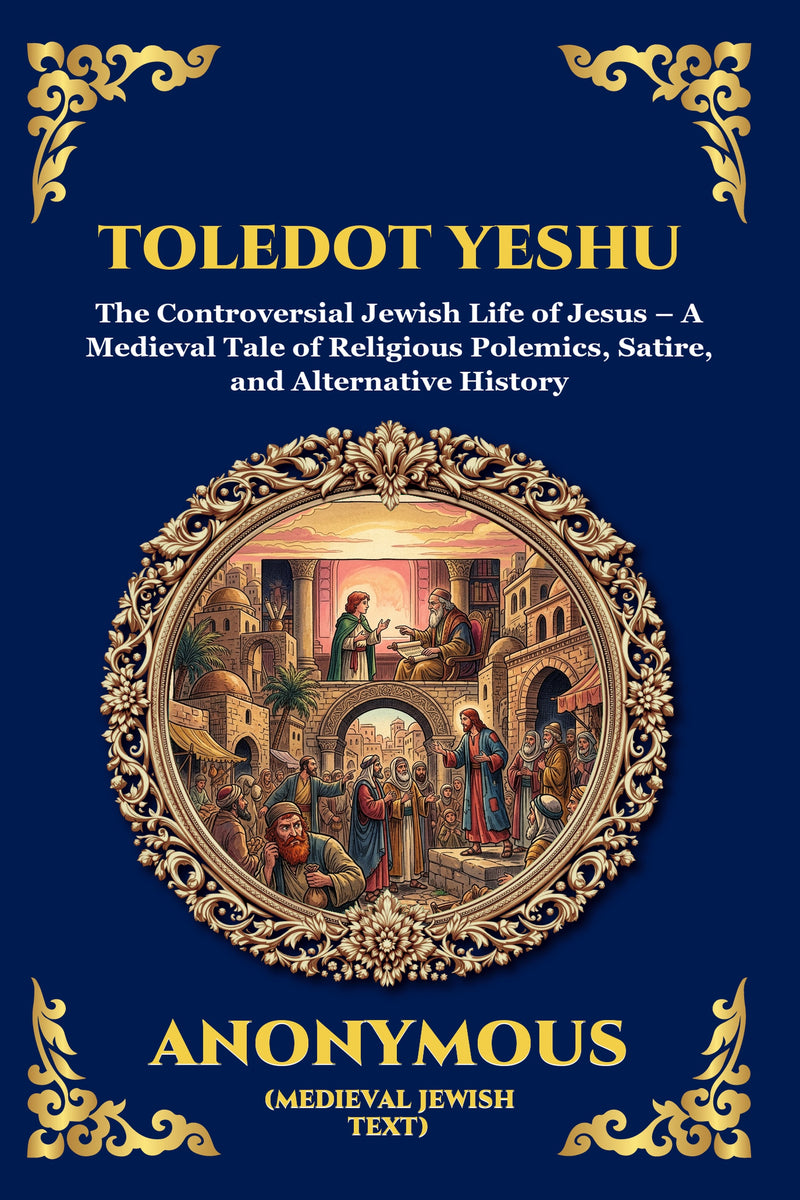
Toledot Yeshu — Large Print
Toledot Yeshu offers a satirical inversion of the Christian narrative, portraying Jesus not as a divine savior but as a bold scholar with secret magical powers. This underground text, crafted by medieval Jewish communities under pressure, served as a theological defense against dominant Christian narratives.
or free app
10,000+ hrs library
30-day guarantee
This Library of Alexandria edition presents the complete Toledot Yeshu in readable modern English, accessible online with full audiobook narration included for members.
Large Print Edition. The complete, unabridged text set in a larger, easy-on-the-eyes typeface for comfortable reading.
Have you ever wondered why early medieval Jewish communities created their own alternative history of Jesus?
In Toledot Yeshu (The Life of Jesus), you will encounter an astonishing piece of underground literature that fundamentally inverts the traditional Christian narrative. For centuries throughout the Middle Ages, as Jewish communities faced intense persecution and aggressive missionary pressure from the dominant Christian majority, they developed their own theological defenses. Among the most fascinating of these was a satirical, highly subversive "anti-gospel."
Rather than portraying Jesus as a divine savior, this alternative history reimagines him as an audacious scholar who acquires magical powers by secretly learning the Ineffable Name of God from the Temple in Jerusalem. Through this forbidden knowledge, he performs miracles, gathers followers, and engages in epic, magical battles of wits with the sages of his era. The text completely recontextualizes the virgin birth, the miracles, and the crucifixion, transforming them into a gripping folktale of deception, political maneuvering, and religious rivalry.
This edition brings the controversial and legendary text to light, offering a window into the intense theological warfare of the medieval period. It explores the psychological and historical reasons why such a text was necessary for a marginalized community struggling to preserve its identity. Whether you are a scholar of religious history, a student of medieval folklore, or simply fascinated by how different cultures use storytelling as a form of resistance, this book provides a comprehensive look at one of history’s most audacious religious satires.
What You Will Discover Inside:
- The Alternative Narrative — Read the provocative, inverted life story of Jesus that circulated in secret among Jewish communities for centuries.
- Religious Polemics and Satire — Explore how medieval writers used satire, subversion, and dark humor to counter Christian dominance and protect their own faith.
- The Magic of the Ineffable Name — Discover the fascinating folklore of how the text explains the biblical miracles through the unauthorized use of the secret, unpronounceable name of God.
- A Window into Jewish-Christian Relations — Gain profound insight into the intense theological rivalries, historical struggles, and cultural survival mechanisms of a minority religion in medieval Europe.
Whether you are exploring this work for its immense historical value, its role in religious polemics, or its fascinating folklore, Toledot Yeshu offers a gripping journey into the past.
Uncover the controversial underground story that challenged an empire. Begin your journey into medieval religious history today.
| Formats | eBook (EPUB + PDF) · Audiobook · Paperback · Hardcover · Large Print |
| Language | English |
| Trim size (print) | 6 × 9 in |
| Binding | Paperback — perfect-bound · Hardcover — casewrap |
| Large Print edition | Same text in a larger, easy-read type — a larger font, not a larger trim |
| Print pricing | Every physical book at our true cost — at-cost, no profit (members) |
| Library | 873 restored titles, always growing |
| Original language | Hebrew |
| Source tradition | Medieval Hebrew manuscript tradition |
| Translation basis | Public-domain scholarly translation, rendered in clear modern English |
| Length | 3,093 words · ~12 min reading |
| Reading level | Grade 8 · clear and comfortable (this modern-English edition) |
| Edition | Modern English translation · 2026 |
Member reviews for this edition are collected as readers finish it — be the first. Across the library: 12,000+ books shipped, every plan covered by a 365-day print guarantee.
About this edition
The complete, unabridged text in clear modern English — faithful to the original, never simplified. Every paragraph is checked against the source, so nothing is cut, summarised, or paraphrased away. It reads cleanly for today while keeping the original meaning intact.
Toledot Yeshu survives in numerous Hebrew manuscript versions from medieval Europe, with significant textual variations across different traditions. This edition derives from standard scholarly translations of the primary manuscript families, rendered in clear modern English.
- Complete & unabridgedVerified paragraph by paragraph against the source — never a scan, never abridged.
- Modern English, faithfulReadable today, with the author’s meaning kept intact. Readable — not simplified.
- Every format, one membershipRead in your browser or the free app, or listen to the full audiobook.
Included free with your membership
Cancel anytime, one click · 30-day money-back guarantee
Edition last updated June 2026
What’s inside
Toledot Yeshu — Large Print — complete and unabridged: all 7 sections included with membership, plus the full audiobook.
Begin reading Toledot Yeshu — Large Print
In clear modern English — the complete text is included with membership.
Chapter 1
It once happened that a certain man named Yoḥanan had a wife named Miriam, and he also had a Hebrew maidservant. A man named Joseph, the son of Pandera, had noticed this maidservant and came to her while she was in a state of ritual impurity due to her natural cycle, lying alone in the dark, and he slept with her. She was so startled that she could not say a word until morning, when she said to her husband: "Yoḥanan, my master! Why did you do last night what is not lawful? You came to me twice. I warned you that I was unclean, yet you did not heed my warning."
He was deeply troubled by this and went and told the matter to Shimon, the son of Shetaḥ. He said to him: "I will tell you what happened to me last night. My wife came and told me that such and such a thing had happened to her, but it was not I who had been with her." Shimon asked him: "Whom do you suspect?" He said: "A neighbor of mine named Joseph, the son of Pandera." Shimon asked: "Do you have any witnesses?" He answered: "I have none." Shimon replied: "Then go and hide witnesses from the culprit, for if he went in once, he will go in again. If you do this, you will make him liable to the death penalty."
Yoḥanan sat idle and did nothing, until he heard the whole town buzzing with gossip about the matter, with people saying that his wife had committed an act of whoredom. Because of this public slander, he went off to Babylonia and did not return. In the meantime, his wife gave birth to a son named Jesus — may the name of the wicked rot. This son grew and excelled in wickedness, until he was heard saying: "Since Jethro, who was merely a proselyte, was Moses' master, the greatness of Moses is thereby diminished." At this the Sages replied: "This one is nothing but a bastard and the son of a menstruate woman." They went also to his mother and asked her: "What is the nature of this youth?" She replied: "I conceived him by Yoḥanan, my betrothed, but he has gone to Babylonia and I do not know what has become of him." Shimon, the son of Shetaḥ, then spoke up and told them what Yoḥanan had related to him about the affair. The Sages asked: "What shall we do with the woman?" Shimon answered: "She bears no liability in this matter, for she did not come to her situation by her own choice." When she heard that they were not going to hold her liable to the death penalty, she told them the true account of the matter and said: "It was afterward made known to me that it was Joseph, the son of Pandera, by whom I had conceived."
Chapter 2
When the son she had borne heard his mother's confession, and heard that the Sages held only him liable for the death penalty, he withdrew to the Temple precincts. The express letters of God's ineffable name were inscribed on the Foundation Stone within the Holy of Holies, and anyone who learned them could do whatever he wished by their power. The nation of Israel lived in fear that the wicked among them might learn these letters and thereby destroy the world. So they fashioned two brazen dogs and had them chained at the entrance to the Temple Sanctuary, so that anyone who learned the express letters of the Divine name and then walked out of the Sanctuary would, upon seeing the dogs, instantly forget from his heart everything he had learned.
In those days the land of Israel was governed by a queen whose name was Helena. Jesus entered the Temple Sanctuary, learned the letters, and made a stipulation over them so that he would feel no pain when his flesh was cut. He wrote them down on a piece of parchment, then sliced open his thigh, inserted the parchment, and drew the skin back over the wound. When he departed he forgot the letters, as the dogs had their effect. But when he reached home he cut open his thigh again, drew out the parchment, and learned the letters once more. He then gathered around him three hundred and ten young men of Israel and said to them: "You call me a bastard, but I am the Messiah, and it was concerning me that Isaiah prophesied: Behold, a young woman shall conceive and bear a son, and you shall call his name Immanuel. And it was said of me: You are my son; this day have I begotten you — that is, without any carnal union between father and mother. Yet all you seek is your own self-aggrandizement."
They answered him: "If you are the Messiah, show us a sign." He replied: "What sign do you seek from me?" They brought before him a man who had been lame from birth and had never stood on his feet. Jesus looked at him, spoke the express letters over him, and the man immediately began to walk. When they saw this, they bowed down before him. When the Sages heard what had happened, they brought Jesus before Helena the queen and said to her: "Your Majesty, this man is a sorcerer." He said to her: "I am the Messiah, and it was said of me: Who shall rise up for me against the wicked?" The queen asked: "Is there anything in the Law that supports what he claims?" They answered: "There is. But the Messiah we await comes with other signs — among them: In his days Judah shall be delivered. And of him it is written: He shall strike the land with the rod of his mouth, and by the breath of his lips shall he slay the wicked. Of this man, however, it is written: That false prophet shall die. And again: You shall put away the evil from among you." Jesus then repeated his claim: "I am the Messiah, and I raise the dead." At this the queen sent some of her own emissaries with him, and he did raise the dead by the express letters of God's Divine name, and the people of Israel were thrown into consternation on his account.
Chapter 3
After many days, he slipped away. The Sages came to the queen and said: "Your Majesty, do you see how he has fled by means of his sorceries? They have not allowed him to remain standing in one place — his disgrace is now plain for all to see!" She sent horsemen after him, as far as Babylonia, where he had gone, but the citizens of Babylonia refused to let them take him, and the two sides came to blows. Jesus said to the men of Babylonia: "Do not fight them. My father who is in heaven, and the sacred letters which are in my own hand, will deliver me!" He said to them: "Bring me a millstone." When they did so, he mounted it, called out the divine letters, and floated upon the surface of the water, seated on the stone. They also fashioned birds out of clay and brought them before him, and the birds began to fly. He said to them: "Go and tell your lady the queen what you have seen." They went and told her, saying: "They brought him a great millstone, he mounted it, and began floating upon the surface of the water, seated upon it, just as an eggshell floats."
She summoned the Sages and said to them: "This Jesus, whom you dismissed as a sorcerer, must be none other than the son of God — for how many signs has he performed!" They replied: "Your Majesty, do not let a single word of his sorcery take hold in your heart, for we are able to do everything he has done." She then sent to him several of those who believed in him. They pleaded with him, saying: "Come back to the queen, for she is astonished by the signs you have performed." At their urging, he gathered his followers together and returned to the land of Israel. In the meantime, however, those in Israel had taken a certain man by the name of Antichei, brought him into the Temple precincts, and had him write the sacred letters on a piece of parchment, whereupon he began to do exactly as Jesus had done. Then they all came together before the queen, and the two sides pressed their accusations against each other, each striving to prevail. Jesus began to speak, saying: "Behold, it is written, He shall take me — meaning, as a bird is lifted up into the air." Antichei answered: "But it is written elsewhere, And the children of those among your people who throw off all restraint."
Chapter 4
He spread out his arms like the wings of a vulture and began to fly through the air. The people of Israel said to Antichei: "Do what he has done, for you have learned what he has learned!" At once Antichei flew up after him, and when he had caught up with him, he called out the letters of God's name as a curse to bring him down from the sky, while the other also called out the letters of God's name to keep himself from falling. When Antichei saw that he would not fall — for he had learned just as the other had learned — he rose up and committed a vile act upon him. Having thus been defiled, they both fell down to the earth. The people of Israel seized him and brought him before the queen. They said to her: "Your Majesty, ask him where the signs that were with him are now!" When he understood that the letters of God's name had vanished from his heart and that he had fallen captive into their hands, he said: "It is written, Their faces have become harder than flint stone. And again it is written, Happy is the man who does not walk in the counsel of the wicked." With that saying he escaped from them, and he and the followers he had drawn in through his words rose up and made war, brother against brother and father against son, until at last his followers freed him and fled away with him, and they remained in a certain place until Passover. Then he took a donkey and rode it, gathered his followers together, and went up to Jerusalem. He said to his followers: "See how Scripture has been fulfilled — he is poor, and riding upon the foal of a donkey."
They came to bring the Passover offering, when one of his own party went to the people of Israel and said: "Are you willing to take Jesus?" They asked him: "Where is he?" He answered: "In Jerusalem." They said: "Show him to us." He answered: "He has already made us swear by the Ten Commandments not to reveal him to others, and he has dressed me in ordinary clothes. But come and greet us, and I will go in and bow down before him, and by that you will know which one he is." When they came, he bowed down before Jesus. The people of Israel, at this betrayal, stepped forward and seized him, and they said to him: "You are the Messiah — deliver yourself from our hands!" When he had fallen into their hands, he said: "It is written, A priest and a prophet they have killed. And it is written, For your sake we are killed all the day long." His companions began to weep when they realized they could not rescue him from the people of Israel, and so they killed him and proceeded to hang him. Now this same wicked man had made a pact with the trees while he still possessed the letters of God's Divine name, commanding that they should not receive him, for he knew they would not leave him in peace. And so it was that every tree they brought him to hang him on broke when he was put against it, until at last they brought the carob tree, and on it they hanged him, and it did not break — for he had made no pact with the carob tree. His followers began to weep and cry out: "Out of his great righteousness, the trees would not receive him."
Chapter 5
At evening, they came to take him down, in accordance with the scripture that says: You shall not suffer his corpse to remain on the tree. So they buried him, and his followers began to weep again at his tomb, saying: "You have made yourselves liable to the death penalty, for you have slain the Messiah!" But the people of Israel retorted: "You yourselves have made yourselves liable to the death penalty, for you have believed in a false prophet!" His followers then said among themselves: "Come, let us take him out of his tomb." They opened the tomb but did not find him there, and so they went to Helena the queen. They said to her: "Consider, your Majesty, how many signs he performed, and how he has now ascended into heaven." At this, she sent for the Sages and asked them: "Where did you bury Jesus?" They answered: "Near the waters of Siloam." She sent word back to them: "If you do not bring him to me, I will not stop harassing a single one of you." They searched for him but could not find him. They said to her: "Give us time." She gave them time, and meanwhile all the people of Israel took upon themselves a fast of affliction until the appointed time had expired, yet still they did not find him, and because of this they began to flee from before the queen. Rabbi Tanhum also fled to the fields, and there found a certain gardener eating. He said to him: "You wicked man! All of Israel has undertaken a fast and they are in sorrow, yet you sit here eating!" The man replied: "My lord, on what occasion has this sorrow come upon the nation?" Rabbi Tanhum then told him the whole account of the matter, and added: "If they should happen to find him, Israel will find some relief." The man answered: "I stole him and buried him in my own garden, so as not to give the wicked an opportunity to steal him away." Rabbi Tanhum, upon hearing this, returned to the city and exclaimed: "This day is a day of good tidings!" So the people of Israel went and took him out of his tomb, tied a rope around his leg, and dragged him through the lanes of Jerusalem until they brought him before the queen. She immediately praised the Sages and grew furious with the followers of Jesus, banishing some of them — three to a mountainous region, three to Greece, and thirteen to Rome — while the rest were scattered among the nations. Then the Most Holy, blessed be He, exacted his judgment in every place. Even so, those in Israel who had risen up to make this breach in the faith continued to oppose the Sages openly, declaring: "He is the Deliverer." And so there was a schism in Israel.
Cancel anytime, one click · 30-day money-back guarantee
Founding annual rate available now — your price locks for life when you join.
Not ready? Get this free chapter by email — read it anytime.
✓ Sent — check your inbox for Toledot Yeshu — Large Print.
Questions about Toledot Yeshu — Large Print
What is Toledot Yeshu and why was it written?
Toledot Yeshu is a medieval Jewish counter-narrative to Christian accounts of Jesus, presenting him as a sorcerer rather than divine savior. It served as theological polemic and community defense against Christian missionary pressure in medieval Europe.
Who wrote Toledot Yeshu and when?
Toledot Yeshu was composed anonymously within medieval Jewish communities, likely emerging in various forms between the 4th-6th centuries CE and evolving through subsequent centuries as it circulated in manuscript form.
Is Toledot Yeshu historically accurate about Jesus?
Toledot Yeshu is not a historical source but rather a polemical text designed to counter Christian claims. Scholars study it for understanding medieval Jewish-Christian relations rather than historical information about Jesus.
Is Toledot Yeshu free to read?
The opening of the text is free to read below. Members read and listen to the complete work — and the entire Lost & Forbidden Library — free.
What is Toledot Yeshu?
Have you ever wondered why early medieval Jewish communities created their own alternative history of Jesus?
How long is Toledot Yeshu?
7 chapters (~3,102 words) in this restored edition.
Shipping & returns
Billing & membership
More from the library


Explore Lost Gospels & Acts
- The Lost Books of the Bible · Various early Christian authors
- Gospel of the Lots of Mary
- Gospel of the Twelve · Anonymous early Christian writers
- Infancy Gospel of Thomas · Attributed to Thomas the Israelite
- Gospel of the Hebrews · Attributed to early Jewish-Chri...
- Acts of Thomas
- Gospel of the Savior · Anonymous (Early Christian Author)
- Acts of Saturninus
- Death of Pilate · Attributed to various early Chr...
- Doctrine of Addai · Attributed to Thaddeus of Edessa
- Gospel of the Nativity of Mary · Attributed to St. Matthew
- Toledot Yeshu
- Papyrus Berolinensis 22220
- Oxyrhynchus Papyrus 1224
- Correspondence of Jesus and Abgar · Attributed to Eusebius of Caesarea
- Papias: Expositions of the Sayings of the Lord · Attributed to Papias of Hierapolis
- Questions of John · Attributed to John the Apostle
- Narrative of Joseph of Arimathea · Attributed to Joseph of Arimathea
- Avenging of the Savior · Attributed to various early Chr...
- Report of Pilate to Caesar
- Letter of Pontius Pilate to Claudius
- Acts of Peter and Simon · Attributed to Leucius Charinus
- Acts of Andrew and Matthias in the City of the Cannibals · Attributed to early Christian a...
- Preaching of Peter · Attributed to the apostle Peter
- Egerton Gospel II
- Gospel of Barnabas
- Letter to the Laodiceans · Attributed to the Apostle Paul
- Diatessaron · Attributed to Tatian
- Descent of Christ into Hell (Harrowing of Hell) · Attributed to the Apostle Peter
- Acts of Pilate (Gospel of Nicodemus) · Attributed to various early Chr...
Toledot Yeshu — Large Print
Toledot Yeshu
The Medieval Jewish Counter-History of Jesus — A Hostile Polemical Life Told from Outside the Church: A Historical Artifact of Jewish-Christian Disputation, Not Scripture and Not History
Library of Alexandria Press
Toledot Yeshu
© Copyright 2026 Library of Alexandria Press. All rights reserved.
Published by Library of Alexandria Press
Printed in the United States of America
It is not legal to copy, share, or send any part of this document in either digital or printed form without written permission from the publisher, except short quotes in a book review.
Table of Contents
Introduction
Chapter 1
Chapter 2
Chapter 3
Chapter 4
Chapter 5
Chapter 6
Introduction
There are books that survive because they are loved, and there are books that survive because they cannot be killed. The text you are about to encounter belongs firmly to the second category. For more than a thousand years, it was copied in secret, hidden in genizot, burned by ecclesiastical authorities, denounced from pulpits, and yet it endured — passed hand to hand through Jewish communities stretching from Babylon to the Rhine, from Cairo to the cities of medieval Spain. It was never officially canonized, never declared sacred, never given a fixed and authoritative form. And yet generation after generation of Jewish readers returned to it, copied it, revised it, laughed at it, argued over it, and kept it alive through centuries of persecution and displacement. That stubborn persistence alone should tell us something important about what this text meant — and continues to mean — to the people who preserved it.
What we are dealing with is an alternative biography of Jesus of Nazareth, written entirely from within the Jewish tradition, offering a radically different account of his origins, his powers, his public career, and his death. It is a text that Christianity found deeply offensive, that Jewish communities found both useful and dangerous, and that modern scholars have found endlessly fascinating. It is simultaneously a work of polemical theology, popular folklore, biting satire, political commentary, and historical revisionism. It defies easy categorization, which is perhaps one reason it has taken so long for it to receive the serious literary and historical attention it deserves.
To read this text in the twenty-first century is to step into a world of extraordinary complexity — a world in which religious identity was not merely a matter of personal belief but a matter of communal survival, in which the boundary between majority and minority cultures was enforced by law, custom, and the ever-present threat of violence, and in which storytelling was one of the few weapons available to those without political power. The Jews who wrote and read and transmitted this alternative life of Jesus were not, for the most part, living in conditions of comfortable intellectual freedom. They were living as a subordinate minority within Christian societies that defined themselves in explicit opposition to Judaism, that blamed the Jewish people collectively for the death of their savior, and that expressed that blame in everything from theological treatises to popular riots. In that context, a text that told a very different story about Jesus — that made him a bastard, a sorcerer, a deceiver, and a fool — was not merely an act of literary creativity. It was an act of cultural resistance.
But we should be careful not to reduce this remarkable text to a simple instrument of resistance, because it is far more complicated than that. The people who composed and transmitted it were not simply thumbing their noses at Christianity from a safe distance. They were deeply engaged with Christian culture, deeply familiar with Christian scripture and Christian theology, and in many cases deeply anxious about the appeal that Christianity might hold for members of their own communities. The text is shaped by that anxiety as much as by defiance. It argues, implicitly and sometimes explicitly, that the Jesus story — the story that had captivated the Roman Empire and then the medieval world — can be told differently, that the miracles can be explained, that the divine claims can be debunked, and that the narrative of salvation can be replaced by a narrative of deception and its consequences. This is not the work of people who were indifferent to Christianity. This is the work of people who took it very seriously indeed.
The text exists in multiple versions, and this multiplicity is itself one of its most important features. Unlike the canonical Gospels, which achieved a relatively fixed form through the institutional authority of the Church, this alternative biography was never subjected to that kind of editorial control. It grew and changed as it moved through different communities and different centuries. A version produced in one part of the medieval Jewish world might differ substantially from a version produced elsewhere — different names, different narrative details, different emphases, different levels of satirical intensity. Some versions are relatively restrained; others are outrageously comic. Some focus primarily on the question of Jesus's parentage; others dwell at length on the mechanics of his miracles. Some end with his death; others continue into the early history of Christianity. This variability is not a defect or a sign of careless transmission. It is a feature, a sign that the text was alive — that it was being actively used and adapted by real communities with real needs, rather than simply copied as a sacred and unchangeable artifact.
Scholars have debated for generations about the origins of this tradition. Some have argued for very early roots, suggesting that certain elements of the anti-Jesus polemic embedded in the text can be traced back to the first or second century of the Common Era, to a period when Christianity and Judaism were still in the process of defining themselves against each other and when the wounds of separation were fresh. Others have been more cautious, pointing out that the earliest manuscript evidence we have dates from the medieval period and that we should be careful about projecting the text's origins too far back into the past. What is clear is that by the early medieval period, some version of this alternative biography was in circulation, and that it continued to develop and proliferate throughout the Middle Ages and into the early modern period. The question of ultimate origins may never be definitively resolved, but it is less important than the question of what the text meant to the communities that used it — and that question can be answered, at least in part, through careful attention to the text itself.
One of the most striking things about the text, for a modern reader approaching it for the first time, is its tone. This is not a solemn theological refutation. It is not a dry scholastic disputation. It is, in large parts, genuinely funny — darkly, subversively, sometimes outrageously funny. The humor is not incidental to the text's purpose; it is central to it. By making Jesus a figure of comedy as well as villainy, the text accomplishes something that straightforward theological argument cannot: it punctures the aura of sacred authority that surrounded him in Christian culture. Laughter is a powerful equalizer. You cannot simultaneously revere something and laugh at it, and the text exploits this psychological truth with considerable sophistication. The comic elements — the farcical scenes, the absurd plot twists, the moments of slapstick and wordplay — are not signs that the text should not be taken seriously. They are signs that its authors understood something profound about how cultural power works and how it can be undermined.
A World of Hidden Texts
To understand why a text like this needed to exist, we need to understand something about the world in which it was produced and consumed. Medieval Jewish communities in Christian Europe occupied a position of profound legal and social vulnerability. They were tolerated, when they were tolerated at all, on the basis of a theological argument that went back to Augustine of Hippo in the fourth century: the Jews were to be preserved as living witnesses to the truth of Christianity, their continued existence and their continued adherence to the Hebrew scriptures serving as testimony to the antiquity of the divine plan. But this tolerance was always conditional, always fragile, and always shadowed by the possibility of expulsion, forced conversion, or massacre. The Crusades, the Black Death, the Inquisition, the repeated expulsions from England, France, and eventually Spain — these were not aberrations in the medieval Jewish experience. They were the extreme expressions of pressures that were constant and structural.
In this environment, the relationship between Jewish communities and the dominant Christian culture was necessarily complex. Jews and Christians lived in close proximity, traded with each other, sometimes formed genuine personal relationships, and inevitably influenced each other's intellectual and cultural lives. But they also inhabited fundamentally different symbolic universes. The central figure of Christian civilization — the man whose life and death and supposed resurrection organized the entire medieval worldview, whose image appeared on every church wall and cathedral facade, whose name was invoked in every legal oath and every royal proclamation — was, from the Jewish perspective, a false messiah at best and a dangerous deceiver at worst. Jewish law forbade the worship of Jesus as God. Jewish theology denied the central claims of the Christian narrative. And yet Jews living in Christian societies were surrounded by that narrative, immersed in it, compelled to interact with it on a daily basis.
The text that is the subject of this book can be understood, in part, as a way of managing that immersion — of giving Jewish communities a private counter-narrative that allowed them to process their relationship to the dominant Christian story on their own terms. When a medieval Jew was forced to listen to a sermon about Jesus, or to witness a Christian religious procession, or to navigate the complex social dynamics of a society organized around Christian belief, the existence of an alternative story — a story in which Jesus was not the Son of God but a human being with a very specific and very unholy human biography — provided a kind of psychological and theological anchor. It said: we know what really happened. We have our own account. The story they tell is not the only story.
But the text was also dangerous, and its creators and transmitters knew it. Christian authorities were well aware that such texts existed — references to Jewish anti-Christian literature appear in Christian polemical writings from a surprisingly early date — and when they could get their hands on copies, they burned them. The Talmud itself was burned in Paris in 1242 partly on the grounds that it contained blasphemous references to Jesus, and texts that were even more explicitly anti-Christian were obviously at even greater risk. The decision to copy and preserve this alternative biography was therefore never a casual one. It was an act that carried real risk, and the people who undertook it did so with full awareness of what that risk entailed. This gives the text's survival a quality that goes beyond mere literary interest. It is a testament to the depth of the need it served.
The physical history of the text is itself a remarkable story. Fragments and complete manuscripts have been found in contexts as varied as the Cairo Geniza — that extraordinary repository of discarded Jewish documents discovered in a synagogue storeroom at the end of the nineteenth century — and the libraries of European universities, where copies sometimes survived because Christian scholars, paradoxically, were interested in them as evidence of Jewish blasphemy. The manuscript tradition is extraordinarily diverse, with versions in Hebrew, Aramaic, Judeo-Arabic, Yiddish, and other languages reflecting the geographic spread of the communities that used the text. Each manuscript tells its own story about where it was copied, who copied it, and what community it served. Taken together, they constitute a kind of underground archive of Jewish responses to Christianity across more than a millennium.
It is worth pausing to consider what it means to read a text that was produced and consumed in conditions of secrecy and danger. Modern readers, accustomed to the free circulation of ideas and the easy availability of controversial literature, may find it difficult to fully appreciate the courage that was embedded in the act of copying this text in a medieval Jewish community. But that courage is part of what the text means. Every manuscript represents a decision — made by a scribe, perhaps in a cramped room by candlelight, perhaps with the knowledge that discovery could bring serious consequences — to preserve this particular story, to keep this particular counter-narrative alive. When we read the text today, we are in some sense reading all those decisions as well, all those acts of quiet defiance accumulated across the centuries.
The text also raises profound questions about the nature of religious polemic and its relationship to genuine theological engagement. It would be easy to dismiss it as mere propaganda — as a crude attempt to blacken the reputation of a figure revered by the dominant culture. And there are certainly elements of it that are crude, in the sense of being deliberately provocative and unsubtle. But a closer reading reveals something more interesting: a genuine grappling with the theological claims of Christianity, an attempt to account for the undeniable historical fact that Jesus had attracted followers and founded a movement, an engagement with the question of why people believed in him and what the consequences of that belief had been. The text is not indifferent to these questions. It has answers to them, and those answers are more sophisticated than they might initially appear.
Consider, for example, the text's treatment of the miracles attributed to Jesus. Rather than simply denying that anything remarkable happened, the text typically offers an explanation: Jesus obtained the power to perform wonders through illicit means, by gaining access to the secret name of God that was inscribed in the Temple. This explanation is theologically interesting because it does not deny the reality of the miracles — it reinterprets them. The power was real, but its source was not divine. It was stolen, misappropriated, used for deceptive purposes. This is a much more nuanced response to the Christian miracle tradition than simple denial would be, and it reflects a genuine understanding of why the miracle stories were persuasive and what would be required to undermine their persuasive force. The text's authors were not naive about the challenge they faced. They were sophisticated thinkers working within a tradition of serious theological reflection.
Reading the Unreadable
For modern readers, whether Jewish, Christian, secular, or of any other background, approaching this text requires a certain deliberate act of historical imagination. We live in a world where interfaith dialogue is considered a virtue, where religious tolerance is enshrined in law in most democratic societies, and where the idea of producing a deliberately offensive counter-biography of another religion's founder would be viewed, at the very least, as bad taste. Reading this text through that modern lens will inevitably distort it. The text was not produced for a world of interfaith dialogue. It was produced for a world of religious warfare, legal discrimination, and existential threat. Judging it by the standards of our own more comfortable era would be both anachronistic and unfair.
This does not mean that we should read it uncritically, or that we should ignore the ways in which religious polemic — of any kind, directed at any target — can contribute to cycles of hostility and misunderstanding. The history of this text includes some genuinely troubling episodes: moments when Christian authorities used the existence of such anti-Christian literature as justification for persecution, and moments when the text's rhetoric about Jesus shaded into something that could be used to justify contempt for Christians more broadly. These are real problems, and a responsible reading of the text has to acknowledge them. But acknowledging the potential for misuse is different from refusing to engage with the text at all, and the latter response would deprive us of something genuinely valuable: a window into a world of religious experience that is very different from our own, and a set of questions about the relationship between power, narrative, and identity that remain urgently relevant.
One of the most valuable things this text can offer a modern reader is a defamiliarization of the Jesus story — a chance to see one of the most familiar narratives in Western culture from an entirely unexpected angle. Most people in the Western world, whether or not they are Christian, have absorbed the broad outlines of the Gospel narrative. The story of the virgin birth, the miracles, the Sermon on the Mount, the betrayal, the crucifixion, the resurrection — these are among the most deeply embedded narratives in Western culture, present in art and literature and music and law and philosophy in ways that are often invisible precisely because they are so pervasive. To encounter an alternative version of this story — one in which the familiar elements are present but radically reinterpreted, in which the hero becomes a villain and the divine becomes the demonic — is to see the original story with new eyes. It is to be reminded that the narrative we take for granted is a narrative, a construction, a particular way of organizing and interpreting a set of historical events that could be organized and interpreted very differently.
This defamiliarizing effect is not merely an intellectual curiosity. It has genuine implications for how we think about religious history and the formation of religious identity. The Christianity that conquered the Roman Empire and shaped Western civilization was not the only possible response to the life and death of the historical Jesus. There were other responses, other interpretations, other ways of making sense of what had happened. Most of those alternative responses were suppressed, marginalized, or simply lost. The text we are about to read is one of the few surviving examples of a sustained alternative interpretation — one that was kept alive not by institutional power but by the determination of a minority community to maintain its own perspective in the face of overwhelming pressure to accept the majority's version of events. That determination is, in its own way, a remarkable achievement.
The scholarly literature on this text has grown substantially in recent decades, reflecting a broader turn in academic religious studies toward taking seriously the perspectives of minority and marginalized communities. Researchers have brought to bear on it the tools of textual criticism, historical analysis, folklore studies, literary theory, and comparative religion, and the results have been illuminating. We now understand much more than previous generations did about the text's manuscript tradition, its likely dates and places of composition, its relationship to other bodies of Jewish anti-Christian polemic, and its reception history in both Jewish and Christian communities. This scholarly work forms an essential backdrop to any serious engagement with the text, and readers who want to pursue these questions further will find a rich body of secondary literature to explore.
But scholarship, however valuable, is not the same as reading. And what this text ultimately demands is to be read — to be encountered as a literary and cultural artifact that speaks across the centuries with a voice that is sometimes shocking, sometimes hilarious, sometimes deeply moving, and always surprising. It asks us to sit with discomfort, to resist the temptation to resolve its contradictions too quickly, and to take seriously the experience of the people who created it and the people who preserved it. It asks us to think about what it means to be a minority in a world organized around someone else's story, and about the extraordinary human capacity for creativity and resistance in the face of power.
The pages that follow contain one of the strangest, most controversial, and most historically significant texts in the long and complicated relationship between Judaism and Christianity. It is a text that has been suppressed and survived, burned and recopied, condemned and celebrated. It is a text that raises fundamental questions about the nature of religious truth, the politics of narrative, and the limits of tolerance. It is also, it must be said, a text that is frequently very entertaining — a reminder that even in the darkest circumstances, the human impulse toward storytelling and laughter cannot be entirely extinguished. Whatever your background, whatever your beliefs, whatever brought you to this book, you are about to encounter something genuinely unlike anything else you have read. The best advice is simply to read with an open mind, a willingness to be surprised, and a readiness to ask questions that do not have easy answers. The text will do the rest.
It is worth noting, finally, that the very act of publishing this text in a scholarly edition with a full introduction and commentary is itself a historically significant gesture. For most of its existence, this was a text that circulated in the shadows, read in private, shared among trusted members of a community, kept away from the eyes of those who might use it as a weapon against its readers. To bring it into the open — to treat it as a legitimate object of scholarly inquiry and literary appreciation rather than as a dangerous secret or a scandalous curiosity — is to honor the people who preserved it by giving their work the serious attention it deserves. It is also, perhaps, a sign that we live in a moment when the conversation between religious traditions can accommodate a degree of honesty about the past that was not always possible. That conversation is long overdue, and this extraordinary, troubling, illuminating text is one of its most essential starting points.
Toledot Yeshu
Chapter 1
It once happened that a certain man named Yoḥanan had a wife named Miriam, and he also had a Hebrew maidservant. A man named Joseph, the son of Pandera, had noticed this maidservant and came to her while she was in a state of ritual impurity due to her natural cycle, lying alone in the dark, and he slept with her. She was so startled that she could not say a word until morning, when she said to her husband: "Yoḥanan, my master! Why did you do last night what is not lawful? You came to me twice. I warned you that I was unclean, yet you did not heed my warning."
He was deeply troubled by this and went and told the matter to Shimon, the son of Shetaḥ. He said to him: "I will tell you what happened to me last night. My wife came and told me that such and such a thing had happened to her, but it was not I who had been with her." Shimon asked him: "Whom do you suspect?" He said: "A neighbor of mine named Joseph, the son of Pandera." Shimon asked: "Do you have any witnesses?" He answered: "I have none." Shimon replied: "Then go and hide witnesses from the culprit, for if he went in once, he will go in again. If you do this, you will make him liable to the death penalty."
Yoḥanan sat idle and did nothing, until he heard the whole town buzzing with gossip about the matter, with people saying that his wife had committed an act of whoredom. Because of this public slander, he went off to Babylonia and did not return. In the meantime, his wife gave birth to a son named Jesus — may the name of the wicked rot. This son grew and excelled in wickedness, until he was heard saying: "Since Jethro, who was merely a proselyte, was Moses' master, the greatness of Moses is thereby diminished." At this the Sages replied: "This one is nothing but a bastard and the son of a menstruate woman." They went also to his mother and asked her: "What is the nature of this youth?" She replied: "I conceived him by Yoḥanan, my betrothed, but he has gone to Babylonia and I do not know what has become of him." Shimon, the son of Shetaḥ, then spoke up and told them what Yoḥanan had related to him about the affair. The Sages asked: "What shall we do with the woman?" Shimon answered: "She bears no liability in this matter, for she did not come to her situation by her own choice." When she heard that they were not going to hold her liable to the death penalty, she told them the true account of the matter and said: "It was afterward made known to me that it was Joseph, the son of Pandera, by whom I had conceived."
End of the free sample
Keep reading, free
Members read and listen to the complete book — and the entire library. Cancel anytime, one click · 30-day money-back guarantee.