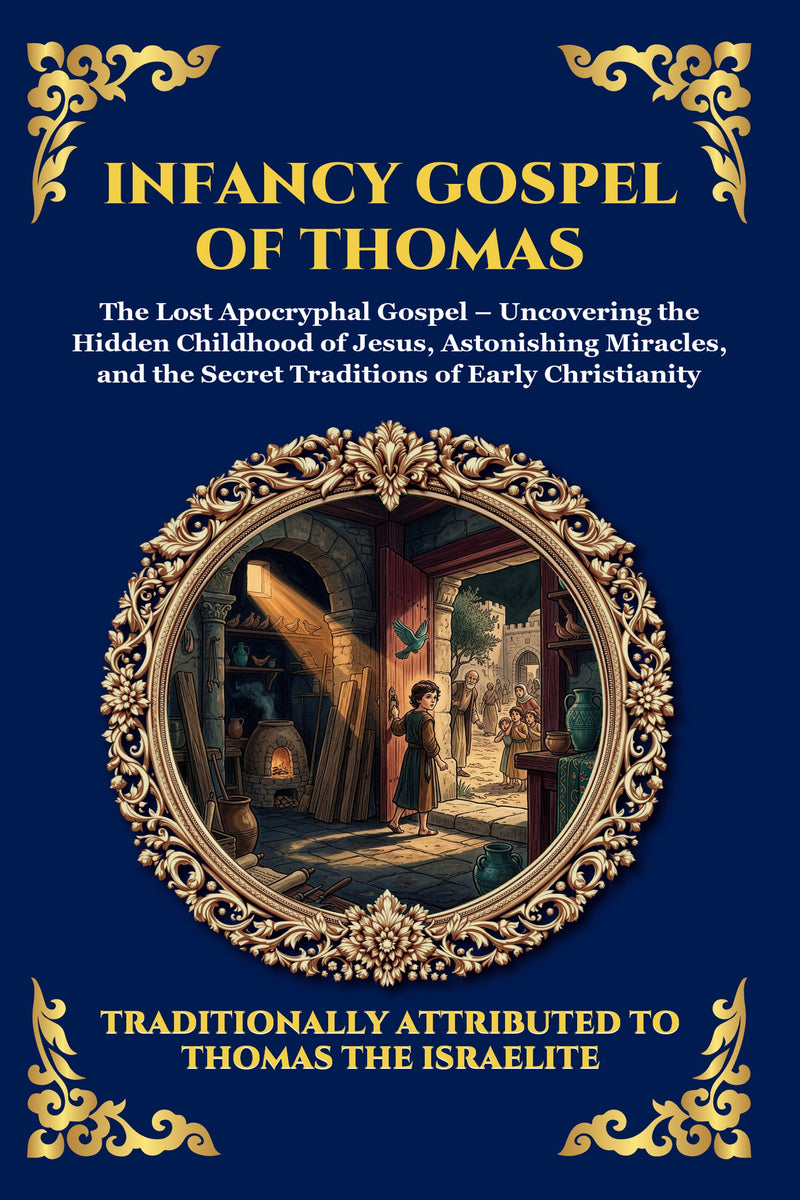
Infancy Gospel of Thomas
The Infancy Gospel of Thomas offers a rare glimpse into the childhood of Jesus, portraying him as both miraculous and unpredictable. Excluded from the Bible, this second-century text reveals a young messiah grappling with divine power in ways that challenge traditional views.
or free app
10,000+ hrs library
30-day guarantee
The Infancy Gospel of Thomas, a 2nd century AD text, is available as a complete modern English translation readable online with audiobook narration included for Library of Alexandria Press members.
The Infancy Gospel of Thomas, circulating as early as the second century CE, became one of Christianity's most controversial texts for its portrayal of the child Jesus performing miraculous and sometimes vengeful deeds.
In the Infancy Gospel of Thomas, you will discover one of the most widely circulated and heavily debated apocryphal texts of the ancient world. For centuries, early Christians hungered for details about the early years of the messiah. How did a child possessing ultimate divine power navigate growing up in a first-century Judean village? This fascinating second-century manuscript attempts to answer that question, offering a portrait of the young Jesus that is completely unique, awe-inspiring, and occasionally deeply unsettling.
Far more than a simple collection of childhood fables, this text provides a raw and unfiltered look at a divine being grappling with human existence. It features astonishing miracles, such as the young Jesus bringing clay sparrows to life, healing venomous snake bites, and stretching wooden beams for his earthly father, Joseph. Yet, it also reveals a fiercely powerful child who does not fully grasp his own strength, striking down those who cross him before eventually learning to temper his divine nature with mercy and wisdom.
By exploring this ancient gospel, readers uncover the complex and varied ways early Christians understood the incarnation, blending human maturation with raw, unbridled divine authority.
What You’ll Discover in This Modern Translation
- The Hidden Childhood: Explore the "missing years" of Jesus between ages five and twelve, filling the massive narrative gap left by the canonical New Testament.
- Astonishing Childhood Miracles: Discover the breathtaking apocryphal stories of bringing clay birds to life, miraculously carrying water in a cloak, and commanding the forces of nature.
- The Struggle of Divine Power: Read the fascinating, sometimes shocking accounts of a young, untamed messiah learning to balance his limitless power with human empathy and compassion.
- Interactions with Earthly Parents: Gain a new perspective on Joseph and Mary as they attempt to raise, protect, and understand a child who possesses the power of the cosmos.
- A Window into Early Christian Beliefs: Understand how ancient believers reconciled the humanity of a growing boy with the omnipotence of the Son of God.
Whether you are exploring this work for its immense historical value, its theological intrigue, or its captivating storytelling, the Infancy Gospel of Thomas offers a compelling journey into the heart of early Christian mythology.
Step back into the ancient world and discover the hidden childhood of Jesus. Begin your journey today.
| Formats | eBook (EPUB + PDF) · Audiobook · Paperback · Hardcover · Large Print |
| Language | English |
| Trim size (print) | 6 × 9 in |
| Binding | Paperback — perfect-bound · Hardcover — casewrap |
| Large Print edition | Same text in a larger, easy-read type — a larger font, not a larger trim |
| Print pricing | Every physical book at our true cost — at-cost, no profit (members) |
| Library | 873 restored titles, always growing |
| Composed | 2nd century AD |
| Original language | Greek |
| Source tradition | Greek, Latin, and Syriac manuscript traditions |
| Translation basis | Public-domain scholarly translation, rendered in clear modern English |
| Length | 2,773 words · ~11 min reading |
| Reading level | Grade 7 · easy, accessible reading (this modern-English edition) |
| Edition | Modern English translation · 2026 |
Member reviews for this edition are collected as readers finish it — be the first. Across the library: 12,000+ books shipped, every plan covered by a 365-day print guarantee.
About this edition
The complete, unabridged text in clear modern English — faithful to the original, never simplified. Every paragraph is checked against the source, so nothing is cut, summarised, or paraphrased away. It reads cleanly for today while keeping the original meaning intact.
The Infancy Gospel of Thomas survives in Greek, Latin, and Syriac manuscript traditions from various periods. This edition derives from the standard public-domain scholarly translation and renders it in clear modern English.
- Complete & unabridgedVerified paragraph by paragraph against the source — never a scan, never abridged.
- Modern English, faithfulReadable today, with the author’s meaning kept intact. Readable — not simplified.
- Every format, one membershipRead in your browser or the free app, or listen to the full audiobook.
Included free with your membership
Cancel anytime, one click · 30-day money-back guarantee
Edition last updated June 2026
What’s inside
Infancy Gospel of Thomas — complete and unabridged: all 22 sections included with membership, plus the full audiobook.
Begin reading Infancy Gospel of Thomas
In clear modern English — the complete text is included with membership.
Chapter 1
I, Thomas the Israelite, write to you, my brothers among the Gentiles, to make known to you the works of the childhood of our Lord Jesus Christ — his mighty deeds, and everything he did after he was born in our land. This is where it begins.
Chapter 2
Jesus was five years old when he was playing at a brook crossing. He gathered the flowing water into pools, made it clean at once, and commanded it by his word alone.
Then he took soft clay and shaped twelve sparrows from it. He did all this on the sabbath, and many other children were playing with him there.
A certain Jew who saw what Jesus was doing on the sabbath went straight to his father Joseph and said: Your child is down at the brook. He has taken clay and made twelve little birds, and he has broken the sabbath.
Joseph went to the place and saw it for himself, and called out to Jesus: Why are you doing these things on the sabbath? It is not lawful. But Jesus clapped his hands together and called out to the sparrows: Go! And the sparrows took flight and went away chirping.
When the Jews saw this they were astonished, and went off to tell their leaders what they had seen Jesus do.
Chapter 3
Annas the scribe's son was standing there with Joseph, and he took a willow branch and scattered the water that Jesus had gathered into pools.
When Jesus saw what he had done, he was angry and said to him: You wicked, godless, stupid boy — what harm did the pools and the water do to you? Listen well: now you too shall wither like a tree, and you will never bear leaves, nor roots, nor fruit.
And at that very moment the boy withered up completely. Jesus then left and went back to Joseph's house. The parents of the withered boy carried him away, weeping over his young life cut short, and brought him to Joseph and accused him, saying that he had a child who did such terrible things.
Chapter 4
Some time later, Jesus was again walking through the village when a child ran into him and knocked against his shoulder. Jesus was angered and said to him: You will not complete your journey. And the child fell down at once and died.
When some of those who were there saw what had happened, they said: Where was this child born, that every word he speaks becomes an accomplished deed? The parents of the dead child went to Joseph and reproached him, saying: You cannot go on living in this village with a child like yours. Either teach him to bless and not to curse, or take him away — for he is killing our children.
Chapter 5
Joseph took the boy aside and warned him, saying: Why do you do such things? These people suffer because of you, and they hate us and persecute us. But Jesus said: I know these words are not your own; nevertheless, for your sake I will hold my peace — but those who accused me will bear their punishment. And at that very moment, those who had accused him were struck blind.
Those who witnessed this were seized with fear and bewilderment, and they said of him that every word he spoke, whether for good or ill, became a deed and a wonder. And when Joseph saw what Jesus had done, he rose and took hold of the boy's ear and twisted it hard.
The boy was angry and said to him: It is enough that you search and do not find, and truly you have acted foolishly. Do you not know that I belong to you? Do not provoke me.
Chapter 6
A teacher named Zacchaeus was standing nearby and caught part of what Jesus said to his father. He was astonished that such a young child could speak this way.
A few days later he approached Joseph and said: You have a wise child, and he has real understanding. Come, hand him over to me so he can learn his letters. Along with the letters I will teach him all knowledge, and how to greet his elders and honor them as he would grandfathers and fathers, and how to love those his own age.
He recited all the letters from Alpha to Omega clearly, with much questioning. But Jesus looked at the teacher Zacchaeus and said to him: You do not even know the Alpha according to its true nature — so how can you teach others the Beta? You hypocrite, first teach the Alpha, if you truly know it, and then we will believe you about the Beta. And he began to confound the teacher over the very first letter, until Zacchaeus could not find any answer to give him.
Then, with many people listening, the young child said to Zacchaeus: Hear the true account of the first letter, O teacher, and pay close attention to this: it has lines, and a middle stroke which you can see, common to both sides, going apart and coming together, raised up on high, dancing, of three signs, alike in kind, balanced, equal in measure. These are the rules of the Alpha.
Chapter 7
When Zacchaeus the teacher heard all these allegories about the first letter spoken by the young child, he was bewildered by the depth and greatness of his answer and his teaching, and said to those who were present: Woe is me, wretch that I am — I am utterly confounded. I have brought shame on myself by drawing this young child to me.
Take him away, I beg you, my brother Joseph. I cannot bear the intensity of his gaze; I cannot even make my own words clear. This young child is not of earthly birth — this is one who could tame fire itself; perhaps this is one who was begotten before the world was made. What womb carried him, what belly nurtured him? I do not know. Woe is me, my friend — he drives me out of my senses, and I cannot follow his understanding. I have deceived myself, thrice wretched man that I am. I set out to gain a disciple and I find that I have a master.
My friends, think of my shame — old as I am, I have been overcome by a young child. I am ready to faint and die because of this boy, for I cannot at this moment look him in the face. And when everyone says that I have been overcome by a little child, what am I to say? What can I tell them about the lines of the first letter of which he spoke to me? I am ignorant, my friends — I know neither its beginning nor its end.
Therefore I beg you, my brother Joseph, take him home with you, for he is something great — whether god or angel or what else I should call him, I do not know.
Chapter 8
And as the Jews were counseling Zacchaeus, the young child laughed aloud and said: Now let those who were barren bear fruit, and let those who were blind in heart see. I have come from above to call them to the things that are above, even as he who sent me commanded — and I was sent for your sakes.
And when the young child had finished speaking, all those who had fallen under his curse were immediately made whole. And after that, no one dared to provoke him, for fear that he would curse them and they would be left crippled.
Chapter 9
Some days later, Jesus was playing on the roof of a house with some other children when one of them fell off and died. The other children ran away, leaving Jesus alone.
The dead child's parents came and accused Jesus of pushing him off. Jesus said, "I did not push him." But they kept on accusing him.
Then Jesus leaped down from the roof, stood beside the dead child's body, and cried out in a loud voice:
Chapter 10
After he had spoken, he said: "Zeno" — for that was his name — "get up and tell me: did I knock you down?" And immediately the boy got up and said: "No, Lord, you did not knock me down — you raised me up." When they saw this, they were amazed, and the parents of the child glorified God for the miracle that had taken place, and they worshipped Jesus.
Chapter 11
After a few days, a certain young man was splitting wood nearby when the axe slipped and cut clean through the sole of his foot. He lost so much blood that he was at the point of death.
There was an uproar, and a crowd gathered. The young child Jesus ran there too, pushed his way through the crowd, and took hold of the injured foot. Immediately it was healed. He said to the young man: Get up now and split your wood, and remember me. When the crowd saw what had happened, they worshipped the young child, saying: Truly the Spirit of God dwells in this child.
Chapter 12
When Jesus was six years old, his mother sent him to draw water and bring it home, and gave him a pitcher. But in the crowd he knocked it against something and the pitcher broke.
So Jesus spread out the garment he was wearing, filled it with water, and carried it to his mother. When his mother saw what he had done, she kissed him, and she kept to herself the mysteries she had seen him perform.
Chapter 13
Again, when the sowing season came, the young child went out with his father to sow wheat in their field. While his father sowed, the young child Jesus also sowed a single grain of wheat.
When harvest came, he reaped it and threshed it and made from it a hundred measures. He called all the poor of the village to the threshing floor and gave them the wheat, and Joseph took what remained. Jesus was eight years old when he worked this sign.
Chapter 14
Joseph was a carpenter by trade, and at that time he made ploughs and yokes. A certain rich man had commissioned him to make a bed. One of the beams — the one called the shifting beam — was too short, and Joseph did not know what to do. The boy Jesus said to him: Lay the two pieces of wood down and line them up at the end closest to you.
Joseph did as the boy told him. Then Jesus went to the other end, took hold of the shorter beam, and stretched it until it matched the length of the other. His father Joseph saw this and was astonished. He embraced the boy and kissed him, saying: How blessed I am, for God has given me this child.
Chapter 15
But when Joseph saw the child's understanding, and that he was coming of age, he thought to himself that the boy should not remain ignorant of letters. So he took him and handed him over to another teacher. The teacher said to Joseph, "First I will teach him the Greek letters, and after that the Hebrew." For the teacher had already heard of the child's ability and was afraid of him; yet he wrote out the alphabet, and Jesus studied it for a long time and said nothing in reply.
Then Jesus said to him, "If you are truly a teacher, and if you know your letters well, tell me the power of the Alpha, and then I will tell you the power of the Beta." The teacher was provoked and struck him on the head. The child was hurt and cursed him, and immediately the man fainted and fell face down on the ground.
The child went back to the house of Joseph. Joseph was grieved, and he gave orders to the boy's mother, saying, "Do not let him go outside the door, for everyone who provokes him to anger ends up dead."
Chapter 16
And after some time, yet another teacher — a faithful friend of Joseph — said to him: Bring the boy to me at the school. Perhaps with a gentle approach I may be able to teach him his letters. Joseph said: If you have no fear of him, brother, take him with you. And the man took him, though with fear and great unease of spirit, while the boy followed him gladly.
When they arrived, the boy walked boldly into the school, found a book lying on the desk, picked it up, and did not read the letters written in it, but opened his mouth and spoke by the Holy Spirit, teaching the law to all who were standing nearby. A great crowd gathered and stood listening, marveling at the beauty of his teaching and the ease of his words — that a child should speak such things.
When Joseph heard what was happening, he was afraid and ran to the school, wondering whether this teacher too had come to grief. But the teacher said to him: Know, brother, that I took this child as my pupil, yet he is full of grace and wisdom. I beg you now, brother, take him home with you.
Cancel anytime, one click · 30-day money-back guarantee
Founding annual rate available now — your price locks for life when you join.
Not ready? Get this free chapter by email — read it anytime.
✓ Sent — check your inbox for Infancy Gospel of Thomas.
Questions about Infancy Gospel of Thomas
Why isn't the Infancy Gospel of Thomas in the Bible?
The Infancy Gospel of Thomas was excluded from the biblical canon by early church councils, likely due to its portrayal of Jesus as a sometimes wrathful child performing miraculous acts that differed from accepted theological views.
Did the apostle Thomas actually write this gospel?
Modern scholars agree that the apostle Thomas did not write the Infancy Gospel of Thomas. The text is pseudepigraphic, attributed to 'Thomas the Israelite' but actually composed by an anonymous Christian author in the second century.
What stories does the Infancy Gospel of Thomas contain?
The Infancy Gospel of Thomas narrates episodes from Jesus's childhood, including making clay birds come alive, cursing playmates, healing injuries, and demonstrating supernatural wisdom, portraying a powerful but sometimes unpredictable divine child.
Is Infancy Gospel of Thomas free to read?
The opening of the text is free to read below. Members read and listen to the complete work — and the entire Lost & Forbidden Library — free.
What is Infancy Gospel of Thomas?
Have you ever wondered why the canonical Bible reveals almost nothing about the childhood of Jesus? In the Infancy Gospel of Thomas, you will discover one of the most widely circulated and heavily debated apocryphal texts of the ancient world.
How long is Infancy Gospel of Thomas?
22 chapters (~2,794 words) in this restored edition.
Shipping & returns
Billing & membership
More from the library


Explore The Lost & Forbidden Library
- 1 Enoch · Attributed to Enoch
- 1–4 Maccabees · Various Jewish authors
- 2 Baruch · Attributed to Baruch
- 2 Enoch · Attributed to Enoch
- 2 Esdras · Attributed to the prophet Ezra
- 3 Baruch · Attributed to Baruch ben Neriah
- 4 Baruch · Attributed to Baruch ben Neriah
- A Valentinian Exposition · Attributed to a follower of Val...
- Acta Archelai · Attributed to Hegemonius
- Acts of Andrew · Anonymous (Early Christian Apoc...
- Acts of Andrew and Matthias in the City of the Cannibals · Attributed to early Christian a...
- Acts of Barnabas · Attributed to John Mark
- Acts of Bartholomew
- Acts of John · Anonymous (Early Christian Apoc...
- Acts of Matthias · Anonymous early Christian writers
- Acts of Paul · Attributed to an unknown early ...
- Acts of Paul and Thecla · Attributed to Onesiphorus
- Acts of Peter
- Acts of Peter and Andrew · Attributed to various early Chr...
- Acts of Peter and Paul · Attributed to Leucius Charinus
- Acts of Peter and Simon · Attributed to Leucius Charinus
- Acts of Peter and the Twelve Apostles · Attributed to early Christian a...
- Acts of Philip · Anonymous (Early Christian Apoc...
- Acts of Pilate (Gospel of Nicodemus) · Attributed to various early Chr...
- Acts of Saturninus
- Acts of Thaddaeus · Attributed to Thaddaeus the Apo...
- Acts of Thomas
- Acts of Titus · Anonymous early Christian writer
- Acts of Xanthippe, Polyxena, and Rebecca
- Allogenes · Anonymous (Early Gnostic Mystic)
Infancy Gospel of Thomas
The Infancy Gospel of Thomas
The Childhood Deeds of the Boy Jesus — His Wonders, His Teachers, and His Growing in Wisdom
Library of Alexandria Press
The Infancy Gospel of Thomas
© Copyright 2026 Library of Alexandria Press. All rights reserved.
Published by Library of Alexandria Press
Printed in the United States of America
It is not legal to copy, share, or send any part of this document in either digital or printed form without written permission from the publisher, except short quotes in a book review.
Table of Contents
Introduction
Chapter 1
Chapter 2
Chapter 3
Chapter 4
Chapter 5
Chapter 6
Chapter 7
Chapter 8
Chapter 9
Chapter 10
Chapter 11
Chapter 12
Chapter 13
Chapter 14
Chapter 15
Chapter 16
Chapter 17
Chapter 18
Chapter 19
Chapter 20
Chapter 21
Introduction
There is a version of Jesus that most people have never encountered. Not the adult teacher who walked the shores of Galilee, not the suffering figure of the Passion narratives, not even the infant of the Nativity stories — but a child. A real child, or at least a literary one: curious, sometimes frightening, occasionally tender, and bristling with a power that the world around him struggles to understand or contain. This child makes sparrows from clay and breathes life into them. He strikes a boy dead for bumping into him in the street, then raises him again. He confounds his teachers with wisdom they cannot fathom. He is, in every sense of the phrase, something else entirely — and for nearly two thousand years, his story has been hiding in plain sight.
The text you are about to explore is one of the most remarkable documents to survive from the early centuries of Christianity. Scholars call it the Infancy Gospel of Thomas, though it has nothing to do with the more famous Gospel of Thomas discovered at Nag Hammadi in 1945. It is an entirely different work, older in its traditions, stranger in its content, and more psychologically complex than almost any other piece of early Christian literature. It purports to tell the story of Jesus between the ages of roughly five and twelve — a period the canonical Gospels pass over almost entirely, leaving only a single episode: the famous scene in the Temple at Jerusalem, where the young Jesus astonishes the religious scholars with his understanding. Everything else, the long years of childhood in Nazareth, the development of a boy who was also, according to Christian belief, divine — all of that is silence. Into that silence, this ancient text rushes with breathtaking audacity.
To read it for the first time is a genuinely disorienting experience, even for those who consider themselves well-versed in early Christian literature. The Jesus of this narrative does not behave the way readers expect. He is not gentle and meek in the manner of Sunday school portraits. He is powerful in ways that are almost terrifying, and the text does not shy away from that terror. When he is wronged, there are consequences. When he is misunderstood, the misunderstanding carries a cost. And yet, woven through these unsettling episodes, there are moments of extraordinary grace — a child who heals a foot, who comforts a grieving parent, who demonstrates a wisdom so far beyond his years that grown men weep in recognition of something they cannot name. The portrait that emerges is not simple, and that complexity is precisely what makes it so endlessly fascinating.
For centuries, this text was dismissed by mainstream Christianity as heretical fantasy, the product of overactive imaginations on the fringes of the faith. The early church fathers mentioned it, usually to condemn it. It was excluded from every canon, every official list of approved scripture. And yet it survived. Copied and recopied across centuries, translated into Greek, Latin, Syriac, Ethiopic, Georgian, Slavonic, and Arabic, it spread across the ancient and medieval world with a tenacity that suggests something important: people wanted it. Ordinary believers, not just theologians or heretics, were drawn to the idea of a childhood Jesus, a boy navigating the world with divine power coursing through him like electricity through a wire. The text met a human need that official Christianity left largely unaddressed — the need to imagine the whole of a life, not just its culminating acts.
This book is an invitation to take that text seriously. Not necessarily as scripture, not as historical biography, but as a profound artifact of religious imagination — one that tells us as much about the communities that created and preserved it as it does about any theological agenda. The Infancy Gospel of Thomas is a window into a world of early Christianity that was far more diverse, far more creatively adventurous, and far more willing to ask uncomfortable questions than the version of Christian origins that has been handed down through official channels. To read it carefully is to discover that the story of Jesus was never as settled or as uniform as later tradition would have us believe. It was, from the very beginning, a story that people felt compelled to continue, to expand, to imagine more fully.
The question of who wrote this text, and when, and why, is one that scholars have debated for generations without reaching anything like a consensus. The name Thomas appears in the earliest manuscripts as the author — Thomas Israelite, or Thomas the Philosopher — but almost no serious researcher today believes that the apostle Thomas had anything to do with it. The attribution is almost certainly a later addition, a way of lending apostolic authority to a text that might otherwise have been dismissed. The actual author is unknown, likely a Greek-speaking Christian writing sometime in the second century, though some of the traditions embedded in the text may be considerably older. The uncertainty is not a weakness of the scholarship; it is an honest reflection of how ancient texts actually come to us — fragmentary, layered, and resistant to easy categorization.
What we can say with confidence is that the text we have today is not a single, unified composition but rather a collection of traditions that were assembled, edited, and re-edited over time. Different manuscript families preserve different versions, with episodes added, removed, or rearranged. Some versions are harsher in their portrayal of the child Jesus; others soften the edges, smooth the troubling moments, make him more recognizably saintly. This fluidity is itself deeply revealing. It shows us a community of readers actively engaging with the material, wrestling with it, shaping it to meet their own spiritual and theological needs. The text was never static. It was always in conversation — with its readers, with the canonical Gospels, with the broader culture of the ancient Mediterranean world.
One of the great pleasures of studying this document is the way it forces us to confront our own assumptions about what early Christianity was and what it believed. We tend to think of the first few centuries of the faith as a period when doctrine was being carefully, rationally worked out by brilliant theologians — and that is partly true. But it was also a period of wild imaginative freedom, when the figure of Jesus was being explored from every possible angle, when questions that the canonical Gospels left unanswered were being answered in a dozen different ways by a dozen different communities. The Infancy Gospel of Thomas belongs to that world of creative theological exploration, and reading it with fresh eyes is a way of recovering some of that original freedom and wonder.
A Gospel Hidden in Plain Sight
To understand why this text matters, it helps to understand what it was competing against — and what gap it was filling. The four canonical Gospels, Matthew, Mark, Luke, and John, present the life of Jesus with a very particular set of priorities. They are concerned above all with his public ministry, his teaching, his miracles among the crowds, his conflict with religious authorities, and above all his death and resurrection. The birth narratives in Matthew and Luke are brief and theologically loaded. Mark begins with the adult Jesus at the Jordan River. John begins before time itself, with the cosmic Word that existed before creation. None of them linger over childhood. None of them ask what it was like to grow up as this particular child, in this particular family, in this particular village.
The silence is striking when you notice it. Luke, who gives us the most extended birth narrative, mentions almost in passing that after the presentation at the Temple, the family returned to Nazareth, and there 'the child grew and became strong, filled with wisdom; and the favor of God was upon him.' Then, after a brief account of the twelve-year-old Jesus in the Temple, he says again: 'And Jesus increased in wisdom and in years, and in divine and human favor.' That is essentially it. Eighteen years of a life — the years of childhood, adolescence, early adulthood — compressed into a handful of phrases. The canonical tradition was not interested in those years, or at least not in a way that produced texts that survived the process of canonization.
But other people were interested. Deeply, persistently, irresistibly interested. The Infancy Gospel of Thomas is the most important surviving example of a broader tradition of 'infancy gospels' — texts that attempted to fill in the missing years with stories, legends, and theological reflections. The Protevangelium of James, another important apocryphal text, focuses on the birth of Mary and the circumstances of Jesus's birth. Other texts, some now lost and known only through references in other works, apparently circulated with similar aims. There was a hunger for this material, and the hunger tells us something important: for many early Christians, the theological stakes of Jesus's childhood were enormous.
Think about what it means to believe that Jesus was both fully human and fully divine. That is the orthodox position that would eventually be hammered out at the Council of Nicaea and elaborated in subsequent councils. But in the second and third centuries, before those councils, the question was wide open, and different communities answered it in radically different ways. Some believed Jesus was purely divine, that his humanity was an illusion or a kind of costume. Others believed he was purely human, a great teacher and prophet adopted by God at his baptism. Still others held positions along a vast spectrum between these poles. The childhood of Jesus was a theological battleground precisely because it was the place where the question of his nature was most acute. How does a divine being learn to walk? How does the Word made flesh experience hunger, fear, the ordinary vulnerabilities of a child's body? These were not idle questions. They were at the heart of what Christianity was and what it believed about the nature of reality.
The Infancy Gospel of Thomas engages these questions not through abstract theological argument but through story — and that is part of its genius. It shows us a child who is unmistakably powerful, whose divine nature keeps breaking through the ordinary surfaces of village life, and yet who is also recognizably a child: impulsive, sometimes angry, needing to learn and grow. The tension between these two aspects of his nature is never fully resolved in the text, and that irresolution is not a failure of the author's theological imagination. It is a faithful representation of the paradox that lies at the heart of Christian belief. The text does not solve the problem of the incarnation; it dramatizes it, lives inside it, explores it from the inside.
The manuscript tradition of this text is extraordinarily complex, and scholars have spent decades trying to untangle it. The earliest surviving manuscripts date from the fifth and sixth centuries, but the text itself is almost certainly much older. Irenaeus of Lyon, writing in the late second century, seems to know a version of at least some of these stories. Origen, in the third century, mentions a childhood gospel. The traditions embedded in the text may go back even further, to oral stories circulating in the communities of early Christianity before anyone thought to write them down. By the time they were written down and collected, they had already passed through many hands, been shaped by many different theological and cultural contexts.
The geographical spread of the manuscripts is itself a testament to the text's remarkable reach. Versions have been found in Egypt, Syria, Palestine, Ethiopia, Georgia, Armenia, and across the Latin-speaking West. Each regional tradition adapted the material somewhat, emphasizing different episodes, adding local color, adjusting the theology to fit local concerns. The Syriac tradition, for instance, tends to present the child Jesus in ways that resonate with Syriac theological sensibilities, while the Latin tradition shapes him somewhat differently. Reading across these different versions is like watching a story breathe — expanding and contracting, shifting its emphasis, always remaining recognizably itself while never being quite the same twice.
What has kept this text alive, across so many centuries and so many different cultural contexts, is ultimately not its theology but its humanity. The stories it tells are vivid, immediate, and emotionally resonant in ways that more abstract theological texts are not. A father trying to find a teacher for his gifted and frightening child. A teacher who discovers, to his bewilderment, that his pupil knows more than he does. A child playing by a stream, making sparrows from mud on the Sabbath day. These are images that lodge in the imagination and refuse to leave. They speak to something deep in human experience — the mystery of children, the terror and wonder of encountering something genuinely other, the longing to understand what we cannot fully comprehend.
Reading the Text Today
Approaching this ancient document in the twenty-first century requires a particular kind of readerly flexibility — a willingness to hold multiple frameworks in mind simultaneously. As a historical document, it tells us a great deal about the diversity of early Christianity and the imaginative freedom with which early believers approached the figure of Jesus. As a literary text, it is sophisticated in ways that are easy to underestimate, using narrative structure, repetition, and contrast to build meaning in ways that reward careful attention. As a religious document, it raises profound questions about the nature of the divine, the meaning of childhood, and the relationship between power and compassion. And as a human document, it speaks to experiences that are universal: the strangeness of children, the inadequacy of our categories when confronted with genuine mystery, the longing to know more than we have been told.
Modern readers sometimes struggle with the episodes in which the child Jesus causes harm — striking people blind or dead in moments of anger or wounded pride. These passages have been used, both by ancient critics and by modern ones, to dismiss the entire text as theologically irresponsible or even malicious. But this reaction misses something important. The author of this text was not naive. The troubling episodes are not accidents or oversights; they are central to the text's theological project. They force the reader to confront the full weight of what it would mean for divine power to be housed in a child's body, subject to a child's emotional responses, operating in a world that does not yet understand what it is dealing with. The discomfort these passages produce is not a bug; it is a feature. It is the text doing its job.
It is also worth noting that the tradition of depicting holy figures as dangerous as well as gracious is ancient and widespread. The God of the Hebrew Bible is not uniformly gentle. The saints of many traditions have their terrifying aspects alongside their merciful ones. The child Jesus of this text participates in a long tradition of sacred power that does not conform to human expectations of niceness. He is not safe, to borrow a phrase from C.S. Lewis's description of Aslan. But he is good, or at least he is becoming good — and that process of becoming, of growth and development and increasing wisdom, is one of the most theologically interesting aspects of the entire text.
The relationship between this text and the canonical Gospels is also worth thinking about carefully before you begin reading. The author clearly knew the Gospel of Luke, at minimum — the episode in the Temple at Jerusalem that closes the narrative is drawn directly from Luke's account, and the text seems designed in part to lead up to that moment, to provide a context for it. But the relationship is not one of simple imitation or expansion. The author is doing something more interesting than merely filling in blanks. He is reading the canonical tradition against the grain, asking what it implies, what it requires, what it leaves unexplained — and then offering answers that the canonical tradition itself would never have provided.
This kind of creative engagement with authoritative texts is not unique to this document. It is a fundamental feature of how religious traditions work. The midrashic tradition in Judaism, the hagiographic tradition in Christianity, the tafsir tradition in Islam — all of these involve communities of believers taking authoritative texts and expanding them, interpreting them, filling in their silences with imagination shaped by faith. The Infancy Gospel of Thomas is a product of exactly this kind of religious imagination, and reading it as such — not as a rival to the canonical Gospels but as a creative engagement with them — opens up dimensions of the text that a more defensive or dismissive reading would miss entirely.
There is also a deeply human story at the center of this text that deserves to be recognized as such. Whatever one believes about the theological claims it makes, the narrative it tells is about a family navigating an extraordinary situation with very ordinary human resources. Mary and Joseph appear in these stories not as icons but as parents — worried, sometimes frustrated, proud, bewildered, doing their best with a child who exceeds their comprehension. The teachers who attempt to educate the young Jesus are not villains; they are professionals confronted with a situation for which their training has not prepared them. The neighbors and townspeople who witness the miracles and the disasters are ordinary people trying to make sense of what they are seeing. The humanity of these supporting characters is one of the text's greatest strengths, and it gives the theological drama a warmth and immediacy that pure doctrinal argument could never achieve.
As you read, you will encounter moments that challenge you, moments that move you, and moments that simply astonish you with their strangeness. You will meet a child unlike any other in ancient literature — a figure who embodies the full complexity of what it means to be both human and divine, both child and God, both learner and teacher. You will encounter a community of early believers who were willing to ask the hardest possible questions about their faith and to pursue those questions into territory that the official tradition preferred to leave unexplored. And you will discover, perhaps to your surprise, that this ancient, contested, frequently misunderstood text has things to say that are as relevant and as challenging today as they were when it was first written.
The story of how this text was transmitted, debated, suppressed, and ultimately recovered for modern readers is itself a remarkable chapter in the history of Christianity — and of human curiosity more broadly. The scholars who have worked to establish reliable texts, translate difficult passages, and situate the document in its historical context have done work of genuine importance, not just for academic specialists but for anyone who wants to understand the full richness of the Christian tradition. This book draws on that scholarship while trying to make the text and its significance accessible to readers who may be encountering it for the first time.
What you hold in your hands, then, is more than an ancient curiosity. It is an invitation to encounter a tradition that has been hidden not because it was lost but because it was too strange, too challenging, too unwilling to smooth away the rough edges of a genuinely difficult idea. The childhood of Jesus, as imagined by this early Christian author, is not a comfortable story. It is a story about power and its consequences, about wisdom and its limits, about the terrifying and wonderful experience of encountering something that exceeds all our categories. It is, in other words, a story about what religion at its most honest and most daring has always been about. Turn the page, and meet a Jesus you have never met before.
The Infancy Gospel of Thomas
Chapter 1
I, Thomas the Israelite, write to you, my brothers among the Gentiles, to make known to you the works of the childhood of our Lord Jesus Christ — his mighty deeds, and everything he did after he was born in our land. This is where it begins.
Chapter 2
Jesus was five years old when he was playing at a brook crossing. He gathered the flowing water into pools, made it clean at once, and commanded it by his word alone.
Then he took soft clay and shaped twelve sparrows from it. He did all this on the sabbath, and many other children were playing with him there.
A certain Jew who saw what Jesus was doing on the sabbath went straight to his father Joseph and said: Your child is down at the brook. He has taken clay and made twelve little birds, and he has broken the sabbath.
Joseph went to the place and saw it for himself, and called out to Jesus: Why are you doing these things on the sabbath? It is not lawful. But Jesus clapped his hands together and called out to the sparrows: Go! And the sparrows took flight and went away chirping.
When the Jews saw this they were astonished, and went off to tell their leaders what they had seen Jesus do.
Chapter 3
Annas the scribe's son was standing there with Joseph, and he took a willow branch and scattered the water that Jesus had gathered into pools.
When Jesus saw what he had done, he was angry and said to him: You wicked, godless, stupid boy — what harm did the pools and the water do to you? Listen well: now you too shall wither like a tree, and you will never bear leaves, nor roots, nor fruit.
And at that very moment the boy withered up completely. Jesus then left and went back to Joseph's house. The parents of the withered boy carried him away, weeping over his young life cut short, and brought him to Joseph and accused him, saying that he had a child who did such terrible things.
End of the free sample
Keep reading, free
Members read and listen to the complete book — and the entire library. Cancel anytime, one click · 30-day money-back guarantee.