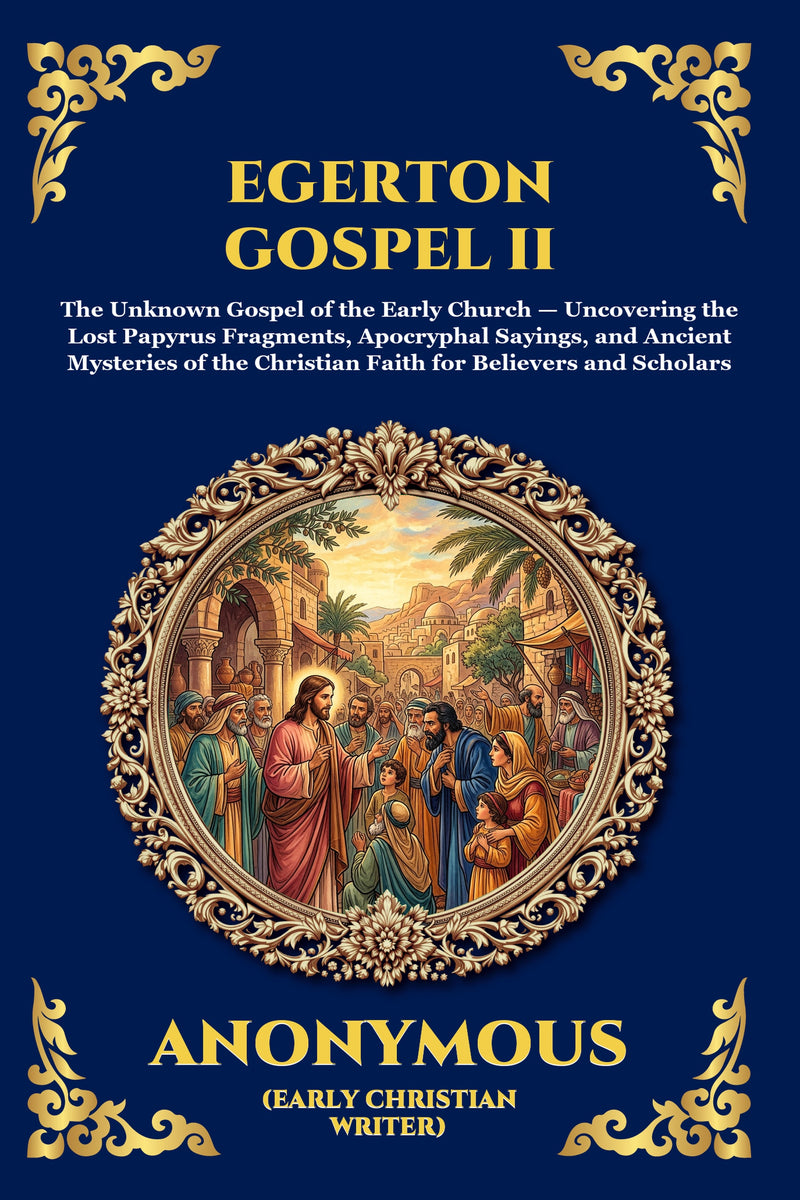
Egerton Gospel II
Egerton Gospel II contains fragments of an early account of Jesus's life that predates many canonical texts. This second-century manuscript offers a unique perspective on familiar events, such as the healing of a leper and debates with religious authorities, revealing details left out of the official Bible.
or free app
10,000+ hrs library
30-day guarantee
This Library of Alexandria edition presents the complete Egerton Gospel fragments in modern English translation, readable online with audiobook narration included for members.
Discovered among ancient Egyptian papyri in the early 20th century, Egerton Gospel II represents one of Christianity's earliest non-canonical gospel fragments, predating many complete New Testament manuscripts.
In the Egerton Gospel II, readers are invited to explore one of the most significant and enigmatic archaeological discoveries in biblical history. Dating back to the middle of the second century, the Egerton Papyrus contains fragments of an "unknown gospel" that predates many of our earliest surviving copies of the canonical texts. This remarkable manuscript does not neatly align with Matthew, Mark, Luke, or John. Instead, it presents a unique, parallel tradition—featuring familiar events like the healing of a leper and fierce debates with religious authorities, but telling them with entirely new details and dialogue.
Far more than a simple historical artifact, this ancient text forces us to reconsider the oral and written traditions that circulated during the dawn of Christianity. It reveals a time when the boundaries of scripture were still fluid, and different communities cherished their own distinct accounts of the Savior's ministry. The fragments capture a Jesus who is fiercely authoritative, deeply compassionate, and actively challenging the religious structures of his day.
This carefully formatted edition brings these fragile papyrus fragments to life for the modern reader. It offers not only the translated texts themselves but the vital historical context needed to appreciate their massive significance. Blending archaeological intrigue with profound theological exploration, this book challenges its readers to expand their understanding of the early church and the many voices that shaped it.
What You’ll Discover in This Apocryphal Masterpiece
- The Lost Stories of Jesus: Explore unique accounts of miracles, including a distinct version of the healing of a leper and an enigmatic story on the banks of the Jordan River.
- Fierce Debates and Hidden Sayings: Read newly discovered dialogues where Jesus directly confronts the religious authorities of his day, offering wisdom not found in the traditional New Testament.
- An Independent Christian Tradition: Understand why scholars believe this text may represent an entirely independent, parallel historical tradition to the Gospel of John and the Synoptic Gospels.
- The Thrill of Biblical Archaeology: Gain a fascinating look into how ancient papyri are discovered, translated, and analyzed to piece together the lost history of the ancient world.
- Insights into Early Christian Diversity: Discover the rich, vibrant, and multifaceted theological landscape of the early believers before the establishment of strict orthodoxy.
Whether you are exploring this work to piece together the historical puzzle of early Christian literature or seeking a deeper, more expansive view of the ancient faith, the Egerton Gospel II is an essential read. Step into the mystery and uncover the lost fragments of history. Begin your journey today.
| Formats | eBook (EPUB + PDF) · Audiobook · Paperback · Hardcover · Large Print |
| Language | English |
| Trim size (print) | 6 × 9 in |
| Binding | Paperback — perfect-bound · Hardcover — casewrap |
| Large Print edition | Same text in a larger, easy-read type — a larger font, not a larger trim |
| Print pricing | Every physical book at our true cost — at-cost, no profit (members) |
| Library | 873 restored titles, always growing |
| Composed | 2nd century AD |
| Original language | Greek |
| Source tradition | Egerton Papyrus 2 (British Museum) |
| Translation basis | Public-domain scholarly translation, rendered in clear modern English |
| Length | 2,965 words · ~12 min reading |
| Reading level | Grade 11 · a confident, adult read (this modern-English edition) |
| Edition | Modern English translation · 2026 |
Member reviews for this edition are collected as readers finish it — be the first. Across the library: 12,000+ books shipped, every plan covered by a 365-day print guarantee.
About this edition
The complete, unabridged text in clear modern English — faithful to the original, never simplified. Every paragraph is checked against the source, so nothing is cut, summarised, or paraphrased away. It reads cleanly for today while keeping the original meaning intact.
Based on Greek papyrus fragments discovered in Egypt and acquired by the British Museum. This edition derives from the standard public-domain scholarly translation and renders it in clear modern English.
- Complete & unabridgedVerified paragraph by paragraph against the source — never a scan, never abridged.
- Modern English, faithfulReadable today, with the author’s meaning kept intact. Readable — not simplified.
- Every format, one membershipRead in your browser or the free app, or listen to the full audiobook.
Included free with your membership
Cancel anytime, one click · 30-day money-back guarantee
Edition last updated June 2026
What’s inside
Egerton Gospel II — complete and unabridged: all 8 sections included with membership, plus the full audiobook.
Begin reading Egerton Gospel II
In clear modern English — the complete text is included with membership.
A World of Fragments and Faith
To understand why the discovery of Papyrus Egerton 2 matters so much, it helps to understand the world from which it came — a world that was, in almost every sense, a world of fragments. The first and second centuries of the Common Era were a time of extraordinary religious ferment across the Roman Empire. The old civic religions of Greece and Rome were losing their grip on the imagination of ordinary people. Mystery cults from Egypt and Persia were spreading westward. Philosophical schools competed for adherents in the marketplaces and lecture halls of Alexandria, Antioch, Corinth, and Rome. And in the midst of all this, the movement that had begun with a Jewish teacher from Galilee was spreading with remarkable speed and remarkable diversity.
We tend, from the vantage point of the present, to think of early Christianity as a single thing — a unified movement with a clear message, a defined leadership structure, and a settled body of scripture. But this is a retrospective illusion, created by the very process of canonization and institutionalization that we will be examining in this book. In the first and second centuries, the Jesus movement was plural. There were communities in Syria that emphasized the wisdom teachings of Jesus and showed little interest in his death and resurrection. There were communities in Egypt that developed elaborate cosmological systems in which Jesus played a role quite different from the one familiar to most modern Christians. There were Jewish-Christian communities in Palestine and beyond that continued to observe Torah while believing that Jesus was the Messiah. And there were the communities associated with the letters of Paul, the communities that would eventually produce what we call the catholic or universal church, with their emphasis on the atoning death of Christ and the imminent return of the Lord.
All of these communities told stories about Jesus. All of them passed those stories along, in oral form at first and then, increasingly, in written form. The process of writing down the Jesus tradition was not a single event but a prolonged, overlapping, and geographically dispersed series of events. Mark wrote his gospel, probably in the late 60s of the first century. Matthew and Luke, working independently, each drew on Mark and on a collection of Jesus's sayings that scholars call Q, producing their own gospels probably in the 80s. John, working from a different tradition and with a very different theological vision, produced his gospel probably in the 90s. But these were not the only gospels being written. The Gospel of Thomas, preserved in a Coptic translation discovered at Nag Hammadi in 1945, preserves a collection of sayings attributed to Jesus that some scholars believe contains genuinely early traditions. The Gospel of Peter, known from a fragment discovered in Egypt in 1886, tells the passion story with striking differences from the canonical accounts. And there were many others — gospels attributed to Philip, to Mary Magdalene, to the Hebrews, to the Egyptians — most of them lost, some preserved only in quotations by later authors who cited them in order to argue against them.
Into this crowded and contested landscape, the Egerton papyrus arrives as a particularly intriguing witness. It is intriguing partly because of its antiquity — as we have noted, the physical manuscript is among the oldest Christian manuscripts we possess. But it is intriguing even more because of its character. Unlike the Gospel of Thomas, which is a collection of sayings with no narrative framework, the Egerton text is narrative. It tells stories. It describes encounters. It has the texture of the synoptic gospels and the theological vocabulary of John. This combination has led some scholars to argue that it represents a very early stage in the development of the gospel genre — a stage before the canonical gospels had fully crystallized into their final forms. Others argue the opposite: that the Egerton text is a later composition that drew on the canonical gospels and wove their material together in a new way. The debate, as we will see, is far from settled.
What makes the debate particularly fascinating is what it reveals about the assumptions we bring to early Christian texts. When we approach a document like this one, we inevitably bring with us a set of prior commitments — about what the canonical gospels are, about how the tradition developed, about what counts as early and what counts as late, about what kinds of creativity and borrowing were available to ancient authors. The Egerton papyrus forces us to examine those assumptions. It does not fit neatly into any of the categories we have constructed for early Christian literature, and that very refusal to fit is one of the most valuable things about it.
Consider, for example, the question of the relationship between the Egerton text and the Gospel of John. Several passages in the Egerton papyrus have very close verbal parallels with Johannine material — so close that most scholars have concluded that there must be some kind of literary relationship between the two texts. But the direction of that relationship is contested. Did the Egerton author know John and draw on it? Or did both the Egerton text and John draw on a common source — a source that no longer exists independently but whose traces can be detected in both documents? Or — most provocatively — did John know the Egerton tradition and incorporate it into his gospel? Each of these possibilities has been argued by serious scholars, and each of them has different implications for our understanding of how the Johannine tradition developed.
The same questions arise, in slightly different forms, when we compare the Egerton text with the synoptic gospels. The healing of the leper, for instance, has parallels in all three synoptics, but the Egerton version is not simply a copy of any of them. It shares some elements with Mark, others with Luke, and introduces details that appear in none of the canonical accounts. How do we explain this? The answer we give will depend heavily on our model of how the gospel tradition worked — whether we think of it primarily as a literary tradition, in which authors copied and adapted written sources, or as an oral tradition, in which stories circulated in fluid, variable forms before being written down, or as some complex combination of both.
These are not merely academic questions. They touch on something fundamental about the nature of religious tradition itself — about how communities remember, transmit, and transform the stories that give them their identity. The early Christians were not passive recipients of a fixed tradition. They were active participants in the ongoing process of making meaning out of the life, death, and reported resurrection of Jesus of Nazareth. The Egerton papyrus is a product of that active, creative, communal process. To read it is to witness that process at work.
And yet we must always remember that what we are reading is a fragment — literally. The papyrus is damaged. Words are missing. Sentences break off in the middle. There are lacunae — gaps in the text — that scholars have attempted to fill by conjecture, sometimes with more confidence than the evidence warrants. Reading a fragmentary ancient text requires a particular kind of intellectual humility: the willingness to say, again and again, that we do not know, that the text does not tell us, that the gap cannot be filled with certainty. This book will try to model that humility, even while pursuing the questions with genuine enthusiasm and rigor.
Why This Text Still Speaks
There is a moment, familiar to anyone who has spent time with ancient manuscripts, when the distance between past and present suddenly collapses. You are reading a text — perhaps in translation, perhaps in the original language — and you encounter a sentence, a phrase, an image, that strikes you with the force of immediate recognition. The centuries dissolve. The cultural differences, the linguistic barriers, the vast gulf of historical change — all of it falls away, and you are simply in the presence of another human being who is trying to articulate something true about the world. That moment of recognition is one of the great gifts of the humanities, and it is one that the Egerton papyrus offers with particular generosity.
Read, for instance, the passage in which Jesus responds to those who challenge his authority with a quotation from Moses and a pointed question about their own failure to believe. The rhetorical move is instantly recognizable — the appeal to shared scripture, the turning of the challenge back on the challenger, the implication that the real problem is not a lack of evidence but a failure of will. This is the Jesus of the canonical gospels, and it is also something more than that: it is a portrait of a teacher who understood the dynamics of public argument and who engaged them with remarkable skill. Whatever we think about the historical origins of this particular passage, it captures something that has clearly been recognized, across many different communities and many different centuries, as characteristic of the figure at the center of the Christian tradition.
Or consider the leper who approaches Jesus and says, in the Egerton text's distinctive formulation, something to the effect that he has traveled with lepers and eaten with them in the inn, and that he himself has become leprous. The detail is striking and strange. It does not appear in the canonical accounts of the leper's healing. It introduces a social and economic dimension — the inn, the shared meal, the journey — that gives the story a specificity and a human texture that is quite different from the spare, almost iconic quality of the Markan parallel. Why is this detail here? What does it tell us about the community that preserved this version of the story? These are questions without certain answers, but they are questions that repay sustained attention.
The mysterious Jordan River episode is perhaps the most arresting of all. The text is badly damaged at this point, and scholars have struggled to reconstruct even the basic outline of what is being described. What seems to be happening is that Jesus scatters seeds on the water — or perhaps on the bank of the river — and then performs some action that causes them to sprout and bear fruit in a miraculous way. The episode has been compared to the nature miracles of the canonical gospels — the stilling of the storm, the feeding of the multitude, the cursing of the fig tree — but it is unlike any of them in its specific details. It has also been compared to certain Jewish traditions about miraculous agricultural abundance in the messianic age, and to Gnostic texts that use agricultural imagery to describe spiritual transformation. None of these comparisons is fully satisfying. The episode remains, in the most literal sense, a fragment — a piece of something larger that we cannot fully reconstruct.
And perhaps that is appropriate. Perhaps the fragmentary character of this text is not just an accident of preservation but a kind of invitation — an invitation to sit with incompleteness, to resist the urge to fill every gap with our own assumptions, and to remain genuinely open to the possibility that the past contains things we have not yet imagined. The study of early Christianity has been transformed, in the past century, by a series of discoveries that have forced scholars to revise their understanding of what the tradition looked like before the canon closed. The Dead Sea Scrolls illuminated the Jewish matrix from which the Jesus movement emerged. The Nag Hammadi library revealed the extraordinary diversity of Gnostic Christianity. The Oxyrhynchus papyri — a vast collection of documents discovered in the Egyptian desert at the end of the nineteenth century — have given us fragments of gospels, epistles, and other early Christian texts that were previously unknown.
Papyrus Egerton 2 belongs to this company of discoveries. It is not the most famous of them, and it has not received the popular attention that the Dead Sea Scrolls or the Gospel of Judas have attracted. But in some ways, its very obscurity makes it more interesting. It has not been sensationalized. It has not been claimed as the key to unlocking some hidden secret of Christian origins. It has simply been studied, carefully and painstakingly, by a succession of dedicated scholars who have tried to understand what it is and where it came from. The result of that scholarship is a body of work that is genuinely illuminating — not because it resolves all the questions, but because it shows us how to ask them well.
This book draws on that scholarship and tries to make it accessible to a wider audience. It is written in the conviction that the questions raised by the Egerton papyrus are not just questions for specialists. They are questions for anyone who cares about the origins of one of the world's great religious traditions. They are questions for anyone who is curious about how texts are made, how traditions develop, and how communities construct and transmit their most cherished stories. They are questions for anyone who has ever wondered what the earliest Christians actually believed, and how those beliefs related to the beliefs of the communities that came before them and the communities that came after.
Cancel anytime, one click · 30-day money-back guarantee
Founding annual rate available now — your price locks for life when you join.
Not ready? Get this free chapter by email — read it anytime.
✓ Sent — check your inbox for Egerton Gospel II.
Questions about Egerton Gospel II
What is the Egerton Gospel and why wasn't it included in the Bible?
The Egerton Gospel survives only in fragmentary form from 2nd-century papyri. It was never considered for biblical inclusion as it was unknown to early church councils and exists only as incomplete fragments discovered in modern times.
What stories does the Egerton Gospel contain?
The surviving Egerton Gospel fragments preserve portions of stories about Jesus including debates with authorities, a healing miracle, and an attempted stoning. The fragmentary nature means complete narratives are not preserved.
Is Egerton Gospel II free to read?
The opening of the text is free to read below. Members read and listen to the complete work — and the entire Lost & Forbidden Library — free.
What is Egerton Gospel II?
Have you ever wondered why some of the earliest recorded accounts of Jesus's life and miracles never made it into the official Bible?
How long is Egerton Gospel II?
8 chapters (~388 words) in this restored edition.
Which formats are available?
eBook and audiobook (included with membership), plus paperback, hardcover and large-print editions printed at cost.
Shipping & returns
Billing & membership
More from the library


Explore The Lost & Forbidden Library
- 1 Enoch · Attributed to Enoch
- 1–4 Maccabees · Various Jewish authors
- 2 Baruch · Attributed to Baruch
- 2 Enoch · Attributed to Enoch
- 2 Esdras · Attributed to the prophet Ezra
- 3 Baruch · Attributed to Baruch ben Neriah
- 4 Baruch · Attributed to Baruch ben Neriah
- A Valentinian Exposition · Attributed to a follower of Val...
- Acta Archelai · Attributed to Hegemonius
- Acts of Andrew · Anonymous (Early Christian Apoc...
- Acts of Andrew and Matthias in the City of the Cannibals · Attributed to early Christian a...
- Acts of Barnabas · Attributed to John Mark
- Acts of Bartholomew
- Acts of John · Anonymous (Early Christian Apoc...
- Acts of Matthias · Anonymous early Christian writers
- Acts of Paul · Attributed to an unknown early ...
- Acts of Paul and Thecla · Attributed to Onesiphorus
- Acts of Peter
- Acts of Peter and Andrew · Attributed to various early Chr...
- Acts of Peter and Paul · Attributed to Leucius Charinus
- Acts of Peter and Simon · Attributed to Leucius Charinus
- Acts of Peter and the Twelve Apostles · Attributed to early Christian a...
- Acts of Philip · Anonymous (Early Christian Apoc...
- Acts of Pilate (Gospel of Nicodemus) · Attributed to various early Chr...
- Acts of Saturninus
- Acts of Thaddaeus · Attributed to Thaddaeus the Apo...
- Acts of Thomas
- Acts of Titus · Anonymous early Christian writer
- Acts of Xanthippe, Polyxena, and Rebecca
- Allogenes · Anonymous (Early Gnostic Mystic)
Egerton Gospel II
Egerton Gospel II
The Unknown Gospel of the Early Church — Uncovering the Lost Papyrus Fragments, Apocryphal Sayings, and Ancient Mysteries of the Christian Faith for Believers and Scholars
Library of Alexandria Press
Egerton Gospel II
© Copyright 2026 Library of Alexandria Press. All rights reserved.
Published by Library of Alexandria Press
Printed in the United States of America
It is not legal to copy, share, or send any part of this document in either digital or printed form without written permission from the publisher, except short quotes in a book review.
Table of Contents
Introduction
A World of Fragments and Faith
Why This Text Still Speaks
Fragment 1, verso
Escape from the Crowd
Healing of the Leper
Fragment 2, recto
Fragment 2, verso
Introduction
Somewhere in the dry, sun-scorched sands of Roman Egypt, nearly two thousand years ago, a scribe sat down and copied words about Jesus of Nazareth. The scribe worked carefully, pressing a reed pen against papyrus, forming letters in Greek — the lingua franca of the ancient Mediterranean world. The text being copied was not the Gospel of Matthew, not Mark, not Luke, and not John. It was something else entirely. Something older, perhaps. Something that had been circulating among early Christian communities before the boundaries of orthodoxy had hardened into the familiar shape we recognize today. When that scribe finished and set down the pen, the document passed through hands we cannot trace, was read by eyes we will never know, and eventually came to rest in the earth, forgotten, buried under the weight of centuries.
Then, in the early twentieth century, it surfaced again. Purchased by the British Museum in 1934 from an Egyptian antiquities dealer, a collection of papyrus fragments arrived in London wrapped in the anonymity of an undocumented provenance. When scholars began to examine them closely, they realized they were holding something that did not belong to any known gospel. The fragments — now designated Papyrus Egerton 2, named after the museum's benefactor, Sir Robert Egerton — contained stories about Jesus, dialogues with Jewish authorities, a healing miracle, and a mysterious episode near the River Jordan that has no parallel anywhere in the canonical New Testament. The scholarly world took notice. Debates erupted. Questions multiplied faster than answers. And nearly a century later, those questions have not been fully resolved.
This book is an attempt to bring those questions to you — not in the dry, technical language of academic papyrology, but in the full, vivid, human terms that this remarkable discovery deserves. The fragments of Papyrus Egerton 2 are not merely a curiosity for specialists. They are a window into one of the most consequential and contested periods in human history: the first and second centuries of the Common Era, when the Jesus movement was still finding its shape, when gospels were still being written and circulated, when the boundaries between what would become Christianity and what would remain Judaism were still fluid and fiercely contested. To read these fragments is to stand at that threshold and peer through.
But let us be honest from the very beginning: this is not a book that offers easy certainties. The study of early Christian texts is a field built on fragments — literal and figurative. We work with scraps of papyrus, incomplete sentences, disputed readings, and scholarly arguments that have sometimes lasted for generations without resolution. The Egerton papyrus is no exception. Its date is debated. Its relationship to the canonical gospels is debated. Its theological character is debated. Even the identity of the community that produced and used it is debated. What we can say with confidence is that it existed, that it mattered to someone, and that it preserves traditions about Jesus that deserve to be taken seriously — not as a threat to faith, but as an enrichment of our understanding of the world in which faith was born.
For readers who come to this book from a position of Christian faith, I want to say something directly: the existence of texts like this one is not a reason for alarm. The early church was not a monolithic institution that sprang fully formed from the pages of the New Testament. It was a living, breathing, arguing, praying, and sometimes deeply confused collection of communities spread across the ancient Mediterranean world. Those communities told stories about Jesus, passed them along, wrote them down, and sometimes disagreed profoundly about what those stories meant. The fact that some of those stories did not make it into the final canon of scripture does not make them dangerous. It makes them historical. And history, honestly engaged, has always been one of the great gifts that faith can offer to the human mind.
For readers who come from a position of scholarly skepticism, or who simply approach this material as historians and lovers of antiquity, I want to offer a different assurance: this book will not shy away from the hard questions. We will look carefully at the evidence. We will acknowledge what we do not know. We will engage with the best scholarship available, from the pioneering work of H. Idris Bell and T. C. Skeat, who first published the fragments in 1935, to the more recent contributions of scholars like Jon Welch, Thomas Wayment, and the many papyrologists and New Testament historians who have continued to wrestle with these texts in the decades since. We will also consider what the fragments tell us about the social world of early Christianity — the communities, the conflicts, the hopes, and the fears that shaped the way people talked about Jesus in the years before the canon closed.
There is also a third group of readers I have in mind: those who are simply curious. People who have heard, perhaps, that there are gospels outside the New Testament and have wondered what they contain and why they were left out. People who have sensed that the story of early Christianity is richer and stranger than Sunday school ever suggested, and who want to explore that richness without having to wade through technical monographs or untranslated Greek texts. For those readers, this book is perhaps most especially written. The Egerton papyrus is, among all the apocryphal and non-canonical texts associated with early Christianity, one of the most accessible and one of the most fascinating — precisely because it is so close to the canonical gospels in some ways, and so tantalizingly different in others.
Consider, for a moment, what these fragments actually contain. In one passage, Jesus is confronted by a group of Jewish legal experts who challenge his authority and attempt to stone him — a scene that resonates strongly with episodes in the Gospel of John, yet unfolds with different details and a different texture. In another passage, a leper approaches Jesus for healing, and the exchange between them echoes the synoptic gospels while introducing elements that appear nowhere in Matthew, Mark, or Luke. There is a question about paying taxes to kings that parallels the famous canonical controversy, yet differs in its framing and its emphasis. And then there is the Jordan River episode — damaged, fragmentary, deeply mysterious — in which Jesus performs some kind of miraculous action involving seeds and water, an episode for which we have no canonical parallel whatsoever and which has generated more scholarly ink than almost any other single passage in the entire text.
Each of these passages raises the same fundamental question, and it is a question that will accompany us throughout this book: Where did these traditions come from? Are they dependent on the canonical gospels, perhaps representing a later author's creative reworking of Matthew, Mark, Luke, and John? Or do they preserve independent traditions — older stories about Jesus that circulated separately from the canonical accounts and were never incorporated into them? The answer to that question has enormous implications, not just for how we understand this particular papyrus, but for how we understand the entire landscape of early Christian literature and the process by which the New Testament came to take the shape it has.
The implications reach even further when we consider the date of the papyrus. The manuscript itself — the physical object that was purchased and brought to London — has been dated by paleographers to approximately the middle of the second century CE, making it one of the oldest surviving Christian manuscripts in existence. But the date of the manuscript is not the same as the date of the text it contains. A scribe copying an older document in 150 CE does not tell us when that document was first composed. Some scholars have argued that the original text behind Papyrus Egerton 2 may date to the first century — potentially as early as the canonical gospels themselves, or even earlier. Others have argued for a second-century composition. The debate is genuinely open, and the stakes are genuinely high.
High stakes, in this context, do not mean sensationalism. The popular press has a long and unfortunate history of treating every new discovery in early Christian studies as either a devastating attack on orthodox faith or a miraculous confirmation of it. Neither of those framings serves the truth. What the Egerton papyrus offers is something quieter and more profound than either headline: a glimpse into the actual, messy, magnificent process by which the Christian tradition took shape. It invites us to sit with uncertainty, to hold our conclusions loosely, and to remain genuinely curious about a past that continues to speak to us across two millennia of distance.
This introduction is not the place to lay out all the arguments or present all the evidence — that is what the rest of the book is for. But it is the place to set the stage and to make a promise. The promise is this: by the time you reach the final page, you will understand not just what the Egerton papyrus contains, but why it matters. You will have a richer sense of the world in which early Christianity was born. You will have encountered some of the most brilliant and dedicated scholars of the past century and learned how they approached the painstaking work of reconstructing ancient texts from damaged fragments. And you will have been invited, I hope, into a deeper appreciation of the complexity and the beauty of the tradition that these fragments, however incompletely, represent.
Fragment 1, verso
"You lawyers are the wrongdoers, not me — how does he do it?"
He turned to the rulers of the people and said, "Search the scriptures; you believe you have life in them. They testify about me. I have not come to accuse you before my Father. Your accuser is Moses, in whom you have placed your hope."
But they said, "We know that God spoke to Moses, but as for you — we do not know where you come from."
Jesus replied, "Now you stand accused, because you do not believe what he wrote. For if you believed Moses, you would believe me, since he wrote about me to your ancestors."
Escape from the Crowd
The crowd picked up stones together and laid hands on him, trying to seize him and hand him over to the crowd. But they could not seize him, because the hour of his arrest had not yet come. So the Lord escaped and withdrew from them.
Healing of the Leper
And look, a man with leprosy approached and said, "Teacher Jesus, while I was traveling with lepers and eating with them at the inn, I myself contracted leprosy. If you are willing, you can cure me."
Then the Lord said to him, "I am willing — be cured." And the leprosy left him at once.
Then Jesus said to him, "Go and show yourself to the priests and make the offering prescribed for your cure, and sin no more."
End of the free sample
Keep reading, free
Members read and listen to the complete book — and the entire library. Cancel anytime, one click · 30-day money-back guarantee.