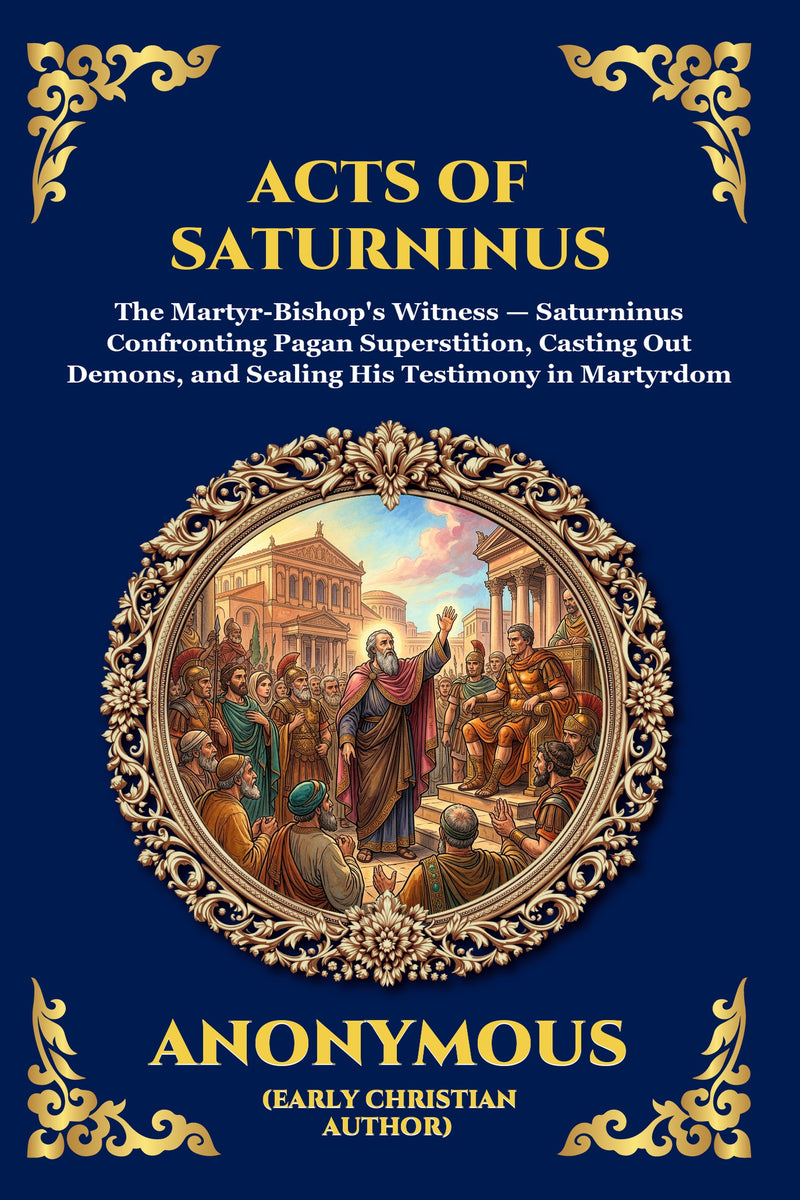
Acts of Saturninus
In 304 AD, Saturninus and his fellow believers defied the Roman Empire by secretly celebrating the Eucharist, risking everything for their hidden faith. Excluded from the canonical Bible, the Acts of Saturninus offers a vivid glimpse into the courage and conviction of early Christians under persecution.
or free app
10,000+ hrs library
30-day guarantee
The complete modern-English translation of the Acts of Saturninus, this early Christian martyrdom account, is readable online with audiobook narration included for members.
The Acts of Saturninus survived centuries of persecution and neglect to become one of Christianity's most vivid martyrdom accounts from the Diocletianic persecution. This ancient text preserves eyewitness testimony that brings readers face-to-face with extraordinary courage under Rome's final systematic assault on the early church.
In the annals of history, few stories possess the raw emotional power and spiritual intensity of the Acts of Saturninus. This meticulously preserved account takes you back to the year 304 AD, into the heat of Roman North Africa, where the Diocletianic Persecution was at its peak. When Saturninus and his fellow believers were discovered celebrating the Eucharist in secret, they weren't just breaking a law—they were challenging the very foundation of Roman authority.
This expanded modern edition brings the ancient text to life, offering a vivid window into the psychological and spiritual battle between the Roman Proconsul Anulinus and the defiant martyrs. It is a story of interrogation, imprisonment, and an unwavering commitment to the "Sunday assemblies" that defined their lives. Through this narrative, readers explore the profound depths of human conviction and the radical bravery required to stand for truth when the cost is everything.
What You’ll Discover in This Modern Translation
- The Heroic Stand of Saturninus and His Companions: Follow the breathtaking account of the martyrs of Abitinae as they face trial with a calm that baffled their executioners.
- The Conflict Between Empire and Faith: Gain a deep understanding of the Roman legal system and the sociopolitical pressure placed upon early Christians to conform to imperial cults.
- A Testament to Spiritual Resilience: Explore the internal strength and theological convictions that allowed these individuals to endure physical suffering without wavering.
- The Origins of Christian Identity: Discover how these "Acts" served as the foundational literature that shaped the courage and liturgy of the early Church.
- Lessons on Moral Courage for the Modern Age: Reflect on timeless principles of integrity, sacrifice, and the importance of standing by one's conscience in the face of overwhelming opposition.
More than just a historical record, Acts of Saturninus is an invitation to witness the birth of a movement that would eventually conquer the empire that sought to destroy it. Whether you are a student of Roman history, a seeker of spiritual depth, or a lover of heroic biographies, this book offers a gripping journey into the soul of the ancient world.
| Formats | eBook (EPUB + PDF) · Audiobook · Paperback · Hardcover · Large Print |
| Language | English |
| Trim size (print) | 6 × 9 in |
| Binding | Paperback — perfect-bound · Hardcover — casewrap |
| Large Print edition | Same text in a larger, easy-read type — a larger font, not a larger trim |
| Print pricing | Every physical book at our true cost — at-cost, no profit (members) |
| Library | 873 restored titles, always growing |
| Length | 4,003 words · ~16 min reading |
| Reading level | Grade 13 · rich, literary prose (this modern-English edition) |
| Edition | Modern English translation · 2026 |
Member reviews for this edition are collected as readers finish it — be the first. Across the library: 12,000+ books shipped, every plan covered by a 365-day print guarantee.
About this edition
The complete, unabridged text in clear modern English — faithful to the original, never simplified. Every paragraph is checked against the source, so nothing is cut, summarised, or paraphrased away. It reads cleanly for today while keeping the original meaning intact.
- Complete & unabridgedVerified paragraph by paragraph against the source — never a scan, never abridged.
- Modern English, faithfulReadable today, with the author’s meaning kept intact. Readable — not simplified.
- Every format, one membershipRead in your browser or the free app, or listen to the full audiobook.
Included free with your membership
Cancel anytime, one click · 30-day money-back guarantee
Edition last updated June 2026
What’s inside
Acts of Saturninus — complete and unabridged: all 5 sections included with membership, plus the full audiobook.
Begin reading Acts of Saturninus
In clear modern English — the complete text is included with membership.
Faith, Empire, and the Courtroom
The courtroom scenes that form the dramatic core of martyrdom accounts like this one are among the most fascinating artifacts of the ancient world. They are, in a sense, the place where two entire civilizations meet and discover that they cannot understand each other. The Roman magistrate, sitting in judgment, is not a monster. He is, typically, a man of education and some humanity, operating within a legal and administrative framework that he did not create and that he may personally find uncomfortable to apply. He offers the accused every opportunity to comply. He explains, sometimes with evident patience, exactly what is required: a pinch of incense, a few words of acknowledgment, a gesture so small that it seems almost meaningless. He cannot comprehend why anyone would choose death over so trivial a concession.
The accused, standing before him, sees the situation entirely differently. For them, the pinch of incense is not a trivial gesture — it is the whole world. It is the question of who you are and what you live for, compressed into a single moment. To offer incense to the emperor's genius or to the gods of Rome is to acknowledge that these powers have a legitimate claim on your ultimate loyalty, and that is precisely what they cannot do. Their God, they believe, is a jealous God — not jealous in a petty human sense, but jealous in the sense that He is the source and ground of all reality, and to pretend otherwise, even in a gesture, even in a form of words, is to participate in a lie so fundamental that it corrupts everything. They would rather die than live within that lie.
This is what makes these texts so philosophically rich and so emotionally powerful. They are not simply stories of heroic suffering — they are explorations of one of the deepest questions human beings face: what are you willing to die for? And the corollary question, just as important: what does it mean to live for something so completely that death becomes preferable to betrayal? These are not abstract questions. They are the questions that define a life, and the men and women in this narrative answer them in the most concrete way possible — with their bodies, in a public place, before witnesses.
The legal framework within which these proceedings took place is worth understanding in some detail. Roman law regarding Christians evolved significantly over the centuries, but certain features remained relatively constant. Christians were not, for most of the empire's history, subject to a specific law that made Christianity itself illegal in the way that, say, certain forms of magic were illegal. Rather, they were prosecuted under a variety of provisions relating to public order, impiety, and the refusal to perform civic religious duties. The famous letter of Pliny the Younger to the Emperor Trajan, written around 112 CE, gives us a remarkable glimpse into how a conscientious Roman official tried to figure out what exactly to do with Christians who came before him. Pliny's uncertainty — his evident discomfort with the whole business — is itself revealing. He was not dealing with a clear-cut legal situation but with a novel social phenomenon that his legal training had not prepared him for.
By the time of the events described in the account of Saturninus, the situation had become somewhat more regularized, but the fundamental dynamic remained the same: a confrontation between an administrative system that demanded compliance and individuals who had placed their compliance elsewhere. The magistrates in these accounts are not, generally, portrayed as sadists — they are portrayed as men doing their jobs, men who would genuinely prefer that the accused simply comply and go home. This makes the drama more interesting, not less. It is easier to resist a monster than to resist a reasonable man who is asking you to do something small. The courage required to face the latter is a different and in some ways more demanding kind of courage.
The community that produced and preserved this account was itself shaped by the experience of persecution in ways that are important to understand. Early Christian communities were not passive recipients of suffering — they actively processed and interpreted their experience, developing a theology of martyrdom that gave meaning to what might otherwise have seemed like pointless tragedy. The martyr, in this theology, was not merely a victim but a witness — the Greek word martys means precisely that, a witness — someone whose death testified to the truth of what they believed. The martyr's suffering was understood as a participation in the suffering of Christ, a completion or fulfillment of the pattern established by the crucifixion. This gave the martyr's death a cosmic significance that transformed it from a defeat into a victory.
This theology is not merely a comforting story told to make sense of senseless deaths. It is a sophisticated and coherent response to a genuine philosophical problem: how do you maintain hope and meaning in the face of overwhelming power? The Roman Empire could kill you. It could take everything you had — your property, your freedom, your life. What it could not do, the martyrs believed, was take what mattered most. And this conviction — that there is something in the human person that power cannot reach, something that belongs to a different order of reality altogether — is one of the most radical and consequential ideas in the history of human thought. It is an idea that has continued to animate resistance movements and sustain individuals under oppression across two millennia, and it is an idea that this ancient text expresses with remarkable force and clarity.
The literary craft of the account deserves recognition as well. The Acta Martyrum as a genre developed its own conventions and techniques, and the best examples of the genre use those conventions with considerable skill. The interrogation scenes are typically structured as a kind of debate, with the magistrate and the accused each articulating their position with increasing clarity and force. The accused's responses often have a quality of almost paradoxical calm — they are not defiant in the way that a political revolutionary might be defiant, full of anger and ideology, but serene in a way that the magistrate finds incomprehensible and that the Christian reader is meant to find inspiring. This serenity is not passivity or resignation — it is the expression of a certainty so complete that external threats have lost their power to disturb it. Whether one shares the theological convictions that underlie this serenity or not, it is impossible not to be moved by it as a human achievement.
Why This Story Still Matters
There is a question that any honest reader of ancient martyrology must eventually confront: why should we care? Not in a dismissive sense — the question is a genuine one. These events occurred nearly two thousand years ago, in a world so different from our own that it sometimes requires an act of imagination bordering on the heroic to bridge the gap. The legal system, the religious framework, the social structures, the very categories of thought that shaped these people's lives — all of it is remote from our experience in ways that go beyond mere historical distance. So what is it that keeps drawing readers back to these texts, century after century? What is it that makes them feel not merely historically interesting but urgently alive?
Part of the answer is simply literary. Good writing survives because it is good writing, because it captures something about human experience with a precision and vividness that transcends its immediate occasion. The best of the martyrdom accounts are genuinely great literature — not great in spite of their religious content but in part because of it, because the extremity of the situation they describe strips away everything inessential and forces both the characters and the reader to confront the most fundamental questions of human existence. What do you believe? What will you do for what you believe? Who are you when everything is taken away? These questions do not age.
But there is more to it than literary quality. The story of Saturninus and his companions speaks to something that remains a live issue in human experience: the conflict between institutional power and individual conscience. The specific form that conflict takes in this narrative — a Roman magistrate demanding religious compliance from Christian believers — is historically specific, but the underlying dynamic is not. Every era has its version of the moment when a person is asked to say something they do not believe, to perform an act that betrays their deepest convictions, to choose between survival and integrity. The details change; the essential structure does not. This is why martyrdom accounts have resonated not only with Christians throughout history but with anyone who has faced the demand to conform at the cost of their soul.
The twentieth century, which produced more martyrs than any previous century in human history — martyrs of every religion and of no religion, people killed for their political beliefs, their ethnic identity, their refusal to collaborate with evil — gave these ancient texts a new and terrible relevance. Readers who had lived through totalitarianism, who had themselves faced interrogation and the demand to inform on their neighbors, who had watched friends and family members disappear into the machinery of the state, found in the Acta Martyrum a mirror for their own experience and a source of sustenance for their own resistance. The specific theology was different, or absent, but the human situation was recognizable: a lone individual standing before the power of the state, being asked to make a small gesture of compliance, and choosing instead to be faithful to something larger than their own survival.
For Christian readers specifically, this text carries an additional weight. It is a document from the earliest centuries of the faith, from a time when Christianity was not a dominant cultural force but a minority movement operating under constant threat. Reading it is a form of connection with the roots of a tradition — a reminder that the faith was not always comfortable, not always culturally sanctioned, not always the religion of the powerful. There is something clarifying about encountering Christianity in this form: stripped of its later institutional grandeur, its theological elaborations, its cultural accretions, reduced to its essential core, which is the willingness of ordinary human beings to stake their lives on the truth of what they believe. Whatever one makes of the theological claims themselves, this willingness is something that commands respect.
The figures in this narrative are also important as historical witnesses in a more straightforward sense. They give us evidence about what early Christianity actually looked like on the ground — not in the texts of theologians and bishops, but in the lives of ordinary believers. What did they think? How did they speak about their faith? What gave them courage? What did they fear? The martyrdom accounts, precisely because they were produced under pressure, in extremis, have a kind of authenticity that more polished literary productions sometimes lack. When someone is about to die, they tend to say what they actually believe rather than what they think they are supposed to believe. This makes these texts invaluable as windows into the inner life of early Christianity.
There is also something to be said about the role of narrative itself in sustaining communities under pressure. The early Christians did not merely experience persecution — they told stories about it. They circulated these accounts among their communities, read them aloud in their gatherings, used them as models and inspirations for their own behavior. The martyrs became exemplars — not distant, impossibly heroic figures, but recognizable human beings who had faced the same fears and temptations as everyone else and had, somehow, found the resources to remain faithful. This is what the genre of martyrdom literature was for: not merely to commemorate the dead but to form the living, to create a community identity rooted in the memory of those who had gone before and the expectation that the same demands might be made of those who came after.
This formative function gives the text a dimension that purely historical reading can miss. It is not only a record of what happened — it is a vision of what human beings are capable of, a testimony to the possibility of a certain kind of greatness that is available not only to the exceptional but to the ordinary. The men and women in this account are not superhuman. They are frightened, as any sane person would be frightened in their situation. They have families and friends and lives they do not want to lose. They are not indifferent to pain or death. What they have is not an absence of fear but a faith that is, in the end, stronger than their fear — and this is presented not as a miraculous exception but as something that any genuine believer might find within themselves when the moment demands it.
As you prepare to enter this narrative, it is worth setting aside, as much as possible, whatever preconceptions you bring to it — whether those preconceptions are religious or secular, sympathetic or skeptical. Try to encounter these people on their own terms, in their own world, facing their own situation. Try to hear the voices of the interrogators with the same attention you give to the voices of the accused — to understand the Roman position not merely as the position of the villain but as a coherent worldview with its own logic and its own values. Try to feel the weight of what is being asked and what is being refused, the enormity of the choice being made in what might seem like a small room in an unremarkable provincial city.
Cancel anytime, one click · 30-day money-back guarantee
Founding annual rate available now — your price locks for life when you join.
Not ready? Get this free chapter by email — read it anytime.
✓ Sent — check your inbox for Acts of Saturninus.
Questions about Acts of Saturninus
Is Acts of Saturninus free to read?
The opening of the text is free to read below. Members read and listen to the complete work — and the entire Lost & Forbidden Library — free.
What is Acts of Saturninus?
Have you ever wondered why a small group of ordinary citizens would choose to face the world’s most powerful empire rather than renounce a hidden faith?
How long is Acts of Saturninus?
5 chapters (~1,492 words) in this restored edition.
Which formats are available?
eBook and audiobook (included with membership), plus paperback, hardcover and large-print editions printed at cost.
Shipping & returns
Billing & membership
More from the library


Explore The Lost & Forbidden Library
- 1 Enoch · Attributed to Enoch
- 1–4 Maccabees · Various Jewish authors
- 2 Baruch · Attributed to Baruch
- 2 Enoch · Attributed to Enoch
- 2 Esdras · Attributed to the prophet Ezra
- 3 Baruch · Attributed to Baruch ben Neriah
- 4 Baruch · Attributed to Baruch ben Neriah
- A Valentinian Exposition · Attributed to a follower of Val...
- Acta Archelai · Attributed to Hegemonius
- Acts of Andrew · Anonymous (Early Christian Apoc...
- Acts of Andrew and Matthias in the City of the Cannibals · Attributed to early Christian a...
- Acts of Barnabas · Attributed to John Mark
- Acts of Bartholomew
- Acts of John · Anonymous (Early Christian Apoc...
- Acts of Matthias · Anonymous early Christian writers
- Acts of Paul · Attributed to an unknown early ...
- Acts of Paul and Thecla · Attributed to Onesiphorus
- Acts of Peter
- Acts of Peter and Andrew · Attributed to various early Chr...
- Acts of Peter and Paul · Attributed to Leucius Charinus
- Acts of Peter and Simon · Attributed to Leucius Charinus
- Acts of Peter and the Twelve Apostles · Attributed to early Christian a...
- Acts of Philip · Anonymous (Early Christian Apoc...
- Acts of Pilate (Gospel of Nicodemus) · Attributed to various early Chr...
- Acts of Thaddaeus · Attributed to Thaddaeus the Apo...
- Acts of Thomas
- Acts of Titus · Anonymous early Christian writer
- Acts of Xanthippe, Polyxena, and Rebecca
- Allogenes · Anonymous (Early Gnostic Mystic)
- Antitheses of Marcion · Attributed to Marcion of Sinope
Acts of Saturninus
Acts of Saturninus
The Inspiring Early Christian Account of Martyrdom – A Powerful True Story of Unbreakable Faith and Defiance Against the Roman Empire
Library of Alexandria Press
Acts of Saturninus
© Copyright 2026 Library of Alexandria Press. All rights reserved.
Published by Library of Alexandria Press
Printed in the United States of America
It is not legal to copy, share, or send any part of this document in either digital or printed form without written permission from the publisher, except short quotes in a book review.
Table of Contents
Introduction
Faith, Empire, and the Courtroom
Why This Story Still Matters
Gathering of the Pagan Crowd at the Capitol
Martyrdom and Burial of Saturninus
Introduction
There are moments in history so charged with human meaning that they refuse to stay buried. They surface again and again across centuries, demanding to be read, to be felt, to be reckoned with. The account you are about to encounter is one of those moments. It is a story about a group of ordinary men and women who were asked a simple question — a question that should, by every calculation of self-interest and survival, have had an obvious answer — and who chose instead to give the one reply that would cost them everything. What they said, and how they said it, and what happened to them because of it, is the subject of this extraordinary document from the earliest centuries of the Christian era.
To read an ancient martyrology is to step into a world that is simultaneously utterly foreign and strikingly familiar. The Roman Empire of the late second and early third centuries was a civilization of breathtaking sophistication. It had roads that stretched from Scotland to Mesopotamia, aqueducts that carried fresh water to cities of half a million people, a legal system of remarkable nuance, and a philosophical culture that produced some of the finest minds in human history. It was also a civilization that could, without particular malice or even much administrative interest, grind individual human beings into dust when they became inconvenient. The machinery of Roman power was not primarily cruel — it was indifferent, and indifference at that scale is its own kind of terror.
Into this world stepped a community of believers whose convictions placed them on a collision course with the imperial order. They were not, for the most part, revolutionaries. They did not seek to overthrow Rome. They paid their taxes, obeyed most of its laws, and lived as neighbors and tradespeople and family members alongside their non-Christian contemporaries. But they held one conviction that the Roman system could not absorb, could not domesticate, and could not ultimately tolerate: they believed that their ultimate loyalty belonged not to Caesar but to a crucified carpenter from an obscure province, and that this loyalty was non-negotiable. When the moment of testing came — and it always came — they had to choose.
The document at the heart of this volume is one of the most vivid and affecting accounts of that choice ever preserved from the ancient world. It belongs to a genre that scholars call the Acta Martyrum, the Acts of the Martyrs — a body of literature that encompasses everything from dry official court records to richly literary narratives of suffering and triumph. Some of these texts are almost certainly verbatim transcripts of actual legal proceedings. Others are pious elaborations, shaped by later hands and theological agendas. Many occupy a fascinating middle ground: rooted in real events and real people, but processed through the memory and devotion of communities who needed these stories to be not merely historical records but living testimonies. Whatever the precise relationship of any given text to the events it describes, the genre as a whole gives us an unparalleled window into the experience of early Christianity under pressure — the texture of daily life, the dynamics of interrogation and resistance, the psychology of faith facing annihilation.
What distinguishes the account of Saturninus and his companions from many others in this genre is a quality that is difficult to name precisely but impossible to miss when you encounter it. Call it immediacy. Call it psychological truth. Call it the stubborn particularity of real human beings refusing to be reduced to symbols. The figures in this narrative are not cardboard saints. They are people — frightened and resolute, confused and clear-eyed, sometimes stumbling and sometimes soaring. Their exchanges with their interrogators crackle with a tension that no amount of time has managed to dissipate. Their moments of doubt and their moments of courage feel earned rather than performed. This is literature that has survived not merely because it was useful to the Church but because it is genuinely, deeply human.
The historical setting deserves some attention before we enter the narrative itself, because context is everything when it comes to understanding what was actually at stake for these individuals. The Roman Empire's relationship with Christianity was complex and varied enormously across time and geography. There were periods of relative tolerance and periods of savage persecution. There were emperors who found the Christians merely annoying and emperors who regarded them as a genuine threat to the social and religious fabric of the empire. There were local officials who enforced anti-Christian edicts with relish and those who did so reluctantly, looking for any excuse to let the accused off the hook. The experience of being a Christian in the Roman Empire was not monolithic — it was a constant negotiation with uncertainty, a life lived in the awareness that the ground could shift at any moment.
What remained constant, however, was the structural tension at the heart of the Christian situation. Roman religion was not, in the modern sense, a matter of private belief. It was a civic practice, a set of public rituals that bound the community together and expressed its relationship to the divine powers that protected and sustained it. To refuse to participate in these rituals was not merely a personal eccentricity — it was a social and political act, a declaration that you stood outside the community, that you did not share its obligations or its loyalties. The Romans were, in general, remarkably tolerant of foreign religions and foreign gods. What they could not tolerate was the refusal to also honor the gods of Rome, because that refusal implied a rejection of the social contract itself. Christians, who insisted that their God was the only God and that the Roman gods were either nonexistent or demonic, could not make even the minimal gesture of public compliance that the empire required. This is why they died.
It is worth pausing on this point, because it is sometimes misunderstood. The Roman persecution of Christians was not, primarily, an expression of religious bigotry in the modern sense. It was an expression of a particular understanding of what society is and what holds it together. The Romans believed — not unreasonably, given the world they lived in — that the gods required propitiation, that the welfare of the community depended on the proper performance of religious duties, and that anyone who refused to participate in those duties was a free rider at best and a dangerous saboteur at worst. From the Roman perspective, the Christians were not being persecuted for their beliefs — they were being prosecuted for their behavior, specifically their refusal to perform the public religious acts that every loyal member of society was expected to perform. The fact that this distinction meant nothing to the Christians themselves, who experienced their beliefs and their behavior as inseparable, is precisely where the tragedy lies.
Gathering of the Pagan Crowd at the Capitol
At that time the true Sun of Righteousness had risen in the darkness and had begun to illuminate the western regions — for gradually, little by little, the sound of the Gospels went out into the whole world, and the preaching of the Apostles, advancing slowly, shone forth in our lands. A few churches were being built in some cities through the devotion of a small number of Christians, while countless temples everywhere sent up the foul smoke of their offerings. By his faith and virtue, the oracles of those demons who were worshipped in this same city began to fall silent; their fabrications were laid bare, their machinations uncovered, and all their power among the pagans, all their deceit, began to wane as the faith of the Christians grew. Because the bishop so often passed the Capitol — which stood between his house and the house of God — on his way to and from the church, which was quite small at that time, the deceitful crowd of demons could not endure the holy man's presence. The statues, overshadowed by no apparitions, stood in silence before the impious worship and the customary prayers of those who came to consult them.
All the priests of that impious superstition, disturbed by so strange and unprecedented a thing, began to ask themselves where this sudden muteness had come upon their gods, and who had shut their ever-babbling mouths — so that, unmoved by the prayers of those who called upon them and uncharmed by the shed blood of bulls and so many sacrifices, the gods refused to give any response to those who consulted them. Were they angry? Were they absent? The priests learned from a certain enemy of our religion that a sect hostile to pagan superstition had arisen, called Christian, and that it was striving to destroy their gods. The bishop of this faith was Saturninus, who passed by the Capitol frequently — it was at the sight of this man that the mouths of their gods were struck with terror and fell silent, and they could not easily be opened again unless an accelerated death removed that bishop from the world.
What unhappy error and blind madness! They heard that this man was a terror to their own gods, that the demons fled from their temples and their shrines when he passed by. Not only did they hear it — they understood it. And yet they would rather kill the man who terrified their idols without even making any threats than honor him. Miserable people, who did not stop to consider that they ought to worship no one more than the one whose servant had authority over their own divinities. For what is more foolish than to fear those who are themselves afraid, and yet not to fear the one who rules over those rulers?
While this eager questioning and astonishment were spreading, a great multitude had gradually gathered, all of them desperately wanting to learn something certain about what was being said, and all of them longing either to win their gods back or to appease them by the sacrifice of so tremendous a victim. At that very moment, the holy Saturninus himself, coming to a solemn service, was recognized by one of that malicious crowd, who cried out: "Look! The adversary of our worship himself — the standard-bearer of the new religion, who preaches the destruction of temples, who despises our gods by calling them demons, whose constant presence prevents us from receiving oracles! Since fate has delivered the very man we need to us at just the right moment, let us take vengeance at once for the injury done to ourselves and to our gods alike! Let our compulsion now force him either to please them by sacrificing, or to gladden them by dying!"
End of the free sample
Keep reading, free
Members read and listen to the complete book — and the entire library. Cancel anytime, one click · 30-day money-back guarantee.