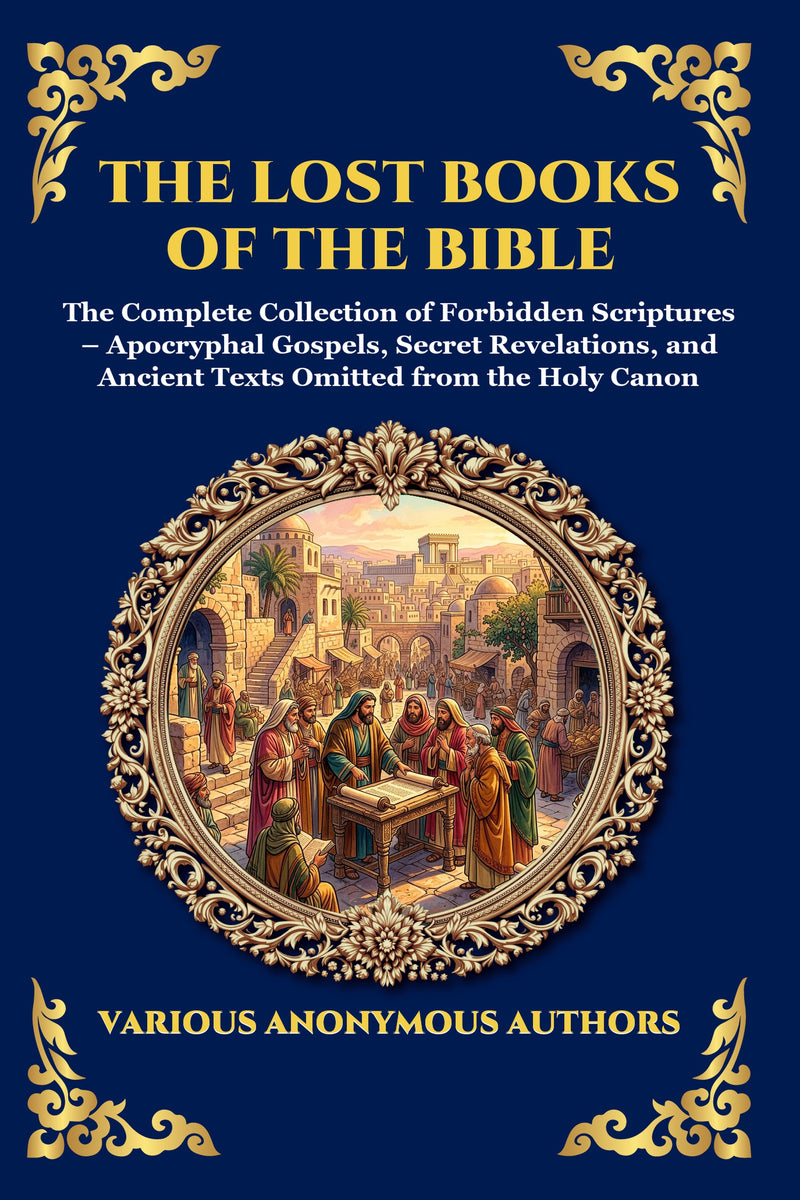
The Lost Books of the Bible
The Lost Books of the Bible were hidden away as the early church solidified its power, excluding texts that challenged its emerging orthodoxy. Buried in sands and concealed in caves, these works remained unread for nearly two thousand years, revealing a forgotten chapter of early Christian history.
or free app
10,000+ hrs library
30-day guarantee
The Lost Books of the Bible presents a complete modern-English translation of early Christian texts excluded from the biblical canon, readable online with audiobook narration included through Library of Alexandria Press membership.
The Lost Books of the Bible reveals the dramatic selection process that determined which sacred texts would survive Christianity's formative centuries and which would be deliberately excluded from the biblical canon.
In The Lost Books of the Bible, you are invited to pull back the curtain on the most significant literary purge in human history. During the early centuries of the Christian era, the followers of "The Way" possessed a vast library of scrolls, letters, and visionary accounts. However, as the institutional church began to solidify its power, a selection process began—one that ultimately excluded dozens of ancient works that did not fit the emerging orthodox narrative. These "Lost Books" were hidden in desert caves, buried in Egyptian sands, or whispered about in secret for millennia, waiting for a generation bold enough to rediscover them.
This comprehensive collection assembles the most profound and provocative of these omitted scriptures. You will step into the Infancy Gospels, which detail the miraculous and sometimes startling childhood of Jesus—stories that were once as popular as the accounts of Matthew or Luke. You will explore the "Protogospel" of James, which provides a detailed history of the Virgin Mary, and delve into the letters of Clement, Polycarp, and Barnabas—men who were the direct successors to the original Apostles. These texts offer a more complex, mystical, and human view of the early Christian movement, revealing the fierce debates and vibrant diversity that existed before the canon was closed.
This modern edition restores these ancient treasures to their rightful place in the historical conversation. Whether you are a student of theology, a seeker of ancient mysteries, or someone who simply wants to know the "untold stories" of the biblical world, this book provides an essential and captivating look at the scriptures that time—and the church—almost forgot.
What You’ll Discover Inside
- The Infancy Gospels — Startling accounts of Jesus as a child, performing miracles long before his adult ministry began.
- The Forgotten Epistles — Essential letters from the Apostolic Fathers like Clement and Polycarp that bridge the gap between the Apostles and the later Church.
- Secret Revelations and Visions — Apocalyptic texts and mystical journeys that offer a different view of the afterlife and divine judgment.
- The Gospel of Nicodemus and the Acts of Pontius Pilate — Ancient attempts to provide a more detailed look at the trial and resurrection of Christ.
- A Window into the Forbidden — Insight into why these texts were excluded from the official Bible and the impact they had on early believers.
Whether you are exploring this work for its immense historical value, its role in the development of early thought, or its spiritual intrigue, The Lost Books of the Bible offers an unforgettable journey into the heart of a marginalized faith.
Uncover the forbidden history of the faith. Begin your journey into the lost scriptures today.
| Formats | eBook (EPUB + PDF) · Audiobook · Paperback · Hardcover · Large Print |
| Language | English |
| Trim size (print) | 6 × 9 in |
| Binding | Paperback — perfect-bound · Hardcover — casewrap |
| Large Print edition | Same text in a larger, easy-read type — a larger font, not a larger trim |
| Print pricing | Every physical book at our true cost — at-cost, no profit (members) |
| Library | 873 restored titles, always growing |
| Composed | 1st-4th centuries AD |
| Original language | Greek, Coptic, and Latin |
| Source tradition | Various traditions including Nag Hammadi codices, Greek papyri, and medieval manuscript collections |
| Translation basis | Public-domain scholarly translations, rendered in clear modern English |
| Length | 122,053 words · ~8 hr 8 min reading |
| Reading level | Grade 9 · clear and comfortable (this modern-English edition) |
| Edition | Modern English translation · 2026 |
Member reviews for this edition are collected as readers finish it — be the first. Across the library: 12,000+ books shipped, every plan covered by a 365-day print guarantee.
About this edition
The complete, unabridged text in clear modern English — faithful to the original, never simplified. Every paragraph is checked against the source, so nothing is cut, summarised, or paraphrased away. It reads cleanly for today while keeping the original meaning intact.
This collection draws from various manuscript traditions including Nag Hammadi codices, Greek papyri, and Latin manuscripts. Based on standard public-domain scholarly translations, this edition renders these early Christian writings in clear modern English.
- Complete & unabridgedVerified paragraph by paragraph against the source — never a scan, never abridged.
- Modern English, faithfulReadable today, with the author’s meaning kept intact. Readable — not simplified.
- Every format, one membershipRead in your browser or the free app, or listen to the full audiobook.
Included free with your membership
Cancel anytime, one click · 30-day money-back guarantee
Edition last updated June 2026
What’s inside
The Lost Books of the Bible — complete and unabridged: all 120 sections included with membership, plus the full audiobook.
Begin reading The Lost Books of the Bible
In clear modern English — the complete text is included with membership.
Chapter I: Origins and Virtues of Mary's Parents
The blessed and ever glorious Virgin Mary, sprung from the royal race and family of David, was born in the city of Nazareth and educated at Jerusalem, in the temple of the Lord.
Her father's name was Joachim, and her mother's Anna. Her father's family was from Galilee and the city of Nazareth. Her mother's family was from Bethlehem.
Their lives were straightforward and upright in the sight of the Lord, devout and blameless before men. They divided all their possessions into three parts:
One part they devoted to the temple and its ministers; another they distributed among strangers and those in poor circumstances; and the third they kept for themselves and the needs of their own household.
In this way they lived for about twenty years, chastely, in the favor of God and the esteem of men, yet without any children.
Joachim's Humiliation at the Temple
They had vowed, however, that if God should bless them with a child, they would dedicate it to the service of the Lord. For this reason they went to the temple at every feast throughout the year. When the feast of the dedication drew near, Joachim went up to Jerusalem with some others of his tribe. The high priest at that time was Issachar.
When Issachar saw Joachim among the rest of his neighbors bringing his offering, he despised both the man and his gift, and demanded to know why a man who had no children would presume to appear among those who had. He added that Joachim's offerings could never be acceptable to God, since God had clearly judged him unworthy to have children — for Scripture says, Cursed is everyone who does not beget a male child in Israel.
He went on to say that Joachim ought first to free himself from that curse by producing offspring, and only then come before God with his offerings.
Joachim was deeply humiliated by this rebuke and withdrew to the shepherds who were out in the pastures with their flocks.
He had no wish to return home, for fear that his neighbors, who had been present and heard everything the high priest said, would subject him to the same public shame.
Chapter II: Angel Appears to Joachim in Light
But when he had been there for some time, on a certain day when he was alone, the angel of the Lord stood before him in a blaze of brilliant light.
Angel's Message of Barrenness Overcome
Joachim was shaken by the sight, and the angel, seeking to calm him, said:
Do not be afraid, Joachim, and do not be troubled by what you see, for I am an angel of the Lord, sent to you by him to let you know that your prayers have been heard and your acts of charity have risen before God.
For he has truly seen your shame, and heard the unjust reproach laid against you for having no children. God is the avenger of sin, not of nature.
And so when he closes the womb of any person, he does so for this reason: that he may open it again in a more wonderful manner, and that the child who is born may be seen not as the product of mere desire, but as the gift of God.
Consider Sarah, the first mother of your nation — was she not barren until her eightieth year? And yet in the very end of her old age she bore Isaac, through whom the promise became a blessing to all nations.
Rachel also, so greatly favored by God and so dearly loved by the holy Jacob, remained barren for a long time, yet afterward became the mother of Joseph, who was not only governor of Egypt but saved many nations from perishing with hunger.
Among the judges, who was more valiant than Samson, or more holy than Samuel? And yet both their mothers were barren.
If reason alone will not convince you of the truth of my words — that conception often comes in advanced years, and that those who were barren have brought forth children to their own astonishment — then hear this: your wife Anna shall bear you a daughter, and you shall call her Mary.
She shall, according to your vow, be devoted to the Lord from her infancy, and shall be filled with the Holy Spirit from her mother's womb.
She shall eat or drink nothing that is unclean, nor shall she live her life out among the common people, but in the temple of the Lord, so that she may not fall under any slander or suspicion of wrongdoing.
And so, as she shall be born in a miraculous manner to a woman who was barren, so she herself, while still a virgin and in a way without parallel, shall bring forth the Son of the Most High God. He shall be called Jesus, and, according to the meaning of his name, shall be the Savior of all nations.
And this shall be a sign to you of everything I have declared: when you come to the Golden Gate of Jerusalem, you will meet your wife Anna there. She has been deeply distressed at your long absence, but she will rejoice when she sees you.
When the angel had said this, he departed from him.
Chapter III: Angel's Annunciation to Anna of Mary's Birth
Afterwards the angel appeared to Anna, his wife, and said: Do not be afraid, and do not think that what you see is a spirit.
For I am the angel who has offered up your prayers and alms before God, and I am now sent to you to tell you that a daughter will be born to you. She shall be called Mary, and shall be blessed above all women.
From the very moment of her birth she will be full of the grace of the Lord. She will spend the three years of her weaning in her father's house, and after that, being devoted to the service of the Lord, she shall not depart from the temple until she reaches the age of discretion.
In short, she shall serve the Lord there night and day in fasting and prayer, shall abstain from every unclean thing, and shall never know any man.
Yet, being a wholly unique instance, untouched by any pollution or defilement, a virgin who has known no man, she shall bring forth a son. A maiden shall bring forth the Lord, who by his grace, his name, and his works shall be the Saviour of the world.
Rise therefore, and go up to Jerusalem. When you come to the gate called the Golden Gate, so named because it is gilded with gold, you shall meet your husband there as a sign of what I have told you — he for whose safety you have been so deeply concerned.
When you find these things fulfilled just as I have said, believe that everything else I have told you will also come to pass without fail.
Fulfillment of the Angel's Promise
In obedience to the angel's command, both of them set out from the places where they were, and when they arrived at the spot the angel had foretold, they met each other.
Rejoicing at the vision each had received, and fully assured of the promise of a child, they gave heartfelt thanks to the Lord, who lifts up the humble.
After praising the Lord, they returned home and lived in cheerful and confident expectation of God's promise.
And so Anna conceived and brought forth a daughter, and, as the angel had commanded, her parents named her Mary.
Chapter IV: Temple Setting and Stairway Description
When three years had passed and the time of her weaning was complete, they brought the Virgin to the temple of the Lord with offerings.
Around the temple there were fifteen stairs to ascend, corresponding to the fifteen Psalms of Degrees. Because the temple was built on a mountain, the altar of burnt offering, which stood outside, could only be reached by climbing these stairs.
Mary's Ascent and Presentation in the Temple
The parents of the blessed infant Mary set her down on the first of these stairs. While they were removing the clothes they had traveled in and putting on cleaner garments, as was the custom, the Virgin of the Lord climbed all the stairs one after another entirely on her own, without anyone to lead her or lift her, in such a way that anyone watching would have thought her a child of much greater age.
Thus the Lord, even in the infancy of his Virgin, worked this extraordinary deed, and by this miracle gave evidence of how great she was destined to become.
When the parents had offered their sacrifice according to the custom of the law and fulfilled their vow, they left the Virgin in the temple apartments with the other virgins who were being raised there, and they returned home.
Chapter V: Betrothal of Mary and Joseph
Among the men there was one named Joseph, of the house and family of David, a man of considerable age, who kept back his rod when the rest brought theirs, so that he alone was without one.
When nothing miraculous appeared in response to the others, the high priest consulted God a second time, and God answered that the one who had kept back his rod was the very man to whom the Virgin should be betrothed. So Joseph was identified.
For when his rod was at last brought forward and he held it in his hand, a dove came down from heaven and settled on the top of it. From this sign it was clear to all that Mary was to be betrothed to Joseph.
After the usual ceremonies of betrothal were completed, Joseph returned to his own city of Bethlehem to set his house in order and make the necessary preparations for the marriage. But Mary returned to her parents' house in Galilee.
Angel Gabriel's Annunciation to Mary
From the time of her betrothal, the Angel Gabriel was sent to her by God, to announce to her the conception of the Lord, and to explain to her the manner and order of it.
Now in those days, as Mary was alone, an angel appeared to her in a visible form and greeted her, saying: Hail, Mary, full of grace, the Lord is with you. You are blessed among women, and blessed is the fruit of your womb.
When she heard these words she was troubled, and asked herself what this greeting could mean. And the angel, who had appeared to her, comforted her and said: Fear not, Mary, for you have found favor with God. Behold, you shall conceive and bear a son, and he shall be called Jesus, for he shall save his people from their sins.
Then Mary said to the angel: How can this be, since I have vowed my virginity to the Lord and have never known a man? The angel answered her: The Holy Spirit shall come upon you, and the power of the Most High shall overshadow you; therefore the holy child born of you shall be called the Son of God. And behold, your cousin Elizabeth has also conceived a son in her old age, and this is now the sixth month with her who was called barren, for with God nothing is impossible.
Then Mary stretched out her hands and lifted her eyes to heaven and said: Behold the handmaid of the Lord; let it be done to me according to your word.
Chapter VI: Joseph's Rod and the Heavenly Sign
Among the rest there was a man named Joseph, of the house and family of David, a man very far advanced in years, who held back his rod when everyone else presented theirs.
When nothing appeared that matched the heavenly voice, the high priest judged it right to consult God again.
God answered that the man to whom the Virgin was to be betrothed was the only one among those gathered who had not brought forward his rod.
Joseph was thus revealed.
Betrothal Completed and Parties Depart
For when he did bring his rod, a dove came down from Heaven and settled on the top of it, and everyone could plainly see that the Virgin was to be betrothed to him.
Accordingly, when the customary betrothal ceremonies were completed, he returned to his own city of Bethlehem to set his house in order and make the necessary preparations for the marriage.
But the Virgin of the Lord, Mary, together with seven other virgins of the same age who had been weaned at the same time and appointed by the priest to attend her, returned to her parents' house in Galilee.
Chapter VII: Angel Sent to Mary in Galilee
Now at this time, during her first coming into Galilee, the angel Gabriel was sent to her from God to announce the conception of our Saviour and to explain the manner in which she would conceive him.
The Annunciation Dialogue and Mary's Consent
He entered her chamber and filled it with a brilliant light, then greeted her with great courtesy, saying:
Hail, Mary! Virgin most favored by the Lord! O Virgin full of grace! The Lord is with you. You are blessed above all women, blessed above all people who have ever been born.
But the Virgin, who had long been familiar with the appearance of angels and to whom such heavenly light was no strange thing, was neither frightened by the vision of the angel nor overwhelmed by the greatness of the light. She was troubled only by the angel's words.
Cancel anytime, one click · 30-day money-back guarantee
Founding annual rate available now — your price locks for life when you join.
Not ready? Get this free chapter by email — read it anytime.
✓ Sent — check your inbox for The Lost Books of the Bible.
Questions about The Lost Books of the Bible
Why were these books excluded from the Bible?
The Lost Books of the Bible contains texts that were not included in the biblical canon as it developed in the early centuries of Christianity. Church councils selected texts based on apostolic authorship, orthodox theology, and widespread acceptance among Christian communities.
What kinds of texts are included in this collection?
The Lost Books of the Bible includes gospels, acts, epistles, and apocalyptic writings attributed to various apostles and early Christian figures. These texts offer insights into the diversity of early Christian thought and practice beyond the canonical scriptures.
Are these texts considered authentic by scholars?
Most texts in The Lost Books of the Bible are considered pseudepigraphic by mainstream scholars, meaning they were written later than their claimed authorship dates. They remain valuable for understanding early Christian communities and theological development.
Is The Lost Books of the Bible free to read?
The opening of the text is free to read below. Members read and listen to the complete work — and the entire Lost & Forbidden Library — free.
What is The Lost Books of the Bible?
Have you ever wondered why certain sacred texts were deemed "too dangerous" for the public to read for nearly two thousand years? In The Lost Books of the Bible, you are invited to pull back the curtain on the most significant literary purge in human history.
How long is The Lost Books of the Bible?
171 chapters (~122,509 words) in this restored edition.
Shipping & returns
Billing & membership
More from the library


Explore The Lost & Forbidden Library
- 1 Enoch · Attributed to Enoch
- 1–4 Maccabees · Various Jewish authors
- 2 Baruch · Attributed to Baruch
- 2 Enoch · Attributed to Enoch
- 2 Esdras · Attributed to the prophet Ezra
- 3 Baruch · Attributed to Baruch ben Neriah
- 4 Baruch · Attributed to Baruch ben Neriah
- A Valentinian Exposition · Attributed to a follower of Val...
- Acta Archelai · Attributed to Hegemonius
- Acts of Andrew · Anonymous (Early Christian Apoc...
- Acts of Andrew and Matthias in the City of the Cannibals · Attributed to early Christian a...
- Acts of Barnabas · Attributed to John Mark
- Acts of Bartholomew
- Acts of John · Anonymous (Early Christian Apoc...
- Acts of Matthias · Anonymous early Christian writers
- Acts of Paul · Attributed to an unknown early ...
- Acts of Paul and Thecla · Attributed to Onesiphorus
- Acts of Peter
- Acts of Peter and Andrew · Attributed to various early Chr...
- Acts of Peter and Paul · Attributed to Leucius Charinus
- Acts of Peter and Simon · Attributed to Leucius Charinus
- Acts of Peter and the Twelve Apostles · Attributed to early Christian a...
- Acts of Philip · Anonymous (Early Christian Apoc...
- Acts of Pilate (Gospel of Nicodemus) · Attributed to various early Chr...
- Acts of Saturninus
- Acts of Thaddaeus · Attributed to Thaddaeus the Apo...
- Acts of Thomas
- Acts of Titus · Anonymous early Christian writer
- Acts of Xanthippe, Polyxena, and Rebecca
- Allogenes · Anonymous (Early Gnostic Mystic)
The Lost Books of the Bible
The Lost Books of the Bible
The Complete Collection of Forbidden Scriptures – Apocryphal Gospels, Secret Revelations, and Ancient Texts Omitted from the Holy Canon
Library of Alexandria Press
The Lost Books of the Bible
© Copyright 2026 Library of Alexandria Press. All rights reserved.
Published by Library of Alexandria Press
Printed in the United States of America
It is not legal to copy, share, or send any part of this document in either digital or printed form without written permission from the publisher, except short quotes in a book review.
Table of Contents
Introduction
Chapter I
Chapter II
Chapter III
Chapter IV
Chapter V
Chapter VI
Chapter VII
Chapter VIII
Chapter I
Chapter II
Chapter III
Chapter IV
Chapter V
Chapter VI
Chapter VII
Chapter VIII
Chapter IX
Chapter X
Chapter XI
Chapter XII
Chapter XIII
Chapter XIV
Chapter XV
Chapter XVI
Chapter I
Chapter II
Chapter III
Chapter IV
Chapter V
Chapter VI
Chapter VII
Chapter VIII
Chapter IX
Chapter X
Chapter XI
Chapter XII
Chapter XIII
Chapter XIV
Chapter XV
Chapter XVI
Chapter XVII
Chapter XVIII
Chapter XIX
Chapter XX
Chapter XXI
Chapter XXII
Chapter I
Chapter II
Chapter III
Chapter IV
Chapter I
Chapter II
Chapter I
Chapter II
Chapter III
Chapter IV
Chapter V
Chapter VI
Chapter VII
Chapter VIII
Chapter IX
Chapter X
Chapter XI
Chapter XII
Chapter XIII
Chapter XIV
Chapter XV
Chapter XVI
Chapter XVII
Chapter XVIII
Chapter XIX
Chapter XX
Chapter XXI
Chapter XXII
Chapter I
Chapter II
Chapter III
Chapter IV
Chapter V
Chapter VI
Chapter VII
Chapter VIII
Chapter IX
Chapter X
Chapter XI
Chapter XII
Chapter XIII
Chapter XIV
Chapter I
Chapter II
Chapter III
Chapter IV
Chapter V
Chapter VI
Chapter VII
Chapter VIII
Chapter IX
Chapter X
Chapter XI
Chapter I
Chapter II
Chapter III
Chapter IV
Chapter V
Chapter VI
Chapter VII
Chapter VIII
Chapter IX
Chapter X
Chapter XI
Chapter XII
Chapter XIII
Chapter XIV
Chapter XV
Chapter XVI
Chapter XVII
Chapter XVIII
Chapter XIX
Chapter XX
Chapter XXI
Chapter XXII
Chapter XXIII
Chapter XXIV
Chapter I
Chapter II
Chapter III
Chapter IV
Chapter V
Chapter I
Chapter II
Chapter III
Chapter IV
Chapter V
Chapter VI
Chapter VII
Chapter VIII
Chapter IX
Chapter X
Chapter XI
Chapter XII
Chapter XIII
Chapter XIV
Chapter XV
Chapter I
Chapter II
Chapter III
Chapter IV
Chapter I
Chapter II
Chapter III
Chapter IV
Chapter I
Chapter II
Chapter III
Chapter I
Chapter II
Chapter III
Chapter I
Chapter II
Chapter III
Chapter I
Chapter II
Chapter III
Chapter I
Chapter II
Chapter III
Chapter I
Chapter II
Chapter III
Chapter IV
Introduction
There is something profoundly human about the desire to know what has been hidden. From the moment we are told that a door is locked, we want to know what lies behind it. From the moment we are warned that certain knowledge is dangerous, we feel an almost irresistible pull toward it. This instinct — ancient, persistent, and deeply wired into our nature — is precisely what makes the subject of this collection so compelling. The texts gathered within these pages were not lost by accident. They were set aside, suppressed, debated, condemned, or simply forgotten over the course of centuries, and the story of why that happened is as fascinating and as consequential as anything contained within the texts themselves.
Christianity, as the world knows it today, is built upon a canon — a carefully defined and officially sanctioned collection of writings that the Church has declared to be divinely inspired, authoritative, and complete. The Bible as most people encounter it, whether in a hotel nightstand drawer, a family heirloom passed down through generations, or a digital app on a smartphone, represents the product of centuries of theological debate, political maneuvering, cultural filtering, and genuine spiritual discernment. It is a remarkable document. But it is not the whole story. It never was.
In the earliest centuries of the Christian movement, the landscape of sacred writing was dramatically more diverse than most modern believers realize. Communities of followers spread across the Mediterranean world — in Alexandria and Antioch, in Rome and Carthage, in the deserts of Egypt and the hills of Syria — each nurtured their own traditions, their own stories about Jesus, their own accounts of the apostles, their own visions and revelations. They read texts that would later be excluded. They venerated writings that would eventually be labeled heretical. They passed down gospels, epistles, apocalypses, and wisdom literature that described a spiritual world far stranger, far richer, and in many ways far more psychologically complex than the version that ultimately prevailed.
This was not a fringe phenomenon. Many of the texts collected here were read aloud in early Christian worship services. Some were quoted by Church Fathers who would later be recognized as pillars of orthodox Christianity. Others circulated alongside the letters of Paul and the four canonical gospels for generations before councils and bishops began the slow, contested process of drawing firm lines between what was Scripture and what was not. The process of canonization — of deciding which books belonged in the Bible — was neither swift nor simple. It unfolded over several centuries, shaped by theological controversy, imperial politics, and the urgent practical need of a growing institution to define itself against internal division and external threat.
What you hold in your hands, then, is a window into the world that existed before those lines were drawn — or rather, a window into the texts that survived after the lines had excluded them. Some of these writings are genuinely ancient, dating to the first and second centuries of the Common Era, composed by communities who believed themselves to be transmitting authentic traditions about Jesus and his disciples. Others are later elaborations, pious fictions, or spiritual allegories that drew on the imagery and vocabulary of early Christianity to explore questions the canonical texts left unanswered. All of them, regardless of their historical origin or theological status, tell us something essential about the human hunger for meaning, for mystery, and for a direct encounter with the divine.
To read these texts with an open mind is not to abandon faith, nor is it to undermine the authority of any particular religious tradition. It is, rather, to engage with the full breadth of human spiritual experience in the ancient world. Scholars, theologians, historians, and curious readers of every background have found in these pages material that challenges, enriches, and sometimes radically reframes their understanding of early Christianity. The questions these texts raise — about the nature of Jesus, about the role of women in the early church, about the relationship between knowledge and salvation, about the structure of the cosmos and the fate of the soul — are not antiquarian curiosities. They are questions that remain alive and urgent in our own time.
Consider, for a moment, what it means to encounter a gospel that was not written by Matthew, Mark, Luke, or John. The Gospel of Thomas, for instance, presents a Jesus who speaks almost entirely in cryptic, paradoxical sayings — a teacher of hidden wisdom who tells his disciples that the kingdom of heaven is spread out upon the earth, but people do not see it. There is no nativity story, no passion narrative, no resurrection account. There is only the voice of a teacher pressing his students toward a kind of radical self-knowledge that sounds, at times, more like Zen Buddhism or Platonic philosophy than the Christianity of Sunday morning sermons. And yet scholars have argued, with considerable force, that some of the sayings preserved in Thomas may be among the earliest recorded words attributed to the historical Jesus — older, perhaps, than anything in the canonical gospels.
Or consider the Gospel of Mary Magdalene, a fragmentary but astonishing text that presents Mary not as a repentant sinner or a passive witness, but as the disciple closest to Jesus, the one to whom he revealed teachings too advanced for the others to receive. In this text, it is Peter who is skeptical and resistant, and Mary who must defend the legitimacy of her spiritual authority against his challenge. For anyone who has ever wondered about the role of women in the earliest Christian communities — and about the forces that shaped the exclusively male priesthood of later centuries — this text offers evidence that the story was once far more complicated, and far more contested, than official history suggests.
These are not isolated examples. Across the full range of texts gathered here, patterns emerge that collectively paint a portrait of early Christianity as a movement characterized by extraordinary diversity, fierce internal debate, and a restless, searching quality that the later institutional church would work hard to contain. The Gnostic gospels discovered at Nag Hammadi in 1945 — perhaps the most significant archaeological find in the history of biblical scholarship — revealed an entire world of Christian thought that had been effectively buried for sixteen hundred years. The Secret Book of John, the Gospel of Philip, the Gospel of Truth, the Hypostasis of the Archons — these texts describe a cosmos populated by divine emanations, a creator god who is not the supreme deity but a flawed and arrogant lesser being, and a path to salvation that runs not through faith and sacrament but through gnosis, the Greek word for knowledge — a direct, experiential apprehension of one's own divine nature.
The discovery at Nag Hammadi was not the only such revelation. The Dead Sea Scrolls, found beginning in 1947 in the caves above the Qumran settlement near the Dead Sea, shed extraordinary light on the Jewish world from which Christianity emerged, preserving texts that illuminate the apocalyptic ferment, the messianic expectation, and the sectarian diversity that characterized Judaism in the centuries immediately before and after the birth of Jesus. Other texts — the Book of Enoch, the Apocalypse of Abraham, the Testament of the Twelve Patriarchs — had never been entirely lost, preserved in Ethiopian, Slavonic, or Armenian Christian traditions that developed along different lines from the Latin and Greek churches of the West. Still others survived only in fragments, quotations embedded in the works of theologians who cited them in order to refute them, preserving the very words they sought to suppress.
The story of how these texts came to be excluded from the canon is, in itself, a story worth telling at length. It is a story that involves some of the most consequential decisions ever made in the history of Western civilization, decisions made by specific human beings in specific historical circumstances, under pressures that were as much political and social as they were theological. Understanding that story does not require one to conclude that the canonical Bible is therefore invalid or untrustworthy. But it does require one to recognize that the Bible is a human document as well as a sacred one — that the hands and minds that shaped it were fallible, that the process by which it was assembled was contingent and contested, and that the voices it excludes are not thereby silenced forever.
The Making and Unmaking of Sacred Texts
To understand why these texts were excluded, one must first understand the world in which the question of exclusion arose. The first followers of Jesus did not sit down immediately after the crucifixion and begin writing gospels. For decades, the tradition was primarily oral — stories told and retold in communities of believers, shaped by the needs of worship, the demands of missionary preaching, and the ongoing experience of living in expectation of an imminent divine transformation of the world. When writing did begin, it arose organically, in response to specific situations and communities, and it produced a literature of remarkable variety.
Paul's letters, the earliest documents in the New Testament, were written in the 50s of the Common Era, perhaps twenty years after the death of Jesus. They were not intended as Scripture. They were pastoral correspondence, responses to crises and questions in specific communities. The idea that they would one day be bound together with a collection of gospels and apocalypses and read as the word of God would have astonished their author. The gospels themselves — Mark, almost certainly the earliest, written around 70 CE; Matthew and Luke, drawing on Mark and on a now-lost source scholars call Q; John, the most theologically elaborate, composed perhaps as late as 100 CE — were similarly occasional documents, written for particular communities at particular moments of crisis and transformation.
But alongside these texts that would eventually achieve canonical status, dozens of other documents were circulating. The Didache, a short manual of church practice and ethics, was read as Scripture in some communities. The Shepherd of Hermas, a lengthy apocalyptic vision, was included in some early canonical lists. The Epistle of Barnabas was accepted by some churches as authentic apostolic teaching. The First Epistle of Clement, written from the church at Rome to the church at Corinth, carried enormous authority in the early centuries. None of these texts made it into the final canon. Others that did make it — the Epistle of Jude, the Second Epistle of Peter, the Revelation of John — were contested for centuries, accepted by some churches and rejected by others.
The process of canonization accelerated dramatically in the second century, driven largely by the challenge posed by a figure named Marcion. A wealthy shipowner from Pontus who arrived in Rome around 140 CE, Marcion proposed a radically simplified Christian canon: ten letters of Paul and a version of the Gospel of Luke, with all references to the Jewish God and the Hebrew Scriptures removed. Marcion's theology was stark and dualistic — the God of the Old Testament was a different, lesser deity from the Father of Jesus Christ, and Christianity represented a complete break from Judaism. The mainstream church rejected Marcion's theology vigorously, but his challenge forced church leaders to think seriously about which texts were authoritative and why. In a very real sense, the orthodox canon was assembled partly in response to Marcion's attempt to create one.
The other great catalyst for canonization was the explosion of Gnostic Christianity in the second century. Groups led by teachers like Valentinus, Basilides, and their followers produced an enormous quantity of new texts — gospels, epistles, apocalypses, and cosmological treatises — claiming apostolic authority for their teachings. The mainstream church, increasingly concerned with establishing clear lines of authority and doctrinal uniformity, needed a way to distinguish authentic tradition from innovation. The appeal to a fixed canon of authoritative texts, alongside the authority of bishops who stood in a line of succession from the apostles, became the primary mechanism for making that distinction.
By the end of the second century, the broad outlines of the New Testament canon were beginning to take shape. Irenaeus of Lyon, writing around 180 CE, argued forcefully for the four canonical gospels and against the proliferation of Gnostic gospels, using an elaborate cosmological argument — there are four winds, four corners of the earth, four living creatures in the vision of Ezekiel, and therefore there must be four gospels. The argument is not, by modern standards, compelling. But it reveals the rhetorical energy being invested in the project of defining the boundaries of legitimate Christian Scripture.
The process continued through the third and fourth centuries, shaped by the needs of a church that was growing rapidly, facing periodic persecution, and then, after the conversion of Emperor Constantine in 312 CE, suddenly finding itself in an entirely new relationship with imperial power. Constantine's decision to favor Christianity transformed the church's situation overnight. Where bishops had previously operated as leaders of minority communities, they now found themselves wielding influence at the highest levels of the Roman state. The Council of Nicaea in 325 CE, convened by Constantine himself, addressed the most pressing theological controversy of the day — the Arian dispute over the nature of Christ — and set a precedent for the use of imperial authority to enforce theological conformity.
In this new environment, the question of which texts were authoritative became more urgent than ever. Athanasius, the bishop of Alexandria, issued a famous Easter letter in 367 CE in which he listed the twenty-seven books of the New Testament exactly as they appear in modern Bibles, declaring them to be the complete and exclusive canon of Christian Scripture. This was not the first such list, and it was not immediately accepted everywhere, but it represents a crucial moment of crystallization. The texts that Athanasius excluded — and he was explicit that certain texts were to be rejected — were not simply to be set aside. They were, in some cases, to be actively suppressed.
It is almost certainly no coincidence that the Nag Hammadi library — that extraordinary cache of Gnostic texts discovered in the Egyptian desert in 1945 — appears to have been buried around the time of Athanasius's letter. Someone, almost certainly a monk or group of monks from a nearby monastery, took the trouble to seal these texts in a large clay jar and bury them in the hillside rather than destroy them. We cannot know their motivations with certainty. Perhaps they were preserving texts they valued against the threat of destruction. Perhaps they were disposing of texts that their superiors had ordered eliminated. Whatever the reason, their act of burial became, sixteen centuries later, an act of inadvertent preservation, returning to the world a library of suppressed voices that the official church had done its best to silence.
The texts that survived outside the Nag Hammadi find did so through a variety of routes. Some were preserved by Christian communities — in Ethiopia, in Syria, in Armenia, in Egypt — that developed along different lines from the Roman church and maintained different canons. The Ethiopian Orthodox Church, for instance, includes the Book of Enoch in its canon — a text that was enormously influential in the period immediately before and after the birth of Christianity, quoted in the canonical Epistle of Jude, and apparently known to the authors of several New Testament books, but excluded from the canons of both the Catholic and Protestant traditions. The Syriac churches preserved their own traditions, including texts and versions of texts that differ significantly from the Greek and Latin manuscripts that formed the basis of Western Christianity.
Others survived because they were too popular to suppress entirely. The Infancy Gospel of Thomas — not to be confused with the Gnostic Gospel of Thomas — which describes the childhood miracles of Jesus, including a disturbing episode in which the young Jesus strikes dead a child who bumps into him, and another in which he brings clay sparrows to life, circulated widely throughout the medieval period and left its mark on Islamic tradition, where a version of the story of the clay birds appears in the Quran. The Protevangelium of James, which tells the story of Mary's miraculous birth and childhood and provides the names of her parents, Joachim and Anna, became the foundation for an entire tradition of Marian devotion that shaped Catholic and Orthodox piety for centuries, even though the text itself was never admitted to the canon.
Still others survived as fragments, preserved in the quotations of their opponents. We know about the Gospel of the Hebrews, the Gospel of the Egyptians, the Gospel of the Ebionites, and several other lost gospels primarily because early Church Fathers quoted them — usually in order to refute them. There is a painful irony in this: the very act of condemnation became the mechanism of preservation. The heresiologists, the ancient heresy-hunters who devoted their careers to cataloguing and refuting deviant beliefs, inadvertently created an archive of the diversity they sought to eliminate.
Why These Texts Still Matter
It would be easy, having traced the historical process by which these texts were excluded, to treat them as merely historical curiosities — artifacts of a road not taken, interesting to scholars but irrelevant to anyone seeking spiritual sustenance or theological insight in the present day. That would be a profound mistake. The texts gathered in this collection matter for reasons that go far beyond their historical significance, and the reader who approaches them with genuine openness is likely to find that they speak to contemporary concerns with startling directness.
Consider the question of spiritual experience. One of the most consistent themes across the excluded texts — particularly those with Gnostic or mystical orientations — is the possibility of a direct, unmediated encounter with the divine. The canonical New Testament certainly contains mystical elements; Paul's accounts of being caught up to the third heaven, John's Gospel with its language of abiding in the divine love, the Book of Revelation with its overwhelming visionary imagery. But the excluded texts often push further, describing in elaborate detail the architecture of the spiritual universe, the nature of the divine light, and the inner transformation that comes with genuine spiritual awakening. For readers who have found the institutional church too focused on external observance and too suspicious of inner experience, these texts offer a tradition of Christian mysticism that is both ancient and radical.
The question of women's spiritual authority, already touched on in the context of the Gospel of Mary Magdalene, runs through many of these texts in ways that are impossible to ignore. The canonical New Testament contains both passages that affirm women's spiritual equality — Paul's declaration in Galatians that there is neither male nor female in Christ — and passages that have been used to restrict women's roles in the church. The excluded texts, taken as a whole, suggest that the earliest Christian communities were considerably more diverse in their practices regarding gender and authority than the later institutional church would acknowledge. The Gnostic traditions, in particular, often assigned positive spiritual significance to the feminine principle, spoke of the Holy Spirit in feminine terms, and portrayed women like Mary Magdalene and Salome as recipients of advanced spiritual teaching. Whether one reads these texts as historical evidence of actual early practice or as theological explorations of the feminine dimension of the divine, they open conversations that remain urgently relevant.
The excluded texts also raise profound questions about the nature of Jesus himself — questions that the canonical texts raise but do not fully resolve, and that the councils of the early church attempted to settle through the formulation of creeds and dogmas that many thoughtful believers have found more puzzling than illuminating. The Nicene Creed, hammered out in 325 CE and refined at Constantinople in 381 CE, declares Jesus to be of one substance with the Father, fully divine and fully human, the eternal Son of God who became incarnate. This formula resolved, at least officially, the fierce debates of the fourth century. But it left many questions unanswered, and the excluded texts suggest that the early Christian imagination ranged far more widely in its attempts to understand who and what Jesus was.
Some of these texts present Jesus as a purely spiritual being who only appeared to have a physical body — a position known as Docetism, from the Greek word meaning 'to seem.' Others present him as a human being who was adopted as God's son at his baptism, or who was temporarily possessed by a divine spirit that departed before the crucifixion. Still others, particularly in the Gnostic traditions, present him as a revealer of hidden knowledge, a divine messenger who came to wake humanity from its spiritual sleep and guide souls back to their true home in the divine pleroma, the fullness of being. None of these positions is identical to the orthodox formulation, and all of them were eventually condemned as heresy. But each of them represents a genuine attempt by thoughtful, spiritually serious people to make sense of an extraordinary figure, and each of them illuminates, by contrast and by comparison, the assumptions that the orthodox tradition built into its own formulations.
There is also, for the historically minded reader, the sheer fascination of encountering the texture of ancient religious life in all its strangeness and richness. The canonical Bible, for all its power and beauty, presents a relatively sanitized and theologically coherent picture of early Christianity. The excluded texts are messier, stranger, more contradictory, and in many ways more human. They argue with each other. They betray the anxieties and conflicts of the communities that produced them. They reveal the extraordinary creativity with which early believers drew on Jewish scripture, Greek philosophy, Persian dualism, Egyptian mythology, and their own visionary experiences to construct a picture of reality that made sense of their encounter with the risen Christ.
The Book of Enoch, for instance — one of the oldest texts in this collection, parts of which may date to the third century BCE — presents an elaborate vision of fallen angels who descended to earth, mated with human women, and taught humanity the arts of war, cosmetics, and astrology, thereby introducing corruption into the world. This myth, which lies behind the cryptic reference in Genesis to the 'sons of God' who took human wives, exercised an enormous influence on early Jewish and Christian apocalypticism. It shaped the way early Christians thought about demons, about the spiritual forces at work in the world, and about the cosmic scope of the salvation brought by Christ. To read Enoch is to encounter the imaginative world from which the New Testament emerged, and to understand the New Testament more deeply as a result.
The Apocalypse of Peter, one of the earliest Christian apocalypses, offers a vivid and at times horrifying tour of heaven and hell that anticipates the great medieval visions of the afterlife — Dante's Divine Comedy, the Irish Vision of Tundale, the countless painted doom scenes above the chancel arches of medieval churches. The punishments described in the Apocalypse of Peter for various categories of sinners are grotesque and specific: blasphemers hang by their tongues over flames; women who braided their hair to attract men are hung by their hair; men who pursued them hang by their feet, their heads submerged in a pit of foul matter. Whatever one makes of the theology, the text reveals the moral imagination of an early Christian community wrestling with questions of justice, accountability, and the ultimate fate of human souls — questions that have never lost their urgency.
The Acts of various apostles — of Thomas, of Andrew, of Paul and Thecla, of Philip — read like adventure stories, full of miraculous healings, dramatic confrontations with pagan authorities, and improbable escapes from danger. They also preserve traditions about the spread of Christianity into regions — India, Ethiopia, Persia, the far reaches of the Roman Empire — that the canonical Acts of the Apostles barely mentions. The Acts of Thomas, for instance, is the primary literary source for the tradition that the apostle Thomas brought Christianity to India, a tradition that the Thomas Christians of Kerala maintain to this day. Whether historically accurate or not, these texts preserve memories of a Christianity that was genuinely global from its earliest centuries, spreading along the trade routes of the ancient world with remarkable speed and adaptability.
What unites all of these texts, despite their enormous diversity, is the quality of spiritual urgency that animates them. They were written by people who believed, with absolute conviction, that they were living at a hinge moment in cosmic history — that the divine had broken into the human world in a decisive and transformative way, and that the right response to this breakthrough was a total reorientation of one's life, one's values, and one's understanding of reality. That urgency speaks across the centuries with undiminished force. Whatever one believes about the theological claims these texts make, one cannot read them without feeling the heat of the spiritual fire that produced them.
The reader who comes to this collection with curiosity and an open mind will find, perhaps surprisingly, that these texts do not undermine faith so much as deepen it — or, more precisely, that they deepen the questions that faith must grapple with. They remind us that the Christianity we have inherited is the product of choices, and that different choices were possible. They remind us that the human encounter with the sacred is irreducibly diverse, that the divine mystery exceeds any single tradition's capacity to contain it, and that the search for truth — spiritual, historical, and philosophical — is never finally complete. They invite us into a conversation that has been going on for two thousand years, a conversation that is richer and stranger and more alive than any official account of it has ever suggested.
This is a collection for the intellectually adventurous and the spiritually curious — for those who have always suspected that the official story was not the whole story, and who are ready to encounter, with fresh eyes and an open heart, the voices that history tried to silence. Those voices have waited a long time to be heard. They have much to say. Turn the page, and listen.
The Lost Books of the Bible
Chapter I
Origins and Virtues of Mary's Parents
The blessed and ever glorious Virgin Mary, sprung from the royal race and family of David, was born in the city of Nazareth and educated at Jerusalem, in the temple of the Lord.
Her father's name was Joachim, and her mother's Anna. Her father's family was from Galilee and the city of Nazareth. Her mother's family was from Bethlehem.
Their lives were straightforward and upright in the sight of the Lord, devout and blameless before men. They divided all their possessions into three parts:
One part they devoted to the temple and its ministers; another they distributed among strangers and those in poor circumstances; and the third they kept for themselves and the needs of their own household.
In this way they lived for about twenty years, chastely, in the favor of God and the esteem of men, yet without any children.
Joachim's Humiliation at the Temple
They had vowed, however, that if God should bless them with a child, they would dedicate it to the service of the Lord. For this reason they went to the temple at every feast throughout the year. When the feast of the dedication drew near, Joachim went up to Jerusalem with some others of his tribe. The high priest at that time was Issachar.
When Issachar saw Joachim among the rest of his neighbors bringing his offering, he despised both the man and his gift, and demanded to know why a man who had no children would presume to appear among those who had. He added that Joachim's offerings could never be acceptable to God, since God had clearly judged him unworthy to have children — for Scripture says, Cursed is everyone who does not beget a male child in Israel.
He went on to say that Joachim ought first to free himself from that curse by producing offspring, and only then come before God with his offerings.
Joachim was deeply humiliated by this rebuke and withdrew to the shepherds who were out in the pastures with their flocks.
He had no wish to return home, for fear that his neighbors, who had been present and heard everything the high priest said, would subject him to the same public shame.
End of the free sample
Keep reading, free
Members read and listen to the complete book — and the entire library. Cancel anytime, one click · 30-day money-back guarantee.