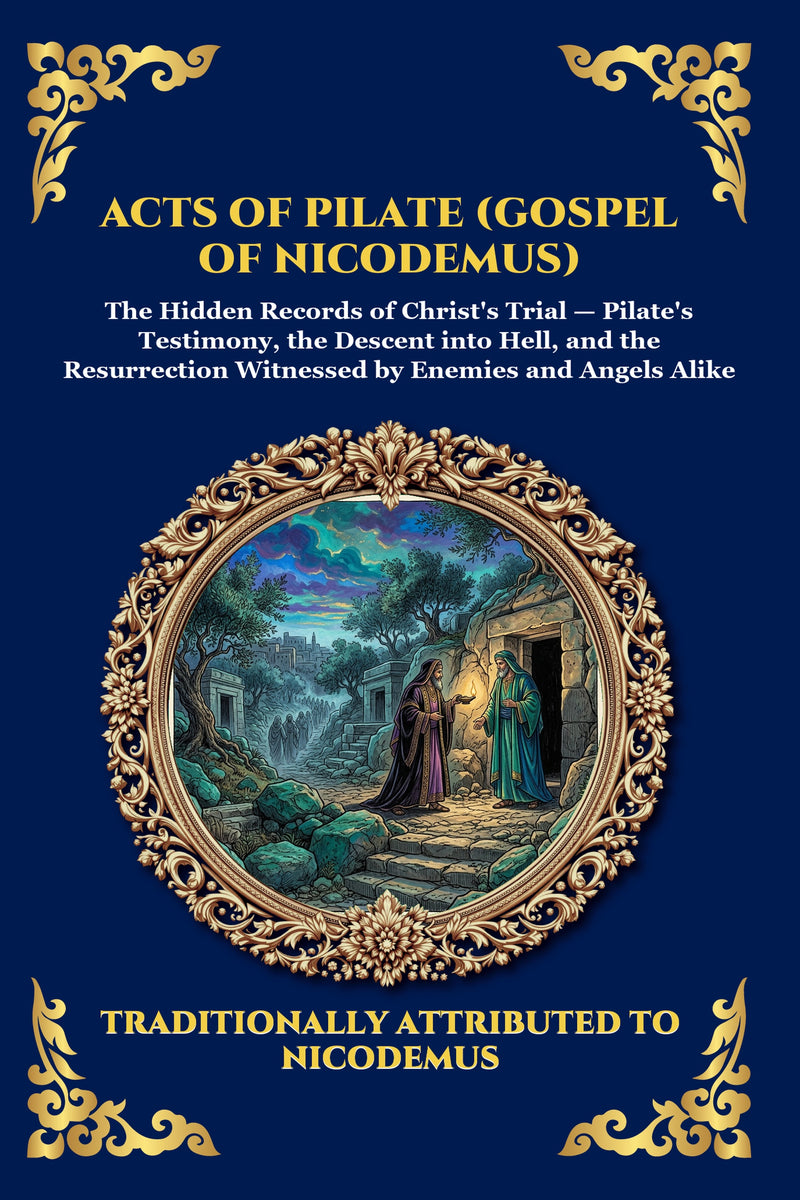
Acts of Pilate (Gospel of Nicodemus)
The Acts of Pilate recounts Christ's descent into the underworld, a vivid detail absent from the canonical gospels. This ancient text, attributed to early followers, offers a dramatic narrative of the crucifixion, resurrection, and the spiritual battles that ensued.
or free app
10,000+ hrs library
30-day guarantee
The Acts of Pilate (Gospel of Nicodemus) is a complete modern-English translation of this influential early Christian apocryphal text, readable online with audiobook included through Library of Alexandria Press membership.
The Acts of Pilate (Gospel of Nicodemus) was quoted by early Church fathers like Justin Martyr in the 2nd century, establishing its ancient origins and widespread influence.
In The Acts of Pilate (also known as the Gospel of Nicodemus), readers are invited to uncover one of the most compelling and influential works of early Christian apocrypha. Attributed to the anonymous early followers of the faith and traditionally framed as the official Roman records of the trial of Jesus, this ancient text offers an extraordinary, expanded view of the crucifixion, resurrection, and the unseen spiritual battles that followed.
Far more than a simple historical chronicle, The Acts of Pilate delves into the profound mysteries of early Christian theology. It provides a detailed, dramatic account of the accusations brought by the religious leaders, the unexpected witnesses who step forward to defend Christ, and Pilate’s intense internal conflict. Most spectacularly, the second half of the text unveils the thrilling narrative of the Harrowing of Hell, where divine light shatters the gates of the underworld, forever altering the balance of cosmic power.
What You Will Discover in This Modern Translation
- The Extended Trial of Christ: Follow the gripping, expanded courtroom drama before Pontius Pilate, featuring testimonies from individuals miraculously healed during Christ's ministry.
- The Harrowing of Hell: Experience the breathtaking theological epic of Christ’s descent into the underworld to defeat death and liberate ancient souls.
- The Testimony of Nicodemus: Explore the courageous actions of Nicodemus and Joseph of Arimathea as they navigate the treacherous political and religious landscape of first-century Jerusalem.
- Pilate’s Dilemma: Gain a deeper psychological and historical understanding of the Roman governor's reluctance to condemn a man he believed to be innocent.
- A Window into Early Christian Theology: Discover the foundational myths and spiritual narratives that profoundly shaped medieval literature, art, and the early church's understanding of salvation.
Whether you are exploring this work for its immense historical value, its deep theological insights, or simply as a captivating story of divine triumph over darkness, The Acts of Pilate offers boundless inspiration and fascination.
Step into a story of unparalleled cosmic victory and discover the ancient text that captivated the early Christian world. Begin your journey today.
| Formats | eBook (EPUB + PDF) · Audiobook · Paperback · Hardcover · Large Print |
| Language | English |
| Trim size (print) | 6 × 9 in |
| Binding | Paperback — perfect-bound · Hardcover — casewrap |
| Large Print edition | Same text in a larger, easy-read type — a larger font, not a larger trim |
| Print pricing | Every physical book at our true cost — at-cost, no profit (members) |
| Library | 873 restored titles, always growing |
| Composed | 4th-5th century AD |
| Original language | Greek |
| Source tradition | Greek and Latin medieval manuscript tradition |
| Translation basis | Public-domain scholarly translation, rendered in clear modern English |
| Edition | Modern English translation · 2026 |
Member reviews for this edition are collected as readers finish it — be the first. Across the library: 12,000+ books shipped, every plan covered by a 365-day print guarantee.
About this edition
The complete, unabridged text in clear modern English — faithful to the original, never simplified. Every paragraph is checked against the source, so nothing is cut, summarised, or paraphrased away. It reads cleanly for today while keeping the original meaning intact.
This text survives primarily in Greek and Latin manuscripts from the medieval period, with the earliest references dating to the 4th century. This edition derives from the standard public-domain scholarly translation and renders it in clear modern English.
- Complete & unabridgedVerified paragraph by paragraph against the source — never a scan, never abridged.
- Modern English, faithfulReadable today, with the author’s meaning kept intact. Readable — not simplified.
- Every format, one membershipRead in your browser or the free app, or listen to the full audiobook.
Included free with your membership
Cancel anytime, one click · 30-day money-back guarantee
Edition last updated June 2026
What’s inside
Acts of Pilate (Gospel of Nicodemus) — complete and unabridged: all 23 sections included with membership, plus the full audiobook.
- Acts of Pilate Chapters 1-16Jesus's trial before Pilate, crucifixion, and immediate aftermath from official Roman records.
- Descent into Hell Chapters 17-27Christ's descent to Hades to liberate righteous souls, told by resurrected witnesses.
Begin reading Acts of Pilate (Gospel of Nicodemus)
In clear modern English — the complete text is included with membership.
Chapter 1
I, Ananias, a man of praetorian rank and a student of the law, came through the divine scriptures to recognize our Lord Jesus Christ, drew near to him in faith, and was counted worthy of holy baptism. I sought out the records that were made in the time of our master Jesus Christ, which the Jews had deposited with Pontius Pilate, and I found them written in Hebrew characters. By the grace of God I translated them into Greek, so that all who call upon the name of our Lord Jesus Christ might be informed. This was done in the seventeenth year of the reign of our Lord Flavius Theodosius, and the sixth year of Flavius Valentinianus, in the ninth indiction.
All who read this and copy it into other books, remember me and pray for me, that God will be gracious to me and show mercy for the sins I have committed against him.
Peace be to those who read and to those who hear these things, and to their households. Amen.
In the fifteenth year of the rule of Tiberius Caesar, emperor of the Romans, and the nineteenth year of the reign of Herod, king of Galilee, on the eighth of the Kalends of April — that is, the twenty-fifth of March — in the consulship of Rufus and Rubellio, in the fourth year of the two hundred and second Olympiad, when Joseph called Caiaphas was high priest of the Jews:
These are the things which Nicodemus recorded and delivered to the high priest and the rest of the Jews after the crucifixion and death of the Lord; and Nicodemus himself first set them down in Hebrew characters.
Chapter 2
The chief priests and scribes assembled in council — Annas and Caiaphas, Somne and Dothaim, Gamaliel, Judas, Levi and Nepthalim, Alexander and Jairus, and the rest of the Jews — and came to Pilate with many accusations against Jesus, saying: We know this man. He is the son of Joseph the carpenter, born of Mary, and he claims to be the Son of God and a king. He desecrates the sabbath and seeks to destroy the law of our fathers.
Pilate said: And what are the things he does by which he would destroy the law? The Jews said: We have a law that no man is to be healed on the sabbath; yet this man, through his evil deeds, has healed the lame and the bent, the withered and the blind and the paralytic, the mute and those possessed by demons — all on the sabbath day.
Pilate said to them: By what evil deeds? They said to him: He is a sorcerer, and by Beelzebub the prince of devils he casts out devils, and all of them are subject to him. Pilate said to them: That is not casting out devils by an unclean spirit — that is the work of the god Asclepius.
The Jews said to Pilate: We beg your majesty to have him brought before your judgment seat and heard. And Pilate called them to him and said: Tell me — how can I, a governor, put a king on trial? They said to him: We do not say he is a king; he says it of himself.
And Pilate called the messenger and said to him: Bring Jesus here, but treat him gently. The messenger went out, and when he saw Jesus he bowed before him, then took the cloth that was on his hand, spread it on the ground, and said to him: Lord, walk on this and enter in, for the governor calls you.
When the Jews saw what the messenger had done, they cried out against Pilate, saying: Why did you not have a herald summon him, rather than a messenger? For the messenger, when he saw him, bowed before him and spread his cloth on the ground and made him walk upon it like a king.
Then Pilate called the messenger and said to him: Why did you do this — spread your cloth on the ground and make Jesus walk upon it? The messenger said to him: Lord governor, when you sent me to Jerusalem to Alexander, I saw Jesus riding on a donkey, and the children of the Hebrews held branches in their hands and cried out, while others spread their garments on the ground before him, saying: Save now, you who dwell in the highest; blessed is he who comes in the name of the Lord.
The Jews cried out and said to the messenger: The children of the Hebrews cried out in Hebrew — how is it that you know it in Greek? The messenger said to them: I asked one of the Jews what they were crying out in Hebrew, and he interpreted it for me. Pilate said to them: And how did they cry out in Hebrew? The Jews said to him: Hosanna membrome barouchamma adonai. Pilate said to them: And how is Hosanna and the rest of it interpreted? The Jews said to him: Save now, you who dwell in the highest; blessed is he who comes in the name of the Lord. Pilate said to them: If you yourselves confirm the words that the children cried out, in what has the messenger sinned? And they were silent. The governor said to the messenger: Go and bring him in however you see fit. And the messenger went out and did as before, and said to Jesus: Lord, enter in; the governor calls you.
Now when Jesus entered, the ensigns were holding the standards, and the busts upon the standards bowed down and did reverence to Jesus. When the Jews saw how the standards bowed and did reverence to Jesus, they cried out loudly against the ensigns. But Pilate said to the Jews: Does it not astonish you that the images bowed and did reverence to Jesus? The Jews said to Pilate: We saw the ensigns themselves make them bow and do reverence to him. And the governor called the ensigns and said to them: Why did you do this? They said to Pilate: We are Greeks and servants of temples — how could we have done him reverence? The images bowed of themselves and did reverence to him while we were holding them.
Then Pilate said to the rulers of the synagogue and the elders of the people: Choose out capable and strong men to hold the standards, and let us see whether they bow of themselves. And the elders of the Jews chose twelve strong and capable men and set them to hold the standards, six to each, and they were placed before the governor's judgment seat. And Pilate said to the messenger: Take him out of the judgment hall and bring him in again however you see fit. And Jesus went out of the judgment hall with the messenger. And Pilate called those who had held the images before and said to them: I swear by the safety of Caesar that if the standards do not bow when Jesus enters, I will have your heads cut off. And the governor commanded Jesus to enter a second time. The messenger did as before and earnestly urged Jesus to walk upon his cloth; and Jesus walked upon it and entered in. And when he had entered, the standards bowed again and did reverence to Jesus.
Chapter 3
Now when Pilate saw this he was afraid, and made to rise from the judgment seat. But while he was still thinking of rising, his wife sent word to him, saying: Have nothing to do with this just man, for I have suffered greatly because of him in a dream last night. And Pilate summoned all the Jews and said to them: You know that my wife fears God and follows the customs of the Jews, as you do. They said to him: Yes, we know it. Pilate said to them: See, my wife has sent to me, saying: Have nothing to do with this just man.
Chapter 4
For I have suffered many things because of him in the night." But the Jews answered and said to Pilate: "Did we not tell you that he is a sorcerer? Behold, he has sent a dream vision to your wife."
And Pilate called Jesus to him and said: "What is it that these men testify against you? Do you say nothing?" But Jesus said: "If they had no power, they would say nothing; for every man has power over his own mouth, to speak good or evil. They shall answer for it."
The elders of the Jews answered and said to Jesus: "What shall we see? First, that you were born of fornication; second, that your birth in Bethlehem caused the slaughter of children; third, that your father Joseph and your mother Mary fled into Egypt because they had no standing before the people."
Then certain devout men among the Jews who stood nearby said: "We do not say that he was born of fornication; we know that Joseph was betrothed to Mary, and that he was not born of fornication." Pilate said to those Jews who claimed he was born of fornication: "What you say is not true, for there was a betrothal, as these men of your own nation confirm." Annas and Caiaphas said to Pilate: "The whole multitude of us declares that he was born of fornication, and we are not believed — yet these men are proselytes and disciples of his." And Pilate called Annas and Caiaphas to him and said: "What are proselytes?" They said to him: "They were born as Greeks and have since become Jews." Then those who said he was not born of fornication — namely Lazarus, Asterius, Antonius, Jacob, Amnes, Zenas, Samuel, Isaac, Phinees, Crispus, Agrippa, and Judas — said: "We were not born proselytes; we are children of Jews, and we speak the truth, for we were present at the betrothal of Joseph and Mary."
And Pilate called to him those twelve men who said that he was not born of fornication, and said to them: "I adjure you by the safety of Caesar — is it true, what you have said, that he was not born of fornication?" They said to Pilate: "We have a law that forbids us to swear, for it is a sin; but let the others swear by the safety of Caesar that what we have said is false, and we will be worthy of death." Pilate said to Annas and Caiaphas: "Do you have no answer to this?" Annas and Caiaphas said to Pilate: "These twelve men are believed when they say he was not born of fornication, yet the whole multitude of us declares that he was born of fornication, that he is a sorcerer, that he claims to be the Son of God and a king — and we are not believed."
And Pilate commanded the whole multitude to withdraw, except for the twelve men who said he was not born of fornication, and he ordered Jesus to be set apart. Then Pilate said to them: "For what reason do they want to put him to death?" They said to Pilate: "They are jealous, because he heals on the Sabbath." Pilate said: "They want to put him to death for a good work?" They said to him: "Yes."
Chapter 5
And Pilate, filled with indignation, went out of the judgment hall and said to them: "I call the Sun to witness that I find no fault in this man." The Jews answered the governor: "If this man were not a criminal, we would not have handed him over to you." Pilate said: "Take him yourselves and judge him according to your own law." The Jews said to Pilate: "It is not lawful for us to put any man to death." Pilate said: "Has God forbidden you to kill, yet permitted it to me?"
Pilate went back into the judgment hall, called Jesus aside, and said to him: "Are you the King of the Jews?" Jesus answered: "Do you ask this of your own accord, or did others tell you this about me?" Pilate answered: "Am I a Jew? Your own people and the chief priests have handed you over to me. What have you done?" Jesus answered: "My kingdom is not of this world. If my kingdom were of this world, my servants would have fought to prevent me from being handed over to the Jews. But my kingdom is not from here." Pilate said to him: "So you are a king?" Jesus answered: "You say that I am a king. For this I was born, and for this I have come into the world — that everyone who belongs to the truth should hear my voice." Pilate said to him: "What is truth?" Jesus said: "Truth is from heaven." Pilate said: "Is there no truth on earth?" Jesus said to Pilate: "You see how those who speak the truth are judged by those who hold power on earth."
Chapter 6
Pilate left Jesus in the judgment hall and went out to the Jews and said to them: "I find no fault in him." The Jews said to him: "This man said he was able to destroy this temple and rebuild it in three days." Pilate said: "What temple?" The Jews said: "The one Solomon built in forty-six years, which this man claims he will destroy and rebuild in three days." Pilate said to them: "I am innocent of the blood of this just man — see to it yourselves." The Jews said: "His blood be on us and on our children."
Cancel anytime, one click · 30-day money-back guarantee
Founding annual rate available now — your price locks for life when you join.
Not ready? Get this free chapter by email — read it anytime.
✓ Sent — check your inbox for Acts of Pilate (Gospel of Nicodemus).
Questions about Acts of Pilate (Gospel of Nicodemus)
Why was the Acts of Pilate excluded from the biblical canon?
The Acts of Pilate was excluded from the canon because it was composed centuries after the apostolic period and lacks apostolic authorship. Early church fathers recognized it as a later composition that didn't meet the criteria for canonical scripture established by early Christian communities.
What does the Acts of Pilate actually contain?
The Acts of Pilate contains an expanded account of Jesus's trial before Pontius Pilate, his crucifixion and resurrection, and a dramatic narrative of Christ's descent into Hades to liberate righteous souls. It presents itself as official Roman court records of Jesus's trial.
Who wrote the Acts of Pilate?
The Acts of Pilate was written by unknown Christian authors in the 4th-5th centuries AD. Despite claims to be official Roman records, scholars recognize it as a later Christian composition that draws on canonical gospels and popular traditions about Jesus's trial.
Is Acts of Pilate (Gospel of Nicodemus) free to read?
The opening of the text is free to read below. Members read and listen to the complete work — and the entire Lost & Forbidden Library — free.
What is Acts of Pilate (Gospel of Nicodemus)?
Have you ever wondered why the canonical gospels leave out the dramatic, supernatural details of Christ’s descent into the underworld?
How long is Acts of Pilate (Gospel of Nicodemus)?
23 chapters (~8,870 words) in this restored edition.
Shipping & returns
Billing & membership
More from the library


Explore The Lost & Forbidden Library
- 1 Enoch · Attributed to Enoch
- 1–4 Maccabees · Various Jewish authors
- 2 Baruch · Attributed to Baruch
- 2 Enoch · Attributed to Enoch
- 2 Esdras · Attributed to the prophet Ezra
- 3 Baruch · Attributed to Baruch ben Neriah
- 4 Baruch · Attributed to Baruch ben Neriah
- A Valentinian Exposition · Attributed to a follower of Val...
- Acta Archelai · Attributed to Hegemonius
- Acts of Andrew · Anonymous (Early Christian Apoc...
- Acts of Andrew and Matthias in the City of the Cannibals · Attributed to early Christian a...
- Acts of Barnabas · Attributed to John Mark
- Acts of Bartholomew
- Acts of John · Anonymous (Early Christian Apoc...
- Acts of Matthias · Anonymous early Christian writers
- Acts of Paul · Attributed to an unknown early ...
- Acts of Paul and Thecla · Attributed to Onesiphorus
- Acts of Peter
- Acts of Peter and Andrew · Attributed to various early Chr...
- Acts of Peter and Paul · Attributed to Leucius Charinus
- Acts of Peter and Simon · Attributed to Leucius Charinus
- Acts of Peter and the Twelve Apostles · Attributed to early Christian a...
- Acts of Philip · Anonymous (Early Christian Apoc...
- Acts of Saturninus
- Acts of Thaddaeus · Attributed to Thaddaeus the Apo...
- Acts of Thomas
- Acts of Titus · Anonymous early Christian writer
- Acts of Xanthippe, Polyxena, and Rebecca
- Allogenes · Anonymous (Early Gnostic Mystic)
- Antitheses of Marcion · Attributed to Marcion of Sinope
Acts of Pilate (Gospel of Nicodemus)
The Acts of Pilate
The Gospel of Nicodemus, Part One — The Trial of Jesus Before Pontius Pilate, the Witnesses for His Defense, and the Testimony of His Resurrection
Library of Alexandria Press
The Acts of Pilate
© Copyright 2026 Library of Alexandria Press. All rights reserved.
Published by Library of Alexandria Press
Printed in the United States of America
It is not legal to copy, share, or send any part of this document in either digital or printed form without written permission from the publisher, except short quotes in a book review.
Table of Contents
Introduction
Chapter 1
Chapter 2
Chapter 3
Chapter 4
Chapter 5
Chapter 6
Chapter 7
Chapter 8
Chapter 9
Chapter 10
Chapter 11
Chapter 12
Chapter 13
Chapter 14
Chapter 15
Chapter 16
Chapter 17
Chapter 18
Chapter 19
Chapter 20
Chapter 21
Chapter 22
Introduction
There are books that history remembers, and there are books that history buries. Sometimes the burying is accidental — the slow erosion of centuries, the destruction of libraries, the indifference of generations who did not think to preserve what came before them. But sometimes the burying is deliberate, the result of councils and edicts and the careful, conscious decisions of religious authorities who chose to draw a line around what counted as sacred and what did not. The text you are about to read belongs to the second category. It was not lost. It was set aside. And the story of why it was set aside, and what it contains, and why it continues to matter more than a thousand years after it was officially marginalized, is one of the most fascinating stories in the entire history of Western religion.
Most readers come to the New Testament through the four canonical Gospels — Matthew, Mark, Luke, and John. These are the accounts that the early Christian church, after centuries of debate and discernment, agreed to place at the center of its sacred library. They are the versions of the Jesus story that billions of people have read, memorized, preached, argued over, and built entire civilizations around. But the early Christian world was not a world of four Gospels. It was a world of dozens of them. Texts circulated widely across the Mediterranean basin in the first several centuries of the common era, each one offering its own perspective on who Jesus was, what he did, and what his life and death meant. Some of these texts were eventually included in the canonical New Testament. Many more were not. And among those that were not, a remarkable number have survived — in fragments, in translations, in manuscripts copied by monks who found them too compelling to destroy even when their superiors might have preferred otherwise.
The text gathered here under the traditional title associated with Pilate and Nicodemus is one of the most significant of these surviving non-canonical documents. It is a composite work, assembled from at least two distinct but related sources, and it covers territory that the canonical Gospels either treat briefly or leave entirely unexplored. The first part concerns itself with the legal and political drama surrounding the trial and crucifixion of Jesus — the formal proceedings before Pontius Pilate, the testimony of witnesses both for and against the accused, and the bureaucratic machinery of Roman justice as it grinds toward its terrible conclusion. The second part ventures somewhere the canonical Gospels barely go at all: into the realm of the dead, into the underworld itself, where the souls of the righteous await what is coming and where something extraordinary is about to happen.
To read this text is to encounter a version of the Jesus story that feels at once deeply familiar and genuinely strange. The major events are the ones you already know — the arrest, the trial, the crucifixion, the resurrection. But the angle of vision is different. The texture is different. The details are different in ways that are sometimes startling and sometimes deeply moving. Here you will find Pilate portrayed with a complexity and even a sympathy that the canonical accounts only hint at. Here you will find a courtroom scene of remarkable dramatic intensity, with named witnesses stepping forward to offer their testimonies. Here you will find the harrowing of hell — that ancient and theologically charged doctrine — rendered not as abstract theology but as vivid narrative, with named figures from the Hebrew scriptures speaking in their own voices about what they have witnessed and what they have hoped for across the long centuries of their waiting.
Understanding why this document exists, what it was trying to do, and why it was eventually pushed to the margins of the Christian tradition requires some sense of the world in which it emerged. The early Christian movement was not, from the beginning, a single unified institution with a single agreed-upon set of sacred texts. It was a diverse, contested, sometimes chaotic collection of communities spread across a vast geographical area, each one grappling in its own way with the meaning of what they believed had happened in Jerusalem in the first century. These communities told stories. They passed those stories down. They wrote them out. They argued about them. And gradually, over the course of several centuries, certain stories came to be regarded as authoritative while others were relegated to a secondary status — still read, still valued by many, but no longer considered part of the core canon.
The process by which the New Testament canon was established was long, complex, and often contentious. It was not a single council meeting that decided everything at once, despite what popular mythology sometimes suggests. It was a gradual process of consensus-building, influenced by theological disputes, political pressures, questions of apostolic authority, and the practical needs of communities that wanted to know which texts they could trust. By the time this process had run its course — roughly by the late fourth century, though debates continued well beyond that — a large body of Christian writing had been classified as apocryphal: not necessarily false, not necessarily heretical, but not canonical either. These texts occupied an ambiguous middle ground, and their fate varied enormously. Some were condemned. Some were quietly forgotten. Some continued to be read and cherished by ordinary Christians even after the official church had moved on.
The document you hold belongs to this category of the beloved and the unofficial. It was enormously popular throughout the medieval period. It was translated into Latin, Greek, Coptic, Syriac, Armenian, and numerous vernacular languages. It was read aloud, dramatized, incorporated into sermons and mystery plays and works of theology. The story it tells — particularly the dramatic account of what happened in the realm of the dead after the crucifixion — captured the imagination of medieval Christians in a way that no dry theological treatise ever could. It gave narrative flesh to doctrinal bones. It answered questions that the canonical Gospels left open. And it did so with a literary energy and a theological seriousness that made it impossible to simply dismiss.
Yet for all its popularity, it remained outside the canon. And this outside status has shaped how modern readers encounter it. For most of the past several centuries, it has been treated primarily as a curiosity — an interesting artifact of early Christian diversity, a window into popular piety, a source of historical data about how ordinary believers understood their faith. What it has rarely been treated as is what it actually is: a serious, sustained, and often beautiful piece of religious literature that deserves to be read on its own terms, with the same care and attention we bring to any significant ancient text.
A Document Born from Controversy
To understand the specific character of this text, it helps to know something about the controversies that likely gave rise to it. The early Christian movement faced a persistent and troubling challenge from its very beginnings: the fact that its founder had been executed as a criminal by the Roman state. This was not a minor public relations problem. In the ancient world, crucifixion was the punishment reserved for the lowest of the low — slaves, rebels, the enemies of civilization. To claim that the Son of God had died in this way was, to many of Jesus's contemporaries, simply incomprehensible. The apostle Paul acknowledged as much when he wrote that the crucifixion was a stumbling block to Jews and foolishness to Greeks. The earliest Christian apologists — those writers who attempted to defend the new faith against its critics — had to grapple constantly with this scandal.
One of the most effective ways to grapple with it was to reframe the trial and execution not as a shameful criminal proceeding but as a miscarriage of justice — a moment in which Roman law itself bore witness, however unwillingly, to the innocence of the accused. If Pilate himself, the representative of Roman imperial authority, had found Jesus innocent and had been pressured against his better judgment into ordering the execution, then the crucifixion became not a condemnation but an exoneration. The Roman state had not found Jesus guilty. It had been manipulated into killing someone it knew to be innocent. This reframing had obvious apologetic value, and it is visible to some degree in all four canonical Gospels, each of which portrays Pilate as reluctant and conflicted. But the canonical accounts are relatively brief on the details of the trial itself. They do not give us witnesses. They do not give us formal legal proceedings. They do not give us the kind of documentary specificity that would make the exoneration feel official and definitive.
This is precisely what the first part of our text provides. It presents itself, at least in some of its manuscript traditions, as an official document — a report filed by Pilate to the emperor, or a set of court records preserved in the archives of Jerusalem. Whether any ancient reader actually believed this framing is an interesting question, but the framing itself is significant. It places the story of the trial within the conventions of Roman legal documentation. It gives named witnesses. It records formal testimony. It creates the impression of an official record that has been preserved and is now being made available to the reader. The effect is to transform the story from a theological narrative into something that feels like historical evidence — evidence, specifically, of Jesus's innocence as attested by the very system that killed him.
The witnesses who appear in this document are worth pausing over, because they represent something genuinely interesting about how the early Christian imagination worked. Some of them are figures familiar from the canonical Gospels — the woman who had been healed of a hemorrhage, the man born blind whose sight was restored. But here they are not just background figures in a miracle story. They are witnesses in a legal proceeding. They stand up before Pilate and the assembled crowd and give their testimony in their own voices. They describe what happened to them. They insist on the reality of what they experienced. And in doing so, they transform the miracles from theological symbols into legal evidence — evidence that the man on trial was not a criminal or a blasphemer but someone with a power that could not be explained by ordinary means.
This legal and evidentiary framework also shapes how the text handles the antagonists in the story. The Jewish authorities who press for Jesus's execution are portrayed with a harshness that modern readers will find uncomfortable and that requires careful historical contextualization. It is important to understand that this portrayal reflects the theological polemics of the early Christian movement as it defined itself against and in tension with rabbinic Judaism — it is not a historically accurate account of Jewish leadership in first-century Jerusalem, and it has, tragically, contributed to a long and painful history of Christian antisemitism. Reading it honestly requires acknowledging this dimension of the text and situating it within its historical context rather than treating it as straightforward reportage. The text is a product of its time and its controversies, and those controversies left marks on it that cannot be ignored.
The second major controversy that shapes this document is the question of what happened to Jesus between his death and his resurrection. The canonical Gospels are remarkably sparse on this subject. They tell us that Jesus died and was buried, and then they tell us that the tomb was found empty and that he appeared to his followers. What happened in between — those three days — is largely passed over in silence. But the early Christian imagination did not pass over it in silence. It filled that silence with narrative. And the doctrine that developed to fill it — the harrowing of hell, the descent of Christ into the underworld to release the souls of the righteous who had died before his coming — became one of the most theologically significant and imaginatively fertile ideas in the entire Christian tradition.
This doctrine appears in the Apostles' Creed, in the phrase 'he descended into hell.' It appears in the letters of Peter, in the first letter of that apostle's reference to Christ preaching to the spirits in prison. It appears in the writings of the early church fathers, who debated its meaning and its implications with great seriousness. But it appears most vividly, most narratively, most dramatically, in the second part of this composite text — the part that describes the underworld itself, the souls waiting there, and the moment of their liberation. This is the section that captured the medieval imagination most powerfully, and it is the section that, even for modern readers, carries the most extraordinary literary and theological charge.
What makes the underworld narrative so compelling is its combination of the cosmic and the personal. On one level, it is a grand theological statement about the scope of salvation — about the claim that the redemption offered through Christ extends not just to those who were alive to receive it but backward through all of human history, reaching even those who lived and died before the new covenant was established. On another level, it is an intimate drama of waiting and hope and recognition. The figures who speak in this section — Adam, the patriarchs, the prophets, John the Baptist — are not abstractions. They are characters with voices and emotions. They have been waiting for a very long time. They know, or sense, that something is about to happen. And when it does, the narrative captures something that pure theology cannot: the feeling of what it would mean for an ancient hope to be finally, overwhelmingly fulfilled.
Why This Text Still Matters
There is a question that any serious reader of apocryphal literature eventually has to confront: why does it matter? If these texts were excluded from the canon, if the church decided that they were not authoritative, if they represent the margins rather than the center of the tradition — why should a modern reader spend time with them? The question is fair, but the answers are numerous and compelling, and they apply with particular force to the document you are about to read.
The first answer is historical. This text gives us an invaluable window into the diversity of early Christian thought and imagination. The Christianity that eventually became the dominant religion of the Western world was not the only form of Christianity that existed in the early centuries. It was the form that won — won theologically, won institutionally, won politically. But the forms that lost, or that were marginalized, or that were absorbed and transformed, are also part of the story. Reading the apocryphal literature is one of the most direct ways we have of accessing those other voices, those other imaginations, those other ways of understanding what the Jesus story meant and what it required of those who believed it.
The second answer is literary. Whatever one thinks of its theological claims or its historical accuracy, this is a document of considerable literary power. The courtroom scenes in the first section have a dramatic intensity that rivals anything in the canonical Gospels. The underworld narrative in the second section has a visionary quality — a combination of the archaic and the urgent — that is unlike almost anything else in ancient Christian literature. To read it purely as a historical document, to approach it only with the tools of the scholar and the critic, is to miss something essential about what it is and what it does. It is a work of imagination as well as a work of theology, and it rewards being read as such.
The third answer is theological. Even for readers who approach this text from within the Christian tradition, and who accept the authority of the canonical scriptures, there is something here that cannot simply be dismissed. The questions this text raises — about the nature of divine justice, about the scope of salvation, about what happened in those three days between the crucifixion and the resurrection — are not questions that the canonical texts answer fully or finally. The tradition has always had to supplement its canonical core with interpretation, with reflection, with imagination. The apocryphal literature is part of that supplement. It represents the early Christian community thinking out loud about the deepest questions its faith raised, and those questions have not become less deep or less pressing with the passage of time.
The fourth answer, perhaps the most important for the reader who simply wants to have a rich and meaningful reading experience, is that this text is genuinely, surprisingly, sometimes breathtakingly alive. There are moments in it that have the quality of great literature — moments where the language rises to meet the magnitude of what it is trying to describe, where a character speaks a line that echoes in the mind long after the reading is finished, where the narrative achieves something that feels less like theological argument and more like direct contact with a profound human truth. These moments are not constant. The text is uneven, as ancient composite texts often are. But they are real, and they are worth the journey required to reach them.
It is also worth reflecting on the particular figures whose names are attached to this document in its traditional title. Pilate is one of the most complex and morally troubling figures in the entire Christian narrative. He is the man who had the power to prevent the crucifixion and did not use it. He is the man who declared the accused innocent and then handed him over to be killed. He is, in some ways, the figure in whom the entire tragedy of the story is concentrated — the person who knew what was right and chose expediency instead. The tradition has treated him in wildly different ways. Some early Christian communities venerated him as a saint. Others condemned him as a coward and a murderer. The Ethiopian Orthodox Church celebrates him as a martyr. The Roman Catholic Church has never canonized him. He is a figure of genuine moral ambiguity, and this text treats him as such — not whitewashing his role, but also not reducing him to a simple villain.
Nicodemus, the other figure whose name is traditionally associated with this document, appears in the Gospel of John as a Pharisee and member of the Jewish council who comes to Jesus secretly by night, drawn by curiosity and something that might be the beginning of faith. He reappears later in John to defend Jesus before the council, and again at the burial, bringing spices to anoint the body. He is a figure of the threshold — someone who stands between the world of official religious authority and the world of the new movement, drawn toward Jesus but unwilling or unable to make a complete break with his old world. His association with this document, whatever its historical basis, gives it a particular flavor: it is a document that claims to come from inside the establishment, from someone who was there, who saw what happened, who could not in good conscience remain silent about it.
As you prepare to read what follows, it may be helpful to approach it with a kind of double consciousness — holding in mind simultaneously its historical distance and its contemporary relevance, its strangeness and its familiarity, its status as a marginalized text and its claim to speak about events of universal significance. It is a document that has been waiting, in its own way, for readers who will take it seriously — not uncritically, not naively, but with the full engagement that any serious work of religious literature deserves. The trial it describes was conducted in public, before witnesses. The events it narrates in its second section took place, according to its own logic, in the deepest possible privacy — in a realm where no living human eye could see. But both parts of the story are offered here as testimony: as the insistence that something happened, that it mattered, and that the record of it should not be lost.
The world in which this text was written is very different from our own. The cosmology is different. The legal system is different. The understanding of the afterlife is different. The relationship between religious authority and political power is different. But the questions at the heart of the document are not different at all. They are the questions that any serious engagement with human existence eventually raises: What do we do when justice fails? What happens to the innocent when power is indifferent to their innocence? What do the dead carry with them into whatever comes after? What does it mean to hope for something across a very long time? These are not ancient questions. They are permanent ones. And this ancient text, for all its strangeness, addresses them with a directness and a seriousness that can still, if we let it, reach across the centuries and find us where we are.
Open these pages, then, with patience and with curiosity. Allow the world of the text to become real to you on its own terms before you begin to judge or analyze or contextualize. Let the courtroom fill with its witnesses. Let the darkness of the underworld become palpable. Let the voices of the waiting dead speak in their own registers. What you will find, if you read with the full attention this document deserves, is not a curiosity or a footnote or a historical artifact. You will find a living text — imperfect, composite, sometimes difficult, but alive with the energy of people who were grappling, with everything they had, with the most important questions they knew how to ask.
The Acts of Pilate
Chapter 1
I, Ananias, a man of praetorian rank and a student of the law, came through the divine scriptures to recognize our Lord Jesus Christ, drew near to him in faith, and was counted worthy of holy baptism. I sought out the records that were made in the time of our master Jesus Christ, which the Jews had deposited with Pontius Pilate, and I found them written in Hebrew characters. By the grace of God I translated them into Greek, so that all who call upon the name of our Lord Jesus Christ might be informed. This was done in the seventeenth year of the reign of our Lord Flavius Theodosius, and the sixth year of Flavius Valentinianus, in the ninth indiction.
All who read this and copy it into other books, remember me and pray for me, that God will be gracious to me and show mercy for the sins I have committed against him.
Peace be to those who read and to those who hear these things, and to their households. Amen.
In the fifteenth year of the rule of Tiberius Caesar, emperor of the Romans, and the nineteenth year of the reign of Herod, king of Galilee, on the eighth of the Kalends of April — that is, the twenty-fifth of March — in the consulship of Rufus and Rubellio, in the fourth year of the two hundred and second Olympiad, when Joseph called Caiaphas was high priest of the Jews:
These are the things which Nicodemus recorded and delivered to the high priest and the rest of the Jews after the crucifixion and death of the Lord; and Nicodemus himself first set them down in Hebrew characters.
End of the free sample
Keep reading, free
Members read and listen to the complete book — and the entire library. Cancel anytime, one click · 30-day money-back guarantee.