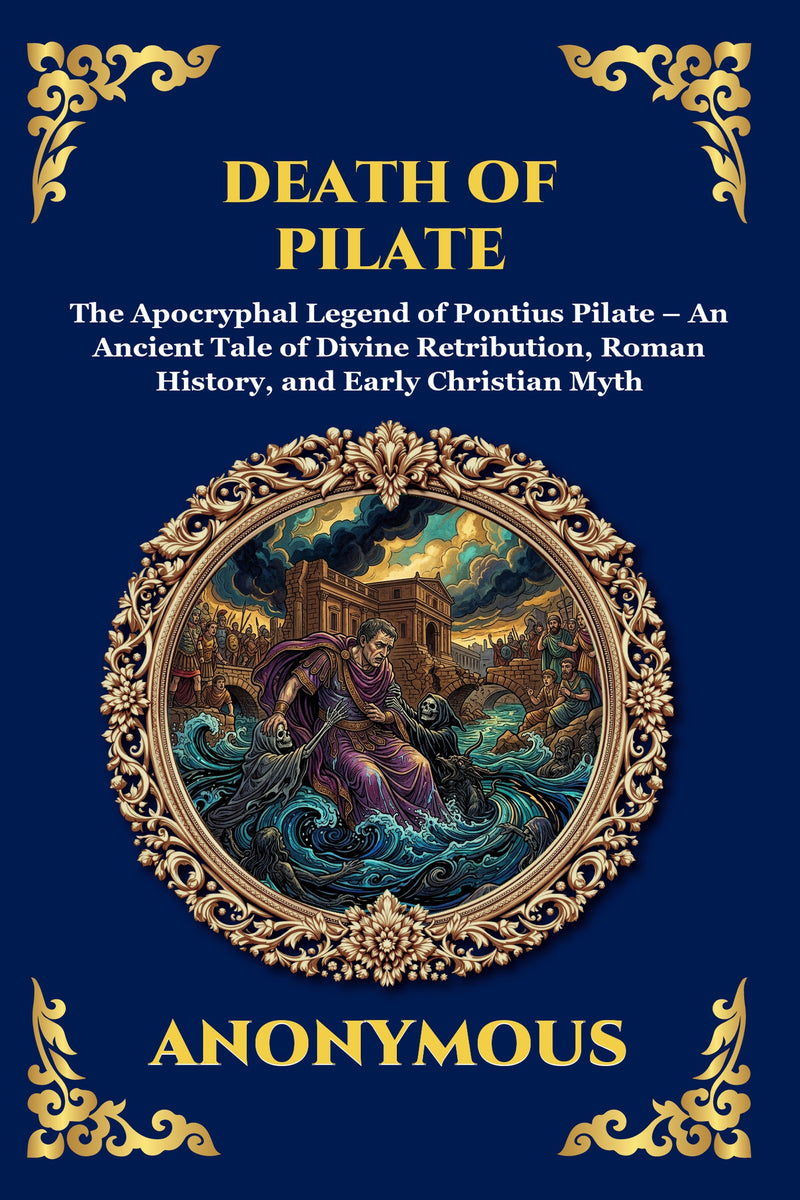
Death of Pilate
The Gospels fall silent on Pontius Pilate's fate, but "Death of Pilate" fills the void with an ancient narrative of his final days. This early Christian text portrays Pilate's harrowing journey back to Rome, where supernatural forces and imperial politics intertwine to seal his destiny.
or free app
10,000+ hrs library
30-day guarantee
This Library of Alexandria edition presents the complete Death of Pilate in readable modern English, accessible online with full audiobook narration included for members.
Pontius Pilate trembles before divine judgment as celestial forces descend to claim the Roman governor who condemned Christ in Death of Pilate.
The Death of Pilate is one of the most intriguing and mysterious works of early Christian apocrypha. While the Gospels leave Pilate’s fate to silence, this ancient narrative fills the void with a gripping, supernatural account of his final days. It is a story of a man pursued—not just by the political machinations of Rome, but by the very fabric of the universe itself.
In this powerful modern translation, you will follow the disgraced governor as he returns to Rome to face the Emperor Tiberius. What follows is a series of miraculous and terrifying events that challenge the power of the Caesars and demonstrate the spiritual authority of the faith Pilate once tried to ignore. From the depths of Roman dungeons to the mysterious waters of the Tiber and the Alps, this text provides a window into how the early church conceptualized justice, repentance, and the fate of those who stand against the divine.
Whether you are a scholar of ancient history, a seeker of spiritual mysteries, or a fan of gothic-style mythology, The Death of Pilate offers a compelling look at a figure caught between two worlds.
What You’ll Discover in This Modern Translation
- The Supernatural Fate of a Roman Governor: Follow the harrowing journey of Pilate as he faces the consequences of his actions in Jerusalem through a series of divine interventions.
- A Unique Perspective on Early Christian Mythos: Explore how ancient writers used storytelling to explain the moral weight of the Crucifixion and the eventual fall of those responsible.
- The Conflict Between Empire and Faith: Witness the dramatic confrontation between the Roman Emperor and the spiritual legacy of the Christ, highlighting the shift from pagan to Christian dominance.
- Historical and Theological Context: Gain insight into the apocryphal traditions that shaped Western literature, art, and the medieval understanding of divine retribution.
- A Masterpiece of Ancient Suspense: Experience a narrative that reads like a psychological thriller, filled with atmosphere, dread, and the search for peace in a world of guilt.
This edition brings the archaic language of the past into a sharp, accessible format, ensuring that the tension and moral gravity of Pilate’s legend are preserved for the modern reader. Can a man ever truly wash his hands of his destiny?
Get your copy today and uncover the lost legend of the man who condemned the King.
| Formats | eBook (EPUB + PDF) · Audiobook · Paperback · Hardcover · Large Print |
| Language | English |
| Trim size (print) | 6 × 9 in |
| Binding | Paperback — perfect-bound · Hardcover — casewrap |
| Large Print edition | Same text in a larger, easy-read type — a larger font, not a larger trim |
| Print pricing | Every physical book at our true cost — at-cost, no profit (members) |
| Library | 873 restored titles, always growing |
| Source tradition | Medieval Latin manuscript tradition |
| Translation basis | Public-domain scholarly translation, rendered in clear modern English |
| Length | 1,170 words · ~5 min reading |
| Reading level | Grade 12 · rich, literary prose (this modern-English edition) |
| Edition | Modern English translation · 2026 |
Member reviews for this edition are collected as readers finish it — be the first. Across the library: 12,000+ books shipped, every plan covered by a 365-day print guarantee.
About this edition
The complete, unabridged text in clear modern English — faithful to the original, never simplified. Every paragraph is checked against the source, so nothing is cut, summarised, or paraphrased away. It reads cleanly for today while keeping the original meaning intact.
The Death of Pilate survives in various medieval Latin manuscripts and later vernacular versions. This edition derives from the standard public-domain scholarly translation and renders it in clear modern English.
- Complete & unabridgedVerified paragraph by paragraph against the source — never a scan, never abridged.
- Modern English, faithfulReadable today, with the author’s meaning kept intact. Readable — not simplified.
- Every format, one membershipRead in your browser or the free app, or listen to the full audiobook.
Included free with your membership
Cancel anytime, one click · 30-day money-back guarantee
Edition last updated June 2026
What’s inside
Death of Pilate — complete and unabridged: all 6 sections included with membership, plus the full audiobook.
Begin reading Death of Pilate
In clear modern English — the complete text is included with membership.
Chapter 1
When Tiberius Caesar, emperor of the Romans, was suffering from a grave illness, he learned that there was in Jerusalem a certain physician named Jesus who could cure any sickness with a single word. Not knowing that the Jews and Pilate had put this man to death, he summoned a trusted friend of his named Volusianus and said: Cross the seas as quickly as you can, and tell Pilate, my servant and friend, to send me this physician, so that he may restore me to my former health.
Volusianus, upon hearing the emperor's command, set out at once and came to Pilate as he had been instructed. He delivered to Pilate the message that Tiberius Caesar had entrusted to him, saying: Tiberius Caesar, emperor of the Romans, your master, has heard that there is in this city a physician who heals the sick by his word alone, and he earnestly asks you to send this man to him so that he may be cured of his illness.
When Pilate heard this, he was seized with great fear, for he knew that it was through envy that he had caused Jesus to be put to death. He answered the messenger in these words: This man was a criminal who drew all the people after him, and so the council of the city's wise men was convened, and I had him crucified.
The messenger then returned to his lodgings, where he met a woman named Veronica, who had been a friend of Jesus. He said to her: Woman, there was a physician in this city who healed the sick by his word alone — why have the Jews put him to death?
She began to weep and said: Alas, my lord! My God and my Lord — Pilate, out of envy, handed him over, condemned him, and ordered him to be crucified.
Then Volusianus, deeply distressed, said: I am greatly troubled, for I cannot accomplish the very thing for which my lord sent me.
Chapter 2
And Veronica said to him: When my Lord was going about preaching, and I, much against my will, was deprived of His presence, I wished to have His portrait painted, so that while I could not be with Him, the image might at least bring me some comfort. And when I was carrying the cloth to the painter, my Lord met me on the way and asked where I was going. When I told Him the reason for my journey, He asked me for the cloth, and gave it back to me bearing the impression of His venerable face.
Therefore, if your lord will look upon that face with devout reverence, he will receive the benefit of his health at once. The messenger asked her: Can a portrait of such power be obtained for gold or silver? She said: No; only through the pious influence of devotion.
I will therefore go with you and carry the portrait for Caesar to look upon, and then return. So Volusianus set out with Veronica for Rome, and said to the emperor Tiberius: Jesus, whom you have been longing to find, has been handed over to an unjust death by Pilate and the Jews, who out of envy nailed Him to the gibbet of the cross. There has come with me a certain woman, bringing a portrait of Jesus Himself; and if you look upon it with devout reverence, you will receive the benefit of your health at once.
Chapter 3
Caesar therefore ordered the road to be spread with silk cloths, and the image to be brought before him; and as soon as he looked upon it, he recovered his former health. Pontius Pilate was then, by Caesar's command, seized and brought to Rome. When Caesar heard that Pilate had arrived, he was filled with extraordinary fury against him and ordered him to be brought into his presence.
But Pilate had brought with him the seamless tunic of Jesus, and he wore it when he appeared before the emperor. The moment the emperor saw him, all his anger fell away, and he rose at once to meet him. He found himself unable to speak a harsh word to him; the man who had seemed so terrible and fearsome in his absence was somehow, in his presence, found to be mild.
When Pilate was dismissed and had gone, the emperor blazed out against him again with terrible fury, crying that he was a wretch, since he had shown none of the rage he felt in his heart. He immediately had him called back, swearing and declaring that Pilate deserved to die, and that it was a disgrace that such a man should be allowed to live upon the earth. Yet the moment he saw him again, he greeted him warmly and felt all the ferocity drain from his mind.
Chapter 4
All were astonished — and the emperor himself was astonished that he had blazed out so fiercely against Pilate in his absence, yet could say nothing harsh to him when he stood in his presence. Then, moved by a divine impulse, or perhaps by the advice of some Christian, he ordered the tunic stripped from Pilate, and immediately felt all his former fury return against him. When the emperor marveled greatly at this, he was told that the tunic had belonged to the Lord Jesus.
The emperor then ordered Pilate held in prison while he deliberated with a council of wise men about what should be done with him. A few days later, sentence was passed: Pilate was condemned to a most shameful death. On hearing this, Pilate took his own knife and killed himself, and so ended his life.
When Caesar learned of Pilate's death, he said: "Truly he has died a most disgraceful death, since his own hand did not spare him." His body was therefore bound to a great weight and sunk in the river Tiber. But the malignant and filthy spirits dwelling in that malignant and filthy body rejoiced together and kept stirring in the waters, and in a terrible manner brought forth lightning and tempests, thunder and hailstorms, so that all the people were seized with horrible fear.
Chapter 5
The Romans dragged him out of the river Tiber and, in contempt, carried him down to Vienne, where they sank him in the river Rhône. For Vienne is called, as it were, Via Gehennae — the way of Gehenna — because it was at that time a place of cursing. But there too evil spirits made their presence felt, working the same torments in the same place.
The people of that city, unable to endure such an affliction of demons, removed that vessel of malediction from among themselves and sent him to be buried in the territory of Lausanne. And the people there, finding themselves equally troubled by the same visitations, removed him from their midst as well and sank him in a certain pit ringed by mountains, where to this day, according to some accounts, diabolical disturbances are said to boil up from the depths.
Cancel anytime, one click · 30-day money-back guarantee
Founding annual rate available now — your price locks for life when you join.
Not ready? Get this free chapter by email — read it anytime.
✓ Sent — check your inbox for Death of Pilate.
Questions about Death of Pilate
Why isn't the Death of Pilate in the Bible?
The Death of Pilate was composed centuries after the New Testament canon was established and was excluded from official Christian scripture. It represents later legendary material rather than apostolic testimony about Pilate's fate.
Who wrote the Death of Pilate?
The Death of Pilate is anonymous, attributed to various early Christian authors in different manuscript traditions. Like many apocryphal texts, its true authorship remains unknown to modern scholarship.
What does the Death of Pilate actually contain?
The Death of Pilate narrates legendary accounts of Pontius Pilate's fate after the crucifixion, typically involving his return to Rome, trial, and supernatural punishment for his role in Christ's death.
Is Death of Pilate free to read?
The opening of the text is free to read below. Members read and listen to the complete work — and the entire Lost & Forbidden Library — free.
What is Death of Pilate?
Have you ever wondered why the name Pontius Pilate remains etched in the collective memory of humanity, not as a hero, but as a symbol of tragic indecision and divine consequence?
How long is Death of Pilate?
6 chapters (~1,174 words) in this restored edition.
Shipping & returns
Billing & membership
More from the library


Explore The Lost & Forbidden Library
- 1 Enoch · Attributed to Enoch
- 1–4 Maccabees · Various Jewish authors
- 2 Baruch · Attributed to Baruch
- 2 Enoch · Attributed to Enoch
- 2 Esdras · Attributed to the prophet Ezra
- 3 Baruch · Attributed to Baruch ben Neriah
- 4 Baruch · Attributed to Baruch ben Neriah
- A Valentinian Exposition · Attributed to a follower of Val...
- Acta Archelai · Attributed to Hegemonius
- Acts of Andrew · Anonymous (Early Christian Apoc...
- Acts of Andrew and Matthias in the City of the Cannibals · Attributed to early Christian a...
- Acts of Barnabas · Attributed to John Mark
- Acts of Bartholomew
- Acts of John · Anonymous (Early Christian Apoc...
- Acts of Matthias · Anonymous early Christian writers
- Acts of Paul · Attributed to an unknown early ...
- Acts of Paul and Thecla · Attributed to Onesiphorus
- Acts of Peter
- Acts of Peter and Andrew · Attributed to various early Chr...
- Acts of Peter and Paul · Attributed to Leucius Charinus
- Acts of Peter and Simon · Attributed to Leucius Charinus
- Acts of Peter and the Twelve Apostles · Attributed to early Christian a...
- Acts of Philip · Anonymous (Early Christian Apoc...
- Acts of Pilate (Gospel of Nicodemus) · Attributed to various early Chr...
- Acts of Saturninus
- Acts of Thaddaeus · Attributed to Thaddaeus the Apo...
- Acts of Thomas
- Acts of Titus · Anonymous early Christian writer
- Acts of Xanthippe, Polyxena, and Rebecca
- Allogenes · Anonymous (Early Gnostic Mystic)
Death of Pilate
The Death of Pilate
The Cursed End of the Judge — The Sickness of Tiberius, the Healing Cloth of Veronica, the Summons and Condemnation of Pontius Pilate at Rome, His Suicide, and the Restless Wandering of His Accursed Body Through the Tiber, the Rhône, and the Mountain Pit of Lausanne (the Medieval Mors Pilati of the Pilate Cycle)
Library of Alexandria Press
The Death of Pilate
© Copyright 2026 Library of Alexandria Press. All rights reserved.
Published by Library of Alexandria Press
Printed in the United States of America
It is not legal to copy, share, or send any part of this document in either digital or printed form without written permission from the publisher, except short quotes in a book review.
Table of Contents
Introduction
Chapter 1
Chapter 2
Chapter 3
Chapter 4
Chapter 5
Introduction
There are figures in history who refuse to stay buried. Long after their deaths, long after the empires that gave them power have crumbled to dust, they continue to haunt the imagination of successive generations, accumulating legends the way a stone wall accumulates moss — slowly, persistently, until the original surface is almost entirely obscured. Pontius Pilate is one of these figures. He was, by the standards of the Roman imperial bureaucracy, a relatively minor provincial administrator: a prefect of middling rank assigned to one of the empire's more troublesome backwaters, governing a restless population in a land far removed from the marble grandeur of Rome. He served his term, made his decisions, and passed from the historical record with the quiet obscurity that claimed most men of his station. And yet his name has been spoken aloud, in churches across the world, every single Sunday for nearly two thousand years.
The reason for that extraordinary persistence is, of course, his role in the trial and crucifixion of Jesus of Nazareth. Whatever one believes about the theological dimensions of that event, its historical and cultural consequences are beyond dispute. The crucifixion became the central narrative of one of the world's great religions, and Pilate — the man who, according to the Gospels, washed his hands of the whole affair and handed Jesus over to be executed — became permanently embedded in that narrative. He is named in the Apostles' Creed. He appears in all four canonical Gospels. He is referenced by the Roman historian Tacitus, by the Jewish historian Josephus, and by a remarkable inscription discovered at Caesarea Maritima in 1961 that confirmed, to the satisfaction of most scholars, that he was a real historical person and not merely a literary construction. Few figures from the ancient world are simultaneously so well attested and so poorly understood.
What we actually know about Pilate, stripped of legend and theological interpretation, is surprisingly thin. He governed Judaea from approximately 26 to 36 CE. He had a contentious relationship with the Jewish population and their religious leadership. He was eventually recalled to Rome by the Syrian legate Vitellius following a violent suppression of a Samaritan uprising, and after that, the historical record falls largely silent. We do not know with certainty where he went, what he did, or how he died. That silence — that vast, inviting blankness at the end of his story — proved irresistible to later generations of storytellers, theologians, and mythmakers. Into that silence, they poured their anxieties, their convictions, their need for narrative resolution, and their hunger for divine justice.
The text you are about to read is one of the most fascinating products of that imaginative hunger. It belongs to a body of literature known as the Christian apocrypha — a sprawling, diverse, and endlessly surprising collection of texts that circulated in the early centuries of the Common Era alongside the writings that would eventually be canonized as the New Testament. These texts were not, for the most part, cynical fabrications or deliberate frauds. They were expressions of genuine religious imagination, attempts by early Christian communities to fill in the gaps left by the canonical scriptures, to answer the questions that the Gospels raised but did not resolve, and to make theological sense of a world in which the followers of Jesus found themselves embedded in the vast machinery of Roman power. Who were these Romans? What happened to them? Did they face consequences for what they had done? Did God's justice reach even into the corridors of imperial power?
The legend of Pilate's death is, at its heart, an attempt to answer those questions. It is a story about consequence and retribution, about the long arm of divine justice and the impossibility of escaping one's own history. But it is also, and perhaps more interestingly, a story about ambivalence. Pilate in the apocryphal tradition is not simply a villain. He is a complicated figure, a man caught between political necessity and moral intuition, between the demands of empire and the unsettling presence of someone he cannot quite categorize or dismiss. Different versions of his legend treat him very differently — in some he is damned, in others he is redeemed, and in the Ethiopian Orthodox tradition he is actually venerated as a saint. This range of responses tells us something important not just about Pilate but about the communities that created these stories and the different ways they understood justice, guilt, redemption, and the relationship between Roman power and Christian faith.
To read this text well is to read it in context — to understand where it came from, what questions it was trying to answer, what anxieties it was trying to resolve, and what literary and theological traditions it was drawing upon. That is the purpose of this introduction: not to summarize what you are about to read, but to give you the intellectual and historical equipment to read it as richly and as fully as possible. The story itself is strange and vivid and sometimes startling in its imagery. It deserves a reader who comes to it prepared.
The World That Made the Legend
To understand why a story like this exists, you need to understand something about the situation of early Christians in the Roman Empire, and about the particular psychological and theological challenges that situation created. The first followers of Jesus were, almost without exception, people living under Roman rule. They had watched their teacher arrested by Roman soldiers, tried before a Roman magistrate, and executed by a Roman method of capital punishment. The cross was not a neutral symbol in the first century. It was an instrument of Roman state terror, designed not merely to kill but to humiliate, to make a public spectacle of the consequences of challenging imperial authority. Crucifixion was reserved for slaves, criminals, and those who threatened the social order. It was, in the eyes of most Romans, a shameful death — and in the eyes of many Jews, a death that carried specific theological stigma.
The earliest Christian communities had to make sense of this. They had to explain why the person they believed to be the Son of God had died in the most degrading way the Roman state could devise. They did this through a theology of redemptive suffering, through the interpretation of Hebrew scripture, and through the proclamation of resurrection. But they also had to navigate a very practical political reality: they were living in the Roman Empire, they needed to survive in it, and they needed to spread their message within it. This created a complex and sometimes contradictory set of pressures on how they told the story of the crucifixion and who they assigned blame to.
One of the most significant and, from a historical perspective, most consequential features of the Gospel narratives is the way they handle the question of responsibility for Jesus's death. The canonical Gospels, written in the decades after the crucifixion and shaped by the communities that preserved and transmitted them, tend to present Pilate as a reluctant participant — a man who found no fault in Jesus, who tried to release him, who was ultimately pressured by the Jewish crowd and religious leadership into authorizing the execution. The famous scene of Pilate washing his hands, found only in Matthew's Gospel, is the most dramatic expression of this tendency: the Roman official literally performing a ritual of innocence, declaring himself free of the blood of this righteous man.
Historians have debated for generations how accurately this portrait reflects the historical reality. A Roman prefect who had shown no hesitation in ordering violent suppressions of other disturbances seems an unlikely candidate for the kind of agonized hand-wringing the Gospels describe. But the Gospels were not written primarily as historical documents. They were written to convey theological meaning to specific communities, and those communities had reasons — both theological and practical — to soften the portrait of Roman culpability. A faith that hoped to spread throughout the Roman Empire could not afford to make the Roman state its primary villain. And so the weight of blame was shifted, with consequences for Jewish-Christian relations that would prove catastrophic across the centuries.
The apocryphal texts about Pilate exist in a different relationship to these pressures. By the time most of them were written — in the second, third, fourth, and fifth centuries CE — the situation of Christianity within the Roman Empire had changed dramatically. Christianity had grown from a persecuted minority faith to, eventually, the official religion of the empire itself. The need to placate Roman sensibilities was less acute; the need to make theological sense of history was more pressing. And so the apocryphal tradition could afford to be more ambiguous about Pilate, more willing to explore the darker possibilities of his story, more interested in the question of what divine justice actually looked like when applied to the powerful.
The texts that make up the Pilate cycle — a loose collection of related apocryphal writings including the Gospel of Nicodemus, the Acts of Pilate, the Letter of Pilate to Claudius, the Letter of Herod to Pilate, the Anaphora Pilati, and the text you are about to read — circulated widely in the early medieval world and were enormously popular. They were not considered canonical scripture, but they were not entirely dismissed either. They occupied an ambiguous middle ground, read and enjoyed and sometimes quoted by serious theologians, copied and transmitted by monks, translated into multiple languages, and woven into the fabric of popular Christian piety. They answered questions that the canonical Gospels left open, and they did so with a narrative energy and a taste for the dramatic that made them compelling reading.
The world that produced these texts was also a world deeply interested in the mechanics of divine justice. One of the persistent theological challenges facing any monotheistic tradition that believes in a just and all-powerful God is the problem of explaining why bad things happen to good people and good things happen to bad people. The early Christian tradition inherited this challenge from Judaism and wrestled with it constantly. One of the ways it resolved the tension — at least provisionally, at least narratively — was through stories of eventual retribution: stories in which those who had wronged the righteous were ultimately brought to account, in which the apparent triumph of power over justice was revealed to be temporary, in which God's patience was not the same as God's indifference.
Pilate was a perfect vehicle for this kind of story. He was powerful, he was Roman, he was historical, and he had made a decision with cosmic consequences. What happened to him afterward? The canonical scriptures were silent. History provided only fragments. And so imagination stepped in, guided by theology, shaped by the narrative conventions of the time, and driven by the deep human need to believe that the universe is, in some fundamental sense, fair.
It is also worth noting that the apocryphal tradition about Pilate did not develop in isolation. It was part of a broader cultural conversation about the relationship between Rome and the divine, between imperial power and religious truth. The Roman Empire was full of stories about rulers who had overreached, who had offended the gods, who had been brought low by forces they could not control or comprehend. The Greeks had their tragedies; the Romans had their histories of tyrants undone by hubris. Early Christian storytellers were working within and against these traditions, adapting familiar narrative patterns to serve new theological purposes. When they told stories about what happened to Pilate, they were drawing on a rich repertoire of cultural resources — Roman historical writing, Greek tragedy, Jewish apocalyptic literature, and the emerging conventions of Christian hagiography and martyrology.
The result is a body of literature that is, by turns, theologically serious and wildly imaginative, historically grounded and fantastically embellished, morally complex and satisfyingly schematic. It is literature that takes its questions seriously even when its answers are mythological. And it has something to say to modern readers that goes beyond mere antiquarian interest.
Reading Myth as History, History as Myth
There is a temptation, when approaching a text like this one, to adopt one of two reductive postures. The first is to treat it as simply false — as a pious fabrication with no claim on our serious attention, a curiosity from a more credulous age that we can safely condescend to from our position of enlightened skepticism. The second is to treat it as literally true — to read its narrative claims as straightforward historical reportage and to evaluate it accordingly. Both of these approaches miss what is most interesting and most valuable about the text.
Myths are not failed histories. They are a different kind of truth-telling. When a culture produces a myth about a historical figure — when it takes someone who actually existed and weaves around them a narrative of supernatural consequence and divine judgment — it is not simply making things up. It is expressing, in the only language adequate to the task, its deepest convictions about how the world works, what matters, and what the relationship is between human action and cosmic order. The myth of Pilate's death is not interesting because it tells us what actually happened to Pontius Pilate. It is interesting because it tells us what the communities that created and transmitted it believed should happen to someone in his position — and what that belief reveals about their understanding of justice, power, guilt, and redemption.
This distinction between the mythological and the historical is one that modern readers sometimes find difficult, because we live in a culture that has largely separated these two modes of understanding. We tend to assume that something is either true in a factual, verifiable sense, or it is not true at all. But this is a relatively recent and culturally specific assumption. For most of human history, and in most human cultures, myth and history have been understood as complementary rather than competing modes of access to reality. The great events of the past were simultaneously historical occurrences and mythological templates; the figures who shaped those events were simultaneously real people and symbolic embodiments of larger forces and principles.
Reading the legend of Pilate's fate in this spirit — taking it seriously as myth without pretending it is history — opens up dimensions of the text that a purely skeptical or purely credulous reading would miss. It allows us to ask not just what the text claims but what it means: what it reveals about the fears and hopes of the communities that told it, what it says about the relationship between individual moral choice and collective consequence, what it suggests about the nature of guilt and the possibility of expiation.
There is also a historical dimension to the text that is easy to overlook if we focus exclusively on its mythological content. The apocryphal literature about Pilate preserves genuine traces of historical memory — not necessarily accurate memory, but memory nonetheless. The names, the places, the political relationships, the cultural tensions that appear in these texts are not invented from whole cloth. They reflect a world that actually existed, a set of historical circumstances that actually obtained, a cast of historical characters who actually lived. Reading these texts carefully, with attention to what they preserve as well as what they invent, can tell us something real about the world of the first century and about the way that world was remembered and interpreted by subsequent generations.
Moreover, the very process by which these legends developed and changed over time is itself historically significant. The different versions of the Pilate story — the ways in which different communities, in different centuries, in different linguistic and cultural contexts, modified and elaborated and reinterpreted the basic narrative — constitute a kind of extended conversation about the meaning of the crucifixion and its aftermath. Tracing that conversation is one of the most rewarding things a reader of this literature can do. It reveals not a single, static myth but a living, evolving tradition, responsive to changing circumstances and changing questions.
The text you are about to encounter has come down to us through a long and complex process of transmission. Like most apocryphal texts, it exists in multiple versions, in multiple languages, with variations that range from minor differences in phrasing to significant divergences in plot and interpretation. Scholars have debated its origins, its date, its relationship to other texts in the Pilate cycle, and the theological tradition or traditions it represents. These debates are genuinely interesting and genuinely unresolved, which is part of what makes the text so rich as an object of study. But you do not need to resolve them in order to read the text with profit and pleasure. You need only bring to it the same qualities you would bring to any great piece of literature: attention, curiosity, a willingness to be surprised, and a readiness to sit with questions that do not have easy answers.
One of those questions — perhaps the central question the text raises — is the question of what justice looks like when it operates on a cosmic scale. We live in a world in which the powerful very often escape the consequences of their actions, in which history is written by the victors, in which the machinery of accountability breaks down with depressing regularity. The legend of Pilate's death is, among other things, a refusal to accept that this is the final word. It insists that there is a reckoning, that power does not ultimately protect those who abuse it, that the universe keeps accounts even when human institutions fail to do so. Whether one finds that insistence theologically compelling or merely psychologically satisfying, it speaks to something deep and persistent in human moral experience.
There is also something unexpectedly moving about the figure of Pilate himself as the apocryphal tradition imagines him. He is not, in most versions of the legend, a straightforwardly evil man. He is a man who made a choice — a choice driven by political calculation, by fear, by the ordinary moral cowardice that afflicts ordinary people in positions of power — and who then had to live with that choice. The legend traces the consequences of that living-with, the way the past pursues us, the way decisions made in a moment of expedience can define and ultimately destroy a life. In this sense, the story is not merely about Pontius Pilate. It is about the universal human experience of moral failure and its aftermath.
The ancient storytellers who shaped this legend were not naive. They understood that the world is complicated, that good people sometimes make terrible choices, that terrible people sometimes display unexpected humanity. The best versions of the Pilate legend honor that complexity even while insisting on the reality of moral consequence. They give us a protagonist who is neither a monster nor a hero but something more interesting and more troubling: a recognizably human figure caught in circumstances that exceeded his moral capacity, making decisions whose full weight he could not have anticipated, and paying a price that the story presents as both inevitable and, in some deep sense, just.
As you turn these pages, you are entering a tradition of storytelling that stretches back nearly two millennia. You are joining a long conversation about power and justice, about guilt and redemption, about the relationship between human history and divine purpose. The people who first told this story are long dead, but the questions they were asking are very much alive. They are, in many ways, our questions too — questions about accountability, about the limits of power, about what it means to be responsible for the consequences of our choices. The ancient world asked these questions in the language of myth and legend. We ask them in the language of politics and psychology and moral philosophy. But underneath the different vocabularies, the questions are the same.
Read this text, then, not as a relic but as a mirror. Read it with the curiosity of a historian, the attentiveness of a literary scholar, and the openness of someone who suspects that an old story might have something new to say. The legend of what became of Pontius Pilate after his moment of infamy is stranger and richer and more thought-provoking than you might expect. It has survived for reasons that go beyond mere antiquarian interest. It has survived because it touches something real — something about the human condition, about the nature of justice, about the stories we tell ourselves to make sense of a world in which power and morality so rarely align.
What follows is one of the most unusual and compelling documents to emerge from the early centuries of the Christian tradition. Approach it with patience and with curiosity. Let it be strange. Let it ask its questions in its own way, in its own idiom, on its own terms. And then ask yourself what those questions mean for us, here, now, in a world that has changed enormously in two thousand years but has not, perhaps, changed quite as much as we sometimes like to think.
The Death of Pilate
Chapter 1
When Tiberius Caesar, emperor of the Romans, was suffering from a grave illness, he learned that there was in Jerusalem a certain physician named Jesus who could cure any sickness with a single word. Not knowing that the Jews and Pilate had put this man to death, he summoned a trusted friend of his named Volusianus and said: Cross the seas as quickly as you can, and tell Pilate, my servant and friend, to send me this physician, so that he may restore me to my former health.
Volusianus, upon hearing the emperor's command, set out at once and came to Pilate as he had been instructed. He delivered to Pilate the message that Tiberius Caesar had entrusted to him, saying: Tiberius Caesar, emperor of the Romans, your master, has heard that there is in this city a physician who heals the sick by his word alone, and he earnestly asks you to send this man to him so that he may be cured of his illness.
When Pilate heard this, he was seized with great fear, for he knew that it was through envy that he had caused Jesus to be put to death. He answered the messenger in these words: This man was a criminal who drew all the people after him, and so the council of the city's wise men was convened, and I had him crucified.
The messenger then returned to his lodgings, where he met a woman named Veronica, who had been a friend of Jesus. He said to her: Woman, there was a physician in this city who healed the sick by his word alone — why have the Jews put him to death?
She began to weep and said: Alas, my lord! My God and my Lord — Pilate, out of envy, handed him over, condemned him, and ordered him to be crucified.
Then Volusianus, deeply distressed, said: I am greatly troubled, for I cannot accomplish the very thing for which my lord sent me.
End of the free sample
Keep reading, free
Members read and listen to the complete book — and the entire library. Cancel anytime, one click · 30-day money-back guarantee.