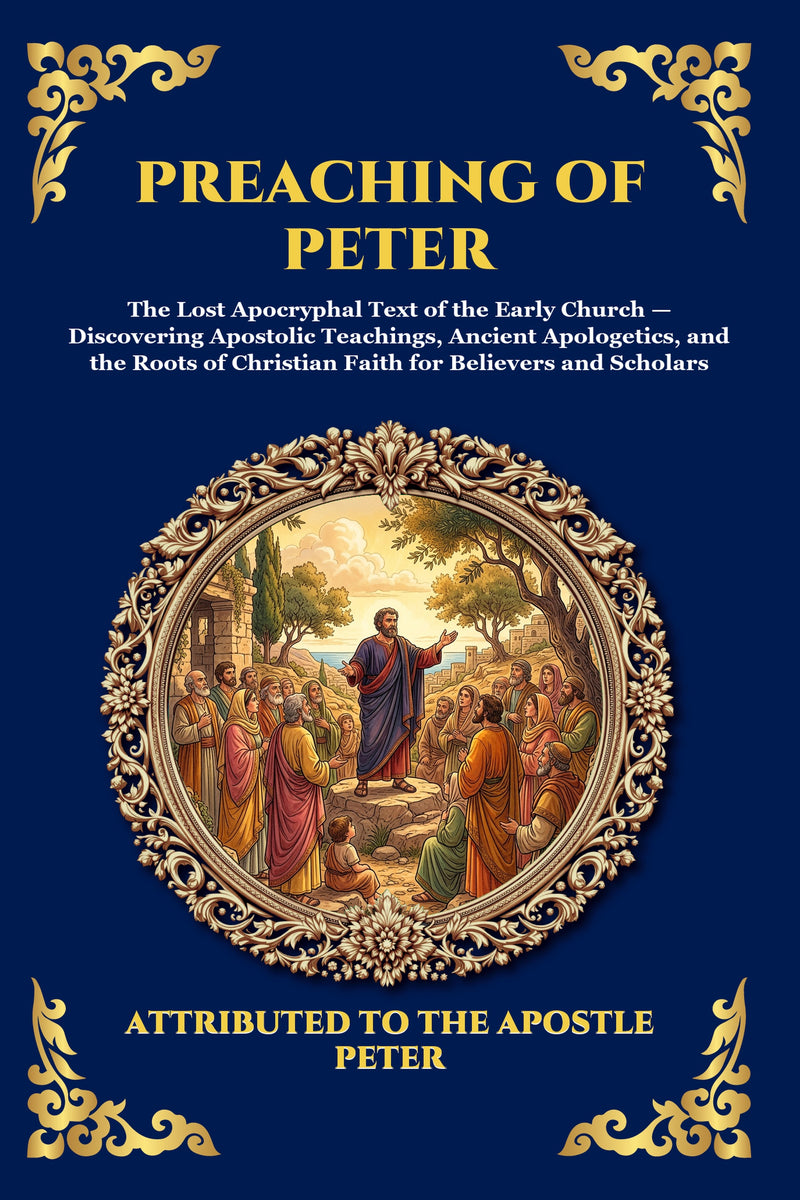
Preaching of Peter — Large Print
The Preaching of Peter offers a rare glimpse into the theological defenses of early Christianity, defining believers as a "third race" distinct from Jews and Greeks. Preserved mainly through Clement of Alexandria, this second-century text reveals how early Christians forged a unique identity in a hostile world.
or free app
10,000+ hrs library
30-day guarantee
The Preaching of Peter presents the complete surviving fragments of this second-century Christian apologetic text in modern English translation, available for online reading with included audiobook narration.
Large Print Edition. The complete, unabridged text set in a larger, easy-on-the-eyes typeface for comfortable reading.
Have you ever wondered why the earliest Christians had to forge a completely new identity, distinct from both the Greeks and the Jews?
In The Preaching of Peter, readers uncover one of the most vital and fascinating lost documents of early Christianity. Dating back to the first half of the second century and preserved primarily through the writings of Clement of Alexandria, this text offers a rare, unfiltered look into the theological defenses of the ancient church. It reveals how the first generations of believers navigated a hostile world, defining themselves not as a sect of Judaism or a new Greek philosophical school, but as a "third race" worshiping the Creator in a revolutionary, spirit-led way.
Far more than a mere historical footnote, this apocryphal text serves as a powerful, ancient handbook for Christian apologetics. In these surviving fragments, the Apostle Peter is depicted addressing the nations, rigorously dismantling the polytheism and idolatry of the Greeks, while simultaneously distinguishing the new Christian worship from traditional Jewish practices. The text boldly proclaims that the teachings and life of Jesus Christ represent the ultimate fulfillment of ancient prophetic literature and the singular path to truly knowing God. It is a brilliant display of early intellectual warfare, designed to legitimize a marginalized faith in the eyes of a skeptical Roman Empire.
This meticulously compiled edition brings the scattered fragments of The Preaching of Peter together into one fluid, accessible narrative, providing the essential historical context needed to bridge the gap between antiquity and the modern reader. By examining this lost apostolic voice, scholars and spiritual seekers alike can trace the very roots of Christian theology, identity, and defense before the canonical boundaries were firmly established.
What You’ll Discover in This Apocryphal Masterpiece:
The "Third Way" of Worship Discover the revolutionary early Christian concept of being a new people, carving out a distinct spiritual path separate from the established religions of antiquity.
Ancient Apologetics in Action Explore the earliest recorded logical and theological arguments used to defend the Christian faith against paganism, idolatry, and philosophical skepticism.
Prophetic Fulfillment and Authority Read how early believers utilized ancient Hebrew scriptures and prophecies to validate the life, death, and resurrection of Jesus Christ to a global audience.
The Enduring Apostolic Voice Gain profound insights into how the authority, teachings, and legendary status of the Apostle Peter were viewed and utilized by the second-century church to instruct new converts.
Unearthing Lost Biblical History Delve into the fascinating process of textual reconstruction, learning how ancient manuscripts are recovered from the quotations of early church fathers like Clement of Alexandria.
Whether you are exploring this work to understand the historical development of Christian apologetics, piecing together the diverse literature of the early church, or seeking to connect with the foundational roots of the faith, The Preaching of Peter provides an invaluable window into ancient devotion. Step back in time and hear the echoes of an apostolic defense that helped shape Western religion. Begin your journey today.
| Formats | eBook (EPUB + PDF) · Audiobook · Paperback · Hardcover · Large Print |
| Language | English |
| Trim size (print) | 6 × 9 in |
| Binding | Paperback — perfect-bound · Hardcover — casewrap |
| Large Print edition | Same text in a larger, easy-read type — a larger font, not a larger trim |
| Print pricing | Every physical book at our true cost — at-cost, no profit (members) |
| Library | 873 restored titles, always growing |
| Composed | 2nd century AD |
| Original language | Greek |
| Source tradition | Patristic citations, primarily Clement of Alexandria |
| Translation basis | Public-domain scholarly translation, rendered in clear modern English |
| Length | 3,512 words · ~14 min reading |
| Reading level | Grade 15 · rich, literary prose (this modern-English edition) |
| Edition | Modern English translation · 2026 |
Member reviews for this edition are collected as readers finish it — be the first. Across the library: 12,000+ books shipped, every plan covered by a 365-day print guarantee.
About this edition
The complete, unabridged text in clear modern English — faithful to the original, never simplified. Every paragraph is checked against the source, so nothing is cut, summarised, or paraphrased away. It reads cleanly for today while keeping the original meaning intact.
Preserved primarily through quotations in Clement of Alexandria's writings, with additional fragments cited by other Church Fathers. This edition draws from the standard scholarly reconstruction of these patristic citations, rendered in clear modern English.
- Complete & unabridgedVerified paragraph by paragraph against the source — never a scan, never abridged.
- Modern English, faithfulReadable today, with the author’s meaning kept intact. Readable — not simplified.
- Every format, one membershipRead in your browser or the free app, or listen to the full audiobook.
Included free with your membership
Cancel anytime, one click · 30-day money-back guarantee
Edition last updated June 2026
What’s inside
Preaching of Peter — Large Print — complete and unabridged: all 10 sections included with membership, plus the full audiobook.
Begin reading Preaching of Peter — Large Print
In clear modern English — the complete text is included with membership.
A Text Hiding in Plain Sight
One of the most intriguing aspects of studying this ancient document is the realization that it has never been entirely hidden. Unlike some of the more sensational discoveries of modern biblical archaeology — texts sealed in jars and buried in desert caves, manuscripts locked away in monastery libraries and inaccessible for centuries — the fragments we are working with have been sitting in plain sight in the writings of early church fathers for as long as those writings have been available. Clement of Alexandria quotes from the text multiple times in his Stromata, his great miscellany of Christian learning. These quotations have been read and studied by patristics scholars for centuries. Yet somehow the document from which they derive has remained on the margins of popular awareness, known to specialists but largely invisible to the broader audience of people interested in early Christianity.
Part of the reason for this invisibility is simply the structure of how we learn about early Christianity. The canonical texts — the four Gospels, Paul's letters, the other New Testament writings — occupy so much of the available intellectual and devotional space that there is little room left for the texts that did not make the final cut. Seminary students learn about the formation of the canon, but the non-canonical texts are usually treated as curiosities or as evidence of early heresy rather than as serious documents that illuminate the diversity and vitality of the early Christian movement. Popular books about early Christianity have begun to change this in recent decades, but the focus has tended to fall on the more dramatically discovered texts — the Nag Hammadi library, the Gospel of Judas — rather than on documents like the one we are examining here, which require patient reconstruction from scattered quotations.
Another reason for the relative neglect of this text is that it does not fit neatly into the categories that have dominated modern discussions of early Christianity. It is not a Gnostic text, so it does not serve the narrative of a radical alternative Christianity suppressed by orthodox power. It is not a straightforwardly orthodox text either, since some of its theological formulations are unusual enough to have made later church authorities uncomfortable. It occupies an interesting middle ground — a document that was widely read and respected in the early centuries, that was associated with the most prominent of the apostles, and that yet failed to achieve canonical status, perhaps because it was too early, too theologically experimental, or simply too associated with communities and traditions that lost influence as the church grew and consolidated.
To understand the document properly, we need to understand something about the world in which it was produced. The first and second centuries of the common era were a time of extraordinary religious ferment throughout the Mediterranean world. The old Olympian religion of Greece and Rome was in decline, at least among the educated classes, though it retained enormous popular vitality and was deeply embedded in the social and political structures of civic life. Philosophy had become, for many educated people, a kind of substitute religion — the Stoics, the Platonists, the Epicureans all offered not just intellectual systems but ways of life, communities of practice, and answers to the great questions of human existence. Judaism was itself in a period of profound transformation following the destruction of the Jerusalem Temple in 70 CE, as rabbinic Judaism began to develop the structures and practices that would sustain it through the long centuries of diaspora. And Christianity was emerging from its origins as a Jewish sect to become something more complex and more universal — a movement that was trying to find its identity in relation to both its Jewish roots and the broader Greco-Roman world in which it was increasingly embedded.
The document we are examining was produced in the middle of this ferment, and it bears the marks of its context on every surviving line. Its engagement with Greek philosophical concepts, its critique of both Jewish and pagan religious practice, its insistence on the novelty and yet the antiquity of the Christian message — all of these reflect the specific intellectual and cultural challenges facing Christian communities in the late first or early second century. Reading the fragments with this context in mind transforms them from mere historical curiosities into living documents that speak with surprising directness to questions that are still very much alive.
The question of authorship is one that we must address honestly and without false certainty. The text presents itself as the preaching of Peter, and early readers clearly took this claim seriously. But modern scholarship has generally concluded that the document was not written by Peter himself — not least because it shows signs of a literary and theological sophistication that goes beyond what we might expect from a Galilean fisherman, and because some of its theological formulations seem to reflect developments that postdate Peter's death. This does not mean, however, that the text has no genuine connection to Petrine tradition. It is entirely possible — indeed, it seems likely — that the document preserves genuine traditions about Peter's preaching, theological ideas that circulated in communities that traced their origins to Peter's ministry, and perhaps even some authentic memories of what Peter actually taught. The relationship between apostolic tradition and later literary elaboration is complex and nuanced, and the honest scholar neither simply accepts the text's self-presentation at face value nor dismisses it as pure fiction.
What we can say with confidence is that the document was taken seriously as a Petrine text by people who were much closer in time to Peter than we are, and that this reception itself tells us something important. The early church was not naive about questions of authenticity. There were fierce debates about which texts were genuinely apostolic and which were not. The fact that a text as learned and widely read as Clement of Alexandria treated this document as a genuine source of apostolic teaching suggests that it had credible connections to early tradition, even if those connections were not as direct as its title implied.
For the modern reader approaching this material for the first time, perhaps the most useful frame is neither credulous acceptance nor dismissive skepticism, but rather what we might call historical empathy — the attempt to understand how this text functioned in its original context, what needs it met, what questions it answered, and why it mattered to the people who read and preserved it. When we approach it this way, the document comes alive in ways that purely critical analysis can miss. We begin to hear in it the voice of a community under pressure, trying to articulate its identity and defend its beliefs in a world that was largely hostile or indifferent. We hear the intellectual excitement of people who believed they had discovered something true and important and who were reaching for the best available conceptual tools to express it. We hear, beneath the theological arguments and the apologetic strategies, the unmistakable note of genuine religious conviction.
This is, ultimately, what makes the study of early Christian texts so rewarding, even — perhaps especially — when those texts are fragmentary and difficult. They bring us into contact with the living reality of faith as it was experienced and expressed before it had settled into the familiar forms that later tradition would give it. They remind us that Christianity was not always what it became, that the faith had a childhood and an adolescence, a period of experiment and exploration and passionate argument, before it reached the relative stability of the great creeds and councils. Understanding that earlier period does not undermine the later tradition — if anything, it enriches it, by showing us the depth and complexity of the roots from which it grew.
Why This Ancient Voice Still Matters
There is a question that any serious book about an obscure ancient text must eventually answer, and it is better to answer it directly than to leave it hovering unspoken over every page: why does this matter? Why should a modern reader — busy, distracted, surrounded by an ocean of competing claims on their attention — invest time and intellectual energy in reconstructing and understanding a document that survives only in fragments, that was written nearly two thousand years ago, and that has been largely unknown outside of specialist circles for most of that time?
The answer, I want to suggest, operates on several levels simultaneously, and the different levels will resonate differently depending on who you are and what you bring to the reading.
For the Christian reader, the value of engaging with this material is perhaps most immediately obvious, though it may also be the most challenging. To read the surviving fragments of this ancient text is to encounter Christianity at a moment of extraordinary openness and possibility — before the great councils had defined orthodoxy, before the institutional church had developed the structures of authority and enforcement that would later characterize it, before the faith had become so culturally embedded in Western civilization that it was difficult to see it clearly at all. This is Christianity as a living experiment, as a community of people trying to work out what they believed and why, as a movement that was genuinely wrestling with the hardest questions of human existence and coming up with answers that were new and surprising and sometimes startling in their implications.
For the Christian who has grown up in a tradition that emphasizes the unchanging nature of Christian truth, this can be unsettling. But it can also be profoundly liberating. To see the faith in its earliest, most dynamic form is to be reminded that Christianity has always been a living tradition, always in dialogue with the world around it, always finding new ways to express ancient truths. The theological creativity visible in the fragments we will be examining is not a departure from authentic Christianity — it is an expression of the same Spirit that has animated the tradition in every generation.
For the historian and the scholar, the value of this material is different but equally compelling. The document we are examining is a primary source for one of the most important and least understood periods in Western religious history. The late first and early second centuries were the crucible in which Christianity took its definitive shape, and every piece of evidence we have from that period is precious. The fragments preserved in Clement and others give us access to a strand of early Christian thought that is not well represented in the canonical texts — a strand that was deeply engaged with the intellectual culture of the Hellenistic world, that was thinking carefully about the relationship between Christian faith and Greek philosophy, and that was articulating a vision of God and humanity that would have enormous influence on later theological development even as the specific document that expressed it faded from view.
The influence of this text on later Christian thought is one of the most fascinating and underappreciated aspects of its history. Ideas that appear in the surviving fragments can be traced through the writings of Clement, through Origen, and into the great theological syntheses of the third and fourth centuries. The document's insistence on the universal scope of divine revelation — its argument that God had been at work in human history long before the coming of Christ, preparing both Jews and Gentiles for the fullness of truth — is an idea that would become central to Christian theology, expressed most famously in Justin Martyr's doctrine of the Logos spermatikos, the seed of the Word scattered throughout human history. Whether Justin knew this document directly or was drawing on a common tradition is a question scholars debate, but the conceptual connections are striking and significant.
For the reader who comes to this material from outside any religious tradition — the secular historian, the student of comparative religion, the simply curious — the value lies in what the document reveals about the dynamics of religious innovation and transmission. How do new religious movements establish their identity? How do they negotiate their relationship with the traditions from which they emerge and the cultural environment in which they develop? How do they construct authority, create community, and articulate belief in ways that are compelling to both insiders and outsiders? These are questions that matter far beyond the specific case of early Christianity, and the document we are examining offers unusually rich material for thinking about them.
There is also, it must be said, a straightforward human interest in this material that transcends any scholarly or theological agenda. The people who produced and read this text were real human beings, living in a world that was in many ways very different from ours but that was animated by recognizably human concerns — the desire for meaning, the fear of death, the longing for community, the search for truth. When we read the fragments that survive, we are eavesdropping on their conversations, hearing their arguments, catching glimpses of their hopes and anxieties. There is something deeply moving about this kind of contact across time, and it is one of the great gifts that the study of ancient texts can offer.
Cancel anytime, one click · 30-day money-back guarantee
Founding annual rate available now — your price locks for life when you join.
Not ready? Get this free chapter by email — read it anytime.
✓ Sent — check your inbox for Preaching of Peter — Large Print.
Questions about Preaching of Peter — Large Print
Why was the Preaching of Peter excluded from the biblical canon?
The Preaching of Peter was likely composed too late for apostolic authorship and lacked widespread acceptance among early Christian communities. Church authorities recognized it as pseudepigraphic rather than genuinely Petrine, leading to its exclusion from the New Testament canon.
What does the Preaching of Peter actually contain?
The Preaching of Peter contains early Christian apologetic arguments, notably describing Christians as a 'third race' distinct from Jews and Greeks. It defends Christian monotheism against pagan polytheism and presents theological arguments for Christianity's superiority over other religions.
Did the apostle Peter actually write the Preaching of Peter?
Modern scholars unanimously agree that the apostle Peter did not write this text. The Preaching of Peter is pseudepigraphic, composed in the second century and attributed to Peter to lend it apostolic authority, a common practice in early Christian literature.
Is Preaching of Peter free to read?
The opening of the text is free to read below. Members read and listen to the complete work — and the entire Lost & Forbidden Library — free.
What is Preaching of Peter?
Have you ever wondered why the earliest Christians had to forge a completely new identity, distinct from both the Greeks and the Jews? In The Preaching of Peter, readers uncover one of the most vital and fascinating lost documents of early Christianity.
How long is Preaching of Peter?
10 chapters (~655 words) in this restored edition.
Shipping & returns
Billing & membership
More from the library


Explore Lost Gospels & Acts
- The Lost Books of the Bible · Various early Christian authors
- Gospel of the Lots of Mary
- Gospel of the Twelve · Anonymous early Christian writers
- Infancy Gospel of Thomas · Attributed to Thomas the Israelite
- Gospel of the Hebrews · Attributed to early Jewish-Chri...
- Acts of Thomas
- Gospel of the Savior · Anonymous (Early Christian Author)
- Acts of Saturninus
- Death of Pilate · Attributed to various early Chr...
- Doctrine of Addai · Attributed to Thaddeus of Edessa
- Gospel of the Nativity of Mary · Attributed to St. Matthew
- Toledot Yeshu
- Papyrus Berolinensis 22220
- Oxyrhynchus Papyrus 1224
- Correspondence of Jesus and Abgar · Attributed to Eusebius of Caesarea
- Papias: Expositions of the Sayings of the Lord · Attributed to Papias of Hierapolis
- Questions of John · Attributed to John the Apostle
- Narrative of Joseph of Arimathea · Attributed to Joseph of Arimathea
- Avenging of the Savior · Attributed to various early Chr...
- Report of Pilate to Caesar
- Letter of Pontius Pilate to Claudius
- Acts of Peter and Simon · Attributed to Leucius Charinus
- Acts of Andrew and Matthias in the City of the Cannibals · Attributed to early Christian a...
- Preaching of Peter · Attributed to the apostle Peter
- Egerton Gospel II
- Gospel of Barnabas
- Letter to the Laodiceans · Attributed to the Apostle Paul
- Diatessaron · Attributed to Tatian
- Descent of Christ into Hell (Harrowing of Hell) · Attributed to the Apostle Peter
- Acts of Pilate (Gospel of Nicodemus) · Attributed to various early Chr...
Preaching of Peter — Large Print
Preaching of Peter
The Lost Apocryphal Text of the Early Church — Discovering Apostolic Teachings, Ancient Apologetics, and the Roots of Christian Faith for Believers and Scholars
Library of Alexandria Press
Preaching of Peter
© Copyright 2026 Library of Alexandria Press. All rights reserved.
Published by Library of Alexandria Press
Printed in the United States of America
It is not legal to copy, share, or send any part of this document in either digital or printed form without written permission from the publisher, except short quotes in a book review.
Table of Contents
Introduction
A Text Hiding in Plain Sight
Why This Ancient Voice Still Matters
God and His Nature
Worship Neither as the Greeks Nor as the Jews
The New Way of Worship Through Christ
The Sending of the Apostles
Prophetic Sources Naming Christ
Affirmation of Scriptural Authority
Christ as Law and Word
Introduction
Somewhere between the canonical Gospels and the settled creeds of later Christianity lies a vast and largely unexplored wilderness — a territory populated by texts that were read aloud in early house churches, debated by bishops, quoted by theologians, and eventually lost to the slow erosion of time, politics, and the relentless narrowing of what the church chose to remember. This book is about one of the most significant inhabitants of that wilderness: a document known to scholars as the Kerygma Petrou, or in its more familiar English rendering, the Preaching of Peter.
To encounter this text — or rather, the fragments and echoes of it that have survived — is to step into a world that feels simultaneously familiar and startlingly strange. It is the world of the earliest Christians, people who lived within living memory of Jesus of Nazareth, who argued passionately about what his life and death and reported resurrection actually meant, and who were trying with urgent sincerity to explain their new faith to a skeptical, religiously saturated Greco-Roman world. These were not yet the Christians of cathedrals and councils. They were a small, embattled, intellectually energetic movement, and the document at the heart of this book was one of their most important early attempts to articulate who they were and what they believed.
For most modern readers — whether they come to this subject as committed Christians, as historians of religion, as students of ancient literature, or simply as curious people who sense that the early church was far more complex and interesting than Sunday school ever suggested — the very existence of such a text will come as a surprise. We are accustomed to thinking of early Christianity as a movement defined by the twenty-seven books of the New Testament. But the New Testament as we know it did not spring fully formed from the apostolic age. It was assembled, debated, and gradually canonized over centuries. During that long process of formation, dozens of other texts circulated among Christian communities — texts that were read, treasured, argued over, and in many cases treated as authoritative scripture by significant portions of the early church.
The document we are exploring here was among the most widely read of these. It was known and quoted by some of the most influential thinkers in early Christian history. Clement of Alexandria, writing in the late second and early third centuries, cited it repeatedly and with evident respect, treating it as a genuine apostolic source. Origen, perhaps the greatest intellectual of the early church, engaged with it seriously enough to question its authenticity — which itself tells us something important: you do not bother questioning the authenticity of a text that nobody reads. The fact that Origen felt compelled to address it means it was circulating widely and being taken seriously. Even Eusebius of Caesarea, the great church historian of the fourth century, was aware of it, though by his time the winds of canonical opinion were blowing against it.
What happened to this text? Why is it not sitting on the shelf beside the Gospel of Mark or the Letter to the Romans? These are questions this book will address in detail, but the short answer is that the process by which Christian communities decided which texts were authoritative and which were not was messy, contested, and deeply influenced by historical circumstances that had as much to do with church politics and cultural pressures as with any purely theological assessment of a document's worth. Texts got lost. Texts got suppressed. Texts simply fell out of use as the communities that had cherished them were absorbed into larger structures or were defeated in doctrinal controversies. The document we are examining here suffered a fate that was neither dramatic suppression nor violent condemnation — it simply faded, quoted in pieces by others, never copied as a complete work into the great manuscript traditions that preserved so much else, and eventually surviving only in the fragments that other writers happened to preserve when they quoted from it.
Those fragments, however, are remarkable. They give us a window into a form of early Christian apologetics — that is, the intellectual defense and explanation of the faith — that is both sophisticated and deeply revealing. The text appears to have been structured as a series of proclamations or preachings attributed to Peter, the fisherman from Galilee who became the most prominent of Jesus's inner circle and who, according to the Acts of the Apostles and a wealth of early tradition, became the leading figure of the Jerusalem community after the crucifixion. Whether Peter himself had any direct connection to the composition of this document is a question that scholarship has wrestled with for generations, and it is one we will examine carefully. But what is clear is that the early Christians who read and valued this text believed they were encountering something genuinely apostolic — a voice from the foundational generation of their movement.
The content of the surviving fragments is striking in several ways. The document appears to have engaged directly with both Jewish and pagan religious traditions, arguing that Christianity represented a third way — neither the worship of the God of Israel as practiced by contemporary Judaism, nor the polytheistic religion of the Greco-Roman world, but something new and yet ancient, a fulfillment of the deepest spiritual intuitions of both traditions while transcending the limitations of each. This is a remarkably ambitious theological claim, and the sophistication with which it appears to have been argued suggests that the author or authors of this text were people of considerable learning and rhetorical skill.
There is also in the fragments a strong emphasis on the uniqueness and universality of the Christian message — a theme that would become central to later Christian theology but that appears here in what may be one of its earliest articulations. The God proclaimed in this document is not a tribal deity or a philosophical abstraction but a living presence who has acted in history and who calls all human beings, regardless of their ethnic or cultural background, into relationship. For a movement that began as a Jewish sect in a corner of the Roman Empire, this was a breathtaking claim, and the energy with which it is made in the surviving fragments helps us understand why this text was read so widely and taken so seriously in the early centuries.
Reading these fragments today requires both historical imagination and intellectual humility. We are dealing with pieces of a larger whole that we cannot fully reconstruct. We are reading translations of translations, in some cases — Greek texts that may themselves have been translated from Aramaic originals, now rendered into modern English through layers of scholarly interpretation. We are trying to hear a voice across nearly two millennia of intervening history, through the distorting filters of the traditions that preserved some things and discarded others. None of this makes the enterprise impossible, but it does make it demanding, and it requires us to hold our conclusions with a certain tentativeness that is not always comfortable but is always intellectually honest.
God and His Nature
Know then that there is one God who made the beginning of all things and has power over their end. He is the invisible one who sees all things, uncontainable, who contains all, having need of nothing, of whom all things stand in need and for whose sake they exist — incomprehensible, perpetual, incorruptible, uncreated, who made all things by the word of his power.
Worship Neither as the Greeks Nor as the Jews
This God worship, not after the manner of the Greeks. Carried away by ignorance and not knowing God as we do, according to the perfect knowledge, but shaping those things over which he gave them power for their own use — wood and stones, brass and iron, gold and silver — forgetting their material and proper use, they set up things subservient to their existence and worship them. And what things God has given them for food — the fowls of the air and the creatures that swim in the sea and creep upon the earth, wild beasts and four-footed cattle of the field, weasels and mice, cats and dogs and apes — their own eatables they sacrifice as offerings to eatable gods. Offering dead things to the dead as to gods, they show ingratitude to God, and by these practices deny that he exists.
Neither worship him as do the Jews, for they, who suppose that they alone know God, do not know him — serving angels and archangels, the month and the moon. And if no moon is seen, they do not celebrate what is called the first sabbath, nor keep the new moon, nor the days of unleavened bread, nor the feast, nor the great day of atonement.
End of the free sample
Keep reading, free
Members read and listen to the complete book — and the entire library. Cancel anytime, one click · 30-day money-back guarantee.