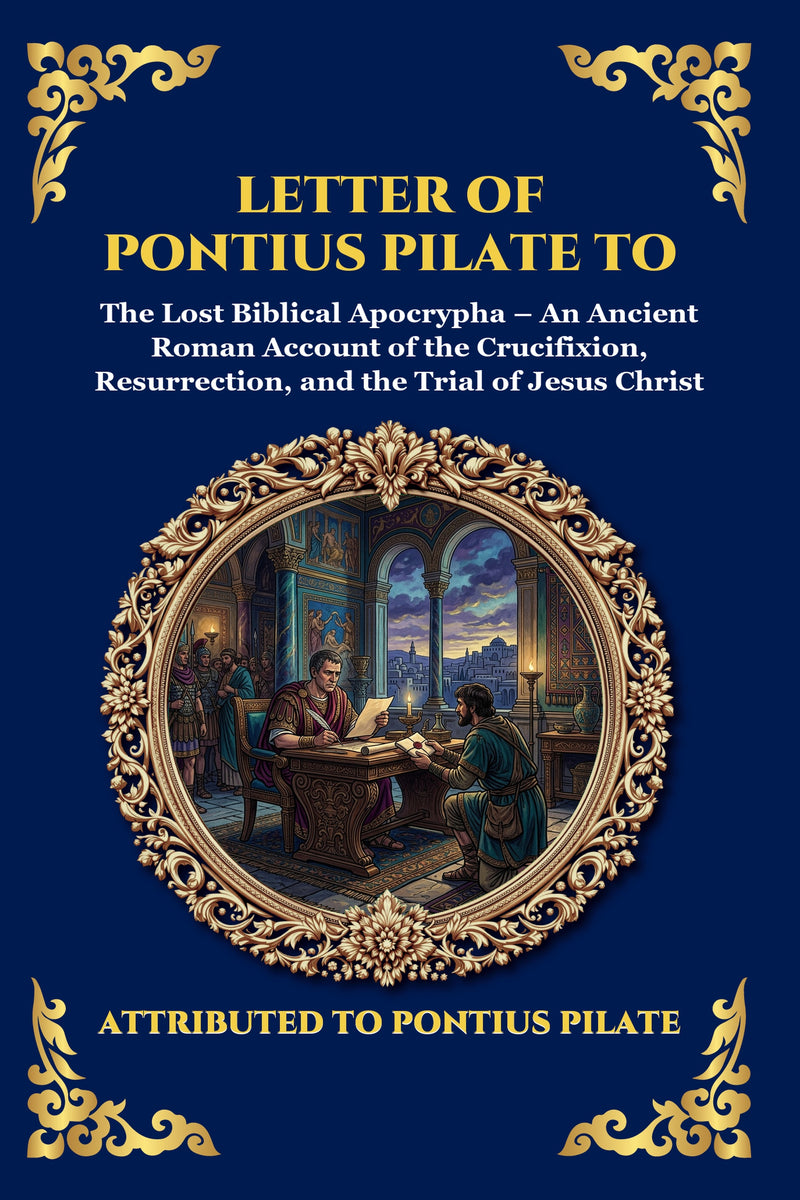
Letter of Pontius Pilate to Claudius — Large Print
Pontius Pilate's letter to Emperor Claudius offers a rare Roman perspective on the trial and crucifixion of Jesus of Nazareth. Lost to history and excluded from the Bible, it claims to document the supernatural events that left Pilate questioning the limits of Roman authority.
or free app
10,000+ hrs library
30-day guarantee
This ancient apocryphal letter from Pontius Pilate to Emperor Claudius receives a complete modern English translation, readable online with audiobook narration included for members.
Large Print Edition. The complete, unabridged text set in a larger, easy-on-the-eyes typeface for comfortable reading.
Have you ever wondered why the Roman perspective on the trial of Jesus Christ was lost to history, and what Pontius Pilate truly thought of the man he condemned?
The Letter of Pontius Pilate to Claudius presents a captivating and controversial piece of ancient literature. This apocryphal text claims to be the direct correspondence from Pontius Pilate, the Roman governor of Judea, to Emperor Claudius, detailing the miraculous events surrounding Jesus of Nazareth.
Far more than a simple administrative report, this letter delves into the profound supernatural occurrences that Pilate allegedly witnessed and investigated. It describes the trial, the immense pressure from the local religious leaders, the crucifixion, and the baffling empty tomb that followed. It offers a unique lens through which to examine the intersection of Roman authority and early Christian narrative, stripping away centuries of tradition to present a purely bureaucratic, imperial view of a world-changing event.
This modern, accessible translation ensures that the historical and theological nuances of this fascinating document remain clear and impactful for today’s readers. It challenges conventional historical narratives and invites readers to explore the profound mysteries of faith from a political viewpoint.
What You Will Discover in This Modern Translation:
- The Roman Account of the Trial — Explore the bureaucratic and political complexities Pilate faced when judging Jesus of Nazareth.
- The Crucifixion and Supernatural Events — Read the purported Roman documentation of the darkening of the sky, the earthquake, and the resurrection.
- Insights into First-Century Judea — Gain a deeper understanding of the religious and political landscape that shaped the early days of Christianity.
- The Defense of a Roman Governor — Examine how Pilate attempts to justify his actions and explain the unstoppable rise of a new faith to his Emperor.
Whether you are exploring this work for its historical curiosity, its apocryphal significance, or its unique narrative angle, The Letter of Pontius Pilate to Claudius offers a thought-provoking experience.
Step into the sandals of a Roman Prefect and discover the timeless intrigue of this ancient letter. Begin your journey into the lost apocrypha today.
| Formats | eBook (EPUB + PDF) · Audiobook · Paperback · Hardcover · Large Print |
| Language | English |
| Trim size (print) | 6 × 9 in |
| Binding | Paperback — perfect-bound · Hardcover — casewrap |
| Large Print edition | Same text in a larger, easy-read type — a larger font, not a larger trim |
| Print pricing | Every physical book at our true cost — at-cost, no profit (members) |
| Library | 873 restored titles, always growing |
| Length | 2,885 words · ~12 min reading |
| Reading level | Grade 14 · rich, literary prose (this modern-English edition) |
| Edition | Modern English translation · 2026 |
Member reviews for this edition are collected as readers finish it — be the first. Across the library: 12,000+ books shipped, every plan covered by a 365-day print guarantee.
About this edition
The complete, unabridged text in clear modern English — faithful to the original, never simplified. Every paragraph is checked against the source, so nothing is cut, summarised, or paraphrased away. It reads cleanly for today while keeping the original meaning intact.
- Complete & unabridgedVerified paragraph by paragraph against the source — never a scan, never abridged.
- Modern English, faithfulReadable today, with the author’s meaning kept intact. Readable — not simplified.
- Every format, one membershipRead in your browser or the free app, or listen to the full audiobook.
Included free with your membership
Cancel anytime, one click · 30-day money-back guarantee
Edition last updated June 2026
What’s inside
Letter of Pontius Pilate to Claudius — Large Print — complete and unabridged: all 5 sections included with membership, plus the full audiobook.
Begin reading Letter of Pontius Pilate to Claudius — Large Print
In clear modern English — the complete text is included with membership.
The World That Produced This Document
To understand what this letter is and why it exists, we need to understand something about the world in which it circulated. The first several centuries of the Common Era were a period of extraordinary textual productivity in and around the early Christian communities. Alongside the texts that would eventually be canonized as the New Testament, dozens — perhaps hundreds — of other documents were produced, circulated, argued over, and variously accepted or rejected by different communities in different places. These texts included additional gospels, acts of apostles not covered in the canonical Acts, letters attributed to figures from the early church, apocalypses, and a particularly fascinating category known as the Pilate literature.
The Pilate literature is a body of early Christian apocryphal texts that centers on the figure of the Roman prefect and his role in the crucifixion. It includes the Gospel of Nicodemus (also known as the Acts of Pilate), the Report of Pilate to Tiberius, the Giving Up of Pilate, the Death of Pilate, and several other related texts. These documents vary enormously in their tone, their theological content, and their apparent purpose. Some seem designed to exonerate Pilate, to present him as a secret sympathizer with Christianity, even as a proto-Christian himself. Others use him as a vehicle for detailed theological reflection on the meaning of the crucifixion and resurrection. Still others read almost like legal documents — formal depositions, official reports, the language of Roman bureaucracy pressed into service for Christian apologetic purposes.
The existence of this entire literary tradition tells us something important about the anxieties and aspirations of early Christianity. The movement was operating in a Roman world, under Roman law, and the fact that its founder had been executed by Roman authority was a theological problem as much as a historical one. How could the Messiah, the Son of God, the Lord of creation, have been killed by a Roman prefect acting on behalf of the Jewish priestly establishment? The Pilate literature represents, in part, an extended attempt to answer that question — to process the scandal of the crucifixion by examining it from every possible angle, including the angle of the man who signed the execution order.
There is also a more immediately practical dimension to this literature. Early Christian communities faced regular accusations from their Roman neighbors and from Roman authorities. They were suspected of sedition, of atheism (in the Roman sense of refusing to honor the traditional gods), of various antisocial practices. One of the most effective responses to these accusations was to point to official Roman records — or to texts that claimed to be official Roman records — that testified to the innocence of Jesus and to the miraculous nature of the events surrounding his death and resurrection. If Pilate himself had reported to the emperor that something extraordinary had happened in Judaea, that the man he executed had apparently returned from the dead, that the heavens and the earth had responded to his death with signs and wonders — well, that was a powerful piece of evidence to place before a skeptical Roman audience.
This apologetic function helps explain some of the document's most distinctive features. The letter is addressed not to Tiberius, who was actually emperor during the time of the crucifixion, but to Claudius, who reigned from 41 to 54 CE. This anachronism has been noted by scholars since the medieval period and is one of the primary arguments against the letter's authenticity as a genuine Roman document. But if we understand the text as a piece of early Christian apologetics rather than an actual official dispatch, the anachronism becomes less puzzling. Claudius was the emperor under whom the early church was expanding most rapidly into the heart of the Roman world. He was the emperor who, according to the historian Suetonius, expelled Jews from Rome because of disturbances connected with a figure named 'Chrestus' — a reference that many scholars believe points to early Christian missionary activity. Addressing a letter to Claudius placed the testimony of Pilate squarely in the context of the empire's first serious encounters with the Christian movement.
The textual history of the letter is itself a fascinating and complicated story. The text has survived in Greek and Latin versions, with significant variations between them, suggesting a complex transmission history involving multiple copyings, translations, and likely some degree of editorial intervention at various points. The earliest clear reference to a document of this type comes from the Christian apologist Justin Martyr, writing in the mid-second century, who refers to 'Acts of Pontius Pilate' as documents that could be consulted in the imperial archives in Rome. Whether Justin was referring to actual official Roman records, to a text like the one in this volume, or to something else entirely, is a matter of ongoing scholarly debate. Tertullian, writing around the turn of the third century, makes a similar claim, asserting that Pilate sent a report to Tiberius about Jesus that caused the emperor to propose his deification to the Roman Senate. Eusebius of Caesarea, the great church historian of the fourth century, refers to forged anti-Christian 'Acts of Pilate' that were circulated by pagan opponents of Christianity — which itself implies the existence of pro-Christian Pilate documents that the forgeries were designed to counter.
What we can say with reasonable confidence is that by the fourth and fifth centuries, documents purporting to be official Roman accounts of the trial and execution of Jesus were in wide circulation in Christian communities across the Mediterranean world. They were read, copied, translated, debated, and in some cases incorporated into liturgical practice. They filled a genuine need — for corroboration, for alternative perspectives on the central events of Christian faith, for the imaginative satisfaction of hearing the story told by voices other than those of the disciples. They represent the ancient world's equivalent of what we might today call historical fiction or creative nonfiction: attempts to inhabit a documented historical moment from the inside, to give voice to the figures who were present but whose testimony has not been directly preserved.
Understanding the document in this context does not diminish it. If anything, it enriches it. We are not dealing with a simple fraud or a naive forgery. We are dealing with a sophisticated piece of early Christian writing that engages seriously with questions of history, testimony, and the nature of miraculous events. We are dealing with a community of readers who wanted to think carefully about what Pontius Pilate might have made of what he witnessed, and who found in that imaginative exercise a genuinely productive way of exploring their own faith. The letter invites us to join that exercise — to sit with the discomfort and the wonder of an official Roman report that cannot quite contain what it is trying to describe.
Reading the Letter Today
There is a particular kind of reading experience that only very old texts can provide, and it has nothing to do with whether those texts are historically accurate or literarily sophisticated in the ways we normally value. It is the experience of genuine temporal vertigo — the sensation of reaching across an enormous gulf of time and touching something that was once alive in a way that is qualitatively different from anything a modern author can manufacture. When you read this letter, even knowing everything that scholarship has established about its complicated origins and uncertain authenticity, you are reading something that was composed by a human being who lived in a world almost unimaginably different from our own, who cared deeply about the events described in these pages, and who chose this particular form — the official letter, the bureaucratic report — as the vessel for that caring. That is worth something. That is worth a great deal.
The letter is short. You could read it in fifteen minutes. But the experience of reading it well — of reading it with the kind of attention it deserves and the kind of preparation that allows its full strangeness to register — requires considerably more than fifteen minutes. It requires knowing something about who Pontius Pilate was and what his world looked like. It requires knowing something about the literary tradition in which the text participates and the theological questions it was designed to address. It requires knowing something about the history of the text itself — how it was transmitted, how it was received, what different communities across different centuries made of it. All of that context is what this volume is designed to provide.
But context, however essential, is only preparation. The text itself must ultimately be encountered directly, and the best way to encounter it is with a kind of double consciousness — holding simultaneously the scholarly awareness of what this document is and is not, and the imaginative openness to what it might be. Let yourself hear it as an official dispatch from a troubled Roman prefect. Let yourself feel the strangeness of its voice — formal and yet shaken, bureaucratic and yet reaching toward something that bureaucracy cannot name. Let yourself notice the moments where the language strains against the weight of what it is trying to convey, where the Roman official's vocabulary proves inadequate to the events it is attempting to record. Those moments of strain are among the most interesting things in the text.
One of the most striking aspects of reading this letter in the twenty-first century is how contemporary some of its concerns feel. Pilate, as he is presented here, is a man caught between institutional demands and personal perception, between what his position requires him to say and what his experience compels him to acknowledge. He is a man writing an official report about events that exceed the categories of official reporting. There is something in that predicament that resonates with a great deal of modern experience — the experience of trying to fit genuinely extraordinary or inexplicable events into the forms and formats that institutions provide for the recording of ordinary ones. The letter's peculiar power comes in part from this tension between form and content, between the cool register of Roman administrative prose and the hot, bewildering reality it is attempting to describe.
For readers who come to this text from a position of Christian faith, the letter offers something that the canonical Gospels, for all their incomparable richness, cannot quite provide: external corroboration from an unlikely source. There is a particular kind of theological resonance in hearing the story of the resurrection reported not by a disciple, not by a believer, not by someone whose life was transformed by what they witnessed, but by the man who ordered the execution — the man who had every professional and personal reason to want the story to end with a sealed tomb and a detachment of guards. When even that man finds himself writing to his emperor about empty tombs and inexplicable appearances, the testimony carries a different kind of weight. It is not the weight of faith but the weight of reluctant acknowledgment, and that is, in its own way, a powerful thing.
For readers who come to this text from a position of historical curiosity or secular interest, the letter offers a different kind of reward. It is a window into the early Christian imagination — into the way that the first generations of believers thought about their own story, about the evidence they found compelling, about the voices they most wanted to recruit to their cause. The choice of Pilate as narrator is itself a theologically and rhetorically sophisticated move. Of all the possible witnesses to the crucifixion and resurrection, Pilate is the one whose testimony would be most valuable to a movement trying to establish its credibility in the Roman world. He is Roman, he is official, he is the representative of the very power that carried out the execution. His conversion — or even his mere acknowledgment that something extraordinary occurred — is the ultimate corroboration. The document's existence tells us that early Christians understood this perfectly well.
For readers who are primarily interested in questions of literature and textual history, the letter raises a set of questions that are genuinely fascinating and not yet fully resolved. How was this text composed? From what sources did its author or authors draw? What is the relationship between the various surviving versions? How did the text circulate, and through what communities and traditions? What does its reception history tell us about the changing needs and anxieties of Christian communities across the centuries? These are questions that scholars have been working on for generations, and this volume engages with the best of that scholarship while remaining accessible to readers who are encountering the material for the first time.
There is also a more personal dimension to the reading experience that deserves acknowledgment. This is a text about death and what may or may not lie beyond it. It is a text about the limits of human understanding, about the moments when the world presents us with something that our existing frameworks cannot accommodate. It is a text about power and its limits — about what happens when an institution built on the assumption of its own permanence and authority encounters something that does not recognize that authority and cannot be contained by that permanence. These are not merely ancient concerns. They are among the most urgent concerns of any human life, in any century, in any culture. The letter speaks to them in a voice that is strange and old and not entirely our own, but the questions it raises are ones we recognize immediately.
Cancel anytime, one click · 30-day money-back guarantee
Founding annual rate available now — your price locks for life when you join.
Not ready? Get this free chapter by email — read it anytime.
✓ Sent — check your inbox for Letter of Pontius Pilate to Claudius — Large Print.
Questions about Letter of Pontius Pilate to Claudius — Large Print
Is the Letter of Pontius Pilate to Claudius authentic?
Mainstream scholarship considers this letter pseudepigraphic, meaning it was written by an unknown author using Pilate's name. No contemporary Roman records mention such correspondence, and the text shows characteristics of later Christian composition.
Why was this letter not included in the Bible?
The Letter of Pontius Pilate to Claudius was never considered for biblical inclusion by early church councils. It belongs to apocryphal literature that developed outside the canonical tradition and lacks the historical authenticity required for scriptural acceptance.
Is Letter of Pontius Pilate to Claudius free to read?
The opening of the text is free to read below. Members read and listen to the complete work — and the entire Lost & Forbidden Library — free.
What is Letter of Pontius Pilate to Claudius?
Have you ever wondered why the Roman perspective on the trial of Jesus Christ was lost to history, and what Pontius Pilate truly thought of the man he condemned?
How long is Letter of Pontius Pilate to Claudius?
5 chapters (~314 words) in this restored edition.
Which formats are available?
eBook and audiobook (included with membership), plus paperback, hardcover and large-print editions printed at cost.
Shipping & returns
Billing & membership
More from the library


Explore Lost Gospels & Acts
- The Lost Books of the Bible · Various early Christian authors
- Gospel of the Lots of Mary
- Gospel of the Twelve · Anonymous early Christian writers
- Infancy Gospel of Thomas · Attributed to Thomas the Israelite
- Gospel of the Hebrews · Attributed to early Jewish-Chri...
- Acts of Thomas
- Gospel of the Savior · Anonymous (Early Christian Author)
- Acts of Saturninus
- Death of Pilate · Attributed to various early Chr...
- Doctrine of Addai · Attributed to Thaddeus of Edessa
- Gospel of the Nativity of Mary · Attributed to St. Matthew
- Toledot Yeshu
- Papyrus Berolinensis 22220
- Oxyrhynchus Papyrus 1224
- Correspondence of Jesus and Abgar · Attributed to Eusebius of Caesarea
- Papias: Expositions of the Sayings of the Lord · Attributed to Papias of Hierapolis
- Questions of John · Attributed to John the Apostle
- Narrative of Joseph of Arimathea · Attributed to Joseph of Arimathea
- Avenging of the Savior · Attributed to various early Chr...
- Report of Pilate to Caesar
- Letter of Pontius Pilate to Claudius
- Acts of Peter and Simon · Attributed to Leucius Charinus
- Acts of Andrew and Matthias in the City of the Cannibals · Attributed to early Christian a...
- Preaching of Peter · Attributed to the apostle Peter
- Egerton Gospel II
- Gospel of Barnabas
- Letter to the Laodiceans · Attributed to the Apostle Paul
- Diatessaron · Attributed to Tatian
- Descent of Christ into Hell (Harrowing of Hell) · Attributed to the Apostle Peter
- Acts of Pilate (Gospel of Nicodemus) · Attributed to various early Chr...
Letter of Pontius Pilate to Claudius — Large Print
The Letter of Pontius Pilate to Claudius
The Governor's Report to the Emperor — Pilate's Own Account of the Envy of the Priests, the Wonders of Jesus, the Crucifixion He Permitted, and the Resurrection His Soldiers Witnessed and Could Not Deny
Library of Alexandria Press
The Letter of Pontius Pilate to Claudius
© Copyright 2026 Library of Alexandria Press. All rights reserved.
Published by Library of Alexandria Press
Printed in the United States of America
It is not legal to copy, share, or send any part of this document in either digital or printed form without written permission from the publisher, except short quotes in a book review.
Table of Contents
Introduction
The World That Produced This Document
Reading the Letter Today
Chapter 1
Chapter 2
Introduction
Somewhere between history and legend, between the sacred and the political, between the dusty archives of Roman administration and the luminous pages of Christian scripture, there exists a document so strange, so provocative, and so endlessly debated that scholars have spent centuries arguing about whether it is a priceless historical artifact or an elaborate ancient forgery — and, perhaps more importantly, why it matters either way. This is a text that purports to be an official Roman report, written by one of history's most infamous bureaucrats, addressed to the emperor of the known world, describing events that would change the course of human civilization forever. It is a letter from a prefect to his emperor. It is a military governor's account of a provincial execution gone terribly, inexplicably wrong. And it is, depending on your perspective, either the most extraordinary corroboration of the Gospel narrative ever committed to parchment, or a masterwork of early Christian imagination.
The name Pontius Pilate is one of those rare historical designations that has transcended its original context so completely that it now exists almost independently of the man himself. We know the name from the Gospels, from the Nicene Creed recited by Christians every Sunday around the world, from centuries of art and literature, from Mikhail Bulgakov's novel and Andrew Lloyd Webber's rock opera and countless Hollywood epics. Pilate is the reluctant executioner, the hand-washer, the man who asked 'What is truth?' and then condemned the man who claimed to be it. He is a figure of profound moral ambiguity — neither villain nor hero, but something more unsettling than either. He is the face of institutional power confronting something it cannot categorize, cannot control, and ultimately cannot destroy.
Yet for all his cultural ubiquity, the historical Pilate remains remarkably elusive. Roman sources mention him briefly. The Jewish historian Josephus describes him in terms that are far less sympathetic than the Gospel accounts — a man capable of considerable brutality, of provocative disregard for Jewish religious sensibilities, of the kind of administrative arrogance that caused repeated unrest in an already volatile province. Philo of Alexandria paints an even darker portrait. The Pilate of secular history is not the thoughtful, conflicted figure of Christian tradition but something closer to a typical mid-level Roman official: ambitious, pragmatic, occasionally cruel, and deeply invested in maintaining the kind of order that kept his career on track. The tension between these two Pilates — the Gospel figure and the historical one — has fascinated theologians, historians, and readers for two millennia.
Into this tension steps the document at the heart of this volume. The text known as the Letter of Pontius Pilate to Claudius — sometimes called the Report of Pilate, or the Anaphora Pilati in its Greek form — is a short but extraordinarily dense piece of early Christian apocryphal literature. In it, the voice of Rome's most infamous prefect addresses an emperor directly, describing the trial of Jesus of Nazareth, the circumstances of his execution, and — most strikingly — the events that followed. The letter does not shy away from the miraculous. It does not offer the hedged, bureaucratic neutrality one might expect from an official Roman dispatch. Instead, it presents a Pilate who is shaken, uncertain, and perhaps even awed — a Roman administrator struggling to fit what he has witnessed into the categories his world has given him, and finding those categories catastrophically inadequate.
To read this text for the first time is to experience something genuinely unusual: the sensation of hearing a familiar story told in an entirely unfamiliar voice. The crucifixion narrative is one of the most retold stories in human history. Most of us, whether believers or not, whether raised in religious households or entirely secular ones, carry some version of it in our cultural memory. We know the broad outlines: the arrest, the trial, the crown of thorns, the cross, the darkness at noon, the death, the sealed tomb, the empty tomb. What we do not expect — what this document provides with startling effect — is the experience of encountering those events through the eyes of the man who ordered the execution, writing to his superior in the formal register of Roman official correspondence. The defamiliarization is immediate and profound. Suddenly the story feels new again, urgent and strange, stripped of the accumulated reverence of centuries and placed back in the raw, bewildering moment of its occurrence.
The question of the document's authenticity is one that this introduction will address at length, because it is impossible to read this text responsibly without understanding the scholarly debate that surrounds it. But it is worth pausing, before we enter that debate, to appreciate something that the debate itself can sometimes obscure: the remarkable literary and theological richness of this text regardless of its ultimate origin. Whether this letter was written by Pontius Pilate in the first century, or composed by an early Christian writer in the second or third century, or assembled from earlier sources at some later point, it represents a fascinating and underexplored window into the ancient world's engagement with the story of Jesus. It asks questions that the canonical Gospels do not ask, or ask differently. It offers a perspective that no other surviving text quite replicates. And it does so in language that is spare, direct, and — in its best moments — genuinely haunting.
Chapter 1
Pontius Pilate to Claudius, greeting.
There has recently come to light a matter which I myself uncovered: the Jews, through envy, have brought fearful judgment upon themselves and their descendants by their own doing. Their fathers had received the promise that their God would send down from heaven his Holy One, who would rightly be called their king, and that he would send him into the world through a virgin. He came during my governorship of Judea. The people saw him give sight to the blind, cleanse lepers, heal the paralyzed, drive demons out of men, raise the dead, rebuke the winds, and walk upon the waves of the sea with dry feet, along with many other wonders — and all the people of the Jews called him the Son of God. The chief priests, therefore, moved by envy against him, seized him and handed him over to me, bringing one false accusation after another, claiming that he was a sorcerer who acted against their law.
Chapter 2
I believed what they told me, and so I had him scourged and handed him over to their will. They crucified him, and when he was buried they posted guards at the tomb. But while my soldiers were keeping watch, he rose again on the third day. The malice of the Jews was so great that they paid money to the soldiers and told them to say that his disciples had stolen the body away. The soldiers took the money, yet they could not keep silent about what had actually happened — they have testified that they saw him risen, and that they accepted payment from the Jews to say otherwise. I have reported all of this to your imperial majesty for one reason: so that no one else might deceive you, and you might not be led to give credence to the false stories of the Jews.
End of the free sample
Keep reading, free
Members read and listen to the complete book — and the entire library. Cancel anytime, one click · 30-day money-back guarantee.