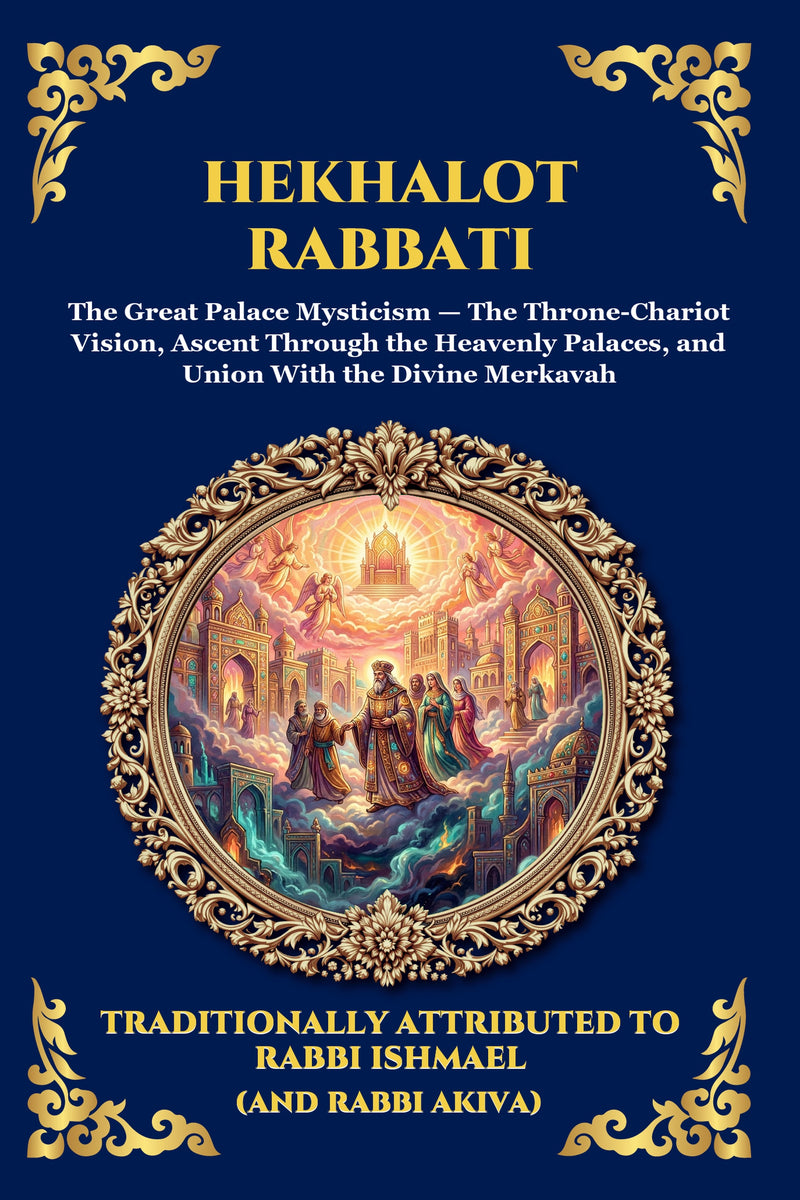
Hekhalot Rabbati — Large Print
Hekhalot Rabbati reveals the perilous ascent through seven heavenly palaces, a path only the most daring mystics dared to tread. Attributed to Rabbi Ishmael, this ancient text was excluded from the canon, preserving its secrets for those willing to face madness and death.
or free app
10,000+ hrs library
30-day guarantee
This 3rd-6th century AD foundational merkavah mysticism text Hekhalot Rabbati receives a complete modern-English translation with online reading access and audiobook narration through Library of Alexandria Press membership.
Large Print Edition. The complete, unabridged text set in a larger, easy-on-the-eyes typeface for comfortable reading.
Have you ever wondered why ancient mystics risked madness and death to gaze upon the divine throne of the universe?
In Hekhalot Rabbati, readers are invited into one of the most mysterious and closely guarded traditions of the ancient world. Attributed to the legendary sage Rabbi Ishmael, this visionary text serves as both a vivid spiritual narrative and an instruction manual for the boldest of seekers: the "Yordei Merkavah," or those who descend to the Chariot. Long before the widespread popularization of the Kabbalah, early Jewish mystics engaged in extreme ascetic practices, seeking to detach their souls from the physical world and ascend through the seven concentric palaces (Hekhalot) of the heavens.
This journey was not for the faint of heart. The text vividly describes a universe charged with unimaginable power and terrifying danger. At the gates of each celestial palace stand fearsome, fiery angelic guards who will instantly destroy any traveler lacking absolute purity and the correct mystical seals. Rabbi Ishmael acts as the ultimate spiritual guide, recounting his own miraculous ascent, his encounters with the supreme archangels, and the overwhelming, blinding majesty of the divine throne room.
Far more than a historical artifact, Hekhalot Rabbati is a masterpiece of religious poetry and esoteric wisdom. It introduces the hypnotic, rhythmic hymns sung by the angels—the Kedushah—and explores the profound theological belief that humanity can achieve direct, transformative contact with the Creator.
What You Will Discover in This Ancient Masterpiece:
- The Seven Celestial Palaces — Follow the perilous, step-by-step ascension through the heavens, unlocking the gates of the divine realms.
- The Secrets of the Merkavah — Explore the profound mysticism surrounding the Chariot of God, a foundational concept that shaped centuries of esoteric thought.
- Angelic Guardians and Mystical Seals — Learn about the terrifying celestial beings who guard the heavens and the secret names of power required to pass them safely.
- The Ecstatic Hymns of the Heavens — Experience the rhythmic, mesmerizing poetry and songs of praise utilized by ancient mystics to induce visionary states.
- The Roots of the Kabbalah — Gain a deeper understanding of the early rabbinic esoteric traditions that paved the way for modern Jewish mysticism.
Whether you are a scholar of religious history, a student of the Kabbalah, or a seeker drawn to the extreme limits of spiritual exploration, Hekhalot Rabbati offers an unforgettable journey.
Prepare to approach the gates of fire. Begin your ascent into the greater palaces today.
| Formats | eBook (EPUB + PDF) · Audiobook · Paperback · Hardcover · Large Print |
| Language | English |
| Trim size (print) | 6 × 9 in |
| Binding | Paperback — perfect-bound · Hardcover — casewrap |
| Large Print edition | Same text in a larger, easy-read type — a larger font, not a larger trim |
| Print pricing | Every physical book at our true cost — at-cost, no profit (members) |
| Library | 873 restored titles, always growing |
| Composed | 3rd-6th century AD |
| Original language | Hebrew |
| Source tradition | Medieval Hebrew manuscript tradition |
| Translation basis | Public-domain scholarly translation, rendered in clear modern English |
| Length | 22,565 words · ~1 hr 30 min reading |
| Reading level | Grade 11 · a confident, adult read (this modern-English edition) |
| Edition | Modern English translation · 2026 |
Member reviews for this edition are collected as readers finish it — be the first. Across the library: 12,000+ books shipped, every plan covered by a 365-day print guarantee.
About this edition
The complete, unabridged text in clear modern English — faithful to the original, never simplified. Every paragraph is checked against the source, so nothing is cut, summarised, or paraphrased away. It reads cleanly for today while keeping the original meaning intact.
Hekhalot Rabbati survives in medieval Hebrew manuscripts from various European collections. This edition derives from the standard public-domain scholarly translation and renders it in clear modern English.
- Complete & unabridgedVerified paragraph by paragraph against the source — never a scan, never abridged.
- Modern English, faithfulReadable today, with the author’s meaning kept intact. Readable — not simplified.
- Every format, one membershipRead in your browser or the free app, or listen to the full audiobook.
Included free with your membership
Cancel anytime, one click · 30-day money-back guarantee
Edition last updated June 2026
What’s inside
Hekhalot Rabbati — Large Print — complete and unabridged: all 41 sections included with membership, plus the full audiobook.
Begin reading Hekhalot Rabbati — Large Print
In clear modern English — the complete text is included with membership.
Chapter 1
Rabbi Ishmael said: What are the songs that one must recite who wishes to behold the vision of the Merkabah, to descend in peace and ascend in peace?
Greatest of all is this: that there are those who take care of him, who gather him in and bring him into the chambers of the palace of the seventh heaven, and cause him to stand at the right hand of the throne of the glory of God. For there are times when he stands before Tazash, the Lord God of Israel, and sees all that is done before the throne of His glory, and knows all that is destined to come to pass in the world: who shall be cast down and who exalted; who shall be weakened and who made strong; who shall be crushed by poverty and who made rich; who shall die and who shall live; from whom inheritance shall be taken and to whom it shall be given; who shall be granted the Torah as his portion and who shall be given Wisdom.
Greatest of all is this: that he sees all the deeds of human beings, even those they perform in their secret chambers, whether those deeds are honorable or corrupt. A man has stolen — he knows it and recognizes it. A man has committed adultery — he knows it and recognizes it. A man has committed murder — he knows it and recognizes it. A man is suspected of having lain with a woman during her uncleanness — he knows it and recognizes it. A man has spread slander — he knows it and recognizes it. Greatest of all is this: that he recognizes all those who practice sorcery.
Greatest of all is this: that any man who raises his hand against him and strikes him is clothed with scabs, covered with leprosy, and crowned with pox. Greatest of all is this: that any man who slanders him is visited with every kind of affliction — morbid growths and discolorations and wounds that break open into running sores.
Greatest of all is this: that he is set apart from all other human beings, exalted in all his deeds, and honored by those above and those below. If any man finds cause to take offense at him, great and evil and harsh offenses fall upon that man from heaven. And if any man stretches out his hand against him in contempt, the heavenly court of justice stretches out its hand against that man to remove him from the world.
Chapter 2: Heavenly Court and Powers of the Merkabah Seer
Greatest of all is this: that all people are set before him as silver before the refiner, so that he knows which is alloyed and which is pure. And beyond that, he sees into families — how many in a family are children of forbidden unions, how many are children born during their mother's impurity, how many have been wounded in the stones, how many have been cut off in their privy members, how many are children of slaves, how many are children of the uncircumcised, how many are unfit for the priesthood.
Greatest of all is this: that any man who hardens his face against him to contradict him is darkened from the light of his eyes. Greatest of all is this: that if any man treats him with contempt, he leaves behind neither root nor branch nor any inheritor. Greatest of all is this: that any man who spreads an evil report against him is consumed — his judgment is sealed and no mercy is shown to him.
Greatest of all is this: that in the heavenly court of justice, three times each day they sound the trumpets three times and pronounce the lesser excommunication, and then pronounce the greater excommunication, declaring: "Let him be excommunicated before Tazsh, the Lord God of Israel, before Him and before the throne of His glory and the crown upon His head, before the heavenly court of justice and the earthly court of justice, before all the host of heaven and all its servants — he who stands before one who beholds the Merkabah and then abandons him."
Songs and Rites of Merkabah Descent
Rabbi Ishmael said: This was the teaching concerning the vision of the Merkabah. One who beholds the Merkabah has no right to rise out of courtesy to a superior, except before three authorities alone: before a king, before a high priest, and before a Sanhedrin. Should he rise before any other, he would be guilty of death for having done so, and he would shorten his days and cut short his years.
Rabbi Ishmael said: What are the words of the songs that a man recites when he descends to the Merkabah? Let him begin and recite the principal songs: The beginning of praise and the opening of song, the beginning of jubilation and the opening of exultation — these are what the princes sing who serve the Lord God of Israel and the throne of His glory each day. They bear up the wheel of the throne of His glory: "Sing, sing for joy, supernal dwelling! Shout, shout for joy, precious vessel, made marvelously and a marvel. Surely you shall gladden the King who sits upon you, as the bridegroom rejoices in his bridal chamber, when I came to take refuge under the shadow of Your wings, in the joy of my heart that rejoiced in You."
Chapter 3: Praise-Generated Fire from Holy Mouths
From the praise and song of each day,
from the jubilation and exaltation of each hour,
and from the utterance that goes forth from the mouths of the holy ones,
and from the melody that wells up from the mouths of the servants,
mountains of fire and hills of flame
are piled up and hidden and poured out each day.
Vision of the Enthroned King of Miracles
"Why should you be frightened, faithful servant? Why should you be terrified, beloved servitor? I say to your face, Zoharariel, Lord God of Israel: if I am not frightened, who then shall be frightened? If I am not terrified, who then shall be terrified? For I am summoned before the Omnipotent six hours in each day, and a thousand times I am dragged to my knees until I touch the throne of glory." And then the voice would answer and say: "As for those who practice upon you those practices — reproach shall not be cast upon their words, nor shall anyone contradict their discourse, nor contradict their words."
His kingly servants behold the majestic King enthroned in the chambers of the palace of silence, dread and fear, holiness and purity.
King of miracles, King of powers, King of wonders, King transcendent. Your throne flies and yet stands still. Very many years, generations without end, have passed since You drove the peg for the weaving of the web on which the perfection of the world and all its excellence stand — and even yet Your throne has not rested its foot upon the firm ground of the seventh heaven, but like a bird in flight it flies and stands still.
The loftiest of the lofty, those whose brows are bound with diadems, and all the angels, the chief hypostases that You have created, stand harnessed beneath the throne of glory and hold it up continually with strength, might, and power. And they too have not rested their feet upon the firm ground of the seventh heaven, but like birds in flight they fly and yet stand still.
And three times each day the throne of Your glory prostrates itself before You and says: "Zoharariel, Lord God of Israel, pray be seated upon me, O splendid King, for Your burden is a delight to me and weighs not heavily upon me."
Chapter 4: Garment of Zoharariel and Its Measures
Wonderful loftiness and strange lordship — the loftiness of exultation and the lordship of splendor — with which the angel of the presence conducts himself three times each day in the heavenly court of justice, as he goes and comes upon the seventh heaven, which is above the heads of the cherubim and above the heads of the ophanim and above the heads of the holy beasts. And the cherubim and the ophanim and the holy beasts are harnessed and stand beneath the throne of glory. And when they behold anyone in the height, as he goes and comes upon the seventh heaven, they are terrified and frightened and faint and fall backward, for no creature is able to reach that place — not within a distance of one hundred and eighty-five thousand myriad parasangs — because of the streaming fires that flow and pour forth from the mouths of the cherubim and from the mouths of the ophanim and from the mouths of the holy beasts, who open their mouths to say "Holy" when Israel says before Him "Holy."
A measure of holiness, a measure of dominion, a measure of fearfulness, a measure of consternation, a measure of trembling, a measure of shaking, a measure of terror, a measure of panic — such is the measure of the garment of Zoharariel, Lord God of Israel, who comes crowned to the throne of His glory.
Inscription, Vision, and Incomparable Kingship
And it is engraved in its entirety, within and without, with the words: The Lord, The Lord. And the eye of no creature is able to behold it — not the eyes of flesh and blood, and not the eyes of His servants. As for one who does behold it, or glimpses or sees it, hallucinations seize the pupils of his eyes, and the pupils of his eyes emit and send forth torches of fire, and these ignite him and these burn him. Why? Because of the measure of the garment of Zoharariel, Lord God of Israel, who comes crowned to the throne of His glory. And pleasant and sweet is His beauty, like the appearance of the beauty of the glory of the majesty of the eyes of the likeness of the holy beasts.
Who is like our King among all the lofty ones who lay hold of kingship? Who is like our Maker? Who is like the Lord our God? Who is like Him among those who bind the knots of diadems? For with six voices do the supernal servants — the bearers of the throne of His glory, the cherubim and the ophanim and the holy beasts — sing before Him, for each voice is exalted beyond its fellows and differs from the one that came before it.
Chapter 5: Songs of the Merkabah and Their Singers
The first voice: everyone who hears it immediately cries out and prostrates himself. The second voice: everyone who hears it immediately falls into confusion and never recovers. The third voice: everyone who hears it is immediately seized by convulsions and dies. The fourth voice: everyone who hears it immediately has the skull of his head and his body shattered, and most of the ends of his ribs are torn out. The fifth voice: everyone who hears it immediately pours himself out like a vessel and dissolves utterly into blood. The sixth voice: everyone who hears it is immediately seized at the heart by a fierce fire; his heart churns and overturns his innermost bowels, and his bile dissolves within him like water.
Who is like our King? Who is like our Maker? Who is like the Lord our God? The sun and the moon emit and send forth the crown upon his head. The Pleiades and Orion and the morning star, constellations and stars and planets, flow and stream forth from the garment of him who sits crowned upon the throne of his glory. And he sends forth a great light from between his eyes. For he is King of miracles, King of powers, King of wonders, King transcendent.
Rabbi Ishmael said: All these songs Rabbi Akiva heard when he descended to the Merkabah, and he seized hold of them and learned them before the throne of God's glory, for there his servants sang them before God.
Decree Against the Ten Martyrs
Rabbi Ishmael said: It was the fifth day of the week when devastating tidings came from the great city of Rome, saying: "Four men from among the mighty of Israel have been seized — Rabbi Shimon ben Gamaliel and Rabbi Ishmael ben Elisha and Rabbi Elazar ben Dama and Rabbi Judah ben Baba; and eight thousand students from Jerusalem shall be their ransom."
When Rabbi Nehunya ben Hakkanah saw this decree, he immediately caused me to descend to the Merkabah, and I questioned Surya, the Prince of the Presence. He said to me: "The heavenly court of justice wrote down ten men and handed them over to Samael the wicked, the ruling power of Rome, saying: 'Go and destroy from among the mighty of Israel every worthy member, thigh and shoulder, to fulfill the decree: He who steals a man and sells him, or in whose hand the stolen man is found, shall surely be put to death. The sons of Jacob stole their brother Joseph and sold him — what then shall be done concerning them?' Authority was at once given to Samael to destroy ten of the mighty in their stead, in order to fulfill the decree. But a vengeance yet to be avenged upon him is stored up against him until the time comes when the Lord shall punish the host of the high ones on high, and he shall be cut down and cast upon the earth, he and all the princes of the kingdoms in the heights, like the goats and sheep of the Day of Atonement."
Cancel anytime, one click · 30-day money-back guarantee
Founding annual rate available now — your price locks for life when you join.
Not ready? Get this free chapter by email — read it anytime.
✓ Sent — check your inbox for Hekhalot Rabbati — Large Print.
Questions about Hekhalot Rabbati — Large Print
What is Hekhalot Rabbati and what does it contain?
Hekhalot Rabbati is an ancient Jewish mystical text describing visionary journeys through seven heavenly palaces (hekhalot). It contains detailed accounts of merkavah (divine chariot) mysticism, angelic encounters, and esoteric practices for achieving mystical ascent to the divine throne.
Why wasn't Hekhalot Rabbati included in the biblical canon?
Hekhalot Rabbati was composed centuries after the biblical canon was established and belongs to the merkavah mysticism tradition rather than biblical literature. Its esoteric content and later composition date placed it outside mainstream rabbinic literature.
Who actually wrote Hekhalot Rabbati?
While attributed to Rabbi Ishmael, Hekhalot Rabbati was likely composed by anonymous Jewish mystics between the 3rd-6th centuries AD. The attribution to Rabbi Ishmael is pseudepigraphic, a common practice in ancient mystical literature to lend authority.
Is Hekhalot Rabbati free to read?
The opening of the text is free to read below. Members read and listen to the complete work — and the entire Lost & Forbidden Library — free.
What is Hekhalot Rabbati?
Have you ever wondered why ancient mystics risked madness and death to gaze upon the divine throne of the universe? In Hekhalot Rabbati, readers are invited into one of the most mysterious and closely guarded traditions of the ancient world.
How long is Hekhalot Rabbati?
41 chapters (~22,737 words) in this restored edition.
Shipping & returns
Billing & membership
More from the library


Explore More Apocryphal Texts
- The Long Lost Friend · Attributed to John George Hohman
- Ars Notoria · Attributed to King Solomon
- Vision of Drythelm · Attributed to the Venerable Bede
- Susanna, Bel and the Dragon · Attributed to the prophet Daniel
- Sefer ha-Razim
- Sefer Yetzirah · Attributed to the patriarch Abr...
- Hekhalot Rabbati · Attributed to Rabbi Ishmael
- The Life of St. Symeon the Stylite · Attributed to Antonius
- The Lausiac History · Attributed to Palladius of Galatia
- The Life of Saint Antony · Attributed to Athanasius of Ale...
- Navigatio Sancti Brendani
- Vision of Tundal
- Book of the Mysteries of Heaven and Earth · Attributed to early Jewish mystics
- Habakkuk Pesher · Attributed to the Qumran community
- Kebra Nagast · Attributed to Ethiopian scribes
- Pseudo-Philo: Biblical Antiquities · Attributed to Pseudo-Philo
- Treatise on the Three Natures · Attributed to Vasubandhu
- Wisdom of Jesus ben Sirach · Attributed to Joshua ben Sira
- Judith · Attributed to Various Jewish au...
- Tobit
- Aristides: Apology · Attributed to Aristides of Athens
- Acta Archelai · Attributed to Hegemonius
- Falling Asleep of Mary · Attributed to John the Theologian
- Treatise on the Resurrection · Attributed to Athenagoras of At...
Hekhalot Rabbati — Large Print
Hekhalot Rabbati
The Greater Palaces – The Ancient Masterpiece of Jewish Mysticism, Celestial Ascension, and the Secrets of the Divine Throne
Library of Alexandria Press
Hekhalot Rabbati
© Copyright 2026 Library of Alexandria Press. All rights reserved.
Published by Library of Alexandria Press
Printed in the United States of America
It is not legal to copy, share, or send any part of this document in either digital or printed form without written permission from the publisher, except short quotes in a book review.
Table of Contents
Introduction
Chapter 1
Chapter 2
Chapter 3
Chapter 4
Chapter 5
Chapter 6
Chapter 7
Chapter 8
Chapter 9
Chapter 10
Chapter 11
Chapter 12
Chapter 13
Chapter 14
Chapter 15
Chapter 16
Chapter 17
Chapter 18
Chapter 19
Chapter 20
Chapter 21
Chapter 22
Chapter 23
Chapter 24
Chapter 25
Chapter 26
Chapter 27
Chapter 28
Chapter 29
Chapter 30
Chapter 31
Chapter 32
Chapter 33
Chapter 34
Chapter 35
Chapter 36
Chapter 37
Chapter 38
Chapter 39
Chapter 40
Introduction
There are books that inform, books that entertain, and books that transform. And then there are texts so ancient, so strange, and so luminous that they seem to belong to an entirely different category of human experience altogether — texts that do not merely describe the sacred but attempt to convey the very texture of it, the overwhelming, terrifying, magnificent weight of standing in the presence of something utterly beyond human comprehension. The work you are holding belongs to this last and rarest category. It is one of the oldest and most extraordinary documents in the entire history of Jewish mysticism, a text that has fascinated scholars, mystics, and seekers for well over a millennium, and yet remains largely unknown outside specialized academic circles. That obscurity is one of the great injustices of religious literary history, and this edition is an attempt, however modest, to begin correcting it.
To understand why this text matters so profoundly, it helps to begin not with the text itself but with the world that produced it. Imagine the ancient Near East in the centuries following the destruction of the Second Temple in Jerusalem in 70 CE. The catastrophe was not merely political or military — it was theological. The Temple had been the axis mundi of Jewish religious life, the single place on earth where heaven and earth were understood to touch, where the divine presence, the Shekhinah, was believed to dwell in a particular and concentrated way. The rituals performed there, the sacrifices, the incense offerings, the elaborate liturgical calendar, the sacred music of the Levites — all of this was understood not merely as ceremony but as cosmic maintenance, as the human contribution to the ongoing order of creation. When the Romans destroyed it, they did not merely demolish a building. They severed, or so it seemed, the umbilical cord connecting humanity to the divine.
Out of this rupture came one of the most creative and anguished periods in the history of religious thought. The rabbis who gathered at Yavneh and elsewhere worked to rebuild Judaism around the Torah, the synagogue, and the life of the community. Prayer would substitute for sacrifice; study would substitute for priestly ritual; the home table would become a kind of altar. This was an extraordinary achievement, the foundation of the Judaism that has persisted to the present day. But it was not the only response to the catastrophe. Alongside the rabbinic mainstream, and sometimes overlapping with it in complex and fascinating ways, there developed a tradition of mystical speculation and practice that sought a different kind of answer to the problem of divine absence. If the Temple was gone, if the physical gateway to heaven had been destroyed, perhaps there were other gateways. Perhaps a sufficiently prepared, sufficiently pure, sufficiently courageous soul could ascend through the heavens on its own — could make the journey that the High Priest had once made into the Holy of Holies, but now undertaking it not through physical space but through the inner architecture of the cosmos itself.
This is the tradition known as Merkabah mysticism, from the Hebrew word for chariot, a reference to the divine chariot-throne described in the opening chapter of the Book of Ezekiel. The Merkabah mystics — and we should be careful here, because we know frustratingly little about who they actually were, how they organized themselves, or exactly when and where they practiced — were concerned above all with the vision of the divine throne. They sought, through elaborate preparation, through fasting and prayer and the recitation of sacred names and hymns, to ascend through the seven heavens, to pass through the gates guarded by terrifying angelic beings, and to arrive at last in the innermost palace, the seventh of the seven, where the throne of glory stood and where the divine presence could be, however briefly and dangerously, perceived.
The text before you is the central document of this tradition, the one that scholars have long regarded as the most comprehensive, most dramatic, and most theologically rich of all the surviving Merkabah texts. It is structured around a series of interconnected narratives and hymns, framed as the teachings of Rabbi Ishmael, one of the great sages of the Mishnaic period, who receives instruction from Rabbi Nehuniah ben HaKanah, a figure associated in Jewish tradition with mystical knowledge and the recitation of a famous prayer for protection. Through their voices, and through the voices of other sages and the angels they encounter, the text unfolds a vision of the cosmos that is at once terrifyingly vast and intimately personal, a universe structured around the divine throne and animated by an endless liturgy of praise.
What makes this text so remarkable is not merely its antiquity or its historical importance, though both are considerable. It is the quality of the writing itself, the sheer visionary power of its descriptions, the way it manages to convey something that by definition cannot be conveyed — the experience of encountering the divine in its most concentrated and overwhelming form. The descriptions of the heavenly palaces, with their gates of fire and their angelic guardians, their rivers of flame and their thrones of glory, have a hallucinatory vividness that has never been surpassed in the literature of Jewish mysticism. The hymns embedded in the text, the songs that the angels sing before the throne, are among the most beautiful liturgical poetry in any religious tradition. And the narrative framework, with its careful attention to the dangers of the ascent and the precise protocols required to navigate it safely, gives the whole work a dramatic tension that keeps the reader in a state of sustained, almost breathless attention.
It is worth pausing here to address a question that any thoughtful reader will naturally raise: what exactly is the status of this text? Is it scripture? Is it literature? Is it a practical manual for mystical practice? Is it theology? The honest answer is that it is all of these things and none of them entirely, and that this very resistance to easy categorization is part of what makes it so fascinating. It was not included in the Hebrew Bible, and it was never given the canonical status of, say, the Mishnah or the Talmud. But neither was it treated as mere fiction or entertainment. The tradition that produced it regarded these accounts as genuine reports of genuine experiences, as descriptions of what actually happened when a properly prepared mystic undertook the heavenly ascent. Whether we, reading from the vantage point of the twenty-first century, choose to interpret these accounts literally, symbolically, psychologically, or in some other way entirely is a question each reader must answer for themselves. What is not in question is the seriousness and the sincerity with which the text was composed and transmitted.
Navigating the Heavenly Architecture
One of the first challenges facing a new reader of this tradition is simply orienting oneself within its distinctive cosmological framework. The world described in these pages is not the world of Genesis, though it grows from the same root. It is a world of layered heavens, each one more overwhelming than the last, each one populated by angelic beings of terrifying power and beauty, each one structured around the central reality of the divine throne. To enter this world requires a certain willingness to suspend the categories and assumptions of ordinary experience and to follow the text into a mode of perception that is simultaneously more abstract and more intensely sensory than everyday consciousness.
The seven heavens of the Merkabah tradition are not simply a cosmological map, though they function as one. They are also a kind of psychological or spiritual topology, a description of the stages through which consciousness must pass in order to approach the divine. Each heaven has its own character, its own angelic population, its own dangers and its own wonders. The lower heavens are closer to the human world and more comprehensible, though still far beyond ordinary experience. As the mystic ascends, the heavens become progressively more intense, more alien, more saturated with divine energy, until the seventh heaven is reached and the mystic stands at the threshold of the innermost palace, the very dwelling place of the divine presence.
The palaces themselves — and the Hebrew word used, hekhalot, gives this entire body of literature its name — are described with an architectural precision that is simultaneously literal and symbolic. They have gates, and the gates have guardians, and the guardians must be shown the proper seals and recited the proper names before they will allow passage. This emphasis on protocol and procedure is one of the most distinctive features of the tradition, and it is important to understand it correctly. It is not mere bureaucracy, not a kind of celestial red tape. It reflects a deep theological conviction that the divine realm is ordered by justice and holiness, that approach to the divine requires preparation and worthiness, and that the power available to one who successfully makes the ascent is so immense that it cannot be entrusted to the unprepared or the impure.
The figure of the Sar ha-Torah, the Prince of the Torah, is one of the most intriguing elements of the text's cosmological system. This angelic being is associated with the transmission of divine wisdom, and the rituals described for invoking his assistance are among the most elaborate in the entire tradition. The connection between the heavenly ascent and the acquisition of Torah knowledge is not incidental — it reflects a fundamental conviction that the deepest understanding of the divine teaching cannot be achieved through study alone but requires a direct encounter with the heavenly source from which the Torah itself descends. In this sense, the mystical ascent is not an alternative to Torah study but its ultimate fulfillment, the moment when the human mind encounters directly the wisdom that the written and oral Torah can only approximate.
The angels who populate this cosmological system deserve special attention, because they are unlike the angels of popular imagination in almost every respect. They are not gentle winged messengers, not the benevolent guardians of Christian iconography. They are beings of almost incomprehensible power and intensity, creatures of fire and light whose very appearance is dangerous to behold. The text describes them with a kind of awed precision that suggests firsthand experience rather than literary invention — the way their faces shine, the way their voices thunder, the way their mere presence causes the mystic to tremble and nearly lose consciousness. And yet they are also, in a profound sense, colleagues and teachers. The relationship between the ascending mystic and the angelic guardians is not simply one of obstacle and passage but one of recognition and initiation. The angels test the mystic not to prevent ascent but to ensure that only the truly worthy proceed.
The divine throne itself, the Merkabah that gives the tradition its name, is described in terms that draw heavily on Ezekiel's vision but go far beyond it in elaboration and intensity. It is not merely a seat of power but a living reality, surrounded by the four living creatures of Ezekiel's vision, attended by the seraphim of Isaiah's temple vision, the focal point of an eternal liturgy that encompasses all of creation. The hymns sung before the throne are not decorative additions to the text but its theological heart — they express, in the concentrated language of poetry and praise, the fundamental conviction that the entire cosmos exists for the purpose of glorifying the divine, that every creature from the highest angel to the humblest human being participates in an endless song of acknowledgment and wonder.
For the reader coming to this material for the first time, it may be helpful to think of the text not as a linear narrative to be followed from beginning to end but as a kind of multidimensional space to be explored. It has a structure, certainly, and that structure rewards careful attention. But it also has depths that reveal themselves gradually, connections and resonances that only become apparent on repeated reading, layers of meaning that operate simultaneously on cosmological, liturgical, psychological, and theological levels. The great scholar Gershom Scholem, who more than anyone else in the twentieth century brought this tradition to the attention of the wider scholarly world, described the Merkabah texts as representing a kind of mysticism that is fundamentally different from the mysticism of later Kabbalah — less concerned with the inner life of the divine and more concerned with the overwhelming majesty of the divine as experienced from the outside, the creature confronting the Creator in all its terrible glory. This distinction is illuminating, though like all such distinctions it should be held lightly.
Why This Text Speaks to Us Now
It would be easy, and not entirely wrong, to approach this text as a purely historical document — a fascinating artifact of a particular moment in Jewish religious history, valuable for what it tells us about the development of mysticism, the relationship between rabbinic and non-rabbinic Judaism, the transmission of ancient visionary traditions. And indeed, for scholars of Jewish history and religion, the text is inexhaustibly rich in this kind of historical and literary significance. The debates about its dating, its composition, its relationship to other Merkabah texts, its possible connections to the Dead Sea Scrolls and to early Christian mysticism, its influence on later Kabbalistic literature — these are genuinely fascinating questions that have occupied some of the finest scholarly minds of the past century.
But to read it only as a historical document is to miss what is most essential about it, which is that it speaks, with remarkable directness and power, to questions that are not historical at all but perennial. What is the nature of the divine? What is the relationship between the human and the sacred? How does one approach the overwhelming mystery at the heart of existence without being destroyed by it? What is the proper posture of the creature before the Creator — not in the abstract, theological sense, but in the immediate, experiential sense of what it actually feels like to stand on the threshold of something infinitely greater than oneself? These are questions that every serious religious tradition has grappled with, and they are questions that remain as urgent and as unanswerable as ever.
The particular way in which this tradition approaches these questions has a great deal to teach us, and not only those of us who come from within the Jewish tradition. The emphasis on preparation and purity, on the necessity of moral and spiritual readiness before approaching the divine, resonates with mystical traditions across many cultures. The insistence that the divine is not simply benevolent and accessible but also overwhelming and potentially dangerous — that the encounter with the sacred is not a comfortable experience but a shattering one — is a corrective to the tendency in much contemporary spirituality toward a kind of cozy familiarity with the divine that the ancient mystics would have found not merely naive but dangerous. The vision of a cosmos structured around praise, in which every level of existence from the highest heaven to the earth below participates in an endless liturgy of acknowledgment, offers a way of understanding the relationship between the human and the divine that is both more demanding and more exalting than most modern frameworks allow.
There is also something deeply moving about the historical circumstances in which this tradition emerged. The Merkabah mystics were, in a profound sense, people who had lost everything — the Temple, the priesthood, the physical locus of divine presence that had organized Jewish religious life for centuries. And their response to this loss was not despair or abandonment of faith, but an extraordinary act of imaginative and spiritual reconstruction. If the earthly Temple was gone, they would find the heavenly Temple. If the earthly priesthood had been dispersed, they would learn to approach the divine throne directly. If the divine presence had departed from its earthly dwelling, they would ascend to meet it in its heavenly one. There is something in this response — this refusal to accept that the sacred is simply absent, this determination to find new pathways to the divine even in the midst of catastrophe — that speaks powerfully to anyone who has experienced the loss of a religious framework that once gave life meaning.
The question of how to read this text is inseparable from the question of what kind of reader you are bringing to it. If you are a scholar of Jewish mysticism, you will find here a text that rewards close philological and historical analysis, a text that stands in complex and fascinating relationship to the broader corpus of Merkabah and Hekhalot literature and that raises important questions about the development of Jewish mystical thought. If you are a practicing Jew with an interest in the deeper dimensions of your tradition, you will find here a window into a world of devotion and vision that is both deeply familiar and startlingly strange — familiar because it draws on the same scriptural and liturgical traditions that shape contemporary Jewish practice, strange because it takes those traditions into territory that most contemporary synagogues never visit. If you are a student of comparative religion or mysticism more broadly, you will find here one of the great documents of the human encounter with the sacred, a text that deserves to stand alongside the great mystical literature of every tradition.
And if you come to this text simply as a reader, as someone drawn by curiosity or by a sense that there is something here worth knowing, you will find something rarer still: a text that has the power to genuinely surprise you, to show you a vision of the cosmos and the divine that you have not encountered before, that challenges your assumptions and expands your sense of what is possible. The ancient mystics who composed and transmitted this work believed that they were describing real experiences, real journeys to real places. Whether or not we share that belief, we can recognize in their descriptions something that has the ring of genuine encounter — not the smooth, reassuring language of religious convention, but the halting, awestruck, almost overwhelmed language of people trying to put into words something that exceeds the capacity of words.
This is, in the end, what the greatest mystical literature always does. It points beyond itself, uses language to gesture toward what language cannot contain, creates in the reader an awareness of depths that the text can indicate but not plumb. The hymns in this text that describe the angels singing before the divine throne are not merely beautiful poetry — they are attempts to convey the experience of beauty so absolute that it becomes indistinguishable from terror, of praise so total that the distinction between the one who praises and the one who is praised begins to dissolve. The descriptions of the divine glory, the kavod, that sits upon the throne are not theological propositions but experiential reports, attempts to describe what it is like to be in the presence of a reality so far beyond ordinary human experience that the very categories of ordinary experience break down.
Preparing to read this text well requires, above all, a willingness to slow down. This is not a work that rewards speed-reading or casual browsing. Its power accumulates gradually, through repetition and variation, through the layering of image upon image and name upon name, through the slow building of a world so different from our ordinary one that entering it requires a kind of deliberate reorientation of attention. The ancient mystics prepared for their ascents through days or weeks of fasting, prayer, and ritual purification. We cannot replicate that preparation, and it would be presumptuous to try. But we can bring to our reading the quality of attention that the text demands and deserves — a willingness to sit with difficulty, to follow the text into unfamiliar territory, to resist the urge to reduce what is strange to what is familiar.
What awaits the reader who makes this effort is genuinely extraordinary. Not merely a historical document, not merely a literary curiosity, but a living text — living in the sense that it continues to generate meaning, to provoke thought, to open up questions that cannot be easily closed, to point toward dimensions of reality that our ordinary frameworks leave out. The ancient masters who composed these pages believed they were transmitting knowledge of the highest importance, knowledge that had been received through genuine encounter with the divine and that carried within it the power to transform those who received it. Whether or not we share their metaphysical framework, we can honor their intention by bringing to this text the seriousness and the openness it deserves. The journey they describe begins here, on this page, with the first word. Step forward.
Hekhalot Rabbati
Chapter 1
Rabbi Ishmael said: What are the songs that one must recite who wishes to behold the vision of the Merkabah, to descend in peace and ascend in peace?
Greatest of all is this: that there are those who take care of him, who gather him in and bring him into the chambers of the palace of the seventh heaven, and cause him to stand at the right hand of the throne of the glory of God. For there are times when he stands before Tazash, the Lord God of Israel, and sees all that is done before the throne of His glory, and knows all that is destined to come to pass in the world: who shall be cast down and who exalted; who shall be weakened and who made strong; who shall be crushed by poverty and who made rich; who shall die and who shall live; from whom inheritance shall be taken and to whom it shall be given; who shall be granted the Torah as his portion and who shall be given Wisdom.
Greatest of all is this: that he sees all the deeds of human beings, even those they perform in their secret chambers, whether those deeds are honorable or corrupt. A man has stolen — he knows it and recognizes it. A man has committed adultery — he knows it and recognizes it. A man has committed murder — he knows it and recognizes it. A man is suspected of having lain with a woman during her uncleanness — he knows it and recognizes it. A man has spread slander — he knows it and recognizes it. Greatest of all is this: that he recognizes all those who practice sorcery.
Greatest of all is this: that any man who raises his hand against him and strikes him is clothed with scabs, covered with leprosy, and crowned with pox. Greatest of all is this: that any man who slanders him is visited with every kind of affliction — morbid growths and discolorations and wounds that break open into running sores.
Greatest of all is this: that he is set apart from all other human beings, exalted in all his deeds, and honored by those above and those below. If any man finds cause to take offense at him, great and evil and harsh offenses fall upon that man from heaven. And if any man stretches out his hand against him in contempt, the heavenly court of justice stretches out its hand against that man to remove him from the world.
End of the free sample
Keep reading, free
Members read and listen to the complete book — and the entire library. Cancel anytime, one click · 30-day money-back guarantee.