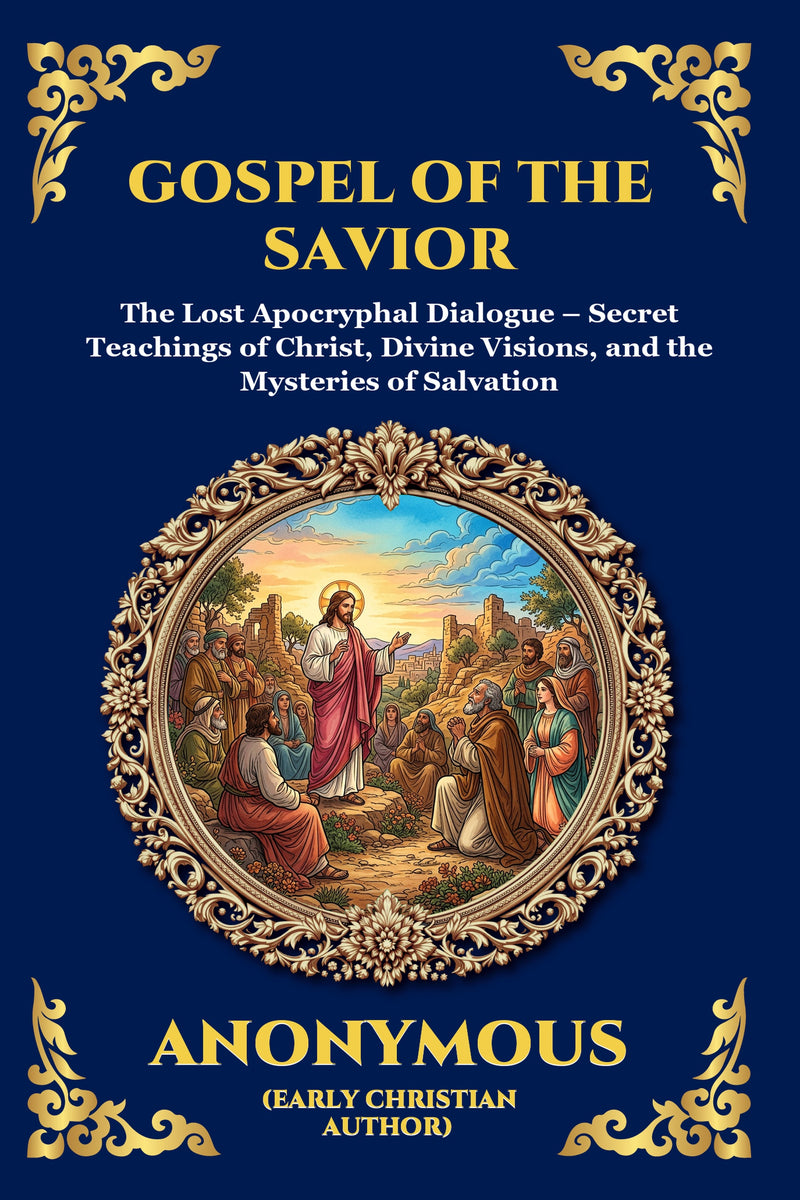
Gospel of the Savior — Large Print
The Gospel of the Savior records an intimate dialogue between Christ and his followers, revealing spiritual truths omitted from the biblical canon. This apocryphal text offers a rare glimpse into early Christian esoteric traditions, exploring divine visions and the ultimate plan for human salvation.
or free app
10,000+ hrs library
30-day guarantee
This Library of Alexandria edition presents the complete Gospel of the Savior in modern English translation, readable online with audiobook narration included for members.
Large Print Edition. The complete, unabridged text set in a larger, easy-on-the-eyes typeface for comfortable reading.
Have you ever wondered why certain divine teachings and mystical visions were hidden from the modern biblical canon?
The Gospel of the Savior provides a remarkable window into the esoteric traditions of early Christianity, offering teachings and narratives that were long thought lost to history. This ancient apocryphal dialogue captures an intimate and profound conversation between Christ and his closest followers, revealing hidden spiritual truths that challenge and expand our understanding of the divine.
Far from being just a historical footnote, this manuscript takes readers on a journey through the celestial spheres, offering detailed accounts of divine visions and the ultimate plan for human salvation. It bridges the gap between orthodox teachings and mystical theology, providing answers to profound questions about the nature of the soul, the cosmos, and the victory of light over darkness. Before the final boundaries of mainstream scripture were firmly established, texts like The Gospel of the Savior circulated among early believers, igniting their imaginations and deepening their faith through vivid descriptions of heavenly ascensions and cosmic secrets.
What You Will Discover in This Ancient Text:
Secret Teachings of Christ: Explore the intimate, unrecorded dialogues between the Savior and his disciples, focusing on spiritual enlightenment and hidden truths.
The Mysteries of Salvation: Delve into unique theological perspectives on how the soul navigates the earthly realm to reach eternal life.
Divine Visions and the Cosmos: Read breathtaking accounts of the heavens, the angelic realms, and the structure of the universe as understood by early mystics.
The Path of the Righteous: Discover timeless lessons on morality, faith, and the inner strength required to transcend worldly suffering.
A Window into Early Christian Mysticism: Gain a deeper understanding of the diverse and deeply spiritual communities that flourished in the first centuries after Christ.
Whether you are exploring this work for its historical value, its philosophical depth, or its spiritual insights, The Gospel of the Savior offers a compelling narrative that continues to resonate. It is an invitation to look beyond the familiar and explore the vast, untamed landscape of early Christian thought.
Step into a world of ancient faith and uncover the hidden teachings of The Gospel of the Savior. Begin your journey today.
| Formats | eBook (EPUB + PDF) · Audiobook · Paperback · Hardcover · Large Print |
| Language | English |
| Trim size (print) | 6 × 9 in |
| Binding | Paperback — perfect-bound · Hardcover — casewrap |
| Large Print edition | Same text in a larger, easy-read type — a larger font, not a larger trim |
| Print pricing | Every physical book at our true cost — at-cost, no profit (members) |
| Library | 873 restored titles, always growing |
| Composed | 3rd-4th century AD |
| Original language | Coptic |
| Source tradition | Fragmentary Coptic papyrus manuscripts |
| Translation basis | Public-domain scholarly translation, rendered in clear modern English |
| Length | 7,509 words · ~30 min reading |
| Edition | Modern English translation · 2026 |
Member reviews for this edition are collected as readers finish it — be the first. Across the library: 12,000+ books shipped, every plan covered by a 365-day print guarantee.
About this edition
The complete, unabridged text in clear modern English — faithful to the original, never simplified. Every paragraph is checked against the source, so nothing is cut, summarised, or paraphrased away. It reads cleanly for today while keeping the original meaning intact.
This text survives in fragmentary Coptic manuscripts from early Christian Egypt. This edition derives from the standard public-domain scholarly translation and renders it in clear modern English.
- Complete & unabridgedVerified paragraph by paragraph against the source — never a scan, never abridged.
- Modern English, faithfulReadable today, with the author’s meaning kept intact. Readable — not simplified.
- Every format, one membershipRead in your browser or the free app, or listen to the full audiobook.
Included free with your membership
Cancel anytime, one click · 30-day money-back guarantee
Edition last updated June 2026
What’s inside
Gospel of the Savior — Large Print — complete and unabridged, included in full with membership, plus the full audiobook.
Begin reading Gospel of the Savior — Large Print
In clear modern English — the complete text is included with membership.
Introduction
There is a moment, familiar to anyone who has ever stood at the edge of a great mystery, when the ordinary world seems to thin and grow transparent, and something older and stranger begins to show through. That moment is precisely what awaits the reader who opens these pages. What you hold in your hands is not simply a book. It is an encounter — with a voice that has been silent for centuries, with questions that have never stopped burning, and with a vision of salvation so intimate, so luminous, and so demanding that it could not be safely spoken aloud in the public squares of the ancient world. It had to be whispered. It had to be hidden. And now, at last, it can be heard again.
The text you are about to read belongs to a category of early Christian writing that scholars call apocryphal — a word derived from the Greek apokryphos, meaning 'hidden' or 'concealed.' But the word carries none of the dismissive weight that centuries of institutional religion have loaded onto it. To call a text apocryphal is not to call it false. It is to acknowledge that it was deliberately set apart, guarded, passed from hand to hand among those deemed ready to receive it. The earliest Christians were not a monolithic movement with a single creed and a single canon. They were a wildly diverse collection of communities, each wrestling with the same shattering event — the life, death, and reported resurrection of Jesus of Nazareth — and each arriving at different, sometimes radically different, conclusions about what that event meant. In that ferment of interpretation, many texts were produced. Most were eventually suppressed, lost, or destroyed. A precious few survived.
The discovery and reconstruction of such a text is never a simple matter. It requires the painstaking work of papyrologists, philologists, historians, and theologians, all of them laboring together over fragments that may be charred, water-damaged, worm-eaten, or simply incomplete. It requires the courage to sit with ambiguity, to resist the temptation to fill gaps with wishful thinking, and to let the text speak in its own voice rather than the voice we might prefer it to have. The dialogue you will encounter in these pages has undergone exactly that process of careful, reverent reconstruction. The result is something extraordinary: a conversation between the Savior and his closest disciples that feels, at every turn, both startlingly ancient and urgently contemporary.
To understand why this text matters — why it matters not merely as a historical curiosity but as a living document capable of transforming the way we think about faith, knowledge, and the human condition — we need to understand something about the world in which it was first composed and first hidden. The first and second centuries of the Common Era were a time of extraordinary spiritual creativity and equally extraordinary spiritual danger. The Roman Empire had created, almost accidentally, the conditions for a vast cross-pollination of religious ideas. Jewish apocalypticism, Greek philosophy, Egyptian mystery religion, Persian dualism, and the nascent movement of Jesus-followers all circulated through the same Mediterranean world, colliding and combining in ways that no single tradition could fully control. Out of that collision came Gnosticism — or rather, came the many movements that modern scholars have grouped under that imprecise but useful label.
Gnostic Christianity, in its many forms, shared a set of characteristic preoccupations. It was fascinated by the nature of knowledge — not ordinary empirical knowledge, but gnosis, a direct, experiential apprehension of divine reality that bypassed the mediating structures of temple, priest, and sacrifice. It was troubled by the existence of suffering and evil in a world supposedly created by a good God, and it developed elaborate mythological frameworks to explain that troubling fact. It was drawn to the figure of Jesus not primarily as a sacrificial victim whose death atoned for sin, but as a revealer, a teacher, a guide who had descended from the realm of light to show imprisoned souls the way back to their true home. And it was deeply, sometimes obsessively, interested in what happens to the soul after death — in the journey through the cosmic realms, in the nature of resurrection, and in the ultimate destiny of those who had received the saving knowledge.
The dialogue you are about to read engages all of these themes, but it does so with a freshness and an intimacy that sets it apart from many other texts in the apocryphal tradition. This is not a dry theological treatise dressed up in narrative clothing. It is a genuine conversation — heated at moments, tender at others, always alive with the sense that the stakes are absolute. The disciples who speak in these pages are not the idealized saints of later hagiography. They are frightened, confused, ambitious, and sometimes obtuse. They ask the wrong questions. They misunderstand the answers. They argue with each other. And through all of it, the figure of the Savior responds with a patience that is itself a kind of teaching — a demonstration, in the very texture of the dialogue, of the compassion that the words describe.
What makes this text particularly remarkable is the nature of the visions it contains. Ancient visionary literature is a rich and complex genre, stretching from the Hebrew prophets through Jewish apocalyptic texts like 1 Enoch and 4 Ezra, through the Book of Revelation, and into the vast literature of Gnostic and Hermetic mysticism. But the visions in this dialogue are unlike any of these antecedents in important ways. They are not primarily visions of cosmic catastrophe, of angels and demons locked in eschatological combat, of thrones and wheels and creatures with many faces. They are visions of interiority — of the soul's own landscape, of the hidden chambers of the self, of the terrifying and beautiful depth that opens up when a human being is willing to look honestly at what they are and what they might become. In this sense, the text anticipates not only the later tradition of Christian mysticism but also, in striking ways, the insights of depth psychology. Reading it, one is reminded at moments of Meister Eckhart, at other moments of C.G. Jung, and at still other moments of something that has no modern analogue at all — something that can only be called, inadequately, primordial.
The question of authorship is one that any honest introduction to a text of this kind must address directly. We do not know, and cannot know with certainty, who composed this dialogue. The manuscript tradition, such as it is, offers no clear attribution. What we can say is that the text bears the marks of a sophisticated author — someone deeply versed in both Jewish scriptural tradition and Greek philosophical vocabulary, someone with a genuine gift for narrative and dramatic characterization, and someone who had clearly undergone experiences of spiritual intensity that they were trying, with great care and great difficulty, to translate into language. Whether that person was a single individual or a community of writers working in a shared tradition, whether they lived in Egypt or Syria or somewhere else entirely, whether they wrote in the first century or the second — these are questions that the scholarship surrounding the text has not definitively resolved, and this introduction will not pretend otherwise. What matters, ultimately, is not the biography of the author but the truth or falsehood of what the author perceived. And on that question, the reader must be their own judge.
A World of Hidden Wisdom
To read an ancient apocryphal dialogue with genuine comprehension, it helps enormously to understand the intellectual and spiritual climate in which such texts were produced and received. The Mediterranean world of the first two centuries was saturated with the conviction that reality had hidden layers — that behind the visible, material world lay a deeper world of meaning, pattern, and power that was accessible, at least in principle, to those who had been properly prepared. This conviction was not the property of any single tradition. It expressed itself in the mystery cults of Greece and Egypt, with their initiatory rites and their carefully guarded secrets. It expressed itself in the philosophical schools, particularly in the Platonic tradition, with its insistence that the world of sense experience was a pale shadow of a higher world of eternal forms. It expressed itself in Jewish mysticism, in the tradition known as Merkabah or 'chariot' mysticism, in which adepts sought to ascend through the heavenly realms to the very throne of God. And it expressed itself, with particular urgency and particular beauty, in the early Christian communities that produced texts like the one you are about to read.
The concept of hidden wisdom — of esoteric knowledge reserved for those capable of receiving it — was not, in this context, a form of elitism for its own sake. It was, rather, a recognition of something that every serious spiritual teacher in every tradition has understood: that certain truths cannot be communicated in the same way that one communicates the price of fish or the date of a festival. They require preparation. They require a particular quality of attention. They require, above all, a willingness to be changed by what one learns — to let the knowledge do its work on the soul rather than simply adding it to one's store of interesting information. The disciples in this dialogue are not being kept in the dark out of cruelty or condescension. They are being led, step by step, toward a readiness that must be earned rather than simply granted. The Savior's teaching, as it unfolds in these pages, is itself a form of initiation.
This is why the dialogue form was so congenial to the writers of early Christian apocrypha. A dialogue is not a lecture. It is a process. The questions that the disciples ask — even the foolish ones, even the ones that seem to miss the point entirely — are part of the teaching, because they reveal the obstacles that must be overcome before understanding can dawn. The reader, watching this process unfold, is implicitly invited to identify with the disciples, to ask their own foolish questions, to sit with their own confusion, and to wait for the moment when the light breaks through. It is a profoundly pedagogical form, and it is used here with great skill.
The cosmological framework that underlies this dialogue will be unfamiliar to most modern readers, and it is worth spending a moment to orient ourselves. The text assumes a universe that is, in a sense, the inverse of the universe assumed by most modern people. For us, the material world is the primary reality, and anything beyond it — spirit, soul, God — is either nonexistent or at best secondary and derivative. For the author of this dialogue, and for the tradition in which they wrote, the situation is precisely reversed. The material world is the secondary reality — a kind of dense, opaque crystallization of more fundamental spiritual realities that lie behind and above it. The human soul, in this framework, is not a product of the material world. It is a visitor, or rather a prisoner — a spark of divine light that has somehow become entangled in matter and has forgotten its true origin and its true home. The work of salvation, in this understanding, is not primarily about moral improvement or the forgiveness of sins. It is about remembering — about recovering the knowledge of who and what one truly is.
This vision of the human condition as a kind of cosmic amnesia — the soul asleep in the prison of matter, dreaming that the dream is real — has an obvious appeal to anyone who has ever felt, even for a moment, that ordinary life is somehow less than it ought to be, that there is something missing, something just out of reach, something that the world of getting and spending and eating and sleeping cannot quite satisfy. It is a vision that has recurred, in different forms, throughout the history of human spirituality — in Plato's allegory of the cave, in the Hindu concept of maya, in the Buddhist teaching on the nature of suffering, in the Sufi poetry of Rumi and Hafiz. The dialogue you are about to read gives this vision a distinctively Christian inflection, rooting it in the figure of Jesus as the one who has come from the realm of light specifically to awaken the sleeping souls and show them the way home.
Cancel anytime, one click · 30-day money-back guarantee
Founding annual rate available now — your price locks for life when you join.
Not ready? Get this free chapter by email — read it anytime.
✓ Sent — check your inbox for Gospel of the Savior — Large Print.
Questions about Gospel of the Savior — Large Print
Why was the Gospel of the Savior excluded from the biblical canon?
The Gospel of the Savior was composed centuries after the New Testament period and reflects later theological developments. Early church councils established the biblical canon based on apostolic authorship and widespread early church acceptance, criteria this text did not meet.
What does the Gospel of the Savior actually contain?
The Gospel of the Savior presents dialogues between Christ and his disciples, focusing on mystical teachings about salvation and divine visions. The text reflects early Christian theological speculation and devotional practices that developed in Egyptian Christian communities.
Who wrote the Gospel of the Savior?
The Gospel of the Savior was written by an anonymous early Christian author, likely in Egypt during the 3rd-4th centuries AD. Like many apocryphal texts, it was composed well after the apostolic period by unknown Christian writers.
Shipping & returns
Billing & membership
More from the library


Explore Lost Gospels & Acts
- The Lost Books of the Bible · Various early Christian authors
- Gospel of the Lots of Mary
- Gospel of the Twelve · Anonymous early Christian writers
- Infancy Gospel of Thomas · Attributed to Thomas the Israelite
- Gospel of the Hebrews · Attributed to early Jewish-Chri...
- Acts of Thomas
- Gospel of the Savior · Anonymous (Early Christian Author)
- Acts of Saturninus
- Death of Pilate · Attributed to various early Chr...
- Doctrine of Addai · Attributed to Thaddeus of Edessa
- Gospel of the Nativity of Mary · Attributed to St. Matthew
- Toledot Yeshu
- Papyrus Berolinensis 22220
- Oxyrhynchus Papyrus 1224
- Correspondence of Jesus and Abgar · Attributed to Eusebius of Caesarea
- Papias: Expositions of the Sayings of the Lord · Attributed to Papias of Hierapolis
- Questions of John · Attributed to John the Apostle
- Narrative of Joseph of Arimathea · Attributed to Joseph of Arimathea
- Avenging of the Savior · Attributed to various early Chr...
- Report of Pilate to Caesar
- Letter of Pontius Pilate to Claudius
- Acts of Peter and Simon · Attributed to Leucius Charinus
- Acts of Andrew and Matthias in the City of the Cannibals · Attributed to early Christian a...
- Preaching of Peter · Attributed to the apostle Peter
- Egerton Gospel II
- Gospel of Barnabas
- Letter to the Laodiceans · Attributed to the Apostle Paul
- Diatessaron · Attributed to Tatian
- Descent of Christ into Hell (Harrowing of Hell) · Attributed to the Apostle Peter
- Acts of Pilate (Gospel of Nicodemus) · Attributed to various early Chr...
Gospel of the Savior — Large Print
Gospel of the Savior — Large Print
The Lost Apocryphal Dialogue – Secret Teachings of Christ, Divine Visions, and the Mysteries of Salvation
Anonymous (Early Christian Author)
Contents
- Introduction
- The Conversation of the Savior
Introduction
There is a moment, familiar to anyone who has ever stood at the edge of a great mystery, when the ordinary world seems to thin and grow transparent, and something older and stranger begins to show through. That moment is precisely what awaits the reader who opens these pages. What you hold in your hands is not simply a book. It is an encounter — with a voice that has been silent for centuries, with questions that have never stopped burning, and with a vision of salvation so intimate, so luminous, and so demanding that it could not be safely spoken aloud in the public squares of the ancient world. It had to be whispered. It had to be hidden. And now, at last, it can be heard again.
The text you are about to read belongs to a category of early Christian writing that scholars call apocryphal — a word derived from the Greek apokryphos, meaning 'hidden' or 'concealed.' But the word carries none of the dismissive weight that centuries of institutional religion have loaded onto it. To call a text apocryphal is not to call it false. It is to acknowledge that it was deliberately set apart, guarded, passed from hand to hand among those deemed ready to receive it. The earliest Christians were not a monolithic movement with a single creed and a single canon. They were a wildly diverse collection of communities, each wrestling with the same shattering event — the life, death, and reported resurrection of Jesus of Nazareth — and each arriving at different, sometimes radically different, conclusions about what that event meant. In that ferment of interpretation, many texts were produced. Most were eventually suppressed, lost, or destroyed. A precious few survived.
The discovery and reconstruction of such a text is never a simple matter. It requires the painstaking work of papyrologists, philologists, historians, and theologians, all of them laboring together over fragments that may be charred, water-damaged, worm-eaten, or simply incomplete. It requires the courage to sit with ambiguity, to resist the temptation to fill gaps with wishful thinking, and to let the text speak in its own voice rather than the voice we might prefer it to have. The dialogue you will encounter in these pages has undergone exactly that process of careful, reverent reconstruction. The result is something extraordinary: a conversation between the Savior and his closest disciples that feels, at every turn, both startlingly ancient and urgently contemporary.
To understand why this text matters — why it matters not merely as a historical curiosity but as a living document capable of transforming the way we think about faith, knowledge, and the human condition — we need to understand something about the world in which it was first composed and first hidden. The first and second centuries of the Common Era were a time of extraordinary spiritual creativity and equally extraordinary spiritual danger. The Roman Empire had created, almost accidentally, the conditions for a vast cross-pollination of religious ideas. Jewish apocalypticism, Greek philosophy, Egyptian mystery religion, Persian dualism, and the nascent movement of Jesus-followers all circulated through the same Mediterranean world, colliding and combining in ways that no single tradition could fully control. Out of that collision came Gnosticism — or rather, came the many movements that modern scholars have grouped under that imprecise but useful label.
Gnostic Christianity, in its many forms, shared a set of characteristic preoccupations. It was fascinated by the nature of knowledge — not ordinary empirical knowledge, but gnosis, a direct, experiential apprehension of divine reality that bypassed the mediating structures of temple, priest, and sacrifice. It was troubled by the existence of suffering and evil in a world supposedly created by a good God, and it developed elaborate mythological frameworks to explain that troubling fact. It was drawn to the figure of Jesus not primarily as a sacrificial victim whose death atoned for sin, but as a revealer, a teacher, a guide who had descended from the realm of light to show imprisoned souls the way back to their true home. And it was deeply, sometimes obsessively, interested in what happens to the soul after death — in the journey through the cosmic realms, in the nature of resurrection, and in the ultimate destiny of those who had received the saving knowledge.
The dialogue you are about to read engages all of these themes, but it does so with a freshness and an intimacy that sets it apart from many other texts in the apocryphal tradition. This is not a dry theological treatise dressed up in narrative clothing. It is a genuine conversation — heated at moments, tender at others, always alive with the sense that the stakes are absolute. The disciples who speak in these pages are not the idealized saints of later hagiography. They are frightened, confused, ambitious, and sometimes obtuse. They ask the wrong questions. They misunderstand the answers. They argue with each other. And through all of it, the figure of the Savior responds with a patience that is itself a kind of teaching — a demonstration, in the very texture of the dialogue, of the compassion that the words describe.
What makes this text particularly remarkable is the nature of the visions it contains. Ancient visionary literature is a rich and complex genre, stretching from the Hebrew prophets through Jewish apocalyptic texts like 1 Enoch and 4 Ezra, through the Book of Revelation, and into the vast literature of Gnostic and Hermetic mysticism. But the visions in this dialogue are unlike any of these antecedents in important ways. They are not primarily visions of cosmic catastrophe, of angels and demons locked in eschatological combat, of thrones and wheels and creatures with many faces. They are visions of interiority — of the soul's own landscape, of the hidden chambers of the self, of the terrifying and beautiful depth that opens up when a human being is willing to look honestly at what they are and what they might become. In this sense, the text anticipates not only the later tradition of Christian mysticism but also, in striking ways, the insights of depth psychology. Reading it, one is reminded at moments of Meister Eckhart, at other moments of C.G. Jung, and at still other moments of something that has no modern analogue at all — something that can only be called, inadequately, primordial.
The question of authorship is one that any honest introduction to a text of this kind must address directly. We do not know, and cannot know with certainty, who composed this dialogue. The manuscript tradition, such as it is, offers no clear attribution. What we can say is that the text bears the marks of a sophisticated author — someone deeply versed in both Jewish scriptural tradition and Greek philosophical vocabulary, someone with a genuine gift for narrative and dramatic characterization, and someone who had clearly undergone experiences of spiritual intensity that they were trying, with great care and great difficulty, to translate into language. Whether that person was a single individual or a community of writers working in a shared tradition, whether they lived in Egypt or Syria or somewhere else entirely, whether they wrote in the first century or the second — these are questions that the scholarship surrounding the text has not definitively resolved, and this introduction will not pretend otherwise. What matters, ultimately, is not the biography of the author but the truth or falsehood of what the author perceived. And on that question, the reader must be their own judge.
A World of Hidden Wisdom
To read an ancient apocryphal dialogue with genuine comprehension, it helps enormously to understand the intellectual and spiritual climate in which such texts were produced and received. The Mediterranean world of the first two centuries was saturated with the conviction that reality had hidden layers — that behind the visible, material world lay a deeper world of meaning, pattern, and power that was accessible, at least in principle, to those who had been properly prepared. This conviction was not the property of any single tradition. It expressed itself in the mystery cults of Greece and Egypt, with their initiatory rites and their carefully guarded secrets. It expressed itself in the philosophical schools, particularly in the Platonic tradition, with its insistence that the world of sense experience was a pale shadow of a higher world of eternal forms. It expressed itself in Jewish mysticism, in the tradition known as Merkabah or 'chariot' mysticism, in which adepts sought to ascend through the heavenly realms to the very throne of God. And it expressed itself, with particular urgency and particular beauty, in the early Christian communities that produced texts like the one you are about to read.
The concept of hidden wisdom — of esoteric knowledge reserved for those capable of receiving it — was not, in this context, a form of elitism for its own sake. It was, rather, a recognition of something that every serious spiritual teacher in every tradition has understood: that certain truths cannot be communicated in the same way that one communicates the price of fish or the date of a festival. They require preparation. They require a particular quality of attention. They require, above all, a willingness to be changed by what one learns — to let the knowledge do its work on the soul rather than simply adding it to one's store of interesting information. The disciples in this dialogue are not being kept in the dark out of cruelty or condescension. They are being led, step by step, toward a readiness that must be earned rather than simply granted. The Savior's teaching, as it unfolds in these pages, is itself a form of initiation.
This is why the dialogue form was so congenial to the writers of early Christian apocrypha. A dialogue is not a lecture. It is a process. The questions that the disciples ask — even the foolish ones, even the ones that seem to miss the point entirely — are part of the teaching, because they reveal the obstacles that must be overcome before understanding can dawn. The reader, watching this process unfold, is implicitly invited to identify with the disciples, to ask their own foolish questions, to sit with their own confusion, and to wait for the moment when the light breaks through. It is a profoundly pedagogical form, and it is used here with great skill.
The cosmological framework that underlies this dialogue will be unfamiliar to most modern readers, and it is worth spending a moment to orient ourselves. The text assumes a universe that is, in a sense, the inverse of the universe assumed by most modern people. For us, the material world is the primary reality, and anything beyond it — spirit, soul, God — is either nonexistent or at best secondary and derivative. For the author of this dialogue, and for the tradition in which they wrote, the situation is precisely reversed. The material world is the secondary reality — a kind of dense, opaque crystallization of more fundamental spiritual realities that lie behind and above it. The human soul, in this framework, is not a product of the material world. It is a visitor, or rather a prisoner — a spark of divine light that has somehow become entangled in matter and has forgotten its true origin and its true home. The work of salvation, in this understanding, is not primarily about moral improvement or the forgiveness of sins. It is about remembering — about recovering the knowledge of who and what one truly is.
This vision of the human condition as a kind of cosmic amnesia — the soul asleep in the prison of matter, dreaming that the dream is real — has an obvious appeal to anyone who has ever felt, even for a moment, that ordinary life is somehow less than it ought to be, that there is something missing, something just out of reach, something that the world of getting and spending and eating and sleeping cannot quite satisfy. It is a vision that has recurred, in different forms, throughout the history of human spirituality — in Plato's allegory of the cave, in the Hindu concept of maya, in the Buddhist teaching on the nature of suffering, in the Sufi poetry of Rumi and Hafiz. The dialogue you are about to read gives this vision a distinctively Christian inflection, rooting it in the figure of Jesus as the one who has come from the realm of light specifically to awaken the sleeping souls and show them the way home.
The Savior said to his followers, "Brothers and sisters, the moment has now arrived for us to lay down our labor and find rest, for whoever finds rest will rest forever. I tell you, keep rising above time. I tell you, have no fear of those who rise against you. I tell you, anger is a fearful thing, and whoever stirs up anger is a fearful person. Yet since you have managed to endure, let it pass away from you."
When people heard these words about anger, they trembled and were afraid. Anger had set rulers over them, and no one could escape it. But when I came, I opened a road and showed people the way meant for those who are chosen and solitary, who have come to know the Father and have trusted the truth. And you offered praise.
So whenever you offer praise, let it happen like this: Listen to us, Father, just as you listened to your only Son and received him into your presence.
You granted him rest after so much heavy labor.
No one can overcome your power, since no one can overcome your weapons — your light, your living word, beyond all reach, ever living.
The word of truth has worked a turning of the heart toward life, and from you this has come.
You are the thinking and the supreme calm of the solitary ones. Once more, listen to us just as you listened to the ones you chose.
By means of your sacrifice, those you chose will come in.
By the good deeds they have done, they have released their souls from the body's blind limbs, so that they may exist for all time.
When the destruction comes, the first power of darkness will move against you. Do not be frightened and say, "See, the moment is upon us." But when you notice even a single staff to hold onto, grasp it — something of that kind will sustain you when the rulers move against you. Truly, the power of darkness is fear. If what is about to move against you frightens you, it will overpower you, and none among them will pity you or deal kindly with you. Instead, turn toward what lies within, for you have learned every word upon the earth. That knowledge will lift you to a place where no ruler exists and no harsh master holds power.
End of the free sample
Keep reading, free
Members read and listen to the complete book — and the entire library. Cancel anytime, one click · 30-day money-back guarantee.